At this time there are many claiming divine power in healing the sick. It is therefore important that we recognize the principle involved, and thus be enabled to distinguish between the false and the true.
There is such a thing as divine healing, for we are asked in James 5:14, 15, to pray for the sick. And in 1 Cor. 12:9 healing is spoken of as one of the gifts of the Spirit. In Luke 9:2 it is made equal with the preaching of the gospel: “And he sent them to preach the kingdom of God, and to heal the sick.”
But though we may be sent out to heal the sick, every case, as you shall see, is not one for divine healing. Sickness is often the result of sin; and ought we to pray for the cure of sickness in order that one may continue in his sinful course? In “Healthful Living,” paragraphs 1020 and 1021, we read: “Some if they should regain their health would indulge in some heedless transgression of nature’s laws.” “We should first find out if the sick one has been withholding tithes or has made trouble in the church.” And in paragraph 1026 we read: “God will not work a miracle to change natural causes which you can control.”
Thus we see that connected with the praying for the sick should go a complete adoption of the reformatory truths which we possess. The Lord is anxious to heal us, but will not perform a miracle to do that which we could and should do ourselves.
A little consideration will show that everything can not be a proper subject for prayer. The writer remembers hearing Evangelist Wm. Sunday’s baseball story, in which just after his conversion he was playing baseball, and the decisive catch of the game fell to him, and as he ran, he prayed that the Lord would help him to catch the ball. And he said: “The Lord did, and we won the game.” But could the Lord do so? Are we at liberty thus to make him partner to our selfishness?
In this case the Christian spirit would have been to pray for defeat, to save the humiliation of his fellows on the opposite side. There is a great deal in the world at the present time claiming to be divine healing that in no wise corrects the habits of the individual, but allows him to pursue his sinful course. Such is, of course, a system of false healing.
By this system cures are apparently wrought; for Satan has power to suspend, in certain cases, the symptoms of disease, and in others, by the action of the mind on the body, we see the sick leave their beds. Some are suffering from imaginary sickness, and some from so-called functional nervous disorders. Over such cases Satan has power, but not over any case requiring creative power. Satan can not create.
At the time of the San Francisco earthquake, there were a number of apparently miraculous restorations to health. Some who had not been able to walk for years, jumped out of bed and ran out into the streets. Just such cases Satan is accumulating all over the land as material for some of his false systems of healing, or perhaps for himself to heal, when he appears as an angel of light.
In these cases there is no organic disease, but for some reason the mind has lost control, and, although the person would, he can’t. But there are cases of paralysis that nothing but the power of God, either directly or through the natural healing processes of nature, can cure. Some examples of these, as spinal sclerosis or neuritis, might be given.
God expects us to do our part. This includes the use of rational remedies; everything that might appeal to one’s reason as being proper, such remedies as common sense might dictate, at the same time avoiding harmful habits in dress and diet; placing the mind in harmony with God’s truth, and living up to the requirements of the Scriptures; the exercise of faith, which banishes depression and acts as a general vital stimulant, greatly supplementing our other efforts.
Any one placing himself in harmony with these requirements, and asking God to heal his malady, may expect to be cured if it is God’s will. But we are to hold on by faith. If not cured immediately, we are to continue steadfast, not allowing our faith to waver. “Sometimes answers to prayers come immediately, sometimes we have to wait patiently and continue earnestly to plead for the things we need. . . . If our petitions are indited by the Lord, they will be answered.”—“Healthful Living,” page 210. “Jesus can limit the power of Satan. He is the physician in whom the sin-sick soul may trust to heal the maladies of the body as well as of the soul!”—“Testimonies for the Church,” page 205.
Grand Rapids, Mich.
Cultivating Our Temptations
Too many of us are gardeners to our temptations. We cultivate them assiduously. We do not realize that the strength or weakness of a temptation depends largely on ourselves. Every time we yield, the temptation to which we have yielded is strengthened for its next attack. Every victory we score weakens that temptation for its future work with us. The weakening and strengthening processes are uniform: it may take half a dozen victories on our part to offset the strength imparted to a temptation by a single failure of ours. And no temptation ever seems to get its death-blow in this life. But that our victories and our defeats are full of significance for to-morrow's fight is a truth to which all can testify. Let us not send cheer into the camp of the enemy! —Selected.
“So the Folks Say”
By C. B. Besse
The curse of the rumshop no mortal can tell,
It robs men of heaven and sends them to hell;
And yet there are many—O can it be, pray?
Who vote it to license, so the folks say.
What, license the grog-shop! do the folks say?
It lightens their taxes, so some of them think,
To license this business of selling strong drink;
So, along with the barkeeper multitudes stray,
Taking bread from the hungry, so the folks say.
What, food from the starving! do the folks say?
'Tis a fell institution they each one confess,
Cruel wrong in the wine cup and sorry distress;
And yet ’mid their praying for peace day by day,
There are those who vote whisky, so the folks say.
What, vote with the brewer! do the folks say?
“Inasmuch as ye did it,” whate’er it may be,
“To the least of my brethren, ye did it to me;”
And by this will he reckon in that judgment-day,
And not by our praying, so the folks say;
By doing and praying! so will all say.
— C. B. Besse.
Temperance in the Home
By Augusta C. Bainbridge
AUGUSTA C. BAINBRIDGE
“Why don't you drink your wine, Laurie?” said Mrs. Burns, as Laurie pushed his glass away at dinner.
“'Tisn't good,” said Laurie; “I don't want it.”
“Not good?” said Mrs. Burns, “I see nothing the matter with it,” as she took up her own glass and put it to her lips.
“Do you see anything amiss, papa?”
“Why, no,” said Papa Burns. “Why do you not want it, Laurie?”
“'Cause it's bad, papa; it has poison stuff in it, and it hurts you inside,” said Laurie.
“Yes, and makes you cross besides,” added Mamie.
“Then some men get drunk with it, and the jail man comes and locks them up. No, no! I don't want any,” said Laurie, pushing his glass farther away.
“Why, what has got into you children? Who told you such things?” asked Mama Burns.
“Kippy told us,” said Mamie and Laurie in the same breath, referring to the little son of a near-by neighbor.
“All right, son, you need not drink it, if you don't want to, nor you either, Mamie; and I will see Mrs. Stone about this later on,” said Papa Burns.
When Mrs. Burns took the baby out for its usual afternoon ride, she went directly to Mrs. Stone's house. She was so impressed with Laurie's earnest manner, that she felt she must know for herself if there was any harm in claret, or the pale ale, or mild beer, or even the white wine she served to her children and guests.
There was Kippy, playing in the sand in front of the house, and she would ask him first.
Question after question brought intelligent replies, and she was almost ready to turn back, convicted and convinced, when a cheery voice from the open window called out, “Come in, Mrs. Burns, and bring the baby. I've not seen her for a long time. The children can play with Kippy.”
Mrs. Burns went in, unburdened her heart, and found that the mother of the little temperance missionary had given him the lessons that he had repeated to her children.
How promptly mother-love responded to the cry of “Danger” to her children, and a short consultation between father and mother brought temperance to the home of Mr. and Mrs. Burns.
While temperance papers and temperance lectures are all right in their place, they can never take the place of the line-upon-line, precept-upon-precept instruction of father and mother in the home.
San Francisco, Cal.
The Girl and Her Influence
By Mrs. C. F. L. Smith
DID you ever stop to think, girls, of the influence that is constantly emanating from your lives—an influence for good or evil, which is having its effect on other lives? Just as every word you say sets in motion vibrations of ether that widen out and go on beating forever, in the same way every act of ours makes an impression somewhere that will never be effaced. Every act has its influence, and that influence is unending, as Henry Burton sung:—
“Never a word is said
But it trembles back in the air,
And the truant voice has sped
To vibrate everywhere;
And perhaps far off in eternal years
The echo may ring upon our ears.”
To some is given a wider influence than others. This is governed by ability and environment. You may not be able to control the extent of your influence, but to every one of you is given the power to control its nature. Wherever you go, you should try to leave a blessing—something which will sweeten another life, or start a new song, or an impulse of cheer or helpfulness in another heart. It is your privilege and should be your aim to—
“Make the world within your reach
Somewhat the better for your living,
And gladder for your human speech.”
The first place for a girl’s influence to be felt is the home. By your thoughtfulness and helpfulness you can do much to brighten the dear mother’s life and ease her burdens. By your gentleness, purity, and sympathy, your life will go a long way toward implanting in the brother a high ideal of womanhood. By directing the conversation into helpful channels you can create a love for instructive themes.
Then in the office, the shop, the school, with your girl associates, there is the constant, silent, daily influence going on. Your conversation, your demeanor, the faithfulness or unfaithfulness with which you do your work, all are stamping their impress upon those around you. Then there are the crises which come into every girl’s life—times when questions arise where principles are at stake, and the answer you give will affect your whole after-influence. It requires stamina sometimes to stand alone at the risk of ridicule, and yet in the end it tells.
I so well remember an incident of my school days. It was at our annual picnic. I was asked to join an amusement, which although there was no absolute harm in it, yet to me, a professed Christian, it was questionable. To refuse was to be the “only odd one.” They could not understand my reason. I argued to myself: Would I not do more good to join and make myself agreeable? I was on the verge of yielding when a higher power within me asserted itself, and I answered: “No, I had rather not.”
What was my surprise, when the very girl who had invited me to join them replied, “I knew it was against your principles.”
How did she know? I had never said so. My life had been telling when I had not realized it, and then in one moment I came very near spoiling all the influence of the previous months. How I thanked God that he helped me to stand true that day. How many times since then the remembrance of it has helped me to say “No.”
Life is more powerful than words, girls. It is not what we desire others to believe us to be, but what we are, that counts. It is not what we tell others they ought to be and do, but what we are and do that appeals to their hearts.
It is said of Fénelon that his manner was full of grace, his voice full of tenderness, and his face full of glory. There is a story told of an atheist who spent a few days with him, and he said: “If I stay here much longer, I shall be a Christian in spite of myself.” Fénelon had used no controversy. It was the13convincing argument of his consistent life. Such an argument is unanswerable.
Remember, girls, you who desire to shine for Jesus, that you can not lift another higher than you yourself have attained. My desire for you is that there may go forth from you, as the power from a magnet, an influence drawing others to higher ideals, truer living, sweeter courtesies, and gentler words, to firmer purposes and a fuller surrender to Jesus Christ.—Mrs. C. F. L. Smith.
The World’s Famous Bridges
BRIDGES have played an important part in history, and from the days when Trajan built the bridge across the Danube, there has been a steady development in the perfection of these structures.
One of the most peculiar bridges in the world is the tubular suspension bridge across Menai Strait. This bridge consists of two lines of immense tubing, each 1,500 feet long, supported by three granite towers besides the shore abutments. This strange bridge is 100 feet above the sea, and weighs 11,000 tons.
The famous Niagara Suspension Bridge was begun in 1852 and completed in 1855. It was 245 feet above the water and 821 feet long.
The Forth Bridge, over the Frith of Forth, near Edinburgh, has two cantilever spans each 1,710 feet in length, the longest in the world. The total length of this structure is one and four-sevenths miles, and there were 51,000 tons of steel used in its construction.
The first cast-iron bridge in the world was the Coalbrookdale Bridge, England, which was built in 1779.
The famous Brooklyn Bridge was begun in 1867, and not finished for nearly seventeen years. Its total cost was about fifteen million dollars.
There have been several London bridges. There was one at the end of the tenth century, and another in 1014 built of wood. In 1176 Colechurch began a stone bridge across the Thames, which was not finished until 1209. The new London bridge was begun in 1824, and completed in seven years, at the cost of one and a half million dollars.—Record-Herald.
Glimpse of a Japanese Home
All Japanese houses are built of wood, and apparently of the lightest kind of wood. They all look from the outside like mere temporary, make-believe houses—a summer day’s play-place. But they have their solidities, as one soon learns through intimate acquaintance. They are almost always open on two sides at least, oftentimes on three, and sometimes on all four. That is, they are built in such a way that the side walls may be taken down entirely, leaving only the interior paper sliding walls, or shoji, which can also be slipped from their grooves and stacked away in their own receptacle, built for them at the corner of each room, thus leaving only the roof and upright supports, with perhaps the little exquisitely wrought ornamentations of oddly shaped apertures and wee side windows of finest white pine and oiled paper by which the structure is beautified. The roof is of gray tiles usually, in the better dwellings, and in less pretentious ones of heavy rice straw thatch, out of which grasses and wild flowers grow, to the intense delight of the humble owners. No Japanese house is ever furnished.
To people in the interior of the country, that which we call furniture would be the most remarkable collection of curiosities. They would not have the remotest idea what use to make of it.
It is all rather difficult to a foreigner at first. One must be trained from babyhood to sit upon one’s feet on the floor without discomfort; to eat off the floor without a single breach of “table manners;” to sleep on the floor without getting rheumatism or other aches and pains as bad, and all these things one must do in a Japanese home. And learning to “do without” things is a matter of some difficulty, too. One envies the native who has never learned to “do with” things. A knife and a fork, for instance, seem upon first thought to be a positive necessity. But how quickly one learns to use the dainty little “chop-sticks,” and how out of place knives and forks soon begin to look among the exquisite small bits of fine china on the little lacquer trays which No San carries in with such charming grace!
In the Japanese kitchen there are also interesting things. What a kitchen can be without a stove, without a chimney, even without pots and pans and kettles and big knives and chopping-boards and wooden bowls and flour-bins and rolling-pins and rattling coal-scuttles and things, that a Japanese kitchen is. All of these “conveniences” would be simple pandemonium to a poor little Japanese cook. He knows not the use of a stove. He has only a little hibachi, or earthenware fire-box, in which he puts live charcoals, and all his cooking utensils he could put into one of his big kimona sleeves. And yet what wonders he can perform! He can prepare a meal for twenty persons with less “fuss” than the ordinary cook from County Cork would make over a small luncheon for two; and he knows how to do everything at a minimum expense. Moreover, he is not always “giving notice,” and he is not lord of the premises. He is a servant in the finest sense of the word, as are the servants above and below him.
There is no “servant question” in this little empire of Japan, because the distinctions of caste are too well defined and too rigidly observed to make such a thing possible. Almost every servant has his servant, and when the “butler” gets scolded, he can go and scold the “boy;” when the cook does something he should not, he has a small helper to blame for it. When the gardener gets cuffed, he can cuff the little chap who keeps the weeds out and picks up fallen leaves and feeds the carp in the pond.—Leslie’s Weekly.
A Wise Resolve
It was a wise mother who said, “I mean to keep young with my children.” She gave the recipe by which this can be done: Live in the present, not in the past; be always interested in whatever the children are interested in, so that they are always sure of finding a proper understanding when they come to mother with their perplexities. Living too continually in the past, comparing things done to-day with the way they were done yesterday, and insisting that former days were better than the present, will inevitably make it difficult to feel in full sympathy with the youth of to-day. The resolve to keep young with the children may mean at first some self-denial; but the reward that will come in a sweeter, more sympathetic intimacy with the children and a greater influence in their lives will many times repay the self-denial.— Selected.
“Thank You”
SEVERAL winters ago a woman was coming out from some public building when the heavy door swung back and made egress somewhat difficult. A little street urchin sprang to the rescue; and as he held open the door, she said, “Thank you,” and passed on.
“D’ye hear that?” said the boy to a companion.
“No; what?”
“Why, that lady said ‘Thank ye’ to the likes o’ me.”
Amused at the conversation, which she could not help overhearing, the lady turned round and said to the boy: “It always pays to be polite, my boy; remember that.”
Years passed away; and last December, when doing her Christmas shopping, this same lady received an exceptional courtesy from a clerk in Boston, whom she thanked.
“Pardon me, madam, but you gave me my first lesson in politeness a few years ago.”
The lady looked at him in amazement, while he related the little forgotten incident, and told her that that simple “Thank you” awakened his first ambition to be something in the world. He went the next morning and applied for a situation as office boy in the establishment where he was now an honored and trusted clerk.
Only two words, dropped into the treasury of a street conversation, but they yielded returns of a certain kind more satisfactory than investments, stocks, and bonds.—The Congregationalist.
Children’s Sleep and Schooling
A NOTED physician has said that up to the fifteenth year, a child attending school should have at least nine hours’ sleep in summer and nine and one half in winter; and the overtaxing of the mind and nervous system of the girl at the age when she enters womanhood should be carefully avoided.—Selected.
German Union Conference Council
By L. R. CONRADI
L. R. CONRADI
IMMEDIATELY after the last sermon in Stettin, our brethren repaired to Berlin, where we had the first session of the German Union Committee at 10 A. M., Monday, Jan. 28, 1907.
The East German Conference kindly invited the committee to have its council in Berlin, and at the same time have some of our ministers address the local church. As we have four hundred and twenty members in this city, we naturally had larger meetings than in any of the other annual conferences.
We found ourselves very busy with the work before us. As our assembly room was in the same building where we lodged, we could keep steadily at work from eight o'clock in the morning until late in the evening, with two hours recess for dinner.
When the annual report for 1906 was handed in, we had every reason to be grateful to God for the way he had blessed us. Sixteen hundred and eighty-two had been baptized, and three hundred and eighty-one had been added by vote, raising our membership in the union from seven thousand at the beginning of 1906 to eight thousand three hundred and twelve at the close, showing a net gain of one thousand three hundred and twelve. About eighty died during the year, some moved away, and a number apostatized, especially in Russia. Our tithe shows a still better increase — $54,033.52 for 1905, and $79,105.20 for 1906, or a net increase of over $25,000. The tithe in the German Union averages $9.53 a member. It is true that, during the last year, a number have paid tithe on their capital, but the Lord has truly been good to his people, by bestowing all these blessings upon them. The other offerings increased from $10,000 in 1905 to $13,000 in 1906.
If we consider the work in the various countries of the union, we find that Germany has, in many ways, taken the lead during 1906. It now has 4,934 members, and there were 1,216 additions during the year in the German empire. We have here seven conferences — the East, the West, the North, the South, the Prussian, the Rhenish, and the Silesian Conferences, with the German Union District. All these conferences pay a regular second tithe. Their tithe during the year amounted to $42,740, or about $12.70 a member. Including their second tithe, they gave to missions $23,000 during 1906 in Germany proper, besides raising $10,000 for the Old People's Home.
In membership Russia follows Germany. It has one conference and four mission fields, with a membership of 2,181. They report 541 additions, but lost quite a number because of their unwillingness to adopt the tithing system. The Russian tithe was about $8,100, or not quite four dollars a member. One remarkable feature in the Russian field is that the Asiatic Russian Mission, which started last year with a membership of fifty-eight, has during the last three months of 1906 risen to one hundred and fifty-eight, largely on account of the removal of about eighty of our members from European Russia to Siberia. This state of affairs has made it necessary for us to adopt a new arrangement, which was proposed at the German Union Council in Berlin. Heretofore, one part of the Asiatic District has been south of the Caucasus, reaching to the Persian border, while the other part was in Siberia, and thus unhandy to work. Therefore, it was unanimously decided by the union committee (knowing they would have the co-operation of the brethren in Russia) that the East Russian Conference be so changed in territory as to include both the north and the south portion of the Caucasus district, with Tiflis and Baku and Erewan, making it a compact field, to be known as the Caucasian Conference, with a membership of about eight hundred. The Volga District, which borders on Siberia, will hereafter be united with Siberia, and will be known as the East Russian Mission, having at present a membership of about four hundred. Elder H. K. Loebsack will be in charge, and we expect that he will visit Siberia, and organize our membership there, as far as this is practicable. Thus the Lord is constantly opening up Siberia and the Transcaucasus, and lights are being kindled throughout those dark regions.
Remarkable, indeed, for the work in Russia, is the following decree, signed by Minister Stolipin, in favor of our people. There is little question but that this favorable decree is, in the hands of God, due to the address of thanks which we presented to his majesty the czar, and which he so kindly acknowledged. The edict is in the form of a circular letter, sent to the various governors in Russia. Freely translated, it reads as follows: —
“Ministry of the Interior
Department of Foreign Confessions.
“6th of November, 1906
Number 5532.
“To the Honorable Governors: —
“By the order of the Imperial Council, of March 27, 1879, which has been confirmed by his Majesty, the sect of the Baptists was allowed to confess their faith without any hindrance, and also to conduct their services in the halls set apart by them for this purpose, and announced as such to the governor. Further, the civil administration is charged to keep records with regard to their marriages, births, and deaths. There was also an order of the Senate, Nov. 12, 1879, in which seven different forms of these records were described, as well as the manner in which the extracts from them should be certified.
“The present Senate declares through an edict of March 14, 1906, No. 2783, that the teachings of the Adventists are similar to the Baptists, and that they can be looked upon as a branch of the latter. As according to paragraph 1106 of the Department of Foreign Confessions the Baptists have perfect liberty to exercise their faith, we have no definite reason to refuse this to the Adventists.”
“In order to avoid all uncertainties in the religious affairs of the Adventists (who number about three thousand in Russia), I deem it necessary to tell you that all the rules which apply to the Baptists, also apply to the sect of the Adventists, and that the keeping of the record of the books, and extracts therefrom, is to be turned over to the civil administration.”
“At the same time we would inform the Lutheran General Consistory that all their pastors be notified to be ready to hand over all documentary extracts concerning the Adventists that might be within their territory to the nearest civil authorities, who henceforth shall be charged with the keeping of the records of their books.
“Ministry of the Interior,
(Signed) “P. STOLIPIN.”
We surely have every reason to be grateful that God has so wonderfully wrought for this people, insignificant as our numbers are in the midst of the one hundred and thirty-five millions of the Russian empire, so that a special edict has been issued granting us full liberty to exercise our faith and to circulate our publications in the Russian and German languages. God is gracious indeed, and to him alone be the praise. If we look back over the twenty-one years since our work first started in Russia, we have every reason to praise his holy name for what he has done for us.
At the present time we are carrying on work in Russia in the Russian, the German, the Esthonian, the Lettonian, and the Armenian languages. We are also beginning among the Bohemians and Jews.
The next field in membership, is German Switzerland. Five years ago, this conference had about two million people, and one hundred and eighty-five members. At that time it was separated from French Switzerland. Two and a half years ago, nearly fifty of the members of the German-Swiss Conference moved from Basel to Gland, when the institutions were transferred to that place. As long as the French and the German parts of Switzerland were together, there was always more or less trouble about locating the camp-meetings so as to suit both the French and German brethren, and there was also the difficulty of having the two different languages at the meetings. The best evidence of the wisdom of forming the division is the growth15that has attended the work since that time. During the last year alone, ninety-four additions were reported, and their membership is now four hundred and thirty-six. It is very evident that buildings alone, good as they may be, do not always make a field grow. The tithe of German Switzerland last year was $4,100. They were able to pay all their workers, and had sufficient left over to buy a second tent for their summer meetings. This small conference turned over about $1,300 to the Old People's Home. Although the Basel House has been sold, yet our people are still able to occupy the depository and chapel room they formerly had, at the nominal rent of three hundred dollars per annum — cheaper than we could let them have it while the building was our own.
(To be concluded)
Alto Parana Mission
By J. W. Westphal
J. W. WESTPHAL
This mission embraces the republic of Paraguay and the territory of Missiones in Argentina. The former has a population of nearly six hundred thousand, exclusive of the Indians, whose number is variously estimated at fifty thousand to one hundred thousand. Missiones has a population of about thirty thousand.
This territory was once the stronghold of Jesuit missionary work in South America, whence the name given to Missiones. At one time it also embraced a portion of Brazil. But the missionaries were gradually driven back by the Brazil slave-hunters, and the Indians taken from the mission stations and captured in the forests were taken to Rio de Janeiro and other slave markets, to be sold. At that time the population of Missiones was one hundred and thirty thousand.
Scattered over Missiones and a part of Paraguay are the ruins of these mission stations. They were composed of a church building, fronting upon a large square or enclosure, which was surrounded by large buildings and courts, in the latter of which the Indians were housed, and, until resigned, were kept from escaping. All was generally built of large rock, and comprised a veritable fortress against the attacks of the savages and slave-hunters. The rougher work was all done by the Indians, who were practically the slaves of the Jesuits. The Indians were taught the various trades, but especially the Catholic religion. By ingenious devices, moving images of saints were made to demonstrate their power, and inspire faith in the heart of the red man, and what could not be done honestly or by deceit, was accomplished by force.
One of the chief and best-preserved ruins is in San Ignacio, on the Parana River, a little above Posados. The church is about eighty by two hundred and forty feet. The walls are six feet in thickness. In the front is still to be seen the image of San Ignacio, hewn in bas-relief on stone. Within the walls are now large orange trees. In the center of the square, in front, is a small cemetery. The enclosure and buildings, as well as the forest about, are filled with orange trees, and the people come from far and near to gather the fruit.
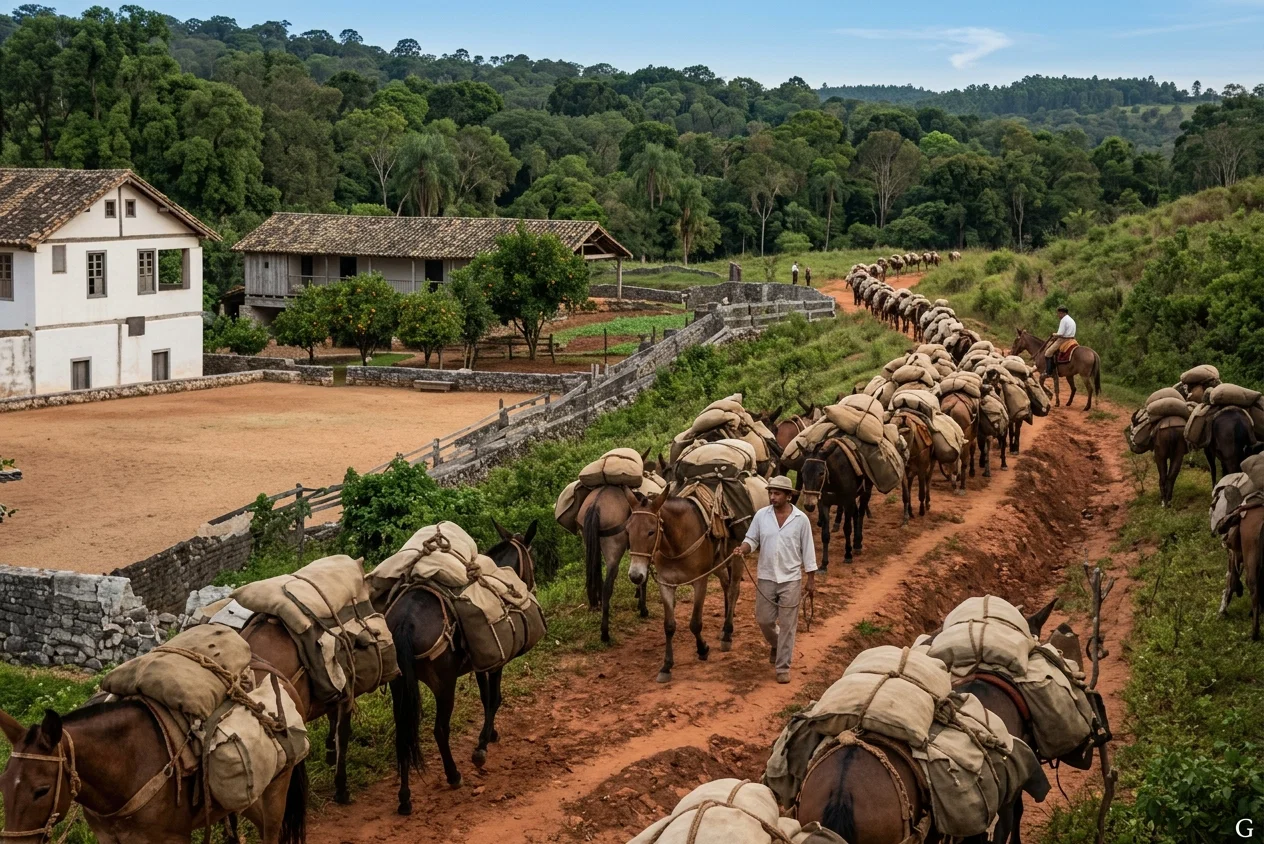
MULE PACK TRAIN IN PARAGUAY
When Spain in 1767 banished the Jesuit order, their missionary efforts in her territory ceased. The dreams of Jesuit greatness and power came to an end. The domesticated Indians still lingered about the stations, making their homes within their abandoned walls, until about 1815, when the stations were laid in ruins by the Portuguese.
It is in this former stronghold of the Jesuits that the third angel's message has made some of its most signal triumphs. In the course of three years, about one hundred and fifty Seventh-day Adventists have been raised up, while there are still others keeping the Sabbath. Throughout the whole region more or less is known of the truth, and urgent calls still come for help. During our recent meeting, two were baptized, and three united with the churches.
Paraguay and Missiones have a distinct race of their own, developed from the early Spanish settlers and the Guarini Indians, and, in Missiones also, the Brazilians. While the official language is Spanish, the language of the people is Guarini. There are thousands who can not understand Spanish, and still more who can not speak it. The Guarini language is itself a mixture of the Spanish and the Guarini of the Indians, so that they are not understood by the Spanish, and but little more by the Indian. Except a translation of parts of the Bible, they have no literature. Few can read in any language. The Bible is unknown, except as the agents of the Bible societies have scattered it. Nominally all are Catholic. Superstition occupies the place of faith everywhere.
Owing to a train of circumstances, religious and social, the moral temperature is lower than in any other country in South America. Ever since the war with Brazil, Uruguay, and Argentina more than thirty years ago, when nearly all the men of military age were killed, the female majority has steadily been maintained. Marriage has largely fallen into disuse. The cigar is found in the mouths of men, women, and children alike. These conditions make Paraguay a difficult field for successful work. In every way the people are enslaved, and the conscience seared. As far as I could learn, Protestant churches generally have succeeded less in establishing themselves than in other South American countries. It is still virgin soil for gospel work.
Including the laborers, there are now thirteen baptized Sabbath-keepers in Paraguay, and six or eight others are keeping the Sabbath. It was my privilege to visit them recently, and I found them firm, and rejoicing in the Lord. They are very scattered, but their isolation does not affect their ardor. I believe all those baptized are faithful in giving to the Lord his own.
My trip which was made through Missiones and Paraguay, as far as Gonzales, in company with Elder Ernst, the superintendent of the mission, was interrupted for a week by the sickness of Elder Ernst. After a three-days' tedious ride on horseback, being tired and warm, he took a cold bath, from which pneumonia resulted. Thanks to the knowledge the Lord has given us of simple treatments, after a week's nursing, I could leave him on the road to recovery. I concluded my visit in company with Brother Ignacio Kalbermatten, the only other laborer in that field. Remember the work and workers in this difficult field, in your prayers.
Diamante, Entre Rios, Argentina.
A Call to Share Salvation
“Pass it on to every nation,
Give the world this great salvation;
Myriads still in sin are lying,
Ev’ry breath a soul is dying.”