Your ShelfYour Projects

Signs of the Times, Vol. 23, No. 1.

Editorial

Signs of the Times

Jan 7, 1897

Pacific Press Publishing Company · Oakland, California · Jan 7, 1897

Editorial
1897.—So we write it; for according to custom another new year has dawned upon us, and the year just past lives only in our memories and in the fruits and results which are the products of its existence.
Retrospection.—It is naturally a time of retrospection and reflection, a looking back and thinking back. There will appear to the various classes of the millions which indulge in this, blastings and blessings, failures and successes, defeats and victories, miseries and mercies. To many it has been wholly a year of discouragement and despair, and not a few have taken their own lives and the lives of others. Many others toil on in grinding poverty and misery, hoping against hope for something better. Some will lay the cause of all their trouble to a beneficent Providence; others will see in all the defeats and miseries the fruits of self and sin.
Introspection.—With nearly all will there be introspection, a looking within. The sins and selfishnesses will be bemoaned and regretted. Many will be sorry for the results of the sin, but not of the sinning. Reasons, purposes, motives will be to a greater or less extent analyzed. Why did I do this or that? Why has this or that come upon me? Why is not my home happier, and life a success? What is the cause? These and many other questions will crowd upon many a thoughtful and honest heart at this the close of the old year and the beginning of the new year. All this naturally leads to the forming of many Resolutions.—Many will be made, as many have been broken. They will be made a little stronger, a little more emphatic than the year before. There will be a few more prayers and tears, but hope springs up anew based upon the wreck of past resolutions renewed. The hope for the vast majority is in the resolution.
“Without Strength.”—But there is no more strength in the resolution than in the person who made it. There is no more purpose in it than in the heart from which it sprang. No resolution, no vow, no promise or pledge, will save a soul or keep from the power of temptation unless there be back of it all a greater power than the temptation or trial to be met. We may resolve, aspire, and promise ourselves, “When the morning calls to life and light, But our feet grow weary, and ere the night, Our lives are trailing the sordid dust.”
The word of God emphatically expresses man’s condition in the two words—“without strength.” And yet men persuade themselves that they can accomplish something, if not singly, by combination in lifting themselves and the world nearer God. Hence all the resolutions; and because of human weakness, all the failures.
An Illustration.—Jesus Christ had already told the disciples in that last sorrowful night preceding his passion, “Without me ye can do nothing;” but notwithstanding his word, notwithstanding the weakness displayed at the arrest of our Lord, especially by Peter, after the resurrection, man’s confidence in himself to do, to accomplish, is again manifested. Returning to Galilee, the scene of former labors in the flesh, the old memories are renewed of the time when the disciples were successful fishermen in its blue waters. “I go afishing,” said Peter. “We also go with thee,” said the others. “They went forth, and entered into a ship immediately; and that night they caught nothing.” What a kind reproof was hidden in the Master’s question the next morning: “Children, have ye any meat? They answered him, No.” There is no success in Christian work, in moral work, in personal heart work, in work which eradicates sin instead of changing its form, apart from Jesus Christ. Your vows to reform in your strength will not avail you, dear reader; your resolutions in your own strength are like ropes of sand. Man can not lift himself by tugging at his boot straps; no more can he purge himself from weakness or sin.
“In Him.”—But in Jesus Christ is all strength. “For it pleased the Father that in him should all fulness dwell.” “For in him dwelleth all the fulness of the Godhead bodily. And ye are complete in him.” “Who of God is made unto us wisdom, and righteousness, and sanctification, and redemption.” For God “hath made him to be sin for us who knew no sin, that we might be made the righteousness of God in him.” All he asks of us is to choose him and his all-glorious wisdom, strength, and beauty by giving up all of self, and he will come into our hearts with his own mighty power, his own all-sufficient life. If we will let him, he will live in us the same life he lived as Jesus of Nazareth of old. Then our power, our success, will not depend upon our resolutions, vows, promises; but upon the eternal power of God.
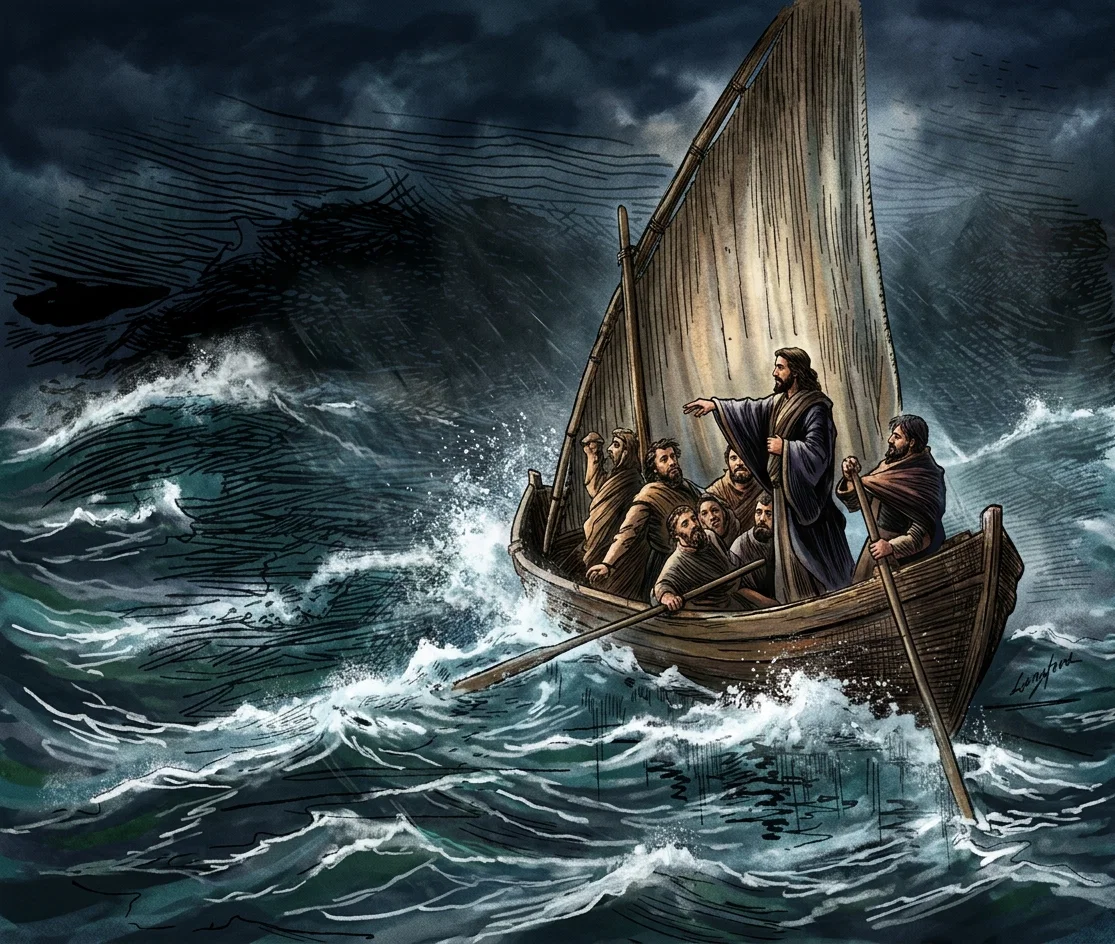
All Power Is in Him.—Friends may rage without; enemies may beset us on every side; waves of persecution and oppression may threaten to engulf our frail bark; worse than all, the evil passions of humanity may rise storm-like, and in the rage and roar of tempest we may hear the shrieking demons of hopeless defeat, despair, and death; but let Jesus into the boat; call upon him for aid; and as in old time on the storm-swept Sea of Galilee, he will arise in the calm majesty of eternal might, and speak the omnipotent words, “Peace, be still.” Reader, will you not this year take Jesus, themighty Saviour, the all-sufficient Friend, with you, to be in you and for you all that he desires to be?

LIFE AND FORM.

CHRISTIANITY is not a creed or a theory, or a mere form; it is a life, a power, a divine energy working out righteousness and life in its possessors.
But this is not to say that it does not have its forms; for life is ever manifest to the material man in form. The forms of Christianity are set forth in God’s holy word. Illustrations of it are Sabbath observance and baptism. The mere resting or refraining from ordinary labor on the seventh day is not Bible Sabbath-keeping. Doing that alone is coming short of God’s glory, and is therefore sin. Rom. 3:23. Depending upon the mere letter means death. One may be immersed in water in the words of the Gospel formula, but there is no saving power in the act, if the life be wanting. To observe the strict form alone leads to Pharisaical self-righteousness.
He also places himself in the way of deception who ignores the divine forms and talks of “the life,” “the Spirit.” He stands where his own conceptions and thoughts and fancies come to him as the voice of God, and God’s word becomes nothing.
The Spirit of God did not find fault with the Jews because they had “the form of knowledge and of the truth in the law” (Rom. 2:20), but because they did not have that form filled with the righteousness—the life of God (Rom. 10:3). Jesus Christ does not say that we should worship in Spirit alone, but “they that worship Him must worship Him in Spirit and in Truth.” John 4:24.
Life has its forms; and departure from the form shows imperfect life. This is manifest throughout nature. Sin has marred God’s handiwork there; and almost every leaf and flower and blade of grass show some imperfection in lack of development or premature death. These are indications that its life is not full and free.
Christianity is life. Its forms are expressed in the word of God. If it be in the heart of the professed Christian to make light of the divinely given forms, to ignore them, to transgress them, it reveals, and should reveal to his conscience, that the life within him is perverted; sin and selfishness are bearing sway. The divine life will follow the divine forms. “This is the love of God, that we keep his commandments.” Reader, think of these things.
A Blessed Better Thing.—When the truth of God takes from us a tenderly cherished tradition; when it strips from our idol the gorgeous, sanctified dress in which our uninstructed and devoted fancy has clothed it; when we find that our hope is based in the hoary error of tradition instead of the word of God; when we learn from that word that our credulity and presumption were founded in the wisdom of man, rather than in the power of God; when God teaches that all the ornate ritual of sacerdotalism, all the creeds of men, all the orders of priests, all the succession of priesthood, are of themselves of no account,—he does not strip us of all these to leave us naked, barren, or hopeless; but that he may give us what is better. God would give us living truth in place of tradition. He would enshrine himself in our hearts in the place of the idol we have worshiped. He would give us the hope based on his immutable promise, “an anchor to the soul, both sure and steadfast.” He would found our faith on the rock of eternal truth, in the wisdom and power of God. He would come in and dwell with us by his Holy Spirit, place in our hearts his Real Presence, connect us with himself by his own life, and be a mighty Helper, a safe, wise, and loving Friend and all-sufficient Saviour all the way to the kingdom of God. God the Father and Jesus Christ would be all of this to us if we desired it enough to choose them. Will we not do it? Will we not choose the blessed, better thing of righteousness, life, and salvation in him?

ENFORCING THE LAW OF GOD.

“For we know that the law is spiritual.” (Rom. 7:14.) Then there can be no fulfilling of the law save in the Spirit. “God is a Spirit; and they that worship him must worship him in Spirit and in truth.” Sometimes people talk about keeping the spirit of the law without the letter, but there is nothing in the Bible about keeping the spirit without the letter. By that expression men mean that they will keep what they think the law means, regardless of what it says. But God knows that the thoughts of man are vain. We are to forsake our own thoughts, as well as our own way. “For my thoughts are not your thoughts, neither are your ways my ways, saith the Lord. For as the heavens are higher than the earth, so are my ways higher than your ways, and my thoughts than your thoughts.” (Isa. 55:8, 9.) God is Spirit; therefore they that worship him must do so in the Spirit which he supplies. He provides the means, and does not ask us to worship him in our spirit, or in our conception of his law.
We are not to worship God as we think him to be, but as he is. And no one, as stated in the text just quoted, can comprehend God, or define the bounds and limits of his will. Then no man can lay down a rule for another, or even for himself. Here is the unlimited word. No man can put a limit on the word of God, or say of any text that he has fathomed its depth, and that he has all the truth there is in it. No; the word is spiritual, and no man can fathom the depth of the mind of the Holy Spirit. For this reason no man, and no body of men, is at liberty to put any construction on the word of God, or to change it, or to hold or teach that it means anything different from exactly what it says.
The knowledge of this shuts out everything like religious coercion, persecution, or the laying down of rules for people to follow; for true worship must be rendered in the Spirit which God alone gives. The word must be taken, not in our own spirit, but in the Spirit of God, and that must lead us into larger and larger ideas, and work in us that which we do not know ourselves. Men have secret faults of which they are utterly unconscious. Not only so, but no man knows the depth of any sin which is brought to his attention, or the fulness of any command which is enjoined upon him. It is plain, therefore, that no man can measure his own righteousness, nor his own sin. He can simply know that he is a sinner, and that the righteousness of God is given to him. The more of the Lord he knows, the greater sinner he will realize himself in himself to be. Therefore no man or body of men, whether in Church or State, can lay down rules by which a man must live; because the field of God’s requirements is as unbounded as his own life, and must therefore ever keep increasing to our vision; and though men filled the world with books in the attempt to define everything, there still would be something omitted.
The Spirit of God must work its own life in every man. This takes the matter out of the realm of civil government entirely. No human authority whatever can impose the Spirit upon any man, or define the mind of the Spirit.
The law of God, which is his righteousness, is the one thing which men are to seek. Christ said, “I know that his commandment is life everlasting;” (John 12:50.) We also are to know the same thing. The law itself is spiritual; it is life everlasting. But life is not a figment, a fancy; it is real, and wherever there is life there must be something living. When we read that the commandment is life everlasting, it does not mean that the written characters are life. They simply declare the fact. Everlasting life is in Jesus Christ. “As the Father hath life in himself, so hath he given to the Son to have life in himself.” (John 5:26.) He is the fountain of life. (Ps. 36:9; Jer. 2:13.)
The commandment or law of God is everlasting life because it is his own life. Then it is the life of the Spirit of God; and putting the Spirit of God into the hearts of men puts the life of God there. It is the law of the Spirit of life in Christ, that gives freedom and peace with God. “The Spirit is life, because of righteousness;” and “if any man have not the Spirit of Christ, he is none of his.” (Rom. 8:1, 2, 9, 10.) Nothing less than the life of Christ is the law of God; and anything contrary to the life of Christ is condemned. Then we can leave the right of any body of men to enforce the law of God entirely outside of the question. It is merely a question of power. Has it the power to enforce the law of God? Has any government on earth power to take the life of God and put it into the hearts of its subjects? Certainly not.
Then when men do make religious laws, and enforce religion upon people, it is certain that they are not enforcing the religion of Christ. Therefore, when they do that, those who are loyal to Christ can have no complicity with it whatever. It is paganism, no matter what form of truth there may be. It is but the form without the power or life. If such enforcement is put in the very terms of the Bible, it is only the more thoroughly pagan; for it is paganism trying to palm itself off as Christianity.
The attempt to enforce the Ten Commandments, even just as they read, would be the greatest dishonor men could offer to the Lord. It would be saying that the law of God is no better than any man may be of himself. It is the same as saying that a man is all right if hekeeps the law so that no man can find fault with him. But the man who merely refrains from outward violations of the law may be worse than the man who utterly disregards it, and knows he is guilty. In the latter case the man has nothing wherein to trust, while in the other, the man is building himself up in his own righteousness, and thinks that he is all right as long as he keeps the letter so far as men can discern.
But the law is spiritual, and only the power of the Spirit can work righteousness in an individual. The recognition of civil government as having anything to do with the law of God, is directly opposed to the idea of justification by faith. To lay down a rule or law requiring obedience to the law of God, with a penalty for disobedience, is to say to a man, “You could keep it if you would try; but you will not try, and so we will compel you to do it.” This is putting man on an equality with God. Anything less than the life of God is sin, and therefore for any power to attempt to enforce any of the precepts of Christ is simply an attempt to compel people to sin, and to hold them in sin.
E. J. W.

TWO LEGITIMATE SPHERES OF GOVERNMENT.

There are two legitimate universal spheres of government in this earth in its present condition which are ordained of God; namely, secular and ecclesiastical, or civil and spiritual. The civil power is designed to restrain evil, to prevent incivility, to guard the equal civil rights of all. For this purpose “the powers that be are ordained of God.” Whether that government be a monarchy or a republic, an autocracy or a democracy, in the sphere above indicated its existence is necessary. But with religion it has no right to meddle. It may not come in between man and the object of his worship, whether that object be the great and ineffable Jehovah or the idol of wood or clay. In other words, God has not ordained civil government to usurp his place or to assume to exercise his authority. Whether the ruler be Christian or pagan, whatever be the religious belief of ninety-nine hundredths of the people, he or they have no right to crystallize these beliefs in civil law, or to attempt to impose them upon a single soul.
In the spiritual sphere of government every individual soul is answerable alone to God. Those of the one faith form the church of God, organized not to tyrannize or lord it over men's consciences, but to be of better service for fallen humanity and helpful to one another. The officers in that government are not to be “lords over God's heritage,” but to be “ensamples to the flock.” If a man wishes to consent to be dominated over by a tyrannical hierarchy, he has the privilege, but neither he nor the hierarchy may consent for others. The spiritual, or ecclesiastical, sphere of government has no right to meddle with politics, to induce or compel rulers to place in civil statute laws the dogmas or beliefs of the church.
On the above basis these spheres of government could exist indefinitely without trouble. Under such conditions true religion has always flourished, and has ever had indirectly an uplifting influence on the unconverted and the state. But it does not please the perverter of all good to see each sphere of government kept to its own purpose. It is his object to pervert and thereby destroy, charging the evil to the government of God. Satan has therefore labored to pervert both by uniting them, and in this he has succeeded remarkably. He is the deceiver of the whole world. This union brings confusion to both Church and State, and inevitably proves the ruin of both. It gave rise to the great Babylonian system of Church and State governments, and has perpetuated the system in various forms ever since. The United States of America, the pride of the nations, for a century stood aloof from the desolating scourge, and would none of it; but of late she is quaffing the poisonous cup of the Babylonian harlot, and is rapidly succumbing to its deadly influence. The sure symptoms are manifest in the demand for religious legislation on the part of ecclesiastical bodies and accession to this demand on the part of time-serving politicians. The results have been, are, and will be in increasing ratio, religious persecution and utter ruin of both Church and State.

THAT “DIVINE LAW.”

From the Congressional Record of December 14 we cull the following excerpt from the proceedings in the Senate:—
Mr. Gallinger.—I present a series of resolutions adopted at a union Thanksgiving service in the town of Hudson, N. H., in reference to the Armenian question. The closing resolution I desire to put on record:—
That international and divine law would justify the great powers of Christendom in putting an end immediately to these atrocities, even though it should necessitate the dismemberment and destruction of the Turkish Empire.
The resolutions are signed by G. W. Buzzell, pastor of the Methodist Episcopal Church; C. D. Swett, pastor of the Baptist Church, and F. P. Chapin, pastor of the Congregational Church.
The question arises, By what divine law are “the great powers of Christendom” justified in destroying the Turkish Empire? The assumption of such a resolution is that “the great powers of Christendom” are Christian; from that standpoint, we ask the question, By what divine law are Christians justified in destroying empires? Christ said of himself, “The Son of man is not come to destroy men’s lives, but to save them;” and he has given neither precept nor example for saving men by means of the sword.
It is a prerogative of the Lord to remove kings and to set up kings (Dan. 2:21; 4:17), and he has given no law authorizing Christians to assume any such responsibility. In his providence he has used armies to overthrow nations, and he has commissioned one nation to chastise or to overthrow another nation. But these are not authorized by any general divine law (or international law, either) to do so at their will. When the Lord wants such a work done, he overrules circumstances in a special way to bring about his purpose.
The Lord does not send Christians to bear the sword against their enemies; no retaliation against persecution is of Christ. “I say unto you, That ye resist not evil; but whosoever shall smite thee on thy right cheek, turn to him the other also.” Matt. 5:39. As Christians, we are as sheep among wolves, and “the weapons of our warfare are not carnal.” The only offensive weapon in the Christian’s armor is the “sword of the Spirit, which is the word of God.”
That the Turkish Empire is to come to its end, and that in a short time, there can be no doubt. We believe that such a result is foreshadowed in the word of God. That the Lord will use the power of other nations to bring about this result, there is no doubt. But when he does use the physical forces of the so-called “Christian nations” to put down a kingdom, it will have been demonstrated that they are not Christian. The very fact of their using weapons not prescribed in the armor of Christ is evidence that they do not belong to the spiritual army of Christ.
When Peter drew his sword to defend the Master’s cause in the Garden of Gethsemane, the Lord said to him, “Put up thy sword into his place; for all they that take the sword shall perish with the sword.” Matt. 26:52. And in all the rules and regulations of the Christian army that order has not yet been countermanded. Those professed Christians who are continually calling for the use of the sword, or the civil law, which is the same thing (for the civil law is nothing if not backed by physical force), should ponder the circumstance recorded in Luke 9:51–56. Here it is related that Christ sent two of his disciples before him to a village to secure lodgings. But the people would not receive him. The disciples were very indignant, and proposed to call down fire from heaven upon the place. “But he turned and rebuked them, and said, Ye know not what manner of spirit ye are of.”
W. N. GLENN.

Question Corner

“Enquire, and make search, and ask diligently.”

No. 452. The Forbidden Fruit.

WHAT was the forbidden fruit that was in the Garden of Eden? T. G. S.
It was the fruit of the tree of the knowledge of good and evil. Gen. 2: 9, 17. We know no reason to believe that it exists on earth now. It was doubtless removed with the Garden of Eden. The sin, the evil, was not in the fruit, but in the transgression of God’s command, in the refusal to work in harmony with the Master’s will.

No. 453. Selling Unclean Meat.

(1) WILL you kindly tell me what is meant in Deut. 14: 21 by the people being commanded not to eat anything that died of itself,—but they could give or sell to strangers? How could it be right or in harmony with the Golden Rule? (2) Is there any place in the Bible that proves that this chapter, with the 11th chapter of Leviticus, was not a part of the old ceremonial law that was done away? MRS. J. A. C.
1. The strangers and aliens referred to did not count such flesh unclean. There are many to-day who eat the flesh of animals who thus die. It was sold or given away for what it was. Those who purchased it were doubtless cognizant and satisfied with what they received or purchased.
2. Technically it could not be considered a part of the ceremonial law as relating to the sanctuary and worship of God; it was rather a law to regulate health, cleanliness, and separation from the grosser practices of the heathen. As a law the prohibitions of these chapters are not now in force; but as principles inherent in the very nature of the things, the creatures then unfit for food are still unfit.

No. 454. Joshua and Jesus.

Why do not Bible writers use the name Joshua instead of Jesus in Heb. 4: 8? INQUIRER AFTER TRUTH.
For the same reason that Elias is used instead of Elijah, Eliseus instead of Elisha, Osee instead of Hosea, Esaias instead of Isaiah. The former of all these names is the Greek form, while the latter is the Hebrew. Jesus is the Greek form, Joshua is the Hebrew; both words mean the same thing, “Jehovah his help, or Saviour.” Jehoshua (1 Chron. 7: 27) is another form of the same word. In the Revised Version these names are uniform.

THE CRUCIFIXION, STILL.

[Among the original poems for holiday editions of various journals, we have seen none better than the following, with the above heading, written by Oakland’s sweet singer, Ina Coolbrith. It appeared in the Sunday Examiner of December 20.]
STILL, still upon the cross! Yet is it writ that Thou, With thorn-pierced brow, Amid the jeer of mocking lips, the toss Of mocking heads, a thief on either side, Wert crucified; Nailed to the awful tree,— Thy throne of agony,— Thou, Son of God! Thy blood, Thy life, didst give That we might live.
Nay, Lord, can this be so And earth not know? Thy star, whose fields Thy feet divine once trod Fresh from the fields of God, Thy natal star, whose skies Have quickened to Thine eyes, While thrilled through boundless space The worlds to greet Thy face From this, dear Lord, one of the least thereof, Great only in Thy love.
In Thy love, only great! O Christ compassionate, Pity us, deaf and blind, Frail humankind! Pity us, loving still, Tho all in vain Seemeth Thy price of pain; Pity us, loving still,— Tho still with sin and shame and strife and hate We thwart Thy will.
Still, still, upon the cross! For lo! our every evil is a thorn Wherewith our hands adorn Thy bleeding brow; each brother-help denied A spear thrust in Thy side, Daily betray we Thee for golden dross; Through the long centuries Unheeding, and still heeding not Thy cries, So hold we thee, O Saviour, crucified— Still, still upon the cross.

THE FAITH THAT WORKS BY LOVE.

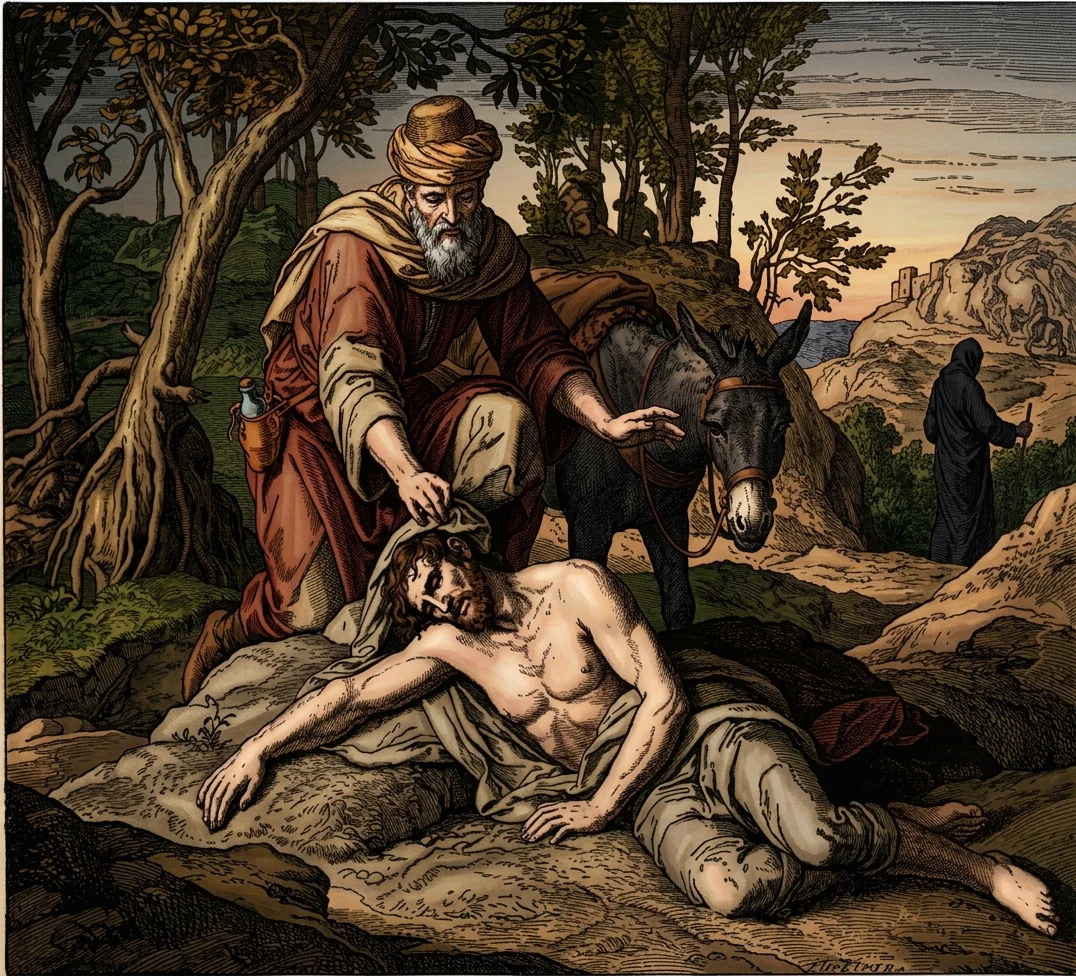
“And, behold, a certain lawyer stood up, and tempted him, saying, Master, what shall I do to inherit eternal life?” Jesus replied: “What is written in the law? how readest thou? And he answering said, Thou shalt love the Lord thy God with all thy heart, and with all thy soul, and with all thy strength, and with all thy mind; and thy neighbor as thyself.” Christ said unto him, “Thou hast answered right; this do, and thou shalt live.” Here is a plain question plainly answered. The condition of eternal life is explicitly defined. It is to love God supremely, and our neighbor as ourselves. This is the principle that underlies God’s law, which is holy, just, and good. But the lawyer, willing to justify himself, said unto Jesus, “And who is my neighbor? And Jesus answering said, A certain man went down from Jerusalem to Jericho, and fell among thieves, which stripped him of his raiment, and wounded him, and departed, leaving him half dead. And by chance there came down a certain priest that way; and when he saw him, he passed by on the other side. And likewise a Levite, when he was at the place, came and looked on him, and passed by on the other side. But a certain Samaritan, as he journeyed, came where he was; and when he saw him, he had compassion on him, and went to him, and bound up his wounds, pouring in oil and wine, and set him on his own beast, and brought him to an inn, and took care of him. And on the morrow when he departed, he took out two pence, and gave them to the host, and said unto him, Take care of him; and whatsoever thou spendest more, when I come again, I will repay thee. Which now of these three, thinkest thou, was neighbor unto him that fell among the thieves? And he said, He that showed mercy on him. Then said Jesus unto him, Go, and do thou likewise.”
God’s law requires that justice and right be exercised between man and his fellow man; it requires that we shall not injure our neighbor in his property, his feelings, his health, or his good name. It requires compassion for the afflicted, even if he be our enemy, that in all our associations with our fellow beings we shall show the same love and care that we would wish to have exercised toward ourselves. Who can stand before this great moral standard, and plead not guilty?
We may ask, How could the priest and Levite satisfy their consciences, and think themselves heaven-bound, while leaving in suffering and distress a fellow creature unto whom they might minister? But these men represent a large class who claim to be God’s children. Each one has some flimsy excuse to offer for failing to do his duty toward those who are suffering around him. But Christians can not harmonize this neglect with the requirement of God, “Thou shalt love thy neighbor as thyself.”
You may see nothing to love in your neighbor’s course of action; but this the Lord does not require of you; it is your neighbor himself, the soul God has purchased at an infinite cost, that he would have you love. You may say, I can never do this; but if you do not, you are not a partaker of the divine nature; you can never behold the purity of heaven, never walk the golden streets. Without holiness, no man shall see the Lord; and only by obeying the dictates of God’s will, can you make it manifest that you have attained to this perfection.
There are many who congratulate themselves upon having a kindly feeling for men generally. They sometimes supply money to the poor, and contribute to public funds; and when they have done this, they consider their duty performed. Wherein, they argue, can I be deficient? They perform a part of their duty; but not all. Self stands supreme. Their neighbor is not loved in the way that Christ would have his children regard each other as members together of the family of God.
When human sympathy is blended with love and benevolence, and sanctified by the Spirit of Jesus, it is an element which can be productive of great good. Every ray of light shed upon others will be reflected upon our own hearts. Every kind and sympathizing word spoken to the sorrowing, every act to relieve the oppressed, and every gift to supply the necessities of our fellow beings, given or done with an eye to God’s glory, will result in blessings to the giver. Those who are thus working are obeying the law of heaven, and will receive the approval of God.
The principles that should govern our actions are plainly marked out in the divine word. Repentance toward God, and faith toward our Lord Jesus Christ, are the conditions of salvation. In James’ day there were men arising who were doing just as many are doing in our day,—preaching that faith in Christ releases men from obedience to the law of God. James declares that “faith, if it hath not works, is dead, being alone. Yea, a man may say, Thou hast faith, and I have works; show me thy faith without thy works, and I will show thee my faith by my works. Thou believest that there is one God; thou doest well; the devils also believe, and tremble. But wilt thou know, O vain man, that faith without works is dead?” He presents before them the case of Abraham, who was justified by living faith, his works proving, or corresponding to, his faith. “Seest thou how faith wrought with his works, and by works was faith made perfect? And the scripture was fulfilled which saith, Abraham believed God, and it was imputed unto him for righteousness; and he was called the friend of God.” It is by the constant exercise of faith and love that believers are made to shine as lights in the world.
If you have been violating the law of God, will you not, my friend, stop and consider? It is not impossible for you, who have been deceived all your life, to look more closely into the law of God, and learn a lesson there. “Thou shalt love thy neighbor as thyself.” Has this love entered into your experience, or have you sought to avoid this plain injunction? Look into the great mirror, God’s law. Does it not tell you that you have not loved your neighbor as yourself? You may seek to shield yourself from its holy light; you may refuse to look into the mirror and discern your deformities of character. You may adopt a standard current with the world; but their customs and practices are not God’s standard. Those truly love their neighbor as themselves who realize their responsibilities and the claims that suffering humanity has upon them, and carry out the principles of God’s law in the daily life. Let no man deceive his own soul. Christ’swords clearly show that if we do not follow his injunctions, we shall be lost. But altho the law can convince us as transgressors, it can not save us from its penalty. “By the law is the knowledge of sin.” “If any man sin, we have an advocate with the Father, Jesus Christ the righteous.” By looking into this mirror, we may discover the spots in our character; but in order to have them cleansed, we must wash in the fountain prepared by the world’s Redeemer. The law is not to be abolished; this would not remove our defects. Christ came not to save men in their sins, but from their sins. When we feel condemned by the law, and come with humble, penitent hearts to God for pardon, Jesus, our Advocate, takes our sins, and imputes unto us his righteousness. We can look to a crucified and risen Saviour, and claim his merits. He, the Great Physician, will heal the wounds that sin has made; for his blood was shed to make the sinner whole. Thus he is made unto us sanctification and righteousness and redemption. MRS. E. G. WHITE.
Continue reading: A CURE FOR CRIME