17 “So when Jesus came, he found that he had been in the tomb four days already. 18 Now Bethany was nigh unto Jerusalem, about fifteen furlongs off; 19 and many of the Jews had come to Martha and Mary, to console them concerning their brother. 20 Martha therefore, when she heard that Jesus was coming, went and met him; but Mary still sat in the house. 21 Martha therefore said unto Jesus, Lord, if thou hadst been here, my brother had not died. 22 And even now I know that, whatsoever thou shalt ask of God, God will give thee. 23 Jesus saith unto her, Thy brother shall rise again. 24 Martha saith unto him, I know that he shall rise again in the resurrection at the last day. 25 Jesus said unto her, I am the resurrection, and the life: he that believeth on me, though he die, yet shall he live; 26 and whosoever liveth and believeth on me shall never die. Believest thou this? 27 She saith unto him, Yea, Lord: I have believed that thou art the Christ, the Son of God, even he that cometh into the world. 28 And when she had said this, she went away, and called Mary her sister secretly, saying, The Master is here, and calleth thee. 29 And she, when she heard it, arose quickly, and went unto him. 30 (Now Jesus was not yet come into the village, but was still in the place where Martha met him.) 31 The Jews then which were with her in the house, and were comforting her, when they saw Mary, that she rose up quickly, and went out, followed her, supposing that she was going unto the tomb to weep there. 32 Mary therefore, when she came where Jesus was, and saw him, fell down at his feet, saying unto him, Lord, if thou hadst been here, my brother had not died. 33 When Jesus therefore saw her weeping, and the Jews also weeping which came with her, he groaned in the spirit, and was troubled, 34 and said, Where have ye laid him? They say unto him, Lord, come and see. 35 Jesus wept. 36 The Jews therefore said, Behold how he loved him!”
QUESTIONS.
How long had Lazarus been dead?
How far was Bethany from Jerusalem?
In consequence of this nearness, what custom among the Jews was followed in this case?
On learning of the approach of Jesus what did Martha do? What did Mary do?
How did Martha express her faith in the power of Jesus over death?
In what statement does she suggest the thought that Jesus may raise him from the dead at once?
What assurance does Jesus give her?
How did Martha respond to this promise?
What central truth did Jesus then announce?
What did he say that faith in him would do for the dead?
What would it do for the living?
What personal inquiry did Jesus then make?
What response did Martha make?
What did she then do? What message did she bear?
How did Mary respond to this message?
Where was Jesus?
What did the mourners do? What reason did they assign for Mary’s leaving the house?
On reaching Jesus what did Mary do? What did she say?
How did the whole scene affect Jesus?
What inquiry did he make? What reply was made?
How did Jesus show his sympathy for the sorrowing?
What did this lead the Jews to say?
NOTES.
1. A GLIMPSE of funeral customs among the Jews is given in the following extract: “The four days since the death had been sad ones in the little household. They had fasted all the day after it, and had since eaten nothing but an occasional egg or some lentils; for that was the only food allowed mourners for the first seven days. The corpse . . . had been borne to the grave after a few hours, an egg had been broken as a symbol of mortality, and the cottage left to the two survivors. The funeral procession had been sad enough, with its dirge flutes and hired wailing women; the two sisters and their relations following, and then the neighbors and friends; for it was held a religious duty in all who could, to attend a corpse to the grave. At the grave’s mouth, the men had chanted the sublime nineteenth psalm in a slow circuit of seven times around the bier, on which lay the dead, wrapped in white linen. The long procession, headed by the women, had stopped thrice on the way to the grave, while the leader spoke words of comfort to the bereaved ones, and tender exhortations to passers by,—‘Comfort ye, comfort ye, ye dear ones! Lift up your souls, lift up your souls! Come to me, all ye who are of sad and troubled heart, and take part in the sorrow of your neighbors.’ Once more in their desolate home, the sisters, with veiled heads, even in their own chamber, and with unsandaled feet, sat down on the earth, in the midst of a circle of at least ten friends or professional mourners with rent clothes and dust on their heads. None spoke until the bereaved ones had done so, but every sentence of theirs was followed by some word of sympathy or comfort, and by the wails of the mourners. And thus it would be for seven days, and had been for four, before Jesus arrived; for many friends had come from Jerusalem to comfort the two sisters.”—Geikie.
2. “Jesus did not desire to meet the afflicted sisters in such a scene of confusion as their home then presented, so he stopped in a quiet place by the roadside, and sent a messenger to inform them where they could find him.”—Spirit of Prophecy, vol. 2, p. 362.
3. “The main teaching of the miracle is announced in the words of Jesus: ‘I am the resurrection and the life.’ In this statement two truths are contained: That resurrection and life are not future only, but present; and that they become ours by union with Christ. . . . He assured her that in him were resurrection and life; that all, therefore, who belonged to him were uninjured by death, and had in him a present and continuous life.”
4. “Christ is the resurrection because he is the life. He has life originally in himself; his essence is life; in his victorious conflict with that death which in our flesh he has power to taste for us (Heb. 2:9) life shows itself as resurrection. . . . Not because he has risen is he the Living; but because he is the Living, therefore has he risen. See Rev. 1:17, 18, R. V. It was impossible that he should be holden of death (Acts 2:24), for the very reason that he is the Living. And what Christ is, this he imparts to his believers. John 14:19. ‘He is the resurrection of the dying and the life of the living.’
For all his believers is this precious word of Christ intended.” Sight says, “In the midst of life we are in death;” but faith says, “In the midst of death we are in life.”
5. “Jesus bade Martha call her sister and the friends that had come to comfort the afflicted women.” “How beautiful is this! When thy Saviour has been offering himself to thee to be thy consolation and light, thy resurrection and life, go thy way, call thy brothers and sisters who, like thee, are in need of help.”
6. “In view of their human distress, and of the fact that these afflicted friends could mourn over the dead when the Saviour of the world stood by, who had power to raise from the dead, Jesus wept. His grief was not alone because of the scene before him. The weight of the grief of ages was upon his soul, and, looking down the years that were to come, he saw the suffering and sorrow, tears and death, that were to be the lot of men. His heart was pierced with the pain of the human family of all ages and in all lands. The woes of the sinful race were heavy on his soul, and the fountain of his tears was broken up, as he longed to relieve all their distress.”—Spirit of Prophecy, vol. 2, p. 364. He wept with me and for me.
Suggestions for Further Study.
The whole subject of the resurrection is naturally suggested by this lesson, and may be studied with profit. Observe that the two great truths emphasized in this lesson are inseparably connected with the person of Christ. So it is with other doctrines. Compare 1 Cor. 1:30. Thus have all doctrines become experience in Christ, that they may be known as experience by us. This is “the truth as it is in Jesus.”
Is the second death implied in this lesson?
How is the time of the resurrection fixed in this lesson? Compare 2 Tim. 2:18. See also John 6:40.
Why could the statement in verse 22 be made unconditionally? Compare Matt. 26:53, 54.
How is life only in Christ taught in this lesson?
Lincoln Fountain Pen.
We are constantly receiving words of recommendation for this pen, and we are thoroughly convinced that it is just as represented in every way. We are allowing special prices on orders for a dozen or more at one time.
Our offer to send the pen for only 75 cents to any one subscribing for the SIGNS OF THE TIMES for one year, and paying the regular subscription price of $1.00, still holds good. Both the SIGNS and the pen for $1.75.
Pacific Press Pub. Co., Oakland, Cal.
New York City. Kansas City, Mo.
News and Notes
FOREIGN.
—It is said that an occult temple is soon to be erected in San Francisco by the Theosophists, all the necessary funds having been already subscribed.
—A disastrous explosion occurred in the Maule coal mine, near Princeton, Ind., on the 26th ult., in which six men were killed and eight severely injured.
—Julio Sanguilly, a citizen of the United States resident in Cuba, has been convicted of conspiracy against the Spanish Government, and sentenced to imprisonment for life.
—That the desperate feud between the Chinese tongs in San Francisco is not yet allayed, is evidenced by the finding of two murdered Chinamen in that city on the 29th ult.
—A Rome despatch of the 28th ult. says that a landslide has entirely destroyed the village of Santa Ana de Pelago, demolishing 118 houses, leaving 150 families homeless. No lives were lost.
—U. S. Consul Bell, at Sydney, N. S. W., noting the new Japanese steamship line between Yokohama and Australian ports, says that “Japan now has a larger carrying trade on the Pacific Ocean than the United States.”
—A press correspondent reports that the bubonic plague is spreading in Bombay. Two hundred thousand natives have fled from the city, and the panic is said to be increasing. The European residents have remained, altho showing much anxiety.
—Within seven weeks ending December 27, seven Chicago banks closed their doors, and others are expected to follow in the near future. A despatch dated the 28th ult. says, “The bank failures of the past two months are the largest in point of volume since the panic of 1872, immediately following the great fire.”
—A severe famine is reported in Western China, province of Szechuen, where there have been prolonged rains. Heavy floods have spread over vast areas of country, destroying the rice and vegetable crops. In addition to deaths by starvation, a landslide carried a large section of the city of Chuantung into the river Kin-Sha, causing the death of about 3,000 people.
—A late despatch from Cuba states that fifteen Texas sharpshooters, known as the Lone Star Company of the Patriot Army of West Cuba, perished to a man, after a heroic battle of over five hours with a much larger force of Spanish troops. They killed double their number, and wounded many more, before being overcome. They refused to surrender, and all died fighting, as did Col. Davie Crockett’s men at the famous battle of the Alamo.
—The steamer Peru, which arrived at San Francisco December 28, brought news that, in addition to the smallpox epidemic in Japanese ports, there is also danger of cholera being introduced by oriental steamers. Cholera has revived at Hongkong, and serious results are expected. The disease has made much headway in Chinese cities and on the island of Formosa. Japanese ports have declared a quarantine against all cholera-infected districts.
—A letter from the secretary of the late General Maceo, the Cuban patriot leader, gives undoubted evidence of the general’s death. In company with thirty of his officers, he was making a journey with the intention of concentrating the forces of Havana Province, and taking some advantage of Captain-General Weyler’s absence from the city. His plans were betrayed to the Spaniards, it is thought by his physician, Zertucha, and he was waylaid and shot.
—We are told by “reliable advices from Constantinople” that the agreement of the powers for the enforcement of reforms in Turkey is complete, with the exception of the matter of methods to be pursued and the time of putting the measures of the coercion agreed upon into operation. But that is just what has been the matter all the time. The powers have for years been agreed upon everything but action. The sultan continues obdurate, and says he will never yield.
—A Dublin despatch of December 29 reports the progress of a great bog-slide on Castle Island, County Kerry, Ireland. The mass is said to be a mile and a half wide, carrying whole farms and all that can not be removed into Lake Killarney. People are fleeing from the path of the slide as fast as possible. Hundreds of homes are being destroyed. It seems that the movement is not a precipitous rush, but it is terrible in its uncontrollable progress, roaring like the ocean.
—Not only in the devastated country regions, but in all the principal cities of Cuba, not excepting the capital, famine is said to be following the war. Starving refugees parade the streets crying for bread or work, and many die unheeded. Men, women, and children wander about by day and huddle together at night. All the charitable institutions are turned into army hospitals, and the poor civilians have no resort but beggary, and the most opulent have little to give. Many who were wealthy before are now destitute wanderers. Such is war, even among “Christian nations.”
—The Portuguese consul in Boston has received a strong plea from the island of St. Michael’s, in the Azores, for aid to sufferers by the bursting of a water-spout over the city of Povacao, on the 2nd of November. The torrent rushed through nine miles of country, carrying with it the homes of the people. The town of Rivera, having 3,000 inhabitants, was also destroyed. It is said the seashore was strewn with the corpses of persons who had perished in the flood, and there is great suffering on the part of survivors.
—Great jealousy is said to exist between Colombia and the states forming the Greater Republic of Central America, because of the rival isthmian canal schemes. The old Panama Canal enterprise lies within the territory of Colombia, while the Nicaragua project is in the territory of Nicaragua, now a part of the Greater Republic combination. The latter claims that Colombia, backed by some interested European powers, is scheming to get control of territory comprising the proposed eastern terminus of the Nicaragua Canal, and thus prevent the completion of that enterprise.
DOMESTIC.
—Brooklyn, N. Y., had a $100,000 fire on the 27th ult. The catastrophe originated in the repair shops of the Brooklyn Heights Railroad.
—On Christmas day fire in New York City destroyed property of the value of nearly a million dollars, leaving about one hundred people homeless.
—At Wichita, Kansas, on the night of the 26th ult., tramps set fire to a circus train, and five cars containing animals were consumed. A tramp was also fatally burned.
—It is said that the Attorney-General is making all preparation to foreclose the government’s lien on the Union and Central Pacific Railroads as soon as due, unless the Funding Bills are passed by Congress.
—In Chicago, on Christmas eve, as Mr. and Mrs. Alverson were out visiting a sick friend, a man entered the house in the guise of Santa Claus, played with the children a while, ate all he wanted, and went off with some $300 worth of valuables.
—The old printing house of Francis & Valentine, San Francisco, was damaged by fire to the extent of $30,000, on Christmas day. Just three years before it was almost entirely destroyed by fire. A fireman fell two stories to the stone sidewalk, and is thought to be fatally injured.
—Still another of our great war-ships—the Boston—is said to be seriously injured by accident. The cruiser ran aground recently near Chemulpo, Korea, and is obliged to come home for repairs. If these great engines of battle are so easily crippled by slight accidents, it would seem that they are not very reliable in case of actual engagement with an enemy’s guns.
—A despatch from El Reno, I. T., says: “Cuban sympathizers here have formed an oath-bound organization which contemplates fighting for the insurgents without violating the United States neutrality laws. The men are to go to Cuba as colonizers, and to purchase or lease lands for the cultivation, manufacture, and sale of tobacco; and other civic enterprises, to be decided upon later, may be entered into. The number of members may not be less than 100 nor more than 200.”
—It was recently reported that the famine in India was greatly relieved, and would be materially shortened by copious rains. But the latest reports are still bad enough. A prominent correspondent of a Calcutta paper states that every day thousands of persons are dying from starvation in the Central provinces. He states under date of December 25, that the government arrangements to cope with the situation are entirely inadequate, and that the famine is beyond control.
—A terrible railroad disaster occurred near Blocton, Ala., on the 27th ult., in which twenty-six persons were killed and ten injured, two fatally. The train crashed through a bridge 110 feet high, plunging into the Cahaba River. A rail had been removed from the track, it is supposed by robbers, and when the engine struck this part of the track the bridge broke and the train went down. The water being shallow, the train caught fire. Some of the victims were burned to death, and others were crushed.
—Everything goes to show that the “wave of prosperity” of which we have heard so much lately, is a wave that bears up the interests of capital while it bears down the poorer classes, especially employees. A number of large manufacturing concerns are reported to have cut wages within the past few weeks. The latest instance on the Pacific Coast is the reduction in the Pacific Rolling Mills, San Francisco, where a cut was made ranging from twenty cents a day for boys to something over a dollar a day for the higher grades of work. As a result 150 employees went out on a strike. After two days, however, a compromise was effected, the strikers agreeing to a cut of ten per cent. If the people would believe the word of God, which plainly indicates that the culmination of the conflict between capital and labor is at hand, and the coming of the Lord is “near, even at the doors,” there would not be so much dependence upon the gilded promises of better times.
—The collector of the port at Jacksonville, Fla., has received instructions to grant clearance papers to the Dauntless with a cargo of munitions of war for Nuevitas, Cuba, requiring of the master and owners the usual oath of masters and owners of vessels carrying general cargoes. Of course other vessels will enter the same trade. This is in harmony with the recent decision of a U. S. Court that, as war is not recognized, there is no law or treaty to hinder trade between the United States and any ports under Spanish jurisdiction.
—A man named W. J. Jackson was pardoned out of the Kansas penitentiary by Governor Morrill, on Christmas day. He had been in prison sixteen years on a life sentence for murder, of which it is claimed he was innocent, a man who died some time ago having confessed the murder. All this time his wife, who resides on a farm in Texas, has been rearing their five children, who are now all grown. She has always believed he was innocent, and has done all in her power to secure his release. He started for his home as soon as released.
—A terrific boiler explosion occurred at the insane asylum near Medical Lake, Wash., on the 28th ult. Four boilers exploded, demolishing the boiler house and doing considerable damage to the main building. There was wild excitement among the inmates, in their mad endeavors to break through the doors and windows. Many of them were more or less injured in the panic, but none fatally. It took considerable time and strenuous efforts on the part of the keepers to quiet the unfortunate inmates. The fireman was the only person injured by the explosion, and he will probably die.
—Some leading financiers are trying to palliate the force of the numerous bank failures in the country, in the face of the siren song of “Good times coming,” by saying that it is “only a weeding out of weak institutions.” Whether that be an encouraging explanation or not, depends upon how many more of such institutions shall prove to be “weak.” From the standpoint of the prophetic word and the outlook upon the “times and seasons,” we may safely conclude that we are past all prospect of anything like permanent good times in this world. There may be temporary and limited spurts of what men call prosperity in this world, but the end of this world’s history is at hand, and the “coming of the Lord draweth nigh.” Just now the all-important thing is, “Prepare to meet thy God.”
LITERARY NOTICES.
VOL. XIII. of the Converted Catholic, for 1896, has been laid upon our table. This magazine, conducted by Rev. James A. O’Connor, a former Catholic priest, is one of the most effectual agencies in the country for bringing Catholics to the saving knowledge of Jesus Christ. Mr. O’Connor conducts a work known as Christ’s Mission, in New York City, the property of which is controlled by trustees of various Protestant Churches. We have read the Converted Catholic for years, and can commend it as the ablest journal in its line, free from vituperation and personal abuse (tho the editor receives much himself), evangelical in spirit and tone, and giving much and valuable information and instruction relative to Romanism and the Gospel. Price of the magazine one year, $1.00; bound volume, 1896, $1.50. James A. O’Connor, 142 West Twenty-first Street, New York, N. Y.
A NEAT little volume of “POEMS,” by Alice J. Conklin, of Frederick, Md., has been placed before us. It possesses much greater poetic merit than many much more pretentious volumes. The spirit of true poetry breathes through the poems and brings you into sympathy with the author. We understand that the author of this little volume is blind, has never seen the material light of day, but she has evidently seen by faith the Light of the world. The little book has 130 pp. and 35 poems. Price in cloth 35 cts.; in paper covers, 20 cents.
THE Cosmopolitan for January contains articles of more than usual interest. Among these are “German Students and Their Absurd Duels,” by Mrs. Reighard; “Some Types in Dixie Land,” by Mrs. D. B. Dyer; “The Farmer’s College,” by Murat Halstead; and “Advance of Photography during 1896;” Price 10 cents. For sale by all newsdealers.
SURE WORD OF PROPHECY.
A study of the book of Daniel.
A concise study of this important prophetic portion of the Bible. Fully illustrated. Paper covers. 96 pages.
Bible Student’s Library No. 131. Price, 10 cents.
Address,
PACIFIC PRESS PUBLISHING CO.
OAKLAND, CALIFORNIA
Kansas City, Mo. New York City, N. Y.
Our Premium Fountain Pen
Every Pen is fully guaranteed and can be returned if not entirely satisfactory
We have found only one imperfect pen in the hundreds we have sold, and this one was immediately replaced with a perfect pen.
OUR SPECIAL OFFER to send a Lincoln Fountain Pen and the SIGNS OF THE TIMES one year for $1.75 still holds good. Send order at once so as to begin with new year.
Address, SIGNS OF THE TIMES, Oakland, Cal.
THE AMERICAN KITCHEN MAGAZINE.
“Practical and Educational: the Leading Household Monthly.”
Edited by —MRS. MARY J. LINCOLN and MISS ANNA BARROWS.—
“Just what the progressive woman needs.”
—The Free Methodist, Chicago.
“A magazine for every up-to-date home-maker and housekeeper.”
—Syracuse (N. Y.) Herald.
HOW TO SAVE MONEY!
This magazine tells how to prepare delicious and wholesome food at a LESS PRICE than is now paid for what is unpalatable and innutritious. “The suggestions contained in a single number are worth more than the price of a year’s subscription.”
SPECIAL OFFER—THREE MONTHS FREE.
All new subscriptions received before January 1, 1897, will begin with October, 1896, and end with December, 1897.
SAMPLE COPIES FREE.
Price, $1.00 a Year.
Published by
THE HOME SCIENCE PUB. CO.
485 Tremont St., Boston, Mass.
CYCLONE WASHER.
WOOD, IOWA, Oct. 23, 1896.
MESSRS. COON BROS., Battle Creek, Mich.—Gentlemen: I received my Washer and yesterday I did a two-weeks washing—which was a severe test of the machine, as the garments were badly soiled—and it did the work splendidly. I am now ready to take the agency. Yours truly, MRS. ENOS CLEVELAND.
EXETER, R. I., Oct. 12, 1896.
MESSRS. COON BROS., Battle Creek, Mich.—Gentlemen: I have not got into working order yet, but trust I shall soon. Every one who has bought a Cyclone of me speaks very highly of it. Please ship goods as per enclosed order. Yours truly, J. ORRIS BENJAMIN.
Agents wanted everywhere.
Address, Coon Bros., 18-20 Hanover St., Battle Creek, Mich.
Pamphlet Orders and Numbering
“Will A Man Rob God?” will appear as No. 145, and all orders we now have for No. 145 will be filled with “Origin, Progress,” etc. In ordering these pamphlets mention name as well as number.
Pacific Press Pub. Co., Oakland, Cal.
New York. Kansas City.
THE SIGNS OF THE TIMES FOR 1897.
By Editor
The SIGNS OF THE TIMES presents as an appeal to the public Great and Important Truths, told in simple English, and backed by the Living Word of God.
What It Has Been
its readers well know. In 1896 every phase of the Gospel of Christ was set forth more or less fully. The great and important doctrines which are agitating the world to-day have been discussed with lucidity and simplicity.
Many of the subjects presented were illustrated; and our five symposium numbers, if published in pamphlet form, would have brought at low rates one-half the price of the paper. It is safe to say that no religious weekly in the land presented before its readers more Gospel Truth than did the SIGNS OF THE TIMES during 1896.
What Shall It Be in 1897?
We expect, by the blessing of God and the coöperation of our subscribers and friends, to do even better in the year 1897. It shall be our aim to “abound more and more.”
While it will have as its friends and contributors devoted servants of God, those who have made the science of Christianity their study and practice for years, and who know how to write, yet it boasts not in men or great names. Its boast is in the Gospel of Jesus Christ.
Among the Great Subjects considered will be the following:—
The Scriptures and Their Inspiration,
Justification, Regeneration and Sanctification,
Life in Its Relation to Righteousness,
Life through Christ, and How Obtained,
Practical Christian Life and Godliness,
The Coming of the Lord and What That Coming Means,
Church and State, Their Union and Separation,
The Dangers That Threaten Both,
The Sabbath in Its Various Phases,
Great and Important Prophecies.
The SIGNS OF THE TIMES will be published in 1897 as a 16-page, illustrated religious weekly, for the entire family. It will be printed from new type. Bright, brief, and original articles will characterize the paper in the momentous year before us.
Never was there such a time of expectation and dread over what is coming to pass as now. THE SIGNS OF THE TIMES will tell
What These Things Mean in the Light of Prophecy.
Various departments will be maintained which will contain instruction from the word of God on the living issues of the time and the vital teaching of the Gospel; some of the more striking indications of the trend of public sentiment, and the omens of the time; helpful suggestions, articles, and stories for the home life; missions and mission fields will receive attention; Sabbath-school and Sunday-school lessons will be expounded; questions on scriptural and historical subjects will be answered; and notes and news of important events will be recorded from week to week. These departments are as follows: Editorial, General Articles, Outlook, Our Question Corner, Missions, The Fireside, Our Sabbath School, International Sunday School, and News and Notes.
But few advertisements will be found in the SIGNS OF THE TIMES, and these will, so far as human foresight can see, be proper for a religious paper, and reliable.
The price of this large 16-page weekly illustrated paper is placed at the exceeding low price of only One Dollar a year. Directions as to how to send money will be found on this page. Special terms in clubs and to agents. See our valuable offer on the opposite page.
Address, SIGNS OF THE TIMES, OAKLAND, CAL.
PILGRIM'S PROGRESS
BY JOHN BUNYAN
A new, clear-type edition of convenient size. Neatly bound in cloth, cover design in colors, 240 pages, size 5x7½ inches.
Price, 50 Cents
Address
PACIFIC PRESS PUB. CO., Oakland, Cal.
43 BOND ST., New York. 18 W. 5th St., Kansas City, Mo
Yosemite Valley and Big Trees of California
Read All About Them in the Book
IN THE HEART OF THE SIERRAS
Nearly 500 Pages, with Many Illustrations. Limp Binding.
Price, 75 Cents.
Address
PACIFIC PRESS PUB. CO., Oakland, Cal.
Or 43 Bond St., N. Y. City.
TEACHERS’ BIBLE PREMIUM OFFER
By Editor
For January and February, 1897
During the first two months of 1897 the SIGNS OF THE TIMES offers to all NEW SUBSCRIBERS a chance to secure a magnificent Self-Pronouncing Teachers’ Bible at an astonishingly low price. Never before have the publishers been able to make such
An Unparalleled Offer
This Self-Pronouncing Teachers’ Bible is American made—not a cheap reprint, but a copyrighted edition from new type-set plates. It has the chapter numbers in plain figures, contains a Complete Series of Helps with Illustrations, and a “Word Book” which embraces a Concordance, Subject Index, Gazetteer, Bible Dictionary, etc., all in one Alphabetical Arrangement. By consulting the Word Book you can find at once what you want, and do not need to look in half a dozen places for it.
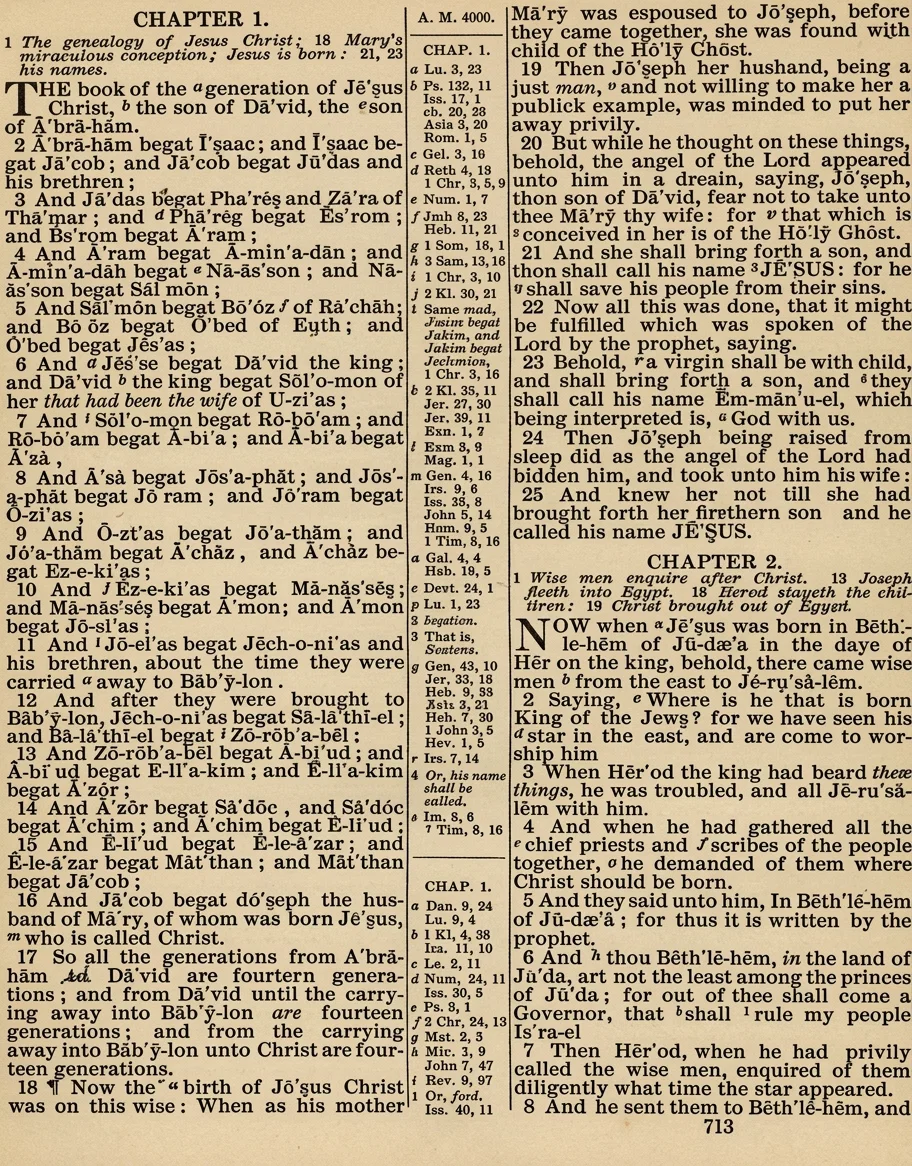
Few people can read and properly pronounce the difficult proper names in the first chapter of Matthew, but the Self-Pronouncing feature in this Bible will enable anyone to read them at sight.
This new Bible has Minion type (see specimen page herewith), is bound in American Morocco, has silk head bands, a silk marker, a silk-finish lining, and red under gold edges, and will be furnished to bona fide new subscribers, together with a year's subscription to the SIGNS OF THE TIMES, if ordered during the month of January or February, 1897, for $2.50. Both Bible and Paper sent post-paid.
Bible contains 17 Maps, A Word Book of 268 pages, and 180 pages of other Helps, making in one volume a Bible and Reference Library of over 1400 pages.
WE GUARANTEE the Bible to give satisfaction, and anyone who is not satisfied with it may return it to us, within three days after receipt, and we will refund his money.
ADDRESS,
SIGNS OF THE TIMES
OAKLAND, CALIFORNIA713
(This page is an exact reproduction of one page of our Premium Bible and shows size of the type.)