Brother Casebeer and I are on our way to the union conference in Argentina, having left Lima January 22. My wife was just recovering from an attack of malarial fever, and I left little Mora sick in bed with the same disease; but it seemed duty to visit some parts of southern Peru on this trip, to avoid the expense of another voyage.
We disembarked in Mollendo, and went by train to Arequipa, where we spent one day selling the Señales, and taking subscriptions for it, with some success. The next day we went to Puno. The railroad over which we traveled is one of the highest in the world. For more than six hours we were more than fourteen thousand feet above sea-level; and we passed beyond 14,800 feet. There is an abundance of water on these highlands, and even some beautiful lakes; but, owing to the great elevation, little vegetation is produced save moss and a kind of bunch grass. These, however, supply food to large numbers of llamas, alpacas, and vicuñas.
The llamas are the famous beasts of burden of Peru. They are cheap, easily managed, and abundant. They do not carry more than fifty pounds each, so the natives usually drive twelve or more to market with their produce. The alpaca is a sort of sheep, I suppose similar to the alpacas in other parts of the world. The vicuñas are, I understand, peculiar to these regions. They much resemble a goat, but are more beautiful, deer-like animals. Each produces a wool, or hair, which is much used for making yarn and weaving cloth, in which arts the native women show commendable skill and industry.
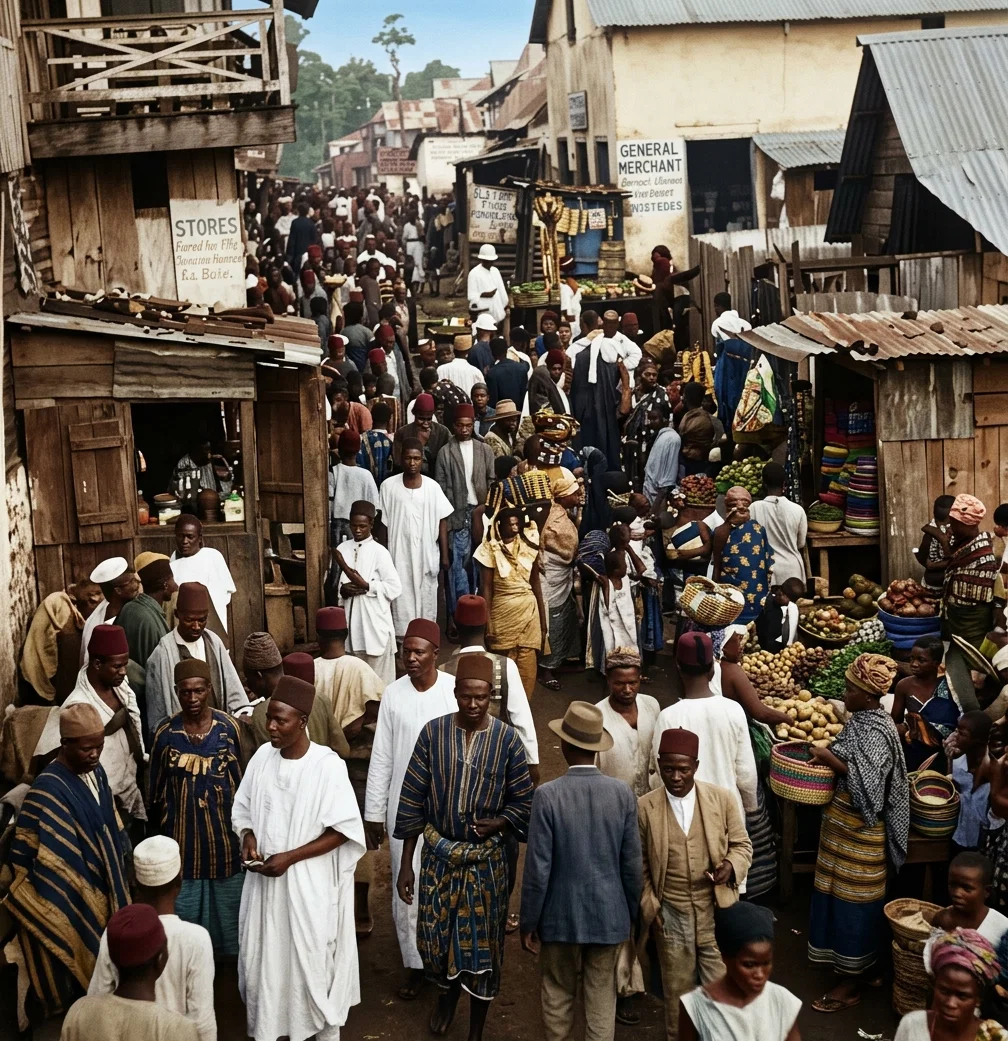
SCENE IN MONROVIA, LIBERIA
Puno is a city of about ten thousand people, situated on the shores of Lake Titicaca. Its well-built adobe houses, with tile or corrugated iron roofs, testified that we were in a country where it rained. I wanted to see a good rainstorm, as I have seen no rain for two years and a half, but I was disappointed: the weather was bright and clear, and the warm sunshine was very agreeable. We did not exert ourselves even to walk very fast. It took most of our energy to keep pumping air into our lungs; for Puno is 12,500 feet above sea-level. Lake Titicaca is the highest navigable lake in the world, about forty miles wide and one hundred thirty long. Upon its waters it is said that the first Inca—Manco Capac—with his wife came down from the sun. Their descendants were known as the children of the sun, and were the royal family of Peru until the time of Pizarro. There are many evidences which show that the early Peruvians were sun-worshipers. But the proud Inca, with his golden treasures, is gone. His people are now little more than the slaves of foreign oppressors. The Indians of the mountains are largely sunk in poverty, ignorance, and vice. If ever a race needed to hear of God's free salvation, it is this one.
Our work is gaining a foothold here in Puno. Some time ago I received a letter written from this place by a man named Morales. He sent in subscriptions to the Señales for himself and a friend. This friend, Peralto, secured seventeen more subscriptions. It was to see these people that I went to this place. Morales had left the city. We found Peralto, a shoe manufacturer in good circumstances. He received us with open arms. He took us to his close friend, Bonefacio Aragón, a subscriber. Seated in the latter's pleasant, well-furnished home, I spoke to these men about an hour, concerning the truth. Their hearts were open, and God gave them faith, and they said, “We want to become members of your people.” We held two meetings, which lasted late into the night. I never saw anything like it before. It seemed as if God gave them faith in our message, and let his converting power rest upon them. There were about twenty present each evening. Three brethren came to the station early in the morning, to see us depart. About fifteen in Puno promised to keep the Sabbath and hold Sabbath-school. The two men first mentioned suggested that they pay for fifty Señales monthly, to distribute or sell. They offered voluntarily to furnish a house and meeting-place free, if I would send them a teacher. To enter the city a stranger, not knowing a single person, and in two days see fifteen or twenty believing, willing to sacrifice and suffer for this blessed truth, was little short of a miracle. Our hearts were filled with gratitude and praise.
But this brings its responsibilities. These dear believers must be educated in the truth. One said, “We have faith, but are ignorant. We must learn more.” I regard this as a most wonderful opening. The two leaders are of more than average intelligence. They are men of property and influence. They are at the head of a large workingmen's society. A large hall is nearly completed for the purposes of this society, these men furnishing most, if not all, the means. Their families are well appearing, intelligent, and obedient.
Now, what can I do? I can not stand the altitude except for two or three days at a time. We have no native laborers who could be of much help to them. And if I could stay there, I have more than I can do elsewhere. God is going before, and opening the way. O that the people of God could sense the burden that is resting upon them! I know of no one in South America whom we can get. All the fields need more help.
Brother Hinckley tells me that he is sure a nurse or two could earn their way in Arequipa. I think the same would be true of Lima. Under a Peruvian immigration law, colonists coming here as laborers or professionals can have their passage paid by the government.
We are having a pleasant voyage. Day after to-morrow (February 13) we reach Valparaiso. May the Lord hasten the day when the work shall be done.
Lima, Peru.
A Trip to Grand Caymans
By F. E. Carey
DECEMBER 5 I started with seven of our brethren and sisters from Bonacca, to visit the little island of Grand Caymans, near Jamaica. We embarked on a schooner which was quite crowded with passengers, and having to beat against a heavy wind, it was a week before we arrived at Caymans. This was a rough, seasick trip of three hundred ten miles. Caymans is an island thirty-five miles long and from two to twelve miles wide. The inhabitants are mostly of English descent. The island is very low, rising in no place more than forty feet above sea-level. This makes a good home for mosquitoes, which abound in and near the swamps. The inhabitants number between one and two thousand, and are mostly Presbyterians. They have five churches in different parts of the island.
When I went there, I took over two hundred papers to give away, and some special Signs to sell. I also took some Scripture mottoes to sell, to pay expenses. I had planned to hold some meetings; and with God's help see what good I could do; but on arriving, I met Brother and Sister Hall, and learned of the tent effort that was in progress, conducted by Brethren Hall and Durant. Some stirring meetings were held, and many were warned. Although our company of believers is very poor, and has no church, the work is started, and I trust that others will take their stand with God's remnant people. I visited all parts of the island, and found a few scattered believers as a result of Brother Hall's work, some time before this effort. I distributed the reading-matter I had, and held some meetings, in the absence of Brethren Hall and Durant, who went to another part of the island to carry the truth.
Our trip home to Bonacca was accomplished in three days, and now we are preparing for a camp-meeting in our conference. Pray for the success of our work here, that sheaves may be gathered for the heavenly garner.
F. E. CAREY.
Second Session of the Northern Union Conference
By I. H. Evans
It was my privilege to attend the second session of the Northern Union Conference, which embraces the States of Iowa, Minnesota, North and South Dakota. This conference was held in Minneapolis from March 5 to 15.
At the very first meeting nearly every worker in the union conference was present, and promptly and regularly attended nearly every meeting. The services began each time at the appointed hour, and closed according to the announced program. No apparent effort was made to accomplish this desirable end. From the first meeting, everything seemed to fall naturally into order and method.
Not more marked was this systematic way of doing things than was the unity and harmony that prevailed in all the councils. Not a discordant note was sounded throughout the entire meeting.
No delegate spoke on the negative side of any question, nor was there a negative vote observed during the entire meeting. Every delegate who spoke seemed anxious to lend his influence to carry out the plan suggested, and added his arguments in favor of the question under consideration. A large amount of business, some of which was far reaching in its results, was transacted. Resolutions were adopted, recommending that the union conference, together with each local conference in its territory, endeavor to raise a sum for foreign missions, which will average not less than ten cents a week for each church-member. In the discussion of these resolutions some of the delegates suggested that it should be fifteen cents instead of ten. Others took up the same idea, and it would have been voted had not the chairman thanked the delegates for their liberality, but suggested they had better adopt the ten-cent-a-week plan, and then endeavor, if possible, to make it fifteen cents a week by a volunteer movement.
The conference also adopted a resolution recommending that each local conference in its territory pay a second tithe into the General Conference treasury for mission work. So unanimous was the sentiment on this question, that when the resolution was read, the question was called and unanimously passed without discussion.
The union conference had a surplus tithe of nearly four thousand dollars, from which they donated two thousand five hundred dollars to the General Conference. Not only did the conference donate this larger portion of funds already on hand to the general work, but the delegates voted that the executive committee should from time to time donate to the General Conference any surplus of funds which the union conference might have to spare.
The liberality of the union conference seemed equaled by the liberality of the local conferences in the union. The Iowa Conference released its president, Elder L. F. Starr, to take the presidency of the Chesapeake Conference. By previous arrangement the Lake Union Conference had kindly offered to release Elder M. N. Campbell, of the West Michigan Conference, to take the presidency of the Iowa Conference, providing Elder Starr should accept the call from the Chesapeake Conference. This whole arrangement was completed at this conference. The Iowa Conference also sent two bright young ordained ministers to join Elder Starr in his work in the Chesapeake Conference, and voted to support them for two years. They also agreed to supply this conference with a new tent. The Iowa Conference also released one of its ministers to take up work among the English-speaking people of North Dakota. South Dakota agreed to supply and support a man in the South for two years, and to give him a new tent. Minnesota agreed to support a man in the South for one year, while the conferences of Minnesota and South Dakota voted to furnish seven hundred dollars jointly to pay a German worker in Baltimore, Minnesota indirectly supplying the man. It was not because these conferences did not need these men that they were willing to let them go. They made these sacrifices that other fields which were represented to be in greater need than themselves might be supplied with men and means to carry on more aggressive work.
The generosity of this union conference reminded me of the Macedonian churches, of whom Paul wrote, when he said, 'For to their power, I bear record, yea, and beyond their power they were willing of themselves.'
Elder R. A. Underwood was elected president of the union conference for the coming term, with a good strong executive committee to assist him in the work. Brother C. M. Everest was elected treasurer, and Brother T. D. Gibson, secretary.
Following the morning service of the last Sabbath of the meeting, four young men were ordained to the work of the gospel ministry. After the sermon Sunday night the session of the conference was closed by a spirited testimony meeting. It seemed that every one desired to speak, but time would not permit. About fifty bore their testimony while the rest of the congregation, by rising to their feet, expressed a desire to say a word to the glory of God. Thus closed one of the best meetings I have ever attended. The Lord surely was there, and it was a Bethel to us all; and we trust that the rich blessings of God will be with his work and workers in the Northern Union Conference during the coming years.
I. H. EVANS.
South Africa
By Mrs. J. V. Willson
KALK BAY, CAPE.—I will write a few lines, to tell you of the sad blow that has fallen upon us all in the death of our dear Sister Anderson, of which you already know by cable ere this.
She had blackwater fever up-country, and all hope for her was given up; but the Lord in mercy raised her up, and as soon as it was possible for her to travel, Brother Anderson started down-country with her and the little daughter, stopping at Livingstone Hospital for a week, and two weeks with us in Kimberley, from which place he returned up-country to his work, and she and Naomi came on to the Plumstead Sanitarium.
The doctor up-country had said that if she had a relapse, she would not live. As she had passed the first and the second period—fourteen and twenty-one days—without a return, we were not looking for a relapse after so long a time. But on Sunday night, just nine weeks from the day and hour of the first attack, she was taken again, without any warning, and without any apparent cause; for she had been improving all the time, and that afternoon had been especially bright and cheerful, planning for her future work. She was conscious for only twenty-four hours, and in twenty-four hours more she quietly passed away.18Dr. and Miss Thomason did everything that could be done for her, not trusting her to the care of any one else. I was with her the last twelve hours, as they sent for me when they saw she was failing so fast. I am eight miles from the sanitarium, at the coast, resting a little before I go back up-country. Mr. Willson went back two days before Sister Anderson died. Brother Anderson took the first train down here, but will not reach here until Wednesday, this week. She was buried at Maitland, near Sister Walston. It will be a hard blow for Brother Anderson, and we all sympathize with him. God knows why he has permitted this, so we can leave it with him, knowing that he doeth all things well. She will rest a little while until the Life-giver calls her and all our loved ones to arise, when we shall all go home together—glad day!
MRS. J. V. WILLSON.
Fifth Annual Meeting of the Review and Herald Publishing Association.
By D. W. Reavis
The fifth annual meeting of the Review and Herald Publishing Association was held March 23, in connection with the biennial session of the Lake Union Conference, in Chicago. The president of the association being prevented from attending the meeting, the vice-president, Elder I. H. Evans, was elected chairman by the thirty-nine members of the constituency present, and D. W. Reavis was appointed secretary.
President’s Report
Elder Evans read the report the president had sent to the meeting, in which was included the rehearsal of the circumstances clustering about the removal of the plant from Battle Creek, to Washington, D. C. It seemed fitting to present these facts at this meeting, inasmuch as at this time the first full year’s report of the officers of the association would be made since the work has been carried on in the new plant, and seeing these reports would demonstrate the wisdom of following the advice given through the spirit of prophecy in all matters pertaining to the interests of our institution, even in the face of man’s conception of prosperity. A review of the events was given, beginning Dec. 30, 1902, when the Review and Herald printing plant at Battle Creek was consumed by fire. In the following April, at the annual meeting of the stockholders of the Seventh-day Adventist Publishing Association, it was voted to discontinue the printing work at Battle Creek, and dispose of the property to another association. In carrying out this plan, the affairs of the old association were placed in the hands of a receiver, who sold at public auction all the assets of the said association to a new corporation, the Review and Herald Publishing Association, Washington, D. C. This association began its first work in the city of Washington in August, 1903, in a rented building, where it continued to publish its various publications until a permanent location could be provided.
Plans for a new building were approved by the constituency at the annual meeting held in Washington in connection with the General Conference in May, 1905, and during the following year the work of construction was completed. The building was first occupied in May, 1906, although it was midsummer before everything was in settled condition. The work of the association was carried forward at a decided disadvantage during the time while an office was maintained at Battle Creek, where the book printing was done, and another office in Washington, where the periodicals were printed, and the removal of the printing outfit from Battle Creek to Washington was done with large expense. This removal of the work from Battle Creek to Washington was not made simply on the judgment of the individuals who had direction of the work, but was in pursuance of explicit instruction given through the spirit of prophecy. There was strong opposition against this action, and there were those who prophesied dire results. Regarded from a human standpoint, it would seem that there was some ground for their prediction. The old Review and Herald had been established in Battle Creek for nearly fifty years. It was well known in the commercial world, had a splendid credit, and a large run of commercial work. To abandon all this, to remove to a new place, and to start all over again without any certainty of being able to secure the same run of commercial work, seemed almost suicidal from a business point of view, but those who had this work in charge had sufficient confidence in the spirit of prophecy to follow the instruction given through this agency, notwithstanding the fear and foreboding of many.
In view of the considerable increase in the cost of paper and other stock, and the necessary advance in wages, owing to the increased cost of living in Washington, and the entire absence of commercial work from the Office, the substantial balance of $25,002.21, found on the right side of the treasurer’s report, was regarded as a complete justification of the counsel given concerning the establishment of our printing work in Washington. While $6,958.20 of this amount was donations, there still remains a net gain of $18,044.01, which the association has earned during the past year. It was also regarded as a marked evidence of prosperity when the report of the Department of Circulation revealed the fact that the association had printed, during the year 1907, 67,000 copies of denominational books more than it printed during the two years just previous to the fire in Michigan, besides the increase in tracts and pamphlets and the circulation of periodicals that was reported.
The developments in our denominational history during the recent years, and the turn of affairs at the nation’s capital have made it clear to all that the removal of the General Conference headquarters to Washington was made none too soon to meet the demands of the situation, and it seemed evident to all that a clear demonstration had been made of the wisdom of that counsel which directed that the publishing work should be located in the same place.
Manager’s Report
The manager made a full report of the detailed workings of the present plant since its removal to Washington, in which he paid a high compliment to the faithfulness of the employees in the Office; explained the methods followed in discontinuing all commercial work; gave a list of the new machinery added to the plant, the improvements and additions made in the building, the new publications recently issued, and many interesting facts about the establishing of, and the work pertaining to, the New York Branch, together with a report of the work being done at the Battle Creek Branch. Both of these branches submitted, in addition to the manager’s report, detailed records of their work. Each showed decided gains, and plausible reasons for increase in business during the coming year.
Treasurer’s Report
The report of the treasurer for 1907 showed a substantial gain in almost every earning factor of the business. The donations received during the year amounted to $6,958.20. Of this amount, $6,533.20 came from the $150,000 fund. The association is to be the beneficiary from this fund to the extent of $10,000 when the total amount is cleared. The total gain for the year, as stated above, was $25,002.21.
All the affairs of the Review and Herald Publishing Association seem to be in a prosperous condition, and the prospects for the future were very encouraging, for which there were marked evidences of gratefulness.
Resolutions and Nominations
The following resolutions were unanimously adopted after having been thoroughly and enthusiastically discussed:—
“1. We, the constituency of the Review and Herald Publishing Association in our fifth annual meeting, in reviewing its work during the past year of its history, recognize the providential dealings of our Heavenly Father in our behalf; his guiding hand in the location of our work at the national capital; in providing us with suitable facilities for the production of our literature; in moving upon the hearts of the people to co-operate in the distribution of the printed pages of truth, and in prospering the institution even amid the recent financial depression. We, therefore, desire to express in this feeble manner our thanks, and to show our appreciation of these tokens of heaven’s blessings by more faithfully consecrating our lives to his service in publishing abroad the glad tidings of a soon-coming Saviour.
“Whereas, The cost of producing our large subscription books has increased since the prices were originally established, from twenty-five to thirty per cent on both labor and material items, and,—
“Whereas, The financial condition of our publishing houses demands increased profits in order to meet their large liabilities; therefore, we recommend,—
“2. That the price on ‘Great Controversy,’ ‘Daniel and the Revelation,’ ‘Patriarchs and Prophets,’ and ‘Bible Readings’ be increased to the following uniform schedule:—
Marbled .......... $2.75
Library (sheep) .... 3.75
Morocco ............ 4.75
“3. That the Board carefully investigate the cost and wholesale prices on the other books published by this association, and in consultation with the19other publishing houses, raise the prices on our publications wherever necessary, in order that all of them may be put on a satisfactory paying basis.
“4. That our conference officers and workers constantly stimulate the circulation of the Review among our people as a means of keeping the churches in close touch with the rapid progress of the message in all parts of the world, and as a source of constant encouragement and spiritual development.
“5. That the Youth’s Instructor be generously supplied in every church Sabbath-school, that our young people may be constantly urged to read it, and to solicit subscriptions among the young people of the world, it being a strong factor in educating and encouraging our youth in a higher conception of life, strengthening the understanding, and supplying the mind with proper information.
“6. That our people in the Lake Union Conference be thoroughly informed upon the value and importance of Liberty and Life and Health, the evident good being accomplished through their circulation, the prepared condition of the public mind for the reception of their teachings, the inducements these journals offer the workers for a liberal support while soliciting for them, and, under the favorable circumstances, of their personal obligation in connection with their circulation.”
The committee appointed to nominate four directors for the Review and Herald Publishing Association for the coming two years, to take the places of those whose present terms are expiring, submitted the following names, and these persons were unanimously elected: W. W. Prescott, S. N. Curtiss, D. W. Reavis, and Morris Lukens.
All the members of the constituency, together with all the friends of the Review and Herald Publishing Association present, expressed great appreciation of the prosperity that has attended the removal of the plant from Battle Creek to Washington, and pledged their renewed interests with the association. Many expressed the firm belief that the prospering hand of God would be seen more decidedly during the coming year than during the past year in the development of the printing work in Washington, D. C. D. W. REAVIS.
South Carolina
By WM. C. RAHN.
SPARTANBURG.—When I settled down in the backwoods of Minnesota, I had never a thought of doing pioneer missionary work in the South; but when the Lord brought a certain calamity upon me, I surrendered all to him, and he directed me to this State. What a field for a self-denying worker South Carolina is!
We have some excellent cities that would be good locations for health restaurants, treatment rooms, and Bible workers. Our canvassers find many calls for such work.
We are a young conference, having been organized only seven months; and although all are willing to work hard, the field is great for so few workers.
We thank the Northern friends for the help they have given us on the Spartanburg church, and in other ways; and while we would not feel like asking any more financial aid, yet how gladly we would welcome some workers full of zeal to carry our good books to the Southern planters and the colored people. The work will soon be finished, and we shall go home, taking our sheaves with us. WM. C. RAHN.
A Call for Workers
By A. L. Manous
GEORGIA, with her one hundred forty-six counties, most of which are unworked, is sending out the Macedonian cry, “Come . . . and help us.”
Brethren and sisters in the strong conferences, and especially you who have any burden for the work in the South, we appeal to you to consider the great needs of the work in the South, and especially in Georgia.
Through the spirit of prophecy the Lord says, “Workers must be called to this field as well as to distant lands.” “If there is a field upon earth which needs to be helped, it is the Southern field.”
In view of this call and the fact that Georgia needs one hundred canvassers now, are there not some who will respond to the call? I shall be glad to correspond with any who have a burden for the canvassing work in this great State, with its 2,600,000 people, most of whom are yet to hear the last message of mercy.
If you have any desire to come this way, write me about it, and I shall be glad to mail you a copy of “Georgia’s Resources and Advantages,” a small tract which we have prepared for the benefit of those interested in this field. I hope soon to hear from many who have a burden to canvass in Georgia. My address is 602 Capitol Ave., Atlanta, Ga.
A. L. MANOUS, Field Agent.
Fiji
By C. H. Parker
BURESALA, LEVUKA, OVALAU.—The work is onward here, and the Lord is richly blessing the effort put forth. I spent a delightful week on the Ra coast of Viti Levu, recently. We had some very good meetings. We dedicated a church building there, and held a general meeting. At one place I spent the best part of a night in study with a native teacher of another denomination. He and his wife were much exercised when they saw the plain teaching of the Bible. They asked a number of good, sensible questions, which, when answered, made things plainer to them. They requested that their two children might enter our school here.
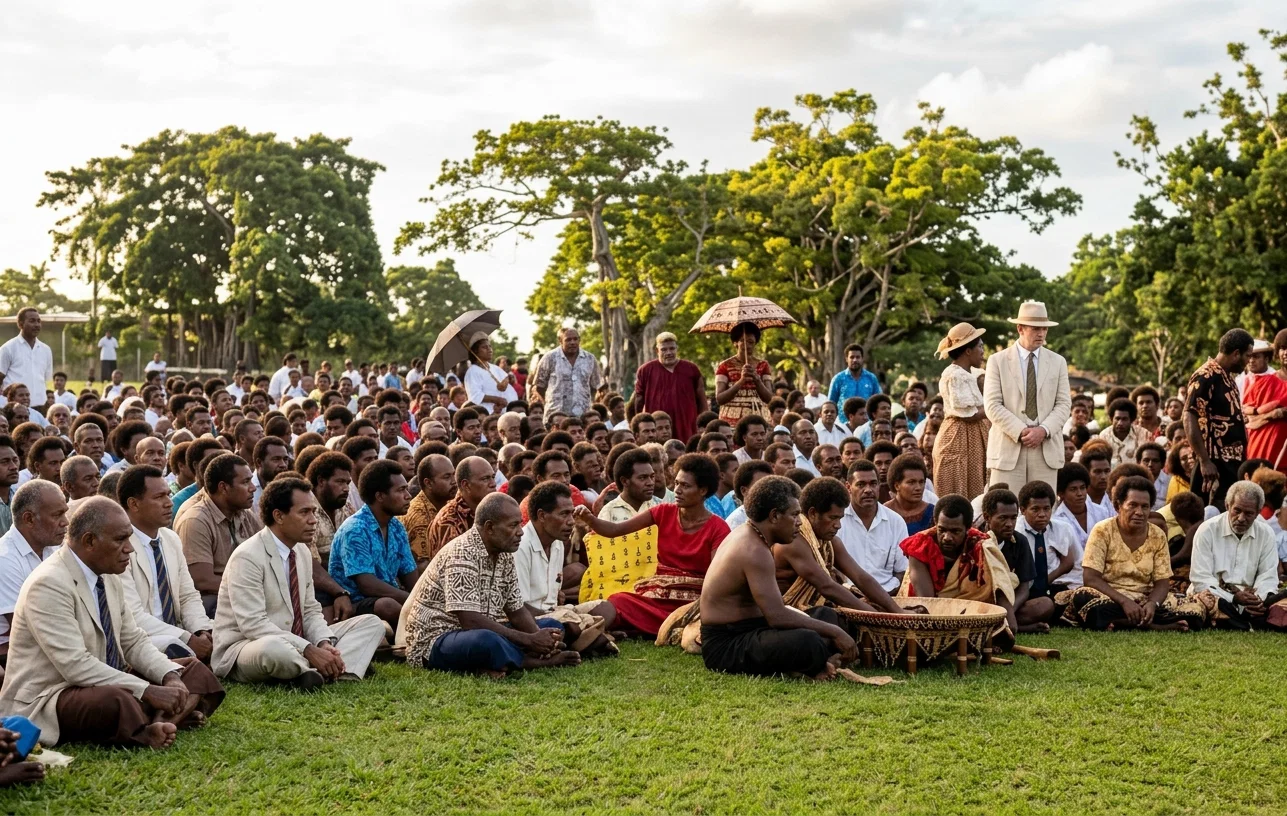
CORONATION CEREMONIES, FIJI
The school is doing nicely. Vacation is over, and we have begun a new year, most of the boys have returned, and a few new students have come. There are a large number more who are desirous of entering, but are hindered by an old native law, by which they must first receive the consent of their tribe, then of their town, then of their district, and, finally, of their province. This makes it very difficult, especially when there is prejudice to meet. The government is anxious for all to obtain an education, but has to work slowly to undermine former conditions. We can only look to God for help at such times.
C. H. PARKER.
Church Officers’ Convention in New Jersey
By G. B. Thompson
MARCH 26-29 a church officers’ convention was held at Bridgeton, N. J. The attendance was quite good, church officers and others being present from most of the churches in the southern part of the conference. There were also present the president of the conference, Elder B. F. Kneeland, Elder Geo. W. Spies, and the writer.
The meeting was a most excellent one. The special blessing of the Lord was manifest, and as the practical duties of Christian living were considered, many were led to renewed consecration to the Lord. The Lord came especially near to us on the Sabbath.
The different branches of the work were considered, and instruction was given concerning the responsibility of each church in carrying forward aggressive missionary work for those within its reach. Considerable time was given to a study of the duties of church officers and the responsibility which rests upon them. The elder is to “feed the flock of God.” This means much. Officers in our churches should be leaders. They should take the burden in the local church to carry forward the plans laid for the advancement of the work, just as the conference officers assume the responsibility in the conference. The burden of increasing the tithe and the offerings to missions, carrying forward aggressive missionary work, and maintaining the weekly prayer-meeting, looking after the discouraged and backslidden, are among the duties which rest upon those chosen to lead in the work in the local churches.
I was glad to meet with the Sabbath-keepers in this part of the New Jersey Conference, and the spirit of unity and brotherly love which prevails is especially encouraging. All departments of conference work are being revived and built up. The Lord is blessing the labors of Elder Kneeland and those associated with him in the work to strengthen20and extend the message in the conference. A number of canvassers will soon enter the field. Several tent companies will do pioneer work in new fields the coming summer. A camp-meeting is to be held later in the season.
Let all pray that the message in this conference may be greatly blessed of the Lord, and that as the faithful laborers go forth, they may have an abundant harvest of souls. G. B. THOMPSON.
Field Notes and Gleanings
Brother Wm. Cubley reports an increasing interest in the meetings he is holding in Freeland, Tex. Several have already decided to obey the Lord and keep all his commandments.
Brother W. H. Thurston writes from Peterboro, Ontario: “We are having interesting cottage meetings, and the outside attendance is from eight to twelve. Six have already acknowledged the truth, and are still attending the meetings. Some others are interested, and have opened their doors for us to come and study the Bible with them. Brother Washington Morse, who is ninety-two years old, is selling papers, and the Lord is blessing him in his work, and he is averaging thirty papers each day in good weather. His wife intends joining him in the paper work in the spring. Brother Morse is one of the pioneers in this cause, and it is refreshing to see the interest he still manifests in the work, and the active service he is still rendering for the salvation of souls.”
From St. John, New Brunswick, Brother J. O. Miller writes: “Our labors here have not been without fruit. This gives us courage, knowing that God is working to lead sinners to repentance. Nine adults, who were before strangers to the truths presented by us, are observing the Sabbath, and ten others are considering the question of taking the same step. We hold public preaching services every Sunday evening, and have a large attendance from the outside. My wife and I hold class meeting each evening during the week except Friday, when we conduct a prayer-meeting at our home. During the day, while making family visits, we scatter tracts. I have sold forty dollars’ worth of ‘Christ’s Object Lessons,’ and twenty-five dollars’ worth of ‘Daniel and the Revelation’ and ‘Coming King.’”
Brother H. S. Preener, writing from Baltimore, Md., says that his “brief stay in the Chesapeake Conference has been a golden chain of good circumstances. Big victories have been gained every morning through the power of God. A Bible reading has been held five afternoons in the week and one every night save Saturday, and in not one instance without fruit. One, two, and three of a company have rallied to the standard, ‘The commandments of God, and the faith of Jesus.’ One preacher is keeping the Sabbath and studying further, and another is awaiting developments, with the hope of following his colleague as he blazes the way. Two of the company attending the Bible reading in German have become obedient. To God be all the praise.”