In the fall of 1909, the General Conference Committee held a council at College View, Nebr. Among other questions considered on this occasion was the establishment of a medical college in connection with the Loma Linda Sanitarium. This, however, was not the first occasion of the consideration of this proposition, but at the above-mentioned council the following action was taken:—
Resolved, That we recommend the board of management of the Loma Linda College of Evangelists to secure a renewal of the charter for the school, that it may develop as the opening providence and the instruction of the Spirit of God may indicate.
Much time was given to the consideration of this proposition, and it elicited considerable discussion, especially as pertaining to the financial side of the question. Favorable action, however, was taken, instructing the brethren connected with the Loma Linda College to secure a charter.
To those in attendance at the council this appeared to be the only consistent course to pursue, in view of the necessity of the denomination’s making some suitable provision for those of our young people who desire a medical education to receive a proper training under favorable conditions to qualify them for medical evangelists, and also in view of the instruction imparted by the spirit of prophecy concerning this obligation, calling upon us to provide at Loma Linda proper facilities for such a work.
From time to time this enterprise has been before the General Conference Committee for consideration, as its work has been developing. At present, by action taken in the organization of the college, the constituency consists of,—
The members of the executive committee of the Southern California Conference of Seventh-day Adventists.
The members of the executive committee of the General Conference of Seventh-day Adventists resident in the United States.
The members of the executive committee of the Pacific Union Conference of Seventh-day Adventists.
The original incorporators.
At the fall council of the General Conference Committee held in October, 1911, at which meeting the presidents of the union conferences and many of the local conference presidents were in attendance, action was taken, recommending that a fund of ten thousand dollars be raised to provide additional facilities at the Loma Linda College of Medical Evangelists in the way of buildings, in order to enable the institution more properly to carry on its work. This ten thousand dollars, it was understood, was to be provided for as follows:—
Pacific Union Conference ........ $ 1,500
Southern California Conference ...... 1,000
General Conference ................. 1,000
Central Union Conference ........... 1,500
Lake Union Conference .............. 1,500
North Pacific Union Conference ..... 1,000
Northern, Southwestern, and Columbia Unions, $500 each .... 1,500
Southern and Southeastern Unions, $250 each ............. 500
Atlantic Union Conference ...... 300
Canadian and Western Canadian Unions, $100 each .......... 200
$10,000
The creation of this fund was made necessary by reason of the requirement of the laws of California for certain buildings and equipments for medical colleges, the most pressing and immediate need being a hospital for clinical work. Our brethren at the head of the medical college are endeavoring to realize as rapidly as possible upon this provision, as they are in immediate need of the funds. Appreciating the situation at Loma Linda, the General Conference Committee is anxious that the various conferences concerned shall furnish the relief necessary at the earliest moment.
W. T. Knox.
Europe’s Armies and Future Armageddon
“EUROPE has now reached a point where the size of her armies has become a matter for anxious comparison. So here are some of the figures that play a part in a future Armageddon. Counting the active list and reserves,—that is to say, all trained men,—England can put into the field 970,864 soldiers, France 4,777,000, Austria 2,690,365, Russia 6,739,418, and Germany 4,768,520. There are, of course, other nations that would try to be helpful in a smaller way, and there are quite a number of war-ships that would give maritime variety to the scene. So that a rough estimate of the military strength of Europe in this “year of our Lord,” 1912, shows the existence of some 20,000,000 men fostered and trained by science, art, and finance to regard killing one another as their chief aim in life.”
MORRIS LUKENS
By Morris Lukens
Australia—No. 2
MORRIS LUKENS
WE arrived in Adelaide, South Australia, Oct. 20, 1911. This is a charming city of 200,000 inhabitants, laid out in a perfect square, and surrounded by parks, with blue hills in the distance.
After visiting the churches in the South Australian Conference, I attended the Victorian camp-meeting, held at St. Kilda, a suburb of Melbourne, Feb. 12-25, 1912. The weather during the whole of this meeting was ideal. About 100 tents were pitched on the ground. There were about 500 in constant attendance at the meetings, in addition to a large number from the city who attended nights and on Sabbath and Sunday. The first Sabbath there were 602 at the Sabbath-school, the second Sabbath 638. The total Sabbath-school offerings amounted to about $100.
The conference business occupied the first three days of the session. This is the plan tried in most of the conferences this year: The meetings begin two days earlier in the week than usual, Tuesday instead of Thursday. Then, with the exception of the early morning service and the night meeting, the entire day is spent in considering conference business, which is all out of the way before the first Sabbath. This plan has worked admirably.
From the beginning, the meetings in Victoria were excellent. The people seemed hungry for spiritual food. Both Sabbath meetings were signally marked by the presence of the Holy Spirit. A large number went forward to consecrate themselves more fully to God’s service. On the last day thirty-three were buried in baptism. On the same day more than $1,500 was pledged for the tent fund and for mission work.
In company with Pastor George Teasdale, I then started for West Australia, to attend the camp-meeting there. As there is no transcontinental railway in this country, we were obliged to make this journey by boat, which requires a week’s time. This camp was pitched in the beautiful suburb of Cottesloe, about seven miles from Perth, the largest city in West Australia. In front of the grounds, a few yards away, was the Swan River, spread out in silvery loveliness, and at the back the hillsides were studded with fine residences, hidden among stately trees and luxuriant foliage.
The camp-ground itself was a peppermint grove, among the trees of which most of the dwelling tents were pitched. The ground was sandy, covered with a fair grass sod, and the weather could scarcely have been better.
There was a good representation of our people present, and at night especially the preaching pavilion was well filled, although but few from the neighborhood came to the meetings. The outside attendance was not large at any time.
In harmony with the beautiful surroundings, a spiritual calm rested upon the encampment, and affected every one who came within its reach. Heart-felt praise, without one discordant note, ascended to God for present blessings.
Among the young people—and West Australia certainly has more than its share of fine young men and women who will soon be a power in the work if they will consecrate themselves to the Lord—there was a general revival, many yielding for the first time to the gracious invitations from the Lord. Of the eighteen candidates for baptism, the majority were youth, children of parents already in the truth. This is as it ought to be. Every year our young people should be gathered into the fold, and not one allowed to slip by unheeded. No surer nor more satisfactory evidence than this could be obtained of the presence of the Holy Spirit, and the outpouring of the latter rain. During this camp-meeting an aggregate of more than $2,500 was pledged for the furtherance of the work.
We returned from this meeting just in time for the conference and camp-meeting in South Australia, April 2-14. All the blessings that were experienced in the other meetings were ours at this meeting. The camp was located in a paddock surrounded by houses, and as a result, the meetings were well attended by the public. Some began the observance of God’s holy Sabbath, and many others gave in their names for reading-matter and further studies.
The meetings during both Sabbaths were signally blessed by the presence of the Holy Spirit, and a large number went forward to consecrate themselves more fully to God’s service. Several young persons, as well as some older ones, for whom special prayer had been offered by loved ones, took their stand definitely for the first time.
About $1,375 was given in pledges and offerings during the camp-meeting, $106 of which was received during the two sessions of the Sabbath-school.
At the closing meeting, held early Monday morning, April 15, the general testimony was that it had been the best camp-meeting ever held in South Australia. This is as it should be; for as we near the end of our work, our meetings should be better.
A Visit to the Somabula Mission
By R. C. PORTER
R. C. PORTER
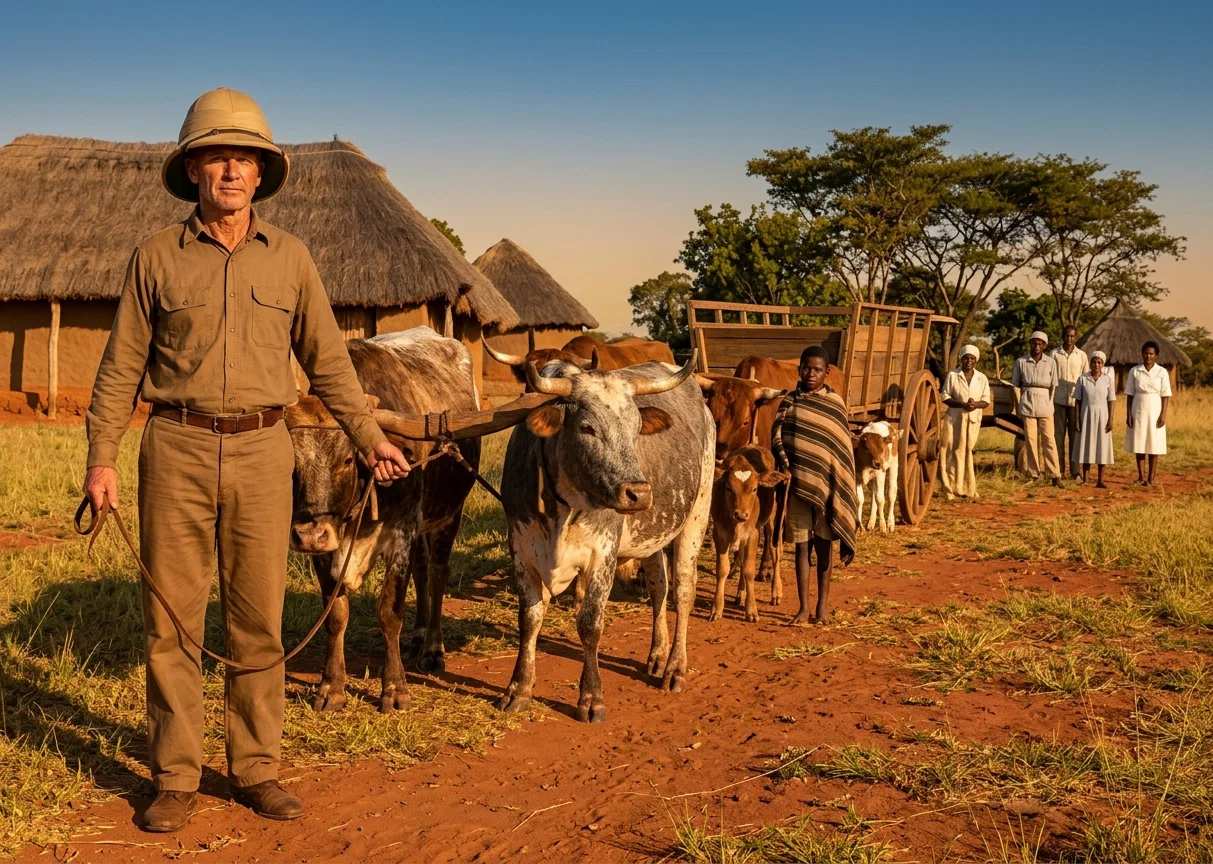
WEARY with a week’s journey north of the Kafue River, and en route to Gwelo, we were glad to meet Brother T. J. Gibson, Sister Butterfield, and some of the mission boys at the station about eight in the evening. Our luggage was soon transferred to the Somabula Mission “express,” a twelve-ox team and large farm wagon, and we were off for the mission. We traveled two hours before reaching a good camping ground, where we outspanned for the night. As all were tired with the day’s journey, we soon made down our beds, and fell asleep under the broad canopy of the heavens.
The next morning we were up at an early hour for a three hours’ trek before breakfast. It was a change from the earthy mattress on which we had lain as long as was comfortable. After one has turned every side toward an undesirable lump that projects too high, there is no inclination to lengthen the night beyond daybreak.
On reaching a place where there was plenty of water, we outspanned, built our camp-fire, and were soon enjoying a substantial, though plain breakfast. There is something about camp life on trek that9gives one a relish for one’s meals akin to the relish for meals in childhood school-days. The food may not be quite so good or so well served as at home, but hunger, born of outdoor exercise, prepares the appetite to give it a hearty reception. At 2 P. M. we reached the mission and were given a warm welcome by Sister Gibson, her three children, Brother Hutchinson, who had returned from Shangani to meet us, and the mission school.
THE SOMABULA MISSION "LIMITED"
On our arrival we learned that a busy program had been planned for us during our stay. Besides the main mission students, and people from the neighboring kraals, about thirty students came in from the different out-schools to attend the Sabbath services. They had come on foot distances ranging from six to forty miles. They were an intelligent-looking class of students, and they manifested a deep interest in the word spoken. Sister Butterfield came a distance of ten miles in an ox-cart, bringing eight Christian boys with her from the farm. These are members of the mission church who have finished their education, and are working with Brother Butterfield on the farm. Brother Butterfield had spent the day before at the mission, then returned to the farm in order to allow the others to attend the Sabbath services.
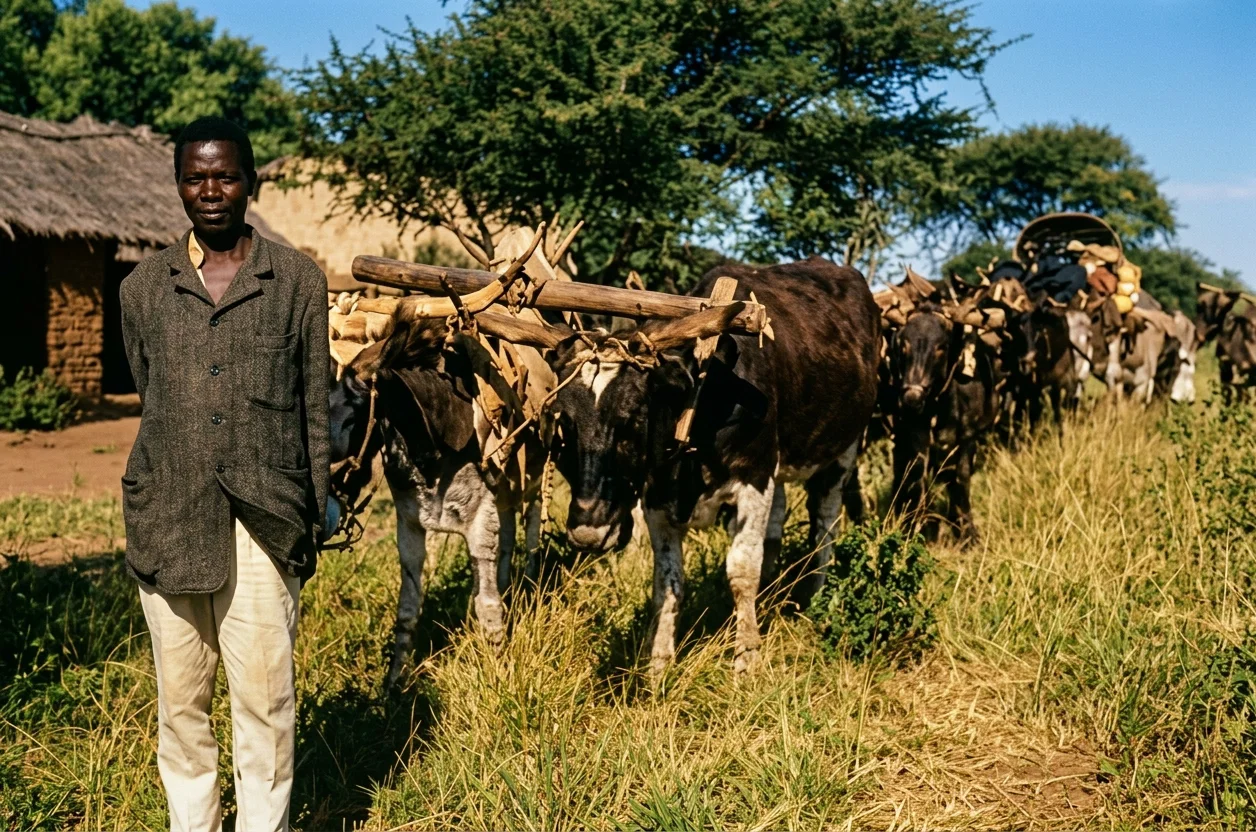
On Monday Brother and Sister Gibson and daughter and Brother Hutchinson and the writer started with the Somabula “limited” (a donkey team) a distance of six miles to visit the Ingiti out-school. We should have taken the oxen for speed, but on account of the cattle disease it is difficult to obtain a permit to travel with oxen. This out-school has an attendance of about twenty. There has been an attendance of thirty-six, but the drought has made it necessary for the young men to go out and work in the mines to support their families. The nearest kraal has about seventy-five family huts, and another, within two miles, has fifty huts. There is every prospect that this out-school will accomplish much in educating the natives of that district and bringing to them the light of the gospel. The headman of the nearest kraal, and a number of the people from both near-by kraals, came together for a service during our visit. After the service we took lunch, and started at once on our homeward journey. We reached home about sunset, feeling that we had spent the day very profitably.
If Christ Should Come To-Night
By Pearl Waggoner
PEARL WAGGONER
If you could know that Jesus would appear
Before another morn should give its light,
O, would your heart be filled with joy, or fear,—
If you could know that he would come to-night?
The things you’d do, the words that you would say,
Perchance the letter you had thought to write,
How many plans would have to change to-day
If you were sure that Christ would come to-night?
How many acts would then remain undone?
How many wrongs would have to be made right,
If you should meet him ere another sun,
And knew for sure that he would come to-night?
How many things would you find time for then,
Now crowded out or else forgotten quite,—
The kindly deed, the hour of prayer again?
Would aught be different, should he come to-night?
Some day that dawns will mark all time as past;
Then may we keep our lamps all trimmed and bright.
O, may we live each day as ’twere the last,
And ready be if Christ should come to-night!
Hinsdale, Ill.
The Heart of the Dark Continent
By John Nevins Andrews
J. N. ANDERSON
THE SOMABULA MISSION "EXPRESS"
AFRICA, the second largest continent in the world, the land where Moses lived and wrought, the scene of a mighty Christian church during the first centuries of the Christian era, the land of Tertullian and of Livingstone, is for very good reasons called the Dark Continent. Following the Mohammedan invasion of the seventh century, which swept away every trace of the Christian faith, except in a few places in the regions of the upper Nile, practically the entire continent of Africa remained unknown and untouched by the rest of the world until a few decades ago.
In the heart of that vast continent where his life was spent, lies buried the heart of its greatest missionary and explorer, David Livingstone, whose ambition it was to “penetrate through Africa;” and then by the power of the gospel bring healing to this “open sore.”
The death of that great man in the depths of that mysterious dark land must have stirred the whole Christian world as it never had been stirred before for any heathen land. All the larger missionary societies of Europe and America promptly and enthusiastically sprang to the task of filling the great gapping door that Livingstone’s death had both opened and made known. Large sums of money were spent and the lives of many heroic missionaries were laid down as the price of laying a foundation upon which has been built an extensive and promising work, and which to-day is represented by 4,273 foreign missionaries under 158 different societies, aided by 69,704 native workers, located at 11,074 stations. The direct result of all this along with other previous missionary efforts, has been that considerable portions of the seaboard margin of Africa is entered and in places quite fully occupied. But the great interior, the very heart of the Dark Continent, remains unreached, and in a large measure unexplored. It is still waiting for some one to penetrate through the interior and carry the gospel of healing to Africa’s “open sore.”
Central Asia has 35,000,000 inhabitants beyond the present reach of all missionary ministration and planning; the vast interior of the Dark Continent has even more. The report of the World Missionary Conference puts the number of untouched souls at 50,000,000,—about one third of the entire continent. Witness the following tabulation from that report: “This area begins a few hundred miles south of the Mediterranean coast and includes, as we shall see, portions of Tripoli, the province Oran, the south half of Algeria, the Atlas-Rif country, the Mulaya Valley, the Sus Valley, and the Sahara district of Morocco; the uncounted thousands of nomads in the Sahara proper; Rio de Oro, with a population of 130,000; 8,000,000 in Senegambia and the Niger district; some 1,700,000 in French Guinea; 1,500,000 in Dahomey; some 500,000 in the Ivory Coast, and over 800,000 in Portuguese Guinea; about 1,500,000 pagans in Liberia; 500,000 in Togoland; some 4,700,000 in Northern Nigeria; 3,000,000 in Kamerun; some 8,000,000 in the French Kongo, besides 4,000,000 of the Baghirmi and Wadai districts; several million at least out of the 30,000,000 of the Belgian Kongo; a large population in Nyassaland; some 2,500,000 in Portuguese East Africa; about 2,000,000 in German East Africa; 3,000,000 in British East Africa; about 2,000,000 even yet in Uganda; and 750,000 in the Italian, British, and French Somaliland.”
Surely in the face of these figures it must be said that Africa’s evangelization is scarcely begun; and that feeling is only deepened when it is remembered that its population is a bewildering medley of races and tribes, whose languages are said to number 523, besides 320 dialects, and, with the rarest exception, all are without the slightest trace of a literature of any kind. “Polygamy is almost universal. Slave raiding, intertribal wars, and cruel superstitions have through long years preyed upon the life10of Africa, and left its population reduced, divided, suspicious.” In certain parts cannibalism is still practised.
Religiously, Africa has about 4,000,000 nominal, spiritless Christians (the Ethiopian and the Abyssinian churches), whose ranks are steadily being thinned by the aggressive invasion of Mohammedanism (now fifty or sixty million strong), whose fierce propaganda is almost invariably favored by the local representatives of the European governments, while on the other hand, they restrict or prevent the extension of Christian missions. The remaining 90,000,000 or so are held in bondage by those tribal beliefs and practises summed up under the names of animism and fetishism. This latter class is reached most readily; “its very misery makes it [the gospel] welcome relief; its utter darkness makes it glad of light.” The door of access into Africa is the greatest in this direction, while Islam is the greatest obstacle; not a mere obstacle, indeed, but a bitter and fanatical rival whose ambition it is to dominate the whole continent.
This in brief tells the story of the Dark Continent as to the present status of missions and the unfinished task. From the merely human point of view it is both appalling and impossible. But that world of heathen and Mohammedan darkness is as much under the care of the Father as is America or Europe, and heaven is as near and as directly overhead the spoiled, benighted African as in our own cases. God’s eternal purpose includes every race, tribe, and tongue of Africa; his invincible light shines for all, and ours is the duty and the privilege to carry that light to every man, since he is—
“Heir of the same inheritance,
Child of the selfsame God.
He hath but stumbled in the path
We have in weakness trod.”
And we must not fail to see God’s hand of power working in Africa as in the other parts of the world. Practically the entire continent is under the political control of Europe, with the result that commercial slavery and intertribal wars have nearly ceased. Nearly all the navigable rivers and lakes of the vast interior now float large flotillas plying in the interest of foreign trade and commerce, and by that very means creating in the minds of the native people a knowledge of, and a desire for, the things of the outside world. Railways are fast being projected into nearly all the different parts of those dark regions, representing the steady and irresistible march of Western civilization upon the Dark Continent. The highway of the King is fully prepared, and all things seem to wait the coming of his messenger. The following lines written on seeing the statue of Gordon as it stands facing the great wastes of the Sudan, are to the point:—
“The strings of camels come in single file,
Bearing their burdens o’er the desert sand;
Swiftly the boats go plying on the Nile,
The needs of men are met on every hand.
But still I wait
For the messenger of God who cometh late.
“I see the cloud of dust rise in the plain,
The measured tread of troops falls on the ear;
The soldier comes the empire to maintain,
Bringing the pomp of war, the reign of fear.
But still I wait;
The messenger of peace, he cometh late.
“They set me looking o’er the desert drear,
Where broodeth darkness as the deepest night.
From many a mosque there comes the call to prayer;
I hear no voice that calls on Christ for light.
But still I wait
For the messenger of Christ who cometh late.”
Foreign Mission Seminary.
General Meetings in China
By A. C. SELMON
A. C. SELMON
I HAVE just returned from a nine weeks' trip through our Mandarin-speaking field. During this time I attended our four general meetings,—one in the province of Hunan, one in Hupeh, one in Honan, and one in Anhwei. I have never before attended such meetings as we had at these four places. In the past, we have had to work hard to get an audience, but now it is a question of how to take care of those who attend our meetings. At the Hunan meetings there were about one hundred fifty of our people in attendance, including inquirers; in Hupeh there were between sixty and eighty, including inquirers; in Honan there were in the neighborhood of two hundred fifty, including inquirers; and at the Anhwei meeting there were about eighty of our people, this also including inquirers. I was greatly impressed that the Lord's time has come for this message to go in China. The Chinese people are more ready to accept the truth than ever before. Of course, it may be said that this is due to the fact that we are able to present the truth with more clearness and force, now that we have the language, than we were a few years ago. However, regardless of the advance which we may have made in the language, there is surely a wonderful opening of the ears of the people to hear. This refers especially to the non-Christians. At the Hupeh, Honan, and Anhwei meetings, we made a special effort every night for the heathen, and the Lord richly rewarded us. At each of these meetings there were over one hundred persons who took their stand for the gospel. While many of them did not fully realize what the step meant, yet among them was a large number of good, earnest persons, and now they only need to be taught and instructed in order to be fully established in the truth, and to make good, substantial Seventh-day Adventists.
In the past, when we have held meetings for outsiders and made calls for men to stand up and thus announce their intention to believe and obey the gospel, there have been very few who would dare do so. They did not dare to take the step, fearing that they would “lose face” with their acquaintances. However, in these meetings men dared to take their stand, and they would even dare to bear testimony before a whole congregation of their heathen friends. This greatly encouraged all of us, and especially was it a great help to our Chinese church. Our Chinese brethren seemed to get a glimpse of the power there is in this last gospel message, and to see that there is in it an antidote for every ill and sin that is in the world, and that it is not only adapted for the people in Babylon, but that it is especially adapted for the idol-worshipers of China.
We were fearfully short of help at all our meetings. We had four services every day for our own people, and the burden of all this work fell on the one or two foreigners who had to do the preaching. In addition to the day meetings there was the work in the evening for the outsiders, and usually these meetings would not close until ten o'clock. This was a great strain, and used up every ounce of energy that we had. At the Chang-sha meeting there were three of us to do the preaching,—Elder and Mrs. R. F. Cottrell, and myself, in addition to the help that some of the Chinese evangelists gave; at the Hupeh meeting there were six of us,—Brother and Sister O. A. Hall, Brother and Sister F. A. Allum, Dr. A. G. Larson, and myself,—and some Chinese evangelists; and at the Honan meeting we had four men,—Brethren Hall, Westrop, Allum, and myself. Sister Allum and Sister Hall conducted the meetings with the women. Brother Allum was very tired and worn at the close of the Honan meeting, but he accompanied me to Anhwei, to help in the Ying-shan meeting. It requires four days to make this trip, and while we were on the way Brother Allum became ill. After reaching the meeting he was able to preach only one sermon, and then was forced to give up and return home. Brother Fred Lee and wife had been in Ying-shan for about three weeks before the general meeting began; but just after we opened the meeting, Brother Lee came down with a severe attack of malaria, so we were deprived of his help also. This left Mrs. Lee and me to carry on the general meeting. There was in addition only one Chinese evangelist, Brother Li Fah Kung, who could go ahead and be of any help in the preaching. Under ordinary conditions, our hands would have been full, but because Ying-shan had been in a turmoil for several months on account of the fighting there during the revolution, and because of other conditions, there was a distressing state of affairs in the church to be dealt with. But in spite of being short of help, and in spite of other difficulties, the Lord greatly blessed.11
Thirteen individuals were baptized at the Ying-shan meeting; thirty-two at the Honan meeting, and thirteen at the Hupeh meeting. At the close of the Hunan meeting nine were baptized, and following the meeting Brother Cottrell opened a Bible school with some twenty-five persons in attendance. This Bible school was to continue for one month, at the end of which time Brother Cottrell expected to baptize about twelve more.
Brother F. E. Stafford and Sister B. Miller have been carrying on an active evangelistic campaign here in Shanghai, and yesterday (June 18) six persons were baptized as a result of these meetings. These six all give promise of being active workers in the cause, when they have the necessary training. One of the six is a teacher from the far western province of Szechuen. This teacher and three of his friends have accepted the truth, and so the Lord has heard our prayers that the work might be started in the province of Szechuen with its eighty-odd millions of people. The door of opportunity is open before us not only in Szechuen, but in many, many other places, and here we are so short-handed for workers that we can not care properly for the work already under way.
During this series of meetings in the interior we made our first attempt to use a tent in China. At the Chowkiakow meeting all the services for outsiders, and some of the meetings for our own people, were held in the tent. The seating capacity of the tent we used was about five hundred, and it was filled every night. We had fears, in the past, lest the crowd could not be kept orderly, and possibly our ropes would be cut, etc.; but no one could have asked for a more orderly crowd. There was no disturbance during any of the meetings. This convinces us of the utility of tent-meetings in the interior of China; and now the brethren in the North Central Mission are planning to take a tent and a company of trained workers, and visit as many cities and market-places as they can reach each tent season.
In Prison for Conscience’ Sake
By J. MUEGGE.
On the twelfth of October, 1906, I entered military service as a recruit, and was brought before a court martial the first week, and sentenced to fourteen days’ imprisonment for refusing to work on the Sabbath. On being referred to the text in the thirteenth of Romans, “Let every soul be subject unto the higher powers,” (the officers did not mention the context during the hearing), I answered that when the laws of man conflict with the laws of God, as in this case, God is to be obeyed rather than man. At the termination of the above-mentioned imprisonment, as I still refused to work on the Sabbath, I was condemned by the court martial to a two months’ imprisonment for having “persisted in disobedience.” During this confinement, I was subjected to further punishment nearly every week for attempting to observe, while there, the commandments of the great God in an upright and earnest way. But, O, great was the joy that I experienced during this imprisonment! Surely I could often testify with the psalmist: “Blessed be the Lord, who daily loadeth us with benefits, even the God of our salvation.”
Having returned to the troops, under guard, on the fifteenth of February, 1907, I was again arrested on account of the same disobedience at the beginning of the Sabbath, and after three months’ imprisonment on trial, was again sentenced to three months in the fortress. This term was somewhat prolonged for disregard of discipline. But in spite of all this, my joy in the Lord was great, and with it was mingled the joy in the thought that I was, according to my conviction, suffering for the truth’s sake. At the expiration of this sentence, I returned to my regiment, but was again sentenced to seven months; later, another six and then still another six months’ imprisonment, and transferred to an inferior class in the military service.
During this time many attempts were made to render Sabbath-keeping as unpleasant as possible, so that I would give up the idea, by taking all work from me for periods of eight, ten, and twelve days. This is a severe trial,—without any occupation whatever, and completely isolated,—and without God it would have been almost enough to drive one to despair. Even this was not enough. According to the direction of the law, a stay of six weeks in a lunatic asylum followed, for a medical examination as to whether my mind was in good condition or not. After the doctor’s testimony had been handed to the court martial,—where no less than forty-eight cases were being tried,—I was sentenced to one month’s imprisonment for each time I had refused obedience to duty, making a total of four years, since my understanding was declared to be in normal condition.
On the nineteenth of March of the same year I was sentenced to still another year’s confinement. After two months, however, I was declared unfit for military service by the commander-in-chief, after the doctor of the fortress had examined my blood; but I had still to serve my time in a civil prison. It is true the difficulties in this struggle of faith were much less in the civil prison than in the military; it was, however, a strange treadmill of daily life. Occupied as a military tailor, one day was exactly the same as another, except the Sabbath; and I was surrounded with severe critics on the points of our glorious truth, having jest and contempt on the one side and a kind of sympathetic laughter on the other. However, my inner feelings were always those of joy at having the privilege to suffer for righteousness’ sake, knowing that our Lord and Saviour had done much more for me. Added to this, thanks be to God, was the assurance that when God considered the hour come for me to be freed from prison, I should surely be delivered by his grace.
On the twenty-fourth of October, 1911, a despatch was received from the office of the commanding general, as a response to a request on my part for grace. What indescribable joy when I read, “To be dismissed”! It was a slight foretaste of the joy described in Psalm 126, and “we were like them that dream.” My five years in prison, filled with rich experiences, now lay in the past.
As a closing word, let me say: I should not wish to have missed the days that I spent in prison, as dreary and comfortless as they often seemed to be. The great God, who also notices the slightest thing, always gave me to understand that as long as we trust in him, and do not rest on the loose sands of human opinion, he will help us to succeed in getting nearer to the heavenly goal, which is the prize of the high calling of God in Christ Jesus. May the Lord grant us all, who call ourselves Christians, the power of his Spirit, that we may practise true, positive Christianity.
J. MUEGGE.
Arkansas Camp-Meeting
By O. B. WATSON
THE camp-meeting and conference convened, as announced, at Little Rock, Ark., July 11. Despite the fact that the preceding year has been a hard one financially, this meeting was well attended, and the Spirit of the Lord was deeply felt.
There was a spirit of oneness in the selection of officers for the ensuing year. Elder J. W. Norwood was reelected president; Brother C. J. Dart, secretary and treasurer; Brother J. A. Tucker, field missionary agent; Miss Mable Seitz, young people's and educational secretary; Sister J. W. Norwood, Sabbath-school secretary.12
The fifteen-cent-a-week plan was discussed, and it was found that this conference was over $600 behind for the past six months of 1912. Donations were taken for this purpose to the amount of $965 in cash and pledges.
Elder F. C. Gilbert gave a very interesting talk on the work being done for the Jewish people, after which an offering amounting to $80 was made for the Jewish work. Elder Gilbert's labors at this meeting were greatly appreciated.
The work for the colored people was in no wise overlooked; $85.50 was raised for this work in the conference, $18.50 of this amount being given by the colored people. The camp-meeting for the colored people was held at the same time and in the same city. The Lord is calling out from this people honest souls to help carry this precious truth to the world in darkness. Surely the work is great, but the laborers are few.
The offering given by the Sabbath-school for the two Sabbaths amounted to $26.88. A fund was also started to help educate worthy young people and $25.50 was given for this worthy and important work. The contributions made at this meeting aggregated $1,200. Surely this shows that God gives his children the spirit of giving even when the evil one is trying to discourage them with poor crops.
But better than all this was the spiritual results of the camp-meeting. The word was spoken with convicting power; strong men were brought to the Saviour with trembling and confession; old and young sought the Saviour together.
The young people's work was under the supervision of Elder E. E. Farnsworth, young people's and educational secretary of the Southwestern Union. The early morning devotional meetings for the young people were well attended not only by the young people, but the blessed presence of the Holy Spirit was felt in a remarkable manner.
O. B. WATSON.
Read This Slowly, and Think
Does my life please God?
Am I studying my Bible daily?
Am I enjoying my Christian life?
Have I ever won a soul to Christ?
How much time do I spend in prayer?
Am I trying to bring my friends to Christ?
Just where am I making my greatest mistake?
Am I doing anything I would condemn in others?
Have I ever had a direct answer to prayer?
Is there anything I can not give up for Christ?
How does my life look to those who are not Christians?
Is the world being made better or worse by my living in it?
Have I ever tried giving one tenth of my income to the Lord?—Canadian Churchman.