Your ShelfYour Projects

Signs of the Times, Vol. 20, No. 50.

One with Him

Signs of the Times

Oct 22, 1894

Pacific Press Publishing Company · Oakland, California · Oct 22, 1894

One with Him.

Jesus Christ identifies himself with his people. This has always been true and will always be true. Whatever is done to them he takes as being done to him. Whatever they suffer, he suffers, and when they rejoice in that which is good, he rejoices with them.

One with the Least.

This blessed truth is thus stated by the prophet of old: "In all their afflictions he was afflicted, and the Angel of his presence saved them; in his love and in his pity he redeemed them; and he bare them, and carried them all the days of old." Isa. 63:9. Our Lord himself thus expresses it in the New Testament: "Inasmuch as ye have done it unto one of the least of these my brethren, ye have done it unto me." "Inasmuch as ye did it not to one of the least of these, ye did it not to me." Matt. 25:40, 45. Christ identifies himself, therefore, not alone with his people generally, but with the very least of them.

One in All Things.

A blessed and sustaining truth is this to the child of God. In the sore temptation he knows that not only did Christ while here upon the earth meet that very temptation in a general way, but he met it for every soul who will have to meet it afterward. He meets it now with the trusting soul. He walks with him the pathway of trouble and conflict. He bears with him the contumely and scorn, the reproach and persecution, of the world. He says, "The reproaches of them that reproached thee fell on me." The persecutor sees but the man, the "heretic," the "fanatic," the "crank," the "criminal," but High Heaven sees in him the Lord Jesus Christ, for whose sake is the persecution, "bound, scourged, and sold again." Every conscientious child of God, every advocate of true liberty, is the ambassador of the kingdom of God, and will not God avenge his chosen?

One in Death and Life.

"But his chosen may die?" Yes, as the world calls dying; but in him they live; in him they cannot die. He has been in the grave, and has come forth a mighty conqueror. He goes with his faithful servant in the grave in the blameless righteousness placed upon that servant, and righteousness is life. And as the grave could not hold Christ because he was righteous, so neither can it hold those upon whom Christ has placed the righteousness there is in him. What though we suffer persecution, Christ suffers with us; he identifies himself with us all the way. That apostle of whom God said, "I will show him how great things he must suffer for my name's sake," declares, "For I reckon that the sufferings of this present time are not worthy to be compared with the glory which shall be revealed in us," "if so be that we suffer with him." With Christ! His presence lights the darkness, smooths the roughness of the way, embalms the bruised feet, dries the tear-dimmed eyes, stays the fainting heart. And if in our blindness, ignorance, and perversity we make mistakes, there is none so ready, so mighty, so willing to forgive us and help us again in the sure path. Blessed indeed is the presence of Christ. Better, indeed, is "fire-walled hell with him than golden-gated Paradise without;" for he maketh the fiery furnace a palace of praise, and the desert waste a wellspring of joy. "O taste and see that the Lord is good; blessed is the man that trusteth in him."

THEIR IDEA OF CHRISTIANITY.

IN writing enthusiastically of the results of the Parliament of Religions in the September Forum, Dr. J. H. Barrows quotes "that eloquent Buddhist, Mr. Hirai," as saying to him on leaving for Japan:—
I go back a Christian, by which I mean that Christianity is a religion which I shall be glad to see established in Japan. Only let the Christian missionaries not interfere with our national usages and patriotic holidays. I have been delighted with America and especially with its tolerance. I expected that, before I finished my address, criticising false Christianity in Japan, I should be torn from the platform. But I was received with enthusiasm.
And that is about the idea of Christianity which one not knowing Christ would receive from the Parliament,—a religion which could fellowship all other religions, and meet all other religions on a common footing. Already the Japanese believe that they are the nation of destiny to Christianize the East. They feel that now they know Christianity, and with the best things in that religion, the best in Buddhism, and other religions, there is no people so well fitted to regenerate China and India as they are. Christianity is to them a political and social force and nothing more, and this is all that it is to many professed Christians. But to the true believer it is the wisdom of God and the power of God, the one only religion able to save.

REVELATION XIII.

LAST week it was shown that the dragon of Revelation 12 represents the great enemy of our Lord Jesus Christ and the church of God, and that as such he is the instigator of all persecution against the people of God. The laws and decrees by which the persecution is rendered most effective, Satan utters through his chosen agents,—the governments or dynasties of earth that have yielded to his deceptions and power. These, from the time when the church of God went into captivity, to her final deliverance, are seven in number, represented by the seven heads of the dragon. The head is that part of the organism which plans and speaks for the mind behind it, and so these governments plan and speak for the Satanic spirit behind them.
In chapter 13 the chief instigator of all this persecution is left in the background, and the earthly agents, the ruling powers, appear under the symbol of a seven-headed, ten-horned beast, having the mouth of a lion, the feet of a bear, the body of a leopard, and receiving from the dragon, or Satan, "his power, and his seat [throne], and great authority."
The composition of this beast carries the student of prophecy back to Daniel 7. There four beasts are presented before the prophet, representing four kingdoms, the lion symbolizing Babylon; the bear, Medo-Persia; the leopard, Grecia, and the nondescript beast, possessing the characteristics of all three, representing Rome, the same as the seven-headed beast of Revelation 13. The fourth beast of Daniel 7 had ten horns, as also the beast of Rev. 3:1-10, symbolizing ten divisions of the Roman Empire. These divisions were brought about by the incursions of the northern barbarians between the years A.D. 351 and 476. They are named by good authority as follows: Ostrogoths, Visigoths, Allemani, Franks, Vandals, Suevi, Burgundians, Heruli, Anglo-Saxons, and Lombards.Among the ten horns another was seen to arise, before which three of these kingdoms fell. They were not united in lifting the little horn to supreme power. This little horn, having a man's eyes and a mouth speaking great things, as not less than ten clear and distinct specifications conclusively prove, refers to that great system of deception and lawlessness called the Papacy. Three of these ten kingdoms were Arian in their belief, while the bishop of Rome was a Trinitarian. The three opposing kingdoms fell before the Roman bishop, and the little horn of the Papacy became the dominating spiritual power of the divided Roman Empire in A.D. 538.
The little horn represents in some slightly different aspects what is represented by the beast of Revelation 13 under the dominance of the papal head. In fact, the Roman Empire, under the spiritual domination of the Papacy, is the special thing presented in Rev. 13: 1-10. The first four heads, through which the devil has uttered his persecuting laws,—Babylon, Medo-Persia, Grecia, and Pagan Rome,—are covered by the prophecies of Daniel and the twelfth chapter of Revelation. The worst work of Pagan Rome, under Satan, that which shows its character, was against the Prince of Glory himself.
The next great persecuting agent, the head in succession, is Papal Rome, the very masterpiece of Satanic deception, strength, and cunning, professedly Christian, but decidedly antichristian. The Roman Empire under this papal head, as before remarked, is the same as the Roman Empire under the little horn of Daniel 7. They both do the same work, and exist for the same time, as the following parallel will show:—
THE LITTLE HORN. THE BEAST.
Speaks "great words" against God. Dan. 7:8, 20, 25. Speaks "great things and blasphemies." Rev. 13:5.
"Shall wear out the saints of the Most High." Verse 25. "Given to him to make war with the saints, and to overcome them." Verse 7.
"Shall think to change the times and the law." Verse 25, R. V. "And they worshiped the beast." Verse 4.
"Shall be given into his hand until a time and times and half a time."—Id. "And power was given unto him to continue forty and two months." Verse 5.
The powers represented by both symbols do the same work, have the same character, occupy the same territory, and continue the same length of time. They are, therefore, identical. This time is from A.D. 538, when the bishop of Rome was made "head over all the churches," and "true and effective corrector of heretics," and ends in 1798, when the power of the Papacy as a persecutor was broken. The change which the Papacy has attempted to make in God's law was considered two weeks ago, and shown to be the substitution of the Sunday for the Sabbath of the Lord, the only authority for which is the tradition of the apostate church.
The first four verses of Revelation 13 present the entire career of the beast under the papal head, namely, its investment with authority and power, its seemingly complete destruction,—"wounded to death,"—and its restoration, and the subsequent homage rendered it by the world. Verses 5-10 refer to its career during the 1,260 years of its continuance as a persecutor, verse 8 looking forward to its restoration.

Its Different Phases.

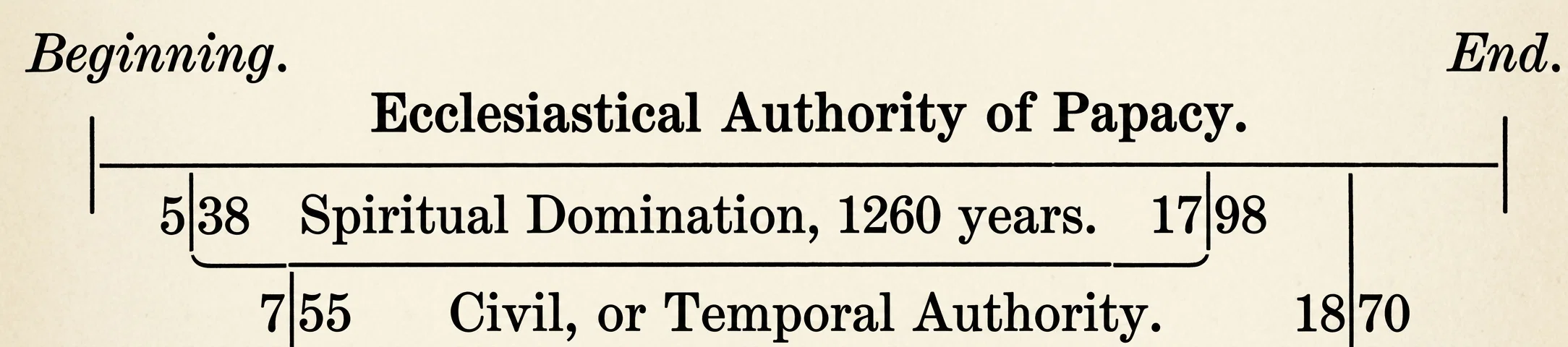
The authority of the Papacy, or the Roman Catholic Church, unconnected with earthly governments, is simply ecclesiastical, the same as that of any other church organization. Its authority which it possessed as a distinct little horn over the papal States, from A.D. 755 to 1870, is what we may call temporal power or authority, limited as regards territory. But the authority swayed by the Papacy from A.D. 538 to 1798 we shall call spiritual domination. It was given to Rome by the civil power, and taken from her by the same power, under God, of course. The Church of Rome was given authority to define what men should profess and practice, and power sufficient to enforce through her agents the temporal penalty which she adjudged due to those whom she was pleased to call heretics.
In order that the Papacy might thus punish what she deemed heresy, it was necessary that civil rulers should submit to her authority. This was done by the divisions of the Roman Empire generally. There were those who at times opposed her assumptions, but sooner or later the Papacy found means to bring them to the feet of the ruler of the Vatican. In other words, these governments generally acknowledged what the Papacy claimed, either because it was believed or for reasons of policy. And the Roman Church claimed the authority to define and punish heresy, with the blasphemous assumptions concomitant to such a claim. This led to the persecution of the church of God; and this it is which the prophecy presents before us.
The different phases of the Papacy may be better understood by the following diagram:—

What Makes a Persecuting Power?

A question of importance, not only as regards the Papacy, but of moment in this present time, is, What made the Papacy a persecutor? Briefly answered, it was religion by law, or power to enforce religious decrees and to punish heretics, or those who disobeyed these decrees. As it has been before more fully expressed:—
Two elements are always essential in order to have a persecuting power; and these two elements united always make a persecuting power. But if either of these is taken away, the power as a persecutor is destroyed. 1. The power must be religious or it will not persecute. The United States Government is perhaps the best example of this. The Federal Government has never persecuted; religion is in no way connected with it. 2. It must have power to enforce its religious dogmas,—to punish what it deems heresy,—or it cannot persecute. Methodists, Baptists, or any other church of this country, is a good example of this. They may issue decrees and pronounce penalties, but they cannot enforce them. This was the condition of the Papacy before 538 A.D. But when the bishops of the Roman Church became "head over all the churches" and "true and only corrector of heretics," the Papacy came into existence as the ruling, controlling power, in other words, the head of the beast. It was given existence or life as a head by the existing government, the powers that be, the government of the empire granting it the authority to define and correct heresy.
As an ecclesiastical system, it was not a head and could not persecute. As such it is not noted in the prophecy. It is placed there because it is a persecutor and destroyer of the people of God. It became a persecutor through the legal acknowledgment of its claims by earthly powers. Let these facts be borne in mind. This power to persecute did not exist by reason of Rome's civil power, for this was not possessed by the Papacy till 755. It did not exist by virtue of ecclesiastical authority, for this Rome had prior to 538, and still has. It existed by virtue of acknowledgment of the Roman bishop's position as "head over all the churches" by the governments of earth. This power that church possessed in a degree between 538 and 756, when she had no civil power. Again between 1798 and 1870 she did not possess this power, although neither the civil nor ecclesiastical element was wanting. It was created by an acknowledgment of her claims on the part of the governments of that empire. The Papacy, the beast under that head, in the light of the prophecy, must have such acknowledgment to exist again.
The taking away of the persecuting power of the Papacy is described by the prophet in these words: "He that leadeth into captivity shall go into captivity; he that killeth with the sword must be killed with the sword," and "I saw one of his heads as it were wounded to death."
These passages refer to the destruction of the Papacy not as an ecclesiastical or civil power but as a persecuting power. This is the only phase noted in this prophecy. The ecclesiastical power still remained, but not as a controlling element. As the head of the beast it was "wounded to death," and the beast as represented by the particular character of that head was no more. The beast still existed, but no longer as a papal beast, because the papal head controlling it was dead as a controlling element in the affairs of State. The wound was deadly.

Has the Deadly Wound Been Healed?

If so, the Papacy is now the corrector of heretics, not in claim merely, but in general recognition by the governments which are symbolized by the horns. But it is patent to everyone that this is not the case. The Papacy was wounded by the Reformation. The decree of toleration by Maria Theresa, empress of Austria, in 1756, the French Revolution, and other events, also sorely wounded it, and its death blow as a persecutor was given by Berthier in 1798. The persecution had really ended before this; the New World had opened its doors to the refugees from papal persecution, and swallowed up its flood of vindictiveness. But some waning prestige still remained. But in 1798 it received its death stroke, and was no longer feared or loved by the rulers of those lands over which it formerly reigned. The death stroke by the French greatly affected its temporal or civil power over the state of the church, but only for a time. Another pope was elected, and the temporal dominion was again restored, but his power in other realms was gone. One of the two essential elements which made it a persecutor was taken away, and it has not yet been restored.
At the time the deadly blow was struck another power, symbolized by another beast, was seen "coming up." This we will consider in our next.

THE LORD'S DAY.

Has the Lord a day—a specific recurrent day of twenty-four hours—that he calls his own? We have no means of answering this question excepting as we may get the answer from God himself. And we are to learn from him through his word: Then what says the Bible?
We find in the Scriptures frequent mention of the "day of the Lord," but this expression invariably refers to a time of judgment, and not to a day recurring at regular intervals. For instance: "The day of the Lord of hosts shall be upon everyone that is proud and lofty, and upon everyone that is lifted up; and he shall be brought low." Isa. 2:12. "Behold, I will send you Elijah the prophet before the coming of the great and dreadful day of the Lord." Mal. 4:5.
The New Testament references to the day of the Lord convey the same idea as those of the Old: "But of the times and the seasons, brethren, ye have no need that I write unto you. For yourselves know perfectly that the day of the Lord so cometh as a thief in the night. For when they shall say, Peace and safety; then sudden destruction cometh upon them, as travail upon a woman with child; and they shall not escape. But ye, brethren, are not in darkness, that that day should overtake you as a thief." 1 Thess. 5:1-4. See, also, 2 Peter 3:9-13. Other scriptures, in both the Old and New Testaments, use the expression "the day of the Lord" in the same sense.
The phrase "the Lord's day" occurs but once in the Bible, Rev. 1:10: "I was in the Spirit on the Lord's day, and heard behind me a great voice, as of a trumpet." Here the reference is evidently to a specific day, but neither the text nor the context gives any clue to the day of the week. This fact would indicate that at the time of writing it was generally understood what day of the week was the Lord's day. Otherwise such indefinite mention of the day on which the vision occurred would be superfluous, would convey no information. But we must look elsewhere for identification of the Lord's day; and in doing so we find that the word of God is very explicit on the subject.
Going back to the beginning, we read that six days were occupied in the creation of the world. "And on the seventh day God ended his work which he had made; and he rested on the seventh day from all his work which he had made. And God blessed the seventh day, and sanctified it; because that in it he had rested from all his work which God created and made." Gen. 2:2, 3. Now that which God sanctifies is set apart for his own glory, to be used in his service; it is his own. This is shown by Num. 8:17: "For all the firstborn of the children of Israel are mine, both man and beast; on the day that I smote every firstborn in the land of Egypt I sanctified them for myself." So, in the beginning, while Adam and Eve were yet in Eden, before the fall, God chose and set apart the seventh day as his own. Beyond question, it was then the Lord's day.
Some 2,500 years afterward God delivered his people from Egyptian bondage, and rehearsed unto them his law from Mount Sinai. They were now free, at liberty to serve God, and the law which they could not observe while in bondage to a heathen king was repeated to them by the Lord's own voice, and engraved on stone. Here was reiterated the fact that the seventh day was claimed by the Lord:—
"Remember the Sabbath day, to keep it holy. Six days shalt thou labor, and do all thy work; but the seventh day is the Sabbath of the Lord thy God; in it thou shalt not do any work, thou, nor thy son, nor thy daughter, thy manservant, nor thy maidservant, nor thy cattle, nor thy stranger that is within thy gates; for in six days the Lord made heaven and earth, the sea, and all that in them is, and rested the seventh day; wherefore the Lord blessed the Sabbath day, and hallowed it."
About 800 years later God spoke by the prophet Isaiah. Through this inspired writer he still claims the Sabbath as his day, calling it (chap. 58:13) "my holy day." Still the seventh day is the Sabbath, and the Sabbath is the Lord's day.
At a later day, during the captivity in Babylon, the Lord speaks through the prophet Ezekiel: "I am the Lord your God; walk in my statutes, and keep my judgments, and do them; and hallow my Sabbaths; and they shall be a sign between me and you, that ye may know that I am the Lord your God." Eze. 20:19, 20. It is still in the "statute" that the Sabbath day is the Lord's.
Coming on about 700 years, we find the Son of God a man upon the earth. Does he proclaim any change in the matter of the statutory day? "Think not," says he, "that I am come to destroy the law, or the prophets; I am not come to destroy, but to fulfill. . . . Till heaven and earth pass, one jot or one tittle shall in nowise pass from the law, till all be fulfilled." Matt. 5:17, 18. Again, he says, "I have kept my Father's commandments, and abide in his love." John 15:10. And again, "The Son of Man is Lord also of the Sabbath." Mark 2:28.
At the death and resurrection of Christ the seventh day of the week was still the "Sabbath day according to the commandment." Luke 23:56. The Sabbath, which the Lord had previously designated as "my holy day," is the day preceding the first day of the week: "In the end of the Sabbath, as it began to dawn toward the first day of the week, came Mary Magdalene and the other Mary to see the sepulcher." Matt. 28:1.
So far there is no disputing that the seventh day of the week is the Lord's day. Has the Lord made any change? Inasmuch as Christ said that he came not to change the law, and that not a jot or tittle of the law should pass till heaven and earth should pass, it is positively settled that he made no change. When we consider how carefully God regarded his "holy day" up to that time, how for forty years in the wilderness he marked its sacred hours by a threefold weekly miracle, and how its desecration caused the chastisement of his people and the destruction of his beloved city, should we not expect that the choice of another day would be accompanied by equally marked tokens of jealous regard?
Would we not expect that the new day would be formally blessed and sanctified, and that it would be formally placed in the heart of the moral law in lieu of the discarded day? Surely God is not less careful of his law and of his memorial days than men are of theirs. He was very jealous of such things in former dispensations; shall we say that he is less mindful of sacred institutions in these times? No, he is "the same yesterday, to-day, and forever."
Then, in the absence of any reference to a change of the Lord's day in the word of God, it is safe to say that he has made no change. In the absence of any record of his authorizing anyone else to make such a change, it is clear that he never so authorized anyone. There is a prophecy that a certain power would "think to change times and laws" (Dan. 7:25), but that power is represented as being antagonistic to God and to his people: "He shall speak great words against the Most High, and shall wear out the saints of the Most High." And this same power is represented by the apostle Paul as "that man of sin," the "son of perdition, who opposeth and exalteth himself above all that is called God, or that is worshiped." And he is "that Wicked, . . . whom the Lord shall consume with the spirit of his mouth." See 2 Thess. 2:3-12.
As God has not chosen any other day than that blessed and sanctified in the beginning, nor authorized anyone to make a change for him, on any pretext whatever, it is certain that no change has been made. As he has told us that a wicked and presumptuous power would "think" to do a work of that kind, we are certainly justified in ascribing all attempts to change the statutory Lord's day to that power which the Lord has told us would attempt to make such a change. And, notwithstanding the pious pretension of such a change, notwithstanding the plausible reason for the alleged change, notwithstanding the popularity of the dogma, the word of the Lord emphatically teaches us that the seventh day of the week is the "Sabbath of the Lord," the "holy of the Lord," the "Lord's day." . . . W. N. G.

THE WORK OF "CHRISTIAN" NATIONS.

This is what W. T. Stead has to say of the work of Christian nations, in the London Review of Reviews; and is it not a true picture?—
It is Christian nations which have armed and drilled the Japanese and Chinese in Corea. It is Christendom that is perfecting its instruments of slaughter, building pneumatic guns which will hurl heavy charges of dynamite a couple of miles, and that is perfecting the Maxim flying machine, which is to extend the area of slaughter, already conterminous with earth and sea, to the air above. Even the Archbishop of Canterbury cannot be induced to raise his voice in favor of an arrest of any further increase of armaments, and the prospect of arranging a truce of God for the closing century seems to be remote. Mankind with brutal animalism, its blood-shot eye and hereditary savagery, seems destined to groan for some time longer under the burden of the prince of this world, whose yoke is not easy, nor is his burden light. A hundred and fifty millions per annum cash down for armaments is a pretty smart fine which we pay for organizing Europe on the principle of Cain in preference to that of the brotherhood of Christ.

THE COMMANDMENTS ARE TO BE OBEYED.

BY MRS. E. G. WHITE.
"THE mercy of the Lord is from everlasting to everlasting upon them that fear him, and his righteousness unto children's children; to such as keep his covenant, and to those that remember his commandments to do them." The conditions upon which the promises of God are to be fulfilled, that we may prolong our days, and abide in the tabernacle of God, to dwell in his holy hill in the heavens, are found in the injunction to keep God's commandments and live, and his law as the apple of the eye. Jesus said, "If ye keep my commandments, ye shall abide in my love; even as I have kept my Father's commandments, and abide in his love. These things have I spoken unto you, that my joy might remain in you, and that your joy might be full." The law of God, with its commands of "Thou shalt," and "Thou shalt not," is in full force to-day, and is as binding on life and character as when it was proclaimed from Sinai.
The living out of the law of God means a life of purity that is impossible to man unless he coöperates with God, becoming a partaker of the divine nature, having escaped the corruption that is in the world through lust. Every sinful indulgence, every form of vice, all selfish ambition, is condemned by the moral law. The cheap, loose, inattentive type of mind and character which is so prevalent in this generation, is not sanctioned by the law of God. That law condemns the sensual vice that clothes itself in an appearance of loveliness until the soul is ensnared and learns by bitter experience how hateful are the results of indulgence in sin. The law of God is an emanation from the divine mind, and the commandments cover the moral obligation of men.
During the brief probation of life, we are to be educated and disciplined for the future immortal life, and the rule of life is to be the commandments of God. "Thou shalt," and "Thou shalt not," are not grievous commands. The law of God is not a yoke of bondage; for the doers of the law shall find life and strength in obedience, and through the grace given them by Jesus Christ they are enabled to be truly obedient to God's holy rule of life. To keep God's commandments is to keep the soul in the love of God, to secure life from evil, and to discipline the character for a heaven of love.
Those who teach that the binding claims of the law of God have been abolished, think that they know all about the commandments of God; but they make it manifest by their course of disobedience that they are ignorant of the first and last principles of the law, and that they know nothing of the character of God, which is portrayed in the law. The young ruler who came to Jesus asking what he should do to inherit eternal life, thought himself very wise, and in self-complacency, and with a touch of offended dignity, assured Christ when he bade him keep the commandments that he had kept them all from his youth up, and yet Jesus opened up to his mind the fact that he was self-deceived, and knew nothing of keeping the commandments of God. When he was directed to sell what he had, and give to the poor, and come and follow the Lord of life, he went away sorrowful. Those who imagine that they understand the law of God while living in disobedience, make their ignorance manifest by their life and example, and reveal the fact that they have no comprehension of the depth and significance of its precepts.
The law is our teacher, instructing us as to what is rectitude and perfection of character, in order that through the righteousness of Christ we may have a living connection with God. "Good and upright is the Lord; therefore will he teach sinners in the way. The meek will he guide in judgment; and the meek will he teach his way. All the paths of the Lord are mercy and truth unto such as keep his covenant and his testimonies." "The secret of the Lord is with them that fear him; and he will show them his covenant."
"I have set the Lord always before me; because he is at my right hand, I shall not be moved." Thus are stated the conditions upon which we may expect the blessing of the Lord. The result of coöperation with God is set forth,—"I shall not be moved." Those who keep the commandments of God are promised the gift of eternal life; but he who disobeys the law shall not see life, but the wrath of God abideth on him.
"Hear, ye that are afar off, what I have done; and, ye that are near, acknowledge my might. The sinners in Zion are afraid; fearfulness hath surprised the hypocrites. Who among us shall dwell with the devouring fire? who among us shall dwell with everlasting burnings? He that walketh righteously, and speaketh uprightly; he that despiseth the gain of oppressions, that shaketh his hands from holding of bribes, that stoppeth his ears from hearing of blood, and shutteth his eyes from seeing evil; he shall dwell on high; his place of defense shall be the munitions of rocks; bread shall be given him; his waters shall be sure. Thine eyes shall see the King in his beauty; they shall behold the land that is very far off." "But there the glorious Lord will be unto us a place of broad rivers and streams; wherein shall go no galley with oars, neither shall gallant ship pass thereby. For the Lord is our Judge, the Lord is our Lawgiver, the Lord is our King; he will save us. Thy tacklings are loosed; they could not well strengthen their mast; they could not spread the sail: then is the prey of a great spoil divided; the lame take the prey. And the inhabitant shall not say, I am sick; the people that dwell therein shall be forgiven their iniquity."
"Love is the fulfilling of the law." God is love, and when we love God supremely and love our neighbor as ourselves, we reflect the character of the Father and the Son. But those who truly love God will be obedient to all his commands. Obedience is the test of love. Jesus says, "He that hath my commandments, and keepeth them, he it is that loveth me; and he that loveth me shall be loved of my Father, and I will love him, and will manifest myself to him." "If a man love me, he will keep my words; and my Father will love him, and we will come unto him, and make our abode with him. He that loveth me not keepeth not my sayings; and the word which ye hear is not mine, but the Father's which sent me." "And hereby we do know that we know him, if we keep his commandments. He that saith, I know him, and keepeth not his commandments, is a liar, and the truth is not in him. But whoso keepeth his word, in him verily is the love of God perfected; hereby know we that we are in him. He that saith he abideth in him ought himself also so to walk, even as he walked." Now lest there should be any misunderstanding as to what commandments should be obeyed, John says, "Brethren, I write no new commandment unto you, but an old commandment which ye had from the beginning." John writes again: "I rejoiced greatly that I found of thy children walking in truth, as we have received a commandment from the Father. And now I beseech thee, lady, not as though I wrote a new commandment unto thee, but that which we had from the beginning, that we love one another; and this is love, that we walk after his commandments. This is the commandment. That, as ye have heard from the beginning, ye should walk in it. For many deceivers are entered into the world." "For this is the love of God that we keep his commandments: and his commandments are not grievous;" they are not a yoke of bondage, as commandment breakers would have us believe. "Here is the patience of the saints; here are they that keep the commandments of God, and the faith of Jesus." "Blessed are they that do his commandments, that they may have right to the tree of life, and may enter in through the gates into the city."

LINES ON A SKELETON.

[Some forty years ago the following poem was found in the London Morning Chronicle. Every effort was vainly made to discover the author, even to the offering of a reward of fifty guineas. All that ever transpired was that the poem, in a fairly clerkly hand, was found near a skeleton of remarkable symmetry of form in the museum of the Royal College of Surgeons, Lincoln's Inn, London, and that the curator of the museum had sent them to the Morning Chronicle.]
BEHOLD this ruin! 'Twas a skull Once of ethereal spirit full. This narrow cell was life's retreat; This space was thought's mysterious seat. What beauteous visions filled this spot, What dreams of pleasure long forgot! Nor hope, nor joy, nor love, nor fear, Have left one trace of record here.
Beneath this moldering canopy Once showed the bright and busy eye; But start not at the dismal void— If social love that eye employed, If with no lawless fire it gleamed, But through the dews of kindness beamed, That eye may be forever bright When stars and sun are sunk in night.
Within this hollow cavern hung The ready, swift, and toneful tongue. If falsehood's honey it disdained, And when it could not praise was chained, If bold in virtue's cause it spoke, Yet gentle concord never broke, This silent tongue shall plead for thee When time unveils eternity.
Say, did these fingers delve the mine, Or with the envied rubies shine? To hew the rock or wear the gem Can little now avail to them. But if the page of truth they sought, Or comfort to the mourner brought, These hands a richer meed shall claim Than all that wait on wealth or fame.
Avails it, whether bare or shod, These feet the paths of duty trod? If from the bowers of ease they fled, To seek affliction's humble shed, If grandeur's guilty bribe they spurned, And home to virtue's cot returned, These feet with angels' wings shall vie, And tread the palace of the sky.

Prayers That Ask Nothing

SOME of our modern divines pray until half the people in their congregations have the backache, and when they get through they have not asked the Lord for anything. — Ram's Horn.
Continue reading: STUMBLING-BLOCKS—FOUNDATION STONES