Your ShelfYour Projects

Signs of the Times, Vol. 30, No. 12.

A LIFE OF HELPFULNESS

Signs of the Times

Mar 23, 1904

Pacific Press Publishing Company · Oakland, California · Mar 23, 1904

A LIFE OF HELPFULNESS.

BY MRS. E. G. WHITE.
CASCADE OF THE AARE, ON THE GRIMZEL ROAD, IN THE SWISS ALPS.
GOD has given every one a part to act in His great plan for the uplifting of humanity. Christ has linked together the human and the divine. On this earth, in the garb of humanity, He lived the life that He desires His disciples to live,—a life of unselfish service. Are we living this life? Are we giving the invitation: "Ho, every one that thirsteth, come ye to the waters, and he that hath no money, come ye, buy and eat; yea, come, buy wine and milk without money and without price. Wherefore do ye spend money for that which is not bread? and your labor for that which satisfieth not? . . . Seek ye the Lord while He may be found, call ye upon Him while He is near; let the wicked forsake his way, and the unrighteous man his thoughts, and let him return unto the Lord, and He will have mercy upon him; and to our God, for He will abundantly pardon"?
GOD calls upon us to point those in error to the right way. How can they hear without a preacher? It is not only ordained ministers who are to do this work. Angels of heaven will co-operate with those who labor unselfishly for the Master. Much more than sermonizing is included in service for God. The ignorant are to be enlightened, the discouraged uplifted, the sick healed. The human voice is to act its part in God's work. Words of tenderness, sympathy, and love are to witness to the truth. Earnest, heartfelt prayers are to bring angels near.
IN His talk with the Samaritan woman, instead of disparaging Jacob's well, Christ presented something better. "If thou knewest the gift of God," He said, "and who it is that saith to thee, Give Me to drink; thou wouldest have asked of Him, and He would have given thee living water." He turned the conversation to the treasure He had to bestow, offeringthe woman something better than she possessed, even living water, the joy and hope of the Gospel. This is an illustration of the way in which we are to work. It is of little use for us to go to pleasure-lovers, theater-goers, drunkards, and gamblers, and scathingly rebuke them for their sins. This will do no good. We must offer them something better than that which they possess, even the peace of Christ, which passeth all understanding. We must tell them of God's holy law, the transcript of His character, and an expression of that which He wishes them to become.
THERE are many who are engaged in a wild chase after worldly pleasure and earthly riches. Thus they think to gain happiness. But pleasure and wealth are powerless to bring true happiness. Fame, genius, skill,—all are equally unable to gladden the sorrowful heart. Games, theaters, horse-races, will not satisfy the longing of the soul. Human beings were not created to be satisfied in this way. Show them how infinitely superior to the fleeting joys and pleasures of this world is the imperishable glory of heaven. Tell them of the freedom and rest and peace to be found in the Saviour. "Whosoever drinketh of the water that I shall give him shall never thirst," He declares. Lift up Jesus, crying, "Behold the Lamb of God, which taketh away the sin of the world." He alone can satisfy the restless craving of the heart, and give peace to the troubled mind. Wealth can not do this; pleasure can not do it. Title, rank, learning, power, all are worthless to bless and heal.
THERE are many souls in perplexity, weighed down by a load of guilt. They desire to be delivered from sin. They have wandered from the springs of true happiness, and have poisoned their lives by drinking of the murky waters of transgression. They need the help of a friendly, outstretched hand. Teach them how to reach upward, how to live so that they will gain the respect of their fellow men. Altho' the will has been depraved and weakened, there is hope for them in Christ. He will waken in their hearts higher impulses and holier desires. They need to hear the words of encouragement, that they may lay hold of the hope set before them in the Gospel. The promises of God's Word will be to them as the leaves of the tree of life. Patiently continue your efforts until, with grateful joy, the trembling hand grasps the hope of redemption through Christ.
IT is the one who has been tempted and tried, and whose hope was well-nigh gone, but who was saved by hearing a message of love, who can best understand the science of soul-saving. He whose heart is filled with love for Christ, because he has been sought for by the Saviour, and brought back to the fold, knows how to work for others. He can point sinners to the Lamb of God. He has given himself without reserve to God, and has been accepted in the Beloved. The hand that in his weakness he held out for help has been grasped. By the ministry of such ones, many prodigals will be brought to the Father, to present themselves before Him in contrition and penitence.

The Lord’s Merciful Guidance

"They shall feed in the ways, and on all bare heights shall be their pasture. They shall not hunger nor thirst; neither shall the heat nor sun smite them: for He that hath mercy on them will lead them, even by springs of water will He guide them. And I will make all My mountains a way, and My highways shall be exalted. . . . Sing, O heavens; and be joyful, O earth; and break forth into singing, O mountains: for Jehovah hath comforted His people, and will have compassion upon His afflicted." Isa. 49:9-13.

THE SOURCE AND MANIFESTATION OF LIFE.

THERE is a potent, animating principle which gives individuality and energy to all organic things—a power that causes their mechanism to perform various appointed functions.
This vitalizing, moving force is called life. Where is it generated? How does it operate? For what purpose are its wonders performed? Is it self-originated, or does it spring from an almighty source? Does it direct its own operations, or is its work guided by an invisible hand?
Human research has not yet found a limit to the theme of life. The latest discoveries of science have not availed to give us full information. Nor is it presumed that this treatise will measure all its heights or fathom its depths.
As man is the central figure in the field of this study, the lens through which the reader is to look will be focused upon him. Yet man has many satellites, such as plants in the vegetable kingdom, and creatures of a lower order in the animal domain, which will also appear in the field of vision, in proportion to the light that may be thrown upon them.

"What Is Man?"

In the inspired writings the shepherd-king of Israel makes the inquiry in these words: "When I consider Thy heavens, the work of Thy fingers, the moon and the stars, which Thou hast ordained; what is man, that Thou art mindful of him? and the son of man, that Thou visitest him?" Ps. 8:3, 4.
When the psalmist thought upon the vastness and glory of God's work in ten thousand constellations, and then considered the perversity of the human heart, manifest in sin, he marveled at the love which continues to reveal itself in behalf of the human race. Its mysteries are as marvelous to-day as when David led the flocks of Jesse over Judah's hills, or when he sat at eventide upon the mountain top to watch the heavens in their glory.

Made of Dust.

The Bible account of man's origin says: "The Lord God formed man of the dust of the ground, and breathed into his nostrils the breath of life; and man became a living soul." Gen. 2:7. Of His own life, the Lord gave man form and vitality. David, in writing of the great Source of all things, said, "With Thee is the fountain of life." Ps. 36:9. It has pleased the Lord to reveal this life in a multitude of forms; but from the beginning it has operated through seed prepared for a specific purpose. Since the completion of creation, not a single instance of life's being produced except from the seed of a parent, has ever been known. The power possessed by created beings of reproducing their kind is traceable directly to the Creator. All things, in both the animal and the vegetable kingdoms, are to bring forth after their kind.
Julian Cutler, while thinking on this subject, composed the following lines:—
"Isn't it wonderful when you think How the creeping grasses grow, High on the mountain's rocky brink, In the valley down below? A common thing is a grass blade small, Crushed by the feet that pass— But all the dwarfs and giants tall, Working till doomsday shadows fall, Can't make a blade of grass. "Isn't it wonderful when you think How a little seed asleep, Out of the earth new life will drink, And cheerfully upward will creep? A seed, we say, is a simple thing, The germ of a flower or weed— But all earth's workmen laboring, With all the help that wealth can bring, Never can make a seed. "Isn't it wonderful when you think How the wild bird sings his song, Weaving melodies link by link The whole sweet summer long? Commonplace is a bird always— Everywhere seen and heard— But all the engines of earth, I say, Working on till judgment-day, Never could make a bird. "Isn't it wonderful when you think How a little baby grows, From his big, round eyes that wink and blink, Down to his tiny toes? Common thing is a baby tho— All play the baby's part— But all the whirling wheels that go, Flying round while the ages flow, Can't make a baby's heart."
The patriarch Job, in the midst of his greatest affliction, still possessed confidence in God as the Lifegiver; and, therefore, he said, "The Spirit of God hath made me, and the breath of the Almighty hath given me life." Job 33:4. The humbled prophet knew that as the Almighty had given him life, He would bring good out of the affliction he was suffering.
The testimony of Moses and Job as to the origin of man makes it clear that he was brought into being by a direct miracle of creation. His material form was produced from the dust by the immediate brooding of God's Spirit over it. The life he received was imparted by the vitalizing breath of the Creator, making him a child of God by a direct and designed miracle.
God has made men because He wants them. The world has been formed and the universe set in motion by the Creator for His own glory. The manner of His work, and the things He did, are revealed in His written Word, the Bible. The works are everywhere visible; man is in touch with them through all his senses; and so he can not avoid responsibility. All things are spread out before him as an aggregation of facts, and he needs no theory or speculation to prove that they exist; they can not be accounted for as coming by mere chance. Should he not take delight in believing that God, through love and wise design, has created all things, and especially him, for a definite purpose?

Emptied Before Being Filled

I BELIEVE firmly that the moment our hearts are emptied of pride and selfishness and ambition and self-seeking and everything that is contrary to God's law, the Holy Ghost will come in and fill every corner of our hearts. I believe many a man is praying God to fill him when he is full already. Before praying that God fill us, I believe we ought to pray Him to empty us.—Moody.

AT THE GRAVEYARD GATE.

BY HELEN M. SMOUSE.
WHAT may express the sorrows of this spot? No power of human language. No, ah! no. Such pain may never be congealed in words. Thought can not compass anguish such as here, O Via Dolorosa! Direful depths Of sorrow's frenzy, where the grief-racked soul, Deaf to all sound beside, hears but the roar Of waterspout and billows; tossing yet From depth to depth, in full abandonment.
What may be likened to these heights and depths, Soundless as the great universe of God, That flow unceasing 'round the soul that trusts? Infinitude of comforting and love Yearning to heal! Love that has sacrificed; Compassion flavored with the hyssop-bough Of infinite experience in thine own Specific grief, O loss-wrenched heart, to-day, Slow passing through this gate.
Didst know those drops Of agony were gathered once and drank By One, who all our griefs and sorrows bore, And drained the last dregs of the draught of woe? Bitter is sorrow's way; O, take His hand Who traveled every inch thy feet must press.
Art thou too weak, too numb, to seek a balm E'en if thou wouldst, dear heart made desolate? What of those heights and depths of Father-love? What means it?—"God, with His own blood, has bought"— God purchased with the blood of suffering— Suffering His own in that death of His Son,— The power to heal thy grief as well as sin.
My sympathy flows to thee, stricken one, Tossed and not comforted, yet powerless The human tide to heal. God's sympathy Gathers thee, laves thy wound and soothes the sting. His tender hand will clasp above thine own About the goblet's stem to sup with thee The cup of suffering again. He knows The inmost sorest places of thy hurt. I grieve thy grief; 'tis graven on His hands, Who, in His Shepherd pity, seeks for thee.
And thou, too weak to rise and blind with tears, But feel for Him, just feel for Him and find, Amid the desolations of thy life, Those same hands clasp thine own and draw thee close To that warm breast of tenderness divine.

THE BUILDERS

(Continued.)
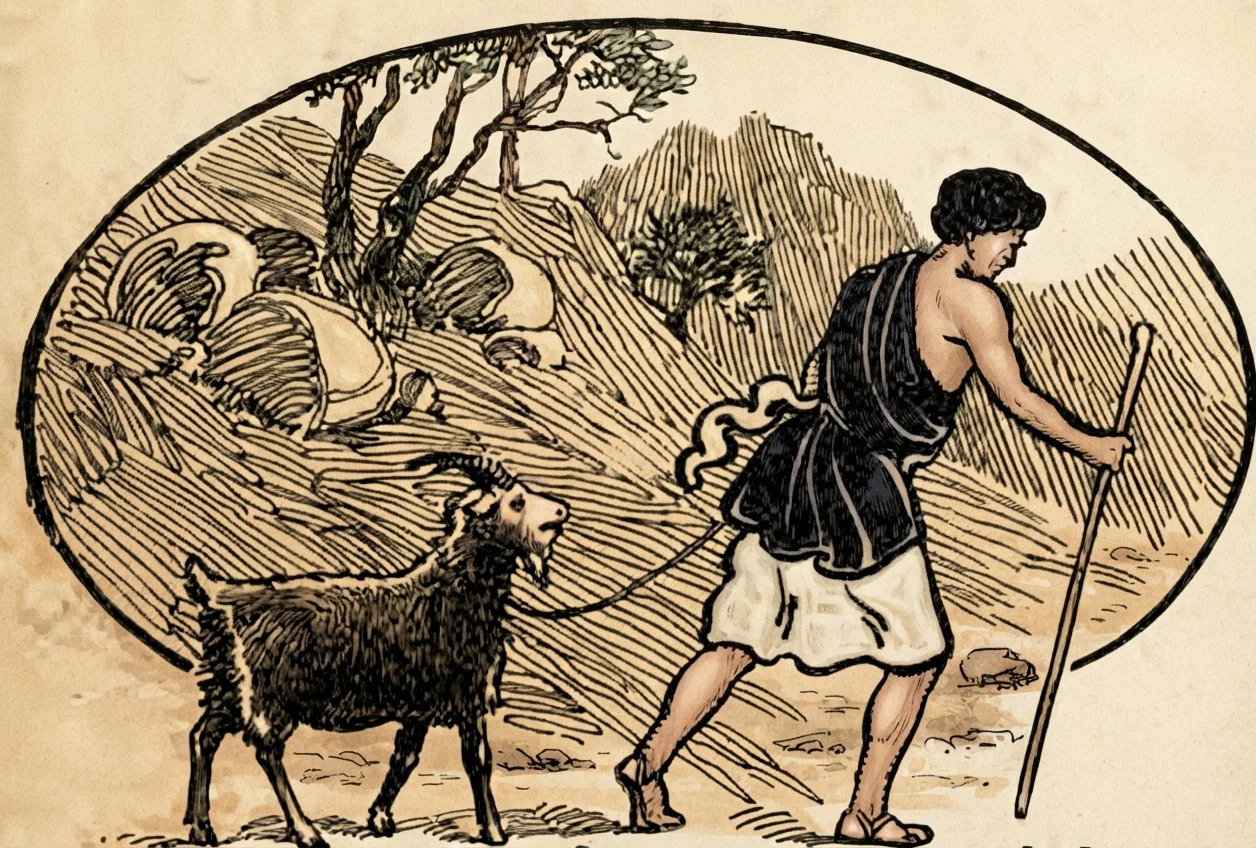
I MUST relate more fully the experience of one day when I sat down in this chair of Faith, and began reading in my Guide-book about the great day of atonement. Lev. 16; 23:27-32. The high priest took the blood of the goat upon which the Lord's lot had fallen, and went into the second apartment of the sanctuary, before the mercy-seat, while the people stood in the court, and confessed their sins, and afflicted their souls before God. The high priest, after making an atonement for all the sins of the people, came out and put the sins upon the head of the scapegoat, which was then carried away into a desolate land where it must perish, for it was never to return to the camp of Israel. After the scapegoat was separated from the camp, the people were all free from sin, and then they rejoiced before the Lord.
Scape-goat being led
"I then turned to another part of my Guide-book, where I read these words: 'Now of the things which we have spoken this is the sum: We have such an high priest, who is set on the right hand of the throne of the Majesty in the heavens; a minister of the sanctuary, and of the true tabernacle, which the Lord pitched, and not man.' Heb. 8:1, 2. I studied the picture on my window, the picture of the sanctuary built by man, the shadow of the true, when suddenly it glowed with a wondrous light, and I saw through it a living picture far beyond, even away in the depth of the heavens. There I saw a glorious throne, like the ark in the earthly sanctuary, on either end of which stood a cherub, radiant with light, one wing of each being extended over the throne. Rev. 11:19; Jer. 17:12. The top of the throne looked like burnished gold, and from it there flowed out toward earth a constant stream of light laden with love and mercy.
"Encircling the throne at a great distance appeared the dome of heaven. Its horizon was a brilliant scarlet, or red, brighter than the most beautiful glow ever seen on an earthly horizon at set of sun. Ex. 26:1. Passing toward the zenith, the color gradually changed, one shade blending into another, until, at a point about half way up, it was a clear, glowing purple. Raising the eye, the changing and blending of colors still continued until, in the zenith, there was a circular space of the softest and most delicate blue. About the throne, and far away toward both zenith and horizon, were bright beings, single and in companies, which were constantly winging their way to and from the throne. They were surrounded by a halo of light, which streamed out before them like the rays from a search-light, and also followed after them in a vanishing trail. In this light I read these words: 'Are they not all ministering spirits, sent forth to minister for them who shall be heirs of salvation?' Heb. 1:14.
"Under the throne, and supporting it, there appeared a perfectly transparent dome, surrounded by an open, circular space. Just outside this space there were placed in circular form twenty-four chairs (Rev. 4:1-4), in four groups of six each. These groups were separated by broad avenues which led up to the throne. Behind the chairs, and extending far back, were four companies of beings (Rev. 4:6-9), separated into six wings, or companies, by narrow passages leading up to the throne between the chairs.
"These beings were all clothed in white, and, as I looked, I could see their eyes everywhere sparkling with delight. Listening, I heard rapturous strains of music, which came from these companies, led by the ones who occupied the chairs. It was a song of praise and adoration, some of the words of which were, 'Thou art worthy to take the book, and to open the seals thereof; for Thou wast slain, and hast redeemed us to God by Thy blood out of every kindred, and tongue, and people, and nation; and hast made us unto our God kings and priests; and we shall reign on the earth.' Rev. 5:9, 10.
"The song completed, I heard them present before the throne the prayers of God's children on earth as sweet incense (Rev. 5:8), and as they were accepted, they would sing, 'Thou art worthy, O Lord, to receive glory and honor and power; for Thou hast created all things, and for thy pleasure they are and were created.' Rev. 4:11. Then I saw that these were the people of earth who were raised from the dead at the time Christ was raised (Matt. 27:51-53; Eph. 4:8), and who had accompanied Him to heaven to assist Him in His priestly work in the heavenly sanctuary, as the Levites did Aaron in the earthly.
"Next I saw the entire human race standing before this throne. The judgment was set, 'and the books were opened, and another book was opened, which is the book of life.' Rev. 20:12. The Judge, before whose face the heavens and the earth fled away, sat upon the throne. The book containing the records of men's lives was being examined, and in many cases the sins were all blotted out, and the name retained in the Lamb's book of life. Rev. 3:5. O, how the heavenly choir would swell the anthem of praise and rejoicing. But in some cases the name was erased from the book of life. Hushed then was the song, and solemn stillness reigned, while sadness swept like a wave over all. I stood amidst that throng, and from the presence of that Judge I sought to hide myself away; but those penetrating eyes would find me out, and search me through.
"Just then I saw a page containing my name, and below the name a record of the deeds of my past wicked life. O, how I trembled lest the Judge should call my name, and my record should be examined. I had sought to confess my sins, and by true repentance to seek the Saviour, but had I fully forsaken them? Here I opened my heart, and all was laid bare, and I cried, 'O God, sweep it all clean; take every idol away; make me meet to be a partaker in the inheritance of the saints in light.'
"Through my tears I saw One sitting to the right hand of the Judge, whose face filled me with hope. In it was so much of sympathy. His eyes beamed with such kindness, His whole countenance was radiant with the light of love. I felt that in Him was my only hope (Col. 1:27), and I fastened my eyes upon Him. I sought to shut out everything else. I claimed Him as my Advocate. I committed my case entirely to Him. 1 John 2:1. Just then one of the bright ministering spirits came to the throne, and passed a record into the hand of Jesus. As He received it He gave me a look of approval, which thrilled through my whole being, and I knew that it was the record of my full surrender to Him, which He had accepted.
"He took the book containing my life record, and, opening to my page, He passed His hand down over it, tracing thereon a trail of blood which soon faded away, leaving the page clean and white. O, how my heart leaped for joy as my name was called, and Jesus acknowledged me as His brother before His Father and before the angels.
"And now, my friend, I need not tell you that I love this room. I love the study of the sanctuary. In this room I see the work of Jesus in a new light. The holy angels seem nearer to me in their ministrations, and, as I think of the judgment and this scene in heaven, I feel to cry out, and to say, O, hasten, holy angels; bear to the throne my confession, and bring back to me the approving smile of my Saviour." (To be continued.)

Useful in God’s Redemptive Plan

WE can not all be poets, philosophers, or millionaires, but each one of us may become a useful factor in consummating God's plan for the redemption of humanity.

History of Government

THE END OF EARTHLY HUMAN GOVERNMENT.

(Concluded.)
WE have now reviewed the history of government on earth. We have seen that every kind of government has been tried, and in every instance has developed unbearable despotism toward men, and blasphemous assumption toward God. In every instance also the government has failed and fallen to ruin—except the ones now existing on earth; and these, founded and conducted upon the identical principles of those which have perished, must inevitably and shortly perish. And this the more shortly and more certainly by the fact that, whereas in every instance in former ages, when governments had reached the breaking point, there were new peoples to arise and perpetuate government in their places; now there are absolutely no new peoples anywhere on earth to take the places of these, and perpetuate government when the ones now existing shall have reached the inevitable breaking point, as have all before them. And this consideration alone makes it certain that when the governments now existing do reach that inevitable breaking point, the only result that there can be, will be the actual ending of all earthly human government. And that this inevitable breaking point is to-day very near, and is hastening greatly in the experience of the present governments of earth, is plain. This very consideration is perplexing the world's rulers to-day. And there can be no other end to these things than the end of all earthly human government.
But that will not be the end of government, thank the Lord! It will not be the end of even earthly government. It will be only, as expressed, the end of earthly human government. For God lives, and He is Governor amongst the nations. And when that crisis comes, which is now imminent, He will take to Himself His own great power, and will reign. Sin has almost finished its course upon earth; the solution of the problem of iniquity is in its last stage; and, presently, “in the days of these kings, shall the God of heaven set up a kingdom which shall never be destroyed, and which shall not be left to other people; but which shall break in pieces and consume all these kingdoms, and it shall stand forever.”
The universal failure of all earthly human government is no proof at all of the failure of all government; for in this history of government on earth, we have seen that the universal cause of the failure of government has been

The Failure of Individual Self-government.

We have also found that the universal cause of the failure of individual self-government has been the attempt at self-government without God, and the universal and inevitable failure of every attempt at self-government without God lies simply in the fact of sin. It was sin in the first place that originated any such attempt; and it is sin which, ever since, has frustrated and will ever frustrate every such attempt.
Sin has enslaved every soul on earth. There is power in sin to enslave and to reign over man, and even against his wish, impelling him to wrong. And man, being thus enslaved to sin and reigned over in power by sin, simply can not possibly truly govern himself. The power of sin must be broken and the enslaved captive freed, before it is possible for him truly to govern himself.
And the power of sin can be broken. The enslaved captive can be freed. For Jesus Christ, the Lord, has met both sin and its author on their own territory, and in the very citadel of their own kingdom, has conquered and has completely broken their power; has openly triumphed over them; and leads in His triumphant train every soul who chooses this only true way of freedom.
And this whole story of the impossibility of human self-government, except by the breaking of the power and the reign of sin by and through Christ Jesus, the Lord, is told in a single passage and few words in the Scriptures. And here is the story:—
“For we know that the law is spiritual; but I am carnal, sold under sin. For that which I do I allow not; for what I would, that do I not; but what I hate, that do I. If then I do that which I would not, I consent unto the law that it is good. Now then it is no more I that do it, but sin that dwelleth in me. For I know that in me (that is, in my flesh), dwelleth no good thing; for to will is present with me; but how to perform that which is good I find not. For the good that I would I do not; but the evil which I would not, that I do. Now if I do that I would not, it is no more I that do it, but sin that dwelleth in me. I find then a law, that, when I would do good, evil is present with me. For I delight in the law of God after the inward man; but I see another law in my members, warring against the law of my mind, and bringing me into captivity to the law of sin which is in my members. O wretched man that I am! who shall deliver me from the body of this death? I thank God through Jesus Christ our Lord. . . . There is therefore no condemnation to them which are in Christ Jesus, who walk not after the flesh, but after the Spirit. For the law of the Spirit of life in Christ Jesus hath made me free from the law of sin and death.” Rom. 7: 14-25; 8: 1, 2.
And this free man, the Christian, free in Christ, free in God, which is the place and the way of the only true freedom, exercising self-government with God, and in God, is

The Manifestation on Earth of True Government.

And that true government is not human; it is divine-human; for divinity is the only source of true self-government. The only person in the universe who, of Himself, can in all things truly and perfectly govern Himself, is God. Self-government, therefore, is in truth but an attribute of God. Therefore, divinity is the only source of self-government; and it is impossible for any creature in the universe to govern himself except as he is allied to divinity; except as he is made partaker of the divine nature. And he who is made partaker of the divine nature has escaped the corruption that is in the world, and is delivered unto the glorious liberty of the children of God.
And this is Christianity. This is the way, the true and living way, revealed by Christ in human flesh. And in this divine-human way,every human soul can walk in the manifestation of the principles and the glory of true government, which is true self-government.
And this manifestation of true government—the true government of self, the exercising of true dominion over self—is greater than is the government of all kingdoms and empires, and he who truly exercises it is greater than all kings and emperors that ever were on earth. “He that ruleth his spirit [is better] than he that taketh a city.” Accordingly, this power of true government—self-government—is truly kingly power. Being from the divinity, it could be nothing else. And He who came into the world to make manifest in human flesh this true government, which is true self-government,—He, when challenged on the point with the words, “Art Thou a king then?” royally answered: “Thou sayest that I am a king. To this end was I born; and for this cause came I into the world [and this is order]; that I might bear witness unto the truth.” And He who was born to the end, and who came into the world for this cause, that He should be King, He “hath loved us, and washed us from our sins in His own blood, and hath made us kings.”
Every Christian is, therefore, by creation, and so by divine right, a king. The ambition that has so manifested itself in all ages to be king, has never been in itself a false or a wrong ambition. The ambition itself has been true and right; it is the course, the manifestation, and the aims of that ambition that have been false and wrong. As we have seen in this whole study of government, the manifestation and aims of the ambition of man on earth to be a king have been invariably to gain power and dominion over others; and to govern and exercise authority upon others; while the true ambition and aim to be king is to gain dominion over self, and to govern and exercise authority upon self.

Jesus, the True King,

has made this distinction plain in the following words to His disciples: “The princes of the Gentiles exercise dominion over them, and they that are great exercise authority upon them; but it shall not be so among you. For whosoever will be great among you, let him be your minister, and whosoever will be chief among you, let him be your servant; even as the Son of Man came not to be ministered unto, but to minister; and to give His life, the ransom of many.” Worldly, false kingship is always government of others and the service of self; while Christian, true kingship is always and only government of self and service of others. With worldly, false kingship it is always the ambition to conquer all nations, that they may serve Him; while with the Christian, true kingship, the ambition is always and only to surrender himself to all nations that he may serve them.
And it is the simple philosophy of Christian kingship that Christ is the greatest of all kings; yea, the very King of kings. Because He surrendered far more, to serve far more, than any other in the universe possibly could. And since true kingship is to surrender self to all, that he may serve all; in the nature of things he who surrenders most to serve most, is the greatest king. And since Christ made the greatest possible surrender in surrendering Himself, and He did it for the greatest possible number, that He might serve absolutely all; it is but the plain philosophy of Christian kingship that He is in very truth the greatest of all kings, the very King of kings. And all who in Him, in God, and with God, surrender themselves to all, that they may serve all, are true kings; and are of His kingdom.

The Coming Kingdom.

And this is the kingdom, this is the government which, upon earth, shall presently succeed all earthly human governments, and which shall stand forever; simply because it is the divinely true government. For in reference to the succession of all earthly human governments, it was declared long ago by the divine Spirit that 'the saints of the Most High shall take the kingdom, and possess the kingdom forever, even forever and ever;' and 'the kingdom and dominion, and the greatness of the kingdom under the whole heaven, shall be given to the people of the saints of the Most High, whose kingdom is an everlasting kingdom, and all dominions shall serve and obey Him.' 'And there shall be no more curse; for the throne of God and of the Lamb shall be in it; and His servants shall serve Him; and they shall see His face, and His name shall be in their foreheads. And there shall be no night there; and they need no candle, neither light of the sun, for the Almighty giveth them light; and they shall reign forever and ever.'
They serve and they reign. They serve Him, they serve Him in serving others, and they reign over themselves. And such alone is true government, whether in heaven or on earth. And because it is true, such government abides eternally.
And such is Christianity in the truth of it. And unto Him, Christ, the Author and Finisher of Christianity—'Unto Him that loved us, and washed us from our sins in His own blood, and hath made us kings unto God and His Father; to Him be glory and dominion, forever and ever. Amen.' And let all the people forever say, 'Amen and amen.'
Continue reading: THE WAY OF THE TRANSGRESSOR