Part 11.
Earlier Egypt.
CONTINUING the subject of ancient Egypt as set forth in the previous article, I quote from another author:
"The civilization of Egypt at its first appearance was of a higher order than at any subsequent period of its history, thus testifying that it drew its greatness from a fountain higher than itself. It was in its early days that Egypt worshiped one only God; in the latter ages this simple and sublime belief was buried under the corruptions of polytheism. The greatest pyramids were built by the fourth dynasty, and so universal was education at that time among the people that the stones with which they were built retain to this day the writing of the workmen." — "Atlantis," p. 131, by Ignatius Donnelley.
When we consider the lofty ideals of the Egyptians as portrayed by their description of what they considered as justice between man and man, the motives they give as the basis of ethics, the high regard in which women were held among them, and their numerous examples of humanity in war, our minds are led back to that "fountain higher than itself" from which it drew its greatness. But their comparatively pure religion in the earliest days is even more conclusive proof of a very intimate connection with those who handed down the torch of truth from the long-lost Eden. On this point I present a quotation from the "American Encyclopedia" (Vol. VI. p. 463):
"In the early days the Egyptians worshiped one only God, the Maker of all things, without beginning and without end. To the last the priests preserved this doctrine and taught it privately to a select few."
The Hindus.
But in these things the Egyptians were not alone. Those marvelous books of the ancient Hindus, "embodying the earliest system of philosophy which we possess," reveal a similar state of affairs.
"The religion of the Veda knows no idols," says Max Müller; "the worship of idols in India is a secondary formation, a degradation of the more primitive worship of ideal gods."
The following also, from the Duke of Argyll, is to the point:
"We have found in the most ancient records of the Aryan language proof that the indications of religious thought are higher, simpler, and purer as we go back in time, until at last, in the very oldest compositions of human speech which have come down to us, we find the divine Being spoken of in the sublime language which forms the opening of the Lord's Prayer. The date in absolute chronology of the oldest Vedic literature does not seem to be known. Professor Max Müller, however, considers that it may possibly take us back 5,000 years. . . . All we can see with certainty is that the earliest inventions of mankind are the most wonderful that the race has ever made. The first use of fire, the discovery of the methods by which it can be kindled; the domestication of wild animals; and, above all, the processes by which the various cereals [oats, wheat, barley, etc.,] were first developed [?] out of some wild grasses—these are all discoveries with which, in ingenuity and importance, no subsequent discoveries may compare. They are all unknown to history—all lost in the light of an effulgent dawn."
Civilization an Inheritance.
To those who have never thought much along these lines it may not seem that the domestication of the horse, ox, sheep, goat, etc., and the cultivation of the grains, is anything very wonderful. But with a little further thought it will be seen that we have in these discoveries, or arts, or whatever we choose to call them, the broad and efficient foundations of civilized life, and without which civilization of any kind is impossible. But when we put with this the further fact that civilization is always an inheritance, that in no single case known to us has a savage race ever thrown off its savagery, and developed an agricultural life and a civilization of and among themselves, and without having learned it from some other people, we see the records of Genesis confirmed, and realize that man did not start on this world as a savage, but only a "little lower than the angels."
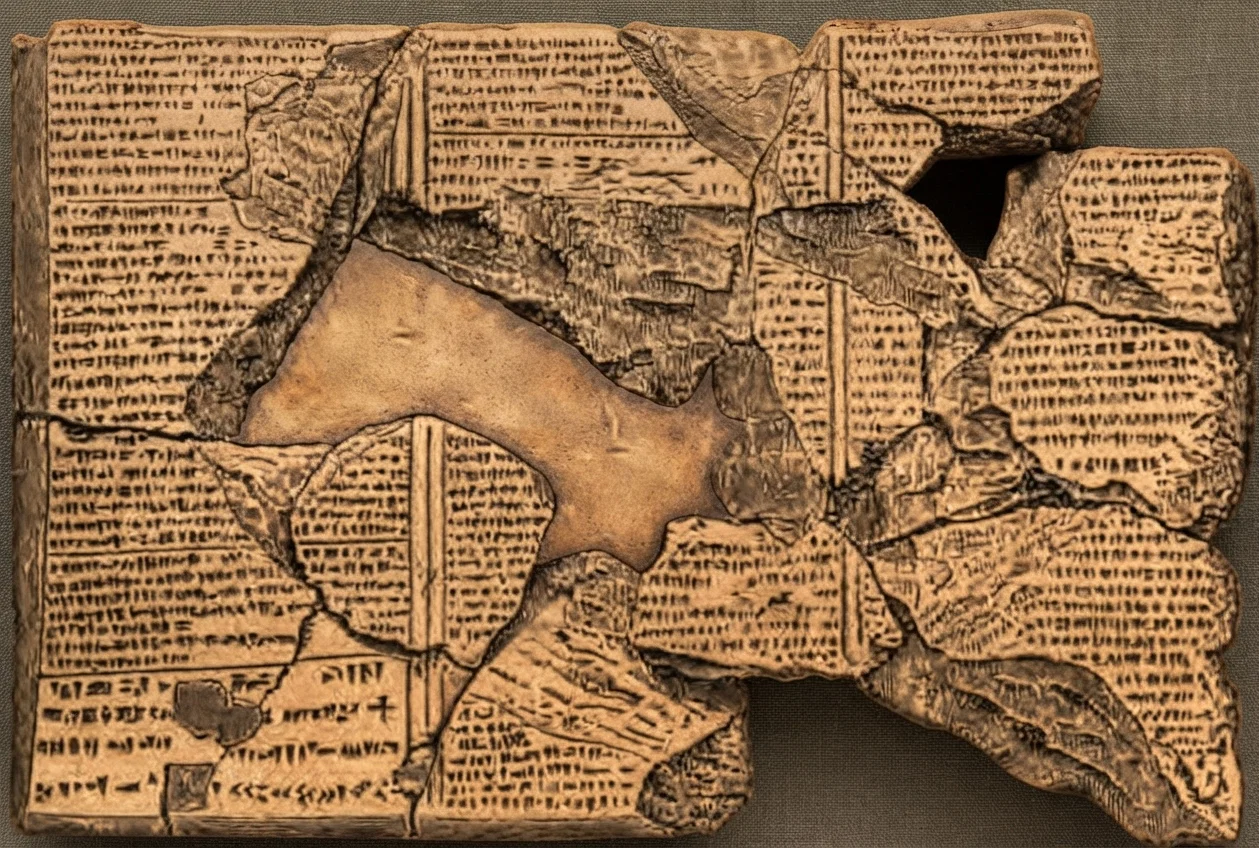
Back of Tablet with Account of the Deluge. A Chaldean Document. From "Chaldean Genesis," by Smith.
A Result of Character and Religion.
And the reason for civilization being always an inheritance and never self-originated, lies in the fact that moral development must come first. Civilization comes only as the result of character, not vice versa. The individuals of a people must acquire a certain amount of industry, perseverance, and self-control; they must learn how to work, and must exercise the determination to accomplish something before anything like civilization is possible. Thus civilization is the result of character training; character development is only the result of religious influences; and vital religion has never been self-originated by an individual or a people. As in biology life can come only from antecedent life, so are civilization and religion only received from those who already possess them.
Why No Advancement?
And since civilization is thus proved to be an inheritance, we see a reason why, for several thousand years, the nations made no advance on that received from the antediluvian world. The past century or so has witnessed a wonderful increase of knowledge and of mechanical power in the hands of man, as predicted in Dan. 12:4; but as we have seen, it is the result of Divine intervention for a special purpose, and is not in any sense the result of evolution or an inherent tendency to progress upward on the part of the race. If it had been the result of natural progress it ought to have come about somewhat gradually, and not be all crowded into the last minute fraction of human history. As it is, we know that up to about the age of Columbus the world possessed practically no arts, except that of printing (and this was then ancient in China), which were not known to the Babylonians, Egyptians, Assyrians, and Hindus.
In the words of Donnelley:
"Phoenicia, Egypt, Chaldea, India, Greece, and Rome passed the torch of civilization from one to another; but in all that lapse of time they added nothing to the arts which existed at the earliest period of Egyptian history. In architecture, sculpture, painting, engraving, mining, metallurgy, navigation, pottery, glassware, the construction of canals, roads, and aqueducts, the art of Phoenicia and Egypt extended, without material change or improvement to a period but two or three hundred years ago." — "Atlantis," p. 130.
When the Domestication of Animals?
Returning now to the problem of the domestic animals and plants referred to in the above-quoted words of the Duke of Argyll, we have, I think, proof absolutely conclusive that they must first have been acquired by man in that vastly-more-favorable climate and soil of the ancient world, before the great catastrophe of the Deluge. The most common domestic food plants are not found wild in any spot on earth, and will not long survive without human care in any climate or soil that we now possess. Where did they come from, except from that old world, when, as Geology shows us, "the whole northern hemisphere enjoyed a kind of perpetual summer;" palms and other tropical plants grew in England; and luxuriant ivies, vines, oaks, walnuts, and magnolias grew in Greenland "within twelve degrees of the pole?" — (Nicholson, "Ancient Life-History," p. 310). I confidently affirm that no other explanation is possible.
Again I quote the words of one who felt the irresistible power of this argument:
"Why is it that the origin of wheat, barley, oats, maize, and rye,—the essential plants of civilization—is totally lost in the midst of a vast antiquity? We have in the Greek mythology legends of the introduction of most of these by Atlantean kings of gods into Europe, but no European nation claims to have discovered or developed them, and it has been impossible to trace them to their wild originals. Out of the whole flora of the world mankind in the last seven thousand years has not developed a single food plant to compare in importance to the human family with these. If a wise and scientific nation should propose nowadays to add to this list, it would have to form great botanical gardens, and, by systematic and long-continued experiments, develop useful plants from the humble productions of the field and forest." — "Atlantis," pp. 177-8.
Mr. Donnelley thought something like this must have been done in his mythical island of "Atlantis," and it was only by the submergence of this land and the dispersion of the survivors that he could account for the simultaneous appearance in different countries of full-grown civilization. But we who believe the Bible will readily see in this theory only a parody of the true explanation, viz., that Noah and his sons brought these precious relics of the Antediluvian world safely over into this ruined one, and passed them along to their descendants.9But again I quote from this author:
"We can not consider all these evidences of the vast antiquity of the great inventions upon which our civilization mainly rests, including the art of writing, which, as I have shown, dates back far beyond the beginning of history; we can not remember that the origin of all the great food-plants, such as wheat, oats, barley, rye, and maize, is lost in the remote past; and that all the domesticated animals, the horse, the ass, the ox, the sheep, the goat, and the hog, had been reduced to subjection to man in ages long previous to written history, without having a conclusion forced upon us irresistibly that beyond Egypt and Greece, beyond Chaldea and China, there existed a mighty civilization, of which these states were but the broken fragments." — Ib. Id. p. 455.
Origin of Languages.
Very little more remains to be said about man's earliest history. I give two facts about the history of languages which, taken together, go very far to confirm the Bible record of Babel.
It must be recollected that language is not merely the conventional instrument of thought, but, to a great extent, its creator, and the mould in which it is cast. The mould may be broken, and races abandon old, and adopt new, languages by force of external circumstances, such as conquest, or contact with, and absorption by, superior races, but there is no instance of its being so transformed from within as to pass into a totally-different type. Nor can we very well see how root-words once attached to fundamental ideas, such, for instance, as the simpler numerals should come to be forgotten and new and totally-different words invented. — S. Laing, "Modern Science and Modern Thought," p. 102.
And yet this same author, evolutionist tho he is, is constrained to acknowledge that "the best authorities tell us that a list of fifty to one hundred languages could be made of which no one has been satisfactorily shown to be related to any other." — Id. p. 100.
No further comment on the above is needed here. They certainly confirm in a striking manner the record of Gen. 11:4-8, and are in accord with the old Babylonian inscription that "He [God] gave a command to make strange their speech," and that of Nebuchadnezzar, concerning "the most ancient monument of Borsippa," that "since a remote time people had abandoned it, without order expressing their words."
World-Wide Tradition of the Deluge.
I can not go into the subject of the world-wide traditions of the Deluge. The astonishing remains of antediluvian man found in the caves of southern France and elsewhere come rather under the head of Geology, and will be thus considered. My remarks on archeology are already too long, and all my readers know of the Chaldean Deluge Tablets, since the discovery of which no reputable scientist has denied that they must represent an actual fact which had burned itself into the memory of all the early races of the world. In the words of Lenormant, "Far from being a myth, the Biblical Deluge is a real and historical fact."
So much then for the testimony of history and archeology on the subject of Evolution. It is needless for me to sum up the matter by saying that they lend no countenance to this theory. Such a statement would be altogether too tame. Rather must we say that we could scarcely wish for more evidence confirming the scriptural record that "God hath made man upright, but they have sought out many inventions."
In our next articles we shall take up that phase of the general theory known as "Darwinism," or the bearings of "natural selection" on the origin of species among plants and animals.
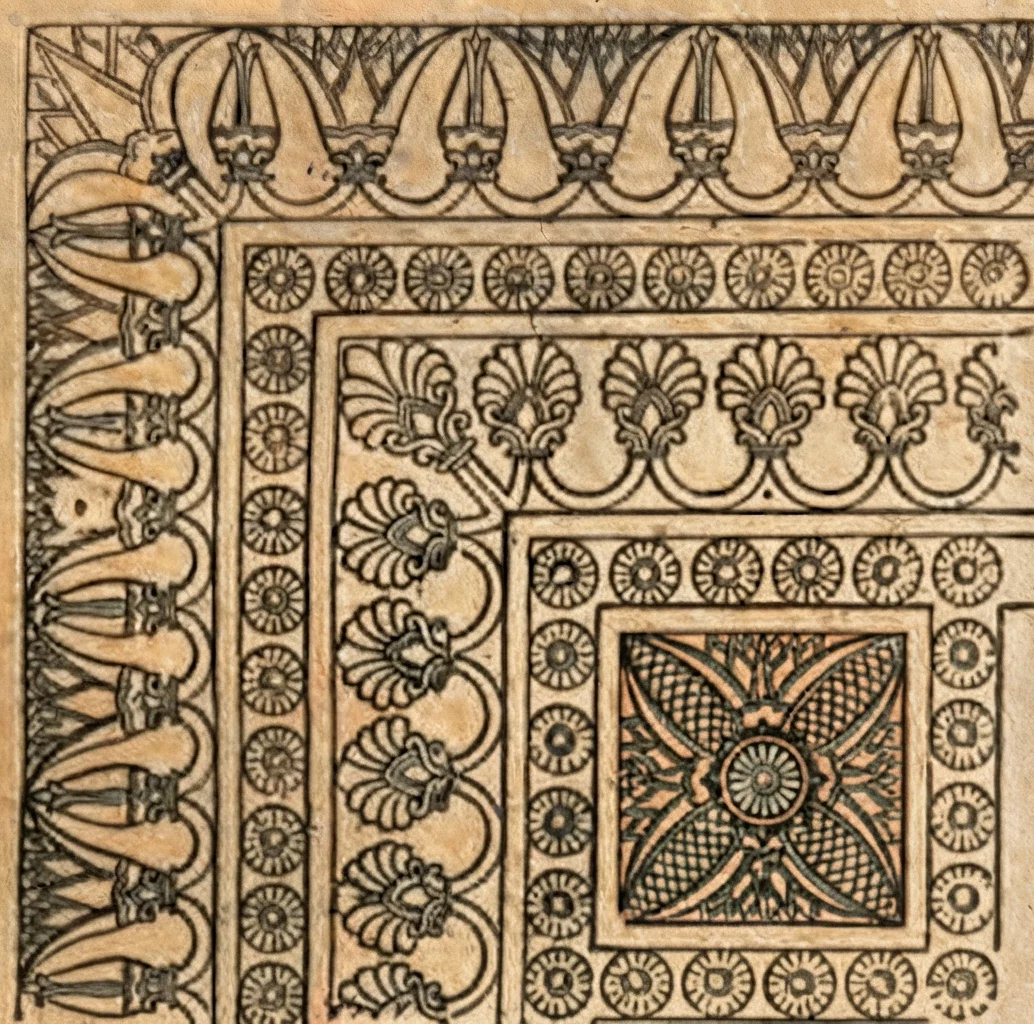
A Slab from the Ancient Pavement of Koyunjik, Assyria.
AN UNCHANGEABLE LAW.
By Ellen G. White
BY MRS. E. G. WHITE.
THROUGH the eternal ages God's law will endure. Its principles are unchangeable. From these principles there can be no sinless swerving. And naught but blessing follows those who reverentially obey.
"Think not that I am come to destroy the law, or the prophets;" Christ declared; "I am not come to destroy, but to fulfil. For verily I say unto you, Till heaven and earth pass, one jot or one tittle shall in nowise pass from the law, till all be fulfilled." I have not come to destroy the law, but to show its immutability, and the holiness of its claims. God could not change His law to meet man in his fallen condition. By suffering the penalty of transgression, I will redeem the race. I have become man's substitute and surety. I have taken human nature, and have come to this earth to pass over the ground where Adam stumbled and fell. In human nature I will bear the test and proving of God. Satan has declared that man can not keep the law. I will show that his statement is false; that man can keep the law. I have come to remove deception from the minds of men, to make plain that which Satan is trying to make obscure. I have come to establish the law Satan is seeking to make void, to show how far-reaching are the principles of this law. I have come to strip from it the burdensome exactions with which man has loaded it down. I have come to show its length and breadth, its dignity and nobility. I will open before men its purity and spirituality. Not to introduce a new law, have I come, but to establish the law which to all eternity will be the standard of obedience.
Some claim that the commandments are not binding on those who are led by the Spirit. What spirit? we inquire. Certainly not the Spirit of Christ; for He declared, "I came not to destroy the law." "Whosoever therefore shall break one of these least commandments," He said, "and shall teach men so, he shall be called the least in the kingdom of heaven." He is a rebel against God's government. He is sinning himself, and is leading others in the path of disobedience. "He shall be called the least in the kingdom of heaven." For him there will be no place in God's kingdom. He is a transgressor of the law, and into the holy city no transgressors are admitted.
"But whosoever shall do and teach them, the same shall be called great in the kingdom of heaven."
Can not men see that to belittle the law of God is to dishonor Christ? Why did He come to this world to suffer and die, if the law is not binding upon human beings? Who could speak more plainly than He did regarding the immutability of the law? He came to bring light and immortality to light by exalting the law, and making it honorable. Where can be found those who preach the binding claims of God's law more plainly and decidedly than did Christ when He was upon the earth?
From every one God requires perfect obedience. Of himself, man can not obey the law. Never could he pay the debt incurred by transgression. Christ came to this world to bring man power to obey. He came in human nature that He might know the temptations and trials to which man is subjected. He who accepts Christ as a personal Saviour will receive divine aid in the struggle against sin. Through the merits of the Saviour, he will become an obedient subject of God's kingdom. In the strength of Christ he will overcome every temptation of the enemy.
In the day of judgment, every one will receive sentence according to his deeds. Every mouth will be stopped, as the cross is presented, and its real bearing seen. Sinners will stand condemned. Every subterfuge, every excuse, will be swept away. Sin will appear in all its sinfulness. The mystery of the incarnation and the crucifixion of the Son of God will be plainly discerned, and every condemned soul will read clearly the result of a rejection of truth. Those who have chosen to transgress will then understand that they have sinned, and come short. They will read the sentence, Thou, O man, hast chosen to stand under the banner of the great apostate, and, in so doing, thou hast destroyed thyself.
THE GREAT CONSUMMATION.
By Lucina Moon
BY LUCINA MOON.
O, WEARY ones, lift up your heads;
Salvation's near at hand,
The Saviour soon, with open arms,
Will greet His faithful band.
Then troubles deep and trials sore
Our soul shall not oppress;
But life immortal, joys untold,
Will then our spirits bless.
O lonely ones, your vision cast
On yonder bright abode,
Where Jesus lives to interpose
For you His precious blood.
Soon, very soon, the angel band,
With Jesus at their head,
Will come to change the living, and
To wake the sleeping dead.
Then they who soon in peace shall meet
Their glorious coming Lord
In robes of righteousness shall shine,
Their lives of one accord.
Upon their lips no guile is found;
All spotless, pure, and bright,
They wait salvation from their foes,
Release from earth's dark night.
Then hail our glorious coming Lord;
Ye saints His praises sing.
We'll greet Him soon, if faithful here.
All hail, our coming King!
San Jose, Cal.
Come to the Waters
"Ho, EVERY one that thirsteth, come ye to the waters, and he that hath no money; come ye, buy and eat; yea, come, buy wine and milk without money and without price."
Good Times and Bad Men
By Sunday-School Times
Good times can not come when bad men are in power.—Sunday-School Times.
THE SABBATH
By L. A. Phippeny
BY L. A. PHIPPENY
THE COVENANTS.
The Everlasting Covenant.
THE subject of the Sabbath is interlinked and interwoven with that of the covenants, of which it is an integral part. Hence the importance attaching to an understanding of the covenants in their relation to the Sabbath.
A covenant is an agreement between two or more parties, involving certain mutual promises, and certain conditions. A contract is a covenant.
A covenant is also a promise made by one party to do or cause to be done certain things, when certain conditions are met. It must involve a second party, altho the second party may not formally enter into the agreement at the time the first party promises. Of this class of covenants, a will, or testament, is an illustration.
In the Scriptures the words covenant and testament are both used, somewhat synonymously, involving the ideas of contract, mutual promises, and testament, or will.
Every covenant, contract, testament, or will, must have its essential object clearly stated. There must also be a consideration. That is, something of value must pass between the parties to bind the covenant, tho the mutual benefits to be derived by the covenantors may be regarded as a consideration, if so agreed between them. In the case of a will several considerations are understood, such as relationship, friendship, benefactions, etc., and the will, or testament, is confirmed by the death of the testator. For its provisions are thus made sure and unalterable forever.
The covenant idea is one that is prominently set forth in the Scriptures, and it requires only an ordinary, careful study of the scheme of the Bible to discern that this thought lies at the foundation of the whole plan of redemption. A covenant was made with Adam, for we read a reference in the sixth chapter of Hosea that backsliding Ephraim and Judah, like Adam, transgressed the covenant. A covenant was made with Noah and his sons; a covenant was made with Abraham, and renewed and repeated with Isaac and with Jacob; a covenant was made with the Israelites, when the Lord led them forth from Egyptian bondage; a covenant was made with David, and his house after him; this covenant was referred to by Isaiah as an everlasting covenant; and a prophecy of a new covenant is made by Jeremiah, and referred to by the writer of the book of Hebrews as the new testament.
The Everlasting Covenant.
The reference by Isaiah to an everlasting covenant is not the only reference to an everlasting covenant. God's covenant with Noah is called His everlasting covenant with the earth; His covenant with Abraham is called His everlasting covenant, and is renewed with Isaac and with Jacob and with Israel, the nation, as His everlasting covenant therefor; and it requires but a glance at the terms of the new covenant to show that whenever it is established its blessings must be everlasting in their effects. What is there, therefore, in these covenants that the Lord refers to as His everlasting covenant, that warrants this term?
The answer to this question is in the covenant matter,—the terms, conditions, promises, and object. To Noah—and to the earth—the Lord promised the preservation of the earth forever from destruction again by a flood of waters; to Abraham, Isaac, and to Jacob, was the promise of the land of Canaan for an "everlasting possession," and that their seed should be as the stars of heaven and the sand on the seashore for number. And in the fulfilment of this promise, so far as its local features were concerned, the Israelites were led from Egypt to the promised land. But the promise of Canaan and the innumerable multitudes to constitute the posterity, was a promise embracing more than the literal land of Palestine, and its capacities. This was clearly understood by the worthies of old.
"By faith Abraham, when he was called to go out into a place which he should after receive for an inheritance, obeyed; and he went out, not knowing whither he went. By faith he sojourned in the land of promise, as in a strange country, dwelling in tabernacles with Isaac and Jacob, the heirs with him of the same promise; for he looked for a city which hath foundations, whose builder and maker is God. . . . These all died in faith, not having received the promises, but having seen them afar off, and were persuaded of them, and embraced them, and confessed that they were strangers and pilgrims on the earth. For they that say such things declare plainly that they seek a country. . . . They desire a better country, that is, an heavenly." Hebrews 11.
The promise—God's part of the covenant—with Abraham, was also that in him should all families of the earth be blessed. "The Scripture, foreseeing that God would justify the heathen through faith, preached before the Gospel unto Abraham, saying, In thee shall all nations be blessed. So then they which be of faith are blessed with faithful Abraham. . . . Now to Abraham and his seed were the promises made. He saith not, And to seeds, as of many; but as of one, And to thy Seed, which is Christ. . . . And if ye be Christ's, then are ye Abraham's seed, and heirs according to the promise." For in Christ "there is neither Jew nor Greek, there is neither bond nor free, there is neither male nor female; for ye are all one in Christ." Galatians 3.
The Restoration of the Kingdom.
These blessings are the blessings of the Gospel in the working out of the plan of redemption through Christ. The all-inclusive object is the anti-typical Canaan—the earth restored—for an "everlasting possession." This was the object of the everlasting covenant mentioned by Isaiah—the "sure mercies of David." The mercies mentioned by David were the Lord's promises to him that his throne should be established forever, that divine mercies should not depart from his house. Christ, the Seed, is to reign on the throne of His father David forever, in the regeneration. That throne will be called the throne of David, and its establishment rested on the successful accomplishment of the Redeemer's mission.
It becomes very clear, then, that the promises made immediately after Adam and Eve sinned, are a part of the everlasting covenant: "I will put enmity between thee and the woman, and between thy seed and her seed; it shall bruise thy head, and thou shalt bruise his heel." Here is the promise of the Redeemer, who should destroy sin. Here is the promise of salvation, of forgiveness, of restoration. It is the beginning of the proclamation of the Gospel. It was the hope of Adam and Eve, and of every soul since, who has desired salvation. Its precious promises, and the unfolding of the plan, were passed on from father to son and from family to family, through the ages, until the Redeemer came. Adam, to whom was given the dominion of earth in its Edenic state, lost it through sin; Christ, the second Adam, has regained it through righteousness. And so the prophecy declares: "And Thou, O Tower of the flock, the Stronghold of the daughter of Zion, unto Thee shall it come, even the first dominion." Micah 4:8.
From the gate of Eden to the restoration of the lost dominion, the work of redemption is one work. The various promises to Adam and to Noah and to Abraham and to Isaac and to Jacob and to Israel and to David, and to us, are all of one, and have one object—"an everlasting possession." The conditions of possession demand a holy people for the everlasting possession, a people who have been made righteous and holy through the Lord's means for making them righteous, a people whose character is His character, in whose hearts is His law. He is to be their God, and they are to be His people, and He is to dwell in and with them. These conditions are the conditions of the new covenant. Indeed, they must be so, for the new covenant is only the clear statement of what must be accomplished in the work of redemption.
[The next article will be "The Covenant-Testament."]
EZEKIEL.
By F. D. Starr
BY F. D. STARR.
"A new heart also will I give you, and a new spirit will I put within you; and I will take away the stony heart out of your flesh, and I will give you an heart of flesh. And I will put My Spirit within you, and cause you to walk in My statutes, and ye shall keep My judgments, and do them." Eze. 36:26, 27.
THE Gospel doctrine of the new birth, the change of heart, is nowhere more clearly taught than in this quotation. Its evangelical nature being thus clearly shown, no question can exist as to the benefits to be derived from a perusal of this book. From the picture of the beautiful rainbow encircling the throne of God as described in chapter one to the closing words of the last chapter: "The name of the city from that day shall be, The Lord is there," the entire book is full of celestial suggestions, and lofty ideas that transport the mind of the reader from earth to heaven. Sublime are the visions given.
An Important Topic.
One of the most important topics of the book is the subject of the Sabbath. The combined testimony of the three major prophets, Isaiah, Jeremiah, and Ezekiel, constitutes a very strong evidence for the importance and enduring nature of this institution. It will be profitable to consider what the Lord has said concerning this subject by the mouth of these three seers of old. In Isaiah 56 we read:11
"Thus saith the Lord, Keep ye judgment, and do justice; for My salvation is near to come, and My righteousness to be revealed. Blessed is the man that doeth this, and the son of man that layeth hold on it; that keepeth the Sabbath from polluting it, and keepeth his hand from doing any evil. . . . Also the sons of the stranger, that join themselves to the Lord, to serve Him, and to love the name of the Lord, to be His servants, every one that keepeth the Sabbath from polluting it, and taketh hold of My covenant; even them will I bring to My holy mountain, and make them joyful in My house of prayer."
In Isaiah 58 is found this testimony concerning the blessedness of the Sabbath. "And they that shall be of thee shall build the old waste places; thou shalt raise up the foundations of many generations; and thou shalt be called, The repairer of the breach, The restorer of paths to dwell in. If thou turn away thy foot from the Sabbath, from doing thy pleasure on My holy day; and call the Sabbath a delight, the holy of the Lord, honorable; and shalt honor Him, not doing thine own ways, nor finding thine own pleasure, nor speaking thine own words; then shalt thou delight thyself in the Lord;" etc. Its existence in the new earth is proven in chapter 66 where we read: "And it shall come to pass, that from one new moon to another, and from one Sabbath to another, shall all flesh come to worship before Me, saith the Lord."
In the book of Jeremiah we find foretold the consequences of observing the Sabbath, and also the results of disregarding it. "If ye diligently harken unto Me, saith the Lord, to bring in no burden through the gates of this city on the Sabbath day, but hallow the Sabbath day, to do no work therein . . . this city shall remain forever. . . . But if ye will not harken unto Me to hallow the Sabbath day, and not to bear a burden, even entering in at the gates of Jerusalem on the Sabbath day; then will I kindle a fire in the gates thereof, and it shall devour the palaces of Jerusalem, and it shall not be quenched." Jer. 17:24-27.
The sanctifying influence of the Sabbath is thus set forth by Ezekiel: "Moreover also I gave them My Sabbaths, to be a sign between Me and them, that they might know that I am the Lord that sanctify them." "And hallow My Sabbaths; and they shall be a sign between Me and you, that ye may know that I am the Lord your God." Chapter 20:12, 20.
The Sacred and the Common.
The distinction between this day and the other days of the week is shown in Eze. 46:1. "Thus saith the Lord God: The gate of the inner court that looketh toward the east shall be shut the six working days; but on the Sabbath it shall be opened." These texts taken together furnish a very comprehensive treatise on the Sabbath question.
Its history is thus briefly traced from Creation in the past to Eternity in the future. It is spoken of in distinction from the six working days. What made the other days of the week working days? The act of God Himself, in working the first six days, thus making the first day of the week, with those that follow a working day. If the first day of the week was a working day with the Creator it surely is such for the creature, man, for whom it was made. Being such a divine institution from the beginning, it is clear that Divine Wisdom would perpetuate it in the new earth, and we see from the closing words of Isaiah's prophecy that such is the case.
The Book of Ezekiel
The Book of Ezekiel abounds in topics of deep interest, and tho in reading the book one is brought into waters that are ankle deep, then knee deep, then waters to the loins, then waters to swim in, as was the prophet himself, according to chapter 47, yet the exercise and the experience are transporting and delightful. Who has not been thrilled with rapture in accompanying the prophet in his vision of the dry bones as found in chapter 37? A lively portrayal of the resurrection indeed! That resurrection power is found in the Word of God. If we feel like saying with Israel of old: "Our bones are dried, and our hope is lost," let us take hold of God and His mighty power as revealed in this book and be revived.
IS IT RIGHT?
By Baptist Commonwealth
It is a very peculiar fact that whenever there is a worldly amusement about which we are in doubt, we invariably ask the question, "Is it wrong to do that?" "Is it wrong for Christians to dance?" "Is it wrong to go to the theater?" "Is it wrong to play cards?" Always, Is it wrong?
It is very much the same as in the matter of eating. When there is something that we desire, we always ask ourselves, "Will it hurt me?" If we can satisfy ourselves that it will not do any serious damage, that it will not bring on indigestion or dyspepsia, or sleeplessness, or cramps, we eat it. We never ask, "Will it help me?" "Is it just what I need to build up body and brain, to make blood and strengthen the tissues, to increase my energy, and improve my general health?" Never. It is always, "Will it hurt me?"
So it is with worldly amusements. "Is it wrong?" we ask. "Does God forbid it?" "Is there anything in the Bible against it?" If we can satisfy ourselves that it is not wrong, we engage in it. Is that all that should be asked? Why not occasionally reverse it, and ask, "Is it right?" Suppose it is not wrong, there is still the question, "Is it best?" "Is it what I need to be more effective in my influence for Christ?" "Is it going to make me nobler and truer, better able to fulfil my life work?" "No," must we say, "it will not do that." Then hands off. Life is too full of that which is uplifting, helpful, and character-forming, to spend our time on that which has at the best only a neutral influence.