Pacific Press Publishing Company · Oakland, California · Jun 29, 1904
WEALTH, STATION, AND MISERY.
The great city of this earth is London, which in itself is representative of the world. Here are gathered from every civilized and semi-civilized land of earth its representatives and products. The extremes of wealth and poverty, of elegance and squalor, of refinement and coarseness, of culture and ignorance, of gentleness and brutality, of plenty and want, of happiness and misery, of righteousness and sin.
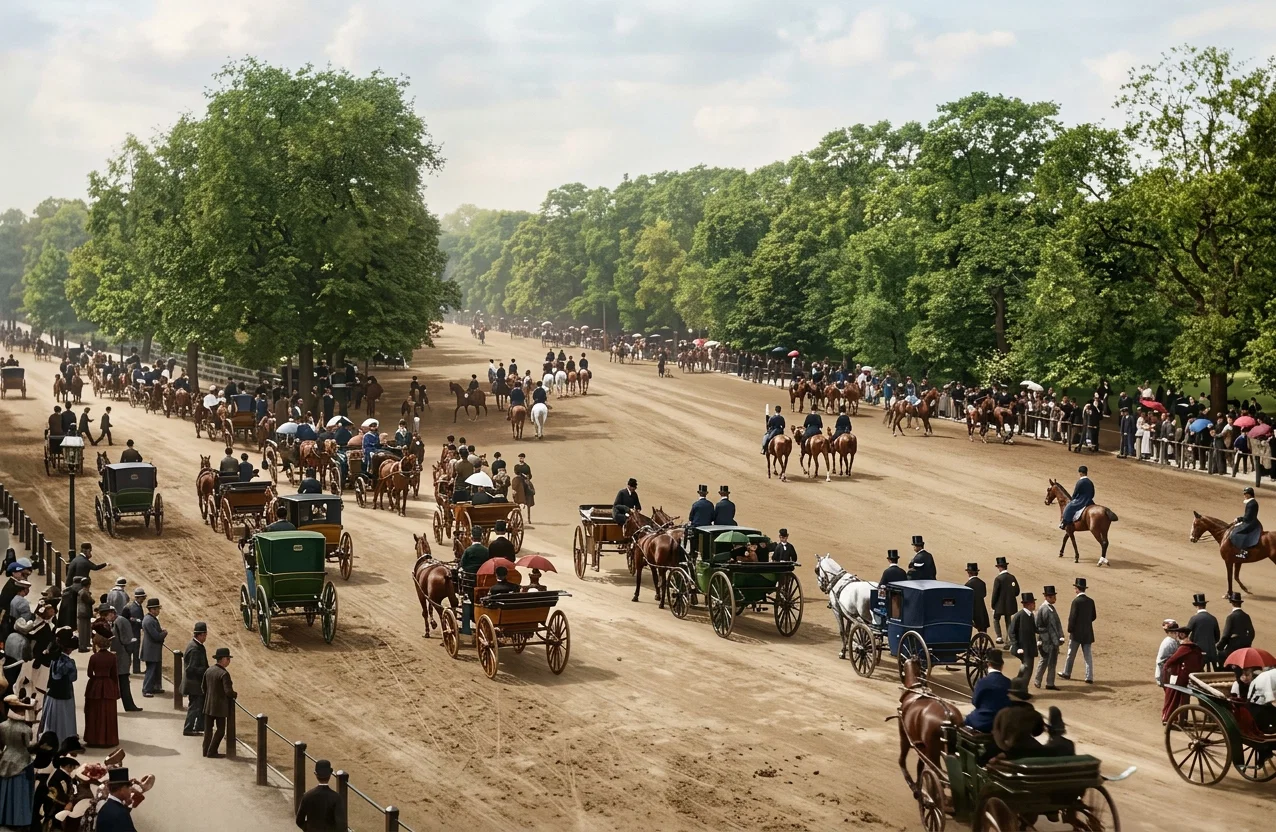
Rotten Row, Hyde Park, London.
One and one-half miles west of the center of London, in this great Babylon, along Piccadilly on the south, or by the way of Regent and Oxford Streets on the north, in the heart of the West End, is one of London's most famous resorts—Hyde Park, with the beautiful Kensington Gardens on the west. The park consists of five hundred and ninety-five acres in irregular shape, formerly a part of the Manor of Hyde, which was once possessed by the Westminster Abbey. When Henry VIII. overturned the religion of the kingdom, the manor became a deer park, stag hunts taking place there as late as Queen Elizabeth, and horse races in the time of Charles II. In the eighteenth century frequent duels were fought here.
The southeast entrance of the park is a fine gateway of three arches. From Oxford Street one enters under the Marble Arch, costing $400,000. Stately and noted monuments have been erected in various places in the Park, and the grounds are well arranged and beautified with varied scenery and flora. The Serpentine is a beautiful sheet of water.
Two of the noted features of the Park are the South Drive and Rotten Row. The former is on the south side, in which, during “the season,” society walks or drives between the hours of 5 and 7 P. M. The border of the walk is lined with chairs (rentable for a penny each) for those who wish to look upon the display of wealth or fashion.
North of this drive is Rotten Row, a corruption of the term, Route de Roi, or King's Road, an illustration of which is reproduced on this page. Here, on the soft easy track, the nobility and gentry drive and ride during the fashionable hours of from 12 M. to 2 P. M. Upon all this lavish display of wealth and luxury look the poor and needy and squalid, with ever-growing discontent; and it is not too much to say that in this famous park and by these famous drives not a few of the seeds of discontent have developed into bitter hatred of the rich, and rebellion against the present unequal social order, in which some are living in unexampled wealth, while others, equally worthy of life, are dying in squalor and poverty. It is a wonderful gulf which separates the East End and the West End of London and other typical cities, and it is growing deeper and wider as the days of deepening contrasts go by.
And yet the wealth and the station in life do not bring happiness. The fact that a man is a duke or an earl does not make him happy. The lowest scullion in his kitchen may be happier than he. The duke may possess great estates, entailed from far-off ancestors, but this, of itself, can not add to his enjoyment. He may own mines and factories; thousands of workmen may do him reverence as he walks through their midst; the rich and great may honor him; but none of these will give the heart rest or the disturbed conscience peace. None of these things can stay the ravages of age, or ward off the cold clutch of death. Money can not purchase peace; position and prominence can not give rest of heart. To the shallow, the superficial, they may seem to be the climax of desire;2 (402)but the vivacious manners, the sweet smiles manifest toward each other, are but society's gilding to hide the unsatisfaction, the ennui, the heart emptiness, of the slavish life of fashion. The gilt trappings and splendid exterior often hide utter hollowness or rottenness within.
These thoughts are not written to set class against class; God forbid. Some of those who are rich are so by inheritance. Personally, they have oppressed no one, defrauded no one. They are simply living the fashionable life, ignorant of how to do better, with but little time in the slavery of fashion to think of aught else. Others are in these circles because, through shrewd business ability, they have “won their way.” Sometimes that way is paved with the broken and ruined fortunes of others. Sometimes the oppressed cry out at every increment to the vast fortune. But God will hold all the possessors of wealth responsible for the way they have obtained it, and the way they use it.
We pity those who have thus obtained their wealth. We pity not less those who covet the ill-gotten gain. They show by their very covetousness that they would acquire fortunes in the same way did they have the ability and opportunity. We pity those who withhold their wealth and influence from the world's great need. God will hold them also responsible. But tho the very rich may do nothing to relieve the world's needs, that does not prevent those who are partakers of God's blessings from using them to help their brother in need; God will hold us each and all responsible, not for what others have, nor for what we have not, but for what we have, in time, in opportunity, in talent, and in ability.
One of the great lessons, which ought to come home with tremendous force to every heart, is that sinful human nature in its motives and principles is essentially the same, whether found in fustian or satin, in denims or in cloth of gold. God designed that the highways of this earth's teeming multitudes should be the Route de Roi, the way of a king, kings over every form of sin and lust and fraud and unrighteousness, kings with the King of kings and Lord of lords. But sin entered, and the Route de Roi became in the natural heart of humanity, the Rotten Row, filled with corruption of every form. Never try to gloss or gild and hide the awful fact, but sooner or later, if left to itself, it is revealed in all its hideous repulsiveness. Happy is he or she who yields all to Jesus Christ, and lets the rightful ruler come in and bear sway. He will take away all the sin, the rottenness, the emptiness, and change the corruption to purity, and make the heart and life once more the way of the King of Righteousness and peace and rest. Then will all the beauty not be the gilded covering of sin, but the outgrowth of life and peace and rest in the King.
“TAKE MY YOKE UPON YOU, AND LEARN OF ME.”
By Ellen G. White
BY MRS. E. G. WHITE.
COME unto Me, all ye that labor and are heavy laden, and I will give you rest. Take My yoke upon you, and learn of Me; for I am meek and lowly in heart; and ye shall find rest unto your souls. For My yoke is easy, and My burden is light.”
In these words Christ is speaking to every human being. Whether they know it or not, all are weary and heavy laden. All are weighed down with burdens that Christ only can remove. The heaviest burden that we bear is the burden of sin. If we were left to bear this burden, it would crush us. But the Sinless One has taken our place. “The Lord hath laid on Him the iniquity of us all.” He has borne the burden of our guilt. He will take the load from our weary shoulders. He will give us rest. The burden of care and sorrow also, He will bear. He invites us to cast all our care upon Him; for He carries us on His heart.
“Take My yoke upon you,” Jesus says. The yoke is an instrument of service. Cattle are yoked for labor, and the yoke is essential that they may labor effectually. By this illustration Christ teaches us that we are called to service as long as life shall last. We are to take upon us His yoke, that we may be co-laborers with Him.
The yoke that binds to service is the law of God. The great law of love revealed in Eden, proclaimed upon Sinai, and in the new covenant written in the heart, is that which binds the human worker to the will of God. If we were left to follow our own inclinations, to go just where our will would lead us, we should fall into Satan’s snare, and become possessors of his attributes. Therefore, God confines us to His will, which is high, noble, elevating. He desires that we shall patiently and wisely take up the duties of service.
Men frame for their own necks, yokes which seem light and easy, but which will prove heavy and galling. Christ sees this, and He says, “Take My yoke upon you.” The yoke you desire to place on your neck will become intolerably heavy. Take My yoke; it is easy. Learn from Me the lessons that you so much need to learn. When you submit to My yoke, when you give up the struggle that is so unprofitable, you will find rest.
Christ’s yoke is a yoke of restraint and obedience. We are to wear it in order that we may labor in harmony with Him. This may necessitate a complete change in our plans and purposes. “If any man will come after Me,” Christ says, “let him deny himself, and take up his cross, and follow Me.” The yoke and the cross are symbols representing the same thing—the giving up of the will to God. Wearing the yoke places man in companionship with the Son of God. Lifting the cross cuts away selfishness from the soul, and places man where he learns how to bear burdens.
We can not follow Christ without wearing His yoke, without lifting His cross and bearing it after Him. If our will is not in accord with the divine requirements, we are to deny our inclinations, give up our wishes, and follow in Christ’s steps. The Lord does not encourage the most cherished plans of human beings if He sees they are not for the best good of His children. Sometimes His purposes come in direct opposition to the plans in which human beings can not see a flaw.
The yoke is placed upon the oxen to aid them in drawing the load, to lighten the burden. So with the yoke of Christ. When our will is swallowed up in the will of God, and we use His gifts to bless others, we shall find life’s burdens light.
He who bears the yoke of Christ no longer follows his own way or does his own pleasure. In times of difficulty he looks to his Master to direct his course, and follows not the way of his own choosing. The more trying the circumstances under which he is placed, the more closely he presses to the side of Jesus. He finds that the heaviest labor can be performed, the heaviest burdens borne, because the Lord gives strength, and He gives gladness in doing the work.
FIRST KINGS.
By F. D. Starr
BY F. D. STARR.
SOMETHING over a century of the history of God’s people is covered by this book, commencing with the death of David and closing with the death of good King Jehoshaphat. “Solomon in all his glory” is one of the first and leading topics of the book. The temple of the Lord, the house of prayer for all nations, here described, is surely a matter to which we should not be indifferent. Would you like to read the history of the wisest man that ever lived? Then do not pass this book by, for this is the very volume that contains that history. Here is God’s promise to this eminent man: “Lo, I have given thee a wise and understanding heart; so that there was none like thee before thee, neither after thee shall any arise like unto thee. And I have also given thee that which thou hast not asked, both riches, and honor; so that there shall not be any among the kings like unto thee all thy days.” 1 Kings 3 : 12, 13.
If we would read with interest the history of such great men as Cæsar, Alexander, and Napoleon, how much more the history of this unique monarch in whom were combined the greatest wisdom of any mortal, unparalleled riches, honor, and magnificence; to whom, by special selection, the Lord committed the honor of building His earthly house. But, it may be said, Solomon fell and tarnished his glory. Yes, alas! that is the case. Yet we403have evidence from what we read in the book Ecclesiastes, written after his sad experience, that he was granted repentance unto life, and was forgiven; and, if faithful, we may see him in the kingdom of God, arrayed in more splendor than ever he bore here. We surely should not fail to study the history of his fall, that we may learn to avoid a similar course.
The dedication of the temple, as recorded in chapter eight, is a delightful portion of inspired history. Here is the longest prayer recorded in the Scriptures. God was pleased with this prayer, for He answered by fire. Just as instantly as the eyes of all Israel, whether at home or in foreign lands, were turned toward that typical sanctuary, just so earnestly should our eyes and voices turn toward the house not made with hands, the true tabernacle where the closing priestly acts are being performed by our Mediator. With the Queen of Sheba we exclaim: “The half has never been told!” 1 Kings 4 : 32 says, “He spake three thousand proverbs; and his songs were a thousand and five.” The Septuagint says, “His songs were five thousand.” We have one of his songs, and less than one thousand of his proverbs on record.
In a time of great apostasy, about three-score years after the death of Solomon, suddenly there appears upon the scene a mighty reformer, an instrument specially prepared of God for that very crisis—Elijah the prophet. Startling was his message, and thorough his work. He was for that age what John the Baptist and Luther were for their respective times. His first announcement was the unwelcome tidings that there was to be no rain upon the earth till brought by his word. We learn from James 5:17 what we would not have known from the Old Testament history of Elijah, that he not only predicted this famine, but that he prayed for it. “He prayed earnestly that it might not rain.” This is the only instance we find on record of a man praying for a drought. Praying for rain is a very common thing, and is also enjoined in the Scriptures. But what could induce a man to pray for a drought? Judging from a human standpoint, can we wonder that the king was angry with him, and was determined to take his life! What would the people think to-day of a man who would pray for such a calamity to come upon the nation? Think of a minister pleading with God not to send rain on the parched earth, and continuing instant in such prayer till three or four seasons had passed by! It would take great faith and spiritual discernment to see the wisdom of such conduct.
But it was simply for the chastisement of God’s chosen, that they might “yield the peaceable fruit of righteousness” (Heb. 12 : 11), and turn their hearts back to God again. And no one was more ready to pray for rain than was Elijah, when sufficient evidence was seen that a reformation was being started, or might be started among the people.
The events of thrilling interest in the life of Elijah are too numerous to mention in this brief article. The sign by which he demonstrated who was the true God, as recorded in chapter eighteen, has not its equal, in its peculiar features, in any historical records. Yet we know how true it is, as stated by James, that this prophet was a man of like passions with us. That he was subject to discouragement is shown by his fleeing from the wicked Queen Jezebel, and wishing that he might die.
Elijah has the honor of being the last person named in the Old Testament (Mal. 4 : 5, 6), and indeed with the promise that one in his spirit and power should appear on earth before the great day of destruction. This promise was fulfilled in the person of John the Baptist (Matt. 11 : 14), and, because he was not received, a “similar work is to be repeated in our own day.” “Remember ye the law of Moses,” is the word in connection with the work of Elijah just before that dreadful day. Can we, then, pass over in a careless manner the book containing the life history of this eminent servant of God? Then let us read with proper care the book of First Kings. It is a significant fact that these two persons last mentioned in the prophecies of the Old Testament, Moses and Elias, are the chosen ones to administer comfort to our Lord just before His suffering. Matt. 17 : 1-3.
From other translations of 1 Kings 21 : 2 we get the idea that the purpose for which Ahab wanted Naboth’s vineyard was that he might make of it a lawn or pleasure garden. Is not the same idea carried out in the large parks, lawns, hunting grounds, etc., reserved for the nobility in so many countries, while many of the poor are deprived of even ground enough on which to raise what little fruit and vegetables they need? Is there not some of this same selfishness seen in this?
This book is also noted for containing the history of the division of God’s chosen people into two nations, Judah and Israel. It has ever been Satan’s plan to get a house divided against itself. We see his success on every hand. Not only in this special case, but in the lack of union in the family, the disruption in the local church, the party spirit in the nation, etc. Read the method he took to bring about this disunion in ancient Israel, and be not ignorant of his devices. 2 Cor. 2:11.
A Mother's Lost Opportunity
A BOY of seventeen came to his mother's room one night and said, “Mother, I have been going to the special meetings in the Central Church, and have about decided to be a Christian, if you will go with me to-night.”
“I have an engagement.”
“To my shame,” said the mother, “he found out what the engagement was. It was a euchre party. I kept my engagement, but I lost my boy. He has not been in a church for a year. My prayers have been of no avail, and I am broken-hearted.”—Selected.
DAY DIVINELY GIVEN.
By Thoro Harris
BY THORO HARRIS.
O DAY divinely given,
Sweet season of delight!
O, sacred boon from heaven,
The brightest of the bright!
The holy choir of angels
Around the great, white throne
Join in Jehovah’s praises
In glorious unison.
For every tribe and nation
The manna falls from heaven;
To men of every station
A Sabbath rest is given.
Type of a new creation!
Illuminating star!
From faith’s high elevation
We view the land afar.
Proclaim the great redemption;
To weary men make known
The tidings of salvation,
The rest in God’s dear Son!
With longing hearts and yearning
To gain th’ eternal rest,
We hail thy glad returning;
O day divinely blest!
LESSONS FROM NATURE.
By Arthur Fox
BY ARTHUR FOX.
THERE is an exquisite little bit of tenderness in the story of the creation which some have probably never noticed. Of all the vast heaven and earth God had spoken and it was done. He said, “Let there be light, and there was light.” At His word there came the grass, and the trees, and the herb yielding seed. At His word there came the creatures that flew in the heavens, and filled the sea, and roamed the land.
But it is written that the Lord God planted a garden. He Himself decked it with flowers; His love bent over them and shaped them in their beauty, and breathed their fragrance. And the garden was the first sanctuary. There amidst the flowers that spake the “Fear not” of God to the heart of man, and that proclaimed His tender care, He walked and talked with His child. And there in the garden was such pure worship as no stately cathedral has ever known.
When Jesus came to redeem fallen man, and to teach him of the Father, He gathered His disciples about Him, not in the temple. He goes there, indeed, but it is to reprove; to overthrow the tables of the money-changers, to drive forth the sheep and the oxen with their defilement, and to scatter the seats of those that sold doves. When He would open His mouth and teach them, He went up into the mountain and sat down amidst the abundance of flowers. We must not picture the scene like one of our own mountain slopes, beautiful as they may be, with purple heather and golden furze, and daisies bright and golden buttercups. Palestine is the land of flowers. Its most striking feature is the abundance of flowers, their variety and brilliance. The land flowing with milk and honey meant a land of rich pastures and many flowers.
We may think of the mountain slopes where Jesus teaches as “a garden of Eden run wild,” rainbow-hued with flowers. And here, as in the garden that the Lord God planted of old, the gracious Saviour sat to tell His disciples of the heavenly Father.
“Fathers and mothers, let your children learn from the flowers. Take them with you into the garden and field, and under the leafy trees, and teach them to read in God’s works the message of God’s love. Let the thought of Him be linked with bird and flower and tree. Lead the children to see in every pleasant thing an expression of God’s love for them. Teach them that He would have their lives beautiful with the graces of the flowers. Teach them as they gather the sweet blossoms, that He who made the flowers is more beautiful than they.”
Of what use are the flowers? They are not necessary to food or clothing. Why, then, does God permit them to grow? Ah, they show how God loves the beautiful, and in return for all the beautiful things which He has given let us give Him beauty in our religious services, and in our lives; imitating Him who is altogether lovely.
Flowers teach the shortness of human life. “Man that is born of a woman is of few days, and full of trouble. He cometh forth like a flower, and is cut down.” Job 14:1, 2. “As a flower of the field, so He flourisheth.” Ps. 103:15. Flowers show God’s love of little things, for He is just as careful of the small as of the great. He who made the sun made also the little flowers which are nourished and strengthened by its heat. His love and care are unlimited, not only to the flowers, but to His human creatures. Not one is considered too insignificant or too small to be loved and cared for by Him. “If God so clothe the grass of the field, which to-day is, and to-morrow is cast into the oven, shall He not much more clothe you, O ye of little faith?” Matt. 6:30.
Let us not despise the lesson taught us by little things. Almost all of Christ’s teaching was of this nature. Let us give heed to these eloquent little preachers. Let us not be like the one of whom it is said:—
“A primrose by a river’s brim
A yellow primrose was to him,
And it was nothing more.”
St. Helena, Cal.
“I GAVE THEM MYSELF.”
SAID a mother to me one day: “When my children were young I thought the very best thing I could do for them was to give them myself. So I spared no pains to talk with them, to read to them, to teach them, to pray with them, to be a loving companion and friend to my children. I had to neglect my house often. I had no time to indulge myself in many things, which I should have liked to do. I was so busy adorning their minds and cultivating their hearts’ best affection that I could not adorn their bodies in fine clothes, tho I kept them neat and comfortable at all times. I have my reward now. My sons are ministers of the Gospel; my grown-up daughter is a Christian woman. I have plenty of time now to sit down and rest, plenty of time to keep my house in order, plenty of time to indulge myself, besides going about my Master’s business wherever He has need of me. I have a thousand memories of their childhood to comfort me. Now that they have gone out into the world, I have the sweet consciousness of having done all I could to make them ready for whatever work God calls them to do.”—Life and Faith.