Your ShelfYour Projects

Signs of the Times, Vol. 32, No. 13.

Fundamental Principles No. 7

Signs of the Times

Mar 28, 1906

Pacific Press Publishing Company · Mountain View, California · Mar 28, 1906

FUNDAMENTAL PRINCIPLES. No. 7.


From Virginia's “ACT for Establishing Religious Freedom.” 1785.
Forcing him [a man] to support this or that teacher of his own religious persuasion, is depriving him of the comfortable liberty of giving his contributions to the particular pastor whose morals he would make his pattern, . . . and is withdrawing from the ministry those temporal rewards which . . . are an additional incitement to earnest and unremitting labors for the instruction of mankind.
Our civil rights have no dependence on our religious opinions, more than our opinions in physics or geometry.
Therefore, the proscribing any citizen as unworthy the public confidence by laying upon him an incapacity of being called to the offices of trust and emolument, unless he profess or renounce this or that religious opinion, is depriving him injuriously of those privileges and advantages to which in common with his fellow-citizens he has a natural right.
It tends also to corrupt the principles of that very religion it is meant to encourage, by bribing, with a monopoly of worldly honors and emoluments, those who will externally profess and conform to it.

HEALTH

How to Find It When Its Lost; How to Keep It When It's Found
Written by B. Franklin Richards, whose long and careful study of the subject of health in its different bearings has well fitted him to answer the questions propounded in the above title.
After showing from reliable statistics the appalling fact that we are fast becoming an eyeless, toothless, stomachless race, the author considers the details of such practical, every-day questions as good foods, food combinations, influence of stimulants, advantages of vegetarianism, how to avoid consumption, care of the teeth, office of the skin, value and proper use of the bath, home remedies, etc.
To illustrate and make all these points perfectly plain, more than a dozen carefully-prepared tables are introduced. These tables alone are worth more than the price of the entire volume. It contains 222 pages, and is so thoroughly indexed as to enable one to instantly refer to any passage.
Well bound in cloth, price $1.00

HERALDS OF THE MORNING

By A. O. Tait. A new edition of this popular work, enlarged and thoroughly up to date. It treats on the second coming of Christ, and the signs that the Scriptures tell us should precede that great event. It tells us the meaning of the appalling loss of life by murder and suicide, and by fearful calamities on every hand, of capital and labor troubles, strikes, fires, perplexity among the nations socially and politically, and the significance of the great phenomena in nature as portrayed all about us. With all this, Christ is presented as the Friend of sinners, and His coming as the cheering hope of His children. It points out the place of refuge for those who would be shielded amid the perils of these last days, and how we may be saved from the great deceptions that Satan is multiplying in the earth. The light from the "sure word of prophecy" is turned on life's pathway, clearing up the obscurity and brightening it up amid troubles and perplexities, even unto the dawning of the morning of the eternal day when strife shall cease.
More than 150 illustrations vividly portray that upon which the subject matter treats. A live book upon a live subject. 358 pages, cloth, marbled edges, $1.50

TO OUR PATRONS.

Please be careful to write all names of persons and places plainly.
Send money by Post-office Money Order, Express Order, or Bank Draft on New York, Chicago, or San Francisco.
Orders and Drafts should be made payable to the Pacific Press Publishing Co.
Paper money or silver should be sent in a registered letter.
Registered mail is safe. Unregistered mail is at the risk of the sender.
The address label on your paper will indicate the time to which your subscription is paid. In case of non-receipt of papers, or any other irregularity, please notify us immediately.
When subscriptions expire, no more papers are sent to the party except by special arrangement.
You are requested to watch the date on your label, and renew early, and save the loss of papers. We can not always furnish missing numbers.
When requesting change of address, be sure to give both old and new addresses.
Important.—If you order SIGNS, Our Little Friend, books, etc., at the same time, use a separate sheet of paper for each. If this request is complied with, it will materially assist in the prompt and accurate despatch of the business.
When writing to the editor, be sure to use a separate sheet of paper.

A FORTHCOMING BOOK.

Our readers will be glad to know that Mrs. L. D. Avery Stuttle's MS. “Making Home Peaceful” will soon be published in book form. The price will not exceed 75 cents.
Address, Pacific Press Pub. Co., Mountain View, Cal.

CO-OPERATION CORNER

The following is a portion of a letter just received, which those interested in the Co-operation Corner will be glad to read:
Dear SIGNS OF THE TIMES,
I can hardly think of going without the SIGNS, but I have been sick and will have to give it up. I have taken the paper eighteen years and it will be hard for me to do without it. I am eighty-eight years old and helpless, depending entirely on my children. I send all the papers where I think they will do the most good.
If there are those who wish to assist in sending the SIGNS to this sister and those in similar circumstances, the SIGNS OF THE TIMES will be glad to receive their donations.
Address, SIGNS OF THE TIMES, Mountain View, Cal.

Our Publications

In this space, we are giving each week, a review of some of our publications. We feel sure that you will be well repaid by watching this page carefully.

HELPS TO BIBLE STUDY

Revised. A series of Bible-readings, simple and easy, designed as an aid to the personal study of the Scriptures, and adapted to the use of individuals or families; also a valuable assistant for Bible workers. 125 pages.
Paper covers, 25 cents; cloth, net 50 cents.

HERE AND HEREAFTER

Or Man's Nature And Destiny
Revised. By Uriah Smith. This work is a thorough canvass of the great question of a future existence, and the nature of man in the present life. Every text in the Bible which has any possible bearing upon these points is taken up and carefully explained.
Cloth, 444 pages, $1.00

MOUNTAIN VIEW, CAL

Pacific Press Publishing Company

MOUNTAIN VIEW, CAL

1109 E. 12th St., Kansas City, Mo.                     285 Salmon St., Portland, Ore.

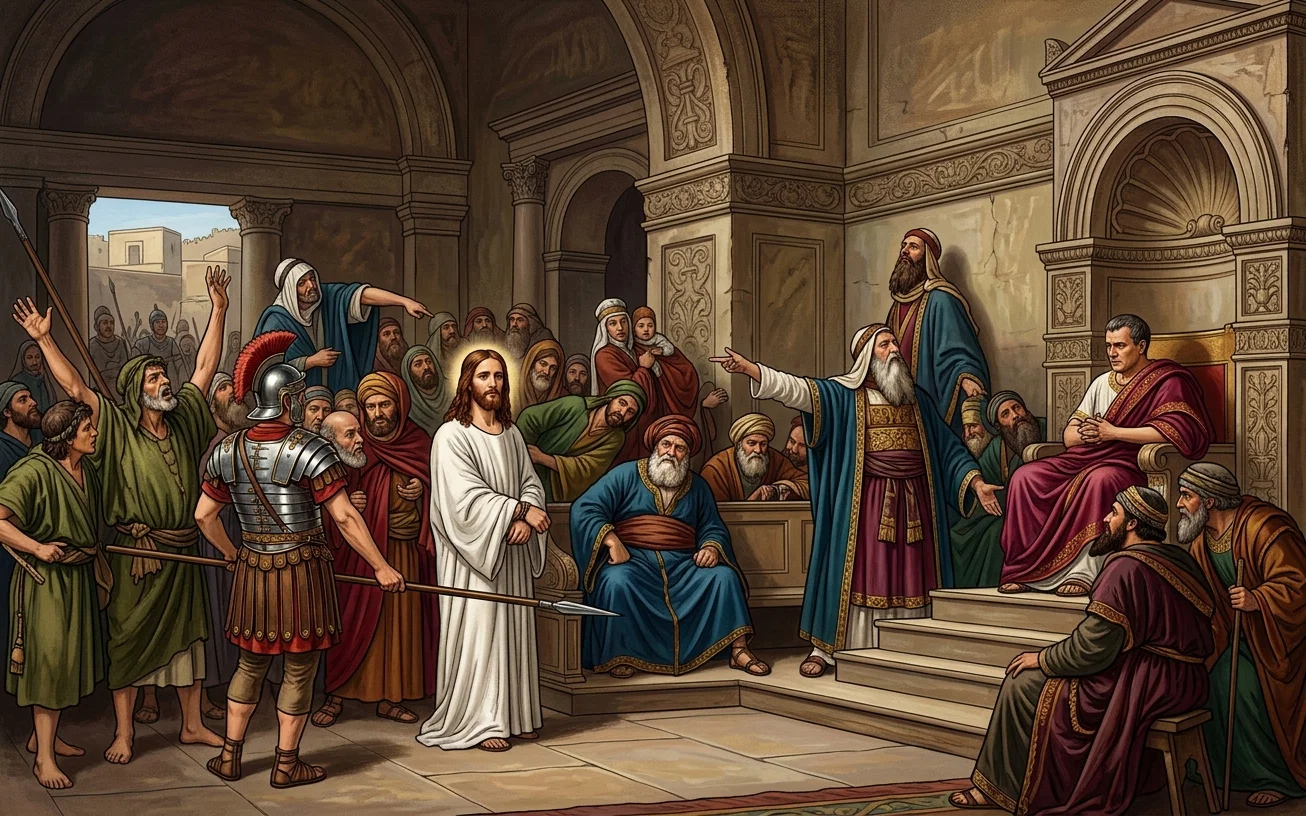
JESUS OR BARABBAS?

“BEHOLD, the Man!” in our last issue, should have followed this chronologically, but the order matters little to the great moral lesson involved. This part of the narrative of the passion week of our Lord deals with a great moral crisis, one of the critical moments of the ages, when the rulers of a nation write its doom.
CHRIST BEFORE PILATE.
JESUS had been before the proud Annas for examination, where He was denied of Peter. Thence He was taken to the haughty Caiaphas, the high priest. Here suborned witnesses testified against Him, and under oath Jesus declared Himself to be the Son of God. For this He was adjudged guilty of blasphemy and “worthy of death.” Then followed the abuse of the brutal servants, who sought, as such minds ever do, to curry favor with their meaner masters by abusing those whom the master hates. They mocked Jesus, and beat Him; they spit in His face; they blindfolded Him and struck Him, and tauntingly asked, “Prophesy unto us, Thou Christ; who is he that struck Thee?” And so the reviling and smiting went on, till even mad malevolence and bestial brutality grew weary. Even so have such hearts treated Christ’s followers in the crisis of centuries which have followed.
ALL this was in the night, and no sentence was then legal according to Jewish law. In the morning the farce was repeated, Jesus was brought before the Sanhedrin, He was condemned. Then came Judas with his too late confession, which condemned the chief priests and elders. Then, as the Jews had no power to execute the death sentence, Jesus was bound and delivered to Pilate in the Prætorium; but, with hypocritical sanctity, the priests would not go in for fear of defilement. They could defile their hearts with murder, but they must not run the risk of coming into outward contact with Roman leaven. By such tricks the devil deceives his dupes in making them believe that they have a conscience.
PILATE went out to the Jews, asked for their accusation, told them to judge Jesus themselves, which they admit they can not do. He examines Jesus, finds Him guilty of none of their charges, and declares to the Jews, “I find no crime in Him.” And when the accusations were heaped higher, the governor again declares, “I find no fault in this Man.” Then learning that Jesus had lived in Galilee, Pilate sent Him to Herod, the governor of that province, then in Jerusalem; and Herod, after his senseless mocking, sends Him back to Pilate uncondemned.
AT the great feast of the Jews, the yearly Passover, it was the Roman custom to release to the Jews whatsoever prisoner they desired. Many of the Jews imprisoned by the Romans were guilty of no petty crimes. Their crimes were against the Roman state. In the eyes of the Jews, they were patriots. Sometimes they had resisted the grasping Roman tax-gatherer, or publican. To make the Jews feel their yoke lighter, and to allay the national spirit likely to burst forth on this great annual gathering, they were allowed to ask this boon of their rulers.
AS THE multitude come before him and clamor for their privilege, Pilate sees in it an opportunity for releasing Jesus. He will not let them choose this time. He will choose two, one the very worst of criminals, a robber and a murderer, the son of Abbas, and the other Jesus. First, he asks, “Will ye that I release unto you the King of the Jews?” He knew that their envy moved them to act. Again and again, stirred by his own sense of justice, by his wife’s message, by the noble bearing of Jesus, he endeavors to obtain their consent to release Him. He tells them there is no crime in Him, nothing worthy of death, no fault at all. But the rulers of the Jews will not hear. They move the people to ask for Barabbas, and the unthinking mob asks for Barabbas. Is it possible, thinks Pilate, “Whether of the twain [Jesus or Barabbas] will ye that I release unto you?” and with one mad voice they cry, “Barabbas.” “What then shall I do with Jesus who is called Christ, whom ye call King of the Jews?” They all say, “Let Him be crucified.” And he said, Why, what evil hath He done? But they cried out exceedingly, saying, “Let Him be crucified.”
PILATE could do no more. He had weakly yielded to one thing after another, the choice of the people, the consent to scourge; and now the people forced him to the ultimate. He took water and washed his stained and guilty hands, and said, “I am innocent of the blood of this Righteous Man; see ye to it.” And all the people gave the awful answer: “His blood be on us, and on our children.” Then released he unto them Barabbas whom they asked for; but Jesus he scourged and delivered to their will to be crucified.” Thiswas the climax of the crisis with that nation. It was God’s last effort to save Israel by sending His only begotten Son. But they despised the prophet of God, they mocked His messenger, they laughed at His message, till the wrath of the Lord arose against them and there was no remedy. If they had known that the Man they crucified was the Son of God, the Messiah, they would not have said the words nor done the deed. They did not know because they did not desire to know. They were willing to be ignorant. They thought more of their sins than of His reproofs of righteousness, and they made an eternal mistake with its awful consequences.
THE lesson is for us as individuals. To us sometime comes the question, “What will you do with Jesus who is called Christ?” We must choose. We may not temporize. It is insistent and must be decided. Put it off if we will, it will come again till it asks, Which will you choose, your own sins and lusts and desires and ways, or Christ? Which will we take? He will not divide our heart between our sins and Himself. It is all or nothing. It is Christ or Barabbas, the robber, the murderer, of our lives.
“Once to every man and nation comes the moment to decide In the strife of Truth with Falsehood, for the good or evil side. Some great cause, God’s new Messiah, points each the bloom or blight, Parts the goats upon the left hand and the sheep upon the right, And the choice goes by forever, ’twixt that darkness and that light.”
Nations are deciding to-day. Men are deciding to-day. We have decided or are deciding to-day. O, decide for Christ. Choose not the son of Abbas, but the Son of God.

AS GOD WILLS—NOT AS MEN MAY.

The contention that God's Sabbath law is different from all other laws in that it is not a legal requirement, is almost too puerile for notice; but there are some people who accept it because they are willing to grasp at any straw that even promises support in disobedience. Such people can be, and are, deceived by the illusion that a commandment of God can be obeyed by doing something else. This deceptive perversion of the Word assumes that it is more pleasing to God to have us ignore what He has positively commanded than to obey it; that we are not to suppose that we must do that which is commanded, but rather that we may do something else, more to our own liking; that by construing His law in this way, we may “show our grateful love and praise to Him” more effectually than by direct obedience of a definite commandment.
The fallacy of such contention may be seen by applying the logic of it to human law, especially to the orders of a human father to his son. The father gives his son definite directions for some specific duty to be performed on some definite day, stating plainly why it should be done on that day—the reason being such as could not apply to any other day. But the son assumes that he can better show his “grateful love and praise” to his father by choosing some other time to perform the service. He argues that the commandment of his father is not something that he must do as commanded, but it would be rather pleasing to the parent for the son to do something different, or to do the same thing at a different time, on some plausible pretext. Very few parents would be better pleased by the son's choosing to have his own way.
So the Lord has set apart a certain time for mankind to memorialize a certain event (Gen. 2:2, 3; Mark 2:27), and men think to better show their “grateful love and praise” by ignoring that institution, and by memorializing another event on another day. In other words, they deem it better to lay aside the commandment and hold to the tradition of men. But the Lord says such worship is vain. Mark 7:5-9. Again, He lays down this eternal principle, that all would do well to heed: “Not every one that saith unto Me, Lord, Lord, shall enter into the kingdom of heaven; but he that doeth the will of My Father which is in heaven.” “Why call ye Me, Lord, Lord,” He says again, “and do not the things which I say?” G.

THE MOTIVE POWER OF GRATITUDE.

THERE is no greater sin than ingratitude. It is well called monstrous, fiendish, treasonable. The sympathetic heart wonders in amazement at the story of the ten lepers. We can hear the vows and promises which their agony-wrung lips uttered previous to their healing; but not one grateful word came back to the Healer from nine of these; and yet their case is typical of millions who are as truly ungrateful. Are we like the Samaritan one, or the professedly Israel nine?
Gratitude is a desire to be kind or beneficial, together with a lively sense of the benefits received. It combines the three elements of humility, truth, and justice. Humility is a realization that we are nothing in ourselves; truth teaches that all that we have came from God; and justice teaches that we ought to render to the Giver all in our power for what He has bestowed.
True gratitude keeps in mind God's received goodness. Its language is:
“Bless Jehovah, O my soul; And all that is within me, bless His holy name. Bless Jehovah, O my soul, And forget not any of His benefits. It is He who forgiveth all thine iniquities, And who healeth all thy diseases; Who redeemeth thy life from destruction; Who crowneth thee with kindness and mercy; Who satisfieth thy mouth with good, So that thy youth is renewed like an eagle’s.”
Ps. 103:1–5, Boothroyd.
In its recognition of God's goodness its question is:
“What shall I render unto Jehovah For all His benefits toward me?”
All our bounties, all benefits, all blessings, which have ever touched our lives are from the Giver of all good, the purchase price of the blood of Christ. He is an all-merciful Giver to an undeserving receiver. The life, and honor, and glory of Heaven's Best was laid upon the altar of sacrifice that God's enemies, slaves of sin, traitors to His government might be saved. O, does not such love awaken within our hearts more than a mere sense of duty? Does it not make the heart tenderer, more responsive to the needs of others? Ought not gratitude to God for all that He has given us call forth from us the highest, holiest consecration to His service in labor for the poor and needy in body and soul? Well has Thomas Gibbons written of the two classes:
“That man may last, but never lives, Who much receives, but nothing gives; Whom none can love, whom none can thank. Creation's blot, creation's blank. But he who marks from day to day, In generous acts his radiant way, Treads the same path his Saviour trod, The path to glory and to God.”
Gratitude must be guided by wisdom. Its exuberance must not always control. Like the healed demoniac of Gadara we may wish to sit at the feet of the Master, or like Peter on the Mount of Transfiguration we may wish to build houses and remain in the blessed Presence; but true, wise gratitude will give heed to the Master's directions to go to the needy ignorant who have known us in sin, or those in the possession of Satan in the very shadow of the mountain of glory. See Mark 5:15–20; Matt. 17:1–9, 14–16.

HOW TO MAKE THE MOST OF LIFE.

PRACTICAL life is an investment of time, means, health, and talents in general; it is the utilizing of opportunities, temporal and spiritual. Like all judicious investments, the more one puts in, the more he will get out. A proper investment of talents has no selfish purpose in view; the thought in mind is that “it is more blessed to give than to receive.” While we may properly “have respect unto the recompense of the reward,” that is not the actuating motive if one would get the most out of the investment.
Christ was the Creator of man, and designed that His creatures should secure the greatest possible returns for their investment of their God-given talent. He not only created man, but when man, through disobedience, was reduced to a life of short duration and limited opportunity, the Lord became Man Himself, and set an example of wise investment of the talents at man’s command. Of all men, He knew best how to put the most into a few years, and consequently how to get the most out of the brief allotment of time.
It is well to note His mode of investment. First, He humbled Himself. This shows that He was not grasping after the gains that pertain to this world. Secondly, He did His heavenly Father’s will instead of His own; He put in His whole time and energy in doing such works as would please the Father. His every effort was to this end. This was His idea of putting the greatest amount into the practical purpose of a well-ordered life. This was His idea of laying up His treasure in heaven, and His advice to us is that the wisest investment is to lay up treasure in heaven, rather than to invest in the perishable goods and transient honors of this world.
Now as to the gains of Christ’s investment during His short career on earth. What did He get in return for all that He in His humble way put into that life? The result to Him, sofar as this life is concerned, was a most cruel execution, an ignoble death. But that, being the result of His faithfulness, was also the seal of His great reward. The record says: “Wherefore God also hath highly exalted Him, and given Him a name which is above every name; that at the name of Jesus every knee should bow, of things in heaven, and things in earth, and things under the earth; and that every tongue should confess that Jesus Christ is Lord, to the glory of God the Father.”
It is not possible to get more out of a life than Christ got out of His; then it is certainly the part of wisdom to follow His example in the matter of investment, of putting the most into life that is possible. By following in His footsteps, we have the promise of reward in the same line of His. “To him that overcometh will I grant to sit with Me in My throne, even as I also overcame, and am set down with My Father in His throne.” Surely, then, to follow Christ in His humble, self-sacrificing earthly life, is to put that into our probationary career which will enable us to get the most out of it. “Blessed are the pure in heart; for they shall see God.” “If thou wilt enter into life, keep the commandments.”
G.

Other Commandments Do Not Nullify the Sabbath

It is a poor excuse for rejecting the Sabbath of the Lord to say that there are other commandments than the Decalogue; to say that “the great body of that people [Seventh-day Adventists] never dream that the word ‘commandments’ ever means anything but the Ten Commandments.” People who read “seventh-day literature” know better, but that stands for nothing when an excuse for disobedience is wanted. Of course there are other commandments of God besides the Decalogue, and Seventh-day Adventists always have recognized the fact, and often refer to them in their literature, especially in advocating health reform, the tithe, the ordinances of the Lord’s house, works of charity, etc. But no matter how many other commandments of God there may be, that fact does not vitiate any of the Ten Commandments. When the psalmist says, “Thou art near, O Lord; and all Thy commandments are truth,” he does not leave out any commandment of the Decalogue.

Question Corner

1788.—Ten Lost Tribes.

Please explain about the ten lost tribes, and where are they? Where did Israel get the message that God sent through Malachi if they were lost? F. H.
The “ten lost tribes” is not a Bible term at all. There have been all sorts of fanciful theories erected on that idea. Of course, the kingdom of the ten tribes was subverted until God utterly overthrew it, and yet the Lord declares in Romans 11 that there was always a remnant left. The honest-hearted ones were true to the worship of the God of Judah. We read that in the time of Josiah, after the ten-tribe kingdom had been overthrown, the tribes were still there, and messengers were sent among them to bring them back. Some turned to the Lord, but others hardened themselves, and while the kingdom was called the kingdom of Judah, there is no question at all but what there were those of the other tribes connected with it all the way through. James addresses his epistle “to the twelve tribes that are scattered abroad, greeting.” There are many different theories, one that the Indians of North America are the ten tribes, another that they are the Anglo-Saxon people; but all these have no ground in the Scriptures. Joseph Wolfe, a converted Jew who traveled extensively in the East, tells us that remains of those tribes are still found in Afghanistan, Persia, and other states in the East, and that the old rallying cry would still call their attention, “Hear, O Israel!” Many of these doubtless accepted Christianity in the early centuries. We do not have the records of these separate tribes, but doubtless God keeps them, for in Christ there is neither Jew nor Greek, circumcision nor uncircumcision, barbarian nor Scythian, bondman nor freeman; all who are in Christ are of Israel.

1789.—Investigative Judgment and 1844.

What is the Bible proof that the investigative judgment began in 1844, and that it will end in this generation, and that then the Lord will come?
To give a full account of this would be to study the whole subject of the sanctuary and priesthood of Christ. See the last of the four Special SIGNS, and also Signs of the Times Leaflet No. 6. The cleansing of the sanctuary, Leviticus 16, in the type was literally a judgment work. All who did not on the last day of ministration, on the great day of atonement, afflict their souls, were cut off from among God’s people. In Dan. 8:14 we read, “Unto two thousand three hundred days, then shall the sanctuary be cleansed.” That period is prophetic, the days standing for years. They began 457 B.C. and ended in A.D. 1844. To this time the angel refers in Rev. 10:7 when he says: “The mystery of God shall be finished, as he hath declared by His servants the prophets.” The mystery of God is the Gospel; the finishing of the mystery is the finishing work of the Gospel. The closing part of every probationary work must be a judgment work, to ascertain how many have availed themselves of the pleasures and opportunities offered. Synchronous with this work is God’s great message of warning and invitation to the world. Rev. 14:6–14. The warning of the judgment must end with the close of the judgment. That judgment simply determines who shall be found worthy to stand when Christ shall come. See works on the sanctuary advertised from time to time in this paper, such as “Christ Our Advocate,” etc. For the meaning of “this generation” see SIGNS OF THE TIMES of February 14 and onward, under heading, “A Great Literal Prophecy.” “This generation” begins with the judgment message and closes with Christ’s coming.

1790.—Close of Probation.

Does probation close to different individuals, or do all living have a chance until the close of probation for all?
Just as long as a single soul lives, he has opportunity, so far as God is concerned, to come to the Lord. His mercy endureth forever, and He declares, “I am the Lord, I change not.” Man’s probation is cut off when he so rejects God’s counsel and reproof and invitation that he can no more hear or distinguish the voice of the Lord or yield to His love. That being the case would indicate that probation closes at different times because different individuals harden their hearts to the utmost, or in other words, take their stand against God. Of course, there will come a time when truth has been covered by the awful errors of the last days when the multitudes in the valley of decision will decide largely together, and thus the probation of the whole world will close. When the last plea of mercy has been made, and infinite love has done all that it can possibly do to reclaim the lost, infinite justice will cry, “It is enough,” and men will be left to themselves to reap the awful fruitage of their own sowing.

1791.—Circumcision and Baptism. Mark 16:15.

Isaac was circumcised when eight days old. Please tell why infants should not be baptized when eight days old. Also tell who has the right to baptize. G. W. S.
Circumcision as applied to the Jewish nation is no parallel with Christian baptism. It certainly is not wise to look back to what might seem to us a parallel or type, but which we are expressly told is nothing (1 Cor. 7:10), when the Lord very clearly reveals the truth and the duty for this dispensation. Peter’s words are, “Repent, and be baptized every one of you.” Acts 2:38. Jesus declares, “He that believeth and is baptized shall be saved.” The whole question turns over the matter of faith. God asks for intelligent children, those who are His by choice. Those who have the right to baptize are those who are sent by Him and ordained to do His work. He ordained the twelve (Matthew 10); He sent them forth (Matt. 28:18–20). Others have been ordained all the way through. He has sent forth others and is still sending them.

1792.—Genealogy of Christ.

Please explain the genealogy of Christ in Matthew 1 and Luke 3. In Matthew Jesus is said to be the son of Jacob, and in Luke he is called the son of Heli, which please explain. F. H.
There are no differences in these accounts, which may be harmonized under two or three suppositions. If we understood the customs of that time and were thoroughly acquainted with the people of that day, we would see no contradiction at all. Heli may have been another name for Joseph, as Levi was of Matthew, or the generally-accepted supposition is doubtless correct, that one gives the genealogy of Christ through Mary and the other through Joseph. In the light of the Jewish laws Joseph was the legal father, hence in both cases he is named as the father of Jesus, because by the law he was so considered; yet of course the fleshly descent came through Mary; but as she was the wife of Joseph, Joseph is treated as the son of her father, and Jesus as the son of Joseph.

1793.—Manifestations of Departed Spirits and John Wesley.

Do you understand that John Wesley was a believer in manifestations of departed spirits of the dead? Is there any proof of this?
We do not now recall as to whether there is anything in Wesley’s writings which we have read to prove this, but the writer has not all of Wesley’s writings. Some of our readers may be able to tell us. He may have so believed. Whether he did or not, of course, does not in anywise affect the truth or falsity of the theory.
Continue reading: RESPONSIBILITY OF FREEDOM