Your ShelfYour Projects

Signs of the Times, Vol. 40, No. 33.

Seed Sowing and Harvest

Signs of the Times

Aug 26, 1913

Pacific Press Publishing Association · Mountain View, California · Aug 26, 1913

Seed Sowing and Harvest

(The meaning of the Parable of the Tares and Wheat by Jesus)
HE that soweth the good seed is the Son of Man; the field is the world; the good seed are the children of the kingdom; but the tares are the children of the wicked one; the enemy that sowed them is the devil; the harvest is the end of the world; and the reapers are the angels.
As therefore the tares are gathered and burned in the fire; so shall it be in the end of the world. The Son of Man shall send forth His angels, and they shall gather out of His kingdom all things that offend, and them which do iniquity; and shall cast them into a furnace of fire: there shall be wailing and gnashing of teeth. Then shall the righteous shine forth as the sun in the kingdom of their Father. Who hath ears to hear, let him hear.

Pacific Press Publishing Association

PACIFIC PRESS PUBLISHING ASSOCIATION MOUNTAIN VIEW, CALIFORNIA

"IF YE WILL INQUIRE, INQUIRE YE."

This Inquirers' Department is conducted for the purpose of helping those who are studying the Bible. The answers are oftentimes only suggestive. They are never to be considered infallible, only as they agree with the infallible Word. The writer who may answer these questions does not consider that his opinion is infallible. He will simply give the best that he has, and plead with the inquirer to search the Word. Such questions only will be answered as, to the editors, seem to minister to the good of the readers and to the mission of the paper. We can not answer repeatedly in the same volume questions upon the same scripture. The name and address must accompany question, not for publication, but as an evidence of good faith, and that answer may be made by letter if deemed advisable. No letters are answered which do not contain the name of the writer. It is well always to enclose stamp for reply.

4160 — Striving for a Prize

Is it wrong for us to enter worldly contests to win a prize? Is this self-denial? G. R.
It would seem as tho the prize which is set before God's children, the crown of eternal life, ought to be so prized as to use all their energies, without dividing them between the crowns or prizes that perish. To the young man Timothy the apostle addressed these words: "No soldier on service entangleth himself in the affairs of this life; that he may please him who enrolled him as a soldier." And then he uses this illustration concerning worldly things: "And if also a man contend in the games, he is not crowned, except he have contended lawfully." Now that is what the Christian ought to do. In the great race set before him, he should contend lawfully, that is, in harmony with the rules of God's word. Another illustration, found in the 12th chapter of Hebrews, is that in running in the race, he should "lay aside every weight, and the sin which doth so easily beset us." In other words, every energy should be bent to the one thing of winning what God has called us to win. See Phil. 3:7-14.

4162 — "Is Greater than He," Matt. 11:11

Please explain Matt. 11:11. I. M. E.
The verse reads as follows: "Verily I say unto you, Among them that are born of women there hath not arisen a greater than John the Baptist; yet he that is but little in the kingdom of heaven is greater than he." Our Lord could not have meant that they were greater in the mission that was given them, or greater in character, because the verse itself tells us that "among them that are born of women there hath not arisen a greater." We could hardly understand this as having reference to all the various qualities that make up the man, but no one had ever been given a greater mission for God than had John. He was the immediate herald of our Lord's coming, but he died without seeing accomplished what he predicted. His whole life seemingly was one of sorrow and disappointment. He himself expressed the truth of it and character of it when he said of Jesus, "He must increase, but I must decrease." The very message which called multitudes from all Judea and all the country round about to hear him must grow less,—nay, must be silenced completely in the greater message, in the greater power and glory of the life of Christ. His mission was great. His privileges, however, were of the very least. He even, when in the prison at Machærus, doubted his very message, or rather, doubted as to whether Jesus was the One who fulfilled it or not. It would seem, therefore, that our Lord's words had reference to point of privilege rather than that of character or greatness of mission. "Yet he that is but little in the kingdom of heaven is greater than he." That is, in the light and glory and illumination that came through Christ, but which John the Baptist did not himself enjoy. "Desire of Ages," page 220, has an excellent comment upon this:
"Aside from the joy that John found in his mission, his life had been one of sorrow. . . . His was a lonely lot. And he was not permitted to see the result of his own labors. It was not his privilege to be with Christ, and witness the manifestation of divine power attending the greater light. It was not for him to see the blind restored to sight, the sick healed, and the dead raised to life. He did not behold the light that shone through every word of Christ, shedding glory upon the promises of prophecy. The least disciple who saw Christ's mighty works and heard His words was in this sense more highly privileged than John the Baptist, and therefore is said to have been greater than he."

4163 — His Soul Within Him Mourneth

Please explain Job 14:21, 22. How could one's soul mourn, and flesh have pain, when in death a man knows not anything?
This is quite easily understood if we will but remember that verses 20 and 21 refer to his death, but verse 22 refers to the time when he lives. "Thou prevailest forever against him, and he passeth: Thou changest his countenance, and sendest him away. His sons come to honor, and he knoweth it not; and they are brought low, but he perceiveth it not of them." That is, he is dead; he knows nothing of these things. But now, while he lives, his flesh upon him has pain, and his soul within him mourns.
Schedule for the Week Ending August 30, 1913
Sunday August 24 Ezekiel 28, 29
Monday 25 30, 31, 33
Tuesday 26 34, 35
Wednesday 27 36, 37
Thursday 28 38, 39
Friday 29 Daniel 1, 2
Sabbath 30 6, 12
We have some very interesting chapters in Ezekiel, predicting the judgments which are to come upon Egypt, one of the greatest of kingdoms. Her rivers are to be dried up, her idols are to be abolished, and she is to become the "basest of kingdoms," every prediction of which has been literally fulfilled. Chapters 33 and 34 are marvelously instructive chapters for God's watchmen at the present time. And with the reproof comes the promise of the one Shepherd that God will set over His flock, and the glorious land in which He will lead them. Chapter 35 is a prophecy against Seir, or Edom; chapter 36, against Israel. Chapters 37, 38, and 39 are predictions which would have been carried out in that day if Israel had complied with the conditions; but not complying with the conditions, God could not fulfil to her what the prophet had foretold. They will be fulfilled in the last days, but under entirely different conditions — much more broadly and strongly and gloriously.
We omit the description of the sanctuary in chapters 40-48 — the sanctuary that never was built, never will be built, but would have been built if the Jews had been "ashamed" and had repented. There are those who tell us that it is yet to be built; but the fact that sacrifices were to be offered in that temple, shows clearly that it is not one that God would again ordain. Our week closes with four chapters from the book of Daniel, — Daniel 1, 2, 6, and 12, — lessons in temperance, in revelation, in God's care for His children in persecution, and in the predictions of that glorious day when all God's prophecies shall be fulfilled, and every man shall stand in his lot.

4157 — Genealogy of Jesus

Will you kindly explain, through your paper, Matt. 1:1-17 and Luke 3:23-38?
Matt. 1:1-17 gives us the royal genealogy of Jesus. Joseph was the reputed father of Jesus, was in law his legal father, and the right of rulership comes through the male; and therefore the genealogy from Abraham down through the royal family of David comes to Jesus through His legal father. This is through the royal line, and it is Matthew that talks of the kingdom of God. The very next chapter tells that Jesus was born in Bethlehem, the city of David, in the days of Herod the king, and was called the king of the Jews. Luke, however, presents our Lord preeminently as the Son of Man; and therefore he shows His descent from Adam, the very first man, tracing it clear back to God, the Creator of man, and reversing the record from Adam down to the mother of Jesus. But inasmuch as the genealogy comes through the male, the mother herself is not named. That would have been contrary to Jewish usage and law. So it tells us that Jesus "began to be about thirty years of age, being (as was supposed) the son of Joseph, which was the son of Heli." Heli was evidently the father of Mary. This seems to be the most reasonable view of it; and tracing back through Heli, we are carried through the royal family of David again, up through the seed of Abraham, to Adam, the progenitor of the race; one tracing Jesus through the royal line, the other through His human descent.
—★—

4158 — Mohammedans and the Sunday

When the great apostasy holds full sway again, and presses legal Sunday keeping on the world, will it bring the Mohammedans in subjection to them in the change of their day of worship from Friday to Sunday? J. L. L.
In the first place, Mohammedans keep only about an hour of Friday, or the sixth day. It has not very much sacredness in their minds—simply a little time for offering prayer. In all probability, the whole world will join in the legal Sunday. It will simply be to many a legal day. That is all that will be required. To some it will be religious. Some will not see in it the worship of the beast power. Even the great heathen countries at the present time are talking seriously of making the first day of the week a mere legal rest day. There will no doubt be more or less struggle between Christianity and Mohammedanism. There are prophecies which seem clearly to indicate it. But the nominal Christian powers which are apostate will be triumphant until our Lord shall come. When He takes to Himself His great power and reigns, all apostasy will be swept away.

4159 — "The Elect Lady"

Please explain 2 John 1. Did "the elder" mean the church and the members, or was the epistle addressed to a member of the church and her family?
G. R.
There are those who think that this was addressed to a certain lady, or member of the church, and her own children. The "elder" has reference to John the writer, and the elder sends to this woman, whom he calls "the elect lady," and to her children through her, this epistle to strengthen and comfort her. This clearly seems to be the meaning of it. Sometimes "the elect lady" is taken as the church, and her children as church-members. And this application would be a very fitting one as an illustration, if nothing more; but the epistle itself seems to have been written to an individual woman.

4161 — Unclean of Itself

Please explain Rom. 14:14. What does it mean?
The text reads: "I know, and am persuaded by the Lord Jesus, that there is nothing unclean of itself; but to him that esteemeth anything to be unclean, to him it is unclean." You will notice that the margin reads, "common,"—"I know, and am persuaded by the Lord Jesus, that there is nothing common of itself." The last two verses of the chapter indicate that the eating must be by faith; but faith has reference to God's word, for it is founded upon the Word. "Faith cometh by hearing, and hearing by the word of God." Rom. 10:17. But God has made distinction as between meats, not simply in the Levitical law as set forth in Leviticus 11 and Deuteronomy 14, but evidently from the very beginning, when sin entered, as shown in the history of Noah in the discrimination that was then made between clean and unclean animals. What the apostle here seemingly has reference to is ceremonial uncleanness, not things that are fitted, or not fitted, for food. We would not gather from this that he meant that whatever there was, and whatever creature there was, was fit for food. There were many, doubtless, in the great Gentile world, that were eating things that were to the Jew abhorrent; and yet the conscience had not been condemned, nor had the soul seen that it was in any way unclean, and the Lord did not judge or condemn such a one, nor ought we. On the other hand, those who were better instructed did see some things as unclean; and if they so saw it, they ought to follow their convictions. If we understood all the questions that arose at the time of the apostle, some of these things would be clearer. There is one rule, however, that he has given us which is always clear, and ought to come home to every true Christian heart, expressed in 1 Cor. 10:31.—"Whether therefore ye eat, or drink, or whatsoever ye do, do all to the glory of God." The soul that follows that, will endeavor to follow his Master in all things, and to use the blessings which God has given us for food in such a way as will give us the strongest body, clearest mind, and a heart that is responsive to Him. Remember that the great central thought of Romans 14 is not a diet question, but that man should not judge his brother.

Watch and Pray

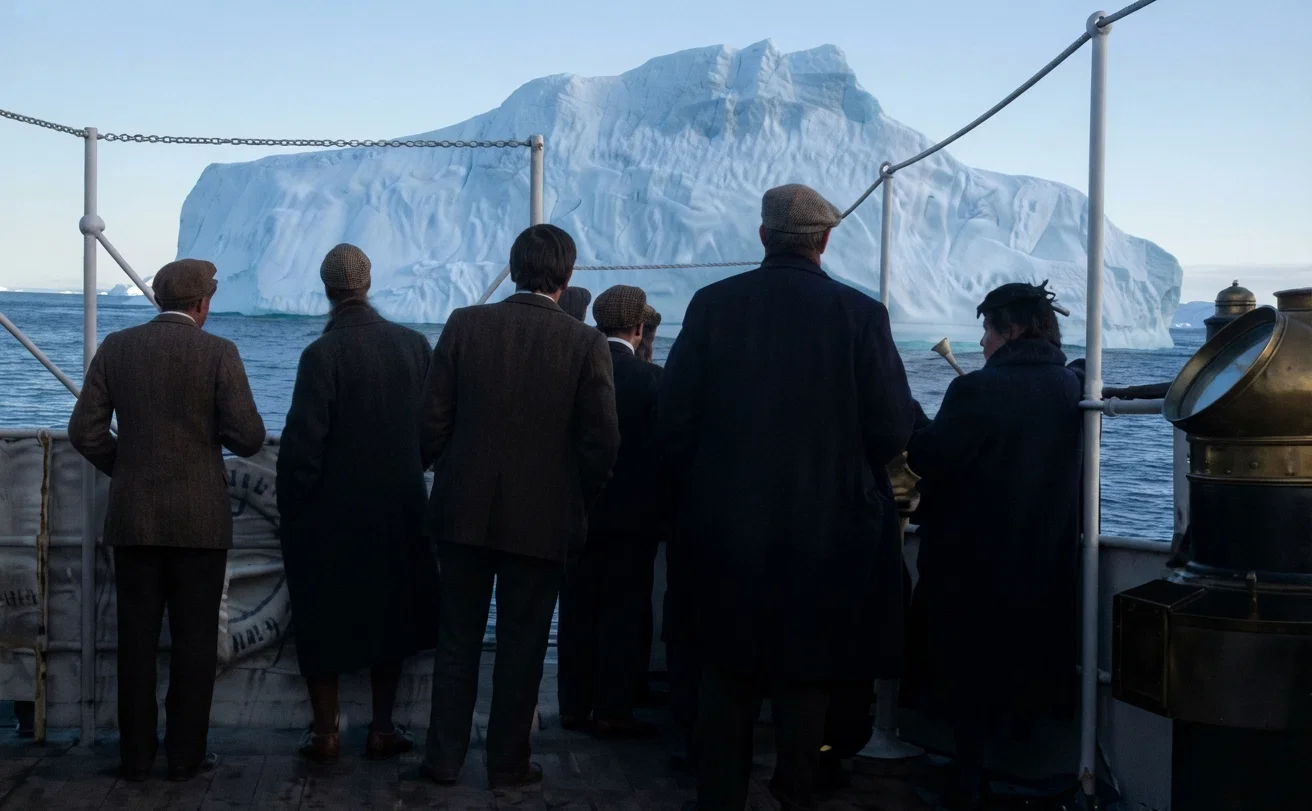
OUR illustration on this page is from life. It is a scene from the French Atlantic liner the Caroline, one of the great, typical, floating cities which are continually crossing the Atlantic. Beyond the ship looms one of the mighty menaces to navigation in the North Atlantic from spring to mid-summer,—a gigantic iceberg.
The officials of the ship measured it by means of a sextant, that useful instrument used to determine latitude at sea, or the angular distances between objects, for finding the position of a vessel, and other things.
The huge monster is determined to be 910 feet long, 520 feet thick or wide, and 227 feet high above the water line. It is from eight to ten times that depth below the water, and it may have ten or a score of feet sticking out in every direction, hidden by the water. It is a veritable mountain of ice, constantly changing its place. It was met in north latitude 47° 44', in west longitude 50° 41', at 5:55 A.M., May 27, near the very place where the ill-fated Titanic went to her untimely grave a little more than one year before.
The importance of care and watchfulness on the part of the Titanic crew seems not to have been emphasized or properly weighed. We may be sure that every precaution was exercised by the men in charge of the Caroline. The memory of the great disaster of thirteen months before had not yet become dim, and the growing chilliness of the atmosphere in the proximity of such a mountain of ice was doubtless apprehended.
About twenty-eight years ago, an Atlantic liner eastward bound found itself one night enveloped in a cold fog. The ship was slowed down, and scarcely felt her way, so slowly did she move the remainder of the night. When the fog lifted in the morning, she was in an open space, with five mighty sentinels surrounding her as if jealous of each other. Caught between any two, she would have been crushed as an eggshell. Her officers knew she was near the great bergs; but the fog hid them, nor had we wireless telegraphy then. It was with devout thanksgiving to God that the ship was slowly navigated through a narrow strait between two of the huge monsters. And we may be sure that the passengers were grateful that the shipmaster did not rush recklessly on in the fog with a vain, confident feeling that his good ship was sufficient.
Photo by Underwood & Underwood
We recall such an instance when crossing on the state line steamer Nebraska, New York to Glasgow, in 1884. The atmosphere one day began to grow cooler. The officers began to lift up buckets of water from the ocean and take their temperature. This was continued at intervals, with the water growing colder, and our cautious Scotch captain knew we were nearing an ice-field. More slowly moved the ship, and in the morning the mighty monster that could cool cubic miles of air and water appeared. Our captain characterized it as a great ice-field broken from some mighty glacier. One mile long, its width indeterminate, and rising from the water one hundred feet, which meant that the whole depth was nearly one thousand feet! We wished the captain to go nearer, but he refused. He would risk neither the projecting hidden feet nor the sudden fog which might arise.
We are all sailors on life's uncertain sea. There are mighty menaces on that sea. There are foes to meet stronger than we. There are temptations as much greater than our unaided power to resist as the iceberg was greater than the Titanic. These menaces to navigation in the Atlantic are dull, insensate things; they mean nothing. The ships simply are crushed by accident, and not because of any intelligent force directed against them. But the Christian has foes with intelligence, malevolent intelligence, directed against him with an intensity and objectivity that he can not escape. Meet them he must; it is their object to destroy him.
Have we a safe master on board? Do wefeel sufficient ourselves? Do we think we have sufficient strength in our ship, sufficient lifting power in her separate chambers, that we could endure the wreck? So the officers of the Titanic felt. Are we so wise in our own estimation that we are willing to run without watch? Such a course is folly in the extreme. The captain of the forces that are against us is Satan. He has practised on the human family the six thousand years of its history. Mightier than we have gone down before him, utter wrecks on life's sea. Some of the men who have won the mightiest battles of the world have yielded to him. We are not stronger than they. Our hope is in having the master of our ship yielded to a mightier Master.
God has given us a chart for the sea of life. It may seem to us all uncharted, looking at it from our human reason; but with God it is charted from end to end. And that chart which points out the sure and safe route, which reveals the hidden dangers, which has within it that power and potency and discernment that will enable us to know that we are meeting these subtle means of destruction,—that chart, that guide, is His word.
But that Word will not guide us unless we desire to know it. We shall not be guided by its marvelous teaching unless we are willing to study it. The Master of that word will not give us the power that lies within it unless we seek His counsel. It is a time to watch; it is a time to pray. Never before in the history of God's church was watchfulness and prayerfulness demanded as it is to-day, and never was there a time in the history of this world when there was so much recklessness and disregard of divine counsels, especially among those who profess His name. The heathen will use all of his various superstitions to insure success. The infidel who has been reared under the influence of Christianity has swung to the other extreme, and feels himself sufficient. The wise man will recognize his own utter weakness and inefficiency. He will learn of the nothingness of humanity from its history in the past, and he will also recognize the great God who leads and guides as He has led and guided those who have sought Him through all the ages. Therefore watch, lest you enter into temptation; and pray that His power may be given you to meet every foe.

Our Lord and Moses

THOSE who reject the writings of Moses must get very little satisfaction, comfort, or help from the record of our Saviour's temptation in the wilderness, and how He met successfully the prince of darkness at that time. Three times He is assaulted by the powerful tempter (Matt. 4:1-11); three times Jesus meets his assault with scriptures drawn from the great treasure-house of the writings of Moses. The first time, He uses Deut. 8: 3; the second, Deut. 6: 16; the third, Deut. 10: 20.
He in whom dwelt “all the treasures of wisdom and knowledge,” drew from the arsenal of God’s word His weapons of defense. If divinity veiled by humanity needed these to conquer, how much more do we! But those who reject Moses, will virtually reject the temptations of Christ, as being merely traditional or allegorical. Most truly said the Master: “For had ye believed Moses, ye would have believed Me: for he wrote of Me. But if ye believe not his writings, how shall ye believe My words?” John 5: 46, 47. There are the same evidences to the truth of the Pentateuch as to the truth of the Gospels. The Bible is one.

The Seeking Saviour

ALL God's people rejoice in the assurance of the divinity of Christ; but is it not of great importance that we keep in our hearts the equal assurance that He is also the Son of Man, the second Adam, a quickening spirit (1 Cor. 15:45), the link between divinity and poor, weak, sinful humanity? "Son of Man" is the title our Saviour always loved to call Himself, as it shows clearly the indissoluble union between God and man; for He was very God and very man — God in the very nature and exercise of His power, and in His ability to save to the utmost; and man in the incarnation of sinful flesh, a man acquainted with all the griefs, sufferings, and sorrows that flesh is heir to.
Luke, "the beloved physician," dwells more on the human side of our Saviour than any other of the sacred writers. Matthew traces His genealogy to Abraham; John, the "beloved disciple," shows His divine genealogy — "The Word was God;" but Luke traces Him back to Adam, the first man.
Great and excellent instruction is given us, in the book of Luke, in the parables of the good Samaritan, the lost sheep, the lost piece of silver, the prodigal son, the penitent thief, the penitent publican, Zacchaeus in the tree, etc. In the nineteenth chapter we have the story of Zacchaeus, the chief tax-gatherer. Being very desirous of seeing the Man of whom he had heard so much, the Man Jesus, but being small of stature, he could not see Him for the crowd, but soon found a position of advantage in a sycamore-tree.
The Master, knowing, all along, the small spark of faith that was in him, announced Himself his Guest. The people murmured, saying that He was gone to be guest with a man that was a sinner. In vindication of His course, Jesus declares, "The Son of Man is come to seek and to save that which was lost." Let us now consider some of the reasons for salvation coming to that publican's house.
(1.) The person — Son of Man; (2.) His work — to seek and to save; (3.) The objects of His work — that which was lost.
1. "Son of Man" — O, wondrous name! The eternal Son of God, yet Son of Man! The eternal Jehovah in the flesh of weak, sinful man, and for man, to lift him out of the mire of sin and death! What wondrous humiliation for the King of Glory, the Creator and Upholder of the universe! Son of God, yet Son of Man! Well may we with rapture sound abroad the name to earth's remotest bounds.
2. "To seek and to save." If you were going through the streets and dropped a straw, you would never think or speak of it; but if you dropped a five dollar note, you would think and speak to others about it, because you could ill afford to spare it. Whenever we lose anything we value highly, we immediately set about trying to find it. Can less be said of God? — No; for here we find Him trying to seek and to save.
3. Then He has surely lost something He values very highly, something He can ill afford to spare. What is it that He who holds the world in the hollow of His hands, and to whom belong the gold and the silver, and the cattle upon a thousand hills — whatis it He could have lost that He could ill afford to spare? O, vicegerent of God, lord of creation, crowning work of all the creation of God — man — it is thou!
Listen to the tender, pleading voice of the seeking Saviour ringing through the lovely bowers of Eden: "Adam, where are thou?" Adam has fallen from his holy and sinless estate, and in his shame and unbelief, seeks to hide from his Saviour. He is ashamed of his nakedness, afraid to discover his sin. But already the Saviour is out, seeking to save that which was lost. Still ringing down through the ages we hear that voice pleading in infinite tenderness and pathos, "Adam [man], where art thou?" "Ho, every one that thirsteth, come ye to the waters." "Turn ye, turn ye; . . . for why will ye die, O house of Israel?" "Come now, and let us reason together, saith the Lord; tho your sins be as scarlet, they shall be as white as snow; tho they be red like crimson, they shall be as wool."
"The Son of Man is come to seek and to save that which was lost." The word "lost" conveys (1) the idea-guilt; (2) the idea-corrupt; (3) the idea-valued; for what can be considered lost that is not valued?
1. The lost is guilty — guilty of transgressing God's holy law. "All we like sheep have gone astray." We are all bound up in the same humanity which received Peter's accusation, "Ye have killed the Prince of Life." So we are all guilty.
2. The lost is corrupt. Intended for the Creator's use, we are now, by nature and practise, of no use to Him, utterly unprofitable. Intended to show His Godhead and power, we have sunk beneath the level of beasts; for humanity has even worshiped "birds, four-footed beasts, and creeping things." We have not only been guilty of transgressing the law, but our natures have become utterly depraved. Every imagination of the thoughts of the heart is only evil continually. Self-will, self-seeking, self-pleasing, have taken the place of God's will, God-seeking, and God-pleasing.
3. The lost valued. If you, poor, lost sinner, would know how much God values you, even tho you may have sunk to the very depths of depravity, look at Calvary, and behold the seeking Saviour enduring the agony of the cross, and bearing in His body your sins, that He may save you from them and from the terrible results of the same. The lost is valued, the lost is loved; and O, how greatly loved! He who holds the reins of ten thousands of stars and systems in His hands; who has ten thousand times ten thousand angels that excel in strength to do His bidding; He who measures the earth in the hollow of His hand, and who spreads out the heavens as a curtain to dwell in; even He who holds in His hand the breath of every living thing, says to you: O lost sinner, I love you, and have lost you! I have lost something I value very highly, even your love and obedience. I want you to love Me. I want to save you, and have you to dwell with Me through the eternal ages. I have loved you so much, that I have, from the depths of My yearning heart, given up My dearly beloved Son, to show you by His sinless life, by His labors of self-sacrificing love, how much I love you; and finally gave Him up to the cruel death of the cross, that He may, for you, and in your place, meet the penalty of an outraged law, that you may be spared the terrible penalty of your sins, and again have a chance to stand pure and sinless in My sight. Will you not come to Me, and accept My love and pardon so freely offered?
And what is the answer, my fellow lost one, that you and I have to make? Let us answer: Yes, Lord, we are lost, we are corrupt, we are guilty. We would write "lost" on the palms of our hands, on the soles of our feet, and on our entire being, our faculties, our intellects, our affections, our all. We would not wait for the judgment-bar to hear the sentence which would then seal our doom. We accept Thy word for it now. We are lost, and joyfully we hear the echo of that word — loved. We take the lost sinner's place, and joyfully claim the lost sinner's Saviour, who brings to us salvation full and free.
All hail the power of Jesus' name!

The Word of God Can Not Fail

By Mrs. E. G. White
LET none for a moment deceive themselves with the thought that their sin will not bring its merited punishment. Their transgressions will be visited with the rod, because they have had the light, but have walked directly contrary to it. God will not more lightly pass over any violation of His law now than in the day when He pronounced judgment against Adam. The Saviour of the world raises His voice in protest against those who regard the law of God with carelessness and indifference. Said He: "Whosoever therefore shall break one of these least commandments, and shall teach men so, he shall be called the least in the kingdom of heaven: but whosoever shall do and teach them, the same shall be called great in the kingdom of heaven."
It is the grossest presumption for mortal man to venture upon a compromise with the Almighty, in order to secure his own temporal interests. "I the Lord thy God am a jealous God," is thundered from Sinai; and we may not disregard that voice because the words were spoken more than three thousand years ago, and were addressed to the lineal descendants of Abraham. The Lord requires willing sacrifice. No partial obedience, no divided interest, is accepted by Him who declares that the iniquities of the fathers shall be visited upon the children to the third and fourth generation of them that hate Him, and that He will show mercy unto thousands of them that love Him and keep His commandments.
There is nothing in the word of God to be thrown aside; there is nothing in the plan of redemption that is unimportant or that may be lightly disregarded. The Bible gives us an account of the dealings of God with man from the creation to the coming of the Son of Man in the clouds of heaven; it carries us even farther into the future, and opens before us the glories of the city of God, and the beauty and perfection of the earth made new, the saints' secure abode. But altho the long line of events extends through so many centuries, and new and important truths are from time to time developed, that which was truth in the beginning is the truth still. The increased light of the present day does not contradict or make of none effect the dimmer light of the past.

The Curse of Ill-Gotten Gains

THAT which is won ill, will never wear well, for there is a curse attends it which will waste it. The same corrupt dispositions which incline men to sinful ways of getting, will incline them to the like sinful ways of spending.

Forgiveness Toward Others

It is vain for you to expect, it is impudent for you to ask of God, forgiveness on your behalf, if you refuse to exercise this forgiving temper with respect to others.—Hoadley.

I Will Sing of Thy Mercies

By Llewellyn A. Morrison
Thou God of Creation, Omnipotent King, With meek adoration Thy goodness we sing! We sing of salvation, The gift of Thy grace, A perfect oblation For Adam’s lost race.
At morning we praise Thee, To Thee doth belong The rapture we raise Thee In anthem and song. The night hath borne to us The strength for the days; Thy mercies renew us To run in Thy ways.
By love we inherit The shield of Thy might; Thy word and Thy Spirit Are guiding and light,— Our comfort in sorrow, Our buckler in strife, Our hope for to-morrow, And promise of life.
Our souls, in Thy keeping, Are safe. In Thy hand, Or waking or sleeping, On sea or on land, No harm can betide us. At last, on Thy breast, We safely shall hide us In love and at rest.
San Francisco, California.

My Redeemer

By Mrs. Lillie Richardson
Be with me, O blest Redeemer! Fill my soul with love divine; When my road is rough and thorny, Hold my hand more close in Thine.
Bear me through the troubled waters; Tell me that I am Thine own; Be with me, O strong Redeemer, Lest my burdens press me down.
Be with me, O sweet Redeemer! Let me hear Thy loving voice; Change my sorrow into gladness, That I may in Thee rejoice.
Tell me I am not forsaken; This is only for my best. Be with me, O great Redeemer, That I may in Thee find rest!
Be with me, O wise Redeemer! Teach me how to think of Thee,— Think of all Thy loving-kindness, Think that Thou hast died for me.
Bring my soul in rapt attention To the scene on Calvary, Worldly cares to cast behind me, And to closely follow Thee.

The Deliverer Is Coming

By Worthie Harris Holden
'Tis ringing, the glad, stirring anthem, Resounding o'er mountain and sea, "Our Saviour is coming to ransom The captives, proclaiming them free!"
The groanings of nature announce it, The rumblings of war versus peace. Men's fearful forebodings attest it, And harassed souls cry for release.
But list for the music of heaven 'Mid chaos and outcries of wo, And quick to thine ear will be given The solace thy spirit would know.
Above all the strife and the friction, Beyond all the terror and care, Flee forth from earth's doom and affliction, And unto thy Refuge repair.

We Love Because He Loves

By Eleanor L. Burns
As little chicks beneath the mother’s breast Are gathered safe and warm within the nest, “So I would gather you,” the Saviour said; “Ye would not.” O, the bitter tears He shed, In agony of soul, for you and me! And when at last upon that curséd tree He yielded up His life, that we might live, What greater proof of pardon could He give?
Ah, wondrous Saviour, Thou whose love divine Has covered this poor, sin-soiled heart of mine, For Thy great sacrifice, what dost Thou ask? Whate’er Thou will’st, ’twill be my dearest task. “O, wayward child, My love I freely give. Come home again, forgiven, beloved, and live. Give Me thine heart, give Me thy will, and let My love new love within thy heart beget, And all the longings of thy soul shall be Fulfilled. This I have promised thee.”

Sabbath Day — Evening and Morning

By Violet Miriam Buck
Long rays of sunshine over the green Of the orchard; hurrying to get things done While yet in the sky is the gold of the sun; And, at the close of the preparation day, The gathering at worship, to sing and to pray, Unto the Father we will seek, For “safely through another week, God has brought us on our way.”
Gently the twilight comes down Over the soft brown Of the vineyard. Quietly the breeze Blows through the cottonwood-trees, While, from a poplar-tree, the song Of a mocking-bird mingles our prayers among.
Peaceful is the rest Of the Sabbath night, On the Father’s breast, Care-free we rest, Till the light of the Sabbath morn Dawns over the mountain’s snow.
Then, in the heart of the morning glow, Once more is born The hope of a Saviour who will come In a cloud from the eastern sky, To gather us up on high— Us, and the dear loved ones who rest In the little cemetery’s breast.
He will bring us to our heavenly home. Eager the eyes which look for Him, Their hope undim. He will come in an hour that we know not of. Let us watch and pray, and look above. After the long, long tarrying time, When the clock of the universe strikes the hour, The Son of God will come with power, With His holy angels. Grant that we May be ready and fit to dwell with Thee!
Continue reading: Angel Drovers