Pacific Press Publishing Company · Oakland, California · Jul 10, 1901
BETHLEHEM
By W. N. G.
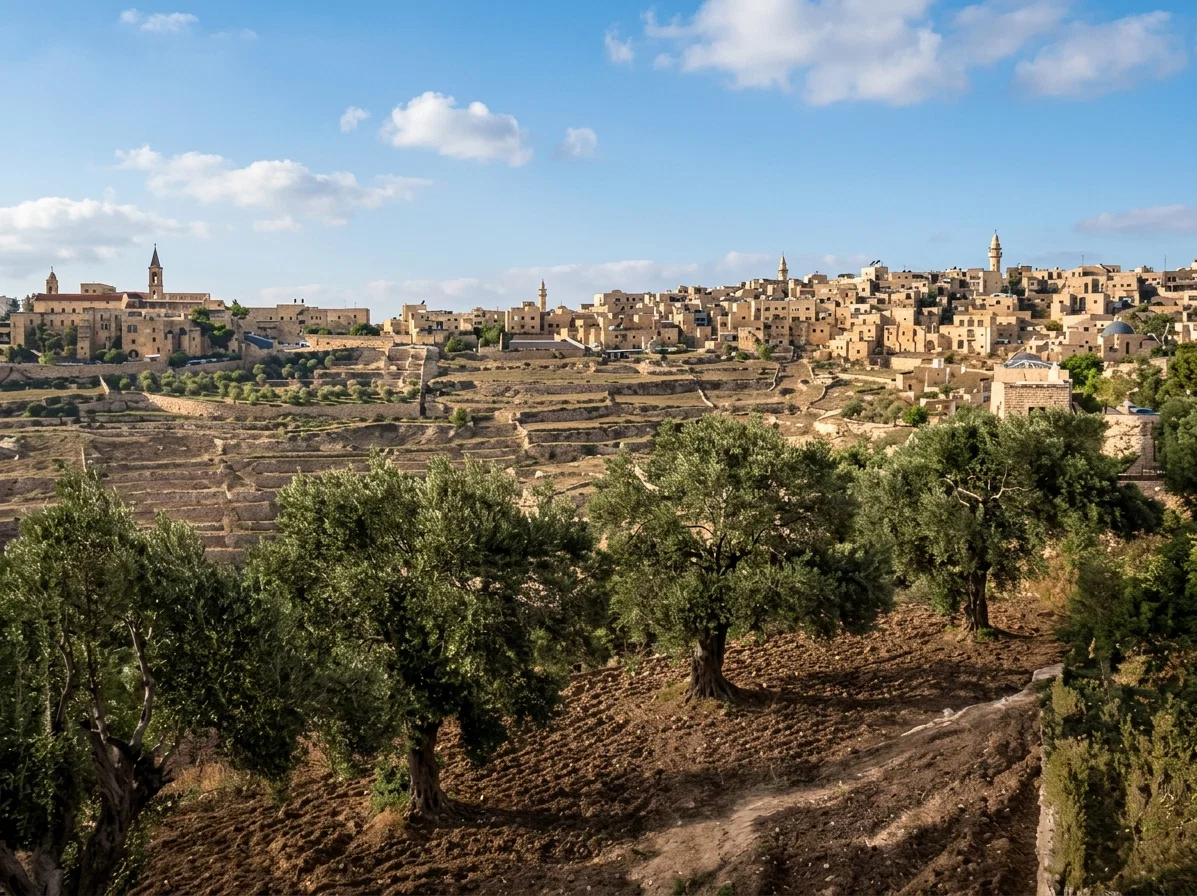
THE city of Bethlehem is situated about six miles southwest of Jerusalem. The name signifies “house of bread.” It is a place of great antiquity, as well as of frequent and prominent note. It never was a large city, altho surrounded by a fruitful country, and the center and scene of events of national and world-wide importance.
Bethlehem.
THE first mention we have of Bethlehem is in connection with Jacob’s return to Palestine from Padan-aram. There it is called Ephrath. Near here, as Jacob and his caravan camped after leaving Bethel, Benjamin was born, and Rachel died. The record says: “Rachel died, and was buried in the way to Ephrath, which is Bethlehem. And Jacob set a pillar upon her grave; that is the pillar of Rachel’s grave unto this day.” Gen. 35:19, 20.
IN the days of the judges, the city of Ephrath, or Bethlehem-judah, is again made prominent by the story of Naomi and Ruth. A man named Elimelech and Naomi his wife, with their sons Mahlon and Chilion, went from Bethlehem to the land of Moab because of a famine in Judah. The sons married women of Moab, and afterward both of them died, as also their father. Then the mother returned to Bethlehem, and Ruth, one of her daughters-in-law, went with her. Here Ruth married a kinsman of Naomi, and by this marriage came into the genealogical line thru which Jesus of Nazareth was proved to be a direct lineal descendant of Abraham. She became the mother of Obed, the grandfather of David. In Ruth 4:11 the name of Ephrath is varied to Ephratah.
WHEN the Lord rejected King Saul and his family as the royal line from whom should come the kings of Israel and finally the Messiah, He sent Samuel to Bethlehem to anoint a successor. “And Samuel did that which the Lord spake, and came to Bethlehem. And the elders of the town trembled at his coming, and said, Comest thou peaceably? And he said, Peaceably; I am come to sacrifice unto the Lord; sanctify yourselves, and come with me to the sacrifice. And he sanctified Jesse and his sons, and called them to the sacrifice.” Here Samuel anointed David, “and the Spirit of the Lord came upon David from that day forward.” 1 Sam. 16:4, 5, 13.
AT one time when Saul was king, the Philistines occupied Bethlehem and had a garrison there. David, with a company of men, was fleeing from place to place to evade the wrath of Saul. He had placed his father and mother in the care of the king of Moab for safety, while he and his men had their secret abode in the cave of Adullam. On one occasion David said to his men, “O that one would give me drink of the water of the well of Bethlehem, which is by the gate!” Then three of his mighty men “brake thru the host434of the Philistines, and drew water out of the well of Bethlehem, that was by the gate, and took it, and brought it to David; nevertheless he would not drink thereof, but poured it out unto the Lord. And he said, Be it far from me, O Lord, that I should do this; is not this the blood of the men that went in jeopardy of their lives? therefore he would not drink it.” 2 Sam. 23:15-17.
THE prophet Micah spake thus concerning this place: “Thou, Bethlehem Ephratah, tho thou be little among the thousands of Judah, yet out of thee shall He come forth unto Me that is to be ruler in Israel; whose goings forth have been from of old, from everlasting.” Micah 5:2. This prophecy was literally fulfilled in the birth of Christ. As the decree of Cæsar Augustus went forth that all should be taxed, the people went to their various places of nativity to be enrolled. “And Joseph also went up from Galilee, out of the city of Nazareth, into Judea, unto the city of David, which is called Bethlehem (because he was of the house and lineage of David), to be taxed with Mary his espoused wife, being great with child. And so it was, that, while they were there, the days were accomplished that she should be delivered. And she brought forth her first-born son, and wrapped him in swaddling clothes, and laid him in a manger; because there was no room for them in the inn.” Luke 2:4-7. And the shepherds of Bethlehem heard the first proclamation of the advent of Christ, as the angelic host sang, “Unto you is born this day in the city of David a Saviour, which is Christ the Lord.” Verse 11.
WHEN the wise men came from the East to seek the One who had been born King of the Jews, they naturally sought information in Jerusalem. Inquiry revealed the words of the prophet Micah, previously quoted. Hastening on to Bethlehem, they were guided by the star to the house where the infant Saviour was abiding. Then the wise men worshiped Him, and gave to His parents the costly presents they had brought in His honor. King Herod had secretly designed to put the child to death, so he enjoined the wise men to bring him word when they found Him. But on being warned of God in a dream not to return to Herod, they went home by another route.
HEROD was greatly angered when he found that his command had been disregarded, and he determined to make sure of his purpose. So he sent soldiers who “slew all the children that were in Bethlehem, and in all the coasts thereof, from two years old and under.” But God had anticipated his wicked design, and warned Joseph in a dream concerning it. Following the Lord’s direction, Joseph “took the young child and His mother by night, and departed into Egypt.”
THERE is no record that Jesus ever visited His native city again. If He did, the visit was of the same character as that to other towns, the place not being deemed a matter of sufficient importance to merit mention. There is enough of traditional idolatry connected with the nativity, without a record of any subsequent visit. After the Saviour’s birth there could be no real importance attached to a genealogical record in Bethlehem. However, the present population (about 3,000) are mostly professed Christians (Roman Catholic), and there is a large church marking the traditional “Grotto of the Nativity.” This church was built in the fourth century, by the Empress Helena.
W. N. G.
WHAT IT MEANS TO BE A CHRISTIAN.
By Ellen G. White
To be a Christian means to be Christlike, to follow the Saviour. Following implies obedience. No soldier can follow his leader unless he obeys orders. Following means imitation. “Learn of Me,” the great Teacher says to those who have taken the name of Christian. Keep your eyes fixed on the Model. Do all things for His glory and in and thru the love He has for you.
The Christian is the world’s light, and the only Bible that many read. Thru Christians men see God. How careful, then, should those be who have taken the name of Christian. But many professing Christians crucify the Son of God afresh and put Him to open shame. He who fails to correct the mistakes shown him in the divine mirror, presents before the world a miserable representation of Christ. Angels vail their faces in sorrow. The world sees that he is not what he professes to be, and they turn from him as a counterfeit. Christians are either under Christ’s rule or under the control of the enemy. Their influence is either a savor of life unto life or of death unto death. They are either doing positive good or incalculable harm.
Christ’s children have been redeemed from Satan’s bondage, and they are to stand under the blood-stained banner of Prince Emmanuel, working with unselfishness and fidelity for the One who owns them. Ever they are to remember the words, “Ye are not your own; for ye are bought with a price; therefore glorify God in your body and in your spirit, which are God’s.” When they took the name of Christian, they pledged themselves to be true to God. They are bound up with Him and the angels in family relation, because Jesus has delivered them from a tyrant’s oppression. In every respect their actions are to be such as become saints. Discarding all that is unbecoming, they are to live a new and holy life. By doing this they show that they are worthy of the sacred trust conferred upon them, that they have been born again, not of the flesh, but of the Spirit, that they no more live to self, but to God, whose they are and whom they serve.
Paul says, “Do all things without murmurings and disputings; that ye may be blameless and harmless, the sons of God, without rebuke, in the midst of a crooked and perverse nation, among whom ye shine as lights in the world.” Like brave, true soldiers, Christians are to obey the orders of their Captain; for they have made a sacred pledge to rule themselves well. They are to strive earnestly to overcome everything that hinders them from fulfilling their high and holy resolve. Mind and body are to be treated with the greatest respect; for they are Christ’s. Day by day they are to be improved, that to the earnest gaze of the watching angels it may be revealed that Christ has not died in vain.
Christians, when you took this name, you promised to prepare in this life for the higher life in the kingdom of God. Take the Christ-life as your pattern. Keep eternity ever in view. Follow righteous principles of action, which with their refining, ennobling influence will restore in man the moral image of God. As by faith we adopt the principles which are an expression of the life of Christ, they are in the soul as a well of water springing up unto everlasting life. The soul overflows with the riches of the grace of Christ, and the overflow refreshes other souls. Thus may the human agent show that he is keeping the pledge he has made. Thus he may work in partnership with Christ, showing to the world what it means to be a Christian.
The Gospel is the voice of duty and the voice of God. What is meant by a failure to obey its principles is shown in the history of Satan, who for his disobedience was cast out of heaven. The highest gifts that could be bestowed on a created being were given to Lucifer, the covering cherub. Before his fall he was a glorious being, occupying a position next to Christ in the heavenly courts. But in seeking to be equal with God he brought upon himself irretrievable ruin.
With this lesson before us let us hide ourselves in Christ. He is the source of all wisdom and power. Behold in the cross of Calvary the guarantee for our salvation. Behold the Saviour giving His life for us that we might be Christians.
Those who live the life of a Christian are battling against the devil’s lie,—that man cannot keep God’s law. Can we doubt the result of this conflict? God lives, God reigns; and daily He is working His miracles. “They that are Christ’s have crucified the flesh, with the affections and lusts.” Before the universe they show that they are trying to live out the words, “Whatsoever things are true, whatsoever things are honest, whatsoever things are just, whatsoever things are pure, whatsoever things are lovely, whatsoever things are of good report, . . . think on these things.”
“Love, joy, peace, long-suffering, gentleness, goodness, faith, meekness, temperance,”—these are the fruit of the Christian tree. The tree that bears only leaves, the life that has only profession, must be withered by the curse of God, even as the fruitless tree which flaunted its abundant foliage before the Saviour.
God help us to be true Christians, consistent to-day, consistent to-morrow, upright in action, kindly in word, pure in thought. The true Christian lives the Christ-life. In all his transactions he lifts the banner of the cross. If he is misunderstood, he takes no offense, but pursues the even tenor of his way. He is kind, thoughtful, and forbearing. He closely examines himself, lest in word or deed he shall deny his Lord. He chooses God’s way. Each day of his life he unselfishly ministers to others. The light that is in him shines forth, and he stills the strife of tongues. Day by day, tho unconsciously to himself, he is working out before men and angels a vast, sublime experiment. He is showing what the Gospel can do for fallen human beings. MRS. E. G. WHITE.
Grace for Each Day
By D. L. Moody
A MAN can no more take in a supply of grace for the future than he can eat enough to-day to last him for the next six months or take sufficient air into his lungs at once to sustain life for a week to come. We must draw upon God’s boundless stores of grace from day to day as we need it.—D. L. Moody.
Ancient History Which Is Also Modern
By Alonzo T. Jones
FROM REPUBLIC TO EMPIRE.
We have seen that the history of this world, from the day of Nimrod until now, is expressed in a succession of kingships expanding into empire, until Rome’s total repudiation of kingship, and the establishment of a republic—a government of the people, by the people, and for the people—which itself expanded into empire and went to ruin: to be followed by establishments of kingships expanding into empire, until the total repudiation of kingship by the thirteen British colonies of America, and their establishment of the republic of the United States—a government of the people, by the people, and for the people—which itself has now expanded into empire.
And now every consideration of the subject forces the question, What shall be the result of this second expansion of republic into empire? Everybody knows that the republic of Rome went that road only to ruin: the question now is, How can the republic of the United States follow that same road without the same result?
This question is the more forcibly suggested by the fairly startling truth, that the course of the republic of Rome is being followed step by step by the republic of the United States; these steps being followed so closely as to be veritably identical. The likeness between the two is so manifest that it is difficult to write the course of the republic of Rome, without incurring the charge of “coloring it” from the course of the republic of the United States; tho the standard histories of Rome, long ago written, are a sufficient defense against the justice of any such charge. The likeness is not in the “coloring,” but in the very texture and substance of the fabric.
Rome established herself upon the then entirely new principle, that men are capable of governing themselves by themselves, and need not kings to lord it over them; that, upon principle, men are of themselves free and as capable of governing themselves as kings are capable of governing themselves; and much more capable of governing themselves than kings can be capable of governing them.
Since all the nations were governed by kings, this new principle, from the beginning, made Rome a mark of attention to the world. And Rome was willing to be a mark of attention to the world; for of her attitude she was justly proud. Thus Rome looked upon herself, and was looked upon by other nations, and especially by oppressed peoples, as the example and conservator of liberty for the world.
When by her valuable and native faculty of self-government Rome had filled her proper home territory, and commanded the respect of the mightiest kings, she considered it to be her high prerogative to extend to neighboring peoples who were struggling against the oppressions of kings, the blessings of liberty. The first of these were the Greek States, who were ever tenacious of liberty, but who, from the example of Rome, were now tenacious of republican liberty. They were struggling persistently, and even desperately, against Philip V. of Macedon to break his kingly power over them.
In her native love of liberty, Rome generously espoused the cause of the struggling States of Greece, that she might extend to them, and that they might know and enjoy, the blessings of republican liberty.
Of her own free will, and wholly at her own expense, Rome sent across the seas her armies and her navies to fight the battles of the Greeks, and to deliver them from the oppression of kingships, and assure to them the great boon of liberty and the blessings of self-government.
In this Rome succeeded wonderfully. In brief campaigns she defeated Philip and the Macedonians, and forced a peace which severed from Philip’s power seven of the States of Greece. And in announcing the peace, Rome made the following glowing proclamation of liberty and self-government to the Greek States:—
“The Senate and people of Rome, and Titus Quintius, their general, having overcome Philip and the Macedonians, do set at liberty from all garrisons, imposts, and taxes, the Corinthians, the Locrians, the Phocians, the Phthiot-Achaeans, the Magnesians, the Thessalians, and the Perrhaebians; declare them free; and ordain that they shall be governed by their respective laws and usages.
All this was wonderfully pleasing to the Greeks. In the excess of their gratitude and joy they went fairly wild. But just as soon as they began to take steps to use the liberty and self-government thus so generously proclaimed, they found themselves balked by temporizings, reservations, and interpretations on the part of Rome. Rome entered the plea that since it was to her the Greek States owed their freedom, they were thereby bound to recognize the sovereignty of Rome in all their affairs.
The Greeks pointed to the plain words of the published proclamation. But Rome would not admit the plea; she would not stand by the obvious meaning of her own published words. By her subtle explanations and interpretations she reduced the proclamation to a mere platitude and a sheer pretense from the beginning. The Greeks appealed to the manifest justice of the case, and to the former acknowledged character of Rome as the example of liberty and justice to the world. But all in vain. They finally appealed to Rome direct: “Put yourself in our place, and decide how you would like it for yourself.”
We hear one of the chief magistrates in the republic of the Achaeans inveigh strongly, in a public assembly, against this unjust usurpation, and ask by what title the Romans were empowered to assume so haughty an ascendant over them; whether their republic was not as free and independent as that of Rome; by what right the latter pretended to force the Achaeans to account for their conduct; whether they would be pleased should the Achaeans, in their turn, officiously pretend to inquire into their affairs; and whether matters ought not to be on the same footing on both sides.
All these reflections were very reasonable, just, and unanswerable; and the Romans had no advantage in the question but force.—Rollin.
No man can deny that so far, this is a faithful sketch of the course of the republic of Rome; and no man can deny that, even to close detail, that course has so far been repeated, item by item, by the republic of the United States.
What, then, is the meaning of all this? Shall it be said that this is all nothing? Think on these things.
And there is more to follow.
ALONZO T. JONES.
PROPHETIC ANNOUNCEMENT OF THE SANCTUARY CLEANSING.
By J. O. Corliss
IN a prophetic vision given to Daniel during the third year of Belshazzar’s reign, he received an announcement which it somewhat puzzled him to understand. The house of Israel was still in Babylonian captivity, and the angel pointed out to the prophet some leading events to transpire which would greatly affect the future of his people. After having the rise and fall of different kingdoms portrayed, a vision of two angels, conversing with each other, appeared. Listening to their conversation, he heard one ask in anxious tone, “How long shall be the vision concerning the daily sacrifice, and the transgression of desolation, to give both the sanctuary and the host to be trodden under foot?”
This was to the prophet the most absorbing theme to which his attention could be called. During the long weary years of Babylonian captivity, his heart had sorrowed for the condition of the sanctuary at Jerusalem, which had been left to be trodden down and defiled by the Gentiles. He longed for its release and purification, and while waiting for some consoling reply, the angel addressed, turned to him with the words, “Unto two thousand and three hundred days; then shall the sanctuary be cleansed.” Dan. 8:14.
The time named was so different from that connected with any known ceremonies, that the prophet began to cast about to ascertain its meaning. Just then he heard a man’s voice above the river saying to his attendant angel, “Gabriel, make this man to understand the vision.” But as the angel came near to Daniel, he became frightened, and fell face downward to the ground. Under the circumstances, little could be said to the prophet. But the angel said this, which was emphatic and direct, “Understand, O son of man; for at the time of the end shall be the vision.” Verse 17.
This settled at least one point of the prophet’s inquiry, while it probably confused his mind on another point. He readily saw that the period in which the cleansing of the sanctuary would be accomplished, was one far removed, even to the latest generation. Another thing was made clear, that the sanctuary to be cleansed, was another than the one in the temple at Jerusalem; for the prophet had already learned thru Jeremiah’s predictions made nearly a hundred years before, that seventy years of alienation from Jerusalem would end the captivity of Israel. Dan. 9:2. He could not well make this coincide with the 2,300 days, which it had been emphatically said would end in “the time of the end.” So far as removing disgrace from the earthly sanctuary which was then desolate was concerned, that must be accomplished upon the return from Babylon. But what about this sanctuary to be cleansed in the distant future?
The prophet was assured that he would be fully informed as to the detail of what should take place before the end would come. Dan. 8:19. But after having explained to him the earlier symbols of the ram and rough goat, and learning of the mighty influence the nations these symbolized would have over the destinies of his own people, the prophet fell deathly sick. Three full weeks he was prostrated4; but at the end of that time he began to attend to the king’s business as before, tho he was greatly depressed at the vision, the effect of which he carefully concealed from his associates.
Indeed, the impression made upon his mind by the revelation was so strong, that he determined, if possible, to learn something more of the matter. He therefore began to fast and pray, that God might be gracious in this respect. First he confessed his sins, and those of all his people. Dan. 9:3–15. He then appealed for the light of God’s countenance to be permitted to shine on the desolate sanctuary at Jerusalem. Verses 16, 17.
Before he closed his intercession, Gabriel again appeared on the scene, saying that he had come to impart the knowledge sought. After Daniel had been told that the visit was by order of God, because he was greatly beloved, the angel said, “Therefore understand the matter, and consider the vision.” Verse 23. This, then, was no less than a heavenly order to take under consideration the very subject that had been dropped because of its former hurtful effect upon the health of the prophet. The only point of the vision then left to be considered was that of the time extending to the cleansing of the sanctuary talked of by the holy ones in Dan. 8:14. It was therefore very fitting that the instruction to be further given should be that spanning the time reaching to the cleansing before referred to.