Your ShelfYour Projects

Signs of the Times, Vol. 26, No. 50.

GOD'S GIFTS—HOW OBTAINED

Signs of the Times

Dec 12, 1900

Pacific Press Publishing Company · Oakland, California · Dec 12, 1900

GOD'S GIFTS—HOW OBTAINED.
THE gifts of God can not inure to any individual imbued with a spirit of selfishness. Neither can any gift of God be purchased with money. If it could be purchased, it would not be a gift. The richest man in the world must come to God just as the poorest must come,—as one owing an enormous debt, and having nothing wherewith to pay. How can one buy anything of God with money, when all the gold and silver are His already? Wherewith can sinful man pay the Almighty for aught, when "the earth is the Lord's, and the fulness thereof; the world, and they that dwell therein" (Ps. 24:1)?
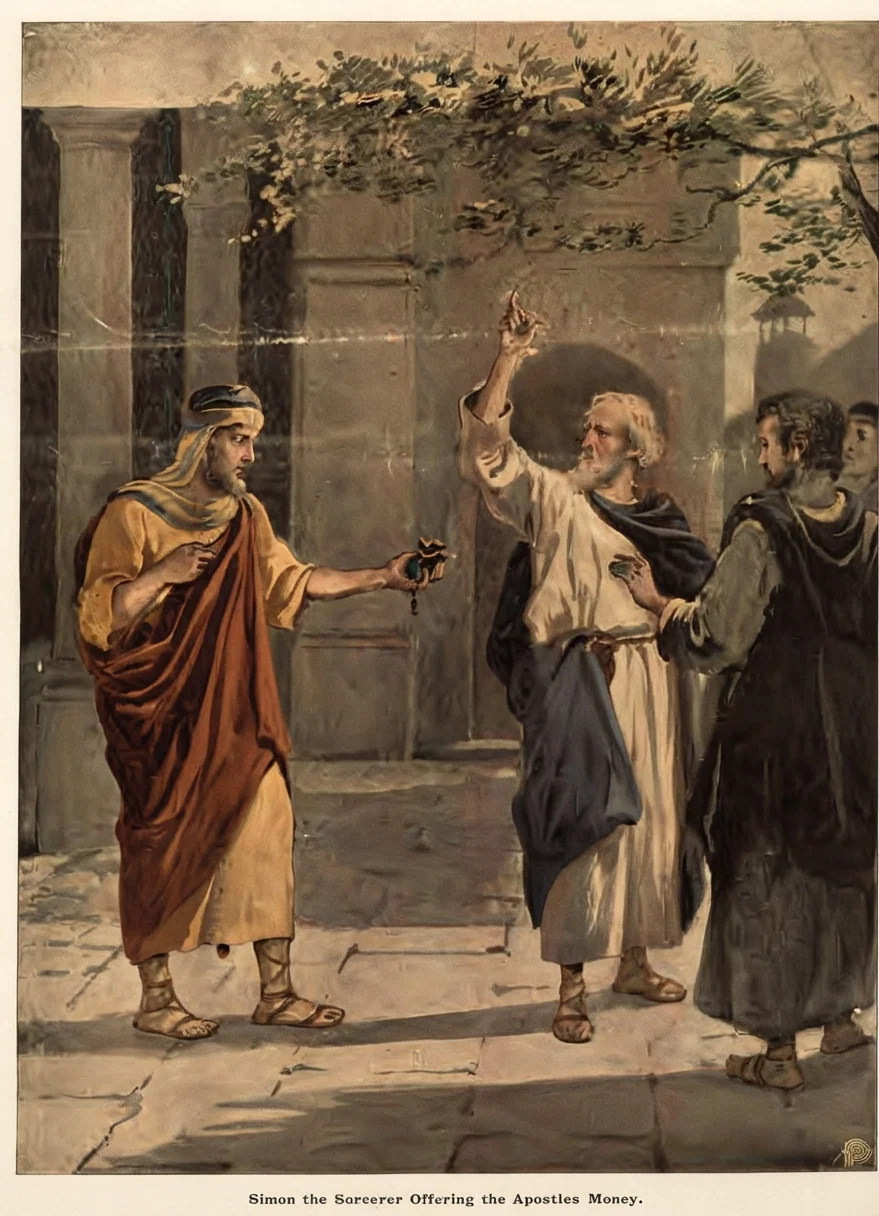
Simon the Sorcerer Offering the Apostles Money.
"THE gift of God is eternal life through Jesus Christ our Lord." Rom. 6:23. A rich man once came to Jesus and asked, "Good Master, what good thing shall I do, that I may have eternal life?" Jesus replied, "If thou wilt enter into life, keep the commandments." The young man claimed that he had done so from his youth up, and on this point the Master tested him. "Jesus said unto him, If thou wilt be perfect, go and sell that thou hast, and give to the poor, and thou shalt have treasure in heaven; and come and follow Me." The Lord did not want the man's money; but He wanted him to have the gift of eternal life, and selfishness stood in the way. His desire to hold onto his wealth, when there were so many poor around him, was proof that he was not keeping the commandment to love his neighbor as himself. So his money could not buy the gift of God, and his selfish spirit precluded his receiving eternal life even as a gift. Jesus loved the man, but this would not avail as long as he loved his earthly riches more than he loved the riches of God—eternal life. "A rich man shall hardly enter into the kingdom of heaven," because his riches have no purchasing power at the throne of grace. The best thing to which Jesus could point this rich man was to "keep the commandments." So He counsels all, "If ye love Me, keep My commandments; and I will pray the Father, and He shall give you another Comforter, that He may abide with you forever." John 14:15, 16.
WE have one instance of a man directly offering money to purchase a gift of God. No doubt many others have given money with the thought of buying such favor who did not so plainly express their minds. The man who was bold enough to make a direct offer of this kind was named Simon, and he lived in Samaria. He had gained a great influence over the people by the use of sorcery, or spiritism. In this way he "bewitched the people of Samaria, giving out that himself was some great one." So great was his influence that to him all the people "gave heed, from the least to the greatest, saying, This man is the great power of God. And to him they had regard, because that of long time he had bewitched them with sorceries." Acts 8:9-11. If Simon had really possessed the power he claimed, and with which he was accredited by the people, he would not have needed to buy any further power. If he were"the great power of God," there was no more power to be had.
BUT there came a time when the power for evil by which Simon had been actuated must acknowledge a superior. Upon the dispersion of the disciples from Jerusalem after the martyrdom of Steven, "Philip went down to the city of Samaria, and preached Christ unto them. And the people with one accord gave heed unto those things which Philip spake, hearing and seeing the miracles which he did. For unclean spirits, crying with loud voice, came out of many that were possessed with them; and many taken with palsies, and that were lame, were healed. And there was great joy in that city."
THE fact that so many people were possessed of unclean spirits in a city where Simon, who claimed collusion with the spirits of the dead, was held in such high regard, showed the character and the result of his work. Seeing the greater power manifested in the preaching and miracles of Philip, Simon, in common with others, could not well refrain from acknowledging the truth thus portrayed. And to save as far as possible his prestige, he would naturally wish to identify himself with the new power. So when multitudes of the people believed Philip's preaching, and were baptized, "Simon himself believed also; and when he was baptized, he continued with Philip, and wondered, beholding the miracles and signs which were done." Simon's was just the kind of mind that would be "converted" by wonderful manifestations, when the plain truth would not have made any decided impression upon him. In this respect he has many counterparts in our own time. As a rule, such "converts" lose interest when the manifestations cease. To such apply the words of Jesus, "Except ye see signs and wonders, ye will not believe."
"Now WHEN the apostles which were at Jerusalem heard that Samaria had received the Word of God, they sent unto them Peter and John; who, when they were come down, prayed for them, that they might receive the Holy Ghost (for as yet He was fallen upon none of them; only they were baptized in the name of the Lord Jesus). Then laid they their hands on them, and they received the Holy Ghost. And when Simon saw that through laying on of the apostles' hands the Holy Ghost was given, he offered them money, saying, Give me also this power, that on whomsoever I lay hands, he may receive the Holy Ghost." Acts 8:14-19.
SIMON'S purpose to make merchandise of the religion of Jesus Christ, and to use it for selfish ends, revealed to the true Christian apostle the real condition of the mere professor's heart. The "discerning of spirits" is a gift of the Holy Spirit (1 Cor. 12:10), and on this occasion it enabled the apostle to detect the sordid principle of Simon's heart. In reply to Simon's offer, Peter said: "Thy money perish with thee, because thou hast thought that the gift of God may be purchased with money. Thou hast neither part nor lot in this matter; for thy heart is not right in the sight of God. Repent therefore of this thy wickedness, and pray God, if perhaps the thought of thine heart may be forgiven thee."
NOT only did Peter show to Simon of Samaria that the gift of God could not be purchased with money, but he has laid down the true principle in his writings: "Forasmuch as ye know that ye were not redeemed with corruptible things, as silver and gold, from your vain conversation received by tradition from your fathers; but with the precious blood of Christ, as of a lamb without blemish and without spot; who verily was foreordained before the foundation of the world, but was manifest in these last times for you, who by Him do believe in God, that raised Him up from the dead, and gave Him glory; that your faith and hope might be in God." 1 Peter 1:18-21.
ALL the gifts of God are comprised in the one gift of His Son. "He that spared not His own Son, but delivered Him up for us all, how shall He not with Him also freely give us all things?" Rom. 8:32. As redemption itself can not be purchased with money, neither can the gifts which inhere in the Redeemer. G.

Serving God, Not Men

"But as we were allowed of God to be put in trust with the Gospel even so we speak; not as pleasing men, but God, which trieth our hearts."

UNFAITHFUL STEWARDS.

Judged out of Their Own Mouths.

THEN began He to speak to the people this parable: A certain man planted a vineyard, and let it forth to husbandmen, and went into a far country for a long time. And at the season he sent a servant to the husbandmen, that they should give him of the fruit of the vineyard; but the husbandmen beat him, and sent him away empty. . . . Then said the lord of the vineyard, What shall I do? I will send my beloved son; it may be they will reverence him when they see him. But when the husbandmen saw him, they reasoned among themselves, saying, This is the heir; come, let us kill him, that the inheritance may be ours. So they cast him out of the vineyard, and killed him. What therefore shall the lord of the vineyard do unto them?" The priests and Pharisees answered, "He will miserably destroy those wicked men, and will let out his vineyard unto other husbandmen, which shall render him the fruits in their seasons. Jesus saith unto them, Did ye never read in the Scriptures, The stone which the builders rejected, the same is become the head of the corner? . . . And whosoever shall fall on this stone shall be broken; but on whomsoever it shall fall, it will grind him to powder."
The Pharisees had watched Christ narrowly as He gave this parable. They were cut to the heart by His words; for they could not fail to see their purpose. The Jewish nation had treated the servants whom God had sent unto them with contempt, injustice, and cruelty; and in consequence the vineyard would be taken from them, and they would be punished with fearful severity. And the Pharisees saw that He had pointed them out as the very ones whose sentence they themselves had pronounced. They were filled with anger against Christ. They decided that He knew too much of their base practises to be allowed to live. They feared that He would expose before the people the wicked deeds they had committed, and the result would be the loss of their popularity.
Baffled thus far in their attempts to entrap Christ, the Pharisees took counsel with the Herodians. Having laid their plans, they "sent forth spies, which should feign themselves just men, that they might take hold of His words, that so they might deliver Him unto the power and authority of the governor." They did not send the old Pharisees, whom Jesus had often met, but young men, who were ardent and zealous, and whom they thought Christ did not know.
The representatives of the Pharisees and Herodians approached Christ with apparent sincerity, as if desirous to know their duty. "Master," they said, "we know that Thou sayest and teachest rightly, neither acceptest Thou the person of any, but teachest the way of God truly." This was a wonderful admission; but their words were not sincere, but were spoken to deceive. The testimony was true, however. The Pharisees did know that Christ said and taught rightly, and by their own words they will be judged.
"Is it lawful for us to give tribute unto Caesar, or no?" they continued. This was a question over which there was much contention. The Pharisees paid their taxes unwillingly, and many denied the right of the Romans to demand tribute. The spies expected Christ to answer the question by a simple yes or no. If He told them it was lawful to pay tribute to Caesar, He would lose popular favor. If He said the tribute was unlawful, they hoped to "deliver Him unto the power and authority of the governor."
They appeared to ask honestly, and they thought they had sufficiently disguised their purpose. But Jesus read their hearts as an open book, and sounded their hypocrisy. "Why tempt ye Me?" He asked, thus giving them a sign they had not asked by showing that He read their hidden purpose. They were still more confused when He said, "Show Me a penny." "Whose image and superscription hath it?" He demanded, and they answered, "Caesar's." Pointing to the inscription on the coin, Jesus said, "Render therefore unto Caesar the things which be Caesar's, and unto God the things which be God's."
Thus Christ rebuked the hypocrisy and presumption of the Pharisees, and to the bystanders His answer seemed so wise that they admired His tact and wisdom. His reply was no evasion, but a candid answer, and in many minds a vexed question was settled. Forever after they held to the right principle. And altho many went away dissatisfied, they saw that the underlying principle had been laid out in straight lines.
When the Pharisees heard Christ's answer, "they marveled, and left Him, and went their way." They were convinced against their will; but they would not yield and accept Christ. They could not at that time satisfytheir wrath, but they were determined to carry out their purpose. Henceforth evidence had no effect on their deep-rooted prejudice. There was no more peace or rest for the Saviour; for they manifested the most bitter opposition and intense hatred, and their plans and schemes to entrap Him were abundant, never ceasing until the purpose of hate was fully accomplished on Calvary.
But in spite of the opposition of the priests and Pharisees, Christ kept His mission ever before Him. With a heart ever touched by human woe, He ministered to those around Him. He spoke with clearness, simplicity, and authority, and His sermons were such as had never before been heard. His principles were so clearly and wisely inculcated that none need make a misstep, if they will but follow Him, and keep His words.
MRS. E. G. WHITE.

NOW AT THIS HOUR OF PRAYER.

Now AT this hour of prayer Bow every knee to God, Bring every vexing care, Bring sorrow's weary load. Here at our Father's knee Lay we our troubles large, And in His presence free Throw down each heavy charge.
Not at His feet so low Do we in terror kneel; No, at His lap we bow, And our raised faces steal Looks at His holy eyes. Dear to Him sure we are; Up to His heart we rise, Children, His joy and care.
So, from this hour of prayer, Reft of each heavy load, Fitted to do and dare, Fitted to live for God, Forth let us go in faith, Knowing His mighty hand Leads in the victor's path Safe to the better land.
Children of God we are, Fitted to do and dare, Fitted by faith and prayer To live for Him.
Oakland, Cal. T. R. WILLIAMSON.

THE ESSENCE OF CHRISTIAN CHARACTER.

"I WILL show him how great things he must suffer for My name's sake." Acts 9:16.
This is the call to the grandest life, so far as the Sacred Record goes to show, that, next to the life of Jesus Christ, the world has ever been privileged to witness. It was distinctly and pre-eminently a life of principle.
Notice the strange language of this divine summons, "suffer"!—word of forbidding aspect and unwelcome sound. "Suffer!"—synonym of unhappiness and all that men most dread. "Suffer!"—word ominous of import and fraught with gloomy apprehensions. What! is there no mistake? Surely this is not a bidding to grandeur of life, but a warning to flee or a threat of vengeance. Can this be the highway to nobility?—'Tis even so.
Even the religion of to-day, for the most part, has failed to discern this. The popular Christianity of to-day is much more a thing of policy than of principle; a religion whose inception is feeling, whose life is nerveless sentimentalism, demanding the arm of the civil law to supply the place of moral courage.
Think of the moral significance, of the influence and teaching of the popular demand for religious laws,—for a Sunday law, for instance, to prop up the sickly religious profession—for surely there is no principle (except a bad one) in it—of the "poor laboring man," "to protect" (?) him in his right to one day's rest in seven, as if any power on earth could compel a true Christian to break the Sabbath, any more than it could compel the three Hebrew worthies to bow down to Nebuchadnezzar's golden image on the plain of Dura. But this gushy solicitude to inject by law some virility into the feeble stamina of the laboring man who has not the manhood to live up to what he believes, is a most striking comment on present-day religion.
Think of the strength of the character of a religious profession so soft, superficial, and volatile that it has to be kept corked and out of the sun, like benzin, for fear it will evaporate. Next we must have a law "protecting" these feeble Christians against the ridicule of public opinion. In order to be logical, and carry out our policy of protecting the right to practise the Christian graces, let us begin with the children. Protect the tender things from the sneers of the youthful sons of Belial, who laugh at them for being loyal to their mothers, for refusing to use tobacco, or profanity, or vulgarity! Protect our young men in their right to be virtuous! Yes, yes, to be sure, protect them from babyhood to old age, till they are emasculated of all moral fiber, nerveless, puny, moral cripples. As an unfailing process for the manufacture of weak, senile, vacillating, shivering, moral invalids, Christians with moral rickets and spinal meningitis, this method certainly deserves an international copyright and World's Fair gold medal, under the title of "The Baby Act."
"I will show him how great things he must suffer." Let us use this as a text or a key while we meditate for a little while on the essential quality in Christian character. Much of the preaching of to-day, much of the exhortation, totally ignore the fact that the offense of the cross has not ceased; that the line of demarkation between the church and the world—"between him that serveth God, and him that serveth Him not"—has not yet been obliterated. The words of the Master seem to be forgotten: "If ye were of the world, the world would love his own; but because ye are not of the world, but I have chosen you out of the world, therefore the world hateth you." John 15:19.
Too often the sinner is led to believe that to "get religion" is the end of all trials; the Christian life shall be a gala day; no clouds shall darken the sky; no thorns shall beset the path; the wind always fair, the tide always favorable, the sails full, the wheels always in motion—the voyage must be glorious, the end triumphant. Alas! the Christian sails in other craft.
Far be it from me to discourage the faintest heart. Nay, more, it is believed that if the purpose of this study be attained, it will prove to the weak, the discouraged, the faint, the index to an unfailing Source of strength and joy.
Let us face squarely the conditions of the call of followers of Christ. What does that call imply as regards our relation to the work?
In Acts 14:22 we are told that "we must through much tribulation enter into the kingdom of God." It is not our aim just now to dwell on the purpose of the Christian's trials, but to make plain the fact that the sacred Word recognizes that the portion which the Christian may expect in this world, especially from the world, can be summed up under the generic term "suffering." When God calls a soul to His service, He wants the terms plainly understood.
The other day I saw a printed call of the United States Government for volunteers to enlist in the army. It was a fine picture, pasted in a conspicuous place. There were uniformed soldiers, from generals, captains, and corporals (I suppose) down to the rank and file. Some were on their prancing steeds; some chatted pleasantly; the gunners looked as if out to salute the sunrise at a Fourth-of-July picnic; and all seemed to have no more responsible duty than to be on continual dress parade.
No suggestion in all this of the jagged bullet's ugly wound, the torn and quivering flesh, the saber's bloody gash, the mangled, ghastly corpses strewn upon the gory battle-field.
But when God calls a man, He covers up nothing; He warns him that enlistment in His cause means a daily readiness to die, and such a death perhaps as only devils can invent. In this war there is neither armistice nor furlough; only continual, active service. There is no exception from the rigid discipline; for "all that will live godly in Christ Jesus shall suffer persecution." 2 Tim. 3:12. As certainly as the hardships of continual winter must be expected by those who would acquire the renown of standing with Polaris as their zenith, so certainly are trials and suffering to be the experience of those who would strive for the starry diadem in heaven; "for even hereunto were ye called; because Christ also suffered for us, leaving us an example, that ye should follow His steps." 1 Peter 2:21.
Let us now sum up what God holds forth as the unavoidable portion of His warriors,—hatred, tribulation, persecution, suffering. "Seek ye out of the book of the Lord, and read: no one of these shall fail."
And not only so, but these things must be met unflinchingly, unhesitatingly, yea, joyfully. To take up the cross daily means more than carrying a burden; it means to be willing daily, if God so wills, for Jesus' sake, to die the death of the cross. The cross is significant of crucifixion.
"Truly," one says, "not a very inviting prospect." No, not to one who sees no value in truth. Whoso would sail with the world, must ship on another line. There is absolutely no affinity, no fellowship between the church and the world; "whosoever therefore will be a friend of the world is the enemy of God." James 4:4. And, lest some one should think that this may possibly be toned down just a little, so far at least that the world might say you are a pretty good fellow after all, the warning is sounded, "Woe unto you, when all men shall speak well of you!" Luke 6:26.
Imagine, therefore, a true Christian soliciting worldly favor. Think of Paul pulling political wires to get elected to the Sanhedrin. Think of Jesus of Nazareth running for alderman of the seventh ward of Jerusalem. Let it not be thought that this suggestion has its origin in any spirit of facetiousness; for, judging by the condition of the church of to-day, one would actually think that there is no incompatibility in the idea.
Since the day long foretold has fully come, when "they shall turn away their ears from the truth, and shall be turned unto fables," I will speak in fables.
Once upon a time a lamb became ambitious to gain popularity among a pack of wolves, but all of his advances were received only with indifference. He thought to imitate them, and attempted to howl like a wolf, but was ridiculed for his pains. He tried to snarl, and made such a miserable spectacle of himself that he met only contempt. He was invited to a banquet of raw meat; and, tho he knew he could not eat it because he was constructed to eat grass, yet he flattered himself that by attending he might gain their good will. So he went, but soon found out to his cost that he himself was to be the banquet. DERBY.
(Concluded next week.)

2 THESSALONIANS 2:9.

THE second chapter of Second Thessalonians is devoted mostly to the coming of the Lord, and the signs that will precede that all-important event.
First, the apostle assures the brethren that the day of Christ will not come until the man of sin is revealed, in his time (A.D. 538), "whom the Lord shall consume with the spirit of His mouth, and shall destroy with the brightness of His coming." Verse 8.
Omitting the supplied words, "even him," we read, "Whose [the Lord's] coming is after [following] the working of Satan with all power and signs and lying wonders, and with all deceivableness of unrighteousness in them that perish." Verses 9, 10. This passage is only one of many that set forth the trying circumstances through which the people of God will pass just before Jesus comes to deliver them.
Erie, Kan. J. S. MAXSON.

A Little That a Righteous Man Hath

"A LITTLE that a righteous man hath is better than the riches of many wicked."

THE SABBATH AND CHRIST.

AS an institution, the Sabbath holds a place distinct and alone. No person could ever have lapsed into heathenism while keeping it; for it is founded upon the great events of creation week. There is no measure of time that is identical with the week closing with the Sabbath, except the week of creation. This week must ever stand as the basis for the dividing of all after-time into periods of seven days. The Sabbath marks the "rest" period after a completed work. It was the "seal" God placed upon the work of His hands, testifying that there was nothing farther that could conduce to perfection. The Sabbath was given as a memorial, not of one point in creation week, but of every act embraced in that week. God says: "Remember the Sabbath day, to keep it holy. . . . For in six days the Lord made heaven and earth, the sea, and all that in them is, and rested the seventh day; wherefore the Lord blessed the Sabbath day, and hallowed it."
Let us see some of the points covered by this far-reaching memorial. "And God said, Let there be light; and there was light." Gen. 1:3. The sun was not yet shining upon the earth, neither did it shine there for three days. Upon what, then, was the light based? The record says, "And God said." Then light, and light as perfect as ever shined from the sun, was shining upon this earth, based alone upon the power in God's word. The Sabbath keeps this grand truth before all men. No heathen sun-worshipper could ever have developed if the Sabbath had always been observed, and this fact kept in mind.
The power of God's word is again shown in the creating of a great "firmament" of life-giving air. Gen. 1:6. The Sabbath is the pledge that God will never take this from those who lay hold of it in the Sabbath; for His Word says, "I know that, whatsoever God doeth, it shall be forever." Eccl. 3:14. This last text verifies the statement that all the changes from this perfect state, tho allowed by the Lord, are yet done by other hands, and can not be commemorated in true Sabbath-keeping.
Pass to Gen. 1:11, 12: "And God said, Let the earth bring forth grass, the herb yielding seed, and the fruit tree yielding fruit after his kind, whose seed is in itself, upon the earth; and it was so. And the earth brought forth grass, and herb yielding seed after his kind, and the tree yielding fruit." "God saw that it was good." Here, again, the life, the growth, the yield of ripe fruit, was not dependent upon the warmth of the sun, because the sun had not yet lighted the earth. Neither were they dependent on the earth, because they were there bearing fruit before they grew from the earth. Proof: "The Lord God made the earth and the heavens, and every plant of the field before it was in the earth, and every herb of the field before it grew." Gen. 2:4, 5. Then when Adam on the sixth day plucked the ripe fruit and ate, he could return no thanks to earth, sea, or sun. He could only see Him who, by the power of His word, brought them all into being, in a perfect state, for man's use.
To him who keeps God's Sabbath, then, and sees what God sees in the Sabbath, there is no fear, tho earth fail to bring forth, and tho the sun's power may be so fierce as to fulfil the prophecy that "the fire hath devoured the pastures of the wilderness, and the flame hath burned all the trees of the field." And again: "The rivers of waters are dried up, and the fire hath devoured the pastures of the wilderness." Joel 1:19, 20. The man of God has laid hold of the pledge of God's power in the Sabbath, a pledge that "was made for man." Mark 2:27. And he can calmly rest in the power of God's word to supply him with those things that are necessary to carry him through. The earth may fail, the rays of the sun may turn to scorching, withering shafts of death (Rev. 16:8, 9), yet God's word can not fail.
Going again to Genesis 1, we pass over the dominion of the earth, the equality of male and female, and find the food of man all marked out complete in the "herb bearing seed" and the tree yielding fruit. Even the beasts were given a diet in which no conscious life should be taken. Gen. 1:29, 30. God saw all the work, and the provision, pronounced it very good, and then He rested. True Sabbath-keeping sees all this, but it never can include aught that is not in these six days. True Sabbath-keeping, then, can not include a flesh diet. It never can countenance the feeling of superiority of husband or wife over the companion; for this was the result of and did not come into the six days. It can never rest with the man who, with every change of the season, looks with gloomy doubts upon the fields, fearing starvation because of the failure of the earth. It never can rest with the man who will take away one point in this great week, and in its place substitute the "inventions" of man. It can rest in the bosom of the man who, trusting alone upon "the word of His power," keeps the "commandments of God and the faith of Jesus."
The question then arises, If the Sabbath given at the close of creation week commemorates only these events, should we not have another Sabbath to commemorate redemption and the work of Christ? This question, which has often been asked, separates Christ from the creation, and this is not correct. Christ was the active agent in the work of creation, and He it was who rested, and made the Sabbath day. That Christ did, with the counsel of the Father, act in the creation, we learn from many texts. "He was in the world, and the world was made by Him, and the world knew Him not." "All things were made by Him." John 1:10, 3. In harmony with this we hear the Saviour saying, "The Son of man is Lord even of the Sabbath day." Matt. 12:8.
Christ is inseparably connected with the Sabbath. He says, "Moreover also I gave them My Sabbaths, to be a sign between Me and them, that they might know that I am the Lord that sanctify them." Eze. 20:12. Take Christ away, and the Sabbath is gone. Thus the Jews, ignoring Christ, and planning His death, observed in their own way the hours of the Sabbath, yet failed to keep the Sabbath, by failing to see Him in the Sabbath. They were keeping a "Jewish Sabbath"—man-made, with no Christ in it.
None but the Creator could be the Redeemer, as, in every case, it must be a new creation. He says, "Therefore if any man be in Christ, he is a new creature." 2 Cor. 5:17. Then the seal of creative power is the assurance of redemptive power. If the one is forgotten the other can but be doubted. He who sees Christ in the creation, and Christ in the Sabbath, will see in the Sabbath the only power that can redeem. "For there is none other name under heaven given among men, whereby we must be saved." Acts 4:12. And that name and its power are forever stamped in creation's Sabbath.
What cause, then, for another Sabbath? It would find no place as creative power—which is redeeming power—and all that will ever be enjoyed by the redeemed soul in a perfect state, is embodied in the reasons God has given for keeping the only Sabbath that He ever gave to represent Himself. This, God assures us, will be kept throughout the eternal ages. Isa. 66:22, 23.
CLARENCE SANTEF.

THE CLEAN UNIVERSE.

Sheol, Hades, Tartarus, Gehenna.

A TIME will come when the universe will be cleansed from sin, and there will be "no more death." Rev. 21 : 4. Then there will be "no more" a hell, or place of punishment. To prove this, let us look into the definitions of these words, "sheol," "hades," "tartarus," and "gehenna," to see if an endless hell is implied in any of them. No attempt will be made to treat the subject exhaustively.
Sheol means the same in Hebrew that hades does in Greek. Prof. Moses Stuart, "Exegetical Essays," p. 112, says: "The meaning of sheol which lies upon the page of the Sacred Record (if I may thus speak), is indeed that of the grave, sepulcher, under-world, or state of the dead, as I have given in the recension of the passages." Mr. Stuart also says that "hades designates the under-world, subterranean regions, simply in opposition to the regions of the earth." "Sheol, in common and popular language, is the world, or region, to which both the righteous and the wicked go after death, e. g., Gen. 25:8; Num. 20:26; Deut. 32:50." Notice that he says in common and popular language; he does not say it is the words of the Bible.
Again he says: "Where is the specific difference between the future state of the righteous and wicked fully set forth in the Hebrew Scriptures? Where are the separate abodes in sheol for each particularly described? I know not, nor do I believe any one can inform me."—P. 122.
This is quite candid; we will quote further: "On the whole, it is to be regretted that our English translation has given occasion for the remark that those who made it have intended to impose on their readers in any case, a sense different from that of the original Hebrew. . . . I am inclined to believe that in their day the word 'hell' had not acquired, so exclusively as at present, the meaning of a world of future misery."—P. 113.
In commenting on Ps. 9:17, "The wicked shall be turned into hell [sheol], and all the nations that forget God," he says it "likely tells the final doom of the sinner; and if so, it is death; the dead can not occupy a world of woe. Ps. 37:10 tells that 'his place . . . shall not be.'"
In the preceding quotation we have the opinion of one of the greatest Greek and Hebrew expositors that "the final doom of the sinner is death." The reader can judge whether the professor means a "death that never dies," or a cessation of existence.
Some may ask, "Was not the rich man of the parable in Luke 16:23 in hell?" This is simply a parable, and has no reference to a literal death or grave, as has often been admitted by critics who hold to the doctrine of endless misery. Hades, or the grave, is not a place of misery; and if it could be proved to be such a place, it would not follow that the misery was endless, as Rev. 20:13, 14 plainly teaches the contrary. Like Ps. 9:17, it seems to be symbolic of the future punishment in the lake of fire. Rev. 20:14.
Tartarus, Mr. Parkhurst, in his Greek Lexicon, says "is the condensed, solid, and immovable darkness which surrounds the material universe." It is but once translated hell, in 2 Peter 2:4, and the meaning of this text perfectly corresponds with the definition oftartarus or tartasoo. We will quote the text, as follows: "God spared not the angels that sinned, but cast them down to hell [Greek, tartarōsas], and delivered them into chains of darkness, to be reserved unto judgment." It can be seen that in this text no hell fire is mentioned, as they are only reserved unto judgment. The same principle of reservation is brought out in verse 9, and also in Jude 6.
Greenfield, in his Greek Lexicon, defines gehenna as the valley of Hinnom (2 Kings 23:10), south of Jerusalem, once celebrated for the horrid worship of Moloch, and afterward polluted with every species of filth as well as the carcasses of animals and dead bodies of malefactors, to consume which, in order to arrest the pestilence which such a mass of corruption would occasion, constant fires were kept burning.
It is evident that our Saviour used gehenna in a figurative sense, as a symbol of the future punishment of the wicked. The concession of Rev. A. Barnes, in his notes on Matt. 5:22, is strong proof that it is only used to symbolize a miserable and eternal loss of life.
Paul wrote fourteen epistles and preached thirty years, yet he makes no mention of any eternal hell. In Heb. 10:26, 27 he explains what Christ meant by being cast into the gehenna of fire. The reader, if not familiar with the text, will please turn to it, and notice it reads "fiery indignation, which shall devour the adversaries," thus corresponding to the gehenna of punishment.
Again he says, "That which beareth thorns and briars is rejected, and is nigh unto cursing; whose end is to be burned." Heb. 6:8. In Rom. 9:22 we read that the wicked are "vessels of wrath fitted to destruction," not to an everlasting hell, as is so often preached.
We find, therefore, no hell in the grave (sheol is hades), nothing but a reservation unto judgment in tartarus, and in gehenna a symbol of punishment in the lake of fire, which is not now in existence, but will be on the earth. See Rev. 20:10. WM. PENNIMAN. Woodburn, Ill.

"HE SAID IT."

ON one occasion, when in the presence of his army, Napoleon's horse took fright, and became unmanageable, greatly endangering the emperor's life; but a private soldier stepped out of the ranks, caught the bridle of the frightened animal, and succeeded in stopping its mad flight. The emperor politely said to this soldier, "Thank you, captain."
At once came the answer, "Of what company?"
Napoleon, perceiving that the man had implicit faith in his word, as well as courage, replied, "Of the Emperor's Guard."
The soldier immediately walked up to the Imperial Guard, who sought to drive him back to his place in the ranks; but he said, "I am captain of this guard."
In amazement they asked, "By what authority?"
Pointing to the emperor, he replied, "He said it." Faith had its reward.
Brethren, shall men have more faith in the word of a man than we have in the word of our God? Yea, is not the word of our heavenly Father worth infinitely more than that of the emperor of France? The assurance of His Word is, "Now are we the sons of God." And, altho we may still wear the common garb of mortality, let us act like what we are, the sons of God; and soon we shall wear the immortal insignia of our great adoption into the very courts of our King. In the banishment of every doubt, and settlement of every controversy, let the "strong consolation" and the "assurance of faith" ever be found in the fact that the Bible, the Word of our Lord, has said it.
H. M. J. RICHARDS.
Continue reading: BETWEEN STATIONS