Your ShelfYour Projects

Signs of the Times, Vol. 24, No. 18.

A LESSON FROM PETER

Signs of the Times

May 5, 1898

Pacific Press Publishing Company · Oakland, California · May 5, 1898

A LESSON FROM PETER.
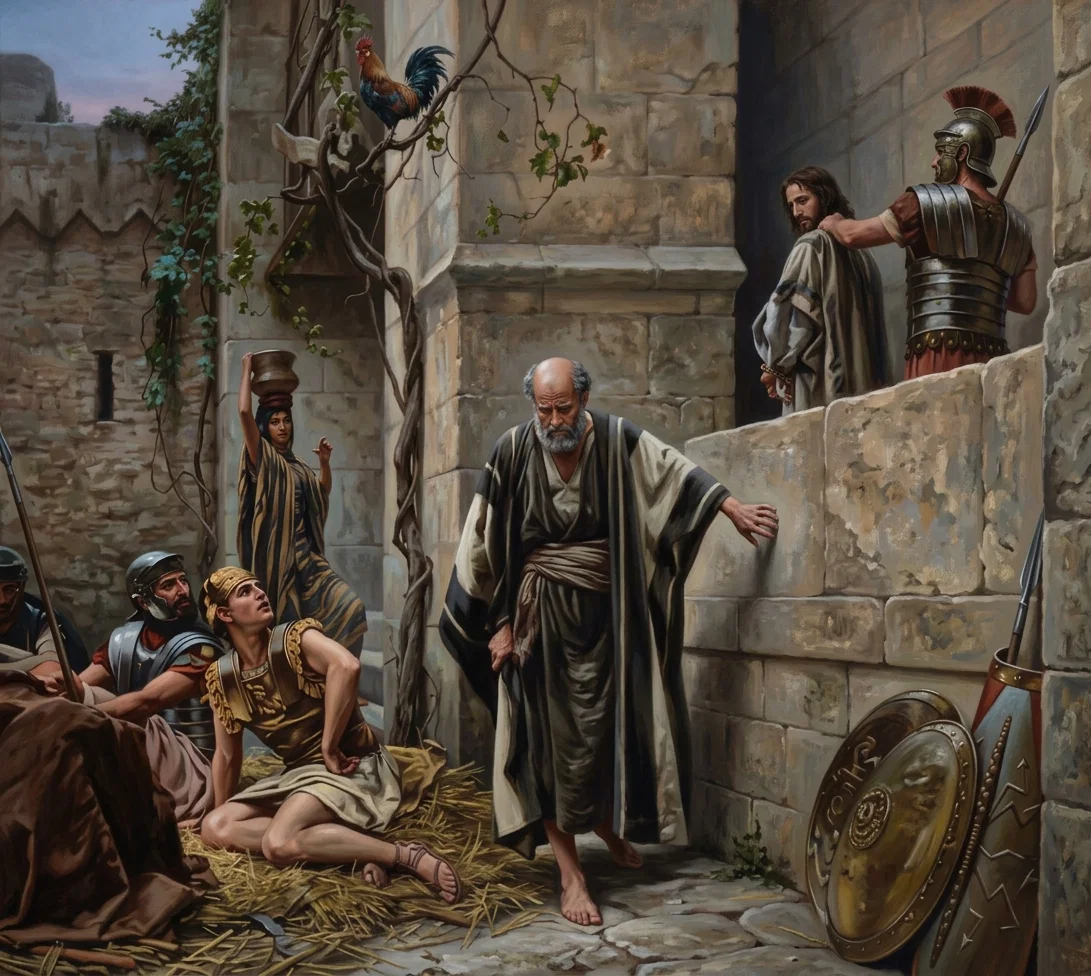
“Then saith Jesus unto them, All ye shall be offended because of Me this night; for it is written, I will smite the Shepherd, and the sheep of the flock shall be scattered abroad. But after I am risen again, I will go before you into Galilee. Peter answered and said unto Him, Tho all men shall be offended because of Thee, yet will I never be offended. Jesus said unto him, Verily I say unto thee, That this night, before the cock crow, thou shalt deny Me thrice. Peter said unto Him, Tho I should die with Thee, yet will I not deny Thee. Likewise also said all the disciples.”
“Another confidently affirmed, saying, Of a truth this fellow also was with Him; for he is a Galilean. And Peter said, Man, I know not what thou sayest. And immediately, while he yet spake, the cock crew. And the Lord turned, and looked upon Peter. And Peter remembered the word of the Lord, how He had said unto him, Before the cock crow, thou shalt deny Me thrice. And Peter went out, and wept bitterly.” Luke 22:59-62.
Jesus entered into controversy with no man. He had a work to do in the world. After His baptism John pointed to Him as “the Lamb of God, that taketh away the sin of the world.” Even when in the wilderness of temptation He was met by Satan, He held no controversy with His foe. He took His stand upon the written Word. The weapon with which He met and repulsed the enemy was, “It is written.” And Christ obtained the victory on the point of appetite in behalf of the whole world, that every soul might have His example before them.
And now the steps of Christ are tending to the last place of His humiliation and suffering in humanity. Turning to His disciples, He said in tones of deepest pathos, “All ye shall be offended because of Me this night;” for it is written, “Awake, O sword, against My Shepherd, and against the Man that is My Fellow, saith the Lord of hosts; smite the Shepherd, and the sheep shall be scattered.” These words were spoken as from a breaking heart.
Throughout His whole discourse, Christ had made no mournful allusion to His own sufferings and death. The Shepherd knows He will be smitten, that the rod lifted in His Father’s hand will fall heavily upon Him because of the law transgressed. But Christ thinks only of His disciples. His heart of tenderest love is ever seeking to cheer them. He must prepare them for the absence of His bodily presence. “Let not your heart be troubled,” He said; “ye believe in God, believe also in Me. In My Father’s house are many mansions; if it were not so, I would have told you. I go to prepare a place for you. And if I go and prepare a place for you, I will come again, and receive you unto Myself; that where I am, there ye may be also.” He alludes to their scattering and forsaking Him at the very time when He most needs their sympathy and prayers. But He does not allow this thought of sadness to leave a depressing gloom upon them. He adds, “But after I am risen again, I will go before you into Galilee.”
The period that is to answer to the prophetic past had come. Christ takes His disciples over the terrible scenes to be enacted, and revives them with hope. He assures them that He will break the fetters of the tomb in the morning of the resurrection, when He will meet them in Galilee. He wanted their hearts to know no fear, but trust in Him.
But now Peter feels that he must speak, and assures his Master that he will never be guilty of denying his Lord. He did not realize that in that very assertion he was refusing caution and reproof from Christ. When men feel themselves so strong, then it is that they need the words of Inspiration brought to their minds, “Let him that thinketh he standeth, take heed lest he fall.” Had Peter done this, he would not have disgraced himself, and put Christ to open shame. The time had come when silence was eloquence, when to think in quietness was far better than any speech he could have made. But Peter knew so little of his own heart that he denied the truthfulness of Christ’s statement.
Christ had told Peter that he was mistaken in his ideas of himself, and that in not receiving and believing the words of Christ he was doing the very evil that Christ had declared he would be guilty of. We see this same spirit manifested to-day. We need ever abiding in the soul the treasure of the Word of God, that when the host of hell shall seek to destroy with temptations, we may be ready with sharp perception to discern his wiles, and meet him as Christ met him in the wilderness, with, “It is written.” When we feel our personal weakness, when we depend on Christ and not on self, we have done what we can. Then the heavenly intelligences are ready to lift up the standard for us against the enemy, saying to the Satanic agencies, “Thus far shalt thou go, and no farther.” The tempted one often does not realize that he has unseen heavenly agencies working in his behalf, but this is so.
“Peter answered and said unto Him, Tho all men shall be offended because of Thee, yet will I never be offended. Jesus said unto him, Verily I say unto thee, that this night, beforethe cock crow, thou shalt deny Me thrice.” O, how poorly will many who feel so self-sufficient, stand the test! Jesus could see the future. He could read even the thoughts of the heart. He knew that Peter’s first denial would not stop there. Having denied his Lord once, occasion was given to deny again, and the second denial brought circumstances in its train to deny the third time, and that with cursing and swearing. Peter should have taken it for granted that Jesus knew him better than he knew himself. He should have humbled his heart, and asked for special grace, that this thing might not be. But he lost this opportunity in not heeding or believing the warning given.
In a most decided manner he declared, “Tho I should die with Thee, yet will I not deny Thee.” Peter was thoroughly honest in his assertion, but he was not half as wise as he thought himself to be. He was ignorant of himself. He did not realize his own weakness. It is the privilege of the believer to know that Christ knows all things, and that He would never have made that statement if Peter had known his own heart.
Jesus did not try farther to make Peter believe that He knew what course he would pursue. But He knew that “the heart is deceitful above all things, and desperately wicked.” At this time Peter should have been examining himself. How distrustful of self should he have been! But he refused to admit that the picture presented before him was correct, and in the place of inviting research, altho the Holy Spirit of God had revealed to him the character he would manifest, under test and trial, he refused to accept it. If he had humbled his soul before God, in place of denying the searching and reading of his inmost soul, he would have said with the prophet, “Wo is me! for I am undone; because I am a man of unclean lips.”
Peter needed a deeper, broader knowledge of Jesus Christ. He had listened to His words and enjoyed His lessons. He had acknowledged Christ as the Son of God, and believed Him to be this; but he had only touched the margin of faith in Christ. There were depths in the knowledge of His character which demanded his homage, his faith, his tribute of perfect trust and unshaken confidence. “Thou shalt see greater things than these,” is the promise that invites increased faith and expectation. Jesus stood ready to reveal Himself to Peter. In His great love He told Peter of his denial. He sought to reveal the defects of his character, and his necessity for the help which Christ alone could give. Peter needed a distrust of himself, and deeper views of God.
When Peter had done the very thing Christ had told him he would do, he was filled with shame and sorrow. He was a repentant man, and became thoroughly converted. Then how tender and charitable, how meek and forgiving, Peter revealed himself to be!
MRS. E. G. WHITE.

THE GOSPEL IN GRAFTING.

IN the book of nature, as well as in the printed Word, God has revealed Himself to us. Everything, animate and inanimate, speaks of the power and wisdom of Him who “commanded and they were created.” “But ask now the beasts, and they shall teach thee; and the fowls of the air, and they shall tell thee; or speak to the earth, and it shall teach thee; and the fishes of the sea shall declare unto thee. Who knoweth not in all these that the hand of the Lord hath wrought this?” Job 12:7–9.

The Subject Outlined.

God’s plan for the salvation of lost man is also clearly set forth in “the visible Gospel,” His working in “the things that are made.” One phase of this teaching will be the subject of our study in this article. The facts concerning the creation of man, his fall, God’s purpose to restore him, and the result of this work, are briefly stated in the following scriptures: “And God said, Let us make man in our image, after our likeness. . . . So God created man in His own image.” Gen. 1:26, 27. “All have sinned, and come short of the glory [character, or image] of God.” Rom. 3:23. “And we know that all things work together for good to them that love God, to them who are the called according to His purpose. For whom He did foreknow, He also did predestinate to be conformed to the image of His Son.” Rom. 8:28, 29. This is accomplished by “the light of the glorious Gospel [the Gospel of the glory] of Christ, who is the image of God.” 2 Cor. 4:4. “And as we have borne the image of the earthly, we shall also bear the image of the heavenly.” 1 Cor. 15:49. “Beloved, now are we the sons of God, and it doth not yet appear what we shall be; but we know that, when He shall appear, we shall be like Him.” 1 John 3:2.
We may summarize these facts in this way: Man at the first was made perfect, but lost that perfection through sin. The Gospel is God’s plan and power for restoring man to his original perfection through the gift of Jesus Christ and the acceptance of His righteousness. The resultwill be that man will be once more like Him.

The Same Thing Revealed in Nature.

Now these same facts are brought to our attention in “the visible Gospel” of nature, and in His Word the Lord has made this instruction clear to us. That the original perfection of man and his subsequent fall are taught in nature, is pointed out in this scripture: “Yet I had planted thee [Israel, verse 14] a noble vine, wholly a right seed; how then art thou turned into the degenerate plant of a strange vine unto Me?” Jer. 2:21. The general method of restoration, as taught by the Saviour, is to “make the tree good, and his fruit good.” The details of the method will be considered later. And the result is “that they might be called trees of righteousness, the planting of the Lord, that He might be glorified.” Isa. 61:3. This shows that the degeneracy of all plants and trees, and their tendency to degenerate, is the visible teaching of the fall of man. And the fact that degenerate plants and trees can be made to yield good fruit, teaches the Gospel of restoration for man. And the method by which a degenerate plant or tree can be made to yield good fruit, when studied in the light of the Scripture, reveals the method by which sinful man can be “filled with the fruits of righteousness.” Let us therefore consider it carefully.

The Fruit of the Nature of the Tree.

The nature of the fruit depends upon and reveals the nature of the tree. “Even so every good tree bringeth forth good fruit; but a corrupt tree bringeth forth evil fruit. A good tree can not bring forth evil fruit, neither can a corrupt tree bring forth good fruit. . . . Wherefore by their fruits ye shall know them.” Matt. 7:17–20. This is the teaching of nature, and the experience of every man has made him familiar with these facts. But since a corrupt tree can not bring forth good fruit, it is evident that, if good fruit is to be obtained from a tree which has become corrupt, the nature, or character, of the tree must be changed. And every gardener knows that this can be done, and that it is done, by the process of grafting. One method of grafting is to saw off the end of a limb of the tree to be grafted, and then insert in the end one or more grafts or scions from a tree bearing a superior variety of fruit; and the nature of the graft or scion determines the nature of the fruit borne on the new branch. It is a well-known fact that our best varieties of fruits have all been obtained in this way.

The Engrafted Word.

But how are these facts interpreted by the Scripture so that we may see in them what they are designed to teach, viz., the method by which man may be restored to the image of God? Let us read and see: “Wherefore lay apart all filthiness and superfluity of naughtiness, and receive with meekness the engrafted Word, which is able to save your souls.” James 1:21. How is the degenerate human tree to be restored so that it may bear good fruit?—Just as is the tree in your garden,—it must be grafted. And what is the graft or scion to be used?—It is the Word, “which is able to save your souls.”
But what or who is the Word?—“In the beginning was the Word, and the Word was with God, and the Word was God.” John 1:1. “And I saw heaven opened, and behold a white horse; and He that sat upon him was called Faithful and True, and in righteousness He doth judge and make war. . . . And His name is called The Word of God.” Rev. 19:11–13.
It is thus evident that the “engrafted Word” which we are to receive, and “which is able to save your souls,” is Christ, the living Word. “He came unto His own, and His own received Him not. But as many as received Him, to them gave He power to become the sons of God, even to them that believe on His name.” John 1:11, 12. “Neither is there salvation in any other; for there is none other name under heaven given among men, whereby we must be saved.” Acts 4:12.

Tree and Graft Must Be of the Same Kind.

But it is now necessary to call attention to another fact which is well known to every one who has had any experience in grafting trees. Any gardener will tell you that in order for the process of grafting to be successful, the graft, or scion, must be nearly related botanically to the tree which is to be grafted. “Thus roses will bud on briers, but not on myrtles. Apricots will on plums; pears will on quinces; because all these are closely related. But apples will not graft on plums, being not of the same order.” This is the chapter in the gospel of nature in which we read of the necessity for, and the fact of, the incarnation of the Son of God.
Here we see the following scriptures: “Forasmuch then as the children are partakers of flesh and blood, He also Himself likewise took part of the same; that through death He might destroy him that had the power of death, that is, the devil; and deliver them who through fear of death were all their lifetime subject to bondage. For verily He taketh not hold of angels, but of the seed of Abraham He taketh hold [margin]. Wherefore in all things it behooved Him [or He was obliged] to be made like unto His brethren.” Heb. 2:13–17. “For what the law could not do, in that it was weak through the flesh, God sending His own Son in the likeness of sinful flesh, and for sin, condemned sin in the flesh; that the righteousness of the law might be fulfilled in us, who walk not after the flesh, but after the Spirit.” Rom. 8:3, 4. “Wherefore when He cometh into the world, He saith, Sacrifice and offering Thou wouldest not, but a body hast Thou prepared Me.” Heb. 10:5.
God’s plan for man contemplated, not the overlooking of sin in man but the removal of sin from man, and his complete restoration to the image of God, a change of character or nature, that we might “be partakers of the divine nature.” But since man, who was at the first and by creation “a noble vine, wholly a right seed” (or seed of truth), had through sin “turned into the degenerate plant of a strange vine,” and had lost the divine nature, so that “there is none righteous, no, not one,” it was necessary, in order to make it possible for him to receive “the engrafted Word,” for his restoration, that the Word should be made flesh, and not merely that it should be made flesh, but that it bear the same kind of flesh. And so God sent His own Son “in the likeness of sinful flesh,” that thus the scion or graft might be prepared so nearly related to us that it might be possible for us to receive the “engrafted Word,” and bring forth fruit after the divine nature.
Since it was man who was to be saved, and sinful man too, the Son of God became the Son of man, not laying aside His divinity but clothing it with our humanity, that He might be able to reach man where he was. This was the only way in which the divine nature could come in actual contact with sinful man as a means of salvation, since the unveiled glory of God could result only in destruction to sinners. “For our God is a consuming fire.” Heb. 12:29.

The Testimony of Prophecy.

All this was clearly set forth in the prophecy concerning the person and work of Christ. Thus we read: “And there shall come forth a shoot out of the stock of Jesse, and a branch [or scion] out of his roots shall bear fruit.” Isa. 11:1, R.V. Here is presented “the Gospel of God . . . concerning His Son, who was born of the seed of David according to the flesh,” but it is clothed in such language that it is most clearly intended as a partial interpretation of that remarkable phenomenon in nature which we are now studying. But another scripture will give further light upon the subject: “Behold, the days come, saith the Lord, that I will raise unto David a righteous Branch [margin, ‘Shoot or Bud’], and He shall reign as King and deal wisely. . . . And this is His name whereby He shall be called, The Lord is our righteousness.” Jer. 23:5, 6, R.V. The family of David is a “sinful nation, a people laden with iniquity, a seed of evil-doers, children that are corrupters” (Isa. 1:4); but to this same nation the promise was made, “Thy people also shall be all righteous” (Isa. 60:21); and inasmuch as this is to be brought about by receiving “the engrafted Word,” the Branch (Shoot or Scion) which is to be used in the process of grafting must be “a righteous Branch,” since the character of the scion determines the character of the fruit to be borne on the new branch. Thus a Branch was prophesied of which would be nearly related to the “degenerate plant,” so that it could be used in the grafting process, but at the same time infinitely superior in the character of its fruit, so that through it could be accomplished the restoration of the “degenerate plant.”

A Righteous Branch.

The meaning of this fact of nature, that the scion and the tree must be nearly related botanically, is further brought out in this scripture: “Thus speaketh the Lord of hosts, saying, Behold, the Man whose name is the Branch [margin, ‘Bud’]; and He shall grow up out of His place, and He shall build the temple of the Lord; even He shall build the temple of the Lord; and He shall bear the glory, and shall sit and rule upon His throne; and He shall be a priest upon His throne; and the council of peace shall be between them both.” Zech. 6:12, 13, R.V. The tree to be restored was man; and so the Branch (or Scion) must be a man, but, in order to “make the tree good,” that it might bear good fruit again, it was necessary that the Branch, or Man, should be of an infinitely superior type, even “a righteous Branch,” so that the scripture should be fulfilled which says, “By His knowledge shall My righteous Servant justify many.” Isa. 51:11.

An Abominable Branch.

These same truths are taught, by contrast, in another way. Thus we read of Lucifer, who was created the light-bearer, but who through his rebellion became Satan, the adversary: “How art thou fallen from heaven, O Lucifer, son of the morning! how art thou cut down to the ground, which didst weaken the nations! For thou hast said in thine heart, I will ascend into heaven, I will exalt my throne above the stars of God; I will sit also upon the mount of the congregation, in the sides of the north; I will ascend above the heights of the clouds; I will be like the Most High. Yet thou shalt be brought down to hell, to the sides of the pit: They that see thee shall narrowly look upon thee, and consider thee, saying, Is this the man that made the earth to tremble, that did shake kingdoms; that made the world as a wilderness, and destroyed the cities thereof; that opened not the house of his prisoners? All the kings of the nations, even all of them, lie in glory, every one in his own house. But thou art cast out of thy grave like an abominable branch. . . . The seedof evil-doers shall never be renowned.” Isa. 14:12–20. Read also Eze. 34:26–30, noticing especially verse 29: “And I will raise up for them a plant of renown, and they shall be no more consumed with hunger in the land, neither bear the shame of the heathen any more.”
What a contrast is here drawn between Christ, the “righteous Branch,” and Satan, the “abominable branch”! The one is He who “giveth power to the faint; and to them that have no might He increaseth strength” (Isa. 40:29); the other is he “which did weaken the nations.” The one is “a plant of renown;” the other “shall never be renowned.” The one came “to seek and to save that which was lost;” the other “walketh about as a roaring lion, seeking whom he may devour.”

The Final, Complete Restoration.

Thus, in the light which the Scripture throws upon it, we may learn the teaching which the Lord designs to impart to us through that really remarkable process, the process of grafting. In it the Gospel of the restoration of man to the image of God, and the method by which it is accomplished, are most certainly taught. So if any man will regard this process in the natural world in the light which is shed upon it from the Word of God, he can see the way in which the degenerate human plant is to be treated, and what the results will be. Thus if one will believe the Gospel in grafting, he will be thereby prepared to “receive with meekness the engrafted Word, which is able to save your souls.”
In the light of what we have learned we may profitably close this study with the following scripture: “Thus saith the Lord God: I will also take of the highest branch of the high cedar, and will set it; I will crop off from the top of his young twigs a tender one, and will plant it upon an high mountain and eminent; in the mountain of the height of Israel will I plant it; and it shall bring forth boughs, and bear fruit, and be a goodly cedar; and under it shall dwell all fowl of every wing; in the shadow of the branches thereof shall they dwell. And all the trees of the field shall know that I the Lord have brought down the high tree, have exalted the low tree, have dried up the green tree, and have made the dry tree to flourish; I the Lord have spoken and have done it.” Eze. 17:22–24. W. W. PRESCOTT.
London, Eng.

ONE SIN.

There was but one crack in the lantern, and the wind has found it out and blown out the candle. How great a mischief one unguarded point of character may cause us! One spark blew up the magazine and shook the whole country for miles around. One leak sank the vessel and drowned all on board. One wound may kill the body; one sin, destroy the soul.
It little matters how carefully the rest of the lantern is protected; the one point which is damaged is quite sufficient to admit the wind. And so it little matters how zealous the man may be in a thousand things if he tolerates one darling sin; Satan will find the flaw and destroy all his hopes.
The strength of the chain is measured not by the strongest, but by its weakest link, for if the weakest snaps, what is the use of the rest? Satan is a close observer, and knows exactly where our weakest points are; we have need of very much watchfulness, and we have great cause to bless our merciful Lord, who prayed for us that our faith fail not.
Either our pride, our sloth, our ignorance, our anger, or our lust would prove our ruin unless grace interposed; any one of our senses or faculties might admit the foe—yea, our virtues and graces might be the gate of entrance to our enemies. O Jesus, if Thou hast indeed bought me with Thy blood, be pleased to keep me by Thy power even unto the end!—C. H. Spurgeon.

CHURCH DOMINION.

“Christ is the head of the church,” and “the church is subject unto Christ.” Eph. 5 : 23, 24. Not only is Christ the head of the church, as “the body of Christ,” but He is the “head of every man.” 1 Cor. 11 : 3. It is claimed by the Church of Rome that Peter was the delegated head of the church after the ascension of Christ, and that the pope as successor of Peter is the vicegerent of Christ, and therefore the visible head, having spiritual dominion of the body. Hence, as head of the church, he assumes to be director of the faith. The only man mentioned in the Scriptures as having a general oversight is not Peter, but Paul. In referring to the persecutions and trials through which he had passed, he says, “Beside those things that are without, that which cometh upon me daily, the care of all the churches.” 2 Cor. 11 : 28. But this “care” is not one of dominion or authority, it is an obligation. “I am debtor both to the Greeks, and to the Barbarians; both to the wise, and to the unwise.” Rom. 1 : 14. “For tho I preach the Gospel, I have nothing to glory of; for necessity is laid upon me; yea, wo is unto me, if I preach not the Gospel!” 1 Cor. 9 : 16. Altho God had anointed him, yet he says to the church at Corinth, “Not for that we have dominion over your faith, but are helpers of your joy; for by faith ye stand.” 2 Cor. 1 : 24.
At the very time Paul was having this “care of all the churches,” tho disclaiming any dominion over their faith, he gives this record of his manner of labor at Ephesus: “Ye know, from the first day that I came into Asia, after what manner I have been with you at all seasons, serving the Lord with all humility of mind, and with many tears, and temptations, which befell me by the lying in wait of the Jews; and how I kept back nothing that was profitable unto you, but have taught you publicly, and from house to house, testifying both to the Jews, and also to the Greeks, repentance toward God, and faith toward our Lord Jesus Christ.” Acts 20 : 18–21.
Nor did he claim a very large income for his services, or allowance for the helpers which his great charge necessitated. Altho he was entitled to temporal support from those to whom he ministered in spiritual things, yet he gives this testimony as to his self-denial in respect to his maintenance: “I have coveted no man’s silver, or gold, or apparel. Yea, ye yourselves know, that these hands have ministered unto my necessities, and to them that were with me. I have showed you all things, how that so laboring ye ought to support the weak, and to remember the words of the Lord Jesus, how He said, It is more blessed to give than to receive.” Verses 33–35.
This is the only true principle upon which any one can have a proper oversight of churches. Jesus said to His disciples: “Ye know that the princes of the Gentiles exercise dominion over them, and they that are great exercise authority upon them. But it shall not be so among you; but whosoever will be great among you, let him be your minister; and whosoever will be chief among you, let him be your servant; even as the Son of man came not to be ministered unto, but to minister, and to give His life a ransom for many.” Matt. 20 : 25–28.
W. N. G.

THE GOSPEL FEAST.

The Gospel feast is spread With wine and oil and living bread to-day; Arise, lift up thy voice, proclaim to all; The joyful sound; the invitation give. Go forth into the highways wide, constrain Them to come in.
Glad tidings to the poor, And blest are those who live to make them known. A welcome waits each messenger of peace, And angels follow on with ministries Of love. Invite them now; the streets and lanes Are full of hungry souls—the blessing shall Be thine. For inasmuch as ye have done It unto Mine,—“the least of these,”—know ye Have done it unto Me.
London, Eng.
HARRY ARMSTRONG.

WHAT EXEMPTION CLAUSES MEAN.

An Italian fruit vender, among eleven others, was recently arrested for Sunday work in the city of Plainfield, New Jersey. In his defense he claimed to be an observer of the seventh day, tho a member of no church. He was convicted and sentenced to a fine of $25. The American Sentinel, faithful to its mission, gives us this further information and just conclusion:—
The mayor and city officials seem disposed to recognize the right of the seventh-day observers to transact business on the first day of the week, under certain restrictions. Among the Seventh-day Baptists of the place are several storekeepers, and these have been informed that they may do business on Sunday provided they do so behind closed doors and drawn curtains, so that their places of business will have the appearance of being closed. The Sunday law of the State, like that of most of the States, contains an exemption for observers of the seventh day, provided their Sunday work be done in such a way as not to “disturb” observers of the day.
This customary phrase in the Sunday laws about the “disturbance of others” has been one of no definite significance; but now the authorities of the city of Plainfield have given it a definite construction, so that it is now known that doing business on Sunday so as not to “disturb” others, means doing it in such a way that nobody will know that it is being done. This, at least, is what it means in the city of Plainfield, N. J.
So extremely sensitive are those who believe in the sacredness of Sunday, that the mere knowledge that other people are conducting themselves in a manner inconsistent with that belief, without observing profound secrecy about it, causes them a “disturbance” which they are not able to bear.
While these storekeepers have been ordered thus to conceal the interior of their places of business on Sundays from public view, the saloonists, on the other hand, under the same law, have strict orders to keep their places of business open to inspection from the outside. The former, however, have declined to accede to the order, and continue to do business on Sundays in the usual manner. As yet, they have only been threatened with arrest.
It is said that the ostensible purpose of the crusade, at its inception, was the Sunday closing of certain disreputable “cider joints” in the city; and that, under this impression, observers of the seventh day gave the movement their full support. If this be so, they have had an excellent opportunity to learn that no support of a Sunday-closing movement, of whatever kind, can be proper. For while such movements may give their first attention to the closing of saloons, in the logical order of things they soon find victims among those of upright character and the most reputable employment. The saloonist appeals to logic, and logic—as regards Sunday closing—knows no distinction between the business of saloon-keeping and any other. If a place of traffic ought to be closed because it is bad in character, it ought to be closed on all days, and on no one day more than on another. But if the plea is that it ought to be closed because the day is Sunday, then every other place of business ought to be closed likewise. This is logic, and there is no evading its requirements.

PURPOSE OF GOD REFUSED.

Babylon the First.

“IN the beginning God created the heaven and the earth.” For six days He wrought, at the end of which creation was complete. Man was the last created work, and was in truth the Creator’s masterpiece in this world. Looking out on creation with that divine eye which could detect the smallest flaw, God was constrained to say, “It is very good.”
Peace and joy reigned. Man received from the lips of His Creator, instructions which tended to give him perpetual joy and peace if followed. The animals of all kinds were obedient to His commands. A home was prepared for the first pair, beautiful beyond description. Here everything that was pleasant to the eye and good for food was supplied by the same Master Hand that supplied the home. This, with life, was all a free gift to man. The only restraint laid upon him was to accept with confidence the Word of the One who had freely given all this as a token of His regard. Properly viewed, this was rather a privilege than a restraint; for what God had done in creating him testified of His superior wisdom to guide; while life, with all its most pleasant surroundings, was enough assurance of His good-will.
Into this paradise of love and order came the tempter. He approached man as a friend, but not as a friend of his Creator. With the goodness of God before them, this should have given immediate rise to suspicion. But it did not.
The first attack was against that which procured to man all his blessings, his liberty, and his safety,—God’s Word. Satan well knew that so long as man had respect for that, he was as an impregnable fortress. So his first words were, “Yea, hath God said, Ye shall not eat of every tree of the garden?” When answered in the affirmative, with the reason attached, “lest we die,” his immediate response was, “Ye shall not surely die; for God doth know that in the day ye eat thereof, then your eyes shall be opened, and ye shall be as gods, knowing good and evil.” It is said by good scholars that the word translated “yea” denotes a sneer. Thus we see that he first made light of God’s Word, then denied it flatly, and then placed instead of that Word, man’s ambition.
It is unnecessary to say that the device of Satan was successful. From this time man went from bad to worse. He had refused in one particular to listen to the voice of God, and Satan had him in his grasp. Had it not been for the interposition of the One whom he had refused to believe, he could never have been extricated from the snare into which he had walked with open eyes. But his Creator became his Benefactor and offered redemption and salvation to him if he would trust His Word. Few were willing to accept it, and so we read that Cain rose up and slew his brother because this brother did right—trusted God—contrary to his own evil works—trusting his own way.
The blessings which God gave men with which to glorify Him, they used to glorify self. This continued until every purpose, desire, and thought of the heart of man was only evil continually. When the time came that they no more thought a good thought, it pleased the Lord to cut them off, after giving them a warning by Noah, the only one whom He found righteous on the earth. As we view the terrible corruption of the earth at that time, and see the retribution it received in the Deluge, we are led to ask again, “And what caused all this?” It was all the result of one misstep,—man left God’s way.
The ark landed among the mountains. Noah and his family went forth to make homes in the earth. The command came from God to them, “Be fruitful, and multiply, and replenish the earth.” Very soon after this we read: “And it came to pass, as they journeyed from the east, that they found a plain in the land of Shinar; and they dwelt there. And they said one to another, Go to, let us make brick, and burn them thoroughly. And they had brick for stone, and slime had they for mortar. And they said, Go to, . . . let us make us a name, lest we be scattered abroad upon the face of the whole earth.” Gen. 11:2–4.
In three short verses we have the history of this people for future time portrayed. The Lord had said to them, “Be fruitful, and multiply, and replenish [fill] the earth.” Gen. 9:1. They could not fill the earth unless they should scatter abroad, and when we hear them saying, Let us do so “lest we be scattered abroad upon the face of the whole earth,” we see that they had already rejected God’s way and were preparing to resist it. As they had rejected God’s way, they must have taken their own in its place. This we see they had done by the expression, “Let us make us a name.” He who knows the character of Satan, therefore, can read ahead the history of this people. It is true they did not succeed in their design, not because they changed their minds in any way, but because they were foiled in their work by the Lord.He confounded their language and “scattered them abroad upon the face of all the earth.” The Lord named this place Babel (confusion) and it afterward became Babylon.
It would seem that such a defeat would have taught these people and all connected with them that it was best to do according to the Word of the Lord. Yet we read that Nimrod, the grandson of Ham, established a kingdom at Babel (Babylon); and not only so, but that this kingdom honored this first rebellious work by naming the site of the tower “Bab-il,” which in the Chaldean language signifies “the gate of god.” And after the Lord had, by lightning and earthquakes, torn it down, the king, Nebuchadnezzar, presumed to build it again, giving as a reason that the god Merodach excited his mind to do so. He says concerning it:—
We say for the other, i. e., this edifice, the house of the Seven Lights of the earth, the most ancient monument of Borsippa: A former king built it (they reckon forty-two ages), but did not finish its head. Since a remote time people had abandoned it, without order, expressing their words. Since that time earthquake and thunder had dispersed its sun-dried clay; the brick of the casing had been split, and the earth of the interior had been scattered in heaps. Merodach, the great lord, excited my mind to repair this building. I did not change the site, nor take away the foundation stone. As it had been in former times so I founded, I made it; as it had been in ancient days so I exalted its summit.—Smith’s Dict. of Bible, art. Babel, Tower of.
Thus we have a kingdom which was established shortly after the Flood, which maintained the part of the Babel-builders. This kingdom had rejected God’s way and were tenacious of their own. God’s way was all for harmony and union, because it is His plan to put His Spirit in every one who chooses His way. The rejection of this brings confusion. Should we not expect that this first great apostasy from God after the Deluge would, in the providence of the One who overrules, be designated “Babylon”—Confusion? C. L. EMERSON.
Continue reading: THE CHRISTIAN'S LIFE