Your ShelfYour Projects

Signs of the Times, Vol. 28, No. 35.

THE BASEST OF THE KINGDOMS

Signs of the Times

Aug 27, 1902

Pacific Press Publishing Company · Oakland, California · Aug 27, 1902

“THE BASEST OF THE KINGDOMS.”

The Reproach of Christ.
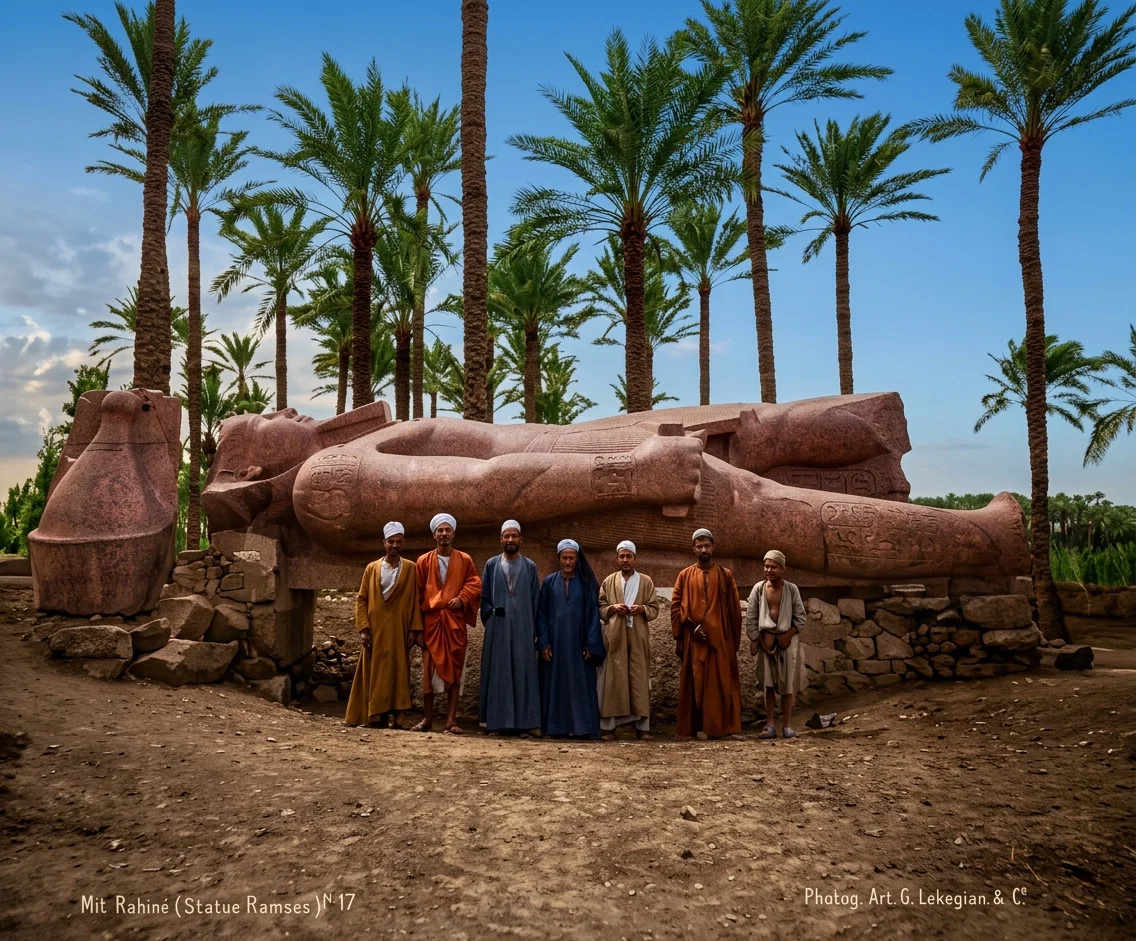
SIX hundred years before Christ the Lord declared by His prophet concerning Egypt, then struggling for supremacy in world-empire against Babylon: “It shall be the basest of the kingdoms; neither shall it any more lift itself up above the nations; and I will diminish them that they shall no more rule over the nations. . . . Her foundations shall be broken down. . . . They also that uphold Egypt shall fall; and the pride of her power shall come down. . . . And they shall be desolate in the midst of the countries that are desolate; and her cities shall be in the midst of cities that are wasted. . . . I will also destroy the idols, and I will cause the images to cease from Memphis; and there shall be no more a prince from the land of Egypt. . . . And I will . . . set a fire in Zoan, and will execute judgments upon No.” (See Ezekiel, chapters 29 to 32.)
Statue of Ramses II., Pharaoh of the Oppression.
OUR illustration of the great prone statue of Ramses II., the Sesostris of the Greeks, the Pharaoh of the Oppression, is graphic evidence of this. For the long period of sixty-seven years in the nineteenth dynasty he ruled over Egypt. Other kings of Egypt were greater warriors; he was the greatest builder. From one end of Egypt to the other his name is found, not among the things of life, but now among the things of death and decay. One writer tells us, “It is almost impossible to find in Egypt a ruin or an ancient mound, without reading his name.” The great rock-temple at Ipsambul, with its enormous colossi of himself, with his image as one of four with three of the gods of Egypt, was not his only work made in honor of himself. He caused to be made the greatest statue of himself ever sculptured by mortal man. It was found at Tanis, the ancient Zoan of Scripture, founded seven years later than Hebron. Zoan was used as the capital city by the Hyksos, or Shepherd Kings, and it is thought by some that Joseph once lived there. When Ramses II. lived, it was celebrated for its beauty, the fertility of its fields, and the abundance of its wild birds and fish.
IT was in this great, noted, and ancient city that Ramses thought to glorify self by the mighty statue raised to his name. Erect and crowned it was ninety-two feet from head to foot, or one hundred and twenty-five feet includingpedestal. When found it had been broken up into rocks of tons each by a later king—Osorkon II., in the twenty-second dynasty—to build a mammoth gateway.
IT was Ramses who oppressed the Israelites, who made their bondage hard and bitter by exacting service in bricks and mortar. It was by the life-blood pressed from this oppressed people that his great monuments grew skyward. He thought only of himself and his own glory. He was the monopolist of the land. To his power and plans all else must bend. His ambitions all must feed. If a nation need to be sacrificed, what of that? There are others left; and the world is prolific. What are lives of slaves compared to a temple to Amen-Ra? What is their toil, their anguish, their sweat, their blood, in comparison with a great phallic monolith to the sun, which we now call a Cleopatra’s needle, tho the voluptuous queen never made one? One monument of stone to himself is worth more than a thousand slaves!
BUT God cared for His oppressed children. Speaking after the manner of men, He went down to the dark land to see how they fared. He saw their sufferings. He heard their groans. He felt their pain. He determined to deliver them. He sent Moses with the message, “Thus saith Jehovah, the God of Israel, Let My people go, that they may hold a feast unto Me in the wilderness;” “that they may serve Me.” It was in every way a reasonable request. Israel’s going into Egypt had been a blessing to the country, and the hard enforced bondage of later years was wholly unjust. Egypt owed Israel both wages and liberty. But the haughty monarch whose chief thought was to glorify himself, who knew neither mercy nor justice, refused to submit to Jehovah. He set himself against God. He ruined his kingdom in the vain strife, and the flower of his army went down in the Red Sea while pursuing the escaping bondmen. It was Jehovah for Israel and Egypt; for great blessings would have come to Egypt, and God’s name would have gotten great glory in the earth, if Ramses had submitted his proud will to God. But Ramses made it Egypt against God; and Egypt fell, never more to rule over the nations. Babylon was more worthy than she, and to Babylon and her successors Egypt became subject.
THE prone broken statue of the great king is a striking object lesson of the end of all human selfish greatness. The fame, the renown, the pomp, the grandeur, the seeming greatness gotten through selfishness, for the purpose of self-aggrandizement and self-exaltation, is doomed to perish. It may sway the world for a time; it may make the nations bow as fields of grass before the wind; it may seem to be solid and stable; but it is all doomed to perish, and those who have identified themselves with it will meet the same fate.
MOSES knew all of Egypt’s glory. He was brought up in the royal courts. He was learned in all the wisdom of the Egyptians. He was mighty in word and deed. He saw the vast difference in social life between the Pharaoh in his court and the slave in his pen. He knew Egypt’s greatness. He could possess it if he would. He was the “crown prince of Egypt.” But he rejected it all for Christ’s sake, and counted a lot with the Christian slave preferable. “By faith Moses, when he was grown up, refused to be called the son of Pharaoh’s daughter; choosing rather to share ill treatment with the people of God, than to enjoy the pleasures of sin for a season; accounting the reproach of Christ greater riches than the treasures of Egypt; for he looked unto the recompense of reward.”
EVERY man has the spiritual darkness of Egypt, the selfishness of Egypt, the lust of Egypt in his own carnal heart. Again and again when the God of Israel asks for the service of his faculties and members, the carnal mind, the king of his Egypt, asks the question, “Who is Jehovah, that I should obey His voice? I know not Jehovah, neither will I yield my all to His service.” (See Ex. 5: 1, 2; Rom. 6: 16–23.) The only way to meet the question is to yield to God. “The wages of sin is death,” and all selfishness is sin. The only hope of salvation from sin is to leave the Egypt of selfishness, and humbly, gladly go with Jesus Christ the only Deliverer.

GOD’S JUSTICE AND LOVE.

BY MRS. E. G. WHITE.
THE love of God is shed abroad in our hearts. For when we were yet without strength, in due time Christ died for the ungodly. God commendeth His love toward us, in that, while we were yet sinners, Christ died for us.”
After the fall of our first parents, Christ declared that in order to save man from the penalty of sin, He would come to the world to conquer Satan on the enemy’s own battle-field. The controversy that began in heaven was to be continued on the earth.
In this controversy much was to be involved. Vast interests were at stake. Before the inhabitants of the heavenly universe were to be answered the questions: “Is God’s law imperfect, in need of amendment or abrogation, or is it immutable? Is God’s government in need of change, or is it stable?”
Before Christ’s first advent, the sin of refusing to conform to God’s law had become widespread. Apparently Satan’s power was growing; his warfare against heaven was becoming more and more determined. A crisis had been reached. With intense interest God’s movements were watched by the heavenly angels. Would He come forth from His place to punish the inhabitants of the world for their iniquity? Would He send fire or flood to destroy them? All heaven waited the bidding of their Commander to pour out the vials of wrath upon a rebellious world. One word from Him, one sign, and the world would have been destroyed. The worlds unfallen would have said, “Amen. Thou art righteous, O God, because Thou hast exterminated rebellion.”
But “God so loved the world, that He gave His only-begotten Son, that whosoever believeth in Him should not perish, but have everlasting life.” God might have sent His Son to condemn, but He sent Him to save. Christ came as a Redeemer. No words can describe the effect of this movement on the heavenly angels. With wonder and admiration they could only exclaim, “Herein is love!”
Christ entered upon His mission of mercy, and from the manger to the cross was beset by the enemy. Satan contested every inch of ground, exerting his utmost power to overcome Him. Like a tempest temptation after temptation beat upon Him. But the more mercilessly they fell, the more firmly did the Son of God cling to the hand of His Father, and press on in the blood-stained path.
The severity of the conflict through which Christ passed was proportionate to the vastness of the interests involved in His success or failure. It was not merely the interests of one world that were at stake. This earth was the battle-field, but all the worlds that God has created would be affected by the result of the conflict.
Satan sought to overthrow Christ, in order that he himself might continue to reign in this world as supreme. And he planned and carried out the murder of Christ in the hope that the Son of God would not endure a death made as terrible as his cunning could make it. He thought to prove the truth of his assertion that Christ was not self-sacrificing.
Inspired by Satanic influences, men clamored for the Saviour’s crucifixion. All heaven watched the successive stages of his humiliation,—His trial, rejection, and death. Satan laid every scheme, planned every evil, inflamed every mind to bring affliction on the Son of God. He it was who instigated the false accusations against One who had done only good; he it was who inspired men to commit the cruel deeds that added to His suffering.
Satan sought to make it appear that he was working for the liberty of the universe. He was determined to make his arguments so varied, so deceptive, so insidious, that every one would be convinced that God’s law was tyrannical. Even while hanging on the cross, assailed by Satan with his fiercest temptations, Christ was victorious. He did not yield up His life until He had accomplished the work which He came to do, and with His parting breath He exclaimed, “It is finished.” The battle had been won. His right hand and His holy arm had gotten Him the victory. The blood of the innocent had been shed for the guilty. By the life that He gave, man was ransomed from eternal death, and the doom of him who had the power of death was sealed.
Not until the death of Christ was the character of Satan clearly revealed to the angels or to the unfallen worlds. Then the prevarications and accusations of him who had once been an exalted angel were seen in their true light. It was seen that his professedly spotless character was deceptive. His deeply laid scheme to exalt himself to supremacy was fully discerned. His falsehoods were apparent to all. God’s authority was forever established. Truth triumphed over falsehood.
Not merely in the minds of a few finite creatures in this world, but in the minds of all theinhabitants of the heavenly universe, has the immutability of God’s law been established. Satan’s course against Christ was heralded to every world. When the issue was finally determined, every unfallen being expressed indignation at the rebellion. With one voice they extolled God as righteous, merciful, self-denying, just. His law had been vindicated.
The heavenly universe had witnessed the weapons that were chosen by the Prince of Life—the words of Scripture, “It is written,” and the weapons used by the prince of the world—falsehood and deception. They had seen the Prince of Life deal in straightforward lines of truth, honesty, and integrity, while the prince of the world exercised his power of cunning, artful secrecy, intrigue, enmity, and revenge. They had seen the One who bore the banner of truth sacrifice everything, even His life, to maintain truth, while the one who bore the banner of rebellion continued to strengthen his accusations against the God of truth. The heavenly worlds and heaven itself were amazed at God’s long forbearance.
When God expressed His abhorrence of Satan, and his indignation against him, the whole universe responded. They had been convinced. The last vestige of affection for the fallen angels had been uprooted; the last tie had been severed. The Lord had demonstrated His wisdom and justice in banishing Satan from heaven.
By his own course of action Satan has forged a chain by which he will be bound. The inhabitants of the heavenly universe will bear witness to God’s justice in his destruction. Heaven itself has seen what heaven would be, if he were allowed to remain in it. All the unfallen beings are now united in regarding God’s law as changeless. They support the government of Him, who, to redeem the transgressor, spared not His own Son. His law has been proved faultless. His government is forever secure. The Father, the Son, and Lucifer have been revealed in their true relation to one another. God has given unmistakable evidence of His justice and His love.

MY RANSOM.

A SLAVE

Who said? What one Shall dare to hold that I, Redeemed with ransom high, Am doomed alone A coward slave to die! That I in chains must lie Supine, and none To save!
O slaves, I once was bound With sorest chains. Then He, My Saviour, set me free; My pardon found On Calvary. My soul His praises shall extol, His name resound Who saves.
M. ELISABETH BURNS-HOWELL.
San Francisco, Cal.

The Coming of the Lord

BY L.A. PHIPPENY

THE MILLENNIUM.

On Earth.

POPULARLY the millennium is referred to as earth’s golden age, the age in which right principles will triumph in the affairs of men, when the arts and the sciences shall flourish in their perfection, when war shall be abolished, when peace and prosperity shall cover land and sea, and the world rejoice in the universal brotherhood of man.
By some it is held that at the beginning of this time the dead will be raised to life and the wicked given a second probation; that the devil and his angels will be banished to some place where they cannot tempt individuals to sin, and that under these favorable conditions the resurrected saints and living saints will go forth to convert the world. It is held that this is the only course for Justice to pursue, in view of the fact that many in all ages must have perished who have never heard the Gospel story or known of the way of salvation. Then those who finally reject salvation will be destroyed.
This theory does not harmonize with the testimony of Scripture. The resurrection of the righteous and the resurrection of the wicked are two distinct events, and take place a thousand years apart. “The rest of the dead lived not again until the thousand years were finished” is the record left by John as he viewed the saints in heaven immediately after the second coming of Christ. We have learned that the second advent occurs very soon after the cessation of the investigative judgment work in the sanctuary in heaven; that when that work ceases probation for all will forever end, the plagues will fall, the righteous dead will be raised to life, and the wicked living will be destroyed by the brightness of Christ’s coming. The beginning of the thousand years is clearly defined and located by the events which take place at that time. These were considered in the preceding article.
It is a mistaken conception of God’s provision for saving men that leads any one to insist that there must be a second probation for sinners. God has made ample provision, even for the heathen. Righteousness is the same the world over, and in all ages, and the heathen in whose conscience is written the law of God will be saved if the voice of conscience is heeded in his life, even tho he may never have heard the name of Jesus Christ. No one will be lost who would not have been lost had apparently greater opportunities been his for perfecting character. The righteous need no second probation, and if granted sinners, it would be wasted by them as was the first probation. The doctrine of a second probation for sinners is exceedingly pernicious, as its tendency is to quiet the fears of the ungodly and those who wish to enjoy the pleasures of sin in this life. If there is to be a future probation for sinners, why not live as one pleases now? The experience of the present will enable one at that time to mend his ways! He will “come out all right at the end”! This is the logic of the doctrine as viewed by the worldly-minded. It is a fatal delusion.
The beginning of the millennium is the beginning of the day of the Lord. For six thousand years the drama of sin and righteousness has been enacting on the stage of earth, in six millenniums of intense activity between the spiritual forces of good and evil, while the sin-cursed ground has groaned under its terrible burden. And now the millennium of rest has come, the antitype of the seventh year, when the land enjoyed her long Sabbath. A thousand years of rest! The earth will be at rest; sinners will be at rest; saints will be at rest! But what a scene will be presented on the earth,—desolation, destruction, chaos! A picture of that time was presented to the prophet Jeremiah, and described by him in the following vivid language:—
“I beheld the earth, and, lo, it was without form, and void; and the heavens, and they had no light. I beheld the mountains, and, lo, they trembled, and all the hills moved lightly. I beheld, and, lo, there was no man, and all the birds of the heaven were fled. I beheld, and, lo, the fruitful place was a wilderness, and all the cities thereof were broken down at the presence of the Lord, and by his fierce anger. For thus hath the Lord said, the whole land shall be desolate; yet will I not make a full end.” Jer. 4:23-27.
The prophet saw no man for the reason that the wicked were slain at the second coming of Christ, and the righteous had been transported to heaven. Isaiah, viewing the scene in the visions of the Lord, saw thorns and brambles in the palaces of earth, and nettles and brambles in her fortresses. Here and there great fires were seen and the smoke was observed to “go up forever,”—that is, until the end of the age of desolations. Life was seen to exist, for it is said that the wild beast of the desert shall meet with the wild beast of the island. And there were seen the cormorant and bittern, the owl and the raven; “there shall the great owl make her nest, and lay, and hatch, and gather under her shadow; there shall the vultures also be gathered, every one with her mate. Seek ye out of the book of the Lord, and read; No one of these shall fail, none shall want her mate.” These four-footed and feathered dwellers of earth are to possess the land “forever, from generation to generation,” with no one to molest or make afraid; for “they shall call the nobles thereof to the kingdom, but none shall be there, and all her princes shall be nothing.” Isa. 34:8-17. In the next article we may note a suggestion as to the reason why many beasts and birds live in the earth during the thousand years.

Not a Full End.

Note the last words quoted above from Jeremiah: “Yet will I not make a full end.” Here is a promise of a change in the desolated condition of the earth. A like promise, referring to the wicked dead, is made by the Lord through Isaiah: “And it shall come to pass in that day, that the Lord shall punish the hosts of the high ones that are on high, and the kings of the earth upon the earth. And they shall be gathered together, as prisoners are gathered in the pit, and shall be shut up in the prison, and after many days they shall be visited.” Isa. 24:21, 22. The grave is their prison; but after many days shall they be visited.
When are the “many days” ended?—At the end of the thousand years, when the “restof the dead” mentioned by John are raised to life. The rest of the dead referred to are the wicked. The thousand years are therefore the “many days” of Isaiah’s prophecy. Then the wicked will be resurrected, but not for the purpose of receiving a second probation. They come forth to receive the final instalment of their reward, which in this instance is punishment for sins committed, as will be noted further on in these studies. So much for the condition of the wicked during the thousand years, and of the earth during this period.
And now there come into view again those spiritual forces who are directly and chiefly responsible for this fearful condition—Satan and his evil angels. During the great controversy between good and evil we have recognized them as the adversaries of truth and righteousness, working in and through humanity. But now the conflict is ended, and Lucifer, the ambitious, proud rebel, may also cease from his labors for a thousand years. This is the time and the occasion of the words: “And I saw an angel come down from heaven, having the key of the bottomless pit and a great chain in his hand. And he laid hold on the dragon, that old serpent, which is the devil, and Satan, and bound him a thousand years, and cast him into the bottomless pit, and shut him up, and set a seal upon him, that he should deceive the nations no more, till the thousand years should be fulfilled; and after that he must be loosed a little season.” Rev. 20:1-3.
In ancient times Satan had the power to appear in heaven in the presence of God in the councils of the sons of God. Having overcome Adam, the first ruler of the earth, he represented himself there as governor of this world. Job 1 and 2. The inhabitants of other worlds were not free from his visits, his aspersions against God, and his temptations. But when Christ died on the cross, when the character of Satan was unmasked before the universe, when salvation for believers was everlastingly assured, the enemy thenceforth devoted his entire energies to this earth, where he had set up his kingdom of darkness. Rev. 12:10, 12. And when all his prisoners are at last gathered and shut up in their graves, the power to leave the scene of his evil working will be taken away, and he will be compelled to remain on the earth, bound as it were in the abysm of destruction for which he is responsible, and prevented by the seal of death on his subjects from further deception for a thousand years. His own end is reserved until later.
Here he may roam at will, with his angels, viewing his work. I can well believe that the thousand years of enforced inactivity for Satan and his angels will be to them a veritable hell. During six thousand years, at least, they have been intensely active in opposing the forces of righteousness. Now they must rest, and their active minds will suffer keenest torture in meditation and in reviewing the whole history of sin and its consequences. For a thousand years they will look forward to the time when their own lives, which began, perhaps, well-nigh countless ages ago amid the pleasures of heaven, will, because of transgression, go out forever.

In Heaven.

Unto himself the Saviour will take the redeemed,—to the city of God, the New Jerusalem, to the throne of the Father. From earth to heaven,—what a journey! And then heaven itself for a thousand years! What will the saints do in heaven? A few things are directly revealed in the Word. A host of other things are suggested in thought and meditation; and still the imagination can picture only feebly the pleasures and occupations of that truly golden age; for the term may be applied appropriately to the millennium in heaven.
I think one of the first things the saints will do will be to eat of the fruit of the tree of life, which is in the midst of the Paradise of God, and drink of the water of life’s river. During the ages of sin on the earth, the race has been deteriorating; but in that land of eternal vigor the lost strength will be regained, and the dwarfed and enfeebled ones of later ages will grow to the original stature of man. Even so the Lord indicates through Malachi: “Ye shall go forth, and grow up as calves of the stall.” The children, also, raised to immortality, will grow to manhood and womanhood under perfect conditions. For a thousand years heaven will be a training-school, with angel teachers,—and Christ himself the Master,—where the former inhabitants of one of God’s worlds will have opportunity at its perfection to learn the essentials of society as God has ordained it, preparatory to assuming an exalted position in the scheme of the universe.
Then there is to be an exceedingly important work in which the redeemed will be engaged during the thousand years. This work is the judgment of the wicked dead. This is not the judgment which decides for or against eternal life. That judgment is in the past. This is for the purpose of deciding upon the measure of guilt, and the degree of punishment for the unrighteous. In this judgment the records of all lives will be examined faithfully, and exact dues determined for every sinful soul. In this important work the saints assist as judges. They will be eminently qualified, for as the names come in review, there will be present and available those of every year in every century and every nation of earth who is familiar with the case before the court. In conjunction with the angel witnesses and the written record, these determine the measure of guilt and of punishment.
Not only will the world be thus judged, but also Satan and his angels. “Do ye not know that the saints shall judge the world? . . . Know ye not that we shall judge angels?” 1 Cor. 6:2, 3. John describes the scene as follows: “And I saw thrones, and they [the redeemed] sat upon them, and judgment was given unto them . . . and they lived, and reigned with Christ a thousand years.” Rev. 20:4. The thrones are thrones or seats of judgment. And thus the saints reign with Christ in the final judgment of sinners and wicked angels.
A thousand years of the society, the beauty, the peace, the inestimable privileges and opportunities, the everlasting joy of heaven! And more than all else, the presence of Christ the Saviour in his majesty, and the presence of the Father of light and of life! Who would miss it? But this is only the beginning of endless joy.
[The subject heading of the next article in the series is “The Third Advent.”]

OBEDIENCE

RELIGION is obedience. The Bible says concerning Christ, “He is the Author of eternal salvation to them that obey Him.” Our Lord says, “Ye are My friends if ye do whatsoever I have commanded you.” “If ye keep My commandments, ye shall abide in My love, as I have kept My Father’s commandments and abide in His love.” Prayer is good. Worship is good. Giving alms is good. But obedience is better. “To obey is better than sacrifice.” The king thought he might be justified in disobeying the commandment of God if he should devote the cattle and sheep, which he had spared, to the Lord for sacrifice. This would answer for a pagan. Heathen religions regard sacrifice as better than good morals. Righteousness may be dispensed with if the temples of the gods are filled with fat victims.
The Bible teaches a different religion. Sacrifice which is not accompanied by obedience is an abomination in the sight of the Lord. Obedience is the way of life. There is no exception. No excuse for disobedience will be accepted. There is no justification for transgression. The majesty of the transgressor is no palliation. The offerings made to the poor make no atonement. The pressure of public opinion furnishes no justification. Obedience is the way of life. Transgression leads to death.—Christian Advocate.

Disease and Demonology

THE MISSION OF PAIN AND THE LANGUAGE OF DISEASE. NO. 1.

[This article was omitted by mistake from its regular place; but inasmuch as each article is independent, it is just as good here.—Ed. S. of T.]
“The Lord is good to all; And His tender mercies are over all His works.” —Ps. 145:9.
A PROPER understanding of this subject proves the key that unlocks many experiences otherwise wholly mysterious and oftentimes apparently unjust. It is strange that pain and affliction, so largely experienced by the human family, are so little understood by the average individual. They have been studied less than almost anything else that affects our physical or moral well-being. God is managing the universe, and whatever happens in our human experience must be with divine permission. Man does not suffer without the knowledge of God; for “in all their affliction He was afflicted.” Isa. 63:9. His mercy is constantly extended “over all His works.” He doeth all things well; and the fact that we do not comprehend His infinite purpose, or fully understand the cause and object of our affliction, does not prove that God is not working for us in love, and doing for us the best He possibly can under existing circumstances.

Disease and Demonology.

Modern scientific research has clearly established the fact that disease is simply nature at work under unfavorable circumstances and unnatural conditions. However the old idea that disease is something that gains possession of a man, and has to be “driven out,” still holds considerable influence over the human race. The idea that pain or disease can be “driven out” of the sick man is held in various ways by all the heathen races. In reality, disease is but an extraordinary struggle for life under conditions wholly unfavorable to health. Acute disease is simply nature fighting a brave battle for the individual’s existence, probably necessitated by his continued transgressions of the laws governing his physical being.
Taking this view of the matter, it is very evident that when poisonous drugs are introduced into the system, nature not only has to continue the struggle against the unfavorable conditions imposed upon her by the individual’s transgression, but in addition must begin the second battle of reacting against these poisons. And in the extraordinary effort of reacting against these drugs, nature oftentimes succeeds in eliminating the disease-poisons which have accumulated within the body. But all the while it must be apparent that the man himself is the battle-ground where nature is compelled to carry on this twofold struggle.
How much more simple and reasonable it is to recognize that disease is the result of definite causes, and seek to help the sick man by removing the cause. To-day we are not, by any means, free from the remnants of the old superstition of disease and demonology. Common people still seek for something “to drive the pain out,” to “draw the inflammation out,” etc. The part that demons have to act in disease is that of tempting man to transgress the laws of health, and thus bring upon himself the corrective penalty of sickness and suffering. But many a sincere soul has gone to the grave in despondency and almost in despair, because of physical afflictions which he supposed resulted from the “power of the enemy” over him, and feeling that his faith must indeed be very weak, else he would be able to rise above this adverse power, and become free from the disease which the adversary had caused to possess him.
As far as human reason can penetrate and human judgment discern, health and disease are matters of sowing and reaping. The part of Satan in the production of disease is that of the tempter, tempting men to sow the seeds of ill health. Of course, when man’s will-power has become weakened as a result of physical disease, and the vigor of his mind has been much impaired, Satan is not slow to recognize this weakening of the mental, moral, and physical resistance, and, as far as possible, lays his plans to control, possess, or even destroy, the one who, by his continued transgression of the laws of life and health, has thus placed himself under the enemy’s power. Thus the enemy’s influence over an individual figures, not as the cause of disease, but as a result of the weakening of the mental and moral resistance effected by long continuation in transgression.
W. S. SADLER.

ABOUT THE DOOR.

In some houses, doors are always closed with a bang. Slam goes the front door after father in the morning! Slam bang after Johnny when he goes to school! Slam when Miss Prue rushes off to catch up with a classmate. And, to the key of that vociferous door, the music or the noise of that home is set, all day long. Try, dear sinners, to reform. Shut the door quietly. It is just as easy, just as effectual and ten times as pleasant. —Christian Herald.
Continue reading: Eden Home