[All questions to this department will be answered which to the editors will seem to minister to the good of the readers and to the mission of the paper. The same question can not be answered repeatedly in the same volume. The name and address must accompany question, not for publication, but as an evidence of good faith, and that answer may be made by letter if deemed advisable. It is well always to enclose a stamp for reply.]
2473.—Justice and Love of God.
We believe that God is too wise to err and too good to be unkind, and that all things belong to Him, and He has a right to do as He will, as He in His own wisdom sees fit; yet it seems to us unjust to bring such awful destruction upon all those nations in Canaan in order to bestow that country upon the Israelites.
There are some things that will seem strange to our poor, human vision, because we know so little; at the very best we get such narrow views. God gives us sufficient evidence of His kindness and goodness so that we may trust Him for the things we can not understand; and yet there are considerations in His dealings with the inhabitants of Canaan which make His dealing with them perfectly consistent with God’s goodness and mercy. He had done all that He could, evidently, to help those peoples in Canaan. They had been warned and entreated until nothing more could be done. Holy men like Melchizedek, king of Salem, lived among them. God sent His own servant Abraham, who sojourned in different parts of that land, and always wherever he went preaching the Gospel, erecting his altars to the true God; a man whose very prosperity and dignity of character would call the attention of men to him. But He would not then let Abraham have the land because the iniquity of the land was not yet full; they had not yet come to that place where their case was hopeless. See Gen. 15: 16. After Abraham died, another holy man, Isaac, with whom was so much of the blessing of God that the Philistines felt that they must make a league with him; and after him, Jacob; and during the 215 years of Israel’s time in Egypt, God left those nations to develop among themselves until they had utterly given themselves up to the blackness and darkness of iniquity. God could have allowed them to go on still, but that would have meant the multiplying of souls doomed to destruction. It was the goodness and mercy of God which decided that it was better for even the devoted people themselves to be destroyed—a greater mercy to the world—to prevent them from bringing other souls into existence under such conditions, than it would be to allow them to live. Looking at it from this viewpoint, we can see that there was mercy in the destruction of the inhabitants of the land of Canaan. On the other hand, God’s wisdom is shown by the failure of Israel to do as the Lord told them, for wherever these wicked nations were left in the land, they invariably led Israel into idolatry; nor did they repent themselves.
2474.—Breaking Bread and Taking Collections on the Sabbath Day.
Is it right to break bread on the Sabbath day, or take collections on that day for Sabbath-school purposes?
The Sabbath law prohibits our own work. Works of charity or necessity are not condemned by the Sabbath precept. The Lord has Himself given us an inspired commentary on its meaning: “If thou turn away thy foot from the Sabbath, from doing thy pleasure on My holy day; and call the Sabbath a delight, and the holy of Jehovah, honorable; and shalt honor Him, not doing thine own ways, nor finding thine own pleasure, nor speaking thine own words: then shalt thou delight thyself in Jehovah.” The Sabbath is not designed to be a day of idleness, but a day of spiritual rest in God—a day in which it is proper to do good service for Him. The priests in the temple did work on that day, offering double offerings on the Sabbath. So if the collections which we take on that day are designed to further God’s cause, to help us to make the Sabbath more profitable, we see no reason in the world why they should not be taken on that day. “Bring an offering, and come into His courts,” sings the psalmist. This of course would pertain to His worship on that day.
So in the breaking of bread. In Acts 2: 46 we read that the disciples broke bread daily. There is nothing in the institution of the Lord’s Supper which would indicate that it must be at a certain stated season. The apostle puts it, “As often as ye eat this bread, and drink this cup, ye do show the Lord’s death till He come.” “As often as ye do this” indicates that it was perfectly proper to do it very frequently, as well as otherwise, resting entirely with the Lord’s own children. See 1 Cor. 11: 26.
2475.—The True Doctrine.
Will you please explain the following passage: 2 John 9-11?
It seems to us that the verses are very plain indeed. We quote from the American Revised Version: “Whosoever goeth onward [margin, “taketh the lead”] and abideth not in the teaching of Christ, hath not God: he that abideth in the teaching, the same hath both the Father and the Son.” So reads verse 9. Surely this is very clear; the Father and the Son are one. He who does not abide in the teachings of Christ certainly does not know the Father. To profess to know God, and yet depart from the essentials of Christ’s teachings, is certainly perverse of all truth, and therefore the apostle continues: “If any one cometh unto you, and bringeth not this teaching, receive him not into your house, and give him no greeting: for he that giveth him greeting partaketh in his evil works.” We do not understand that this means that we should not help one who is needy, but that we should not receive such a one as the teacher of the truths of God, should not help him in his work of perverting the Gospel. Consistency would require this; loyalty to Christ surely demands it.
2476.—Progress in Christian Life.
Will you please explain Acts 19:2, 3? Some persons believe that this means a second blessing.
Read the context. When Paul came to Ephesus, he found certain disciples, “and he said unto them, Did ye receive the Holy Spirit when ye believed? And they said unto him, Nay, we did not so much as hear whether the Holy Spirit was given. And he said, Into what then were ye baptized? And they said, Into John’s baptism.” A.R.V. The record goes on to state that Paul told them John’s baptism was the baptism of repentance, saying to the people that they should believe on Jesus who was coming after; and that after Paul instructed them, they were baptized into the name of the Lord Jesus. His hands were laid upon them, and they spake with tongues and prophesied.
It would seem as tho it would be clear to any reader, if he did not have a theory to maintain, that to these disciples, as to many other believers at different times in the history of the world, there had come additional light. Apollos was a disciple of John the Baptist. He did not understand all about the Gospel. He had been baptized with John’s baptism; was looking for a Saviour to come of whom John was the herald. He did not understand the teachings of Christ, knew nothing of the promises concerning the Spirit; therefore when Paul told him that Jesus had come, that the predictions of John had been fulfilled, that John in and of himself could do nothing, but that Jesus did bestow life and power thru the Spirit, a great flood of new light came to him. He with the others yielded his heart to the message; or in other words, they walked in the light. That of course came at one particular time in their experience, and was a greater step than would be noted every day; yet to every soul there comes day by day and week by week new light and new duties, and it is the duty as well as the privilege of the soul to go forward in that light. “The path of the just is as the shining light, that shineth more and more unto the perfect day.” God has second blessing, and third blessing, and fourth blessing, and so on until the blessing becomes complete in immortality. This idea of going thru certain forms or doing certain things in order to obtain a second blessing upon which to place our hope or hold us back to a past experience is unscriptural. God gives the righteousness of His Gospel from faith unto faith to the perfect day.
2477.—Purgatory.
—E. L. W.—There is nothing in the scriptures, Matt. 5:26; 12:32, nor 1 Cor. 3: 15, which would establish the doctrine of a purgatory. The first one is simply an illustration of what would be done to a debtor in the days of the Saviour if he refused to pay the debt. He would be delivered to the judge, cast into prison, and kept there until his debt was paid. That, of course, was the fact as regards earthly matters. The great spiritual fact is this, however, that “the wages of sin is death;” and the man who does not repent of his sins must die. The force of the illustration is not as regards the kind of punishment, but the fact that the law demands the full punishment, just the same as the civil law demands the full civil penalty of crime. The full penalty of sin is death. Read Matt. 12: 32 in the light of the parallel passage in Mark, “hath never forgiveness.” That is the force of the passage. 1 Cor. 3: 15 simply intimates that while a man may do ineffectual work for God, yet he himself may be saved. The thought is that there will not be an abundant entrance, not a crown full of stars in winning souls; yet he will be saved, because he has had a heart devoted to God. If purgatory were true, why would not the wood, hay, and stubble, pass thru the fire and be saved? The gold, the silver, the precious stones, represent the souls built on the true foundation; the wood, the hay, the stubble, represent those who have not made a success of character-building; such are utterly destroyed.
We can understand 1 Cor. 15:29 only by reading the whole chapter, keeping the very point of the chapter in mind all the way thru. The one subject above all others in that chapter is the resurrection of the dead. Christ died for us. Christ was raised for us. In His death only we have hope. All the preaching of the apostle, all the faith of Jesus, centers in that great fact of the resurrection, and now if that resurrection is nothing, “our faith is vain.” Dead men we are without Christ. By faith, if Christians, we are “baptized into His death,” and are risen again with Him in a new life. We are baptized with reference to the dead and the resurrection from the dead. “Else what shall they do that are baptized for the dead,” in the faith of Him who died for us, and who lives again for our justification?
2479.—V. S.
—The Seventy Elders of Ex. 24: 1 are not parallel with the elders of Rev. 4:4. The elders of Rev. 4:4 find their type in 1 Chron. 24: 1-18, in the twenty-four courses of priests which served in the temple. The seventy elders of Moses’ time were administrative officers in the commonwealth of Israel. The elders of Rev. 4:4 are those who assist our Lord in His priestly work, typified by the twenty-four courses of priests, as before mentioned.
2480.—E. L. L.
—The word “Jesus” is not found in the Old Testament in English. In the Septuagint, or Greek Version, the word “Joshua” is called “Jesus.” “Joshua” is the Hebrew word; “Jesus” is the Greek translation. Heb. 4:8 means Joshua instead of Jesus the Christ. So also in Acts 7:45. In both of these cases the American Revised has corrected the thought, and given us the Old Testament names.
Christ the Teacher and Healer
By Ellen G. White
By Mrs. E. G. White
Helping the Tempted.
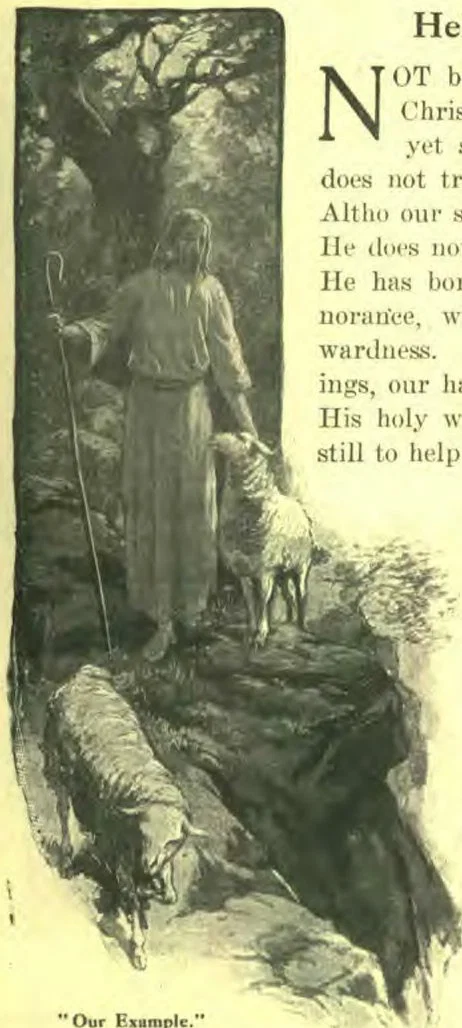
Not because we first loved Him did Christ love us; but "while we were yet sinners," He died for us. He does not treat us according to our desert. Altho our sins have merited condemnation, He does not condemn us. Year after year He has borne with our weakness and ignorance, with our ingratitude and waywardness. Notwithstanding our wanderings, our hardness of heart, our neglect of His holy word, His hand is stretched out still to help us in our need.
"Our Example."
Grace is an attribute of God exercised toward undeserving human beings. We did not seek for it, but it was sent in search of us. God rejoices to bestow His grace upon us, not because we are worthy, but because we are so utterly unworthy. Our only claim to His mercy is our great need.
The Lord God thru Jesus Christ holds out His hand all day long in invitation to the sinful and fallen. He will receive all. He welcomes all. It is His glory to pardon the chief of sinners. He will take the prey from the mighty, He will deliver the captive, He will pluck the brand from the burning. He will lower the golden chain of His mercy to the lowest depths of human wretchedness, and lift up the debased soul contaminated with sin. Every human being is the object of loving interest to Him who gave His life that He might bring men back to God. Souls guilty and helpless, liable to be destroyed by the arts and snares of Satan, are cared for as a shepherd cares for the sheep of his flock.
The Saviour's example is to be the standard of our service for the tempted and the erring. The same interest and tenderness and long-suffering that He has manifested toward us, we are to manifest toward others. "As I have loved you," He says, "that ye also love one another." If Christ dwells in us, we shall reveal His unselfish love toward all with whom we have to do. As we see men and women in need of sympathy and help, we shall not ask, "Are they worthy?" but "How can I benefit them?"
Rich and poor, high and low, free and bond, are God's heritage. He who gave His life to redeem man sees in every human being a value that exceeds finite computation. By the mystery and glory of the cross we are to discern His estimate of the value of the soul. When we do this, we shall feel that human beings, however degraded, have cost too much to be treated with coldness or contempt. We shall realize the importance of working for our fellow men, that they may be exalted to the throne of God.
The lost coin, in the Saviour's parable, tho lying in the dirt and rubbish, was a piece of silver still. Its owner sought it because it was of value. So every soul, however degraded by sin, is in God's sight accounted precious. As the coin bore the image and superscription of the reigning power, so man at his creation bore the image and superscription of God. Tho now marred and dim thru the influence of sin, the traces of this inscription remain upon every soul. God desires to recover that soul, and to retrace upon it His own image in righteousness and holiness.
Our Want of Compassion.
How little do we enter into sympathy with Christ on that which should be the strongest bond of union between us and Him—compassion for depraved, guilty, suffering souls, dead in trespasses and sins! The inhumanity of man toward man is our greatest sin. Many think that they are representing the justice of God, while they wholly fail of representing His tenderness and His great love. Often the ones whom they meet with sternness and severity are under the stress of temptation. Satan is wrestling with these souls, and harsh, unsympathetic words discourage them, and cause them to fall a prey to the tempter's power.
How to Reach Hearts.
It is a delicate matter to deal with minds. Only He who reads the heart knows how to bring men to repentance. Only His wisdom can give us success in reaching the lost. You may stand stiffly, feeling, "I am holier than thou," and it matters not how correct your reasoning or how true your words; they will never touch hearts. The love of Christ, manifested in word and act, will win its way to the soul, when the reiteration of precept or argument would accomplish nothing.
We need more of Christlike sympathy; not merely sympathy for those who appear to us to be faultless, but sympathy for poor, suffering, struggling souls, who are often overtaken in fault, sinning and repenting, tempted and discouraged. We are to go to our fellow men, touched, like our merciful High Priest, with the feeling of their infirmities.
It was the outcast, the publican and sinner, the despised of the nations, that Christ called, and by His loving-kindness compelled to come unto Him. The one class that He would never countenance was those who stood apart in their self-esteem, and looked down upon others.
"Go out into the highways and hedges, and compel them to come in,"4Christ bids us, "that My house may be full." In obedience to this word we must go to the heathen who are near us, and to those who are afar off. The "publicans and harlots" must hear the Saviour's invitation. Thru the kindness and long-suffering of His messengers the invitation becomes a compelling power to uplift those who are sunken in the lowest depths of sin.
Christian motives demand that we work with a steady purpose, an undying interest, an ever increased importunity, for the souls whom Satan is seeking to destroy. Nothing is to chill the earnest, yearning energy for the salvation of the lost.
Mark how all thru the word of God there is manifest the spirit of urgency, of imploring men and women to come to Christ. We must seize upon every opportunity, in private and in public, presenting every argument, urging every motive of infinite weight, to draw men to the Saviour. With all our power we must urge them to look unto Jesus, and to accept His life of self-denial and sacrifice. We must show that we expect them to give joy to the heart of Christ by using every one of His gifts in honoring His name.
Saved by Hope.
"We are saved by hope." The fallen must be led to feel that it is not too late for them to be men. Christ honored man with His confidence, and thus placed him on his honor. Even those who had fallen the lowest He treated with respect. It was a continual pain to Christ to be brought into contact with enmity, depravity, and impurity; but never did He utter one expression to show that His sensibilities were shocked or His refined tastes offended. Whatever the evil habits, the strong prejudices, or the overbearing passions of human beings, He met them all with pitying tenderness. As we partake of His Spirit, we shall regard all men as brethren, with similar temptations and trials, often falling, and struggling to rise again, battling with discouragements and difficulties, craving sympathy and help. Then we shall meet them in such a way as not to discourage or repel them, but to awaken hope in their hearts. As they are thus encouraged, they can say with confidence, "Rejoice not against me, O mine enemy: when I fall, I shall arise; when I sit in darkness, the Lord shall be a light unto me." He will "plead my cause, and execute judgment for me: He will bring me forth to the light, and I shall behold His righteousness."
He bids us, in dealing with the tempted and the erring, consider "thyself, lest thou also be tempted." With a sense of our own infirmities, we shall have compassion for the infirmities of others.
"Who maketh thee to differ from another? and what hast thou that thou didst not receive?" "One is your Master; . . . and all ye are brethren." "Why dost thou judge thy brother? or why dost thou set at naught thy brother?" "Let us not therefore judge one another; . . . but judge this rather, that no man put a stumbling-block or an occasion to fall in his brother's way."
Were the Christians of Past Centuries Sealed without the Sabbath?
By A. Delos Westcott
By A. Delos Westcott
A VERY interesting question in connection with the subject of God's seal is this: How were those Christians sealed who never observed the seventh-day Sabbath, which is declared in the Bible to be God's sign, or seal? How was the thief on the cross sealed? He was not even baptized.
With the exception of our dear Saviour, no person ever lived upon this earth who did not at some time break one or more of the Ten Commandments; "for all have sinned, and come short of the glory of God;" and "whosoever committeth sin transgresseth also the law: for sin is the transgression of the law."
It is therefore certain that no person can transgress any one of God's commandments without making himself a sinner; and hence that no one can transgress the fourth commandment, by working on the seventh day, without becoming a sinner. His sin may be one of ignorance, of carelessness, or of presumption. "And if a soul sin, and commit any of these things which are forbidden to be done by the commandments of the Lord; tho he wist it not, yet is he guilty, and shall bear his iniquity." Lev. 5:17. "When he knoweth of it, then he shall be guilty in one of these. And it shall be, when he shall be guilty in one of these things, that he shall confess that he hath sinned in that thing." Verses 4, 5. "And the priest shall make an atonement for him concerning his ignorance wherein he erred and wist it not, and it shall be forgiven him." Verse 18. "If we confess our sins, he is faithful and just to forgive us our sins, and to cleanse us from all unrighteousness." 1 John 1:9.
"If we walk in the light, as he is in the light, we have fellowship one with another, and the blood of Jesus Christ His Son cleanseth us from all sin." 1 John 1:7. It is a good thing to be cleansed from all sin, but that is not enough; we must also be filled with all righteousness. The cleansing from sin removes all the blots and false entries from our life's record, leaving its pages clean and white—a perfect blank. But God requires that the pages shall be filled with perfect deeds. "For we are His workmanship, created in Christ Jesus unto good works, which God hath before ordained that we should walk in them." Eph. 2:10. These works which God has ordained (or "prepared," margin) are enumerated in His law.
Our life record may be divided into two parts—the past and the future. How shall we be able to fill with good works the pages of the past? "Being justified freely by His grace thru the redemption that is in Christ Jesus: whom God hath set forth to be a propitiation thru faith in His blood, to declare His righteousness for the remission of sins that are past, thru the forbearance of God. To declare, I say, at this time His righteousness: that He might be just, and the Justifier of him which believeth in Jesus." Rom. 3:24-26. Ah, the righteousness of Jesus that is to be credited to our account to take the place of our past record of sin!
When Jesus was here in the flesh, He lived a life of perfect obedience to the law of God. He "was in all points tempted like as we are, yet without sin." Heb. 4:15; 5:7-9; Ps. 40:7, 8; John 15:10. He said, "I must work the works of Him that sent Me." "For I have not spoken of Myself; but the Father which sent Me, He gave Me a commandment, what I should say, and what I should speak." How was He enabled always to obey? What was the secret of His power? He said, "I can of Mine own self do nothing." His success is all summed up in one word—faith. Faith is the key that unlocks the power-house of heaven. "O ye of little faith!" was His reproof to His disciples when they were unable to do the works which He did.
Christ's life of obedience in the flesh was just as essential to our salvation as was His death. By taking our sins upon Himself, and then having His life of perfect obedience credited to us on the books of heaven, He was able to repair our sad record of the past. "For if, when we were enemies, we were reconciled to God by the death of His Son, much more, being reconciled, we shall be saved by His life." "For if by one man's offense death reigned by one; much more they which receive abundance of grace and of the gift of righteousness shall reign in life by One, Jesus Christ. Therefore as by the offense of one judgment came upon all men to condemnation; even so by the righteousness of One the free gift came upon all men unto justification of life. For as by one man's disobedience many were made sinners, so by the obedience of One shall many be made righteous." Rom. 5:10, 17-19.
In what did Christ's Sabbath righteousness consist? Did it not consist in obeying the fourth commandment by the observance of the seventh day? Probably every observer of the Sabbath in the world to-day has sometime broken this commandment. We have all come short. What are we to do? Only one thing can be done—we must let Christ have our Sabbath-breaking, our sin, and we must accept His Sabbath-keeping instead. Then when the Father looks upon the books of heaven, He will not see our mistakes and disobedience at all, but will see only the perfect obedience of His Son. Perhaps some Sunday observers have not kept that day as carefully as they felt they should. What are they to do? They must also accept the Sabbath obedience of Christ. And if they accept it, will it not appear on the books of heaven that they are observers of the seventh day? In other words, if Christ's Sabbath righteousness becomes their Sabbath righteousness, will they not be the same kind of Sabbath-keepers that Christ was? No one5claims that Christ ever kept Sunday; consequently He has no Sunday righteousness, or obedience, to give to anybody. There was no command in the Bible to observe Sunday, and of course there could not be any obedience when there was no law to be obeyed.
It is therefore certain that all who have been saved by the righteousness of Christ are recorded in heaven as seventh-day Sabbath-keepers. Perhaps thousands of them kept Sunday all their lives, supposing it to be the true Bible Sabbath. They accepted Christ's righteousness without stopping to consider exactly what it was. They walked in the light so far as they had opportunity to learn of it. When they awake in the resurrection, they will be surprised at some of their mistakes (who will not?), but they will be glad that they accepted Christ's righteousness for what it really is, rather than for what they knew about it.
(Continued Next Week.)
That Ill-Favored Compound.
By Emma Hildreth Adams
By Emma Hildreth Adams.
FAR out in the eloquent, ever-preaching Pacific, over two thousand miles from our fascinating West Coast, lies a little island, some of whose inhabitants never have hope of leaving its green, flower-gemmed shores.
Amid the vast sea they will abide for life, no matter how earnestly loving hearts may long for a sight of their faces; may long for the tones of their voices; for a grasp of their hands; no matter how touchingly may plead life's interests and ties in far-away lands; nor how appealing the invitation from other islands of the group, with their embroidery of rivers, plains, volcanoes, and mountains, those people are there for life; until death claims them, Molokai's green shores will encircle them.
They are the victims of disease—a disease contagious, afflictive, and in most cases hopeless of cure; a disease which bars entrance to the homes of their loved ones; which closes the door to coveted society; thrusts aside many of the laudable pursuits of life; says "No" to ambition, to the winsome cry of right endeavor, and commands, "Turn back" at every pathway to fame, to wealth, to high mental attempt.
One's first thought, and true thought, about these isolated men and women is: How sad, how pitiable is their lot! Each ill one can tell his tale of sorrow only to other ill ones, since, surely, there can be found no SANE man or woman who will consent to dwell among them for the purpose of cheering, comforting, and ministering to them.
Such step would involve voluntary and probably final separation from home, relatives, and friends; the surrender of life's inviting labors, pleasures, and rewards. Yes, hardest of all, the surrender of life itself, for sake of a pitiable, island-bound, death-facing community.
But let us be not too hasty. A few, a very few, yet very SANE persons, pitiful, sympathetic, and Christlike in their self-denial, have bidden farewell to the pathways of culture, the refined pleasures, the sweet fellowship so priceless to them, and have become gracious ministers to these hopeless dwellers on Molokai.
That term "self-denial" is an uncomely compound, at first sight. Few words have an aspect more repellent, more chilling. It is sure to arouse antagonism. An army of wants and needs springs up at first call for it. A single glance at the term satisfies most of us. It is a married expression whose partners seem very unequally yoked together.
What is the element in this compound which distresses us so much? "Self," the first member, has an attractive look. It is rounded out with the things we like. Self-esteem, self-conceit, self-sufficient, self-righteous, self-defense, self-protection, and a still longer catalog crowds the four first letters. Every one has a smiling, pleasing countenance. We take them all by the hand, cordially.
It must, therefore, be the second partner, "Denial," which so repels us, is so ill-visaged. Let us see. What if by some strange procedure both words should turn out to be our friends in an exalted sense?
There have been occasions in our lives when we have been wonderfully charmed by a face whose features once strongly repelled us. What subtle, invisible influence produced this change in us?
We discovered simply that back of the homely visage reigned character, an almost indefinable quality fashioned into delicate beauty, able to perform noblest deeds, wrought of material destined to endure long after the earth-born face molders back to dust.
Thus has it been, thus will it be again, with our strangely affective compound. At first sight, at first thought, we turn from it as from an enemy equipped to harm us. But let us once experience the elation, the unalloyed pleasure, which trains after the class of deeds for which it stands, and in the flash of a star it becomes a magnet drawing us Godward with immense power.
Self-denial includes LOVE, that noblest element, that absolute essential in the divinest character. But for boundless love, God had never given His Son, that whosoever believeth in Him might not perish, but have everlasting LIFE. And but for love Christ had never said, "The Son of Man hath not where to lay His head"—words breathing the very essence of self-denial.
Who can estimate, who can conceive, the total results to man, of Christ's love and self-denial? Paul once wrote to the Corinthians, "Eye hath not seen nor ear heard, neither have entered into the heart of man, the things which God hath laid up for them that love Him."
Will not those "THINGS," whatever they shall be, prove munificent reward for all the self-denial we shall here have practised for Christ's sake?
We might site noble instances of self-denial almost endlessly. They illumine the pages of history. They are flash-lights bursting forth from places of suffering, of peril, of daring. They glorify some of the humblest, not less than some of the most cultured, homes in every land.
Nevertheless, the want of our race is that the cultivation of this element become more wide-spread. And this leads us to remark that the home is the place for the development of this heaven-born characteristic. We have been in families in which self-abnegation seemed the settled practise of the household, and the example of Christ was charmingly followed. But such homes are infrequent. The world were better off if they were common.
Frequently one parent or one child is the only exhibitor of the noble grace. This is ever most unfortunate, since to the degree that one member of a family yields his will, wants, rights, possessions to other members, without equal surrender on their part, do they become rooted in the fertile soil of selfishness. The effective remedy for selfishness is self-denial.
Permit a daughter to sacrifice continually her time, pleasure, rights, chances in life, to the will of a brother, and you dwarf in him the very element of character which will take him out into the world to be a blessing, to live the noblest and truest life. He needs the edifying experience of "doing without things" as much as does the daughter, and possibly more.
He Was Afflicted.
JESUS, on earth Thou, too, didst feel
Temptation's fearful power;
Thou Friend of sinners, help me now,
In this my trying hour.
Jesus, Thy friends did fail Thee, too,
In time of direst need;
O, now the strongest human trust
Is but a shaking reed.
Reach out Thy tender, loving hand
To save my sinking soul;
Show Thy loved face and speak the word
To make me strong and whole.
Give me but Thee; all else I lose;
Let me Thyself but see.
O, let me in Thy presence stand,
My heart find rest in Thee.
—Alice B. Wickles.
Living by the Day
By F. W. Robertson
It is a blessed secret, this of living by the day. Any one can carry his burden, however heavy, until nightfall. Any one can do his work, however hard, for one day. Any one can live sweetly, patiently, lovingly, and purely, until the sun goes down. And this is all life ever means to us—just one little day. "Do to-day's duty, fight to-day's temptations, and do not weaken and distract yourself by looking forward to things you can not see, and could not understand if you saw them." God gives us nights to shut down the curtain of darkness on our little days. We can not see beyond. Short horizons make life easier, and give us one of the blessed secrets of brave, true, holy living.—F. W. Robertson.
Disobedience to Unjust Human Laws
We are bound in all cases to disobey, when human legislation contravenes moral law, or invades the rights of conscience.—Rev. Charles G. Finney.}],