Your ShelfYour Projects

Signs of the Times, Vol. 21, No. 43.

HE WILL COME AGAIN

Signs of the Times

Oct 31, 1895

Pacific Press Publishing Company · Oakland, California · Oct 31, 1895

HE WILL COME AGAIN.
BY F. M. W.
THERE is, perhaps, no one theme in the Sacred Scriptures commanding so much attention as the second coming of Christ to this earth. Almost every book of the Bible, and many indeed of its chapters, contain some allusion, direct or implied, to this great event. Christ will come again. His coming has been set before the church in all ages as its hope, the fruition of its joys, the culmination of its earnest desires and eager expectations. The Bible opens with a prediction which includes Christ’s second advent (Gen. 3:15); and the beloved disciple closes the sacred canon with a prayer for the speedy return of his loving Master (Rev. 22:20).
HE “SHALL SO COME IN LIKE MANNER.”
Prophet and apostle alike have made the coming of Christ in glory the grand central theme of their prophecies and teachings. To Enoch, the seventh from Adam, it stood as an anchor to the soul in the flood-tide of wickedness which sought to overthrow him: “And Enoch also, the seventh from Adam, prophesied of these, saying, Behold, the Lord cometh with ten thousand of his saints, to execute judgment upon all, and to convince all that are ungodly among them of all their ungodly deeds which they have ungodly committed, and of all their hard speeches which ungodly sinners have spoken against him.” Jude 14, 15. Job in his sorrows and afflictions found comfort in what awaited him at the coming of his Lord: “For I know that my Redeemer liveth, and that he shall stand at the latter day upon the earth; and though after my skin worms destroy this body, yet in my flesh shall I see God; whom I shall see for myself, and mine eyes shall behold, and not another; though my reins be consumed within me.” Job 19: 25–27. David in his persecutions could look with joy to the time when every wrong would be righted, and a difference made between the people of God and the enemies of his truth: “Our God shall come, and shall not keep silence; a fire shall devour before him, and it shall be very tempestuous round about him. He shall call to the heavens from above, and to the earth, that he may judge his people. Gather my saints together unto me; those that have made a covenant with me by sacrifice.” Ps. 50: 3–5. Thus in every age of the church has Christ’s second advent been set before his people as their hope. Isaiah, Jeremiah, Ezekiel, Daniel, and a host of others have borne witness to its glorious reality.
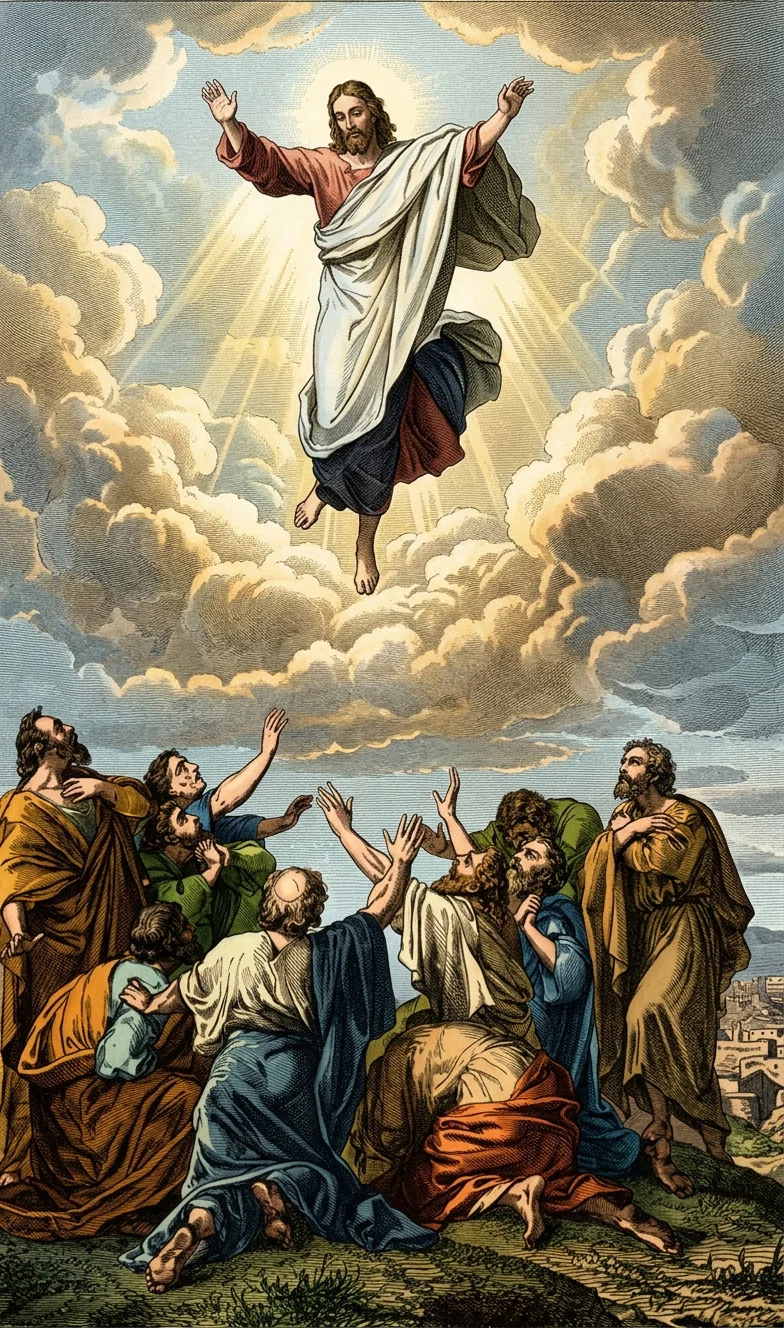
But probably the most important testimony regarding Christ’s return is found in the words of Christ himself, and thus directly associated with him. On the memorable night of his betrayal he comforts the sorrowinghearts of his followers with this promise: “Let not your heart be troubled; ye believe in God, believe also in me. In my Father’s house are many mansions; if it were not so, I would have told you. I go to prepare a place for you. And if I go and prepare a place for you, I will come again, and receive you unto myself; that where I am, there ye may be also.” John 14: 1–3. At the time of his ascension the same promise is verified to us in the words of the angel: “Ye men of Galilee, why stand ye gazing up into heaven? this same Jesus, which is taken up from you into heaven, shall so come in like manner as ye have seen him go into heaven.” Acts 1:11.
Paul, and Peter, and James, and John all bear witness to the return of Christ. There is no discord, no jar in all the witness borne. With one universal voice the sacred writers proclaim the return of the Lord a second time to the earth. “And unto them that look for him shall he appear the second time without sin unto salvation”—their Redeemer and Saviour. Heb. 9: 28; Isa. 25: 9.

THE BLESSED HOPE.

Come, King of Glory, come! Earth's woes thy healing crave; Its weary, wasted sum Of hopes but find a grave In moaning hollows of distress Or blank abysmal nothingness.
THE BLESSED HOPE.
THE BLESSED HOPE.
O Christ, when shall again Thy presence Israel bless? We look for thee to reign Thy reign of righteousness; We hold that promise sacred yet The angels gave at Olivet.
Did not thy shining ones A light of life impart, Brighter than noonday suns, To cheer the church's heart? This Jesus ye have seen ascend Again to earth his steps shall bend.
Fulfill, O Christ, fulfill That hope of advent given! We hold that promise still A beam of light from heaven Thy church to cheer along its way To sunshine of a perfect day,
When, crowned with sevenfold crown, And garments dipped in blood, To smite oppression down And curb the restless flood Of human wrong, thou'lt come again, The King of kings on earth to reign.
—Christian Index, Glasgow.
There is a King of glory, Erelong on earth to rise, Sung in prophetic story, Descending from the skies; The Babe of Bethlehem, 'tis he; It is the Man of Calvary— Not crowned with thorns, and gory, But crowned with glory now! Not crowned with thorns to-day, Not mocked and led away, But crowned with everlasting glory now!
—Alone.
I long to behold Him arrayed With glory and light from above, The King in his beauty displayed, His beauty of holiest love: I languish and sigh to be there, Where Jesus hath fixed his abode; O, when shall we meet in the air, And fly to the mountain of God?
—Charles Wesley.
'Tis but a little while And He shall come again Who died that we might live, who lives That we may with Him reign; Then, O my Lord, prepare My soul for that glad day; O, wash me in thy precious blood, And take my sins away!
—Horatius Bonar.

Let Not Your Heart Be Troubled

“Let not your heart be troubled; ye believe in God, believe also in Me. In My Father's house are many mansions; if it were not so, I would have told you. I go to prepare a place for you. And if I go and prepare a place for you, I will come again, and receive you unto Myself; that where I am, there ye may be also.” John 14:1-3.

This Same Jesus

The Manner of His Coming.

BY D. T. J.
After we have assured ourselves from the study of the Scriptures that Christ will come to this earth the second time, the question that next arises is, How will Christ come? Will his second coming be spiritual or literal? Will his coming be known to all who dwell on the earth at the time it takes place, or only to a favored few? Correct answers to these questions will help us much in understanding the nature and manner of Christ’s coming. Where shall we go for data? It is a field in which the human mind may theorize to almost any extent, and many pleasing pictures may be drawn, but there is only one source of reliable authority, and that is the Bible. God has given us his inspired word “for doctrine, for reproof, for correction, for instruction in righteousness; that the man of God may be perfect, thoroughly furnished unto all good works.” 2 Tim. 3:16,17. Everything, therefore, that the Bible contains is of value to the Christian. On the subject of the second coming of Christ and the manner of his coming we shall find the Scriptures very full and complete, indicating that this is a question of interest and importance to every child of God.
Let us notice a few of these texts and learn from them the nature of the second coming of Christ and

How He Will Come.

We will begin with the testimony of the heavenly beings who bear witness to the manner of Christ’s second coming. On the day of his ascension he led the disciples out as far as Bethany, on the Mount of Olives; after giving them the commission to preach the Gospel to all the world, he lifted up his hands and blessed them. While in the act of blessing them “he was taken up; and a cloud received him out of their sight. And while they looked steadfastly toward heaven as he went up, behold, two men stood by them in white apparel; which also said, Ye men of Galilee, why stand ye gazing up into heaven? this same Jesus, which is taken up from you into heaven, shall so come in like manner as ye have seen him go into heaven.” He had been taken up literally, bodily, in their sight. He is to so come again in like manner as they had seen him ascend. His coming is therefore to be a literal, personal coming. John, in speaking of his coming, in Rev. 1:7 says, “Behold, he cometh with clouds; and every eye shall see him.”
When the disciples were sorrowing because their Master had told them he was going away, he said unto them: “Let not your heart be troubled. . . . I go to prepare a place for you. And if I go and prepare a place for you, I will come again, and receive you unto myself; that where I am, there ye may be also.” John 14:1-3. A little later he said to them, “A little while, and ye shall not see me; and again, a little while, and ye shall see me, because I go to the Father.” Chapter 16:16. The context shows that he referred to his going to heaven, during which time he would not be personally and visibly present with them, and his returning to receive them to himself: “Ye now therefore have sorrow; but I will see you again, and your heart shall rejoice, and your joy no man taketh from you.” Verse 22. His personal presence would again be manifest among them; for during all the time of his absence he is but spiritually present with his people. Almost his last words to them were, “Lo, I am with you alway, even unto the end of the world.” But the time will come when he will be personally present with them again, and this will be at his second appearing, when he comes in the clouds of heaven, and all the holy angels with him, when he sends forth his angels to gather his people from the four quarters of the earth. Matt. 13:41. Says the apostle Paul, in his letter to the Thessalonians: “The Lord HIMSELF shall descend from heaven with a shout, with the voice of the archangel, and with the trump of God; and the dead in Christ shall rise first; then we which are alive and remain shall be caught up together with them in the clouds, to meet the Lord in the air; and so shall we ever be with the Lord.” Jesus himself says of his second coming:—
“And then shall they see the Son of man coming in a cloud with power and great glory.” Luke 21:27.
“And they shall see the Son of man coming in the clouds of heaven with power and great glory.” Matt. 24:30.
All these texts refer to one and the same definite event,—the second coming of Christ. They declare that he himself shall come, and that every eye shall witness that coming. In short, they teach us, unmistakably, that the second coming of Christ will be personal and visible.

The Two Advents Compared.

In his masterly letter to the Hebrews, Paul proves from the Scriptures that Jesus is the Messiah, the antitype of all the sacrifices of the old dispensation, and the great High Priest typified by Melchizedek. In concluding his argument in the ninth chapter, he uses a strong figure to illustrate the certainty of His second coming. These are his words: “As it is appointed unto men once to die, but after this the judgment; so Christ was once offered to bear the sins of many; and unto them that look for him shall he appear the second time without sin unto salvation.” Heb. 9:28. Here the two advents are brought together; in the first, he comes to offer himself as a propitiation for sin; in the second, he comes, the same Jesus, not with a sin offering, but to save those who have accepted of the propitiation that he has made for them.
In the Old Testament scriptures the two comings of Christ are very closely connected. Sometimes it is difficult to distinguish the prophecies that relate to one from those which relate to the other. By confounding them the Jews expected that their Messiah, when he should come, would take the throne of David and rule over his people as a temporal sovereign, and deliver them from their oppressors; and when he did not fulfill their expectations, they rejected him. They were not mistaken in the promises, but in the application of their fulfillment to the first advent of the Messiah instead of the second. These two important events are so intimately connected in the plan of redemption that the prophecies sometimes speak of both in the same connection, and in such a way that their words apply in part to each. For examples of this read the latter part of the third chapter of Joel and the last chapter of Malachi.
The former was applied by Peter to the pouring out of the Spirit on the day of Pentecost, and the latter by Christ to John the Baptist, but both will have a further fulfillment in connection with the second advent. This shows how closely the two are related, being the complements of each other in the divine plan of redemption. One is the sowing, the other the harvest. As there could be no harvest without the sowing, so the sowing will profit nothing without the harvest. As at the first advent Christ offered himself literally as a propitiation for sin, that men might be reconciled to God, so at his second advent he comes literally to save those who have accepted of that propitiation and become reconciled to God. Both before and after his first advent Christ is the mediator between God and man, but before his second coming his mediatorial work will cease, and he will come as king, in fulfillment of Ps. 2:8, 9 and Matt. 25:31.

Conclusions.

From the texts cited we see that when Christ comes the second time, he will come (1) personally and visibly, in the clouds of heaven, with all the holy angels; (2) that his coming will be literal; (3) that his coming will be witnessed by all who dwell on the earth.

“THIS IS OUR GOD.”

In the day of our Lord’s appearing it will be said, “Lo, this is our God; we have waited for him, and he will save us; this is the Lord; we have waited for him, we will be glad and rejoice in his salvation.” Isa. 25:9. These words, however, will be spoken only by those who know the Lord. There will be an emphasis on “this” and “our”: “Lo, this is our God; we have waited for him, and he will save us.” For just before this the people who know not God—whether in the world or in the church—will have professed allegiance to another, even to him who “is transformed into an angel of light” (2 Cor. 11:14), and whose steadfast aim is to put himself before men in the place of God. It is not enough to know that Christ is coming; we must also be acquainted with him, so that we may be able to recognize him when he comes.—Present Truth.

THE PLACE OF THE SECOND ADVENT IN THE SCHEME OF REDEMPTION.
BY W. N. GLENN.
“The grace of God that bringeth salvation hath appeared to all men, teaching us that, denying ungodliness and worldly lusts, we should live soberly, righteously, and godly, in this present world; looking for that blessed hope, and the glorious appearing of the great God and our Saviour Jesus Christ.” Titus 2:11–13.
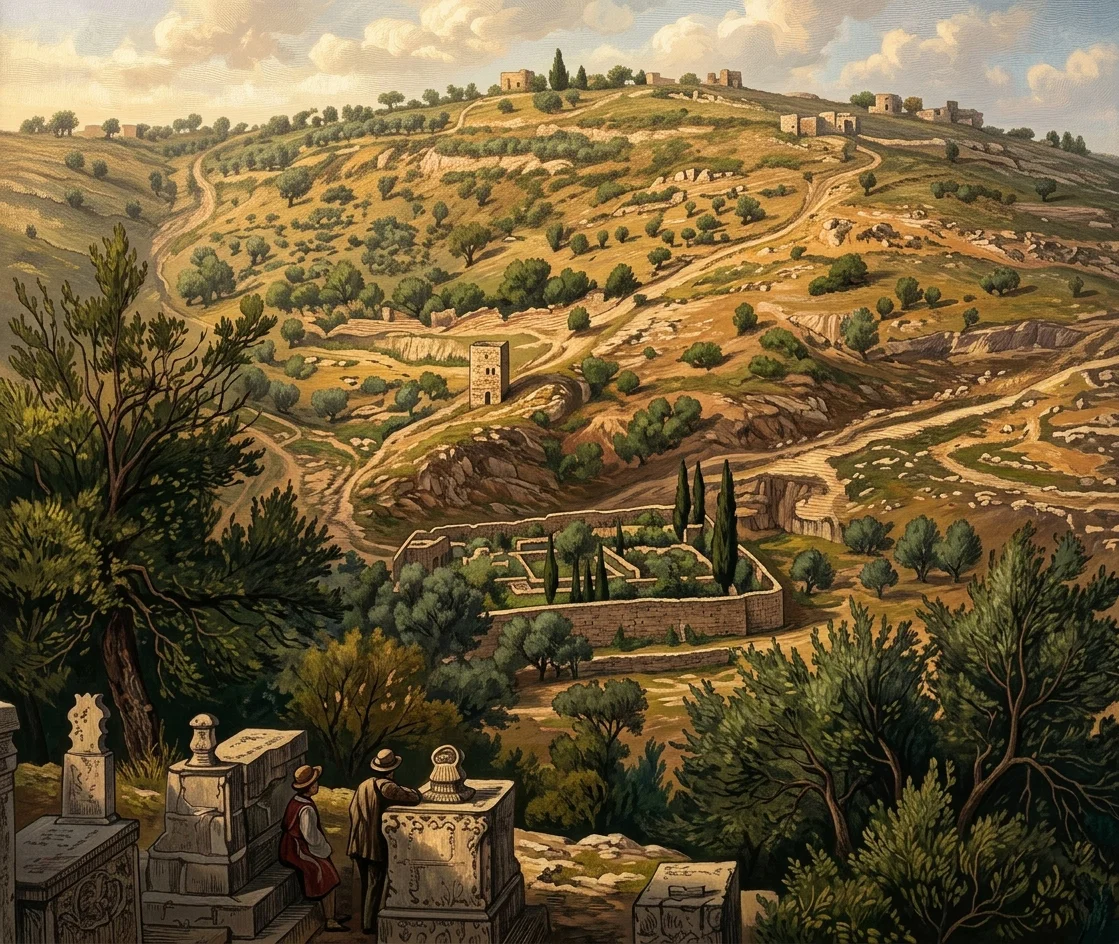
THE MOUNT OF OLIVES
THE MOUNT OF OLIVES
Every feature, every event, every principle involved in the great plan of salvation, has its indispensable place, and, as God does not deal in superfluities, not one could have been left out. Therefore it would seem presumptuous in man to draw comparison as to which is the most important. Yet in all matters having an ultimate object in view, the consummation of that object is always the point to which the expectant mind is especially directed. So to the “little flock,” tempted, tried, persecuted in this life (as “all that will live godly in Christ Jesus” must be (2 Tim. 3:12), the day of final victory and entrance into immortal glory must ever be the point in which the “blessed hope” is centered. Of Christ himself it is said that “for the joy that was set before him” he “endured the cross, despising the shame, and is set down at the right hand of the throne of God.” Heb. 12:2.
As to chronological order, the place of Christ’s second coming in the scheme of redemption must be yet in the future, for he tells us concerning that event that “as the lightning cometh out of the east, and shineth even unto the west; so shall also the coming of the Son of man be.” Matt. 24:27. Also that “all the holy angels” will be with him (chap. 25:31), that the righteous dead will be raised, and the living saints will be changed, and all “caught up together to meet the Lord in the air” (1 Thess. 4:16, 17). As none of these things have yet taken place, it is evident that the Lord has not yet come, notwithstanding the many delusive claims to the contrary.
But that to which we would here call special attention is the exalted place the second advent occupies in the Scriptures, in the design of the Author and Finisher of our faith, and consequently in the mind of “all them that love his appearing.” What does the Lord’s coming mean to his disciples? We have this question profusely answered in the word of God. The foundation principle of redemption is stated in John 3:16: “For God so loved the world, that he gave his only begotten Son, that whosoever believeth in him should not perish, but have everlasting life.” The love of God is the starting point of the great plan, and everlasting life for all who will believe is the ultimate object. While the true believer in Christ now has eternal life, by means of the Holy Spirit dwelling in him (1 John 5:11, 12; 4:13), yet the “crown of righteousness,” immortality, is given at the second advent of the Lord (2 Tim. 4:8). Then will be fulfilled the prayer of Jesus,
“Father, I will that they also, whom thou hast given me, be with me where I am; that they may behold my glory, which thou hast given me.” John 17:24. Then also will be fulfilled the promise, “To him that overcometh will I grant to sit with me in my throne, even as I also overcame, and am set down with my Father in his throne.” Rev. 3:21.
Well may that glad day be called the “glorious appearing,” for not only will he “come in his glory, and all the holy angels with him,” but there is involved in it the precious promise to believers, that “when the chief Shepherd shall appear, ye shall receive a crown of glory that fadeth not away.” 1 Peter 5:4. To this we may very appropriately add the testimony of John: “Beloved, now are we the sons of God, and it doth not yet appear what we shall be; but we know that, when he shall appear, we shall be like him; for we shall see him as he is.” 1 John 3:2. With this glorious prospect in view, it is not difficult to appreciate the joy of those who, coming up to that long-looked-for time “through much tribulation” (Acts 14:22), will shout in triumphant acclaim, “Lo, this is our God; we have waited for him, and he will save us; this is the Lord; we have waited for him; we will be glad and rejoice in his salvation” (Isa. 25:9).
Even the natural man, whose only hope is in the things of this life, labors earnestly for reward; and ofttimes many will contend for a prize which only one can possibly obtain. 1 Cor. 9:24. And to this common characteristic the Lord makes appeal in beseeching men to seek eternal reward: “Lay up for yourselves treasures in heaven, where neither moth nor rust doth corrupt, and where thieves do not break through nor steal.” Matt. 6:20. “Labor not for the meat which perisheth, but for that meat which endureth unto everlasting
life, which the Son of man shall give unto you.” John 6:27. “This is the Father’s will which hath sent me, that of all which he hath given me I should lose nothing, but should raise it up again at the last day.” Verse 39.
Of Moses it is said that “he had respect unto the recompense of the reward,” therefore he chose “rather to suffer affliction with the people of God, than to enjoy the pleasures of sin for a season.” Heb. 11:24–26. All who have lived or will yet live by faith in Christ, have done so or will do so in hope of reward, of which the measure of the Spirit imparted here is but the “earnest,” or partial payment, for the sustenance of faith. “We through the Spirit wait for the hope of
righteousness by faith.” Gal. 5:5. The faithful in all past ages have waited for the consummation of their hope: “And these all, having obtained a good report through faith, received not the promise; God having provided some better thing for us, that they without us should not be made perfect.” Heb. 11:39, 40.
And when shall the reward be fully meted out?—At the coming of the Lord. “For the Son of man shall come in the glory of his Father with his angels; and then he shall reward every man according to his works.” Matt. 16:27. Then the second advent of the Lord will be a “glorious appearing,” the fruition of the “blessed hope,” because it will be the great pay day for those servants who “endure to the end,” “whom the Lord when he cometh shall find watching,” as well as for those who were “faithful unto death.” Heavenwill be emptied and silent, in order that “all the holy angels” may be spared to swell the bright cloud of glory upon which the Lord will descend “when he shall come to be glorified in his saints, and to be admired in all them that believe.” 2 Thess. 1:10.
Happy pay day! inestimable reward! wonderful exchange of condition! “when this corruptible shall have put on incorruption, and this mortal shall have put on immortality,” for “then shall be brought to pass the saying that is written, Death is swallowed up in victory.” 1 Cor. 15:54. Then will the glorious King give unto the redeemed host, “beauty for ashes, the oil of joy for mourning, the garment of praise for the spirit of heaviness; that they might be called Trees of righteousness, The planting of the Lord, that he might be glorified.” Isa. 61:3.
In that great and glorious day of rewards, all the trials and afflictions which the faithful will have endured during their probationary sojourn here will seem as nothing. Then will be fully appreciated the words of Paul, “I reckon that the sufferings of this present time are not worthy to be compared with the glory which shall be revealed in us.” Rom. 8:18. But even the Scriptures fail to convey to our finite minds the glory of which the redeemed will be made full partakers, and the unspeakable reward of faith in the crucified Nazarene. Our inquiry in this direction is cut short by the inspired word: “Eye hath not seen, nor ear heard, neither have entered into the heart of man, the things which God hath prepared for them that love him.” 1 Cor. 2:9. Suffice it for the present purpose to add this injunction of the apostle Peter: “Wherefore gird up the loins of your mind, be sober, and hope to the end for the grace that is to be brought unto you at the revelation of Jesus Christ.” 1 Peter 1:13.
Continue reading: WHAT CHRIST'S COMING MEANS TO MEN