Your ShelfYour Projects

Review and Herald, Vol. 78, No. 34.

REJOICE

Review and Herald

Aug 20, 1901

Seventh-day Adventist Publishing Association · Battle Creek, Mich. · Aug 20, 1901

REJOICE

MRS. M. F. ROWE.
Listen, O Christian, to the Master's voice: “Rejoice alway; again I say, Rejoice.” Phil. 4:4.
Yes, so I may, when all is bright before. Nay, but Christ says, “Rejoice for evermore.” 1 Thess. 5:16.
How, when the storm-cloud lowers darkly 'round, Under His sheltering wings may joy be found? Ps. 63:7.
When tempest-tossed and driven far from land, Fear not; He holds the billows in His hand. Isa. 40:12.
Can I rejoice when I my weakness see? — The Lord's own joy thy very strength shall be. Neh. 8:10.
When harvests, flocks, and fruits untimely die, Rejoice; the Lord will all thy need supply. Heb. 3:17, 18.
Can I rejoice when other hearts are sad? — The upright heart may well be light and glad. Ps. 97:11.
When pressed by busy cares that will annoy? — Cares vanish in the fullness of His joy. Ps. 16:11.
Fullness of joy! Can this indeed be mine? — The Lord himself has promised; it is thine. John 16:24.
When strength and senses fail, life's lamp burns dim, Yet will the Lord sustain; rejoice in Him. Acts 20:24.
When waiting in death's dark and lonely vale, Rejoice e'en here; His presence will not fail. Ps. 23:4.
Then in the glory of eternal day, With joy unspeakable, rejoice for aye. Jude 24.

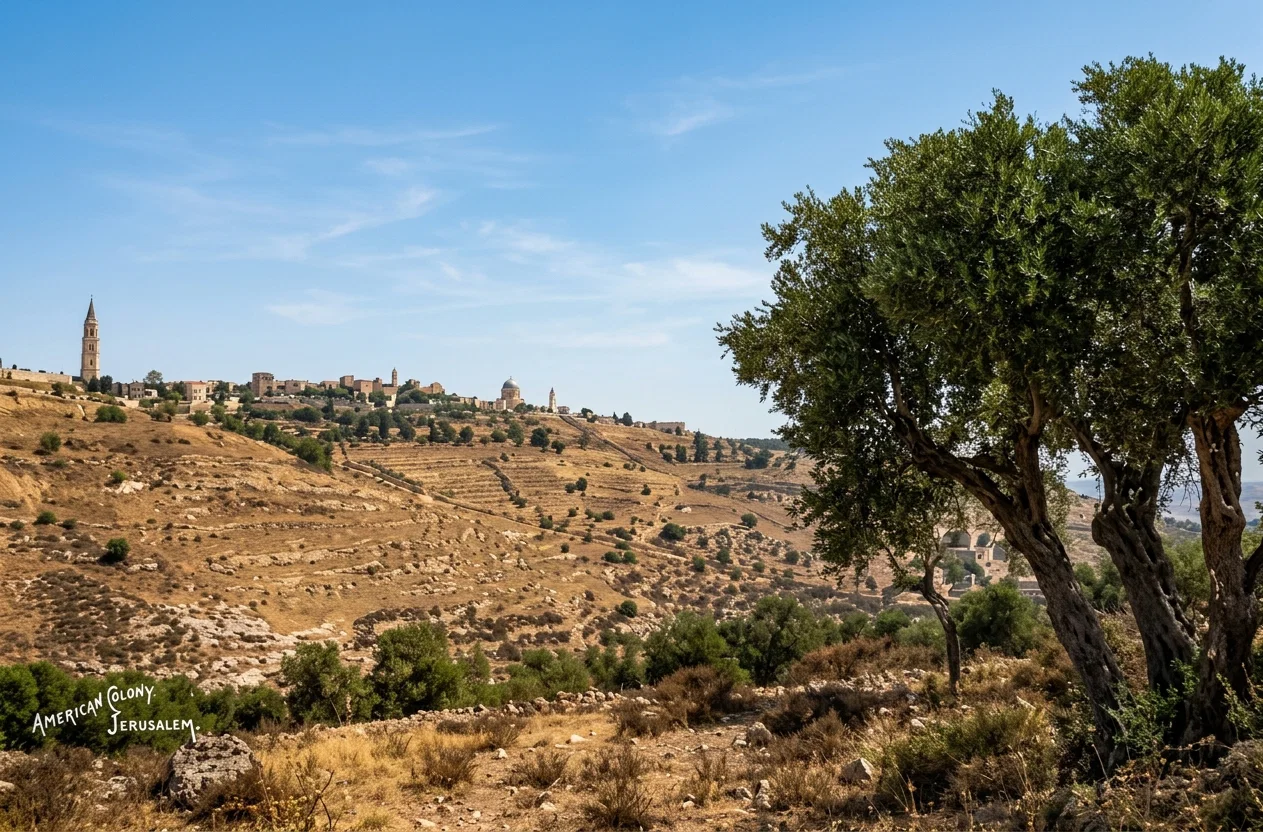
THE MOUNT OF OLIVES.

F. H.
The picture represents the Mount of Olives, as we see it to-day, with but a few old olive trees on it. At the foot of the mountain we see a beautiful building on which there are several golden domes. This is near the garden of Gethsemane. On the summit of the mountain there is a high tower, with two hundred and seventy-six steps. A little to one side is another building, which ends in a large dome. This represents the so-called Ascension church. All of these last-named buildings have been erected by the Russian Greek Catholic Church. From the tower one has a beautiful view away to the mountains of Judea, to the Jordan, and to the Dead Sea.
MOUNT OF OLIVES, LOOKING EAST FROM JERUSALEM.
The Mount of Olives was the place where at one time our beloved Master, with His disciples assembled around Him, looked sorrowfully upon the city of Jerusalem, the inhabitants of which were bound with the cords of sin. This was also the place where He prophesied the destruction of Jerusalem, and, among other things, also spoke of the long time of persecution through which the followers of Jesus would pass. Here He also mentioned the signs which should indicate the nearness of the end of the world and of His second coming, as recorded in Matthew 24 and also in the Gospels of Mark and Luke.
On the road from Bethany to Jerusalem one comes to a sharp turn in the path, on the southwest declivity of the hill, at which point a view of the city of Jerusalem breaks suddenly on the beholder. This, in the days of Christ, must have been a scene of magnificence and beauty, for then the gorgeous temple of Jerusalem, the place of which is now occupied by the Mohammedan Mosque of Omar, rose grandly in the foreground. This is supposed to have been the spot at which Christ wept over Jerusalem, as recorded in Luke 19:41.
Having briefly referred to what the New Testament says about the Mount of Olives, let us see what the Old Testament says about it. If we take our Bibles and turn back to the prophecy of Zechariah, we read, in chapter 14:4, that our Saviour will, at His return, put His feet “upon the Mount of Olives, which is before Jerusalem on the east, and the Mount of Olives shall cleave in the midst thereof toward the east and toward the west, and there shall be a very great valley; and half of the mountain shall remove toward the north, and half of it toward the south. . . . And the Lord my God shall come and all the saints with thee. . . . And the Lord shall be King over all the earth; in that day there shall be one Lord, and His name one.”
It is clear that this will take place at the return of the Saviour to receive His own, as He promised His disciples before He ascended, and as the angels assured them after His ascension. Acts 1:9-12. He will return and set His foot on the same place from which He ascended—on the Mount of Olives, as is shown in this last-named reference. And the city of God will come down and occupy the plain made by the cleaving of this mountain. See Rev. 21:2, 10.
Dear reader, you may not be permitted to set your foot on the Mount of Olives on this sinful earth as it is now; but may you be privileged finally to enter in through the gates into the city, as one who has a right to the tree of life. We all may do this by overcoming through Him who saves to the uttermost.

SAVED BY GRACE.

MRS. E. G. WHITE.
“And he showed me Joshua the high priest standing before the angel of the Lord, and Satan standing at his right hand to resist him.”
This is the position that Satan now occupies toward the Church of God and the ministers of the gospel. He stands before the angel of the Lord to resist them in their official work, the ministry of the Word, to resist the Lord’s working in behalf of His people. Satanic agencies are moved by a power from beneath to stir up wicked men to unite with the enemy in causing distress to the people who are keeping the commandments of God. The whole world is stirred against them because they will not worship the institution of the papacy. Satan is as full of bitter hatred and malignity against them as he was against Christ, when he stirred the world to choose a robber and murderer instead of the Son of God. When the question was asked, “Whom will ye that I release unto you? Barabbas, or Jesus which is called Christ?” the answer came back, “Release unto us Barabbas.” The religious leaders and guides of the people—the men who ought to have led in right paths—persuaded the poor, ignorant multitude to reject the Son of God, and choose a robber and murderer in His place.
Let us remember that we are in the world in which the Son of God was crucified. Those who to-day allow the spirit of envy, hatred, and unbelief to control them will persecute the people of God even as the Jews persecuted Christ.
In the chapter preceding the one containing the words, “And he showed me Joshua the high priest standing before the angel of the Lord, and Satan standing at his right hand to resist him,” we read, “I lifted up mine eyes again, and looked, and behold a man with a measuring line in his hand. Then said I, Whither goest thou? And he said unto me, To measure Jerusalem, to see what is the breadth thereof, and what is the length thereof. And, behold, the angel that talked with me went forth, and another angel went out to meet him, and said unto him, Run, speak to this young man, saying, Jerusalem shall be inhabited as towns without walls for the multitude of men and cattle therein: for I, saith the Lord, will be unto her a wall of fire round about, and will be the glory in the midst of her. . . . Sing and rejoice, O daughter of Zion: for, lo, I come, and I will dwell in the midst of thee, saith the Lord.”
God had given commandment for Jerusalem to be rebuilt, and the measuring of the city was a symbol that He would give comfort and strength to His afflicted ones. Satan and his army were greatly discomfited and alarmed by this. Satan stood before the angel, representing to him the imperfections of God’s people, and urging the disregard of His commandments. The work which he saw in prospect stirred him to resist Jesus in His work of mercy. He did not wish the people who had been suffering because of transgression to be favored. He wished to see them remaining in depression and sorrow, weakness and suffering. He saw the work the Lord was about to do for His people through the Messiah. He claimed the Church as his own, declaring that its members had dishonored God by yielding to temptation and disobeying God’s commandments.
Both priest and people were in a position of repentance unto obedience, and in answer to their prayers and in pity for their affliction the Lord had come to their relief.
“And the Lord said unto Satan, The Lord rebuke thee, O Satan; even the Lord that hath chosen Jerusalem rebuke thee: is not this a brand plucked out of the fire?” Unworthy though they might be to do His great work, Christ declared that His people were accepted through the righteousness of One who had resisted every art and device of the enemy.
“Now Joshua was clothed with filthy garments, and stood before the angel.” Satan had represented the chosen people of God as full of defilement and sin. He could well speak of the sins of which the people had been guilty; for had he not led the confederacy of evil in tempting the people to commit these very sins? But Israel had repented. The people had accepted Christ.
Christ looked pityingly and compassionately upon the punished, repenting people; “and He answered and spake unto those that stood before Him, saying, Take away the filthy garments from him. And unto him He said, Behold, I have caused thine iniquity to pass from thee, and I will clothe thee with change of raiment.”
The Lord does not deny the charge of Joshua’s unworthiness, but He demonstrates that He has bought him with a price. He clothes him with His garments of righteousness, not putting these garments over the filthy garments of disobedience and transgression, but saying first, “Take away the filthy garments from him.” Then He said to Joshua, “Behold, I have caused thine iniquity to pass from thee, and I will clothe thee with change of raiment.” “Let them set a fair miter upon his head. So they set a fair miter upon his head,” and on this miter was written, “Holiness to the Lord.”
This change is made on condition of obedience. “Thus saith the Lord of hosts, If thou wilt walk in my ways, and if thou wilt keep my charge, then thou shalt also judge my house, and shalt also keep my courts, and I will give thee places to walk among these that stand by.”
When God’s professed people repent of their sin in departing from plain Bible truth, they will bring forth fruit meet for repentance. Jesus will hear their prayers. They will work the works of righteousness. If those who have departed from the Lord will take warning, if they will change their course of action, they will be received into favor, and their transgressions will be pardoned. If they make thorough work, according to the measurement of God, avoiding a repetition of their sins, God will bestow rich blessings upon them. God tests and tries His people. He waits for them to show true repentance, that He may say, “It is enough,” and that He may grant them pardon.
Nothing else in this world is so dear to the Lord as His Church. Nothing else is guarded by Him with such jealous care. He paid a costly ransom for His heritage, and He is not willing that anything should separate them from Him, so that He cannot protect them and give them prosperity. He permits them to be sorely tried in the fiery furnace, that the dross may be separated from them. But as they are being purified, He watches them every moment, that they may not be consumed.
“Thus saith the Lord of hosts: After the glory hath He sent me unto the nations which spoiled you: for he that toucheth you toucheth the apple of His eye. . . . Sing and rejoice, O daughter of Zion: for, lo, I come, and I will dwell in the midst of thee. . . . And many nations shall be joined to the Lord in that day, and shall be my people: and I will dwell in the midst of thee, and thou shalt know that the Lord of hosts hath sent me unto thee. And the Lord shall inherit Judah His portion in the holy land, and shall choose Jerusalem again.”

THE SANCTUARY QUESTION.

The Manner in Which the Apostle Introduces the Subject of the Sanctuary.

ELDER S. N. HASKELL.
(Continued.)
“Now of the things which we have spoken this is the sum: We have such an High Priest, who is set on the right hand of the throne of the Majesty in the heavens; a minister of the sanctuary, and of the true tabernacle, which the Lord pitched, and not man.” Heb. 8: 1, 2. The seven preceding chapters in the book of Hebrews prepare the way for the apostle’s coming directly to the sanctuary question and its service in heaven. “This is the sum” of what he has previously stated, that “we have such an High Priest.” It is such a Priest as the apostle has described in the previous chapters, and this High Priest is “set on the right hand of the throne of the Majesty in the heavens; a minister of the sanctuary, and of the true tabernacle, which the Lord pitched, and not man.”
Let us consider some of the leading thoughts in the preceding chapters. The first chapter presents Christ—His character and position. He is the brightness of the Father’s glory and the “express image of His person, and upholding all things by the word of His power.” He is better and much more exalted than the angels, “as He hath by inheritance obtained a more excellent name than they.” He is the Son of God, and therefore has inherited every name which is applied to God, the Creator of the heavens and the earth. He also is the Creator, and is called God. “Thy throne, O God, is forever and ever.” Again, “Thou, Lord, in the beginning hast laid the foundation of the earth; and the heavens are the works of thine hands.” Here Christ is presented on an equality with the Father, not created as were the angels, but the Creator of the angels—the great “I AM,” He who inhabiteth eternity. It is thus the apostle introduces us to the subject of the sanctuary. It is not to such and such dimensions, to the material of which the earthly sanctuary was made, but to Christ its minister, and to the Father, to whom the sanctuary belongs. The High Priest is ours, but the sanctuary is God’s. We are the worshipers in the sanctuary.
The second chapter is introduced by showing the importance of these truths. Even the word spoken by angels was steadfast, and every transgression and disobedience received a just recompense of reward. “How [then] shall we escape, if we neglect so great salvation; which at the first began to be spoken by the Lord, and was confirmed unto us by them that heard Him?”
This subject brings to view the gospel of Christ as no other, and the preaching of this gospel has been established “by signs and wonders, and with divers miracles, and gifts of the Holy Ghost.” The apostle then presents man as he was when first created, and also his present condition, and how Christ stepped down from His high and exalted position, made himself lower than the angels, and even took man’s fallen nature, for the suffering of death, that through death He might destroy him that hath the power of death, that is, the devil, and deliver them who through fear of death were all their life subject to bondage. He was made like unto His people, that with His human arm He might encircle the human race, and take His people as far above angels as He himself was above angels before He came to the earth. In this humiliation He was tempted, and suffered, so that He might be able to succor them that are tempted. O what a High Priest is this! It is thus heaven and earth are connected.
The third chapter of this book presents Christ as an apostle, a high priest, and refers to Moses, who was faithful in all his house, to illustrate the greatness of our High Priest. It was Christwho originated the Jewish economy, and He is worthy of more glory than was Moses, as he who hath builded the house hath more glory than the house. Christ is over His people, who are His house, or living temple. Paul then presents the fact that Israel had the promises made to them, and because of their unbelief they failed. If they had seen the light that flashed from the Levitical service, they would have become living temples, fit for the indwelling of the Holy Ghost. The apostle then proceeds to quote from David, “To-day if ye will hear His voice, harden not your hearts.” Had they listened to His voice, they would have entered into His rest, and their carcasses would not have fallen in the wilderness. The land of Palestine would have become a second garden of Eden, and a training-school for missionaries, who would have gone forth to the world bearing the message of God. But their carcasses fell because of unbelief, and became a warning to all candidates for the heavenly Canaan.
The fourth chapter carries the mind still further, and shows there are still promises for the people of God. The rest is still in the future. A spiritual rest by faith can now be obtained, which is a foretaste of the real rest that remains for the people of God. This rest is in Christ, and as a pledge in the seventh-day Sabbath; for God placed it in the Sabbath at the creation of the world. The proper observance of the Sabbath, therefore, brings to the soul that spiritual rest of Christ that bears witness to acceptance with God, and becomes a foretaste of that real rest which awaits the child of God in the kingdom of God. The last portion of this chapter shows where this rest lies, and how it is obtained. The word of God is living and powerful, sharper than a two-edged sword. As the sinner in the law of Moses separated the fat, which represented sin, from the parts of the animal, so an unqualified belief in this word would enter the very joints and marrow and into the very thoughts and intents of the heart. Christ is present as our great High Priest, and is passed into the heavens; and as He has become one with humanity, He can sympathize with man in his fallen condition; and because of this we are exhorted to come boldly to the throne of grace, to find grace and help in time of need.
The fifth chapter develops the subject still further. The apostle draws a contrast between the Aaronic priesthood and the Melchisedec priesthood. The Melchisedec order is Christ’s position. He learned by obedience and suffering how to be a High Priest after the order of Melchisedec, and only those who can appreciate these truths will be able teachers in the word of God; “for every one that useth milk is unskillful in the word of righteousness: for he is a babe.” But those who by reason of use have their senses exercised to discern both good and evil can appreciate these truths, and partake of the strong meat, or the blessings promised in them.
The sixth chapter shows the importance of gaining a richer and deeper experience in the things of God. It also reveals the fact that there is an experience, attainable by the people of God in this world, which may be lost by not progressing in the things of God. If these blessings and privileges, given them of God, are viewed from a common and ordinary standpoint, the soul will become like the soil which bears only thorns and briars, which are finally rejected, and whose end is to be burned. The most common way of sinning against the Holy Ghost is in not realizing the sacredness of the work of Christ. This chapter concludes with a statement concerning the certainty of the promises of God, which promises and hope we have as an anchor of the soul, both sure and steadfast, and which enter into that within the veil, whither our Forerunner has entered. A forerunner implies that some are coming after, and thus the attention of all heaven is turned to those who follow the forerunner, Christ Jesus.
The seventh chapter further discusses the character of the Melchisedec priesthood, and reasons that confining the tithing system to the Levitical priesthood was not according to the Melchisedec order; hence the necessity of a change in the law of Moses. So the Levitical priesthood was changed to give place for the Melchisedec order. The priests on earth after the Levitical order died, for they were made after the law of a carnal commandment. But the Melchisedec order was after the power of an endless life. Thus it is shown that there was no perfection in the Levitical law of itself; but the bringing in of a better hope, which was of the Melchisedec order, brought perfection. This priesthood that Christ represents is an unchangeable one because of its nature and of His position in heaven, and His relation to God the Father and to fallen humanity, and of His faithfulness upon the earth. And on account of the unchangeableness of His priesthood, “He is able also to save them to the uttermost that come unto God by Him, seeing He ever liveth to make intercession” for us. He is made higher than the heavens, and it is not necessary that He offer up sacrifices daily, as did the earthly priest, first for his own sins, and then for the people’s, for Christ offered a sacrifice once, when He offered up himself; but He is consecrated forever without any infirmity in heaven. Such is the apostle’s argument on the priesthood, directing the mind from the earthly sanctuary to the heavenly.
It is thus by seven successive steps, each one revealing Christ as He is, the apostle is prepared to say, “Now of the things we have spoken THIS IS THE SUM.” We have such an High Priest, who is set on the right hand of the throne of the Majesty in the heavens; a minister of the sanctuary, and of the true tabernacle, which the Lord pitched, and not man. For every high priest is ordained to offer gifts and sacrifices: wherefore it is of necessity that this man have somewhat also to offer. For if He were on earth, He should not be a priest, seeing that there are priests that offer gifts according to the law; who serve unto the example and shadow of heavenly things, as Moses was admonished of God when He was about to make the tabernacle; for, See, saith He, that thou make all things according to the pattern showed to thee in the mount.”
All who present the sanctuary subject as directed by the Spirit of God in these chapters, will present Christ as exalted above all angels, one with the Father, yet partaking of flesh and blood and suffering death that He might deliver us, then as entering heaven as the forerunner of the human race. The attention and work of all the heavenly host are centered upon the heirs of salvation, those who are presenting their bodies as living temples for the indwelling of the Spirit of God; for they are the company of whom He is the forerunner.
(Concluded next week.)

Persevering Prayer for Revival

LET praying fathers and mothers never grow faint of heart. Let desponding churches, long unvisited by revival blessings, only close up their ranks more compactly about the mercy seat, and besiege heaven with new importunity. For above the dark cloud of their discouragement is written, “He that asketh receiveth; and he that seeketh findeth; and to him that knocketh it shall be opened.” — Cuyler.

SUNDAY CAUSE MEETS OPPOSITION.

E. K. SLADE. (Ann Arbor, Mich.)
The “American sabbath” defenders are by no means asleep, nor are they in any way lax in their efforts to enforce upon others the rest and recognition that they feel that that day demands. In various parts of the country, the American Sabbath Union has, by determined attempts, sought to gain new ground for the Sunday cause.
At present, the discussion of the question of the Sunday closing of the Buffalo Exposition, is causing many things to be said for and against Sunday legislation. It is refreshing, indeed, to hear, among the many voices, those who take a logical and consistent position against the whole evil principle of religious legislation and usurpation.
The New York Truth Seeker has the following to say on the attitude of the clergy in the matter of Sunday closing:—
“If the directors of the Buffalo Exposition thought to placate the clergy by their compromise on the Sunday-opening matter, they little knew their men. Nothing less than the whole thing will satisfy these would-be monopolists of Sunday. Anything not in accord with their puritanical notions meets their wholesale condemnation, and anything which takes a customer away from their shops is denounced as inimical to religion—meaning their trade. . . . As for the ministers of the country, they could not rail any harder at a completely open exposition than they will at a partly open one. The only policy that will really suit them is to close everything but the churches on Sunday, and then use the police force to drive the people into them. The preachers would undoubtedly be willing to labor themselves and let the policemen work if this pious state of things could be brought about.”
But coming nearer to the point in the principle involved in the whole proceeding, are the words of Dr. Lewis, appearing in the Literary Digest of June 29, 1901. His reference to golf-playing points to the case of Benjamin Adams, of Yonkers, N. Y., who was arrested and acquitted for playing golf on Sunday.
I quote the following very pointed and pertinent words of Dr. Lewis:—
“Every student of the question knows that Sunday legislation had its beginning in the most intense form of the pagan State-Church system, under Constantine, in 321 A. D. With slight modifications, Sunday legislation continued as part of the State-Church system when the empire became nominally Christian. This tendency increased as the centuries went forward, and the largest type of civil legislation concerning religious matters obtained throughout the Middle Ages.
“Christianity among English-speaking people was developed under the same State-Church system. The Puritan supremacy in England—1640-60 A. D.—was marked by an extreme union of Church and State. While Puritanism did not legislate concerning saints’ days, it intensified the legislation concerning Sundays and days of humiliation and thanksgiving. English legislation, with the strong Puritan coloring, was transferred to the American colonies, and became the source of all Sunday laws in the United States. These laws have gradually fallen into disuse, but they have never been removed from their original religious basis. Some decisions from the lower courts have attempted to evade the religious feature of the Sunday laws, though the majority of the decisions maintain or admit the religious character of the laws. . . .
“If our Sunday laws be analyzed, they show a positively religious basis in their structure as plainly as they do in their historical genesis. Sunday would have no feature of ‘a civil sabbath’ except as the civil law protects it as a day upon which it is wrong to do those things which are wholly harmless on other days. For example, there is no peril to the interest of the State, local or general, from the playing of golf or similar recreations on other days. It is not a breach of good order. It does not inculcate treason, nor menace the welfare of communities in any way. Seen from the standpoint of good health and rational enjoyment, it is much to be desired. The attempt to prohibit it on Sunday is based upon the idea that Sunday is different from other days, and that men are under obligation to refrain from business, labor, and sports, on that day for the day’s sake.
“This fact makes it impossible to evade the truth that religion is at the basis of all legislation concerning Sunday. The term ‘desecration’ hasno meaning if the day is not sacred in the eyes of the civil law. Certain exemptions based upon ‘necessity and mercy’ have no meaning except from the religious basis. This idea is drawn directly from the Fourth Commandment of the Decalogue. It is needless to continue statements and suggestions in this direction. Golf-playing, being harmless and in keeping with the best interests of society on all other days, cannot be harmful and opposed to the interests of the commonwealth except upon the assumption that Sunday is a day upon which ‘worldly business and amusements’ are wrong because they are worldly, in contrast with spiritual or religious duties.
“Until the friends of Sunday legislation are willing to separate the civil law from the religious day, and let the latter take its chances alone, it is useless for them to claim that they do not seek the support of Sunday as a religious institution through civil law. This theoretical distinction between the civil sabbath and the religious Sabbath did not appear in history until the right of the civil law to interfere in religious matters was challenged. Since then men have labored to make this impossible distinction. If the Bible be accepted as the standard of religious duty, the seventh day alone is the Sabbath. In any case, the whole question of Sabbath observance is a religious one, and should be left to the individual conscience without any interference on the part of the civil law.”
These quotations are expressions of truth that need no comment. It is pleasing to know that there are still those who love liberty in its broad sense, and who are able and ardent to proclaim against oppressive measures.

NICKED CHINA.

MRS. ADA D. WELLMAN.
A LADY once declared regarding a beautiful piece of china that had been nicked, that she would rather it had been broken in bits; for then it would have been thrown away out of sight, whereas, being only nicked, it remained to tantalize her with its marred beauty.
Likewise, I have wondered whether our Father is much more grieved at the utter breaking of His Sabbath than at the nicking of a few minutes from its edge.
Throughout the week, we need to “remember the Sabbath day,” and so plan as to be prepared to “keep it holy.” And when, by any unexpected circumstance, our work tends to crowd upon sacred time, would we determinedly leave the unfinished task, we should learn that the Lord of the Sabbath controls results. Indeed, what we thought must be done, we may find was better undone. Many instances have demonstrated this truth.
We cannot keep the Sabbath holy unless we keep it wholly. Having sufficient faith in God to forfeit business and social advantages in order to observe the memorial He has given, have we not enough faith to enable us to observe it entire?

TOO BUSY.

MINNIE EMBREE.
Too busy to be civil, Too busy to be kind, Too busy with my daily work, To well improve my mind.
Too busy with my sewing To speak a word or two, Thinking not of another's need, But of what I have to do.
Too busy to read my Bible, Too busy to say my prayers, O'erwhelmed with the work of every day, Forgetting there is One who cares.
Too busy to learn of Jesus, And walk in the way He trod; In the work and worry of daily life Too busy to think of God.
When at last I stand at the pearly gate Of the city all free from sin, Can it be that the angel there will be Too busy to let me in?

AN EXPERIENCE AND ITS LESSON.

ELSIE A. BROWN.
  • (Montgomery, Ala.)*
Some time ago I had an experience in caring for a patient six miles out in the country, who was burned nearly to death, and who lived but two weeks after the accident. Her clothing caught from the back, while she was standing in front of a fireplace in her father’s home, where she was spending the holiday season. Three comfortables were burned up in the effort of her mother to smother the flames upon her. Two thirds of the surface of the entire body was burned, and much of it so deeply that the flesh sloughed off with the skin.
All day long and until after dark at night, I dressed those dreadful wounds, only stopping at times to let her rest enough to be able to go on; carefully moistening and removing the soiled dressings, cutting away the sloughing flesh and skin, cleansing with sterilized water and a weak solution of carbolic acid, also with hydrogen dioxide, powdering with iodoform (not full strength), and spreading, as with icing upon a layer cake, with a soft, soothing salve, covering with soft cheese-cloth dressings, then packing in absorbent cotton, and bandaging. Trying as were the days, they seemed less wearisome than the nights; for she would sometimes go nearly to sleep while I was dressing her, and did not know when I had finished the part upon which I was working. Nothing given induced sleep at night.
My bent position over her low wide bed so continuously was exceedingly taxing, although assisted by a lady member of the family who was excellent help in many respects, but who did not understand symptoms well enough to detect danger. The patient was inclined to heart failure, which made it necessary for me to be with her almost constantly day and night, and my only release from the room was for my meals. For nine days my shoes were not unfastened from my feet.
The different members of the household several times said to me, “I cannot see what keeps you up.” They thought that because I did not use flesh, and had requested that my food be simply prepared and entirely free from soda and grease of any sort, having no other seasoning than a little salt, that I was neither eating nor sleeping. I told them God’s power was added to our effort to meet the demand of the case, and I daily realized that this was so. I felt myself upheld in a special manner, and was thankful that the work of caring for this afflicted, suffering one fell to me. She, and they all, seemed to trust me fully, and my lengthy experience in the surgical wards of the Sanitarium Hospital was especially helpful here. I think I appreciated it as much as ever in my life. The physician said he did not doubt that the care given prolonged her days.
My heart was deeply moved at thought of the strange providence that had without warning cut her down in the morning of life, when its prospects were brightest and best. She was young and beautiful, had been married but two years, the mother of a little one just learning to walk, of a sweet, lovable character, which made her greatly beloved by her husband and father’s household. She had professed faith in Christ, and bore her suffering with remarkable fortitude and patience. The poor heart failing at last, she fell asleep without the least apparent struggle.
As I left them, they said to me, “Miss Elsie, you did all in your power to save her.” I wasmade more than ever to realize the unstable character of the things of this life, and even of life itself, by this experience. Truly, if we live for the things of this life, better had it been for us had we never lived.
“Boast not thyself of to-morrow; for thou knowest not what a day may bring forth,” and “set your affections on things above, not on things on the earth;” for—
“Swift to its close ebbs out life’s little day; Earth’s joys grow dim, its glories pass away; Change and decay in all around I see; O Thou, who changest not, abide with me!”

PARENTS, DON'T!

Don’t try to train up your young children upon the theory that knowledge is power. In the sphere of morals, knowledge is not power, and is oftentimes a source of weakness rather than of strength. Knowledge does not come first in the divine system; but “add to your faith, virtue; and to virtue, knowledge,” etc.
Parents, don’t lead your little innocent children to the tree of the knowledge of good and evil. Don’t take the fruit of that tree and give it to them. Remember the fate of Eve. Little children have no great amount of will power. Curiosity is with them a much stronger force to lead them into evil than you can put into their untrained minds to keep them from it.
“Heaven lies about us in our infancy.” There is a blissful ignorance which is the birthright of every child. Don’t take it from him: it is the complement of his innocence. Let the little bud open according to the laws of its nature. Don’t take hold of the delicate petals and force them open with your fingers; if you do, you will have a sorry-looking flower. Your business is not to force the child,—not to anticipate nature,—but to provide the conditions under which nature can work to the best advantage. Provide the bright sunshine, the refreshing rain, and the pure atmosphere, and let the little plant develop according to the laws of its being, which represent omnipotent power and wisdom.
How then shall we keep evil away from our little children, if not by telling them about it before they have learned it? The answer is, By keeping them active in that which is physically and morally healthful. Keep their little minds full of what is pure and wholesome. Keep them employed. Don’t expect them to find proper employment for themselves. It is not enough merely to provide them a few playthings, and then leave them to themselves. Take time to find some occupation for them every day that is pleasing, instructive, elevating. Make this part of your business, and let it cost you something if necessary. No other business you can be in will pay so well in the end.
“Overcome evil with good.” Fill the mind constantly with good, and thus keep evil continually crowded out. Thus good will be constantly assimilated into the character, and by and by when the age is reached where the child must come in contact with the evil of the world around it, the love of that which is good will hold it against the influences that lead the steps of youth in the downward path. L. A. S.
Continue reading: SYSTEM AND MANAGEMENT IN HOUSEWORK