THERE is a call for old-fashioned faith in God,—a faith that believes in his judgments as well as in his mercy, in his wrath as well as in his love. We need more fiber to our faith. To go through life trusting that somehow God will pick us up at the last day, and cleanse us, much as a king might do with a diamond that he had picked out of the mud, and place us in his crown, is a very unsatisfactory faith with which to face the day of judgment. If we live in the mud, it is more than probable that the mud will be our portion. We have no right to trust God's love where we would not obey his voice; we have no claim upon his mercy when we have all our lives ignored it.—The United Presbyterian.
Why Abstain From Meat?
By D. H. Kress
D. H. KRESS, M. D.
“It was because the Lord desired to make the children of Israel his representatives that he provided them with a special bill of fare. They were placed under careful restrictions in regard to their diet. The people were to be holy, and the Lord knew that the use of flesh-meats would be a hindrance to their advancement in spiritual life. The food provided for them was of a nature to promote physical, mental, and moral strength. If the Israelites had been given the diet to which they had been accustomed while in Egypt, they would have exhibited the unmanageable spirit that the world is exhibiting to-day. The human family as it is to-day, is an illustration of what the children of Israel would have been if God had allowed them to eat the food and follow the habits and customs of the Egyptians.”
In these days, just as truly as anciently, God desires a people that will represent him to the world. But to bring this about, he must again provide for them a special and separate bill of fare from the world. God knows that flesh eating still proves a hindrance to advancement in spiritual life, therefore attention has been called to the need of reforms in eating and drinking. If they should continue to eat the food to which they were accustomed in the world, they would exhibit the same unmanageable spirit that the world is exhibiting. All who refuse to accept these reforms in diet, will sooner or later become unmanageable and rebellious.
It is being fully demonstrated in the world to-day that the food God in the beginning provided for man is of a nature to promote physical, mental, and moral strength. Athletes are calling the attention of the athletic world to this truth. Men of mental and intellectual strength who have accomplished much through the adoption of food reform are speaking with no uncertain voice to the intellectual world in favor of these simple foods.
Men of spiritual and moral strength in the past and present testify by precept and example that the acquirement of Christian virtues is made easier by the adoption of simple, non-stimulating foods. Daniel and his three companions, men of both intellectual and moral worth, though dead, still speak in favor of these reforms. Moses, Caleb, and Joshua, men in whom dwelt an excellent spirit, fully co-operated with God in urging upon a rebellious people the need of abandoning the flesh of animals as food.
The leading doctors, physiologists, and scientists of to-day are calling attention to the advantages, physically, mentally, and morally, of a fleshless diet. They express their convictions based on science, personal experience, and laboratory experiments, as follows:—
Sir Henry Thompson, M. D., F. R. C. S., says: “It is a vulgar error to regard meat in any form as necessary to life. All that is necessary to the human body can be supplied by the vegetable kingdom. I know that much of the prevailing meat diet is not merely a wasteful extravagance, but a source of serious evil to the consumer.”
Alex. Haig, M. D., F. R. C. P., says: “That it is easily possible to sustain life on the products of the vegetable kingdom needs no demonstration for physiologists, even if a majority of the human race were not constantly engaged in demonstrating it; and my researches show not only that it is possible, but that it is infinitely preferable in every way, and produces superior powers both of mind and of body.”
Rev. Henry Ward Beecher, in one of his sermons said: “I have known men who prayed for the grace of good temper in vain until their physician told them to stop eating meat; for they were of a peculiar temperament that could not endure such stimulation. So long as they ate animal food, they could not control themselves, they were so irritable; but as soon as they began living on a diet of grains and fruits, they were able to keep their temper. They sought in prayer relief from their irritableness. Their physician, by the aid of science, revealed to them the cause of that irritableness, and their prayer was answered. They were not unwise in praying, but they were wise when to prayer they added medical advice.”
Professor Gauthier, a noted French authority, from his laboratory observations of the influence of flesh on animals, says: “A flesh diet is a more important factor in determining a savage or violent disposition in any individual than the race to which he belongs. It is well known that the white rats of our laboratories, as long as they are fed on bread and grains, are very gentle, but when given flesh to eat, become quarrelsome and destructive.”
And Dr. Baron Liebig, another world-recognized authority, says: “The ingestion of flesh produces in the carnivorous races a ferocious and quarrelsome disposition which distinguishes them from herb eaters.”
From these statements it will be seen that God had the physical and spiritual good of Israel in view in withholding from them flesh-meats. He heard their prayers while in Egypt, and desired to save them from Egypt’s diseases and immorality, and purposed to do so by saving them from habits which were responsible for them.
He himself established for the good of mankind the relation that exists between sin and disease, between cause and effect. The effects are right, the causes are wrong. The effects are permitted to call attention to the causes. Our great burden therefore should not be to seek the removal of effects, but to ascertain and seek the removal of the causes which produce the effects.
The people to-day, as anciently, desire and seek God’s blessing of physical and spiritual health, but too often they are unwilling to co-operate with him in the removal of the obstacles which withhold these good things from them.
The history of Israel has been written for the benefit of all, and especially for the benefit of those upon whom the ends of the world are come, that they should not lust after evil things as they also lusted, and as a result be overthrown in the wilderness.
It certainly seems that the time has come when God’s professed people should cut loose from everything that defiles God’s temple, and put on the whole armor, that they may be able to stand, “and having done all, to stand.”
Wahroonga, N. S. W.
The Rose-Colored Glass
By Charles Stewart Pratt
ONCE, when a child, I found somewhere
A piece of clear red glass,
And when I looked through it, it brought
A miracle to pass;
The dull old earth and clouded sky
Became most wondrous bright,
And tree and flower and everything
Rejoiced in rosy light.
And through the years of later life
Some happy folk I’ve known
Who’d found the magic of the glass
And made it all their own;
Some happy folk for whom the sun
Still shone on cloudy days,
For whom the flowers would always spring
Along the stony ways;
Brave-hearted folk who yet could smile
When troubles closely crept,
Who ever had a word of cheer
For those who sighed or wept;
Dear folk whom it was good to know,
Who made the dull grow bright,
And shed about their way on earth
A rosy heavenly light.
And oft I think how good a time
’Twould surely bring to pass
If all of us could look on life
Through their rose-colored glass!
— Charles Stewart Pratt, in Housekeeper.
Stand by Your Post of Duty
“STAND by your post of duty. Do not try to pull up the post and remove it to some other place, or seek another post. God will move or change the post at the right time.”
Among the Country People in Honan, China
By Bertha Selmon
BERTHA SELMON
Throughout China there are narrow, beaten, one-wheel tracks. Sometimes they are beside the main cart road, and sometimes they take a shorter cut; but they always wind in and out more or less, for no road or path is straight in China. It is thought that the evil spirits can not follow over a winding path, and so China spends many years of time going the long way around. Yet, after all, some evil spirit finds most of the poor darkened souls, binding them in sin, often by the opium habit, which is one of the greatest curses of China.
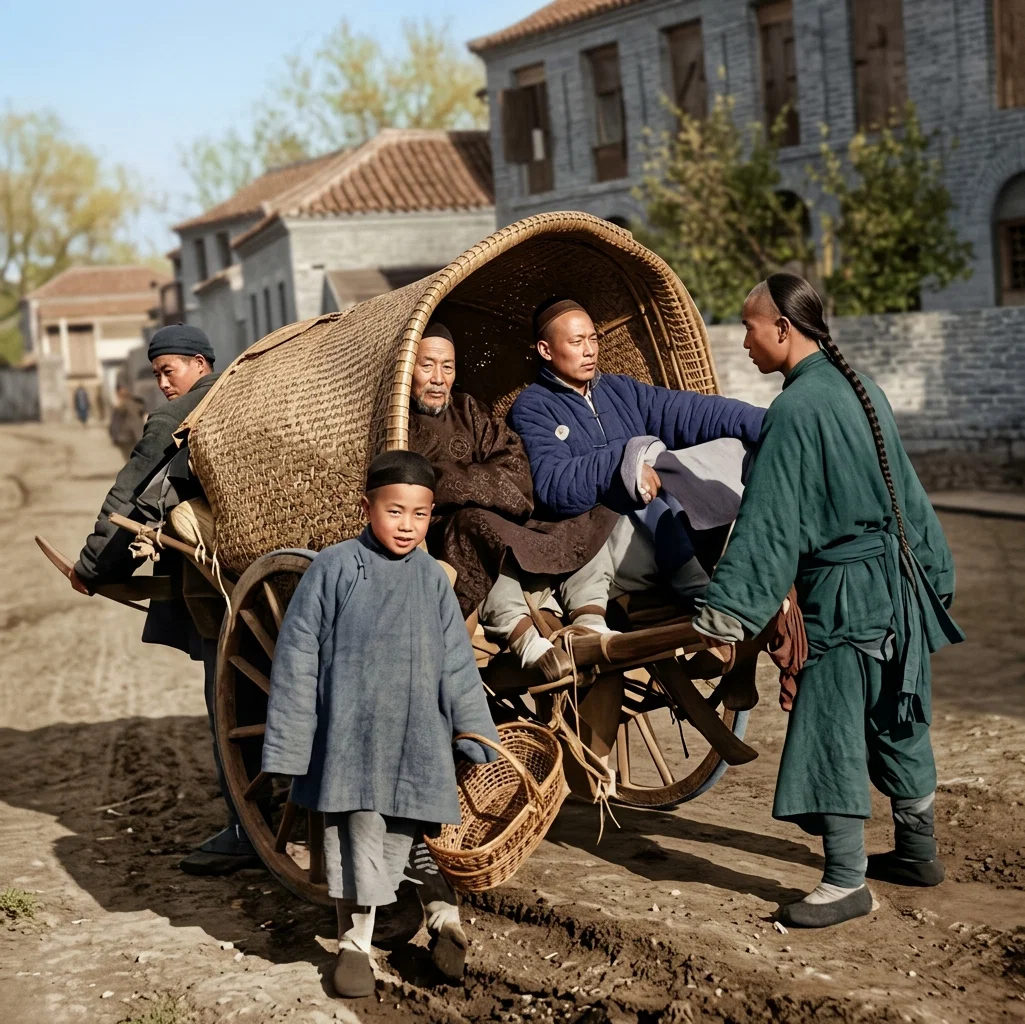
A CHINESE WHEELBARROW
Over these winding paths travel most of China’s passengers and freight. Man himself is the burden-bearer. When it rains, the wheelbarrows stop for shelter, and wait until it dries off, which is surprisingly soon after the sun shines out on these ancient tracks. Barrow follows barrow day after day, till even in the very stones of the bridges are left the marks of years and centuries of travel.
One morning as the clouds of threatened rain cleared away, a neighbor Chinese woman and myself seated ourselves on either side of a wheelbarrow, and off we rolled over the country road in North Honan. We were bound for a journey of about thirty li, or ten English miles. A pleasant country this is to see in the spring, as the level plain in every direction is springing into life with the green fields of wheat, and here and there are villages, with their trees and gardens.
The Chinese salute every one wherever they happen to meet. They may have never met, and may never meet again, but this pleasant, though often meaningless, exchange of words, spices up the toilsome journey. For instance, our cart meets another going in the opposite direction. The man pushing us sings out, “Going south?” The answer is an affirmative, followed by, “You’ve come from the south, have you?” this remaining unanswered as the distance widens between them.
Arriving at our destination, which is a small village, we are ushered into one of the earth houses. Then at once a reception begins. First, it is the village children; then, all the people, old and young, must come to have a look! for a woman who was not born in China, and whose feet are not bound, is very much of an attraction to those who never saw such a person.
We stop with a family who heard the gospel and discarded all their idols several years ago. Several sick people come for attention, and keep us busy until the darkness of night leaves us with only a flickering light, such as the Chinese use. This light is made in a saucer-like lamp, the wick consisting of little white strings of pith taken from some kind of plant and dried for this use. The oil is kerosene of poor quality, and with no burner or chimney, this gives a smoky light, not so good as candle-light.
The crowd having dispersed, I have an opportunity to talk with the woman whom I came especially to see, and invite her to come and be my helper in the mission.
The Chinese are a very hospitable people, and many kinds of food are set before me, but only plain bread and gruel that I am able to eat. A courtyard full of people wait outside to hear the gospel, and by moonlight I tell them, as best I can, the gospel story, contrasting God’s truth with Satan’s deceptions. This over, I am tired enough to rest until the early dawn brings again a train of the neglected sick ones. These keep me more than busy till noon, and then there are more waiting than when I began.
As rain threatens, we are compelled to start on our journey home. It is pitiful to leave them; but they can come to the mission dispensary, and China is full of such as these. They try to stop us several times; but supplies also are nearly gone, and it is of no use to stay.
Poor, neglected people, often in need of the most simple measures! The native treatment is worse than nothing. Often they are stabbed with long needles, which are even thrust into the eyes. This may be to let out the demon which causes the disease, but it results in loss of eyesight, abscesses, etc. Simple measures often work wonders. A large part of the diseases are of the eyes.
On our way home we pass a procession of the always-squeaking wheelbarrows. There are seventeen, and the sound resembles a great swarm of bees.
Back to the station, we reflect that the need of China is great, and we are, O, so small! How we must hasten to get this language better, that we may not be crippled as this growing work fills up the measure of our time and strength. May the Lord of the harvest send forth reapers, for the field is fully ripe.
The Santal Mission, India
By W. A. BARLOW
W. A. BARLOW
WE are very thankful to all our friends who have in the past few years helped the Santal mission work by their means and by prayer, and we are glad to send a few lines, to let them know how God is leading and is blessing the efforts put forth in his name for his sake.
During the past year we had about four hundred and sixteen sick persons to attend. We are not doctors, but we do what we can for the poor suffering farmers and others around us. Among the Mohammedans, Hindus, and Santals, we14use the water treatments, wherever possible to do so, and God blesses the treatments, and the sick ones are always grateful for any help received. While treating the sick, we have a good opportunity to teach the gospel of salvation and health, and to tell of a soon-coming Saviour in this generation, when sickness and sorrow will all be over, and those who are converted and ready to meet Christ will enjoy an eternal life of joy and happiness.
While traveling from Simultala to Babolmohol, in company with Dr. Ingersoll and Elder W. W. Miller, a few months ago, we were stopped by some Hindu villagers half-way, who asked us to stop awhile and see some sick people. Dr. Ingersoll gave some advice, and invited them to the mission. Next morning several came for medical aid, and those who could read got a Hindi tract on present truth, printed by our Watchman press, in the Hindi language and characters.
I may give you another account of the last trip we made through the same villages with Sisters Burroway and Haegart, on our way to Babolmohol mission, a short time ago. The people saw us nearing their village, and came out in large numbers, and again requested us to stop to see the sick ones. Sister Burroway gave the sick women and others some good advice on hygiene and health, and afterward we met a poor starving man, who looked like a skeleton. We went to see his home and family, and found a mud house, partly fallen down, and only half a roof over the poor family of several little ones and a sorrowful-looking mother. We called for the village shopkeeper, and gave the family the first remedy, by way of a few seers of rice for their half-starved bodies. The next day the mother came to the mission, and took the promised medical aid, and a cloth kindly given by Sister Burroway.
One more case I may mention, that of a poor old Mohammedan widow, who came crying to us, crawling upon her hands and knees, one night. We went out to see what was the matter, and found she had been badly burned by fire while sleeping under some temporary shelter. She had been cast out of her home and family because she had taken some food from other people outside of her own caste. We did what we could for her by prayer and simple treatments, and now she is well again, and able to get about as usual. Brethren J. L. Shaw, W. W. Miller, and J. C. Little saw the poor old woman a few days after we took her in, and Brother Miller gave her a warm blanket, as the weather was very cold. She was grateful for this. We have tried to get her family to take her in again, but they refuse, and she will not leave us now.
We could take in many more surgical and other difficult cases if we had a medical missionary to help us—one who would begin to learn the language as soon as he entered the field. It is an important point, if one wishes to be useful among the Hindi and Santal people. No time is lost learning the language; for while doing so, one is learning about the people whom he wishes to reach. One can speak freely within a year, and feel quite at home, if he perseveres with prayer and patience.
The Santal students are doing well in their studies and in the Gospels. They are now busy, digging holes for one hundred Pappea and other fruit-trees. The Pappea grows well here, and fruits within a year or so, if well cared for, with plenty of water in the hot season. They are still digging two new wells—one in each mission station.
The two Seventh-day Adventist Santali teachers are doing well, one at each school. We could open fifty village schools if we had the means and teachers. The people are continually calling for teachers and schools, and each school would cost two dollars a month. The boarders in our school cost one dollar a month, and we have only thirteen students, up to May, owing to funds being short, but we could take in many more if funds permitted. I try to keep free of debt, and take in as many as funds allow.
Who will dedicate their life and all they have to the Master's service, for India or elsewhere, and say, “Here am I, Lord, send me”? The time is short, and eternity is drawing nigh. Jesus is coming in this generation, and what will you do toward proclaiming the last message for the last days to the millions of heathen who lie in darkness and in the shadow of death?
“Soon will the season of rescue be o’er,
Soon will they drift to eternity’s shore.
Haste then, my brother, no time for delay,
But throw out the life-line, and save them to-day.”
Iceland—The Customs of the People
By DAVID OSTLUND
DAVID OSTLUND
THE climate and other conditions have given the Icelanders a peculiar character. Even the cities bear testimony to this, but it seems even more a fact in the country. Let us observe an Icelandic farmhouse for a few moments, and we shall soon notice this. The house is, for the most part, built of sod, with walls several cubits wide. The ceiling is covered with grass and sod. The dwelling-houses have usually several rooms. The barn is built a little way from the house. The different apartments of the main dwelling are built parallel with one another, with one end toward an open court. In the most primitive form each house has but one room below. Then there is sometimes a room up-stairs. If the house is large, there may be two rooms down-stairs and two on the second floor. The light has access to these rooms only from a little window, high up, and there is very little opportunity to get fresh air. Benches around the walls, beds with canopies, at the window generally a little table—in most cases this is the only furniture. Very seldom is a chair to be seen. The kitchen is generally a house in itself. It is the only room where there is fire. This is used for cooking purposes.
The dwelling-houses in Iceland are generally damp, on account of the lack of fresh air; but a reform in this is difficult, as there is no timber on the island, and importing it from other places makes it very expensive. But of late there has been much improvement.
The main articles of diet are milk, dried fish, and mutton. The dried fish must, for the greater part, take the place of bread, and is eaten with butter. Potatoes are very scarce. Thus you will see that the Icelanders live mostly on animal food.
There are very few amusements in Iceland. In later times there have been a few theaters erected in different cities; but one can hardly speak of art in connection with these. The meetings of the Good Templars are very well attended by the people. But in the country there are very few entertainments. The people of Iceland are great readers. They read their old histories and books and papers, and all they can get hold of. It is astonishing how much they read. You can hardly find a farmer who is not well versed in history and in the questions of the day, and can speak entertainingly in conversation of things that are happening.
Especially are the Icelanders careful of their language, to speak and write it correctly. You can scarcely find a man who will be careless in the use of words. It is to be supposed that their desire for reading has produced this result; and the language has, because of this, been kept pure and just as it was written several hundred years ago.
With reference to trading and commerce, the Icelanders are far behind. Although they are great readers, and have a good amount of knowledge, they have no ability in practical lines.
There are no factories to speak of in the island, though there are opportunities, if the people had any inclination to make the most of them. They import their clothing and other articles that are needed from foreign countries.
In agricultural lines, they are behind also. Although the country is mountainous, there are some portions which might be made to produce generously, but they are neglected, and as a result the people are poor.
Reykjavík, Iceland.
Let Us Advance Upon Our Knees
“LET us advance upon our knees,” said Neesima, the great Japanese evangelist who founded the Doshisha Christian College at Kioto; and this must be the watchword of every soldier of the cross, whether it be in the East or in the West. For it must not be forgotten that as yet there is but the sound of abundance of rain—merely the earnest of wondrous things to come. Before the great rain falls which will revive the whole of the parched earth, God’s people must—like his prophet of old—prostrate themselves before him in continual prayer.
Virginia
By H. J. FARMAN
LOWRY.—Our tent-meeting closed here October 8, with one of our largest congregations. Many expressed regret that the meetings were to close, but the weather demanded it.
From the first, our audiences were rather small; all paid good attention, but at no time did we have any great crowds. This may be accounted for, perhaps, because the year before a short series of meetings was held, but the work was not completed. The result was that prejudice arose, and many decided against the truth without having a real knowledge of it. But we have great reasons to praise the Lord for his goodness. Several have become very much interested, and a few have taken their stand with the remnant church. A church has been purchased, and meetings are continued therein. We hope soon to organize a church. Pray for the work here.
H. J. FARMAN.
South Africa
By O. O. Fortner
CAPE TOWN.—We give to the REVIEW readers the privilege of reading the following letter which we lately received. This furnishes another instance showing what may result from the distribution of our literature and other rightly directed missionary work. During the late war we sent out to the refugee and prisoners’ camps thousands of papers, tracts, and small books, the distribution of which we firmly believe will yet turn many into the paths of righteousness. Brother Van Rensburg came across a copy of the little book, “His Glorious Appearing,” which first arrested his attention; and when Brother Dumini, who had learned the truth through Brother Morrow’s labors in Bermuda, came along, he and his family were prepared to receive the whole truth. The following is the letter, which has been translated from the Dutch:—
“Mr. O. O. Fortner,
“MY DEAR FRIEND: Be good enough to send me the price-list of your books. During the war I found a book named ‘His Glorious Appearing,’ and about a year ago I began to read the same. To my great astonishment and conviction, I learned that the teaching of our church with reference to the second coming of the Lord was wrong, together with many other doctrines.
“A few months ago a friend of mine, named H. Dumine, arrived from Bermuda. He taught me many things, among others the Sabbath. I also met another brother named De Lange, of Bethlehem, Orange River Colony.
“It is pleasant to me that the love of the Lord convinces my wife also to follow the Saviour in all things in the blessed hope. We keep the Sabbath of the Lord with joy, although it was a terrible conflict. Dear brother, remember us in your prayers, that we may be steadfast and endure to the end in the truth. I feel myself of no account, to think that I must join a church which expects the Lord and keeps the commandments of God and the faith of Jesus. Let me know how I can obtain the Sabbath-school lessons, as I want them very much.
“I trust soon to meet Elder Freeman for the first time.”
O. O. FORTNER.
Roseau, Dominica
By PHILIP GIDDINGS
In the center of the Caribbean Sea, Dominica belongs to the sisterhood of volcanic-formed islands, with its Boiling Lake in the southern part, which now and then emits sulphurous and other gases, perceptible even in town. Being but twenty miles northwest of ill-fated Martinique, we are reminded that in the midst of life, we are in death.
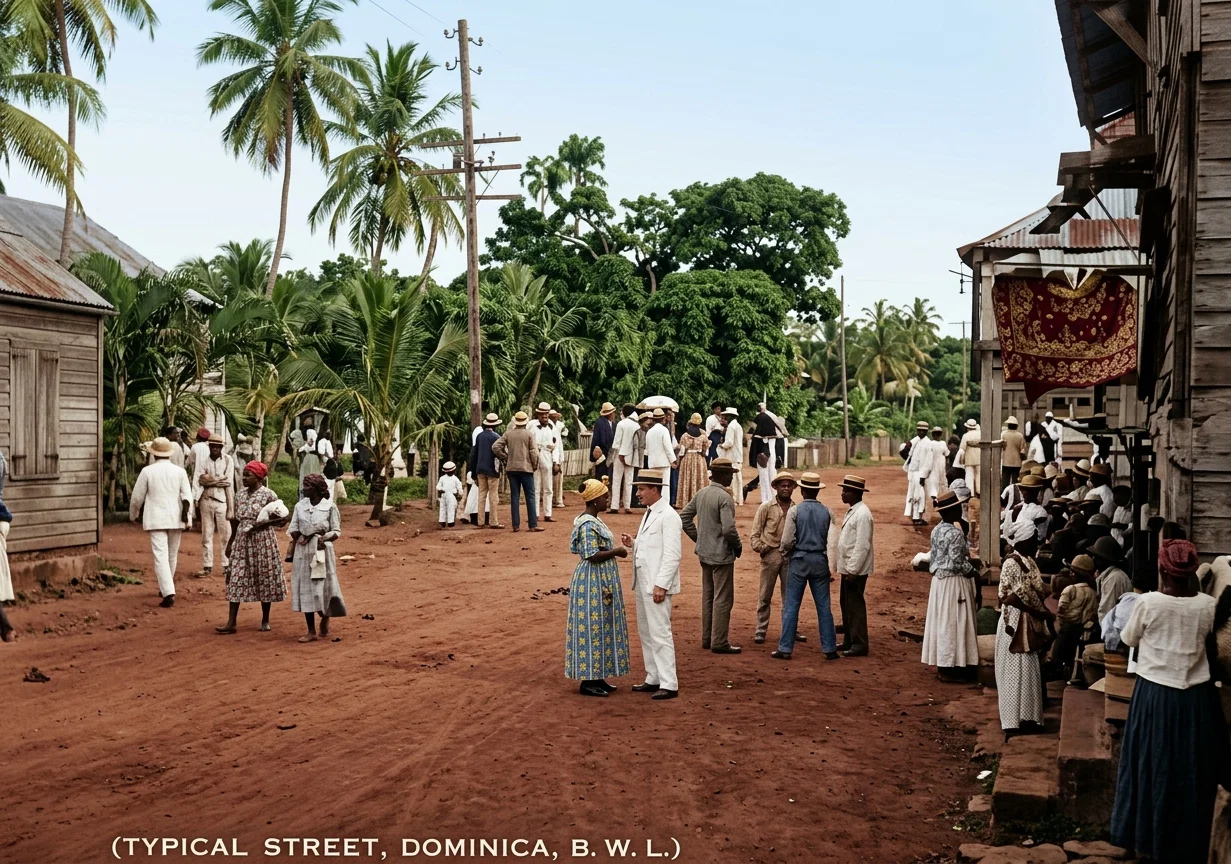
SUNDAY AFTERNOON ON THE STREET
Communication with the different parts of the island, except by waterway, is difficult, there being but a few miles of good road to and from town, and part of it by overhanging cliffs, with ponderous rocks that look murderously down. And in a country where rain is plentiful, washing away the soil that holds these rocks, one can imagine how a stranger feels as he passes under. There have been cases where the rocks have fallen, and crushed passers-by to death.
Withal, Dominica is a beautiful island. Some of its highlands are from four thousand to over five thousand feet above the sea, dressed from top to bottom with a mantle of arboreous green that gives a pleasing softness to the aspect.
Its botanic garden, with its thick, soft, evenly mown grassy carpet, is said to be the best in the West Indies. While the hand of art is evident, yet it is subdominant to nature, who revels in her native mood and freedom, which suggest and create a longing desire for that other garden from which sin turned man. I met two young men last week, and asked, “Where are you going?” “Into the garden,” they answered. “Would you mind that we start for the garden of Eden to-day?” I asked. “But so far,” they said. “But it will be nearer to-morrow if we start to-day,” I replied. They caught my meaning, and hope to comply some time, before too late. Of the twenty-eight thousand inhabitants, twenty-four thousand are Catholics.
One mile from town I hold a night-school on the evenings I have no meetings. I find many, especially in the country places, who do not know the alphabet, and even some who read do not understand what they read. We are using the “Gospel Primer.” May God bless the efforts. The work necessarily goes hard and slow in Catholic countries; but we are of good courage.
The accompanying view represents a typical scene on the most popular street, on Sunday afternoons, where we hold open-air service. We use a red banner, on which are printed in white letters, the words “JESUS ONLY.” Thus we try, in the kindest way we know, to eliminate those dead human saviors by which this country is afflicted, and point alone to the one Mediator between God and men—the Lamb of God, who alone takes away the sins of the world.
We have started a fund for the building of a Seventh-day Adventist church here, the site of which we will describe in our next writing.
This island owes its name to the fact that it was discovered on Columbus's second voyage (1493), on a Sunday; hence, ‘Dominica,’ the Spanish Domingo, means Sunday, of the popular Sunday-Lord's day error.
We ask God's people everywhere to remember us in Sunday Island.
PHILIP GIDDINGS.
Central America and Bay Islands
By H. C. Goodrich
I HAVE seen some wonderful evidences of how the loud cry will go, I believe, in the different places I have visited recently. For instance, in La Ceiba, Spanish Honduras, a Spanish lawyer of some note began to keep the Sabbath last October, through reading “Prophecies of Jesus.” Although he could not understand all he read, yet he was convinced of the truth. One part of his experience was with spirits of devils, who, when they found him determined to accept the Sabbath and believe the Bible, turned right about and told him to keep the Sabbath and study the Bible, and follow Christ, only the spirits must always tell him what the Bible meant. Mr. Allen writes that he is advancing daily in the truth.
In Ruatan, Bay Islands, the agent of a commercial company, who had always been a wild young man, was suddenly seized with a desire to be a Christian. His mother is a member of the Utilla Seventh-day Adventist church. The young man's wife was quite prejudiced; but while attending a meeting on the second coming of Christ, conducted by a Holiness man, the thought flashed into16her mind that the seventh day is the Sabbath; and when I came, they sent for me to visit them. They kept the next Sabbath, set up the family altar, began paying tithe, and subscribed for our papers.
A man in French Harbor, Ruatan, who a year ago was bitterly opposed to our work, is now very friendly, and is willing to donate a lot for a church. This man's daughter, aged twenty years, told me her experience. One Sabbath, while at work, the impression came to her very forcibly that it was the Sabbath. The next Sabbath this impression returned with still greater force, and she determined to obey.
H. C. GOODRICH.
Brazil—General Meetings
By F. W. SPIES
The date for the Castro general meeting was April 14-21. The ministerial help planned for consisted of Brethren Lipke and Hoelzle, and the writer. Having been a member of the committee for the locating of the printing plant, I could not reach Castro until toward the close of the meeting. The attendance of our people was good. Some, even women, and they not very robust, traveled about one hundred and ten miles, part of the way on foot, the rest on horseback, in order to attend this gathering. The outside attendance was also good. In fact, even though toward the close of the meeting the weather was decidedly unpleasant, raining very much, the meetings were well attended; and although it had been planned for Brother Hoelzle to also accompany us to Blumenau to assist in the meeting there, it was found necessary for him to remain in Castro to follow up the interest created by the general meeting. The Castro meeting was attended almost wholly by Brazilian brethren, and it afforded a good opportunity to instruct them in many important things, among these the importance of healthful living, and giving the Lord his own in tithes and offerings.
And one thing we need to teach quite clearly and early is the spirit of prophecy. The various Protestant missionaries of Brazil have found the need of something with which to battle against the truths we teach, and the weapon of their choice is Canright's book, which they have caused to be translated into the Portuguese language. Then they make the spirit of prophecy the main issue, by making all sorts of ridiculous and untrue misrepresentations concerning it. So we find it necessary at times, even when we begin work with certain souls, to show them what the Bible teaches with reference to this subject, and also the fulfilling of it as revealed in the remnant church. We find that, as a rule, those who have come to the point of recognizing the Bible as the Word of God, have no difficulty whatever with the spirit of prophecy. Of course, here as elsewhere, “the wicked shall do wickedly: and none of the wicked shall understand,” because they do not wish to understand.
The Castro general meeting likewise ended with a baptism, seven souls being buried with their Lord in the watery grave. This was followed by the ordinances of the Lord's house, which seemed to make a deep impression on many of the townspeople who had come to our meetings.
April 24 Brother Lipke and I left Castro to go to the Blumenau meeting. On the first of May we arrived at Brusque, and after getting ready to move to Rio Janeiro the things we still had there, after the meeting had closed, we went to Timbo, Blumenau, where the meeting was to be held.
Here again, although it had been raining almost constantly, and the roads were well-nigh impassable, we were agreeably surprised at seeing a goodly number of our people present. The evening services were also well attended for a country place, from two hundred to two hundred and fifty persons being present on some evenings. But later work showed that this was largely due to curiosity, rather than to a real interest.
At the close of this meeting two sisters were baptized. This, like the other meetings, gave opportunity to present many timely truths to the brethren, and also to the people of the neighborhood, and the testimonies borne showed that many of our people had consecrated themselves anew to the Lord and his work.