ALREADY six weeks have passed since the terrible sixteenth of August which brought death and destruction to thousands of homes in the central part of Chile. Since I have visited different cities destroyed, and seen the ruins of what were once country houses, besides being an eye-witness to the destruction of Valparaiso, I doubt if the reports really represented the greatness of the catastrophe. In some of the cities in the path of the earthquake there is scarcely a house left standing.
There have not twenty-four hours passed since the sixteenth that there have not been from one to twelve or more temblors, some being quite strong. When the strong ones come, the people run screaming from their houses to the street. Some thirty or forty thousand people left Valparaiso as soon as they could after the earthquake; those remaining have erected shanties of corrugated zinc in the plazas, avenues, and other available places, or live in tents that were furnished by the Argentine government. The houses erected are small and without conveniences of any kind, and during the heat of the summer will be like furnaces. The sanitation is also very bad, giving every opportunity for the breaking out of plague; indeed, smallpox has already broken out, and if this should be joined by bubonic plague or typhoid fever, the death-rate would be appalling. It is a notable fact that the authorities take no steps in cases of this kind until the people begin to die by hundreds, and then in many cases the money appropriated goes to fill the coffers of the officials.
Already work has begun on all the buildings which it is possible to repair, and others are being torn down, and the débris cleared away preparatory for the rebuilding of the city.
As soon as possible after the earthquake, we printed a special number of our missionary paper The Signs of the Times (Spanish). Our monthly circulation is four thousand, and the largest edition we had ever published was ten thousand, but of this number we printed thirty thousand. The brethren took hold of the work as never before, and the entire edition was sold in less than three weeks. We are now getting out another and better edition, and expect to print thirty thousand if we can get paper, as our supply has been exhausted, and at present it is impossible to obtain suitable paper in Valparaiso.
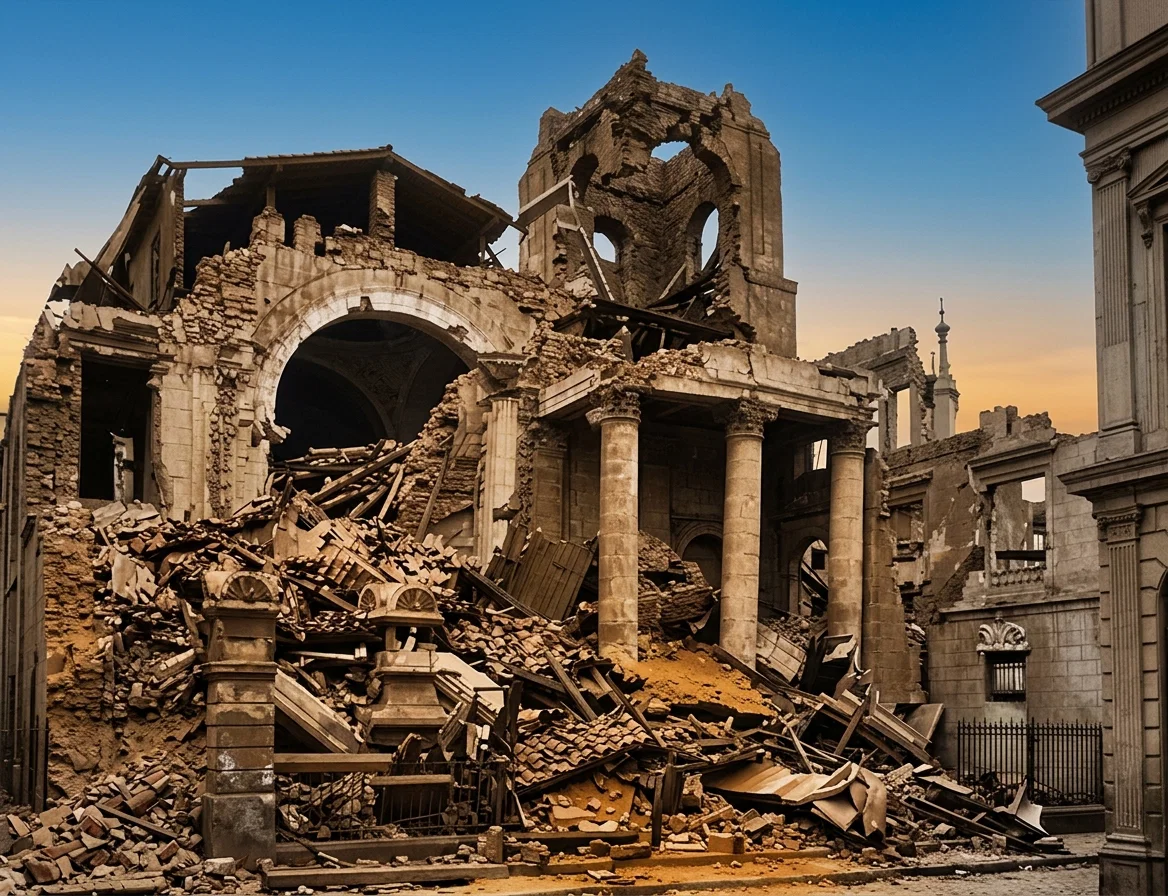
MERCED TEMPLE, IN WHICH EIGHT HUNDRED PERSONS, MOSTLY WOMEN, ARE SAID TO HAVE BEEN KILLED
The brethren have been awakened, and are working as never before. Thus, thousands of people will have an opportunity to learn what these things mean, who, if the earthquake had not come, would possibly not so soon have had the opportunity. Thus we see the working of the Lord. Truly his ways are not our ways. We hope the brethren may continue to work with our paper so that we may be able to print a large edition each month. It has been contrary to the customs of the country for the sisters to engage in this work, but as some of them took courage and went out with the paper, they have had good success in selling it. Thus their eyes have been opened as to their possibilities in helping to spread the message. But we are in need of more workers. We need workers to enter Bolivia, which is, perhaps, the most superstitious of all the South American countries. One brother has recently gone there to engage in Bible work, but we need more workers, more literature, and more means, that these poor people who are in such great darkness may have an opportunity to see the light that the Lord has so mercifully shown us.
Last Sunday a mass was held in the park for the souls of all those who were killed by the earthquake; their number is now thought to be from three to six thousand. It is said that eight hundred were killed in one church. Only about two hundred and fifty of the bodies have been taken out; the rest are still under the hundreds of tons of brick that fell as the church was completely destroyed. They were having what they call “novena,” a nine days' mass, consequently many persons were in the churches, and had no opportunity to escape.
The president and his cabinet attended the services last Sunday; and all the officers of the army in their gold attire, the soldiers in full uniform, with many bands of music, made a grand display, which is dear to the heart of the Chileno. It seemed as if all who could do so attended the services which were conducted by the priests. The control that they still have over the people is remarkable. We long for the time to come when the power of the enemy will be broken, and Christ's kingdom be set up. May all the brethren realize their duty toward these priest-ridden people, and do all in their power to carry the gospel either by coming themselves or by giving of their means that others may come.
A New Conference in Central America
By J. A. Strickland
J. A. STRICKLAND
The general meeting of the Panama Mission field was scheduled to take place at Bocas del Toro, Panama, September 7-17. On account of quarantine regulations, caused by the prevalence of smallpox at Colon, I had to take a lengthy and circuitous route, leaving Jamaica August 25.
Monday, August 27, we called at Savanilla, an important Colombian port. A stop there of twenty-four hours permitted us to see something of South American manners and customs, and form some idea of what qualifications our worker should possess who first enters there with the truth for our times. Wednesday we entered the harbor of Carthagena, and were soon traversing the narrow streets of that quaint old town that remains a relic of the days of piratical plunderers and sea-rovers. A solid stone wall surrounds the city, built13to repulse the attacks of marauders of the Captain Kidd class. It stands to-day firm, and seemingly untouched by the hand of time. My limited Spanish vocabulary was taxed to the utmost as I visited the shops, public buildings, and churches of this ancient Spanish stronghold. Here I saw the result of Romish ritualism fully matured: massive church buildings, embellished with altars on all sides, which were laden with gaudily dressed dolls representing supposed saints, before which the ignorant masses reverently worshiped, while the educated classes stood with stoical countenances, silent and motionless; men working in the street had near them a cheap lithograph of a woman, which was thought by them to be a picture of the Virgin Mary. Candles burned before it. The poorer class of women bowed as they passed, while the men who happened that way crossed themselves as they went by. What an eloquent, though silent appeal these things were for us to send them the light of the blessed gospel of Christ! While viewing the sights of Carthagena, a fellow passenger from the steamer said to me, “Will your people ever preach the Sabbath in this superstitious old city?” “Yes,” I answered; “these stone walls can not exclude the sound of the third angel’s message, and the darkened minds and sad hearts of these people will soon be made light and glad by that gospel which proclaims the commandments of God and the faith of Jesus. Some here will receive the Word, and it will be to them the power of God unto salvation.”
Sabbath, September 1, we dropped anchor in the harbor of Port Limon, Costa Rica. Here we have an organized church, with a membership of thirty. A frame church building has been erected on the outskirts of the town. I was in time for Sabbath-school, for which I was heartily thankful. I remained with the brethren of Port Limon four days, holding meetings each night. Large crowds attended these services, and an encouraging interest was manifested. Wednesday, the fifth, in company with Brethren E. N. Rogers, local elder of the Port Limon church; A. J. Wright, deacon; H. L. Mignott, a licentiate of the Panama Mission; and Brethren Ashley and Horton of Pacuarito, Costa Rica, we took passage for Bocas del Toro, on the “Kearsage,” a two-mast schooner, with Brother T. M. Robinson, deacon of the St. Andrews Island church, as owner and captain. Seventeen were aboard the boat, and all but two were Sabbath-keepers. Brother J. B. Haughton, of Old Providence, had very thoughtfully brought his folding Estey organ, which was a great help in the song services, and an acceptable addition to the morning and evening worship we held on board. Captain Robinson looked after my every comfort, with the tender solicitude of a father, which enabled me, in spite of the twenty-four hours’ calm we experienced, and twelve hours of terrific tropical sun, to pronounce my passage on his vessel a rare and pleasant treat.
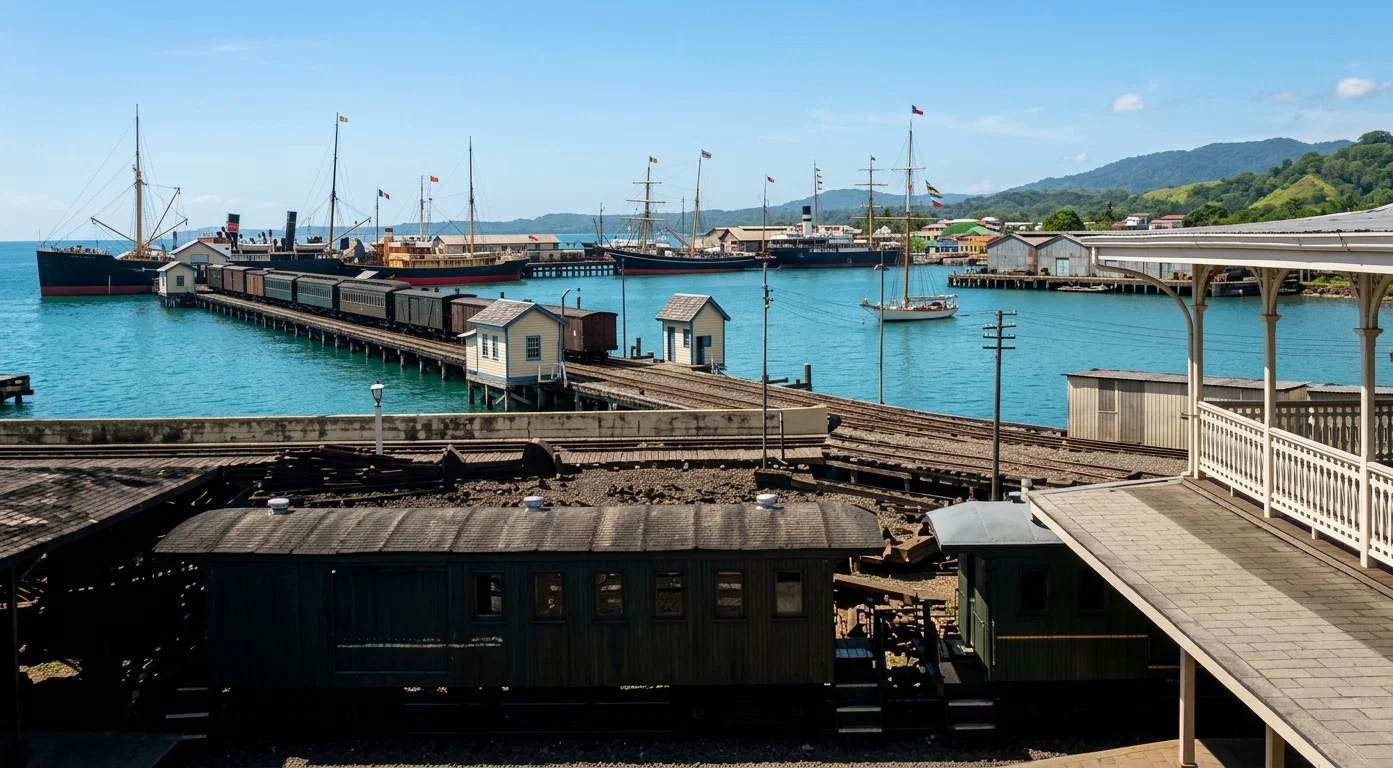
RAILWAY PIER, PORT LIMON, COSTA RICA
Early Friday morning we anchored in the calm waters of Bocas del Toro. Soon passengers and crew gathered for morning service. As we sang that grand old hymn,—
‘Lord, in the morning thou shalt hear
My voice ascending high;
To thee will I direct my prayer,
To thee lift up mine eye,’
a crowd gathered upon the wharves near by, and the news went like wildfire through the town that a schooner-load of Adventists had arrived. A messenger hurried to the mission house, and informed Elder Knight, and in a few minutes we heard the puff of a gasoline launch, and saw, rounding a projection in the lagoon, with her prow pointed toward us, that splendid and shapely little mission vessel, the “Harbinger.” And I wish to say here that the money invested in the “Harbinger” was well spent. The success of the Panama Mission is largely due to the fact that Elder Knight had this boat. The territory is composed of scores of lagoons, with as many islands that can be reached only by a boat.
Glad were the greetings when the boat, bearing Elder I. G. Knight, Sister Carrie Knight, and their little boy, came alongside. But they could not come aboard our ship, because we had not yet been inspected by the port authorities. A wait of a few minutes brought the doctor and the customs officials. The examination of our baggage was brief and most polite, for our work and workers have won the respect and confidence of the officials at Bocas del Toro. Half-past eight found us ashore.
The services were held in a tent, pitched on an attractive spot in the center of the town. From the start the power and presence of God was felt. Perfect harmony prevailed in all the deliberations, and every act of the assembly breathed faith and courage. Over one hundred believers were counted. Many more would have been present but for the fact that traveling expenses are exceedingly high, and transportation can not always be secured from one place to another.
The work in this field was started in 1901, by Elder F. J. Hutchins. In 1902 he died. Elder I. G. Knight and his wife were sent to fill the vacancy the following year. The name was changed from Central American Mission South to Panama Mission, in 1904. At that time there were about twenty-five Sabbath-keepers. Now there are two hundred and fifty Sabbath-keepers, six organized churches, and several unorganized companies of believers.
This field needs two good men—competent, consecrated men. They are needed now. We must have them, brethren, or the price you will pay for your failure to supply them will be many souls, and the loss of much vantage-ground already gained.
By a unanimous vote, it was decided to organize the field into a conference. Happy, harmonious, and hopeful was the West Caribbean Conference, launched amid the hearty amens of more than a hundred loyal hearts. This field was self-supporting last year. There is at present more than five hundred dollars in the treasury. At this meeting the brethren pledged $279.50 to the West Indian Training-school in Jamaica. Of this amount, one hundred and five dollars was paid in cash. The territory of the conference includes the republics of Panama, Costa Rica, and Nicaragua, and St. Andrews, Old Providence, and Corn Islands. Officers were elected as follows: President, Elder I. G. Knight; Vice-President, Elder Hubert Fletcher, of Jamaica, who was invited to begin his labors here at once; Treasurer, Elder I. G. Knight; Secretary, Mrs. Carrie Knight; Secretary Sabbath-school and Young People’s Society, Mrs. A. J. Read; Executive Committee, I. G. Knight (Chairman), T. M. Robinson, H. L. Mignott, Samuel Knapp, A. E. Comer. Credentials were given to Elder Knight. H. L. Mignott was ordained, and received credentials. Ministerial licenses were granted to T. M. Brown and A. J. Read. Missionary licenses were given to A. J. Wright, J. B. Stuyvesant, W. H. Dean, Sheridan Archibald, and Mrs. Carrie Knight. The meetings were largely attended by the people of the town, who paid respectful14attention to the truths that were proclaimed from our platform. I never saw people more eager to hear. The service on Wednesday night, when Brother H. L. Mignott was set apart for the gospel ministry, was especially solemn and impressive. Unfortunately, I had to leave after the service the next night, or be delayed three weeks in reaching home, but my heart was made glad by knowing that more than twelve souls decided that night to walk in obedience to God.
I reached Port Limon Friday morning, but was refused permission to land. The authorities were afraid I had brought smallpox or yellow fever to their shores. The Costa Rican government claims, and I believe justly, too, that white men born in temperate climes take those diseases more readily than do other people. So I was banished, if I may use that expression, to a little island near Port Limon. As I stepped from the boat upon the shores of the island that is to be my home for five days, a group of Spaniards saluted me in their own language. Not hearing one English word, I said, “Hay alguien en este lugar que habla ingles?” (Is there any one here who speaks English?) The leader of the group answered, “No, senor; nos hablamos espanol” (No, sir; we speak Spanish).
I have no fault to find with my accommodations, nor with the health regulations that placed me here. I spend the time resting, writing, and studying Spanish. As I write now, I discern far away on the southern horizon the funnel of a steamship sending forth a column of black smoke. It is approaching Port Limon. Perhaps it is the ship that will take me home. But whether it is or not, I know in a few days I shall say to my pleasant Spanish detention guards, “Hasta la vista, senors,” and will go aboard some steamer that will bear me back to dear old Jamaica, where loving hearts pray for my safe return.
Quarantine Station, Port Limon.
The Holland and Flemish Belgium Mission
By Guy Dail
GUY DAIL
Our general meeting here was held in the delightful capital of Holland, The Hague, August 16-19. This pleasant city, with its fine streets and canals, contains about two hundred and thirty thousand inhabitants. It has no unimportant place in the history of the Netherlands, and it has not been without influence in the politics of the civilized world. The Binnenhof is the home of the Parliament, or States-General. Portions of it date from the thirteenth century, when it was a castle of the Counts of Holland. Some of the most important events in connection with the long struggle of the Netherlands for freedom occurred in this building. One admirer of Dutch institutions writes: “To me, whenever I visit it, the square of the Binnenhof at The Hague is the holiest spot in modern Europe, for here the great deliverance was wrought out.” Not only have scenes of glory to the people of Holland been enacted here; also acts of violence and caprice have been perpetrated, for it was opposite the “Hall of the Knights,” that, embittered by theological differences (which were very marked in the early days of Dutch independence), Stadholder Prince Maurice of Nassau caused his former friend and coworker, Johannes Van Olden-Barneveld, to be unjustly executed in May, 1619. Here, too, the visitor is shown the old gateway and tower where was imprisoned Cornelius de Witt, who played a leading part with Sir William Temple in securing the treaty that culminated in the triple alliance between England, Holland, and Sweden (1667) in favor of the Protestant States. Five years later, incensed by his enemies' reports that he had conspired against the life of William III, the Orange mob broke into the prison, seized Cornelius, with his brother John, who happened to be visiting him, and murdered them. And most of our readers will remember The Hague Peace Conference, which so shortly antedated one of the briefest, but most severe, of the wars of recent years.
Last June our brethren began a series of quite well-attended lectures in The Hague. At the same time several col porteurs were engaged in the canvassing work in the place, and thus a number of interested persons were found, some of whom were able to take their stand definitely for the truth during the conference. At the close of the Sabbath, six were baptized. The Sabbath had been one rich in blessing to the eighty or ninety delegates who had been together in the hall we had secured for our meetings. In the afternoon the dedication of the new mission boat, “Maranatha” (the Lord cometh), recently secured and fitted up for service in the Rotterdam harbor by Capt. J. Christiansen, was an occasion of encouragement to the people.
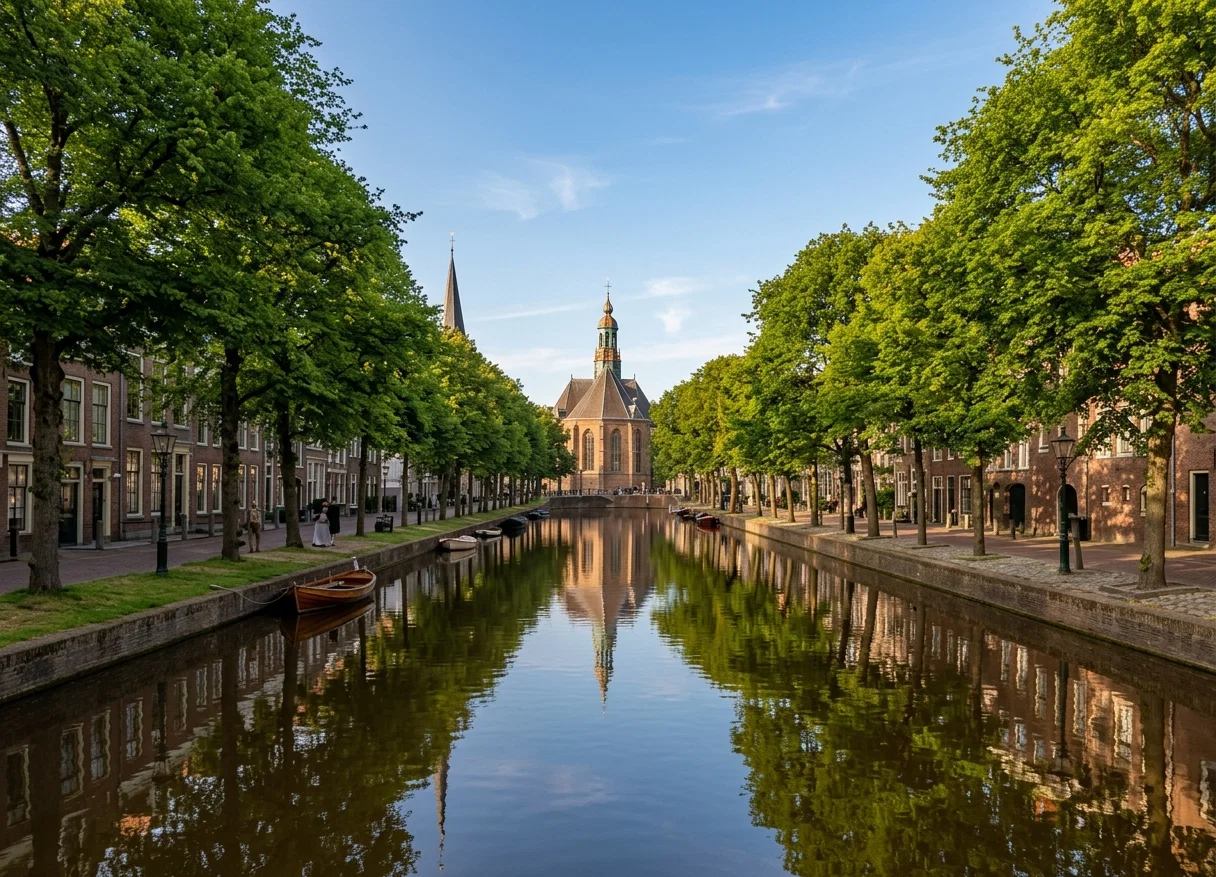
TURF MARKET, CANAL, AND NEW CHURCH, THE HAGUE
The assistance rendered by Brethren Conradi, O. Luepke, and G. Schubert, was appreciated by the local workers and lay members, as the counsel and teachings of these more experienced laborers were helpful and timely. Brother Peter Nyambo, who here attended the last general meeting at which it was his privilege to be present before leaving for East Africa, was also enabled through his intercourse with the people, to quicken their interest in missions and missionary work, especially for those waiting for the light in Africa.
There was no lack of union and harmony in the councils of the committee, or in the business transacted in the open sessions of the conference. The only ordained minister, Elder Klingbeil, was again unanimously chosen as director of the field; and the other members of the committee are as follows: J. Wintzen, M. Arendse, E. A. Traarbach, J. Wibbins (Secretary). Ministerial credentials were granted to R. G. Klingbeil; ministerial licenses to Brethren J. Wintzen, J. Wibbins, and P. Schilstra; missionary credentials to Brethren Arendse, Loots, Girou, and Sister15Maayer. Thirteen were chosen as canvassers, with Brother Arendse as General Agent.
The funds at the disposition of the mission field are continually being increased by the gifts and tithe of the brethren themselves, but there is not yet enough native income to support the workers, so that this is one of the fields that must be assisted by subsidies from the German Union treasury. In 1904 the native tithe amounted to $625; gifts, $104; book sales, $1,123; in 1905 the tithe amounted to $714; gifts, $183; book sales, $794. We are glad to state that the canvassing work during the first half of 1906 shows a good growth,—sales amounting to $915 being reported,—and the outlook for this branch is cheering for the future.
We are especially pleased that the work in Flemish Belgium has been doing well, and that Brother Klingbeil now has the assistance of two Bible workers there, one of whom is working in Brussels, and the other is with Elder Klingbeil in Antwerp. Brussels, the gay capital of Belgium, with its wide streets, public squares and markets, and artistically arranged buildings, contains 598,000 people, and we are now just entering it; while in Antwerp, which has 292,000 inhabitants, a nice little company of believers has been gathered out. We surely ought to think of our workers in Belgium, as well as in Holland. The Holland and Flemish Belgium Mission field is about twice the size of Massachusetts, but has a population of about 8,860,000, nearly three times as many as live in the Bay State.
Our wish is that God may hear the prayers of his children, that the work here may progress faster than ever, and that this part of the great vineyard may soon hear, in its fulness, the message for this time, and such as are being saved be gathered out to the remnant people.
Our Matabeleland Missions
By W. S. Hyatt
Recently I spent several weeks with our missions in Matabeleland. The work is going forward, and there are many encouraging omens. It is true that Satan is doing his best to close up the way before us, but the message is spreading, and its influence is being felt. We now have a number of young men who are getting an education that is fitting them for service wherever we may place them.
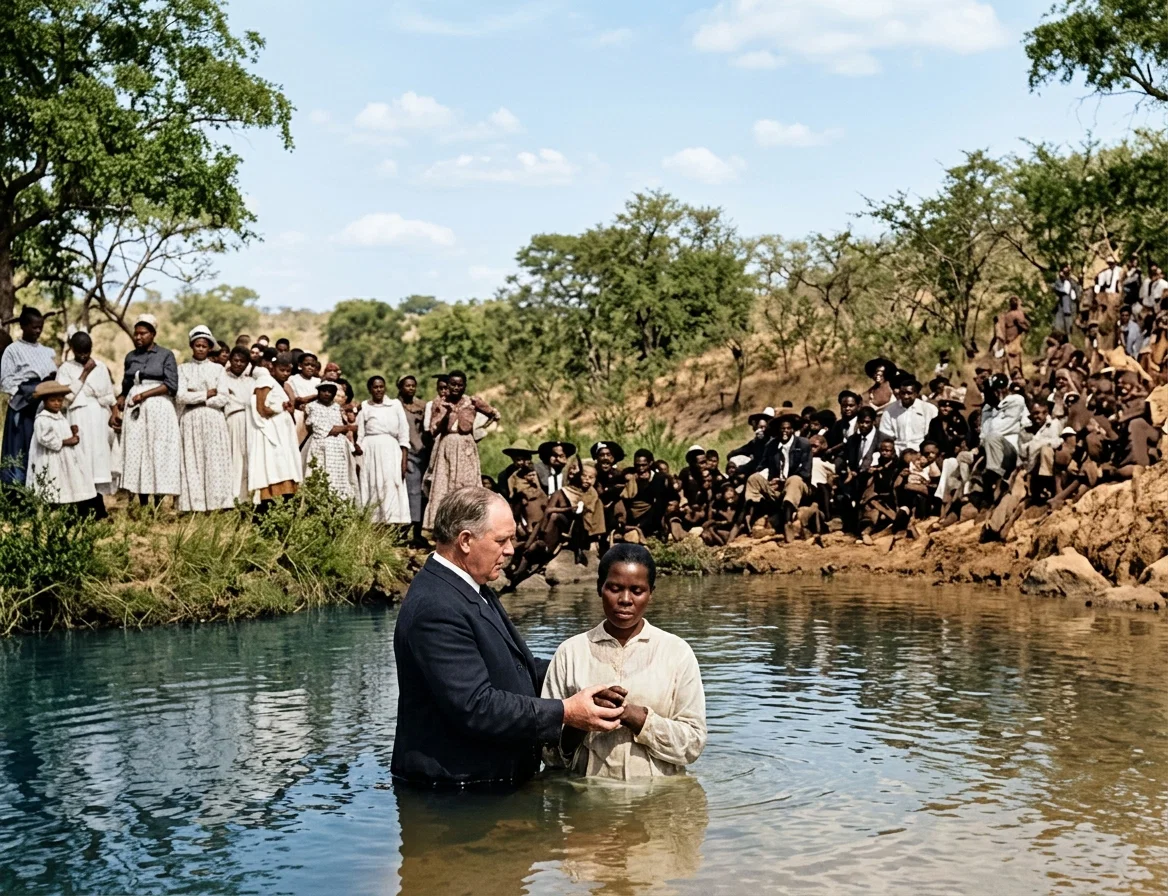
A NATIVE BAPTISMAL SCENE
Several of these young men have a longing to go to their people and labor among them. Brother Anderson having found the parents of Jim, a native teacher at the Solusi Mission, we have sent him to Barotseland to work among his people. Young men from Nyassaland and Zululand are anxiously waiting for the time to come when they can return to their home lands and engage in giving the truth to the people.
A chief from north of the Zambesi came to the Somabula Mission searching for a missionary and teachers to enter his country. We were sorry that we could not enter this open door at once, but promised to do so as soon as the rainy season is over. Surely, Ethiopia is reaching out her hands to us for the bread of life.
Financially our missions are in the best condition they have been for several years. They are now well stocked with cows which yield good returns. At Solusi there was raised and sold three hundred and fifty bags of corn at one pound a bag. Besides this a large amount of food was raised at both missions, placing them in a good condition. We are thankful that the outlook for the finances is so good, considering the hard times through which this country is passing.
While at Somabula we had the privilege of baptizing eight young people. These have been in connection with the mission for three or four years, and are well established in the truth. At Solusi we baptized nine young men. It greatly encourages our brethren to know that the truth finds responsive hearts among these young natives.
Having my magic lantern with me, I gave several exhibitions during my visit. The natives were deeply impressed, as they had never seen anything of the kind before. They may not know how to read a book, but they do know how to read a picture understandingly. Some came several miles to attend the services. We feel sure that a lantern would be a great help to any mission, since it attracts the people, and thus enables the missionary to present the gospel to them. I firmly believe that every honest means, such as the lantern and music, should be provided and used in this work of reaching the African native.
W. S. HYATT.
Italy
By Chas. T. Everson
ROME.—We have again entered with renewed zeal upon our winter’s work. On our return from our good camp-meeting held at Gland, Switzerland, we found that our clerical friends had not forgotten us. During our absence they had posted on the door of the hall a sign upon which was depicted a cross with two palms, underneath which was written the words, “Closed on Account of Bankruptcy.”
But we did not allow them to remain long in this delusion, for we quickly opened up meetings with a good attendance and interest, and preached the message with more vim than ever.
We have a number of people inquiring into the truth, and studying it earnestly with us. We have some young men who are especially interested, and who give promise of becoming fully identified with the message. We have a young man this year at the school at Gland, Switzerland, who seems to be doing a good work, from the reports that I have received, and we hope that he may become a worker for his people. Also this year a young man is canvassing in the Italian part of Switzerland, and seems to be doing well. We are interested in the Italian people, no matter in what country they may be, and wish to see them gained for present truth.
I have just received a letter from Florence from a young man who is a teacher, to whom I have sent some literature. He writes that he is convinced of the truth as far as he has learned it, and wishes more reading-matter.
Of the interested ones here at Rome, I might speak of one case in particular. It is that of a gentleman who comes from a16high position in the church of Rome. He was passing the hall one evening, when, led by curiosity, he entered and stood at the door, listening to the words spoken by one of our workers. Becoming interested, he sat down and stayed till the end of the service. At its close he came forward and said that he had been impressed with the truth we taught, and with the method that we employed of letting the Bible explain the Bible. I made an appointment with him for Bible study. We have now been studying the truth together for some weeks, and he is pleased with what he is learning, and finds that we have a great truth and a good method of presenting it.
He told me not long ago that he is beginning to feel a peace and tranquillity in his soul that he has never known before. Since coming among us and studying the truth he finds a change taking place in his life. He said to me, ‘This change is not sentiment or fancy, but it is something real. I feel a peace that I never knew before; it is a kind of music in my soul. Before I came here, I did not feel it, and therefore could not say that I did; now I feel it, and therefore I tell it.’
When God begins to work upon a heart, then there is hope; for without the intervention of his grace we can do nothing. We stand helpless before the soul that is struggling toward the light. We may teach, pray, and work, but if God does not come in and touch the heart, all is in vain. The best sign that something will be accomplished is that the heart is beginning to experience a change. God’s power is sufficient to touch and change a heart that has been molded and fashioned for a lifetime under the crafty and astute system of the papacy. CHAS. T. EVERSON.
Pundita Ramabai Opening Missions
This most fervid Hindu Christian, though already caring for more than fifteen hundred young widows, writes that the Lord has laid it on her heart to open twenty mission stations in different villages to which she may send her Christian girls to preach the gospel. She asks for experienced workers from America and England who will be willing to bear the hardships of village life in order to be leaders in this form of redemptive work.
Elder G. K. Owen in Colombo
ELDER G. K. OWEN stands the climate well wherever he goes, and seems to be sun-proof. He recommends plenty of outdoor exercise and a vegetarian diet as the best means of keeping well in these hot climates. By giving Bible readings and lectures at his own expense, he is acting a part in giving the last message to Colombo (Ceylon).—Eastern Tidings.
Newfoundland
By C. H. Keslake
We are glad to report that the work in this island is progressing, although but slowly. Others can appreciate the difficulties that confront the workers here. With but few exceptions the people are affiliated with some one denomination; all are priest ridden or creed bound. Notwithstanding this, from the first our services have been well attended, and frequently our seating capacity has been taxed to the utmost. Whatever else may be said of Newfoundlanders, it is but just to say that they are churchgoers.
Although several efforts have been made to establish our work in other parts of the island, so far each effort has been a failure, at least so far as immediate results are concerned. The most prolonged effort, I believe, was made in Twillingate, the northern metropolis. Elder Tracy went there soon after my arrival, remaining until last August. He landed there in a snowstorm, and met with a very cold reception. Apartments had previously been secured for him and his family, but when they arrived, they were refused them because of Seventh-day Adventism. This was due to the opposition of certain ministers.
The circumstances were indeed forbidding—household effects piled on the wharf, and no place of shelter for himself and family, one of them a babe a few months old. But the Lord overruled in this matter. A desire to hear the truth was created, and the preaching resulted in removing a great deal of prejudice, but no further results were developed. But even this is some gain. Newfoundlanders are slow to accept anything new. I have confidence to believe that the seed sown will yet germinate, and precious fruit will be borne.
Last March it was my privilege to spend a few weeks in Twillingate. A part of the journey, some thirty-five miles, was over ice from four to five feet in thickness. Before we had gone far, a blinding snowstorm overtook us, but we had a good guide, and arrived without mishap at our destination, grateful to the Lord for his protecting care. This to me was a new and thrilling experience.
From Twillingate Elder Tracy and I went to Moreton's Harbor, where we held a few meetings, which we feel sure were effective for good. Last July I again visited Twillingate. While there I baptized a sister from Shoe Cave, who had been keeping the Sabbath for some time. In making this visit I went the entire distance by boat.
The population of Newfoundland, numbering two hundred and twenty-five thousand, is largely scattered along the coast, the principal industry being the fisheries. There are only a few places with over a thousand population, the others being fishing villages or hamlets. Only a few of these places can be reached by steamer, and none at all by railroad. No halls can be hired; tents have proved a failure on account of the cold nights even in summer; and yet these people must have the truth preached to them. At the last session of the Canadian Union Conference it was voted to supply this field with a portable tabernacle. This will undoubtedly be a great help, but its use will involve great expense. There is only one other way that we can see, and that is a missionary boat, but at present that seems out of the question. Our hope, however, is in God. He alone can open up the way.
We are rapidly coming face to face with stringent Sunday laws. The Methodist Conference has planned for a representative of the Canadian Lord's Day Alliance to come here and start a crusade in behalf of better Sunday observance. Individuals through the papers are beginning to agitate this question. Seeing the issue before us, we are planning to meet it with our literature, a good supply of which we already have on hand waiting for the opportune time.
We have now effected the needed improvements in our church-school building. We have also installed a baptistery in the church. Recently we baptized four willing souls. This ceremony attracted a large number from the city. Every available space was occupied, the building being literally packed. Even then hundreds were turned away. There are still others to be baptized. Just recently another dear soul has accepted the truth. I am giving Bible readings during the week to several who are interested, and we have hopes of some of these accepting the truth.
Elder Tracy has left this field, having connected with the Maritime Conference. Brother F. W. Johnston, a native believer who was recently graduated from South Lancaster Academy, has begun labor in this island. At present he is circulating our literature. We are fondly hoping to revive the medical work, which has been allowed to collapse. A nurse and Bible worker has been promised us, and we expect her in the early spring. I am certain that a consecrated physician could soon build up a practise, and with a competent nurse could soon be operating treatment rooms. Is there not one such among our physicians who would come in the name of the Lord and for the sake of suffering humanity? I pray that the Lord will raise up such a worker.
We are of good courage, and bespeak the prayers of God's people in behalf of the work here. C. H. KESLAKE.
Central America
By H. C. Goodrich
BELIZE, BRITISH HONDURAS.—Mr. Allen writes of some interested ones: A man (not a Spaniard) about twenty miles down the coast from La Ceiba has taken hold of the truth, and has sent for the REVIEW. Another, a Spaniard, living nine miles the other way, has begun the observance of the Sabbath. A woman who bought some books one week began to keep the Sabbath the next week.
We are so separated by water that it is very hard for one person to do all that ought to be done. There is no regular sail route, but by way of the United States. And besides, last year and this there has been a rigid quarantine on, for fear of yellow fever, so that I have not had any opportunity to go from place to place, as I ought to.
I feel that any minister or worker who comes to this country should expect to spend a part of his time in learning the Spanish language. I have hoped that some one would be raised up from among our young people to go to the Spanish people, but as yet we have seen none. We all know that the Spanish people, raised as they are in the darkness of Catholicism, and having lost confidence, in some measure, in their religious leaders, will be a hard people for whom to work. Yet I think we can never expect a more favorable time to labor for them than now. We have hardly touched Spanish Honduras yet, and there is not a soul in Guatemala or San Salvador to lift up the voice of warning. There are many fields, I know, but this one is in need of help.
I hope this trying time of quarantine will close with the present season. The Bay Islands have a new governor, and I have written him for special permission to come to the islands, and thus I can reach La Ceiba also.
We are all well, and of good courage. Our street meetings seem to have a growing interest; yet how it will be when we come to present testing truths, I can not tell. H. C. GOODRICH.