Pacific Press Publishing Association · Mountain View, California · Mar 25, 1913
“IF YE WILL INQUIRE, INQUIRE YE.”
This Inquirers’ Department is conducted for the purpose of helping those who are studying the Bible. The answers are oftentimes only suggestive. They are never to be considered infallible, only as they agree with the infallible Word. The writer who may answer them does not consider that his opinion is infallible. He will simply give the best that he has, and plead with the inquirer to search the Word. Such questions only will be answered as, to the editors, seem to minister to the good of the readers and to the mission of the paper. We can not answer repeatedly in the same volume questions upon the same scripture. The name and address must accompany question, not for publication, but as an evidence of good faith, and that answer may be made by letter if deemed advisable. No letters are answered which do not contain the name of the writer. It is well always to enclose stamp for reply.
4026 — The Soon Coming of the Lord
Please explain what you mean when you say in your good paper, which a friend lends me to read, that our Lord is at hand, is very near, at the door. To this I say, Amen. I love His coming, and am watching and waiting. But at your camp-meetings your preachers tell us there is a great deal to be fulfilled yet, and they speak of the seven last plagues. Kindly explain through your question column. M. C.
When we say that our Lord is soon coming we mean this. All the evidences in the Scripture prove this to be true. There is, too, a great work to be done before our Lord comes, a work that would be an utter denial of all claims of His near coming, were it to depend upon man, but it depends upon the power of God. How frequently we look at a field of grain this week. It is very green, yet it seems to us that it will not be ready for harvest for weeks and weeks to come, but the weather is such that in one week the grain is ripened for harvest. God’s power in air and sunshine has wrought the change.
We read of God’s closing work in Rom. 9:28: “For the Lord will execute His Word upon the earth, finishing it and cutting it short;” or, as in our Common Version, “For He will finish the work, and cut it short in righteousness: because a short work will the Lord make upon the earth.” It is the tendency of all things to culminate rapidly, and in this day and age of the world, when human invention has made the world, as it were, one small district, when human action can be accelerated by telephone and telegraph and wireless telegraphy, when great transactions are carried on in this way, rather than by the slow human couriers of the past, or the more recent railway transmission of communications, it will not take God long to do His work. The reason of this is that all the various principles which culminate and cumulate in the last days have been in sowing through all the centuries of the past. The harvest will come quickly. To the great world must be given the threefold message of Rev. 14:6-12; but that message has been going to the world through living preacher and publications, for more than half a century. The people of the whole world are ranging themselves on one side or the other of the great Prince. Shall it be the worship of Him who made the heavens and the earth, or shall it be the worship of humanity, of human opinions? Shall we depend upon salvation through our Lord Jesus Christ and His mighty gospel, or shall it be through evolution, self-salvation? It was this vision which Joel saw when he said, in the 3d chapter and the 14th verse, “Multitudes, multitudes in the valley of decision: for the day of the Lord is near in the valley of decision.” So that while there is very much yet to be done, very much yet to be fulfilled, we have the great power of God in its fulfilment, and it may come very quickly. The seven last plagues of Revelation 16, in all probability, cover one year, “the day of the Lord’s vengeance, and the year of recompenses for the controversy of Zion.” Isa. 34:8. The same prophetic day is indicated in Rev. 18:8. “Therefore in one day shall her plagues come, death, and mourning, and famine.”
Will you please give a clearer rendering of the expression found in the 9th chapter of Daniel, verse 26: “And the people of the prince that shall come shall destroy the city and the sanctuary.” It is the marginal reading we wish to have made clearer. G. H. S.
Then why not take the text? That was considered by the translators to be the better sense: “And the people of the prince that shall come shall destroy the city and the sanctuary,”—that is, the Romans. Why not let it rest there? Of course the margin is, “And they shall be no more his people,”—that is, the Jews. Or, they shall be no more the prince’s (Messiah’s) people. Of course that is true, but it seems to us that the better rendering is in the text. So the Revised Version reads, “And the people of the prince that shall come shall destroy the city and the sanctuary.” Spurrell’s translation: “And the city and the sanctuary shall they destroy, even the subjects of the prince who cometh.” The Septuagint reads, “And he shall destroy the city and the sanctuary of the prince that is coming.” For the benefit of this inquirer, and also for all our readers, we give an arrangement and translation by Houbigant. There are many variant readings of this passage of Scripture (Dan. 9:24-27), and after very long study Houbigant has arranged them and given us the following rendering, beginning with verse 24:
“24. Seventy weeks are determined upon thy people, and the city of thy sanctuary: that sin may be restrained, and transgressions have an end; that iniquity may be expiated, and an everlasting righteousness brought in; that visions and prophecies may be sealed up, and the Holy of Holies anointed.
“25. Know therefore and understand: from the edict which shall be promulgated, to return and rebuild Jerusalem, there shall be seven weeks. Then it shall be fully rebuilt, with anxiety, in difficult times. Thence, to the Prince Messiah, there shall be sixty-two weeks.
“26. And after sixty-two weeks the Messiah shall be slain, and have no justice. Afterwards He shall waste the city and the sanctuary, by the prince that is to come. And his end shall be in straits: and to the end of the war desolation is appointed.
“27. And for one week He shall confirm a covenant with many: and in the middle of the week He shall abrogate sacrifice and offering: and in the temple there shall be the abomination of desolation, until the ruin which is decreed rush on after the desolation.”
4028 — Sealing the 144,000
May we know when the work of sealing the 144,000 is completed? If so, how? N. B.
There will be no sign, so far as we know, that will indicate the time when this work of sealing will close. We may know this, however, that God’s children are doing work for Him, and His work is to save souls, and they will go on preaching the great message of the everlasting gospel till the last soul is gathered in and sealed for eternity. When that time comes they will lose all burden for souls. Every one who can be convinced will have been convinced, and God’s work shall close. He will then withdraw His Spirit from the world and there will be no burden of soul resting upon His people. We know of no other way by which we shall conclude that God’s work is done, and in this case it may conclude with some cases long before it does with others. What other evidence the Lord may give them at that time we do not know.
1 Sam. 19:24 and 2 Sam. 6:20 seem to indicate that it was a custom among the prophets to go naked sometimes. What could that be for? A. K.
By the term “naked” is not meant entirely destitute of clothing. It was simply laying off the outer garment that covered the whole person. The undergarment was the tunic, a sleeveless woolen or linen garment reaching down to the knees, and worn next to the skin. Over this was another garment, which was taken off at night and used as a covering. When this outer garment was laid aside, the individual was often said to be naked.
4030 — Writing Letters on the Sabbath
Do you think it is right to write letters on the Sabbath? And what about wishing people “a merry Christmas,” when we are fully informed about its origin? A. K.
It depends altogether on the letters. It is just as proper to write a good missionary letter on the Sabbath, a letter of cheer and hope and courage, as it is to have a good talk with an individual on the Sabbath, or to preach a sermon on the Sabbath. It depends entirely on the motive and object of the letter. Let Isa. 58:12 guide. Writing business letters, or letters which pertain to our own work, is another thing. Regarding “merry Christmas,” we think it would be a great deal better if Christians, and those who know the origin of the semi-idolatrous day, would let it alone. So far as wishing people a happy time is concerned, why, that is proper enough under all circumstances, on all days. But the “merry Christmas” is generally a repetition of the old days of the pagan Saturnalia, altho the spirit in many who wish it is truly Christian.
4031 — The Indians
How did the Indians ever originate in America, as they were here when this country was discovered? M. M. M.
Evidently they came from Asia by the way of Bering Strait. In the vicinity of Bering Strait there is a great deal of volcanic activity, and there are those who contend that the strait was once completely bridged, an isthmus of land connecting Asia and America, but through volcanic action this has been broken up, or, if this were not the case, that the strait was so much narrower then that it was not difficult at all to cross over with canoes, rafts, etc., and that during this time for centuries there was emigration from Asia over to North America.
4032 — Shortening Life
I have heard it said that the Lord permitted men to eat flesh to shorten their sinful lives. Does the Bible teach that? A. K.
We know of no explicit instruction regarding that. We have these facts, however, clearly set forth: first, that humanity did eat flesh after the Deluge; and secondly, that their lives became very greatly shortened; and it would be but a logical inference to connect the one with the other, and conclude that man’s life did become shortened because of the change of his diet. We do not think that God directly shortened life. He allowed it to come through man’s own transgression.
4033 — Length of Torment
How long will the torment last, spoken of in Rev. 20:10? “Day and night” would make it seem that it would be going on for some time. Inquirer.
We do not know, nor does anybody. Only God Himself can mete out the punishment that is due in the exact proportions belonging to each. Some will no doubt suffer longer than others. See No. 111 Bible Students’ Library, “Tormented Forever and Ever,” for fuller explanation of these scriptures.
We close Deuteronomy with two of the marvelous songs of Moses concerning Israel, and the account of the death of the great prophet and mighty leader. The influence, perhaps, of no agent of God has gone farther than has that of Moses. He has had a molding power upon all civilized nations.
The book of Joshua, Moses' lieutenant, follows. His name signifies the same as does Jesus in Greek—Saviour—and in the leading of Israel he was a type of our Lord. The book was written, doubtless, at the close of his life, according to Usher's chronology 1427 before Christ. The beginning of the story of the book is in about 1451, the same year that Moses died. Chapters 1 to 4 record the preparation for passing over Jordan, Joshua's meeting with Christ the Prince of God's host, and the crossing of the river at full flood. The week's reading closes with Psalm 78, a song of Israel's journeying.
The Church’s Great Need
By Ellen G. White
By Mrs. E. G. White
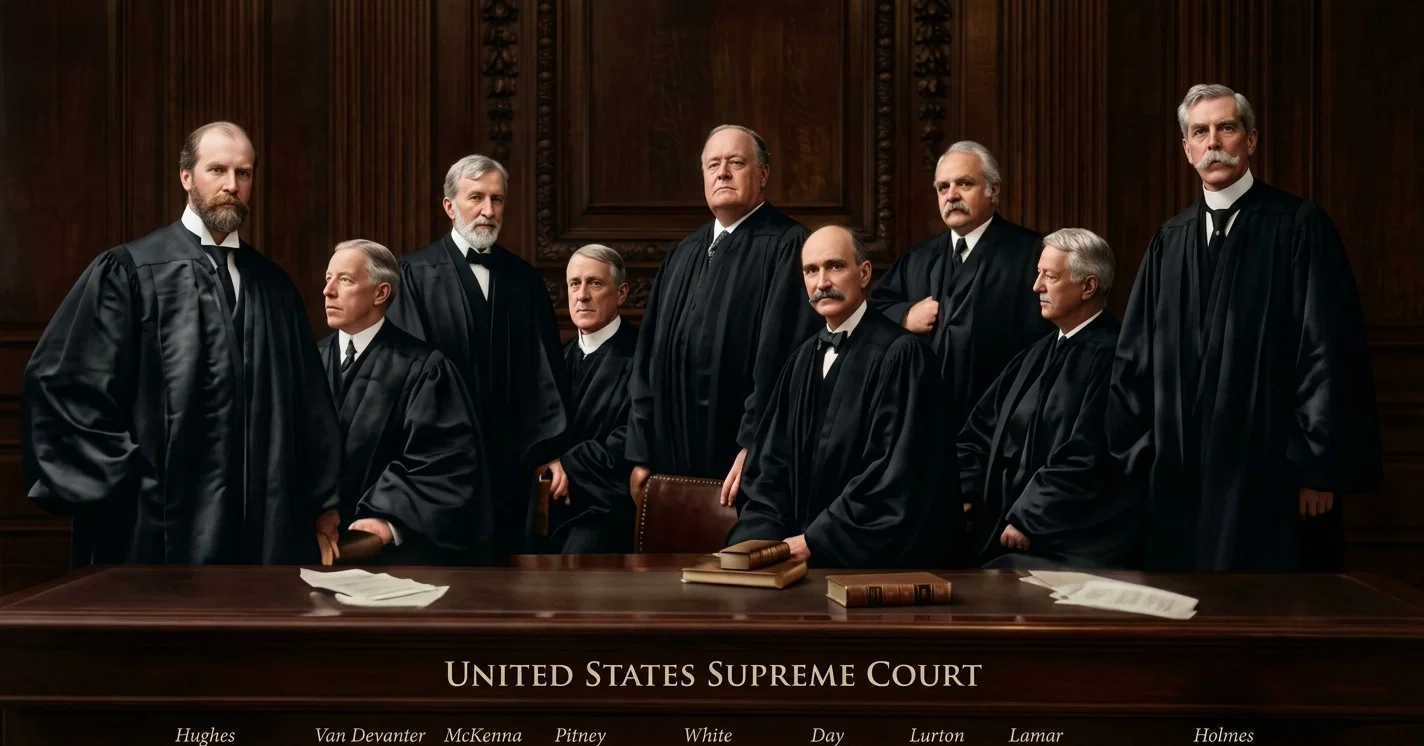
THE SUPREME COURT OF THE UNITED STATES
A REVIVAL of true godliness among us is the greatest and most urgent of all our needs. To seek this should be the first work at our camp-meetings. There must be earnest effort to obtain the blessing of the Lord, not because God is not willing to bestow His blessing upon us, but because we are unprepared to receive it. Our heavenly Father is more willing to give His Holy Spirit to them that ask Him, than are earthly parents to give good gifts to their children. But it is our work by confession humiliation, repentance, and earnest prayer, to fulfil the conditions upon which God has promised to grant us His blessing. A revival need be expected only in answer to prayer. While the people are so destitute of God’s Holy Spirit, they can not appreciate the preaching of the Word. But when the Spirit’s power touches their hearts, then the discourses given will not be without effect. Guided by the teachings of God’s Word, with the manifestations of His Spirit, in the exercise of sound discretion, those who attend our camp-meetings will gain a precious experience, and returning home will be prepared to exert a healthful influence in the churches.
The old standard-bearers knew what it was to wrestle with God in prayer and to enjoy the outpouring of His Spirit. But these are passing off the stage of action; and who are coming up to fill their places? How is it with the rising generation? are they converted to God? Are we awake to the work that is going on in the heavenly sanctuary, or are we waiting for some compelling power to come upon the church, before we shall arouse? Are we hoping to see the whole church revived? That time will never come.
There are persons in the church who are not converted, and who will not unite in earnest, prevailing prayer. We must enter upon the work individually. We must pray more, and talk less. Iniquity abounds, and the people must be taught not to be satisfied with the form of godliness without the spirit and power. If we are intent upon searching our own hearts, putting away our sins, and correcting our evil tendencies, our souls will not be lifted up unto vanity; we shall be distrustful of ourselves, having an abiding sense that our sufficiency is of God.
We have far more to fear from within than from without. The hindrances to strength and success are far greater from the church itself than from the world. Unbelievers have a right to expect that those who profess to be keeping the commandments of God and the faith of Jesus will do more than any other class to promote and honor, by their consistent lives, by their godly example and their active influence, the cause which they represent. But how often have the professed advocates of the truth proved the greatest obstacle to its advancement. The unbelief indulged, the doubts expressed, the darkness cherished, encourage the presence of evil angels, and open the way for the accomplishment of Satan’s devices.
The adversary of souls is not permitted to read the thoughts of men; but he is a keen observer, and he marks the words; he takes account of actions, and skilfully adapts his temptations to meet the cases of those who place themselves in his power. If we would labor to repress sinful thoughts and feelings, giving them no expression in words or actions, Satan would be defeated ; for he could not prepare his specious temptations to meet the case. But how often do professed Christians, by their lack of self-control, open the door to the adversary of souls!
There is great loss in every dissension. Personal friends of both parties take sides with their respective favorites, and thus the breach is widened. A house divided against itself can not stand. Criminations and recriminations are engendered and multiplied. Satan and his angels are actively at work to secure a harvest from seed thus sown. Worldlings look on and jeeringly exclaim, “Behold how these Christians hate one another. If this is religion, we do not want it.” And they look upon themselves and their irreligious characters with great satisfaction. Thus they are confirmed in their impenitence, and Satan exults at his success.
The great deceiver has prepared his wiles for every soul that is not braced for trial and guarded by constant prayer and living faith. As ministers, as Christians, we must work to take the stumbling-blocks out of the way. We must remove every obstacle. Let us confess and forsake every sin, that the way of the Lord may be prepared, that He may come into our assemblies and impart His rich grace. The world, the flesh, and the devil, must be overcome. We can not prepare the way by gaining the friendship of the world, which is enmity with God; but by His help we can break its seductive influence upon ourselves and upon others. We can not individually or as a body secure ourselves from the constant temptations of a relentless and determined foe; but in the strength of Jesus we can resist them.
From every member of the church a steady light may shine forth before the world, so that they shall not be led to inquire, What do these people more than others? There can be and must be a withdrawal from conformity to the world, a shunning of all appearance of evil, so that no occasion shall be given for gainsayers. We can not escape reproach; it will come; but we should be very careful that we are not reproached for our own sins or follies, but for Christ’s sake.
There is nothing that Satan fears so much as that the people of God shall clear the4way by removing every hindrance, so that the Lord can pour out His Spirit upon a languishing church and an impenitent congregation. If Satan had his way, there would never be another awakening, great or small, to the end of time. But we are not ignorant of his devices. It is possible to resist his power. When the way is prepared for the Spirit of God, the blessing will come. Satan can no more hinder a shower of blessing from descending upon God’s people than he can close the windows of heaven that rain can not come upon the earth. Wicked men and devils can not hinder the work of God or shut out His presence from the assemblies of His people if they will with subdued, contrite hearts, confess and put away their sins, and in faith claim His promises. Every temptation, every opposing influence, whether open or secret, may be successfully resisted, “not by might, nor by power, but by My Spirit, saith the Lord of Hosts.”
We are in the great Day of Atonement, when our sins are by confession and repentance to go beforehand to judgment. God does not now accept a tame, spiritless testimony from His ministers. Such a testimony would not be present truth. The message for this time must be meat in due season to feed the church of God. But Satan has been seeking gradually to rob this message of its power, that the people may not be prepared to stand in the day of the Lord.
What is our condition in this fearful and solemn time? Alas, what pride is prevailing in the church, what hypocrisy, what deception, what love of dress, frivolity, and amusement, what desire for the supremacy! All these sins have clouded the mind, so that eternal things have not been discerned. Shall we not search the Scriptures that we may know where we are in this world’s history? Shall we not become intelligent in regard to the work that is being accomplished for us at this time, and the position that we as sinners should occupy while this work of atonement is going forward? If we have any regard for our souls’ salvation, we must make a decided change. We must seek the Lord with true penitence; we must with deep contrition of soul confess our sins, that they may be blotted out.
A Study of the Sanctuary
By E. E. Andross
By E. E. Andross
I. The Gospel in Type
Illustrated in Abel and His Offering
WHEN announcing to the shepherds the birth of Jesus, “the angel of the Lord came upon them, and the glory of the Lord shone round about them: and they were sore afraid. And the angel said unto them, Fear not: for, behold, I bring you good tidings of great joy, which shall be to all people. For unto you is born this day in the city of David a Saviour, which is Christ the Lord.” Luke 2: 9-11.
This announcement contained the germ of the gospel which, in the life and death, the resurrection and intercessory work of the Saviour, developed into the fulness of the glorious gospel of the blessed God. The gospel is bound up in one word as revealed by the angel to Joseph when he said, “Thou shalt call His name JESUS: for He shall save His people from their sins.” Matt. 1: 21.
“The wages of sin is death.” “When lust hath conceived, it bringeth forth sin: and sin, when it is finished, bringeth forth death.” “Wherefore, as by one man sin entered into the world, and death by sin; and so death passed upon all men, for that all have sinned.” Rom. 6: 23; James 1: 15; Rom. 5: 12.
From the above scriptures it is clear that death came into the world by sin; that sin is the primal cause of death; and that death can not be removed except by the removal of sin. It was for this purpose that Christ came into the world. “Now once in the end of the world hath He appeared to put away sin by the sacrifice of Himself.” Heb. 9: 26.
“Whosoever committeth sin,” declares the apostle John, “transgresseth also the law: for sin is the transgression of the law.” 1 John 3: 4. The law which man transgressed being in its very nature eternal, immutable, unchangeable, demanded the life of the transgressor; it could not be violated with impunity; hence, except One equal with the law should take upon Himself the wages of sin, should Himself suffer death in the place of the transgressor, man must inevitably perish.
The Dawning Hope
When Adam and Eve awoke to the consciousness of the terrible nature of their sin, and to the awful consequences that must follow, before they left the Garden of Eden the clouds parted and a ray of light penetrated the gloom that had gathered about the souls of the once holy, happy pair. In the sentence pronounced upon their enemy, “I will put enmity between thee and the woman, and between thy seed and her Seed; it shall bruise thy head, and thou shalt bruise His heel,” they saw the promise of a Deliverer, and of the ultimate triumph of righteousness. God revealed to them what redemption would cost in the humiliation, the sufferings and death of His beloved Son. The entire ritual of the sacrificial system was “ordained by God to be to man a perpetual reminder and a penitential acknowledgment of his sin, and a profession of his faith in the promised Redeemer.” It was “intended to impress upon the fallen race the solemn truth that death is the result of sin, the transgression of the law of God.” From the gates of Paradise to Calvary, the types and shadows of the patriarchal and Jewish ages pointed forward to the one all-sufficient offering on the cross. Another has truly said, “Christ was the foundation of the Jewish economy. The whole system of types and symbols was a compacted prophecy of the gospel, a presentation in which were bound up the promises of redemption.”
“By faith Abel offered unto God a more excellent sacrifice than Cain, by which he obtained witness that he was righteous, God testifying of his gifts: and by it he being dead yet speaketh.” Heb. 11: 4. “Abel was a keeper of sheep,” and “brought of the firstlings of his flock and of the fat thereof. And the Lord had respect unto Abel and to his offering.” Abel realized that he had sinned, and that his sin stood between himself and God. The prophet Isaiah says: “Your iniquities have separated between you and your God, and your sins have hid His face from you, that He will not hear.” Isa. 59: 2. Abel heard the voice of God speaking unto him saying, “Look unto Me, and be ye saved, all the ends of the earth: for I am God, and there is none else.” Isa. 45: 22. In his dying victim, by faith he beheld “the Lamb of God, which taketh away the sin of the world.” The lamb which he brought was sinless, but over its head the sin of the transgressor was confessed, and the innocent lamb died in the place of the guilty sinner. In the blood flowing from the wound which his own hand had inflicted Abel saw a representation of the blood of the Son of God, which, when the fulness of time should come, would flow from wounds which his sins would help to inflict and which would actually cleanse his soul from its guilty stain.
While it is not possible that the blood of animals should take away sin, the sacrificial victims did serve as a most appropriate means of expressing the faith of the truly penitent in the new covenant to be sealed by the death of the Son of God.
The One Name
The truth uttered four thousand years after the fall, the fundamental truth enunciated by Peter was just as vital at the cherubim-guarded gate of Paradise, and all through the succeeding ages to the cross, as when before the high priest at Jerusalem, filled with the Holy Ghost, he declared, “Neither is there salvation in any other: for there is none other name under heaven given among men, whereby we must be saved.”
A type is a visible representation of a future truth. The sacrificial offerings of the old dispensation were designed to serve this very purpose, and through them the “holy men of old” looked forward to the cross of Calvary. Through the faith thus expressed they obtained witness that they were righteous, and we are compelled to acknowledge with profound admiration the mighty power of the all-conquering faith in the gospel manifested by that long line of ancient worthies of whom we have a brief record in Hebrews, chapter eleven.
“Wherefore seeing we also are compassed about with so great a cloud of witnesses, let us lay aside every weight, and the sin which doth so easily beset us, and let us run with patience the race that is set before us, looking unto Jesus the author and finisher of our faith; who for the joy that was set before Him endured the cross, despising the shame, and is set down at the right hand of the throne of God.” Heb. 12: 1, 2.
While the services of the Hebrew economy were beautiful and admirably adapted to the purpose for which they were given, we must not forget that they were the shadow while we have now reached the substance; the light which shone dimly then is shining with great brilliancy now. With the increased light comes increased responsibility. “In other ages” the gospel light “was not made known unto the sons of men, as it is now revealed unto His holy apostles and prophets by the Spirit.” Eph.53: 5. It is therefore unquestionably the duty of the church, and of each individual member, to gather up the rays of light reflected from the altars of the patriarchs, from the tabernacle reared at Sinai, and from the temple at Jerusalem, and with the glorious light shining directly from the cross to let the “righteousness thereof go forth as brightness, and the salvation thereof as a lamp that burneth.” “Arise, shine; for thy light is come, and the glory of the Lord is risen upon thee.” Isa. 62: 1; 60: 1.