Your ShelfYour Projects

Signs of the Times, Vol. 32, No. 14.

FUNDAMENTAL PRINCIPLES. No. 8.

Signs of the Times

Apr 4, 1906

Pacific Press Publishing Company · Mountain View, California · Apr 4, 1906

FUNDAMENTAL PRINCIPLES. No. 8.

From Virginia’s “ACT for Establishing Religious Freedom.” 1785.
To suffer the civil magistrate to intrude his powers into the field of opinion, and to restrain the profession or propagation of principles, on the supposition of their ill tendency, is a dangerous fallacy, which at once destroys all religious liberty, because he being of course judge of that tendency, will make his opinions the rule of judgment, and approve or condemn the sentiments of others only as they shall square with or differ from his own.
It is time enough for the rightful purposes of civil government, for its officers to interfere when principles break out into overt actions against peace and good order.
Truth is great, and will prevail if left to herself; she is the proper and sufficient antagonist to error, and has nothing to fear from the conflict, unless by human interposition disarmed of her natural weapons, free argument and debate, errors ceasing to be dangerous when it is permitted freely to contradict them.

The Bible

IN PLAIN ENGLISH
Many of the Bible's deepest and most significant passages are misunderstood or altogether missed by the average reader, because of the strange and unfamiliar words no longer used or known except to the Bible student and scholar.
It was to make the meaning of the Scriptures plain to all that the work of bringing out the AMERICAN STANDARD BIBLE was undertaken. For twenty-nine years the ablest and most devout scholars in America and England gave themselves to reverent, patient, and careful study of the original text, and how to convey its exact true meaning in the language of to-day.
The American Standard is not a new Bible, but the old Bible made plain; not a new story, but the Old Story more clearly and simply told.
It is not a departure from the inspired Word, but a drawing closer to it.
It is the standard for all the great religious papers of this country, and is used by Ministers, Theological Seminaries, Bible Training Schools, Y. M. C. A., Universities, Colleges, Religious Associations, and the various societies of every denomination, because it is the Bible in plain English, thus making the use of Bible Commentaries unnecessary.

CALIFORNIA'S BIG TREES

and

THE FAMOUS YO SEMITE VALLEY

are attractively described and beautifully pictured in that remarkable book
"In the Heart of the Sierras"
It is the most authentic and intensely interesting description of these wonders ever written. The book contains nearly 500 pages of text, with over 150 illustrations, 28 of which are full page artotypes. To read its pages is almost to see the trees of whose discovery it speaks and to hear the thunder of the Valley's waterfalls.
Prices Fine English cloth, - - - - - $2.75 Fine English cloth, gold edges, - - - 3.25 Full Sheep Library style - - - - 3.50

A Cheaper Edition

The Tourist Edition contains everything described above except the full page plates. It is bound in paper. Regular price 75c, reduced to 50c.
Pacific Press Publishing Company, Mountain View, Cal.

SOME SELECTED NUMBERS

Style R. Minion Type, text Bible, no references or concordance, size 4 x 6 inches, 12 maps, cloth, limp, round corners, red burnished edges . . . . . . . . . . . . . . . . . . . . . . . . . . . . . . . $0 50

LARGE TYPE BIBLES, 5¼ x 8 inches; references and maps, but no concordance

Style R 1. Cloth Boards, red edges . . . . . . . . . . . . . . . . . . . . . . . . . . . . . . . . . . . . . $1 00 " R 2. Egyptian Seal, limp, round corners, red under gold edges . . . . . . . . . . . . . . . . . 1 75 " R 5. Egyptian Seal, divinity circuit, leather lined to edge, round corners, red under gold edges . . 2 75

INDIA PAPER EDITION. Same as above, but only ¾ of an inch in thickness

Style R 7. Persian Levant, divinity circuit, leather lined to edge, silk sewed, round corners, red under gold edges . . . . . . . . . . . . . . . . . . . . . . . . . . . . . . . . . . . . . . . . . . . . . . . . . $5 00 " R 8. Levant, divinity circuit, calf lined to edge, silk sewed, round corners, red under gold edges . 7 00 " R 9. Sealskin, divinity circuit, calf lined to edge, silk sewed, round corners, red under gold edges . 9 00

VERY LARGE TYPE BIBLES, 6¾ x 8¾ inches. References and maps, but no concordance

Style R 10. Cloth Boards, red edges . . . . . . . . . . . . . . . . . . . . . . . . . . . . . . . . . . . . . $1 50 " R 11. Egyptian Seal, limp, round corners, red under gold edges . . . . . . . . . . . . . . . . . 2 50 " R 12. Egyptian Seal, divinity circuit, leather lined to edge, silk sewed, round corners, red under gold edges, India paper . . . . . . . . . . . . . . . . . . . . . . . . . . . . . . . . . . . . . . . . . . 6 00

TEACHERS' EDITION. Containing the concise Bible Dictionary and a new Concordance to the Revised Bible with Indexed Bible Atlas, Large Type, size 5¼ x 8 inches

Style R 13. Egyptian Seal, limp, round corners, red under gold edges . . . . . . . . . . . . . . . . $2 25 " R 14. Egyptian Seal, divinity circuit, round corners, red under gold edges . . . . . . . . . . . . 2 50

INDIA PAPER EDITION. The thinnest printing paper in the world

Style R 15. Egyptian Seal, divinity circuit, leather lined to edge, silk sewed, round corners, red under gold edges . . . . . . . . . . . . . . . . . . . . . . . . . . . . . . . . . . . . . . . . . . . . . . . . . $5 25 " R 16. Levant, divinity circuit, calf lined to edge, silk sewed, round corners, red under gold edges 8 50

PACIFIC PRESS PUBLISHING COMPANY

MOUNTAIN VIEW, CAL.

TO OUR PATRONS.

Please be careful to write all names of persons and places plainly.
Send money by Post-office Money Order, Express Order, or Bank Draft on New York, Chicago, or San Francisco.
Orders and Drafts should be made payable to the Pacific Press Publishing Co.
Paper money or silver should be sent in a registered letter.
Registered mail is safe. Unregistered mail is at the risk of the sender.
The address label on your paper will indicate the time to which your subscription is paid. In case of non-receipt of papers, or any other irregularity, please notify us immediately.
When subscriptions expire, no more papers are sent to the party except by special arrangement.
You are requested to watch the date on your label, and renew early, and save the loss of papers. We can not always furnish missing numbers.
When requesting change of address, be sure to give both old and new addresses.
Important.—If you order SIGNS, Our Little Friend, books, etc., at the same time, use a separate sheet of paper for each. If this request is complied with, it will materially assist in the prompt and accurate despatch of the business.
When writing to the editor, be sure to use a separate sheet of paper.

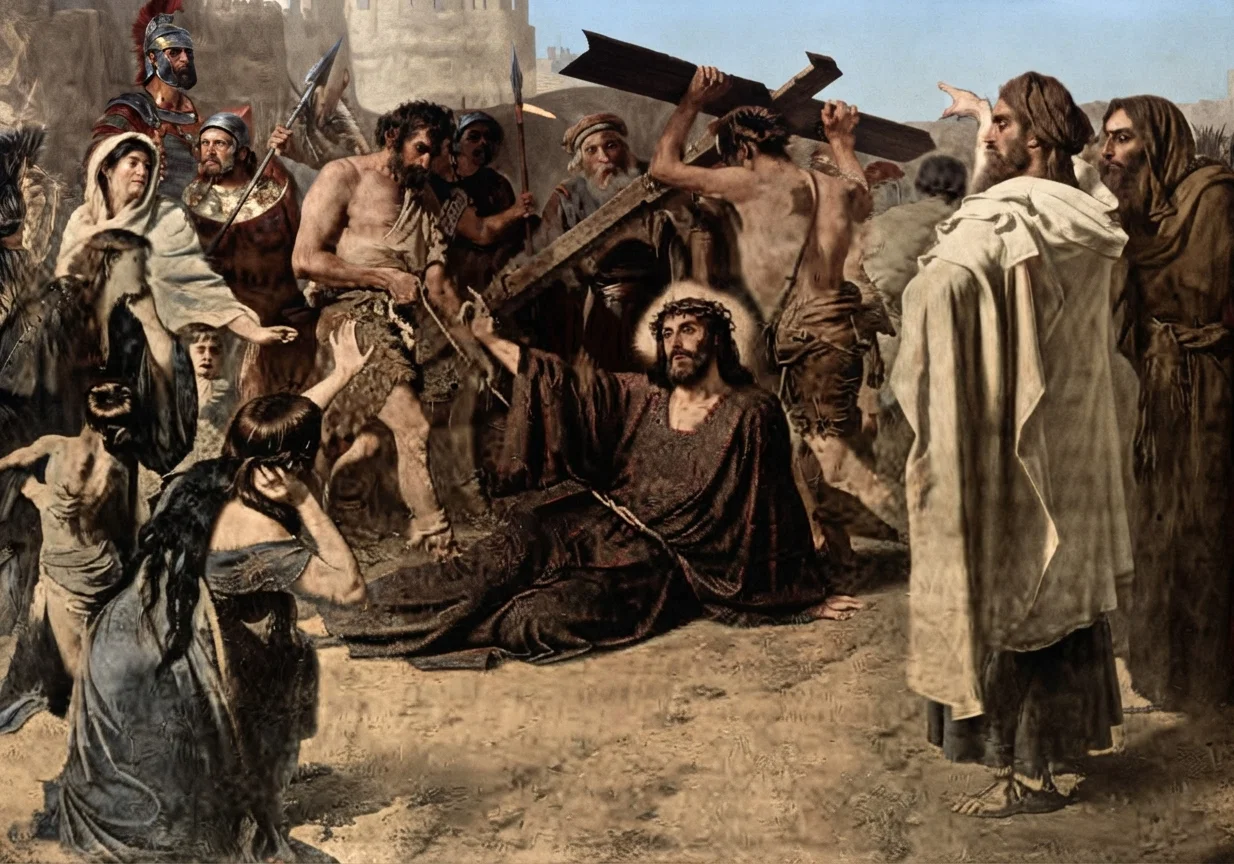
"THE JOURNEY TO THE CROSS."

MEN so designate the passing of our Lord from Pilate's judgment hall to the elevation of ground on which He was crucified, called Calvary. Just where it was, we do not know, the probable site seems just north of Jerusalem, through the Damascus gate, the distance of a half-mile or more from His place of trial. It matters little, tho men warred for hundreds of years to obtain possession.
AFTER Pilate's sentence, Jesus was again mocked, ridiculed, smitten, spat upon, by the mad rabble and soldiers, till they grew weary of mocking. Then they removed, in no tender manner, we may well believe, the gorgeous garments with which they had clothed Him, placed upon Him His own garments, and led Him out to be crucified. Upon His own shoulders was laid the rude, heavy cross. But human nature was too weak to bear it. For hours He had been passing through the greatest anguish of soul for His disciples, His people, and the world. That agony was intensified by the awful thought that He might fail. This He must not do; and the trial of Gethsemane with its bloody sweat bears mighty witness. Through all the remaining hours of the night after His arrest, He had been dragged from pillar to post; He had been thorn-crowned, struck, beaten, scourged, till human nature could bear no more; the cross was evidently too heavy, and the Man of sorrow and suffering sank under it. Meeting Simon of Cyrene coming from the country, the father of two young disciples, the soldiers impress him into service, and he bears the cross of Christ after his Master. Blessed is he that beareth His cross without compulsion.
ON THE WAY TO CALVARY.
THE pitiful condition of Jesus as He walked along the way touched the hearts of the mothers and sisters who beheld Him. They doubtless thought of how it would be if He were their own son or brother. They were touched by more than mere curiosity. A great many of the women who followed "bewailed and lamented Him." It need not be said that Jesus appreciated their sympathy because of His physical suffering. That is all they knew or saw. They did not see that the cause of His suffering would bring still greater trouble upon the nation. They saw His present sufferings, and they wept. Jesus looked beyond that. Turning unto them, He said: "Daughters of Jerusalem, weep not for Me, but weep for yourselves, and for your children. For behold, the days are coming, in which they shall say, Blessed are the barren, and the wombs that never bare, and the breasts that never gave suck. Then shall they begin to say to the mountains, Fall on us; and to the hills, Cover us. For if they do these things in the green tree, what shall be done in the dry?"
THEY did not know that the deeds then being done would come back upon them a hundredfold. The leaders, and the people led by their leaders, did not know that the wind they were sowing would be reaped by them in a whirlwind. They did not know that in leading to His death the Anointed of God, who came to take away their sins, they were allying themselves with all the sins of the past, and were joining hands with the primal revolter who sought to overthrow the throne of God. If they would weep for themselves and Jerusalem now, for the awful sin of striking at thevery throne of God in the slaying of His Messenger, they would save the weeping by and by.
THERE is another thought in this last instruction of our Lord. Over and over in the Scriptures with which the Jews were familiar is God called the Rock, the Refuge of His people, the Shelter in the time of storm, the Shade in the weary land. It was their privilege to hide in that Rock; but they refused. They would not see the refuge, the shelter, the shade, the hiding-place. They would not be cleansed by the blood of the Lamb. But the time was coming when they would say to the material, insensate crags and rocks, "Fall on us," "cover us," "hide us from the face of Him that sitteth on the throne, and from the wrath of the Lamb; for the great day of their wrath is come; and who is able to stand?" Rev. 6:16, 17.
THESE things in which Jesus was the central figure, were a judgment upon sin. The Innocent suffered the punishment of the guilty, the Righteous One for the sinner. The time would come when every incorrigible sinner must bear his own sin. If this awful penalty of death so falls in awful judgment upon the Innocent, upon the green, fruitful tree, bearing only the sins of others, what will that punishment be when it falls upon the incorrigibly wicked at the destruction of Jerusalem, or at the great antitype of that destruction, the judgment of the last day? How awful, how solemn, the warning!
THE great journey of Christ to the cross did not begin at the Roman Prætorium. It began when He gave Himself for a lost and sin-marred universe, the Lamb slain from the foundation of the world. Every step from that time till He was nailed to the cross of Calvary was a step in "the journey to the cross." From the time He entered His earthly ministry, He could see the cross on before, and every step was a pace nearer the consummation of His infinite sacrifice at Golgotha. And when He died and rose again, His people took up the journey with the cross and to the cross of suffering for the sake of others, to fill up what is behind of the sufferings of Christ. Well has Lowell sung: "We see dimly in the present what is small and what is great, Slow of faith, how weak an arm may turn the iron helm of fate; But the soul is still oracular, amid the market's din, List the ominous stern whisper from the Delphic cave within— 'They enslave their children's children who make compromise with sin.' 'By the light of burning heretics, Christ's bleeding feet I track, Toiling up new Calvarys ever with the cross that turns not back, And these mounts of anguish number how each generation learned; One new word of that grand Credo which in prophet hearts hath burned, Since the first man stood God-conquered, with his face to heaven upturned, 'For humanity sweeps onward; where to-day the prophet stands, On the morrow crouches Judas with the silver in his hands; Far in front the cross stands ready, and the crackling fagots burn, While the hooting mob of yesterday in silent awe return To glean up the scattered ashes into history's golden urn." "Count me o'er earth's chosen heroes,—they were souls who stood alone, While the men they agonized for hurled the contumelious stone, Stood serene, and down the future saw the golden beam incline To the side of perfect justice, mastered by a faith divine, By one man's plain truth to manhood, and to God's supreme design."

BOLDNESS IN THE FAITH.

IN writing to the church at Rome, Paul declared, "I am not ashamed of the Gospel of Christ; for it is the power of God unto salvation to every one that believeth." As a matter of fact no man is ashamed of power; that is just what every one most desires—power to do the things he would like to have accomplished. Then why should any one be ashamed of that which puts him in living touch with the greatest of all power—the power of God?
Paul had realized to his great sorrow that he was bound to a body of death (Rom. 7:24), and had cried for deliverance from his "wretched" condition. Having found deliverance through Jesus Christ, why should he be ashamed of that which had been the means of his salvation? or why should he be ashamed to proclaim it to others who are under condemnation of death?
When we consider what Paul had attained through the power of the Gospel, it seems not surprising, but the height of reason and logic, that he should determine "not to know anything . . . save Jesus Christ, and Him crucified." 1 Cor. 2:2. He had experienced a wonderful manifestation of the power and mercy of God through the Gospel of Christ.
After leading a most cruel crusade against the disciples of Christ in Jerusalem, Paul was journeying to Damascus for the purpose of continuing his work of persecution. As he neared that city, the One whose children were being hunted by the destroyer suddenly appeared in the heavens. Just one flash of the power and glory of His majesty was sufficient to lay the proud persecutor prostrate upon the ground. One word from the mouth of the hated One, and one breath of His Spirit upon the hard heart of the tyrant, was sufficient to transform him into a humble suppliant. "Trembling and astonished," the self-righteous Pharisee inquired of the once humble Nazarene, "Lord, what wilt Thou have me to do?"
Then follows the honor that fell to a humble disciple in Damascus. Jesus says to Paul, "Arise, and go into the city, and it shall be told thee what thou must do." So a disciple named Ananias, one of those whose life was sought by the persecutor, was the one chosen to instruct his would-be executioner as to what he must do to be saved. Such is the power of God unto salvation. It is a power mingled with love and mercy; a power that is ever used with the primary purpose of saving rather than of destroying. The power that creates is also the power that saves. The Creator of men became the Saviour of men when they fell under condemnation of death through arraying themselves against His law. This Saviour humbled Himself to the condition of sinful men, in order that He might exert His wonderful power in the exercise of mercy toward those who would accept it by believing on Him.
The merciful and forgiving Spirit, combined with the power of God, is also manifest in the Lord's immediately taking the penitent one into His confidence, and making him a co-worker in the greatest cause in the universe. When Ananias hesitated to visit Paul, knowing of his purpose in coming to that city, the Lord said to him, "Go thy way; for he is a chosen vessel unto Me, to bear My name before the Gentiles, and kings, and the children of Israel."
Thus Paul, who had sought and secured authority from the Jewish high priest to destroy men's lives, became imbued, through the Gospel of Christ, with power from on high to save men. He had not been ashamed of his former authority and work, then why should he be ashamed of the higher calling and greater power? And his privilege of being vitally connected with "the power of God unto salvation" is open to "every one that believeth." Why, therefore, should any one be ashamed of such an attainment?
The trouble in this connection is not that men are ashamed of the power, but they are ashamed of the Gospel, and of the humiliating process through which the power is attained. They are ashamed to confess sin, and ashamed to come out from the world and stand with the "little flock." The worst part of this trouble is, many even of those who have made the profession of faith are ashamed of some of the requirements of the Gospel, and seek compromise with the ways of the world. This sad condition comes of a lack of faith in, and appreciation of, the power of God.
But right here is a vital point. The Lord puts us squarely to the test on this issue: "Whosoever therefore shall be ashamed of Me and of My words in this adulterous and sinful generation; of him also shall the Son of Man be ashamed, when He cometh in the glory of His Father with the holy angels." How much better, then, to stand out here in the strength of the power of God, to be found in the keeping of "the commandments of God, and the faith of Jesus," than to be subjected to the scorn of Him who shall gather the jewels for the everlasting kingdom.
Shall we not rather say also with the apostle, that "neither death, nor life, nor angels, nor principalities, nor powers, nor things present, nor things to come, nor height, nor depth, nor any other creature, shall be able to separate us from the love of God, which is in Christ Jesus our Lord?"

ATTRIBUTES OF GOD'S REMNANTS.

WHEN sin is in a human soul, that soul is bound to Satan by just so much. When God translates an individual, He translates no sin along with him; He translates nothing but that which is His own. The individual who is translated from this earth at the second coming of Christ, will, through the power of God, have squared and trimmed his life in accordance with "the pattern shown in the mount;" that is, the law of God, the expression of the character of God. That pattern, given to man on Sinai, has never been revised, because the character of God has never changed. He is "the same yesterday, and to-day, and forever."Satan owns man by just so much as there is sin in man. Sin in man is the product of Satan's campaign against God. Righteousness in man is the product of the eternal purpose of God. "Let not sin therefore reign in your mortal bodies," is the admonition of the Word; for the reign of sin is the reign of Satan. Every day of our life we are choosing our master in the deeds we do, the words we speak, and the thoughts we think.
When sin is entirely cleansed from our souls, God can place His hand upon us and say, This is all Mine; come up to be with Me. That is no ordinary experience; and the trials borne by such souls are no ordinary trials. God found such an one in Enoch, the seventh from Adam. He found another such one in Elijah the Tishbite. He will find many in the very closing days of this dispensation when the fiery trials of Satan's focused wrath have proved unable to overthrow God's remnant in the earth.
It is necessary that we measure our own lives by God's great standard of righteousness. Is there enmity in our soul? God disowns that attribute. He will not take into His kingdom that which is the antithesis of His own character; for He is love. He will not take us to His eternal abode bearing that barnacle of iniquity, to plant again the seeds of another rebellion.
Is there covetousness there, a spirit of taking that which is not our own? That, too, is unlike God. That brought disruption in heaven, and cast Satan and his angels out of their former abode, to enter again no more.
Is there the lust of the eye and the pride of life? They are foreign to God's purpose; they are weeds and tares that will choke out of your soul the very shoots of eternal life. God can not lay His hand on you and say, This is all Mine, while such thorns and thistles are cultivated and thriving in your heart.
Is there envy and jealousy in your heart? Satan was jealous of God,—envied Him His throne,—and what God could not permit in Lucifer, the Light Bearer, He can not permit in you. If God could tolerate those things in you, He would not have expelled His own covering cherub for holding them.
When Christ was ready to be offered, He said, "The prince of this world cometh, and hath nothing in Me." If Satan could have found any of his attributes in Christ, the work of Christ in our behalf would have been a failure. There is a deep significance in the expression, "hath nothing in Me." Christ would have been Satan's in just so far as He possessed the attributes of the evil one; and had Jesus Christ possessed a single evil attribute, God could not have claimed Him as His wholly. Christ was free from all such evil contaminations, all such evil ownership.
Why, then, was He not translated without seeing death, even as Enoch and Elijah?—Because He had another work to do, not for Himself. All that was done in His life. There can be no reason given for the death of Jesus Christ, save the reason that He Himself gave—"a ransom for many." He died to free us from the mortgage that eternal death held upon us; died that He might have a right to unlock the tombs of all who believe on Him and accept the release purchased by His blood.
Of those who are redeemed and permitted to "follow the Lamb whithersoever He goeth," this is said: "In their mouth was found no lie; they are without blemish." Rev. 14:4, 5. This also is said of them: "Here is the patience of the saints, they that keep the commandments of God, and the faith of Jesus." Rev. 14:12. When God points to a people and declares that they "keep the commandments of God," it means something. It means more than a mere formal obedience. It means a life separate from sin; for He claims that company as His, and He can not and will not claim ownership of sin.
If we expect to dwell with God in that kingdom where righteousness rules and sin has no abode, we must begin now, by God's help, if we have not already, to pluck up out of our lives, one by one, the roots and shoots of sin, and cast them to-day into the burnings of God, lest to-morrow they should carry us with them into the burnings that will consume them and us. S.

Question Corner

1794.—Destroying Soul and Body. Matt. 10:28.

Please explain Matt. 10:28.
The text reads, "Fear not them which kill the body, but are not able to kill the soul; but rather fear Him which is able to destroy both soul and body in hell." The text means just what it says. All that man is able to do is to kill the body; the soul, the life, is still with God; and that is all the word "soul" here means, "life." Jesus Christ has power over death and the grave, "and all that are in the grave shall hear His voice, and shall come forth." But if at that time we are not His, we shall come forth to condemnation, and that means the destruction of both soul and body. If we are found His, we shall have His life through all eternity.

1795.—Is Saturday the Seventh Day of the Week?

How can you give Bible proof that Saturday is the seventh day of the week, or, in other words, do you know from the Bible alone that Saturday is the seventh day, any more than we know that Sunday is the seventh day?
Such questions as these are to a certain extent catch questions. It is very easy to prove from the Bible as to which the seventh day is, but we must depend on authentic history and other corroborative evidences this side of the Bible. The Scripture canon closes with the close of the first century. Since that time we must depend on other things. This question has been answered in the Signs often before, but we give, in brief, these facts:
1. God in the beginning set apart the seventh day. Gen. 2:2, 3. Certainly men knew then what day the seventh day was.
2. When He called His people out of Egypt, He marked the seventh day by a threefold miracle by the fall of the manna for forty years. Exodus 16. Men certainly knew then which day was the seventh day and the Sabbath.
3. He commanded that same seventh day from Mount Sinai. Ex. 20:8-11.
4. From that time to the time of Christ, there is no candid Christian scholar but what freely admits that the Jews preserved the knowledge of the seventh-day Sabbath, and those faithful to God kept it.
5. Jesus Himself observed the Sabbath (Luke 4:16), and at the time of His death the holy women who had been with Him in His ministry also observed it "according to the commandment." Luke 23:56. That was the seventh day, for the very next was the first day of the week, and that Sabbath was the Sabbath "according to the commandment," and the commandment taught the seventh day. The first day of the week was the day after the Sabbath.
6. The Jews, scattered all over the world, have preserved the knowledge of that same seventh day to the present time. There has been no dispute among them in regard to the matter.
7. As apostasy came in, Sunday and Sabbath became sister days in the church. They are so recognized in Abyssinian churches to-day.
8. All histories and all the various churches recognize that Sunday is the first day of the week, and many of them keep it in honor of Christ's resurrection on that day.
Now all these things show just as clearly as any evidence can show that we have the same seventh day of the week in order from the Creation to the present time. Do you not think so?

1796.—Keeping Business Open on Sunday.

If a man is arrested for keeping his business open on Sunday, should he keep his store open after his arrest on that day, or should he close it according to the law of the land?
This is a question almost wholly of conscience, and is for the proprietor himself to decide. It is to be hoped that he has a principle in the thing that is not moved by mere arrest or non-arrest, or from any sort of defiance to legal authority. Under God, if he has kept the Sabbath day, he certainly has a right to work six days. If he does this quietly and unobtrusively and his family is needing his income, certainly we do not see why he should not go on keeping his store open; but let him be careful and his advisers be careful that it is not done in any way to spite his enemies or to defy the authority, or in any way bring reproach upon the cause of Christ. God is willing to lead and guide in all these things. Seek Him for guidance to do just right.

1797.—Three Days and Three Nights. Matt. 12:40.

"As Jonah was three days and three nights in the whale's belly; so shall the Son of Man be three days and three nights in the heart of the earth." We are told in the Bible that Christ was buried Friday evening, and early Sunday morning the women came to the sepulcher to anoint Him, and they found that He was risen; so it seems that He could have been in the grave but two nights. Please explain.
1. The term "night and day" as used in the Bible simply means day, because the day was composed of darkness and light, so that a part of a day is counted as a whole day.
2. Matt. 12:40 does not even intimate that Jonah was absolutely seventy-two hours in the sea monster, but he was in the monster for a certain period called "three days and three nights," which might have been simply a part of two days and one whole day. This would be, according to the language of the Scripture's reckoning, three days and three nights.
3. Matt. 12:40 does not say that Jesus was to be in the grave during that time. It is a purely arbitrary interpretation which says that "the heart of the earth" means the grave. Could we not just as truly say that it means the very powers of the earth which were at that time in the hands of the Romans? In speaking of the three days, Jesus invariably associated with His crucifixion and burial the betrayal. Take, for instance, Matt. 16:21 in which suffering the many things of earth may be included in the three days implied in the passage. (Mark 8:31, and other passages.) We also learn that at the very close of the third day, in which Jesus rose on its morning, His disciples themselves say, "It is now the third day since these things came to pass." Luke 24:21. To the mind of the writer, the third day began when Jesus was delivered into the power of the authorities. Until that time came, His work was not done. No man laid hands on Him; but when that time came He said, "When I was daily with you in the temple, ye stretched not forth your hands against Me, but this is your hour, and the power of darkness." That was on what would be Thursday night, or in the Bible reckoning, sixth-day evening. There would be all of the sixth day, the seventh day, and a part of the first day, that He would be in the hands of the powers of darkness, or in the heart of the earth. At the end of that time God's glorious power was demonstrated in His resurrection.
Are the sin against the Holy Spirit and "the sin unto death" one and the same?
The words would seem to indicate that they are both unforgivable sins. Of course in that case they would be the same. They are unforgivable because they are unrepentable. The Spirit of God is the means by which the Lord touches hearts and conscience, but he who persistently refuses to listen to that Spirit finally becomes so hardened that that Spirit can not touch his heart and can not make it repent. Certainly it then must be the "sin unto death."

SUNDAY LEGISLATION IN MASSACHUSETTS.

ACCORDING to a report in the Boston Globe, the enforcement of Sunday observance by law, and incidentally the movement to put religious education in the schools and to form a federation of the Protestant churches, were all vehemently denounced as perils to the liberty of the republic at a “Religious Liberty Day” meeting of Seventh-day Adventists in Lorimer Hall, Boston, on February 24. The purpose of the meeting was to protest against the Sunday bill before the Massachusetts Legislature, a hearing upon which had just been given by the Legislative Committee on Probate and Chancery. The speakers were Rev. L. S. Wheeler, pastor of the church, and Prof. P. T. Magan, formerly of the Battle Creek (Mich.) College. The Globe quoted Mr. Wheeler as follows:
This country was the first in the world to build its government on the foundations laid by Christ, of civil and religious liberty, with the complete separation of church and state. Jesus Christ proclaimed this principle when He said to the people, “Render unto Cæsar the things that are Cæsar’s, and unto God the things that are God’s.”
In this government from the very beginning, the church and state have been separate; but within recent years there has grown up a party seeking to unite church and state. The effort has been made to enforce religious teaching in the public schools. The effort has thus far been unsuccessful, but if it succeed, it means that some religion, whether Catholic or Protestant, Jewish or Mohammedan, must be taught by the force of the government. Religious instruction can not be enforced without prosecutions and persecutions.
Another great effort which has come from this recent movement has been one to have the observance of Sunday enforced by law. Here in New England we have the Sabbath Protective League, whose work is to lobby the legislators of this state and to worry the members of Congress into the passage of laws which will put the power of the state back of religious observances.
The government has no more right to enforce Sabbath observance than it has to enforce the observance of baptism, or the Lord’s Supper, or any other religious institution. The Lord is Lord of the Sabbath, and He does not ask that His Gospel shall have the protection of human governments.
I believe God has raised us up to give warning to the people of the danger which confronts their liberties in the passage of these religious laws. The people are sleeping when they ought to be awake to the danger, and while they are sleeping, the enemies of liberty are planning to drag them back into the bondage of domination by the church.
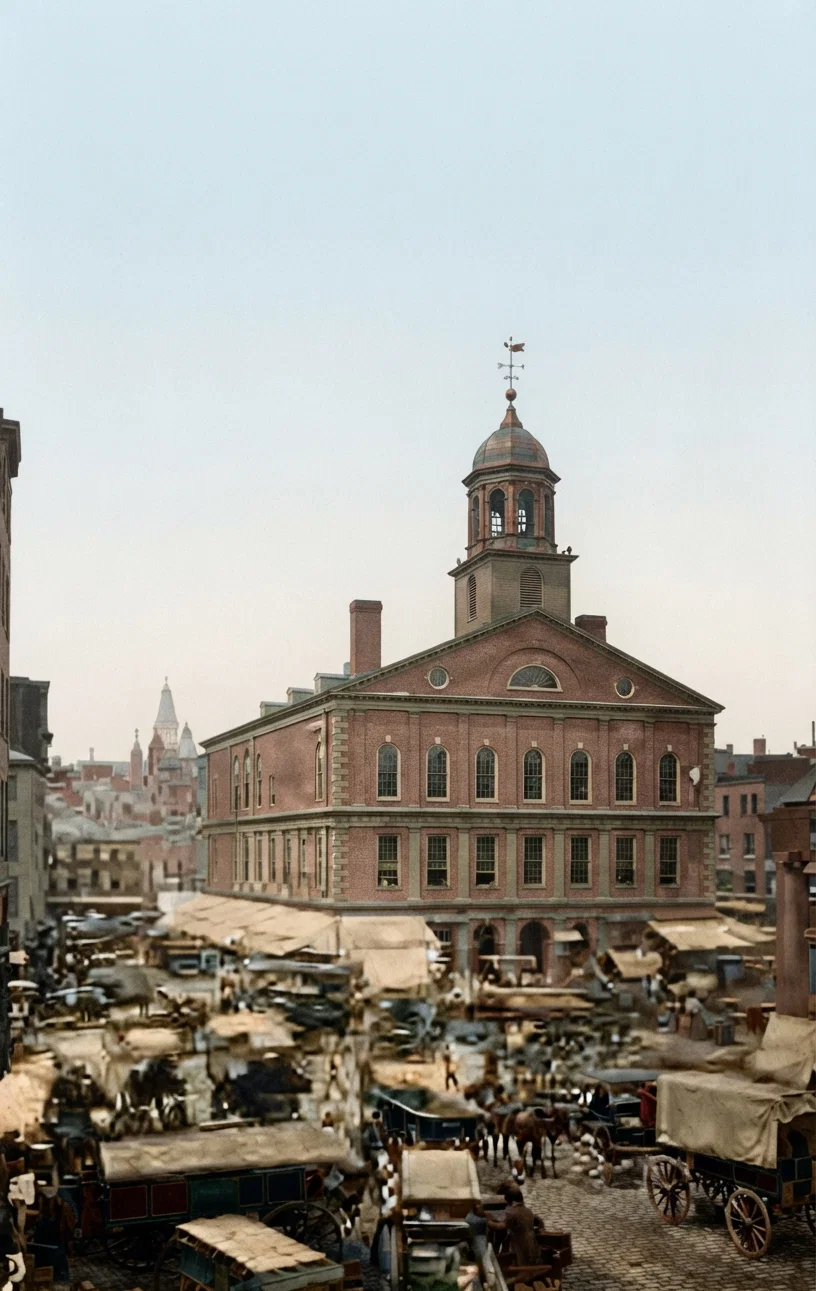
Faneuil Hall, Cradle of Liberty, Boston, Mass.
Professor Magan was quoted as follows:
If the people could realize what these subtle movements mean to their future liberties, they would not tolerate them for one moment. Passage of Sunday-observance laws will bring into this state what has been experienced in other states, such as the prosecution of a poor woman for buying five cents’ worth of ice to cool the feverish brow of her dying child. The passage of Sunday legislation will bring about the destruction of the church which attempts it. The moment you get a confederation of churches in this country, that moment Revelation is realized in the appearance of the false prophet of the West. Out of a movement to force the people by law to an observance of religious rites, will come scenes more terrible than the world has ever yet seen, and in comparison with which the events of the French Revolution are insignificant.
Events in this world are moving rapidly toward that day of judgment foretold in Revelation. Today hardly a merchant can buy or sell his goods without the consent of the trusts. At the same time on every hand come the mutterings against them, come the wrath and the fury of public investigations, and the culmination of all those terrible things which will mark the closing days of this world. For the sake of the truth that has been given us, let us turn to with all our might, and proclaim to every one the truth, and the way to liberty and life.
Continue reading: THE LOW-WATER MARK