Your ShelfYour Projects

Review and Herald, Vol. 90, No. 29.

A Vision of the Evening

Review and Herald

Jul 17, 1913

Review and Herald Publishing Association · Takoma Park Station, Washington, D. C. · Jul 17, 1913

A Vision of the Evening

On summer eve, when nature sinks to rest And all the tumult of the day is done; When crimson hues are darkening in the west And darkness follows the retiring sun, Then, fond as mother's prayer for those she loves, Pure as the hearts of children in their play, Our hearts ascend to that dear home above, That blessed land of everlasting day.
Dear is the promise of that heavenly home In the eternal gardens of the sky; Sweet is the land where death can never come, And quivering lips ne'er breathe a last good-by,— That home where fadeless flowers nod and swing, That Summer-land where crystal waters play, Rich with the verdure of a thousand springs, Sweet with the fragrance of eternal day.
Mid gathering gloom our hearts ascend above To that dear land of joy and light and song, Where glad responses meet the lips of love, And "white robes" clothe the everlasting throng: Where toil, and pain, and sorrow are no more, But every wrong's forgotten and forgiven. There, happy on the everlasting shore, We'll breathe the air, and sing the songs, of heaven.
Moline, Ill.
Don't Forget to Take Subscriptions!

"What to Do First," and "Digestive Disorders" Number

The Magazine That Tells You How to PREVENT as Well as CURE Disease
June Edition Sold by May 28—Second Large Edition of July Number (10,000) Fast Disappearing!

SOME AUGUST FEATURES

  • Beautiful Cover Design (3 Colors)
  • What to Do First for Burns, Drowning, etc.
  • Digestive Disorders—How to Remedy Them
  • Sunlight and the Body
  • What is the "Staff of Life"?
  • Is Alcohol Never a Food?
  • What to Do for Hay Fever
  • Friedmann Tuberculosis Treatment
  • How to Make Wholesome Breads
  • How to Loosen a Cough
  • "U. S. Inspected and Passed"
  • Questions and Answers, etc.
  • Human Carriers of Disease
EARN A SCHOLARSHIP: Sell anywhere from 1,700 to 3,000 copies to earn a year's scholarship in the Academy or College you have picked out. Sell half the number for a half year's scholarship. Three to eight weeks of vigorous effort will suffice! All aboard!
Make All Arrangements for Territory and Supplies With Our Agency Nearest You. See List in Magazine
10 cents in stamps will bring you a sample copy
Send $1.00 for 20 copies; $2.00 for 50; $4.00 for 100; $8.00 for 200. Fifty or more, 4 cents each, post-paid.

ORDER THROUGH OUR NEAREST AGENCY

(If you do not know the address of our Agency, ask "Life and Health," Washington, D. C.)
'Don't Forget to Take Subscriptions! PRICES, POST-PAID Yearly subscription - - - $1.00 Six months - - - .50 (Subscriptions for less than six months not accepted) Three years (or 3 subs. 1 year) - - - 2.00 Five years (or 5 subs. 1 year) - - - 3.00 Five copies, one year, to one or more addresses 3.00 NO EXTRA CHARGE ON FOREIGN SUBSCRIPTIONS Ask Agency for Guaranteed Subscription Receipt Book.

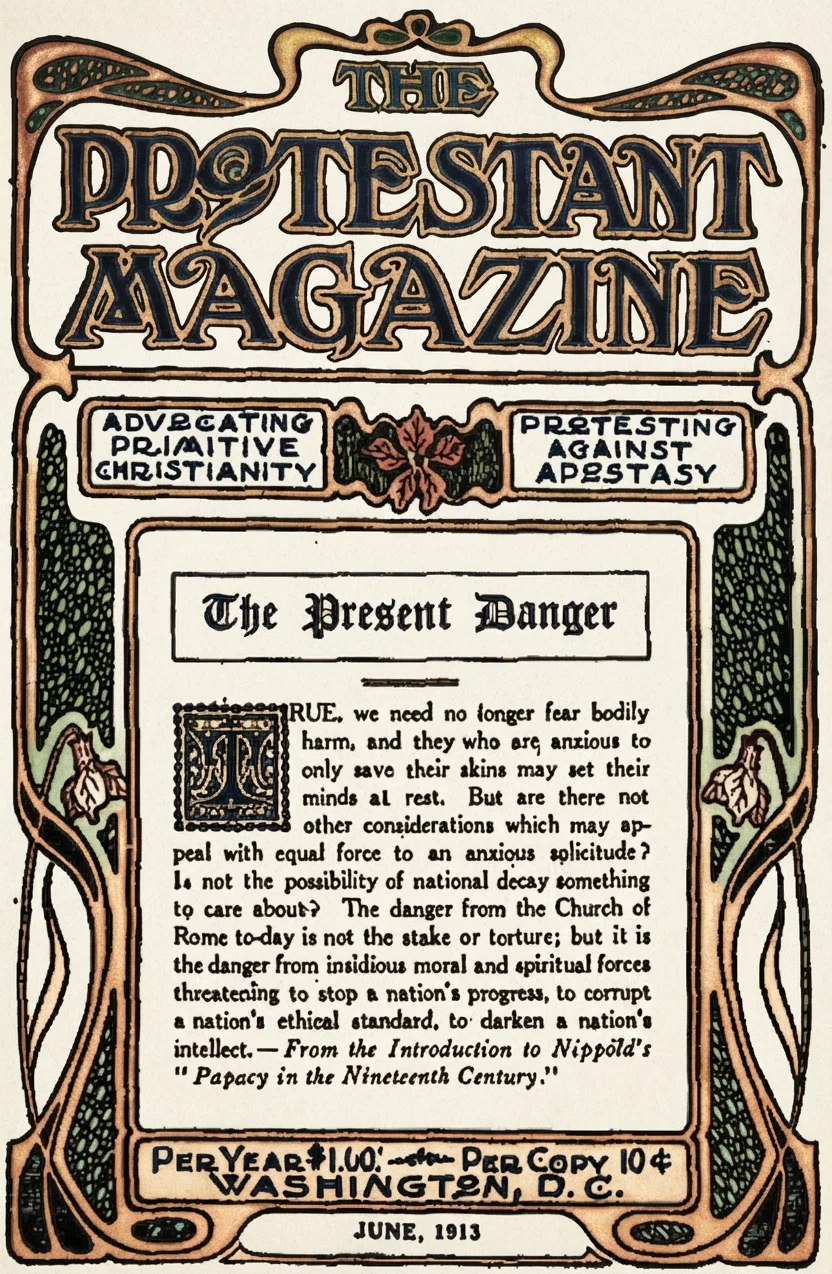
The Present Danger

TRUE, we need no longer fear bodily harm, and they who are anxious to only save their skins may set their minds at rest. But are there not other considerations which may appeal with equal force to an anxious solicitude? Is not the possibility of national decay something to care about? The danger from the Church of Rome to-day is not the stake or torture; but it is the danger from insidious moral and spiritual forces threatening to stop a nation's progress, to corrupt a nation's ethical standard, to darken a nation's intellect.—From the Introduction to Nippold's "Papacy in the Nineteenth Century."
Ten two-cent stamps will pay for one set.
If desired, we can start a few more subscriptions with the March number containing Part I of "A Convent Tragedy."
Yearly Subscription, $1.00
Six Months, 50 Cents

ORDER THROUGH OUR NEAREST AGENCY

(If you do not know the address of our Agency, ask "Protestant Magazine," Washington, D. C.)

The Heart of Our Message In These Two Numbers!

FOR $1.00 WE WILL MAIL THEM TO TEN OF YOUR CATHOLIC FRIENDS
Note how the BIBLE PICTURES of the PAPACY appear in Rome's own WRITINGS.
See articles: "The Priest as God," "Creator of His Creator," "The Mass, Meat, and Murder," "A Convent Tragedy," "Rome Versus Free Press," etc.
Or, for 50 cents we will mail these two numbers to five different addresses—yours and four others, if desired.
No minister, teacher, Bible worker, or student of prophecy should be without these latest documents confirming the Bible prophecies concerning Rome!

THE FRUIT OF THE REFORMATION

The open Bible and the bold return to the Word of God and the life of Christ, direct communion with him and justification by faith, were the fruit of the Reformation, the direct fruit of that Protestantism which is not negative, but so affirmative and positive that it revolutionized Christendom, linked itself forever with human freedom, and once more reestablished for humanity the truth as it is revealed in Christ Jesus.—Thomas Nelson Page, in the Churchman, April 19, 1913.

Defying God

MRS. E. G. WHITE
PLACED on the throne by the ten tribes who had rebelled against the house of David, Jeroboam was in a position to do much toward bringing about a spiritual reformation in his kingdom. Had he used his influence in strengthening the confidence of the people in the God of heaven as their Supreme Ruler, he might have encouraged multitudes to seek after righteousness. Under the rulership of Solomon, he had revealed discretion, aptitude, and sound judgment; and the knowledge of spiritual things that he had gained during years of faithful service he could have used to bring untold blessings to those who had chosen him as their leader. But instead of advancing in the way of righteousness, he failed to make God his trust. Of him it is written:—
"Jeroboam said in his heart, Now shall the kingdom return to the house of David: if this people go up to do sacrifice in the house of the Lord at Jerusalem, then shall the heart of this people turn again unto their lord, even unto Rehoboam king of Judah, and they shall kill me, and go again to Rehoboam king of Judah.
"Whereupon the king took counsel, and made two calves of gold, and said unto them, It is too much for you to go up to Jerusalem: behold thy gods, O Israel, which brought thee up out of the land of Egypt. And he set the one in Bethel, and the other put he in Dan."
"And he made an house of high places, and made priests of the lowest of the people, which were not of the sons of Levi." The Levites generally refused to serve; and the king was compelled to elevate to the priesthood of his false religion men from "the lowest of the people." Many who remained true to God, fled to Jerusalem, where they might worship in harmony with the divine requirements.
"Jeroboam ordained a feast in the eighth month, on the fifteenth day of the month, like unto the feast that is in Judah, and he offered upon the altar. So did he in Bethel, sacrificing unto the calves that he had made: and he placed in Bethel the priests of the high places which he had made."
The king's bold defiance of God and his worship was not allowed to pass unrebuked. Even while Jeroboam was officiating at the dedication of the altar, and burning incense, there appeared before him a "man of God" from the kingdom of Judah, sent to denounce him for presuming to introduce new forms of worship. The prophet "cried against the altar, . . . and said, O altar, altar, thus saith the Lord; Behold, a child shall be born unto the house of David, Josiah by name; and upon thee shall he offer the priests of the high places that burn incense upon thee, and men's bones shall be burnt upon thee.
"And he gave a sign the same day, saying, This is the sign which the Lord hath spoken; Behold, the altar shall be rent, and the ashes that are upon it shall be poured out." And immediately the altar "was rent, and the ashes poured out from the altar, according to the sign which the man of God had given by the word of the Lord."
On seeing this, Jeroboam was filled with a spirit of defiance against God, and he attempted to restrain the one who had delivered the message. In wrath "he put forth his hand from the altar," and cried out, "Lay hold on him. And his hand, which he put forth against him, dried up, so that he could not pull it in again to him."
Terror-stricken, the king appealed to the prophet to intercede with God in his behalf. "Entreat now the face of the Lord thy God," he pleaded, "and pray for me, that my hand may be restored me again. And the man of God besought the Lord, and the king's hand was restored him again, and became as it was before."
Vain had been Jeroboam's effort to invest with solemnity the dedication of a strange altar, respect for which would have led to disrespect for the worship of Jehovah in the temple at Jerusalem. By the message of the prophet, the king of Israel should have been led to repentance. His wicked purpose to lead the hearts of the people away from the true worship of God, should have been renounced. But angered by the interruption, he hardened his heart, and determined to follow the way of his own choosing. It was this that led him to repudiate the message and to attempt to arrest the messenger.
At the time of the feast at Bethel, the hearts of the Israelites were not fully hardened. Many were susceptible to the influence of the Holy Spirit. The Lord designed that those who were taking rapid steps in apostasy should be checked in their course before it would be too late. In mercy he sent his messenger to reveal to king and people what the outworking of this apostasy would be. The rending of the altar was a symbol of God's displeasure over the abomination that was being wrought in Israel.
The Lord seeks to save, not to destroy. He delights not in the death of sinners. "As I live, saith the Lord God, I have no pleasure in the death of the wicked." By warnings and entreaties he calls the wayward to cease from their evil-doing,and to turn to him, and live. He gives his chosen messengers a holy boldness, that those who hear may fear and be brought to repentance. How firmly this man of God rebuked the king! And this firmness was essential; for in no other way could the existing evils have been rebuked. The Lord gave his servant boldness, that an abiding impression might be made on those who heard. The messengers of the Lord are never to fear the face of man, but are to stand unflinchingly for the truth. So long as they put their trust in God, they need not fear; for he who gives them their commission gives them also the assurance of his protecting care.
Having delivered his message, the prophet was about to return, when Jeroboam said to him, "Come home with me, and refresh thyself, and I will give thee a reward."
"If thou wilt give me half thine house," the prophet replied, "I will not go in with thee, neither will I eat bread nor drink water in this place: for so was it charged me by the word of the Lord, saying, Eat no bread, nor drink water, nor turn again by the same way that thou camest."

Shall I Be There?

G. W. HOWARD
WHEN Jesus comes the second time, With all the holy angel band, To take his ransomed people home, Shall I among the righteous stand?
When heaven and earth shall pass away And no more place be found for them, Shall I find refuge in that day In him who died to save lost man?
When the new earth, where saints shall reign, Shall from this old earth's ashes rise, Shall I with all the faithful gain A home in that blest paradise?
That day is near when Christ will come, When Michael's trump will wake the dead. Shall I with saints be gathered home? Will joy and gladness crown my head?
These questions I must now decide, Nor wait until some future time. Lord, help me now, in thee I'll hide, Because tomorrow is not mine.

Avoiding Debt

T. E. BOWEN
IN an article published some weeks ago we made mention of how Jesus avoided debt by providing for his disciples beforehand, or as the needs of the cause developed. Also, with what recklessness people in this age borrow money often to maintain a show of wealth, and how easily one may become involved in debt by procuring things, almost anything, upon the instalment plan — all styled "easy payments."

Church Debts

Shall this principle of carefully avoiding debt by economizing and practising self-denial, apply to the individual and the family, and stop here? Or does it still have force when individuals and families band themselves together into church relationship? In providing places for worship, shall plans be adopted which result in creating a large obligation of debt to rest upon the church for a long time to come? Is that which has been accounted a thing to be shunned and avoided when applied to the individual and the family now become a thing to be countenanced and desired when applied in a more direct sense to the work of God? Does that which has been styled an enemy to the peace and contentment of the individual and home, now become robed as an angel of light and admitted to an honored pew in the church?

Bible Instruction for Erecting Houses of Worship

The wise man wrote: "Prepare thy work without, and make it fit for thyself in the field; and afterwards build thine house." Prov. 24: 27. God's three great dwelling-places, in which he was worshiped and in which he visibly dwelt, were built in this manner. The tabernacle in the wilderness was dedicated without debt, all materials provided beforehand; likewise Solomon's temple — probably the grandest structure that ever adorned this earth; also the temple rebuilt by Ezra and his associates after the captivity. Money, timber, gold, silver, stones, and all building materials needed were first provided either by gifts direct from the people or by kings, as in the preparations made for the temples at Jerusalem by David, Solomon, and Artaxerxes. Ample provision for building these houses of worship was made first; then the structures went up to a finish, and that, too, without debt.
When the house of the Lord at Jerusalem needed repairing in the days of Jehoash, king of Judah, this same plan was adopted of first providing the necessary means and then doing the work. We read: "Jehoiada the priest took a chest, and bored a hole in the lid of it, and set it beside the altar, on the right side as one cometh into the house of the Lord: and the priests that kept the door put therein all the money that was brought into the house of the Lord. And it was so, when they saw that there was much money in the chest, that the king's scribe and the high priest came up, and they put up in bags, and told the money that was found in the house of the Lord. And they gave the money, being told, into the hands of them that did the work, that had the oversight of the house of the Lord: and they laid it out to the carpenters and builders, that wrought upon the house of the Lord, and to masons, and hewers of stone, and to buy timber and hewed stone to repair the breaches of the house of the Lord, and for all that was laid out for the house to repair it." 2 Kings 12: 9-12.

The Principle for Building Laid Down by Jesus

Jesus laid down the same principle: "Which of you, intending to build a tower, sitteth not down first, and counteth the cost, whether he have sufficient to finish it? Lest haply, after he hath laid the foundation, and is not able to finish it, all that behold it begin to mock him, saying, This man began to build, and was not able to finish." Luke 14: 28-30.

Instruction of the Testimonies Concerning Debt

In carefully studying what has been written in the Testimonies on the subject of debt, both in communications addressed to individuals in private life and to boards and committees responsible for the conduct of institutions, one can not but be impressed with the plain statements regarding the baleful effects resulting from debt. Let us refer to a few of them.

LIVING WITHIN ONE'S MEANS

To a man constantly in debt, comes this personal testimony: "A man with a small family, and a good capital of strength, yet constantly involved in debt and leaning upon others. This is all wrong. You have lessons to learn. . . . Here you are with a man's strong energies, and yet are not self-sustaining. . . .
"Were you infirm, were you unable to labor, then your brethren would be in duty bound to help you. As it is, all you needed from your brethren when you changed your location, was a start. If you felt as ambitious as you should, and you and your wife would agree to live within your means, you could be free from embarrassment. You will have to labor for small wages as well as for large. Industry and economy would have placed your family, ere this, in a much more favorable condition. God wants you to be a faithful steward of your strength. He wants you to use it to place your family above want and dependence." — "Testimonies for the Church," Vol. II, pages 435, 436.

DEFRAUDING OTHERS BY UNPAID DEBTS

Another personal testimony regarding running into debt, found in Volume V, pages 179, 180: —
"You bring a reproach upon the cause by locating in a place where you indulge indolence for a time, and then are obliged to run in debt for provision for your family. These your honest debts you are not always particular to pay, but, instead, move to another place. This is defrauding your neighbor. The world has a right to expect strict integrity in those who profess to be Bible Christians. By one man's indifference in regard to paying his just dues, all our people are in danger of being regarded as unreliable. . . .
"God has given you strength and skill, but you have not used them. Your strength is sufficient to abundantly support your family. Rise in the morning, even while the stars are shining, if need be. Lay your plans to do something, and then accomplish it. Redeem every pledge, unless sickness lays you prostrate. Better deny yourself food and sleep than be guilty of keeping from others their just dues."
(To be continued)

Hearing, an Important Talent

A. E. PLACE
(Concluded)
As an illustration of the eliminating process, I shall refer to an actual experience. One day in Denver, Colo., I went into the Western Union Telegraph office to speak to a friend, who was an expert operator. I should judge that there were nearly one hundred instruments in one room. Each operator was either fingering a key or listening to its click. There was such a Babylon of noise and discord of sounds that at first it seemed impossible for me to talk, or even to think what I wanted to say. I finally said to my friend, "Mrs. Hillker, in the presence of this awful bedlam, how are you able to know anything your own instrument is saying?" Her reply was:"By concentration and elimination. It was very difficult for me at first, but I knew I must do it if I succeeded, and I was bound to succeed; so I put my mind as much as possible upon the sound of my own instrument, and paid as little attention as possible to other instruments, and gradually I found that the other instruments had less and less effect upon me until today I do not notice their noise at all. I seldom hear them. In fact, I suppose I hear my own instrument about as distinctly and easily as if there were no other instruments in the room."
What a simple and brief statement of the case! and what a world of meaning in it! To paraphrase it, and condense to simplest form, it would read: "I concentrate and eliminate. I listen for the voice of my own instrument. I attend to my own business. I find myself lost to everything else."
That little conversation awakened a train of thought in my soul that has kept ringing on and on to this day. It brought to my mind the words of the great apostle Paul, "This one thing I do." It brought also the words of the wise man, "Whatsoever thy hand findeth to do, do it." I thought of the thrilling words of Jesus, which I feel sure were quiet words, but were heard by the winds and waves of storm-tossed Galilee, "Be still." And the record reads, "And there was a great calm."
My friend said, "I listen to my own instrument." The Christian's instrument is Christ. The soul who listens for his voice—"the still small voice"—will after a time learn that it can be as truly and clearly heard in Babylon (if it is necessary for him to be there) as in the quiet of one's own room.
My friend said, "I knew I must do it if I succeeded." Hers was an earthly work. Success to her meant ability to listen correctly to the voice of the world. It meant listening for money. To the Christian it means listening for the voice of God, and it means joy now and eternal life hereafter.
To learn this lesson, to demonstrate this truth, constitutes at least one of the greatest purposes of life. This is true education. "Take heed therefore how ye hear."
San Jose, Cal.

The Christian's Attitude Toward the Erring

MRS. IVA F. CADY
We, as servants of our Lord, are to continue the work that he began when here upon earth. "To wit, that God was in Christ, reconciling the world unto himself, not imputing their trespasses unto them; and hath committed unto us the word of reconciliation. Now then we are ambassadors for Christ, as though God did beseech you by us: we pray you in Christ's stead, be ye reconciled to God." 2 Cor. 5: 19, 20.
God was in Christ, reconciling the world unto himself, and now he has committed unto us the word of reconciliation. So, then, we are ambassadors for Christ, his representatives here on earth; and as such, we must manifest his spirit in dealing with those around us. Instead of seeking to control the conscience of another and trying to compel him to do as we think he should, let us have due regard for his opinion, and give him the right that we claim for ourselves,—liberty of conscience. Christ has divine power, and knows all things. We must acknowledge that he is much better fitted than any of us to direct men, and yet he does not compel them to do what he knows they should do; while we poor mortals sometimes take it upon ourselves to try to force others to do as we think they ought to do. Who can think of Christ as manifesting any other spirit than that of love and kindness as he dealt with the erring? and should we not manifest that same spirit if we are Christ's?
We believe that Paul sought to follow the example of Christ. He said, "As though God did beseech you by us: we pray you in Christ's stead, be ye reconciled to God." He did not attempt to drive the people into the path of obedience, but he besought them and entreated them to be reconciled to God. So we may labor in love and patience to instruct those around us, and to draw them to Christ, praying that the Lord will incline their hearts to serve him. It is not for any of us to be "lords over God's heritage." The history of the church during the dark ages furnishes many examples of the evil of man's seeking to domineer over the consciences of his fellow men.
But if a person be overtaken in a fault, what is our duty toward him? He may have been casting reproach upon our own character; but should we for that reason avoid meeting him, and not put forth any effort to restore him? The Scriptures say, "Ye which are spiritual, restore such an one in the spirit of meekness; considering thyself, lest thou also be tempted." Gal. 6: 1. If we think that we ourselves are spiritual, then we are not to shun this one who is doing wrong, but we are to go to him, being sure that we go in the spirit of meekness, and try to help him. If we have in our hearts the pharisaical spirit, and feel that we are a great deal better than he is, then we must first consider ourselves—our weaknesses and shortcomings—and remember that we have nothing good in ourselves except as it is given us of God. We need to consider these things, lest we be tempted to judge too harshly the one whom we desire to save, and so drive him farther away from the Lord. If we take the position, "I am holier than thou," we cannot help the person; so for this reason we are advised to consider ourselves, that we may be mindful of our own weakness, and so be able to go to him in the spirit of meekness.
"Put on therefore, as the elect of God, holy and beloved, bowels of mercies, kindness, humbleness of mind, meekness, long-suffering; forbearing one another, and forgiving one another, if any man have a quarrel against any: even as Christ forgave you, so also do ye. And above all these things put on charity, which is the bond of perfectness." Col. 3: 12-14.
It is most important that we exercise charity, for without this all our good works and self-sacrificing would profit us nothing. When we have put on these Christian graces, then, and not until then, may we hope to be successful in winning souls to Christ; for if we have only bitter envying and strife in our hearts, we shall be tempted to speak harsh, unkind words that will only repel. "And the servant of the Lord must not strive; but be gentle unto all men, apt to teach, patient, in meekness instructing those that oppose themselves; if God peradventure will give them repentance to the acknowledging of the truth; and that they may recover themselves out of the snare of the devil, who are taken captive by him at his will." 2 Tim. 2: 24-26.
Continue reading: Evidences of Divine Grace