Your ShelfYour Projects

Review and Herald, Vol. 90, No. 46.

THE WORK AND THE WORKERS

Review and Herald

Nov 13, 1913

Review and Herald Publishing Association · Takoma Park Station, Washington, D. C. · Nov 13, 1913

THE WORK AND THE WORKERS
Have you seen the beautiful and practical November Life and Health? Don't miss it!
Evangelist E. L. Cardey recently sold over 300 copies of the Protestant Magazine in connection with his lecture to the Guardians of Liberty in Albany, N. Y.
One dear old sister in Portland, Oregon, has been selling 3,000 copies of Liberty and Life and Health per month. Why not try 20 copies for $1.00, 25 of each for $2.00?
In a sermon in his church on Sunday, October 12 (Columbus day), Reverend ———, pastor of the Second United Presbyterian Church, New Jersey, read from the Protestant Magazine.
Brother Chas. Dunham, one of our Pittsburgh, Pa., colporteurs, writes: “I sold 62 copies of the Protestant Magazine tonight in a patriotic meeting, in a little while. Could have sold 100 more.”
Our brethren in Knoxville, Tenn., circulated 1,200 copies of Liberty and the Protestant in connection with the “Protestant day” feature of the Conservation Exposition, recently held in that city.
In his article in the Texas Christian Advocate, dated Oct. 9, 1913, “Rome—America’s Peril,” Rev. Chas. L. Brooks, of Oklahoma, used several quotations from the Protestant Magazine, for which he is a regular subscriber.
Will lemons cure consumption? This is but one of many practical questions answered in the excellent November Life and Health, which we have called the “Vegetarian,” “Hygiene,” “Colds,” and “Consumption” number. An easy seller. Send $1.00 for 20 or $2.00 for 50 copies before they are all gone. Remember we pay the postage.
The beautiful two-color photograph of George Washington on the front cover of the current Liberty, and the striking two-color cartoon on the back cover, make this number a ready seller. Yearly subscription, 35 cents. Ten subscriptions ordered at one time, only $2.00. Put nine of your friends and yourself on our mailing list at once.
Do you know that it is costing the Protestant patriots of Silverton, Oregon, $50 a week to guard Miss Lasanen, the nun who escaped from the Mt. Angel, Oregon, Convent, and took refuge in the home of the pastor of the Christian Church in Silverton? For further reports watch the Protestant Magazine. For $3.00 it will be mailed to you and nine friends for six months.
A mother living in the South writes: “Enclosed find $1.00 for a year's subscription to the Protestant Magazine. Please start it with the March, 1913, number, if possible, as I want that ‘Convent Tragedy’ story, which began in that number. My object is to try to save my son untold bitterness through his plan to marry a woman older than he, of the Catholic faith.” A very few more subscriptions can be started with the March number.
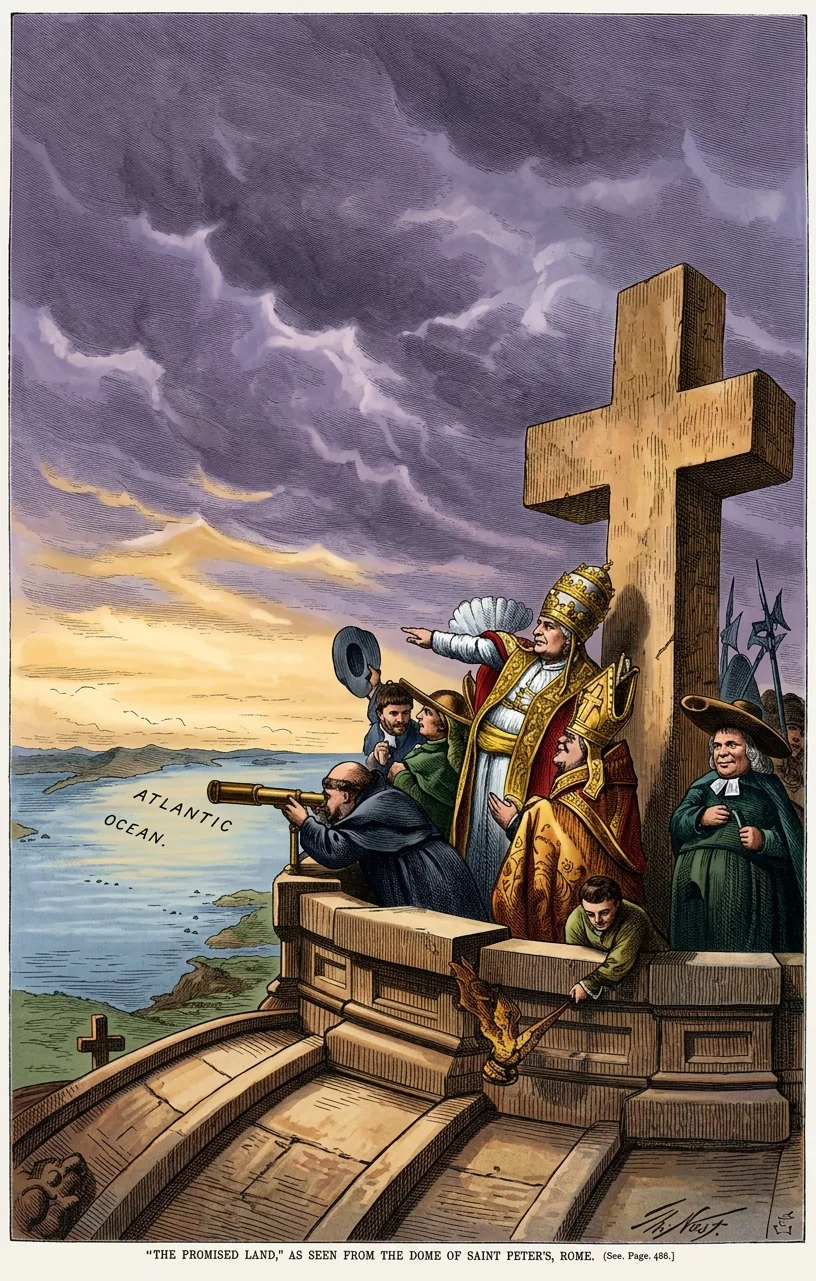
The Holy Father in his outlook from the watch-tower of the Vatican sees about him the lowering clouds of direful disaster, but away in the West there is the gleam of hope.—The Missionary (Roman Catholic), January, 1912.
The striking cartoons by that greatest of cartoonists, Thos. Nast, which the Protestant Magazine is reproducing from the old files of Harper's Weekly, are in themselves well worth many times the price of a year's subscription. See sample cartoon on this page. Yearly subscription $1.00; six months, 50 cents. Five yearly (or 10 six months') subscriptions, to different addresses, $3.00.
A number of officers and organizers of both the Guardians of Liberty and the Knights of Luther have applied for agency for the Protestant Magazine. Supplies of Liberty and the Protestant are on display at the national headquarters of these two patriotic organizations in New York City and Des Moines, Iowa. You can be our agent too!
You will have no trouble in selling a large supply of either the Protestant or the Liberty Magazine to the members of the following patriotic organizations: Guardians of Liberty, Junior Orders United American Mechanics, Patriotic Order Sons of America, Knights of Luther, Protestant League of America, American Federation of Patriotic Societies, Orangemen, Knights of the Maccabees, the Legions, American Minutemen, Masons, etc. Find out when these lodges meet, and ask permission to make a speech to the members after their business sessions, and present the educational and patriotic features of these magazines. Send $1.00 for 20 or $2.00 for 50 today. These patriotic men crave this information. Try the plan.

The Week of Prayer

Editorial

The Week of Prayer

Another week of prayer! Surely this occasion is needed by every member of the church. It is well that we pause in the midst of life's busy activities and take a little time for retrospection and serious consideration. What have the last twelve months brought to us? Where do we stand in the sight of heaven? What is our relationship to God, to his work in the earth, to our families, to our brethren and sisters?

A Period of Great Danger

The church of Christ confronts today greater danger than ever before in her history. It is the time of the last great conflict between truth and error. The controversies of the ages are revived. Satan is making his last supreme effort to destroy faith out of the earth. To his insidious attacks we see thousands in the great Christian world succumbing. The old-time simplicity of Christian faith and practise is well-nigh lost.
The mission of Seventh-day Adventists today is to stem this rising tide, to contend for the faith once delivered to the saints, to set an example to all the world of the power of vital godliness operating in the life. Is the Seventh-day Adventist Church today meeting its divine mission? Perhaps the question should be made more personal. Are the members of the Seventh-day Adventist Church today fulfilling God's great purpose in giving to the world a knowledge of his truth? Are we indeed standard-bearers and heralds of gospel light and saving grace, or are we, like many professed Christians in the great church around us, succumbing to the deadly influences operating in the world?

Important Considerations

To what extent have we lost the simplicity which once characterized the believers in this message, and which we are glad to say characterizes many of them today? To what extent is the spirit of worldliness and formalism entering our lives? Are we being carried away by the spirit of commercialism and the strife after riches for riches' sake?
Does the hypnotic power of worldly pleasure which is leading so many to forget God, and which is declared by the apostle to be a prominent feature of present-day Christianity, control our lives? Unconsciously and little by little is there coming into our experience a disregard for sacred things, leading us continually to minimize the difference between the holy and the profane? Do we keep the Sabbath of the Lord as Sunday is generally observed? Are we returning conscientiously to God our tithes and offerings? Has our faith become dimmed? Are the increasing signs on every side, which show the coming of the Lord to be near, becoming commonplace, leading us to say in our hearts, “My Lord delayeth his coming”? Is the spirit which we manifest in the home or in the church one of impatience, harshness, gossip, or criticism? Are we failing to apply in our lives the principles of true temperance and healthful living? Do we neglect secret prayer, family worship, or Bible study?
These great evils are manifest everywhere in the world around us, and are sapping the spiritual life of the great Christian church. Through them the enemy is making strong appeal to the members of the Seventh-day Adventist Church. Some, we fear, are succumbing to their deadly influences. In the light of God's Spirit shall we not pause and take time to think, and to determine if there is in us “an evil heart of unbelief, in departing from the living God?” The apostle admonishes us to “exhort one another daily, while it is called Today; lest any of you be hardened through the deceitfulness of sin. For we are made partakers of Christ, if we hold the beginning of our confidence steadfast unto the end.” Heb. 3: 13, 14.

“Turn Ye, for Why Will Ye Die?”

Wherein we find that sin has separated us from God let us make haste to return to our Father's house. “Behold, the Lord's hand is not shortened, that it cannot save; neither his ear heavy, that it cannot hear.” Isa. 59: 1. He is waiting today to be gracious. To his wandering children he says: “O Israel, return unto the Lord thy God; for thou hast fallen by thine iniquity.” Hosea 14: 1. He not only invites us to return, but he puts in our mouth the very words we are to use as we come back to the Father's house: “Take with you words, and turn to the Lord: say unto him, Take away all iniquity, and receive us graciously: so will we render the calves of our lips. Asshur shall not save us; we will not ride upon horses: neither will we say any more to the work of our hands, Ye are our gods: for in thee the fatherless findeth mercy.” Verses 2, 3.
How many times in the past have we sought help of Asshur. We have looked to men instead of to God. We have had faith that there was power in the work of our own hands, but have been forced to admit, through repeated failures, that we of ourselves could do nothing. To this seeking on the part of his children God graciously responds. His promise is: “I will heal their backsliding, I will love them freely: for mine anger is turned away from him.” Verse 4.

Confession of Sin

Oftentimes sin against God is sin against our fellows. The sins of the heart, the evil motives and purposes which have possessed us, and the sinful thoughts in which we have indulged,—the confession of these, as a rule, belongs to God alone. But wherein these evil purposes have been expressed in the life, wherein the wrong thoughts have borne fruitage in words and deeds, and have brought injury to our fellows or placed before them an evil example,—the confession of these outward sins belongs to our fellows as well as to God. A safe rule is that the confession should be as broad as the knowledge of the sin. Impatience and harshness in the home should be confessed at the family altar, to our loved ones and to God. An injury to a brother, such as taking advantage in a business deal, should be confessed to him and to others who may know of the injury wrought. Public sins, such as violation of the Sabbath and an evil example in the community, should be confessed to the church.

God's Mighty Working

And perhaps the very confession of these wrongs in the home, or to a brother, or in the church, may open the way for God to work marvelously duringthis season in behalf of his church and of his work in the earth. We must remove from the pathway of others the stones of stumbling in order that the way of the King may be prepared, so that he may come in and do his mighty work in every heart. A confession of our wrong to our children will prepare the way for God to work for their salvation. Let us make straight paths for our feet that those who are lame may not be turned aside nor caused to stumble.
Having made wrongs right, it is our blessed privilege to believe that God accepts us, not for anything that we have done, nor for anything that we may do, but on account of the “great love wherewith he loved us, even when we were dead in sins.” Eph. 2: 4, 5. Receiving ourselves his divine forgiveness, and rejoicing in his love, we may go forth to labor effectually for those who know him not. We may give with drawing power the invitation, “Come and see.” O, how much of this labor is needed even in this church!
How many of our brethren are struggling with some fierce temptation! how many are well-nigh discouraged and ready to draw back and give up the conflict! how many of our young people are drifting into a state of carelessness and worldliness! And then there are those who have once been associated with us in church fellowship, but have wandered away and become separated from this movement. Our hearts may go out after them, and our prayers ascend to God for their conversion. Working as we pray, and believing as we work, we shall become colaborers with God in the great work of restoration.

Our Great Need

Our great need as a people today is for more of God. No formal profession will save us. We cannot purchase the riches of heaven by offerings of gold or silver or any material service. “There is none other name under heaven given among men, whereby we must be saved” (Acts 4: 12); there is but one power which can transform our lives, and that is the power of the risen Saviour. There are many in Israel today who are blind and naked and wretched and miserable, and know it not. Truly it is high time for us who know the times and seasons, and who realize that the coming of the Lord draws nigh, to “awake out of sleep: for now is our salvation nearer than when we believed. The night is far spent, the day is at hand: let us therefore cast off the works of darkness, and let us put on the armor of light.”
“Come, and let us return unto the Lord: for he hath torn, and he will heal us; he hath smitten, and he will bind us up.” “Sow to yourselves in righteousness , reap in mercy; break up your fallow ground: for it is time to seek the Lord, till he come and rain righteousness upon you.” “Behold, I stand at the door, and knock: if any man hear my voice, and open the door, I will come in to him, and will sup with him, and he with me.” “Today if ye will hear his voice, harden not your hearts.”
F. M. W.

Getting Right With God

THIS is the week of prayer. It is a special season to more than one hundred thousand persons, who are invited to petition the throne of grace, as one man, in behalf of the greatest work ever committed to mortals.
But while there is going up to our Father in heaven this mighty petition that wraps the whole world in its embrace and concerns a work that is to touch every portion of earth, God would have his people realize that a right relation to him, on their part individually, is of greater importance to the work, to themselves, and to him than any amount of time spent in the repetition of words of prayer while the life is out of harmony with the purpose of God and the principles of the closing message. It must not be a season of lip service. That, our Saviour says, is hypocrisy. “Ye hypocrites, well did Esaias prophesy of you, saying, This people draweth nigh unto me with their mouth, and honoureth me with their lips; but their heart is far from me.” Matt. 15: 7, 8. Such service is not recognized by the Lord as service unto him.
When we pretend to possess what we do not possess, we act a falsehood. When our lips speak one thing and our lives another, we act a falsehood, and in so doing bring into disrepute the cause we pretend to serve. It is better not to pretend than to pretend and not do. But that does not release us in any sense from our duty of service. Service is our duty; to possess the things of God and to experience the blessings of service are our privilege.
We are in the time of the end; and because we are, this admonition and invitation of the Lord is particularly applicable to this generation and to us individually: “The day of the Lord is great and very terrible; and who can abide it? Therefore also now, saith the Lord, turn ye even to me with all your heart, and with fasting, and with weeping, and with mourning: and rend your heart, and not your garments, and turn unto the Lord your God: for he is gracious and merciful, slow to anger, and of great kindness, and repenteth him of the evil. . . . Blow ye the trumpet in Zion, sanctify a fast, call a solemn assembly: gather the people, sanctify the congregation, assemble the elders, gather the children, and those that suck the breasts: let the bridegroom go forth of his chamber, and the bride out of her closet. Let the priests, the ministers of the Lord, weep between the porch and the altar.” Joel 2: 11-17.
The whole chapter and the chapter following deal with the same thing. It is God’s personal call to his people to turn from the service of the world to his service; and the reason, written plainly through the whole book, is that it is the day of Jehovah’s preparation for his last great work, and he will not leave his people unwarned. But mere profession will not do. It is true heart service to which he calls his people now. The rending of the garments—the formal and outward profession of sorrow and repentance—will not suffice. The Lord sees not as man sees; he looks not on the outward appearance. He sees the heart and searches the purpose; and when he sees stubborn and unconverted hearts covered with the rent garments of professed conversion and professed repentance, he says, “Ye hypocrites,” “rend your heart, and not your garments.” If we refuse to do that, we are lost; for pretense and profession without possession are abominable in the sight of heaven.
“But,” one says, in excusing himself from the service of God and accusing others for not living up to their profession, “I do not make any profession,” as if that were something to be commended. That does not help the matter; for, while God refuses to permit the hypocrites to enter his kingdom, he also refuses entrance to those who make no pretense of service. The kingdom of righteousness is a kingdom of loyalty, of truth, of sincere service, of unquestioned devotion. The characters that go into that kingdom will not be clouded with sin and selfish ambition. The searchlight of God will play upon those characters and find in them nothing but the pure crystal. Therefore God calls them his jewels. They are his precious trophies mined out of the dark and dismal shafts of this world of sin.
The purity of character which God requires has been held before the eyes of some by Satan in order to discourage them by the very impossibility of human attainment. But God has not left man to himself to accomplish that undertaking. “My grace is sufficient for thee.” “By grace are ye saved through faith; and that not of yourselves: it is the gift of God.” What is necessary is submission to the divine will. When the soul is yielded to God, so that God can work out his will in the individual unhindered, the work will be accomplished.
Christ said, “I and my Father areone.” They were one because there was only one purpose between the two. Now if there is only one purpose between us and God, we also shall be one with him, true children of God the Father and true brethren of the Lord Jesus Christ. Then the prayer of Jesus in our behalf will come true in our experience: “Holy Father, keep them in thy name which thou hast given me, that they may be one, even as we are.” John 17: 11. Again: “Neither for these only do I pray, but for them also that believe on me through their word; that they may all be one; even as thou, Father, art in me, and I in thee, that they also may be in us. . . . I in them, and thou in me, that they may be perfected into one.” Verses 20-23.
As we, through the grace of Christ, put out of our lives those things that hinder our being at one with God, we shall at the same time and by the same act put out of our lives those things that hinder our being at one with one another. As we draw nearer to God in reality, we draw nearer to one another in reality, and find less and less occasion for faultfinding against one another. It will be a wonderful, glorious, and soul-satisfying thing to step over the line from mortality to immortality, and realize that all the sorrows and disappointments and woes of this world are in the past, while eternity stretches before us in the kingdom of righteousness, where nothing can ever come to hurt, to disturb, or to annoy. But they who long for that blessed experience must realize that in order for such a kingdom ever to be, God must see to it that no one who enters there shall have in his soul the taint or contagion of sin. While God makes the requirement, he also furnishes the facilities for bringing it about. In the life and the sacrifice of Christ, and in the power and grace he has promised, man finds all he needs to enable him to pass within the gates of the New Jerusalem and to share with all the redeemed what God has in store for his faithful children.
Therefore let this be a season of true heart searching, of consecration, of glad yielding to God’s leading, of drawing nearer to God and nearer to one another. Then we can say, “The Lord hath done great things for us; whereof we are glad.”
C. M. S.

The Harvest Ingathering

A Personal Experience

If I had followed the suggestions of my feelings when the time came for the Harvest Ingathering campaign, I should not have gone out to the work. But I did not follow those suggestions, for I have learned and proved that there is a better, safer guide than our feelings. Like Abraham, who, when he was called, went out by faith and was blessed and was made a blessing, so I by faith—not feeling—went out and was blessed, and I trust was made a blessing. Besides the money I received (I now have ten dollars for the missions, and this is only the start), I had many good visits with the people, and opportunities to “speak a word in season to him that is weary.”
I found several who were not only willing to give me money for missions, but were willing to receive the word of God. As I went on my way, I was happy because I was doing the will of him who had sent me, and was having a part in finishing his work. Like Jesus, who at the well asked drink of the Samaritan woman and then gave her the water of life, I could also say, “My meat is to do the will of him that sent me, and to finish his work.” I prayed and sang, before I started and as I went on the way, “Make me a blessing to-day.”
I believe, dear brethren, that in order to finish the gospel work in this generation, we need what the people had in the days of Nehemiah. “So built we the wall; and all the wall was joined together unto the half thereof: for the people had a mind to work.” If we will be faithful in our place and repair the breach in the wall by us and make our prayer unto God and have “a mind to work,” as they prayed and worked, we, too, shall rejoice in a finished work. Let us say, as Nehemiah said, “The God of heaven, he will prosper us; therefore we his servants will arise and build.”
I do not want to be numbered with the Tobiahs and Sanballats, nor with the nobles of the Tekoites, who “put not their necks to the work of the Lord.” I want my neck to get used to the yoke of Christ; for his yoke is easy, and his burden is light. I have had a part in all these Harvest Ingathering campaigns, and I can say that every one has brought a harvest of joy and rich blessing to my soul, and I hope some glad day to see more fruit of the good seed I have scattered.
Soon, very soon, the harvest work will be finished. The “harvest home song” will be sung. There will be two classes in that day. One class will say, “The harvest is past, the summer is ended, and we are not saved.” The other class, who have sowed in tears, will reap in joy; they went forth weeping, bearing precious seed, and will come again rejoicing, bringing their sheaves with them.
With which of these two classes do we choose to be? To be with the joyful reapers we must do something more than desire or wish. We must choose—will, determine, resolve—to go forth and sow beside all waters with earnest prayer; then we shall come rejoicing, bringing our sheaves with us. In due time we shall reap if we faint not.
I wish, dear reader, when you finish reading this article, you would get your Bible and read Matt. 25:31-46. Observe that those who inherit the kingdom prepared for them from the foundation of the world, simply did those little things we all have an opportunity to do,—fed the hungry, clothed the naked, visited the sick, etc.,—in other words, did home missionary work. Of those on the left hand it is not said that they were very bad or wicked; they simply neglected to do those things for which the righteous were commended.
O brother, listen! “How shall we escape, if we neglect so great salvation?” Heb. 2:3. All we shall ever get or take out of this old world to make us happy through eternity will be the souls of those who are saved by the precious truth we bring to them. “For what is our hope, or joy, or crown of rejoicing? Are not even ye in the presence of our Lord Jesus Christ at his coming? For ye are our glory and joy.”
DANIEL NETTLETON.

Seek the Lord While He May Be Found

“SEEK ye the Lord while he may be found, call ye upon him while he is near: let the wicked forsake his way, and the unrighteous man his thoughts: and let him return unto the Lord, and he will have mercy upon him; and to our God, for he will abundantly pardon. For my thoughts are not your thoughts, neither are your ways my ways, saith the Lord.”

Readings for the Week of Prayer

To Be Read in the Churches December 13-20, 1913

A Word to Church and Conference Officers

The events of the hour and the demands upon the remnant church in such a time as this constitute a solemn appeal from heaven to seek God for a fresh baptism of power and of blessing from on high. This is fully emphasized in the readings for the week of prayer. From now until that season opens, church officers and conference workers will surely carry a burden of special prayer and earnest planning. Everything possible should be done to prepare to make the season a time of refreshing in every church. In the prayer-meetings and in the family worship, as well as in private devotions, may the prayers ascend that the coming season shall bring reviving for all, and salvation to the unconverted and the discouraged.
Make a definite announcement of meeting arrangements, and urge all to plan their work so that advantage may be taken of this time of world-wide intercession. Arrange for visiting absentees, and interested ones who are not regular attendants, with personal invitations to attend the services of the week. And through all the services watch for souls, and urge the unsurrendered to give their hearts to God. Encourage all to do personal work for others. May the tender, melting love and grace of Christ fill every church, and make this season a time of refreshing and victory indeed. Before each service it is good if the leaders can meet for a few moments of prayer aside, praying that God may bless the one who is to present the reading, and whoever is chosen to lead in the service following. It is a week of prayer; let us do much praying.

The Annual Offering

The last Sabbath of the week of prayer, December 20, is the time for the annual offering for missions. No year before in our history ever called so earnestly for a large offering. The work presses in the mission fields; the sending of the new recruits this autumn will require enlarged appropriations to keep the work going among the millions in dark lands. On Sabbath, December 13, the envelopes for the offering should be placed in the hands of every one, with special announcement of the great need, so that all may pray and plan for the annual offering on the closing Sabbath of the week of prayer. COMMITTEE.

Week of Prayer for the Children

In these closing hours of probation, and during this week of prayer, the children must not be neglected nor forgotten. In every time of danger the first thought is, Are all the children safe? How is it, parents, church elders, and Sabbath-school officers, with those God has placed in your care? If Jesus should come now, are they ready? Are they getting ready? Has all been done that you can do to save them?
This week of prayer affords excellent opportunity for personal effort in behalf of children as well as for others. Let not one be passed by. Plan a time and place for the children's meetings, and select the best help to conduct them. Let the hearts of fathers and mothers be turned to their children, that whole families may be blessed together.
Where regular meetings cannot be held, let parents study these lessons with their children on the appointed days, and then all seek the Lord together. The hour of family worship might be the best time. Blessings will surely fall where this is done. Let this be a time for seeking the lost piece of silver, the prodigal son or daughter.
“The lost coin represents those who are lost in trespasses and sins, but who have no sense of their condition. They are estranged from God, but they know it not. Their souls are in peril, but they are unconscious and unconcerned. In this parable Christ teaches that even those who are indifferent to the claims of God are the objects of his pitying love. They are to be sought for, that they may be brought back to God. . . .
“The woman in the parable searches diligently for her lost coin. She lights the candle and sweeps the house. She removes everything that might obstruct her search. Though only one piece is lost, she will not cease her efforts until that piece is found. So in the family, if one member is lost to God, every means should be used for his recovery. On the part of all the others, let there be diligent, careful self-examination. Let the life-practise be investigated. See if there is not some mistake, some error in management, by which that soul is confirmed in impenitence.
“If there is in the family one child who is unconscious of his sinful state, parents should not rest. Let the candle be lighted. Search the Word of God, and by its light let everything in the home be diligently examined, to see why this child is lost.”—“Christ’s Object Lessons,” pages 193-195.
For those who labor for and instruct the children, these encouraging words are spoken:—
“In our work for the children the object should be not merely to educate and entertain them, but to work for their conversion. We should ask the blessing of God on the seed sown, and the conviction of the Holy Spirit will take hold of even the little ones. If we exercise faith in God, we shall be enabled to lead them to the Lamb of God that taketh away the sin of the world.
“This is a work of the greatest consequence to the younger members of the Lord’s family. In these meetings, even children who are favored with Christian instruction at home can learn much that will be a great help to them. If the children are taught in the simplicity of Christ, . . . they will bring forth from the treasure-house of the heart precious lessons.”—“Testimonies for the Church,” Vol. VI, page 105.
The lessons are simply suggestive. Let the week be one of earnest prayer and effort for the salvation of others.
VESTA J. FARNSWORTH.
Continue reading: (Reading for Sabbath, December 13)