Personal Soul-Winning; the Duty of the Church in View of the Close of Probation
G. B. THOMPSON
“BEHOLD, the day of the Lord cometh, cruel both with wrath and fierce anger, to lay the land desolate: and he shall destroy the sinners thereof out of it.” Isa. 13:9. “Knowing therefore the terror of the Lord, we persuade men.” 2 Cor. 5:11.
Prophets have portrayed the day of God in the most solemn and thrilling words. The close of probation, the fixing of the destiny of earth’s unnumbered millions, the day of the Lord’s anger,—these are words of terrible import.
To look upon our neighbors, friends, and kindred, whom we dearly love, and know that in a few brief years, if unsaved, they must stand without any hope in God, and with all the tribes of the earth, mourn as they see the Son of man and all the angelic host come in glory and power, is a most solemn and appalling thing to consider.
To view the ruin of one city shocks the sensibilities; but to meditate upon the ruin of every city—ruin world-wide and indescribable—when the “slain of the Lord” will be “from one end of the earth even unto the other end,” when the “foundations of the earth” will shake, mountains be moved out of their places, and islands disappear, staggers the imagination, and causes the heart to cry to God for a hiding-place in that dreadful hour.
As the overshadowing cloud of the world’s doom grows darker, surely great earnestness should characterize the lives of those who believe these things. We should be untiring in our personal efforts to warn and save the souls of our neighbors, our friends, and our kindred. If we saw them in a burning building, fast being consumed by the angry flames, we should put forth almost superhuman efforts to save them from destruction. No earthly thing would be allowed to hinder us in the work of rescue. But a doom more terrible than this awaits those in our homes and neighborhood who are unconverted. Can we sit unmoved and indifferent and see them swept over the great Niagara of ruin? Gracious Lord, forbid! The hour has fully come for every one who believes this message to take hold of earnest missionary work.
Our greatest need is a burden for souls. Many do but little in soul-winning. Every unsaved, unwarned soul should pain our hearts.
One day from the deck of an ocean liner a boat was seen drifting in mid-ocean. It had come from a sinking vessel. A boat and crew were sent in pursuit. In the bottom of the drifting boat a man was found, exhausted and unconscious. As he was lifted up and taken into the other boat, he partially revived, and the first feeble words heard from his lips were, “There’s another man in the boat.” Saved himself, his first thought was to have another saved.
This incident illustrates the spirit of the true Christian. One of the first evidences of conversion is an interest in some other soul, in the other man in the boat. The Scriptures abound in examples of personal work for souls. Some of the greatest sermons Jesus preached were to one soul. By night he talked personally with Nicodemus, and instructed him about his soul. A large part of the third chapter of John is a record of the instruction given at this interview. In a personal talk he taught the Samaritan woman the way of life, who began personal work and brought other souls to the Master. To the one who said, “Master, I will follow thee whithersoever thou goest,” Jesus gave some valuable lessons. To another he said, “Go thou and preach the kingdom of God.” He instructs another concerning the sin of “looking back.” The one man seems to have been the congregation in much of Christ’s ministry. In this he has left us an example. Are we following in his footsteps?
Andrew, who had found the Messiah, “findeth his own brother Simon,” Philip, being found of Christ, “findeth Nathanael.” Philip, the evangelist, has a personal interview with the treasurer of Queen Candace, and leaves him a baptized believer. Paul and Silas labor personally with the jailer and his household in the midnight hours, and have the joy of witnessing their conversion and baptism before dawn. Aquila and Priscilla do personal work with Apollos and expound unto him the way of God more perfectly. These few examples gleaned from the lives of Christ and his followers, as recorded in Holy Writ, should admonish us as Christian workers to similar endeavor.
A visitor at a pottery observed a workman molding a piece. The process seemed slow. The visitor asked if there was no tool that could do the work. “No,” replied the potter, “we have tried several, but somehow in this work we must have the human touch.” So in molding human souls into vessels for the Master’s use, there must be the personal touch. We cannot do our missionary work by proxy, we must personally come close to those needing salvation.
It is this personal work in our churches which I am sure needs emphasis. To be a successful soul-winner, we must put forth personal efforts for others. Much of the fruit of souls must be hand-picked. There is danger, while giving attention to other things, of our losing sight, in a measure, of our real work, that of saving souls.
Within easy reach of each of us there are many lost fathers, mothers, and youth who need some one to show them the way to their Father’s house. Their condition is a mute appeal to us for help. Some of these sit every Sabbath in our churches. Some are in our homes. It seems unspeakably sad to allow them to sit there week after week and no personal effort be made to bring them to Christ.
I was on a camp-ground once when the word went out that a little boy, who had been left in a tent while the parents attended a morning meeting, was lost. Soon the whole camp was astir. Tears were shed, and anxiety was seen on every face. Breakfast was forgotten. None cared to eat. In every direction scores of people scattered and continued their search until the lost boy was found. But in every church there are lost boys and girls, and no such stir as this is seen. Can anybody give a satisfactory reason for our indifference? What can we say personally?
If you are a Christian, you are to be an agent in the hands of God to resurrect the dead, those who are “dead in trespasses and sins.” An instructive miracle wrought by Elisha throws some light on how this may be done. The son of the Shunammite woman died. In her sorrow and distress, the mother laid him on Elisha’s bed, and hastened to the man of God for help. “And when Elisha was come into the house, behold, the child was dead, and laid upon his bed. He went in therefore, and shut the door upon them twain, and prayed unto the Lord. And he went up, and lay upon the child, and put his mouth upon his mouth, and his eyes upon his eyes, and his hands upon his hands: and he stretched himself upon the child; and the flesh of the child waxed warm. Then he returned, and walked in the house to and fro; and went up, and stretched himself upon him: and the child sneezed seven times, and the child opened his eyes.” 2 Kings 4:32-35.
Elisha had to deal with the dead. He was not satisfied with merely cleansing the dead body, embalming it, or wrapping it in fine linen and leaving it still a corpse. He was not satisfied either when the corpse seemed to wax warm. The dead must live. He labored on until life was restored. Our mission is bringing life from heaven to spiritually dead souls. When Elisha came, he shut the door, and alone with the dead child prayed earnestly to God. He came in close personal touch with him. He was rewarded by seeing the dead live. There is a lesson in this for each of us as to how to win souls for the Master. It means prayer, unconditional surrender, deep consecration, and personal, persevering labor.
It would help us, perhaps, to become more active and earnest in the work of saving souls if we could realize fully the value of even a child. I read something recently which impressed this very deeply on my mind:—
“A farmer in North Carolina once1104drove with two high-mettled horses into the town. Stopping in front of one of the stores, he was about to enter when his horses took fright. He sprang in front of them, and heroically seized the reins. Maddened by strange noises, the horses dashed down the street, the man still clinging to the bridles. On they rushed, until the horses, wild with frenzy, reared on their haunches, and, leaping upon the man, all came with a crash to the earth. When the people came to rescue the bleeding body of the man, and found him in death’s last agony, a friend, bending tenderly over him, asked, ‘Why did you sacrifice your life for horses and wagon?’ He gasped with his last breath, ‘Go and look in the wagon.’ They turned, and there, asleep in the straw, lay the man’s little boy. As they laid the mangled form of the hero in his grave, no one said, ‘The sacrifice is too great.’”
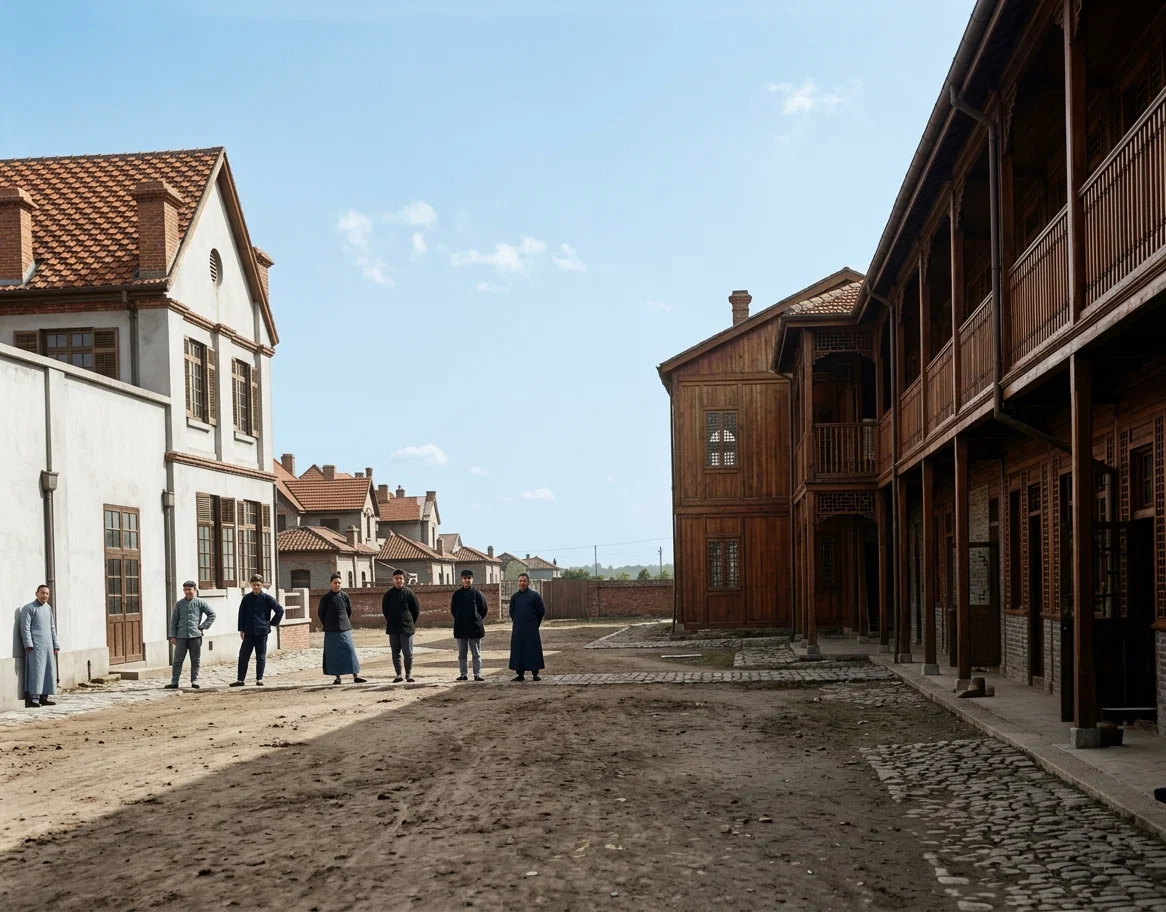
REAR VIEW OF SHANGHAI, CHINA, HEADQUARTERS
Now it was his little boy asleep in the wagon that caused this father to sacrifice his life. He was not thinking about the value of the team or the wagon. He was thinking about his boy. He was entirely oblivious to danger, and willing, if necessary, to die to save his little boy. Did he make too great a sacrifice? Nobody will say he did. But there are boys, worth just as much as this boy, near us who are not saved. Is it putting it too strong to say that we should put forth as earnest efforts to save eternally in heaven those who are unconverted as this father put forth to save his boy from being killed?
If all the church-members had this yearning of heart to see souls saved, many would be brought to Christ. I sometimes fear that our efforts to save souls are illustrated by the man who was drowning in the pond on a cold day. Some one, desirous of helping him, gave him the end of a plank that was covered with ice. The man tried repeatedly to get hold of it and save himself, but finally exclaimed, in despair: “Give me the other end of the plank; this end is icy!” We need to be sure, if we wish to win souls, that we do not hold out to them the icy end of the plank, but through love come in warm, personal touch with them.
Our responsibility in personal work, as well as the need of our doing it, was impressed on my mind recently by the following incident:—
“A minister was called to conduct the funeral service of a young girl who was a stranger to him. He went to her Sunday-school superintendent and asked, ‘Was Minnie a Christian?’ ‘Really, I don’t know,’ replied the superintendent. ‘She has attended Sunday-school for several years, and I have often thought that I should like to ask her, but never did.’ The minister then called upon her teacher and said, ‘Was Minnie a Christian?’ The teacher replied, sadly, ‘I do not know. I have often thought that if I ever got her alone, I should talk to her, but never did.’ Then the minister went to her mother, and repeated the question, ‘Was Minnie a Christian?’ ‘I do not know,’ replied the weeping woman. ‘She went to Sunday-school, and I thought the teacher and the superintendent ought to talk to her. I never seemed to be able to say anything to her on the subject.’”
I have wondered if a condition similar to this exists in any of our churches. Should one of the children in your church die, would you know at the funeral whether he was a Christian or not? We may know that he came from a Sabbath-keeping home, and attended church and Sabbath-school, but that does not make him a Christian. Young people need a change of heart. They must be converted to be saved.
Our greatest joy in heaven will be to see souls there whom we have led to Christ. “For what is our hope, or joy, or crown of rejoicing? Are not even ye in the presence of our Lord Jesus Christ at his coming? For ye are our glory and joy.” 1 Thess. 2:19, 20.
We may consistently ask ourselves the question, Why am I a Christian? Is it for my own good, or is it for the good of others? Believing that the days of human probation are almost past, we have a great responsibility resting upon us. “We owe a great debt, and it is long overdue. ‘I am a debtor both to the Greeks, and to the barbarians,’ said Paul. What had he received of them?—Absolutely nothing. But he had what they needed and must have, and he was their debtor until he had met that need. We have in our hand a pardon for a man condemned, and we are his debtor until we put it into his hand. It was for that purpose that we received it, and with it went the message, Go quick everywhere.”
O that the Lord would break the spell of coldness and indifference upon us concerning the lost! A godly minister once said, “I am a broken-hearted man; not for myself, but on account of others. God has given me such a sight of the value of precious souls that I cannot live if souls are not saved.” David Brainerd said, “I cared not where or how I lived, or what hardships I went through, so I could but gain souls to Christ. I dreamed of these things; and when I waked, the first thing I thought of was this great work.”
But before we can prevail with men, Jacob-like we must prevail with God. The gospel we preach must save us; we must be able to tell of personal salvation. We ourselves must be in the ark to which we invite others. We must be men and women of prayer. We must receive from God in secret before we can disperse in public. Mr. Whitefield’s chapel was called a “soul trap.” This is what every place of worship should be,—a place where souls are caught for the Master.
It has been suggested that we set as a goal the doubling of our membership. It seems like a big task to talk of doing this. But it is quite possible if we all take hold of the work. It means simply that we each bring one soul into the truth, and the task is accomplished. Cannot we do this much the coming year? Is one soul a year too many in the days of the close of probation?—Surely not. Brethren, this can be done, and more. Shall we not consecrate ourselves to the work of bringing people to Christ as never before? Shall not each of us determine, God helping us, to bring at least one soul to Christ the coming year? This will bring new life into our own hearts, new life into our churches, new power into our work, and hasten the close of the work of God in the earth. How many will dedicate themselves to this work, and know no rest till they have brought some souls to Christ?
There will be no starless crowns in glory. Our own salvation, as well as that of others, depends on our faithfulness in guiding the lost to the fold.
(Reading for Thursday, December 18)
By W. T. Knox
The Response of the People to the Increasing Demands of the Work
W. T. KNOX
“MOSES my servant is dead; now therefore arise, go over this Jordan, thou, and all this people, unto the land which I do give to them, even to the children of Israel. Every place that the sole of your foot shall tread upon, that have I given unto you, as I said unto Moses.” Joshua 1:2, 3.
For forty years Israel had been wandering in the wilderness, although it was but an eleven days’ journey from Horeb by the way of Mt. Seir to Kadesh-barnea. These forty years were years filled with instruction from God, that they might be made acquainted with him, concerning whom they had well-nigh lost knowledge during the years of their Egyptian bondage. They had been years abounding in marvelous manifestations of the Lord’s power and tender mercy and love. “In all their affliction he was afflicted, and the angel of his presence saved them: in his love and in his pity he redeemed them; and he bare them, and carried them all the days of old.” Isa. 63:9.
And, alas! notwithstanding all this, these years contained too full a record of their blindness and stubbornness, their murmuring and rebellion. Time and again the dark apostasies of the tribes stirred the jealousy of Moses and the anger of God. “But they rebelled, and vexed his Holy Spirit: therefore he was turned to be their enemy, and he fought against them.” Isa. 63:10.
He led them to the very borders of the promised land, and permitted them to look upon its beauties and riches, but they turned back and entered upon one of their most serious apostasies and rebellions. As a result, God condemned them to forty years of wandering, until they should all perish in the wilderness. Once again the hosts of Israel are led by the fiery, cloudy pillar to the borders of the promised land, and there, in the valley of Shittim, as the result of their final and most flagrant apostasy, the last of the original host that were led out of Egypt were stricken by the plague. And Moses, who notwithstanding all their murmuring and complaining was, under God, always their faithful and patient leader, was, after viewing the beauty of the promised land and the final triumph and glory of his people, laid away upon lonely Mt. Nebo because of the one transgression into which he had been led by their sin.
To Joshua now comes the command from Heaven, “Arise, go over this Jordan.” The Jordan was overflowing in its floods. The cities were more strongly fortified than in the days of the twelve spies, and the giants were as tall and great as then. The ancient leaders of the people were dead, and the veterans of the host had perished, and their bones were whitening in the wilderness. But Joshua had heard the command, “Arise, and go over this Jordan,” and the promise, “Every place that the sole of your foot shall tread upon, that have I given unto you.” Not waiting to question how, Joshua commanded the officers of the people, saying, “Pass through the host, and command the people, saying, Prepare you victuals; for within three days ye shall pass over this Jordan, to go in to possess the land, which the Lord your God giveth you to possess it.”
Israel and their leader might have hesitated and questioned the possibilities of the flood-burdened Jordan or the towering walls of Jericho that opposed their progress, but these obstacles had no terrors for them, or, if they had, the command and the promise of God far outweighed them; for, leaving their wives, their children, and all their possessions in the hand of God, we hear the men of Israel answering Joshua: “All that thou commandest us we will do, and whithersoever thou sendest us, we will go.” Before obedience and faith, Jordan became a dry path for their feet, and the city Jericho a terrorized prey.
When they began their pilgrimage, they trembled for their flocks, fearing that the Lord would not be able to set them a table in the wilderness. They feared for their lives and for the lives of their wives and little ones, accusing Moses of bringing them into the wilderness to perish. But they had finally come to the place where they were willing to leave their families and possessions with the Lord, and to daily eat the bread of faith. And so an abundant entrance was given them into the land of promise, and that which was faith became sight. The manna ceased, and “they did eat of the fruit of the land of Canaan.”
For almost seventy years God has been leading this people through the wilderness of sin toward the promised land.1106Who can question but that his mercies and his loving-kindnesses to us have been as great as those bestowed upon Israel of old? that the revelations of his will have been as clear and distinct to us as to them? As we review the history of modern Israel, we cannot fail to see that at times we have been brought to the very border of the heavenly Canaan, and that lack of faith and of godliness has repeatedly turned us back into the wilderness.
It has been his purpose, through us, to reveal to the world his righteous statutes and judgments, and his saving message of grace. To us has been given the “everlasting gospel to preach unto them that dwell on the earth, and to every nation, and kindred, and tongue, and people, saying, . . . Fear God, and give glory to him; for the hour of his judgment is come: and worship him that made heaven, and earth, and the sea, and the fountains of waters.” Rev. 14:6, 7.
To take a people that were not a people, that were enfeebled and debased by generations of cruel servitude, to free them from their bondage, and establish them in a land occupied by strong, warlike, and progressive nations, was a miracle, an accomplishment to be wondered at. It was effected by that people’s yielding themselves wholly to God and permitting him to work for them,—a work of entire consecration and surrender. It is no less a miracle for the Lord to take a few men and women, poor in this world’s goods, distinguished only by a truth that makes them peculiar by its requirements, and of necessity largely separates them from the busy activities and ambitions of the world, and by them place this same truth among every nation and people of the earth, to establish in strategic locations institutions of learning, publishing houses, and sanitariums, and by them, in conjunction with these facilities, prepare the world for the glorious appearing of the great God and our Saviour Jesus Christ, and gather “a glorious church, not having spot, or wrinkle, or any such thing; . . . holy and without blemish.” Eph. 5:27. Both instances are miracles of God’s grace.
The early struggles of this people, their privations, self-denials, and patient efforts to establish the truth in America, have passed into the history of the church, and contain many striking instances of God’s overruling power and fostering care. Their early efforts to carry the message to other peoples and nations, and the providences of God that made this possible, are of too recent occurrence to be forgotten.
It is only in recent years that the work in foreign lands has been inaugurated. Our real efforts among the heathen have been confined to the past quarter of a century. As the magnitude of the work has opened before our minds, and we have contemplated the meagerness of our facilities, our own weakness, the shortness of time, our hearts have repeatedly failed, and we have realized that the task is beyond us. But, thanks be to God, who giveth us the victory, our Leader is the same who led Israel out of Egypt, spread for them a table in the wilderness, showed them his statutes and judgments, and revealed unto them his way, so that through faith they “subdued kingdoms, wrought righteousness, obtained promises, stopped the mouths of lions, quenched the violence of fire, escaped the edge of the sword, out of weakness were made strong, waxed valiant in fight, turned to flight the armies of the aliens.” Heb. 11:33, 34.
Without depreciating the task before us, nor the great difficulties that attach to the gathering out of a people of God from the darkness and superstition of heathenism, we cannot but rejoice as we contemplate the wonders God has wrought for us. Beginning in weakness, without friends or influence, without even the semblance of a treasury to finance the work, there was laid upon the founders of this movement the stupendous task of sending this gospel of the kingdom to all nations of the earth in this generation, in order that a people might be prepared for the coming of the Lord. They saw that for this work they must have certain facilities,—schools in which to train workers, publishing houses to prepare gospel literature, sanitariums for the dissemination of right principles, the development of special workers, and the care of the sick. Though without funds, they, early in our history, began to follow the leadings of the Lord in these things. Their first efforts were, of necessity, in great weakness. In the year 1849 the first attempt was made to publish a paper, the Present Truth. Three years later a small printing plant was established in Rochester, N. Y., with an investment of less than seven hundred dollars. In 1866 our first health institution was established in Battle Creek, with an investment of from twenty to twenty-five thousand dollars. The educational work of the denomination was also begun with a small school in Battle Creek, the Battle Creek College being established in 1876.
From this small beginning, under the fostering care of God, the institutional work has expanded until we have twenty-nine publishing houses, with assets to the amount of $1,600,000, producing gospel literature in seventy-five languages, the value of their annual product being in the neighborhood of $2,000,000, or considerably in excess of their entire investment. These printed pages of soul-saving literature are receiving, by the hands of our 2,000 colporteurs, a world-wide circulation, creating in all lands urgent demands for the living preacher.
The denomination is operating forty sanitariums, with an investment represented by $2,900,000 assets, augmented by twenty-nine privately owned institutions, with $1,250,000 assets. From 25,000 to 30,000 patients are yearly cared for in these sanitariums, and thus brought in contact with the 2,000 workers in them who have given their lives to the dissemination of the truth.
The educational work shows even greater development. Ninety colleges, academies, and intermediate schools are operated, valued at $2,230,000, having an enrolment of over 8,200 students, while our primary schools are attended by 15,600.
These three classes of institutions, operating in their three separate spheres, but all educational in character, have made it possible for the denomination to recruit an army of men and women 9,500 strong, who are carrying heaven’s last message of warning to the world, spreading it in printed form in seventy-five languages, and orally in ninety-one tongues.
A most remarkable feature brought out in these figures is that of the entire membership of the denomination, one twelfth are actively engaged in this work. We may have confidence that this volume of work will be maintained, from the fact that from 114,000 composing our membership, one fifth are enrolled in our schools, receiving a Christian education, and a training to qualify them for some phase of God’s work.
What the past fifty years has wrought in the development of the work, is most strikingly seen in the growth of our funds for evangelical work. Considering the figures in decades, the tithe has been as follows:—
First ............ $ 176,826.03
Second ........... 505,136.60
Third ............ 1,837,915.94
Fourth ........... 4,342,193.08
Fifth ............ 11,086,438.41
Total ........... $17,948,510.06
The amount of offerings during this same time by decades has been as follows:—
First ............ $ 8,552.57
Second ........... 56,700.86
Third ............ 496,467.01
Fourth .......... 1,271,527.24
Fifth ........... 5,936,924.82
Total .......... $7,770,172.50
The grand total of both tithes and offerings is $25,718,682.56, the annual tithe now amounting to $1,500,000, and the mission offerings to $600,000.
Instead of being solely dependent upon America for our resources of men and means, we now have two strong bases of supplies, America and Europe, from which to draw our recruits and their support. Who can doubt that the remarkable progress and growth shown in these facts must be attributed to the Lord’s purpose to speedily close his work in the earth, especially when considered in conjunction with the developments in heathen lands, where a few years since it was almost impossible to obtain a hearing, and in some cases even an entrance to certain countries? Now all this is changed. Many are eagerly seeking instruction in religious matters. Companies of believers are springing up who have never seen the face of one of our American or European workers. The calls for help are not from favored or special sections only, but are well-nigh universal.
To receive the three angels’ messages in their fulness, without becoming possessed and consumed with the foreign missionary spirit, which sent Christ to this world, is an impossibility.1107The very language of the messages makes this so, for they are world messages. So whatever we may be doing, plowing or preaching; wherever we may be, at home or abroad, every one is in spirit to be a foreign missionary in the sense that his supreme motive and purpose is to get this message to every nation, and kindred, and tongue, and people.
For this people to give in tithes and offerings over $2,000,000 annually, indicates that the message is sanctifying their hearts and pocketbooks. But the cause of God may, doubtless will, call for greater evidence of our consecration than this. But whatever he asks us to do, wherever he asks us to labor, he has promised to be with us, and never leave nor forsake us. We are simply to be for him in China, India, Africa, or America, hands and feet in the execution of his great purpose of love and mercy. In the light of the final results, nothing we may do for him and his truth, nothing we may relinquish to complete the work in all the world, can really be called a sacrifice, for the returns to us are to be innocence, joy, peace, health, the new earth, the city of God, God and his Son, eternity. At most there can intervene but a few more years until this great consummation. A little more labor and trial, and that for which the church of all ages has waited will be realized. We shall behold the King in his beauty. We shall, if faithful, hear his voice welcoming us to his joy. Standing on the sea of glass before the throne of our Heavenly Father, members of that great company that no man can number, of all nations and kingdoms and peoples and tongues, and encircled with the glories of God’s kingdom, surrounded with the evidences of his love,—who then will regret the years of his service, the trifles that on earth have been relinquished, the trials and the sufferings that may have been endured? Like Paul, we shall reckon that the sufferings of earth are not worthy to be compared with the glories of heaven, made ours by Christ.
Certainly the conditions existing in the political, social, and religious world say distinctly that the end of all things is at hand. The rapid development of our own work strongly emphasizes this, and calls for a response from the people of God in consecration of effort, talent, and means commensurate with the solemnity of the occasion, and the magnitude of the enterprise in which we are engaged.
Soon we shall hear, not, ‘Arise, and go over this Jordan,’ but, ‘Come, ye blessed of my Father, inherit the kingdom prepared for you from the foundation of the world.’
Be Ye Also Ready
Lesson for the Children—No. 5
“Be Ye Also Ready”
Memory Text: “Therefore be ye also ready: for in such an hour as ye think not the Son of man cometh.” Matt. 24:44.
We are not ready while getting ready. If you expect a visitor, you wish the house and your dress to be clean and tidy, your work done so you can welcome your friend and have a pleasant visit. You are not ready till all this is done.
We have learned that Jesus is coming soon. He is “even at the door.” Are we all ready for him to come? We must—
FirstLOOK to JESUSThen
None can be saved “unless they obtain the victory over every besetment, over pride, selfishness, love of the world, and over every wrong word and action.”
—“Early Writings.”
We cannot make ourselves ready. We can only confess our sins, and ask Jesus to forgive and make us ready to meet him. Then we must keep doing right. If we forget and make mistakes, the only way is to go to Jesus again in prayer, tell him we are sorry, and ask him to keep us from sinning. He has promised to do this. 1 John 1:9.
(Make the way so plain that the children will know the right path.)
Have you sometimes wondered why the little hand on the clock points to the hour, and the long hand to the minutes? The minutes are very precious now because Jesus is so near, and there is so much to be done to get ready. If we improve every minute, the hours will be well spent.
(Show a pair of balances. If you cannot do better, show a picture; but if possible have the real article.) Here is a pair of balances. What are they for? “To weigh,” “To measure,” you say. Just now while we are having this meeting, God is weighing people. He does not weigh their bodies, but their actions. The time when they are being weighed is called the judgment. That work has been going on in heaven for a long time, and it is nearly finished. Somebody is being weighed while we talk about it. Your name will be called soon. Should you like to know how it is done? Listen!
“I have seen an angel standing with the scales in his hands, weighing the thoughts and interest of the people of God, especially the young. In one scale were the thoughts and interest tending heavenward; in the other were the thoughts and interest tending to earth. And in this scale were thrown all the reading of story-books, thoughts of dress and show, vanity, pride, etc. O, what a solemn moment! the angels of God standing with the scales, weighing the thoughts of his professed children, those who claim to be dead to the world and alive to God. The scale filled with thoughts of earth, vanity, and pride quickly went down, notwithstanding weight after weight rolled from the scale. The one with the thoughts and interest tending to heaven went quickly up as the other went down, and O, how light it was! . . . Said the Angel, ‘Can such enter heaven?’—No, no; never. Tell them the hope they now possess is vain, and unless they speedily repent and obtain salvation, they must perish.’”
—“Testimonies for the Church,” Vol. I, page 124.
(If time will permit, refer to the case of Belshazzar. Dan. 5:27.)
We must hurry now to seek the Lord for ourselves, or we shall be too late. “The night cometh, when no man can work.” We cannot wait, saying, “I will be a Christian when I am older.” No, today is the time to seek the Lord and ask him to make us ready to meet him.
How sad it would be to see others saved and we left behind! Many will cry bitterly then, as the people did when Noah was in the ark and they were shut out.
(Earnest prayer and effort should be combined in this meeting, that the Spirit of God may touch every heart that has not a true Christian experience. Requests for prayer may be made by the children for themselves and others.)
Work to Be Done
Lesson for the Children—No. 6
Work to Be Done
MEMORY TEXT: “Be strong, all ye people of the land, saith the Lord, and work: for I am with you, saith the Lord of hosts.” Haggai 2: 4.
Children love to hear father or mother say, “Now you may go and play,” or “I think you had better rest,” and they love to be told they can go and visit places where they enjoy going; but when mother says, “Now it is time to work,” then there are cross faces, whining tones, and we often hear, “Why must I do this?”
God is a worker. Jesus said, “My Father worketh hitherto, and I work.” So we find they have set us an example. When we have hard things to do, let us remember how Jesus worked, and that will help us. When he was tired at one time, he said, “My meat [food] is to do the will of him that sent me, and to finish his work.” He would rather work for his Father than eat his dinner. When we learn to work as he did, it will not be so hard.
There is much work to be done for the Lord now, and the children can help. There are books and papers to sell, tracts to lend and give away, visits to make, and many other things to do. “The night cometh, when no man can work.” When darkness comes, our work ends. When probation ends and no more can be saved, night truly comes to this world. God would have us work for everybody now as long as we can. He does not want us to be lazy Christians. You know a wheelbarrow does not move unless it is pushed, and Jesus wants willing workers.
When he was on earth, the children were his helpers. At one time he told some men that if the children stopped praising him, the stones would cry out.
Children may help finish the last work on earth. They can work here and in other countries. Many people must be told how to get ready to meet the Lord, and that he is coming soon. Everywhere, the old people, and the children, too, must hear this last message to sinners.
(Show a piece of coral.) Every little insect has its work. This piece of coral was made by some so small they can scarcely be seen; but millions of these tiny folk worked together and built great reefs and islands, some hundreds of miles long, which the raging waves cannot break down. One of these little insects could do nothing alone, but when all work together great things are accomplished.
So it will be in the Lord’s work now, when so many countries are to be warned. If all will work together, soon the words will be spoken, “It is finished.”
There was once a king who was visited by a friend who wondered that he had no high walls to defend his cities. The king told his friend he would show him his walls, and, leading him to where his army was, he pointed to his soldiers and said, “There are the walls of Sparta, ten thousand men, and every man a brick.” In the Lord’s army he wants each of us to be a brave soldier, filling our place like the bricks in a wall.
Let us pray that God will make us willing and able to work for him.