Your ShelfYour Projects

Signs of the Times, Vol. 21, No. 49.

All Men Are Created Equal
Earlier text: All Men Are Created Equal

CHARACTER OF THE LAW REVEALED IN CHRIST'S LIFE.

BY MRS. E. G. WHITE.
In the prayer of Christ for his disciples, he said concerning them: “The glory which thou gavest me I have given them; that they may be one, even as we are one: I in them, and thou in me, that they may be made perfect in one [in spiritual union]; and that the world may know that thou hast sent me, and hast loved them, as thou hast loved me.”
The glory of Christ is his character, and his character is an expression of the law of God. He fulfilled the law in its every specification, and gave to the world in his life a perfect pattern of what it is possible for humanity to attain unto by coöperation with divinity. In his humanity Christ was dependent upon the Father, even as humanity is now dependent upon God for divine power in attaining unto perfection of character. God’s law is an exponent of his character, an expression of his holiness; but, viewed by him who has fallen through sin, it is a voice of condemnation, a ministration of death. It is not in the province of law to pardon the transgressor; for “by the law is the knowledge of sin.” “By the law shall no flesh be justified.” No ray of hope shines forth from the law to the sinner, and its transgressor can find no answer from the law to his anxious inquiry, “What shall I do to be saved?” “How shall I be just with God?”
But through Christ a way of escape has been provided. Our Redeemer came in the flesh to condemn sin in the flesh, to lay hold of the repenting soul with an unyielding grasp, and at the same time to grasp the throne of God, becoming the connecting link between humanity and divinity, between earth and heaven. He is the only refuge for the guilty soul. In searching to know God, man is directed to Christ, who lived out thelaw of God, and manifested to the world the attributes of the Father. In the Son of God the inexpressible goodness of God is revealed; for in him mercy and truth meet together, righteousness and peace kiss each other. “God so loved the world, that he gave his only-begotten Son, that whosoever believeth in him should not perish, but have everlasting life.” Christ in the flesh, condemning sin in the flesh, was a perfect revelation of God to the world. Christ declared: “I am the way, the truth, and the life; no man cometh unto the Father, but by me.”
In answer to the request of Philip, “Lord, show us the Father, and it sufficeth us,” Jesus said: “Have I been so long time with you, and yet hast thou not known me, Philip? he that hath seen me hath seen the Father; and how sayest thou then, Show us the Father? Believest thou not that I am in the Father, and the Father in me? the words that I speak unto you I speak not of myself; but the Father that dwelleth in me, he doeth the works.” The Lord Jesus is the embodiment of the glory of the Godhead. The light of the knowledge of the glory of God is seen in the face of Jesus Christ. God has revealed himself to men; he stooped to take upon him our nature, and in his Son we see the glory of the divine attributes. Those who see not in Christ the divine character are in the shadow of Satan’s misrepresentation of divinity. “The god of this world hath blinded the minds of them that believe not, lest the light of the glorious Gospel of Christ, who is the image of God, should shine unto them.” “Who being the brightness of his glory, and the express image of his person, and upholding all things by the word of his power, when he had by himself purged our sins, sat down on the right hand of the Majesty on high.” “In whom we have redemption through his blood, even the forgiveness of sins; who is the image of the invisible God, the firstborn of every creature.”
In Christ Jesus is a revelation of the glory of the Godhead. All that the human agent can know of God to the saving of the soul, is the measure of the knowledge of the truth as it is in Jesus, to which he can attain; for Christ is he who represents the Father. The most wonderful truth to be grasped by men is the truth, “Immanuel, God with us.” Christ is the wisdom of God. He is the great “I Am” to the world. As we contemplate the glory of the divine character as revealed in Christ, we are led to exclaim, “O the depth of the riches both of the wisdom and knowledge of God!” This wisdom is displayed in the love that reaches out for the recovery of lost and ruined man.
The work of God in the creation of man needed no undoing. There was nothing imperfect, nothing incomplete. He spake and it was done. The very dust of the ground from which man was formed was pure, and the breath of life which God breathed into his nostrils was holy. He was placed in Eden, the garden of God, and its atmosphere was undefiled, and from the beams of the sun in the heavens which blessed and cheered the earth, to the fountains and streams that watered the garden, all was holy, all was clothed with spotless purity and unexcelled loveliness, and was in harmony with the character of the Father and the Son, by whom the worlds were made, and in whom was life, and the life is the light of men.
But in the transgression of man both the Father and the Son were dishonored. Man committed sin, and sin is the transgression of the law, which is holy, just, and good. Through sin the temple of God which he had builded for his own indwelling and glory, was reduced to ruin, was fallen and in decay. Satan beguiled the holy pair to their own destruction, and introduced an element of character that was antagonistic to God and to their fellow-creatures. Before the entrance of sin, the hearts of God’s children had been filled with love toward their Creator, and they were in harmony with his will; but upon yielding to the tempter a warring element began to work in the human agent. Even the earth itself shows the curse of transgression, and signs of enmity appear. Darkness covers the earth like the pall of death, and will continue to shroud the glory of God until death is swallowed up in victory.
In the creation of God before the entrance of sin, every part of nature was in perfection; God had nothing to take down as unnecessary to his plan. He needed to set into operation no power by which to dispossess; he needed to inaugurate no opposing force. But through the calamity of sin, the work of disintegration was begun, and the beautiful temple of God’s building was defiled and laid in ruins. God no longer was a dweller in the heart of man. To oppose and bring to naught the work of the enemy, the promise was given, “I will put enmity between thee and the woman, and between thy seed and her seed, it shall bruise thy head, and thou shalt bruise his heel.”
In the councils of heaven, hope was furnished for the fallen race. Jesus Christ offered his life as a ransom for the lost, as the price by which he might purchase the right to re-create the sinner, and form again the image of God in the soul. Fallen man was to be renewed in the divine likeness. He was to be uplifted, to be pardoned and redeemed, not by the law, but by Jesus Christ, our Righteousness. Angels fly through the midst of heaven, proclaiming the glad tidings that a ransom has been found, and that the treasures that have been hidden from ages and generations in Christ, are to be displayed before a wondering universe.
In Christ is found a resource that has never before been called out. Clothing his divinity with humanity, with the wealth of the treasures of heaven at his command, he was to come to our world to counteract the ruin that Satan has wrought. What a scene was that when angels, cherubim, and seraphim rejoiced as they hastened through the heavenly courts, proclaiming that a ransom had been found, and that God could be just, and yet be the justifier of him who believes in the ransom that had been provided! The law could be magnified and made honorable, and yet fallen man could be restored to more than his former dignity and glory, and exalted as an overcomer of the Satanic hosts. Every one who should believe in Jesus, should be recreated to walk in newness of life, and from the ruins that Satan had wrought through sin, should arise in purity and holiness the fallen temple of the Lord. Man was to be reconstructed, to be formed after the image of Jesus Christ, the Wisdom of God. “Unto whom coming, a living stone, rejected indeed of men, but with God elect, precious, ye also, as living stones, are built up a spiritual house, to be a holy priesthood, to offer up spiritual sacrifices, acceptable to God through Jesus Christ.”

E. J. W

“Dost Thou Steal?”—Most people will say, “No; I am honest in all my dealing.” Very well, but let us not decide the case off-hand. Let us examine the Scripture. It says, “The law is spiritual.” Rom. 7:14. “The word of God is quick, and powerful, and sharper than any two-edged sword, piercing even to the dividing asunder of soul and spirit, and of the joints and marrow, and is a discerner of the thoughts and intents of the heart.” Heb. 4:12. No matter how correct we are in our outward acts, if in spirit or thought we have transgressed, we are guilty. The Lord looks at the heart, instead of the outward appearance. 1 Sam. 16:7. Again, it is just as wrong to steal from God as to steal from man; have you given God his due? have you dealt in a perfectly honest way with him? Hear what he says: “Will a man rob God? Yet ye have robbed me. But ye say, Wherein have we robbed thee? In tithes and offerings. Ye are cursed with a curse; for ye have robbed me, even this whole nation.” Mal. 3:8, 9. Does this mean you? Have you rendered to God that which is his due in tithes and offerings? If not, what will you answer when the word of inspiration asks, “Thou that preachest a man should not steal, dost thou steal?”
“The Law Is Spiritual.”—In the fifth chapter of Matthew the Saviour has set forth the spirituality of the law. He says that unless our righteousness shall exceed the righteousness of the scribes and Pharisees, we can not enter the kingdom of heaven. What was their righteousness? He said to them, “Ye also outwardly appear righteous unto men, but within ye are full of hypocrisy and iniquity.” Mat. 23:28. Therefore, unless we are righteous inwardly, we are nothing. God desires “truth in the inward parts.” Ps. 51:6. Following on in the fifth of Matthew the Saviour shows that a man may break the sixth commandment, which says, “Thou shalt not kill,” by the utterance of a single word. He also shows that we may break the seventh commandment, which says, “Thou shalt not commit adultery,” by a look and a thought. The same principle, of course, obtains with all the commandments. This being the case, it becomes a man to be very careful about saying that he has perfectly kept the law.
Some have said that the Ten Commandments are a very low standard, and that a man might keep them all and still not be worthy of admission into respectable society. Such know nothing about the law. As a matter of fact, a man may break all the commandments, and still figure as a shining light in the “best society.”
Name of God Blasphemed.—“The name of God is blasphemed among the gentiles through you, as it is written.” Who has done this?—The man who teaches the law, and who says that a man should not take the name of the Lord in vain. When David sinned in the case of Uriah’s wife, God said to him, “By this deed thou hast given great occasion to the enemies of the Lord to blaspheme.” 2 Sam. 12:14. That is, he was a professed follower of the Lord, and by his violation of the law of the Lord, he had given unbelievers a chance to say, “There, that is a specimen of Christianity.” Who is there that can say that as a professed follower of the Lord he has always correctly represented the truth? Who is there that must not admit to himself and God that, either by his words or actions, he has sometimes, nay, very often, misrepresented the truth which he professed? Who is there that has not by his failures, either in teaching or acting, given people a miserably inadequate idea of what true godliness is? In short, who is there that must not say yes to the apostle’s question, “Through breaking the law, dishonorest thou God?” And since thus the name of God is blasphemed through professed Christians, who is there that can declare himself guiltless before God’s law?

E. J. W

MADISON'S VIEWS OF TOLERATION.

Religious liberty was a matter that strongly enlisted his feelings. When it was proposed that, under the new Constitution, all men should enjoy the fullest toleration in the exercise of his religion, according to the dictates of his conscience, Madison pointed out that this provision did not go to the root of the matter. The free exercise of religion according to the dictates of conscience, is something which every man may demand as a right, not something for which he must ask as a privilege. To grant to the state the power of tolerating is implicitly to grant to it the power of prohibiting; whereas Madison would deny to it any jurisdiction whatever in the matter of religion. The clause in the Bill of Rights, as finally adopted, at his suggestion, accordingly declares “that all men are equally entitled to the free exercise of religion, according to the dictates of conscience.” The incident not only illustrates Madison’s liberality of spirit, but also his precision and forethought in so drawing up an instrument as to make it mean all that it was intended to mean.—Appleton’s Cyclopedia of American Biography, vol. 4, page 165.

On Sincerity and Honesty in Speech

“Be honest with yourself, whatever the temptation; say nothing to others that you do not think, and play no tricks with your own mind. Of all the evil spirits abroad at this hour in this world, insincerity is the most dangerous.”

THE MEASURE.

[He “comprehended the dust of the earth in a measure.” Isa. 40:12. “Thou . . . givest them tears to drink in great measure.” Ps. 80:5.]
God, the Creator, with a pulseless hand Of unoriginated power, hath weighed The dust of earth and tears of man in one Measure and by one weight, So saith his Holy Book.
Shall we, then, who have issued from the dust, And there return—shall we, who toil for dust, And wrap our winnings in this dusty life, Say: “No more tears, Lord God; The measure runneth o’er”?
O Holder of the balance, laughest thou? Nay, Lord, be gentler to our foolishness For His sake who assumed our dust, and turns On thee pathetic eyes Still moistened with our tears.
And teach us, O our Father, while we weep, To look in patience upon earth, and learn, Waiting in that meek gesture till, at last, These tearful eyes be filled With the dry dust of death! —Elizabeth Barrett Browning.

INALIENABLE OR NATURAL RIGHTS.

OUR Legislatures are not sufficiently apprised of the rightful limits of their power—that their true office is to declare and enforce only our natural rights and duties, and to take none of them from us. No man has a natural right to commit aggression on theequal rights of another; and this is all from which the law ought to restrain him; every man is under the natural duty of contributing to the necessities of society; and this is all that the law should enforce on him; and, no man having the natural right to be the judge between himself and another, it is his natural duty to submit to the umpirage of an impartial third. When the laws have declared and enforced all this, they have fulfilled all their functions, and the idea is quite unfounded that, on entering into society, we give up any natural right.—Jefferson’s Views on the Doctrine of Natural Rights, in a letter to Francis W. Gilmer, dated at Monticello, June 7, 1816.

WHERE HE BIDS US.

BY IDA M. POCH.
CHRIST our example. How little most of us appreciate the meaning of those simple words! When one is called to leave home and friends to bear “glad tidings of great joy” to those far away, we feel that they are truly following in the footsteps of the Master—and we too long to follow. Truly with great joy they go, but may it not be the greater sacrifice to step aside and let another fill the place we perhaps hoped to fill? The servants of the Master are not all “Marthas,” there are some “Marys.” “They also serve who only stand and wait,” is true when the Lord has commanded to “stand still.”
It is not that we must do something great and wonderful, but only the being ready, the willingness to stand still even, patiently waiting for the next order, and if the word comes, “Forward,” do not hesitate, and if it is, “Be still,” patiently trust and wait.
Christ is our example. Think of those long, patient years he spent at home, with Mary and Joseph, working at his carpentering, in little Nazareth. Those years he listened to the voice of God and lived the life he afterward taught. “They were the years of a sinless childhood, a sinless boyhood, a sinless youth, a sinless manhood, spent in that humility, toil, obscurity, submission, contentment, prayer, to make them an eternal example to all our race.”
Only a few of us can imitate him in the exercise of his ministry, but God has placed most of us amid the commonplace little duties of uneventful routine, very like those first thirty years of our Saviour’s life. It is during those years when “he began to do,” before “he began to teach,” that his life is an example for most of us.
And let not one of us undervalue his humble lot. Surely it calls for much exercise of the divine graces, faith, hope, and charity, to be the gentle influence that soothes like the shining of the sunlight and breathes around it an unspeakable calm. That loving, gentle spirit “. . . droppeth as the gentle rain from heaven Upon the earth beneath.”
And for those who have this spirit, “the cup of loving service” will surely be filled to overflowing, to extend to our needy brethren and sisters—“in His name.”
The battle of life is on for each of us always. It may be that noiseless conflict that leaves no trace behind except the chastened spirit and calm courage of the conqueror. In this silent battle, as well as in that in which the clash of weapons is heard, we follow our Leader and develop characters that shall add to his glory.
If we are but sure we listen to the Voice, and are truly willing to follow orders as they come, let us be content to do our humble little, trusting God for all the rest, knowing that his love passeth knowledge.

THE DECLARATION OF INDEPENDENCE.

When, in the course of human events, it becomes necessary for one people to dissolve the political bands which have connected them with another, and to assume, among the powers of the earth, the separate and equal station to which the laws of nature and of nature’s God entitle them, a decent respect to the opinions of mankind requires that they should declare the causes which impel them to the separation.
We hold these truths to be self-evident, that all men are created equal; that they are endowed by their Creator with certain unalienable rights; that among these are life, liberty, and the pursuit of happiness. That to secure these rights, governments are instituted among men, deriving their just powers from the consent of the governed; that whenever any form of government becomes destructive of these ends, it is the right of the people to alter or to abolish it, and to institute a new government, laying its foundation on such principles, and organizing its powers in such form, as to them shall seem most likely to effect their safety and happiness. Prudence, indeed, will dictate that governments long established, should not be changed for light and transient causes; and, accordingly, all experience hath shown that mankind are more disposed to suffer, while evils are sufferable, than to right themselves by abolishing the forms to which they are accustomed. But when a long train of abuses and usurpations, pursuing invariably the same object, evinces a design to reduce them under absolute despotism, it is their right, it is their duty, to throw off such government, and to provide new guards for their future security. Such has been the patient sufferance of these Colonies, and such is now the necessity which constrains them to alter their former systems of government. The history of the present king of Great Britain, is a history of repeated injuries and usurpations, all having, in direct object, the establishment of an absolute tyranny over these States. To prove this let facts be submitted to a candid world:—
He has refused his assent to laws the most wholesome and necessary for the public good.
He has forbidden his governors to pass laws of immediate and pressing importance, unless suspended in their operation till his assent should be obtained; and, when so suspended, he has utterly neglected to attend to them.
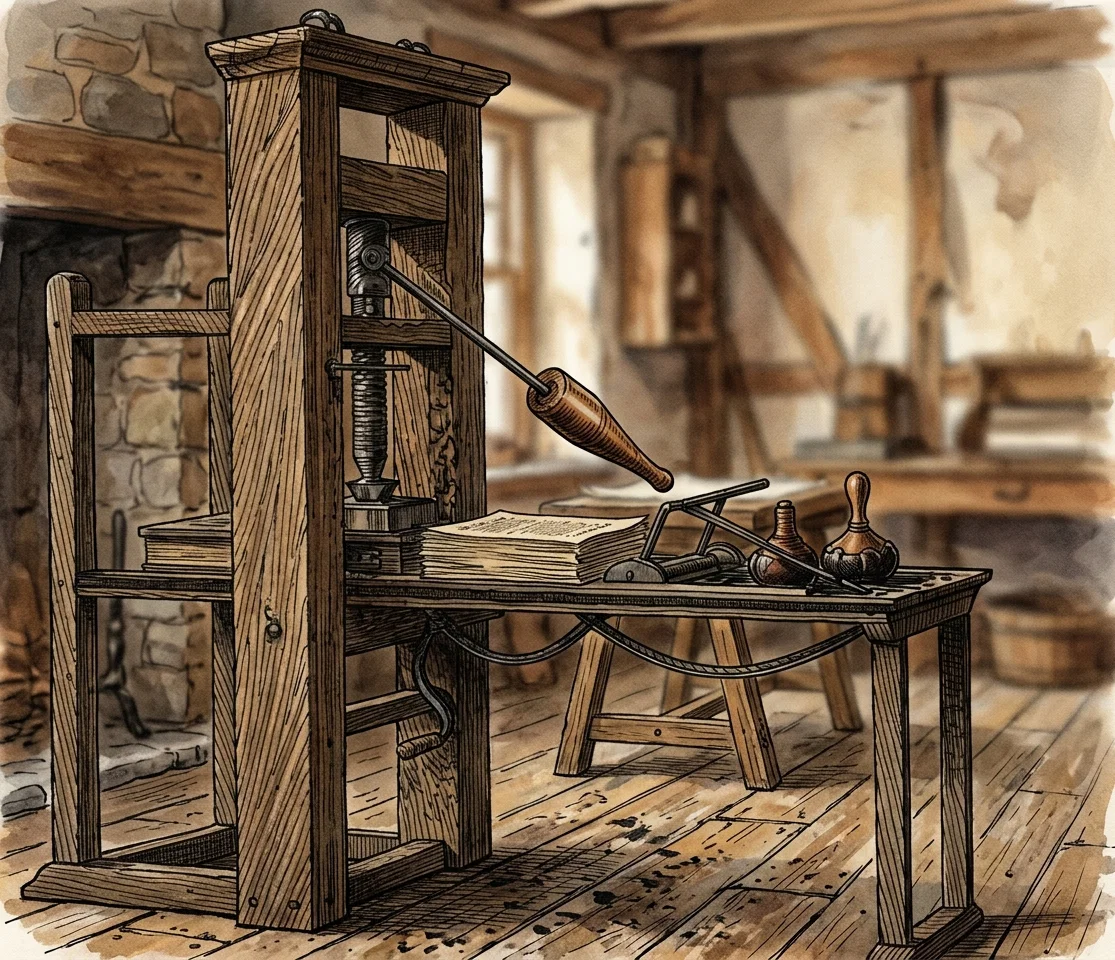
The Old Ephrata Press, on Which the Declaration of Independence Was Printed. (See last page.)
He has refused to pass other laws for the accommodation of large districts of people, unless those people would relinquish the right of representation in the Legislature; a right inestimable to them, and formidable to tyrants only.
He has called together legislative bodies at places unusual, uncomfortable, and distant from the depository of their public records, for the sole purpose of fatiguing them into compliance with his measures.
He has dissolved representative houses repeatedly, for opposing, with manly firmness, his invasions on the rights of the people.
He has refused, for a long time after such dissolutions, to cause others to be elected; whereby the legislative powers, incapable of annihilation, have returned to the people at large for their exercise; the State remaining, in the meantime, exposed to all the danger of invasion from without, and convulsions within.
He has endeavored to prevent the population of these States; for that purpose obstructing the laws for the naturalization of foreigners, refusing to pass others to encourage their migration hither, and raising the conditions of new appropriations of lands.
He has obstructed the administration of justice, by refusing his assent to laws for establishing judiciary powers.
He has made judges dependent on his will alone for the tenure of their offices, and the amount and payment of their salaries.
He has erected a multitude of new offices, and sent hither swarms of officers to harass our people and eat out their substance.
He has kept among us, in times of peace, standing armies, without the consent of our legislature.
He has affected to render the military independent of, and superior to, the civil power.
He has combined, with others, to subject us to a jurisdiction foreign to our Constitution, and unacknowledged by our laws; giving his assent to their acts of pretended legislation.
For quartering large bodies of armed troops among us:
For protecting them, by a mock trial, from punishment for any murders which they should commit on the inhabitants of these States:
For cutting off our trade with all parts of the world:
For imposing taxes on us without our consent:
For depriving us, in many cases, of the benefits of trial by jury:
For transporting us beyond seas to be tried for pretended offenses:
For abolishing the free system of English laws in a neighboring province, establishing therein an arbitrary government; and enlarging its boundaries, so as to render it at once an example and fit instrument for introducing the same absolute rule into these Colonies:
For taking away our charters, abolishing our most valuable laws, and altering, fundamentally, the powers of our governments:
For suspending our own legislatures, and declaring themselves invested with power to legislate for us in all cases whatsoever.
He has abdicated government here, by declaring us out of his protection, and waging war against us.
He has plundered our seas, ravaged our coasts, burnt our towns, and destroyed the lives of our people.
He is, at this time, transporting large armies of foreign mercenaries to complete the works of death, desolation, and tyranny, already begun, with circumstances of cruelty and perfidy scarcely paralleled in the most barbarous ages, and totally unworthy the head of a civilized nation.
He has constrained our fellow-citizens, taken captive on the high seas, to bear arms against their country, to become the executioners of their friends and brethren, or to fall themselves by their hands.
He has excited domestic insurrections among us, and has endeavored to bring on the inhabitants of our frontiers the merciless Indian savages, whose known rule of warfare is an undistinguished destruction of all ages, sexes, and conditions.
In every stage of these oppressions, we have petitioned for redress in the most humble terms; our repeated petitions have been answered only by repeated injury. A prince whose character is thus marked by every act which may define a tyrant, is unfit to be the ruler of a free people.
Nor have we been wanting in attention to our British brethren. We have warned them, from time to time, of attempts made by their legislature to extend an unwarrantable jurisdiction over us. We have reminded them of the circumstances of our emigration and settlement here. We have appealed to their native justice and magnanimity, and we have conjured them, by the ties of our common kindred, to disavow these usurpations, which would inevitably interrupt our connections and correspondence. They, too, have been deaf to the voice of justice and consanguinity. We must, therefore, acquiesce in the necessity which denounces our separation, and hold them, as we hold the rest of mankind, enemies in war, in peace friends.
We, therefore, the Representatives of the United States of America, in General Congress assembled, appealing to the Supreme Judge of the world for the rectitude of our intentions, do, in the name and by the authority of the good people of these Colonies, solemnly publish and declare, That these United Colonies are, and, of right, ought to be, free and independent States; that they are absolved from all allegiance to the British crown, and that all political connection between them and the State of Great Britain is, and ought to be, totally dissolved; and that, as free and independent States, they have full power to levy war, conclude peace, contract alliances, establish commerce, and do all other acts and things which independent States may of right do. And, for thesupport of this Declaration, with a firm reliance on the protection of Divine Providence, we mutually pledge to each other our lives, our fortunes, and our sacred honor.

ROME AS THE LEADER IN KNOWLEDGE.

BY H. F. PHELPS.
The 5th of September, 1895, was a great day in the annals of the northwest, especially that of St. Paul, Minn. The occasion was that of the consecration of the Catholic seminary just completed, made possible by the gift of $500,000 from the great railroad magnate, J. J. Hill, president of the Great Northern Railroad. Mr. Hill is not a Catholic, but his wife is.
Pontifical high mass was celebrated in the open air by Mgr. Satolli. The dedicatory sermon was by Dr. O’Gorman. Speeches were also made by Satolli, Archbishop Ireland, Bishop Kean, and J. J. Hill. Dignitaries of the church were present from all parts of the country. Upwards of two hundred priests were also present. Over one hundred voices from the various Catholic choirs of the city of St. Paul rendered the music. It was estimated that fully twelve thousand witnessed the ceremonies. After the addresses the buildings received the blessing of the ablegate. A congratulatory telegram was received from the pope through Cardinal Gibbons.
While there were many good things said in the various addresses in regard to education, the main drift was the education of the priesthood. There were also some things said that a Protestant would criticise. With no desire, however, simply for criticism, the writer would desire to call especial attention to some things said by Dr. O’Gorman. In speaking upon the social conditions, and the desire upon the part of some for a more equal distribution of wealth, he said:—
This is the aspiration of the world to be realized in the thoughts of many by impracticable dreams and impossible Utopias. The church has the real solution. The ethics she teaches—the duty of labor and capital—favor the production of wealth, and she alone has the moral lessons and influence that render the use of wealth just and humane. As to the distribution of riches, what power is more needed than the one that proclaims the principles of justice and charity, the fatherhood of God and the brotherhood of man?
Now this is an exaltation of the Catholic Church above all others, and even above Jesus Christ. For, notice, the ethics, the solution, the influence, and the moral lessons are all to be found in the church—the Roman Catholic Church—not in any other church, nor even in the Gospel of Christ. Let man rather say that the ethics, the solution, the influence, and the moral lessons for these times, are all to be found in the Gospel of Jesus Christ, which is the power of God.
Another statement is the following:—
Fear not for the church. She is the mother of liberty, science, and order; in her are the principles, the strength, all the resources to guide the new movements of humanity, as Leo XIII. is showing and doing. No fear of the church; this is not the question nor the present concern.
The mother of liberty! Forsooth! And when did she become such? O! I see; it is the liberty of and for the Catholic Church. For has not Pope Pius IX. said in his encyclical of August 15, 1854, “Cursed be those who assert the liberty of conscience and worship, and all such as maintain that the church may not employ force”? And that ultramontane editor, Veuillot, said, “When Protestants are in the ascendency we demand religious liberty, because that is their doctrine; but when Catholicism is in the ascendency we deny religious liberty, because that is our doctrine.” She the mother of liberty? It is only one of those sops that just now are being thrown out to deceive sleepy Protestants. But again Dr. O’Gorman says:—
Give us then a clergy holy, master of knowledge and expression, and America, destined by providence, according to all appearances, to be the theater upon which modern improvements are to have their greatest and quickest developments, America shall be Christian and Catholic. Such is the purpose of the St. Paul Seminary, and such, in a higher and wider sense, is the purpose of the Catholic University of America, to which your seminary is affiliated. Such is the program outlined by Leo XIII. In science Catholics ought not to be followers but leaders, is the watchword that has come down to us from the Vatican.
The Roman Catholic Church to be the leader in science! And for wonder! Look at her history in countries where she has the rule to-day, and in days gone by. Why was she not the leader in knowledge in and during the Dark Ages? And why does she not lead in Mexico and in South America to-day? Let her go to those countries and there establish her claims. As she admits the doctrine of religious liberty in countries where that is the doctrine, so she favors education where she can best obtain her ends by that means. And even here it is the education of the priesthood, according to these addresses, and the parochial school under the dominating influence of the priests, because in this country her people are made to see the need of education. But where she rules, as in Mexico and in South America, she has no aspiration to become a leader in science, or to assert or give proof that she is the mother of liberty. And in this country, where religious liberty is the doctrine, could she gain the ascendency, our liberty would soon become the same as in those countries where now she rules. But ever since this nation, by the affirmation of the Supreme Court, became a “Christian nation,” these claims of the Papacy have been made with a boldness that is an astonishment to those who are inclined to look at the logical results of admitting those claims. They are but sops that are continually being put forward to lull the nation to sleep. And the nation is being deceived by these claims—to its ruin and to the ruin of the world. And this ruin is incidentally mentioned by the doctor as follows:—
“The priest is the keeper of knowledge, and from him shall the law be sought.” “And what,” continued the prophet, “if he depart out of the way and cause many to stumble at the law?” “Ah, then,” saith the Lord, “I have made you contemptible and base before all people. I will send poverty upon you, and I will curse your blessings; I will scatter upon your face the dung of your solemnities.” More than sacrifice, sacraments, worship, and rites has been committed to the priests—knowledge of the law and order.
Of all the churches in all the world, it is to the Roman Catholic Church, according to history, that the words of the prophet are applicable: “Her priests have violated my law, and have profaned mine holy things; they have put no difference between the holy and profane, neither have they showed difference between the unclean and the clean, and have hid their eyes from my Sabbaths, and I am profaned among them,” in that they have expunged the second commandment from the law, and set the Sunday—“the wild solar holiday of all pagan times”—in the place of the Sabbath of the Lord, thus putting no difference between the holy and the profane. Thus it is true that they have “caused many to stumble at the law.” But the time is not far distant when the doom that is written by the prophets will fall upon mystical Babylon and all that will be found connected with her. Therefore the words are now going, “Come out of her, my people, that ye be not partakers of her sins, and that ye receive not of her plagues.”

THE LATEST “HEALER.”

Francis Schlatter, “the Healer,” suddenly closed his work in Denver, two days before the time appointed, and with nearly a thousand people waiting in line in the chill morning for his supposed magic touch. At first it was a mystery where he had gone, as he left in the night without warning, but he has been found on a ranch near by resting. It is said that he will go to Chicago next.
What is he? and what are we to think of him? Dr. Addison Blanchard, pastor of our Second Church, Denver, writes us in a way to dissipate much of the extravagance concerning him. When he talks about being “Messiah,” it is evident he means to use that term in the sense in which it is used by those who believe in Theosophy or the various forms of “occultism,” so common now in this land.
That he claims to be “Messiah” in any such sense as the Christian understands it, is not true. He has dabbled in Spiritualism, and has studied Christian Science, so called, and does not claim to be a Christian. Much has been made of his alleged resemblance to the great masters’ representations of Christ, but he does not speak of Christ at all. That name is entirely ignored. He is claimed by the Spiritualists, and those around him are of that persuasion apparently. He is a mediumistic healer, possessing whatever of power of an evil kind such people may have. Stories of healing are magnified as they get out from Denver, but some do claim to have been helped. With all that Dr. Blanchard has as yet seen, it has not been marked or abiding, but there are many reported cases of alleviation. That is, however, not the crucial question.
When it is remembered that our Lord said that when the Holy Spirit came, the Spirit should glorify him, and testify of him, we do well to distrust any man who comes ignoring “that name.” When he utterly leaves out the name of Jesus and claims only to do these things in the power of “the Father,” we do well to inquire who his father may be, and to study John 8:38-44. Our Lord said, “No man hath seen God at any time; the only-begotten Son, which is in the bosom of the Father, he hath declared him.” We do not get the Father save by knowing the Son. He that hath not the Son hath not the Father.
Remembering 2 Thess. 2; 1 Tim. 4:1; 2 Peter 2:2, it is probable that 1 John 4:1-3 is in point, and should be carefully considered in judging the claims of this man. He seems to be himself the most deceived of all, but he is not the simple-minded, ignorant peasant that he has been represented to be. Our cities are overrun with various forms of “occultism,” which is none other than heavyold heathenism from the Orient. True Christians will not be led away when they know what it is, but many who know not their Bibles will for a time run after such men as this “Western healer,” so called.
Peter, when he healed the man at the Beautiful Gate of the temple, was exceedingly careful to state and to define the source of power. This man, utterly failing to honor “the Name that is above every name,” shows in this very fact sure marks of his character.—The Advance.
Continue reading: BUT OUGHT IT TO BE?