In my first article I stated that from the time when Magellan discovered the group in 1521, no special effort was made to conquer or colonize the islands till the time when Legaspi was sent out in 1564 as the captain-general of the expedition, accompanied by the friar Urdaneta, the leader of the spiritual forces. The object of King Philip in sending out this expedition was chiefly religious. This object is expressed in the monument which stands on the Luneta in Manila, on which are the figures of Legaspi and Urdaneta, the friar bearing aloft the cross, and the general carrying by his side a great sword. In speaking of this matter a certain writer says, “In examining the political administration of the Philippines, then, we must be prepared to find it a kind of outer garment, under which the living body is ecclesiastical. Against this subjection to the influence and interests of the church, energetic governors rebelled, and the history of Spanish dominion is checkered with struggles between the civil and religious powers, which reproduced on a small scale the medieval contests of popes and emperors.”
The work of Christianizing and civilizing the pagans of these islands was placed in the hands of the friars, large numbers of whom were sent out from Spain and Mexico. The letter of instruction given to Urdaneta and the friars who accompanied him in 1564 began as follows: “Very Beloved Sons: You are aware how Filipe, by the grace of God, King of the Spains and the Indies, and our Lord, has been greatly pleased with the news that some brethren of our order are to go with the expedition now being equipped by his illustrious viceroy, . . . to the end that, according to right reason, and the benign counsels of Christian piety, both at home and abroad as will best seem consistent with the purpose of his Royal Majesty, you may control the fleet and troops of the Spanish army,” etc.
In 1565 an order was sent to Mexico, containing the words: “Priests, and a goodly number of soldiers and muskets, so that if the natives will not be converted otherwise, they may be compelled to it by force of arms.”
When we consider the crude ideas of the Catholic Church as to what conversion means, it is not strange that the four centuries of the complete control of the education of the Filipinos has resulted in a moral condition but little if any better than the heathen. Like Xavier in Malacca and India, who counted as converts babes snatched from their mothers’ arms and sprinkled, so these Spanish friars made conversions by the wholesale. One writer says, “The king of Cebu accepted baptism at once. Crowds knelt and were baptized in rows. Where reluctance to accept the new faith was apparent, a large and influential party of the missionary friars were ready to employ force. In fact, one of the burning questions of early friar evangelism was whether it was right to use force in securing conversions to the Christian faith.”
In accepting the Catholic faith, little if any change was necessary in the lives, or in the forms of worship, of the Filipinos. The gods worshiped before the arrival of the friars were similar to those worshiped to-day in Java and Borneo. These were exchanged for the adoration of the virgin and other saints. As I visited the churches of Manila and saw the images before which the people bowed, and then sailed across the China Sea, only two days by steam, and visited the pagan temples of Canton, I could see but a slight difference between the forms of worship. In both there were altars and images, lights constantly burning, paintings on the walls, incense ascending, etc. On the outer walls of some of the churches were images of animals almost identically with those on the walls of the Buddhist temples. One thing that facilitated the conversion of the heathen Filipinos was their love of the beautiful in art as well as music. The Romish priests knew how to use these to advantage. On visiting the Manila cathedral on Christmas day I saw more clearly than ever the power of music and glittering display on the heathen mind. The priests were robed in rich attire, brilliant lights shed their radiance all around, while the ear was regaled with the richest music I ever heard. Almost in spite of himself a person begins to have a feeling of reverence for this heathenish ceremonial.
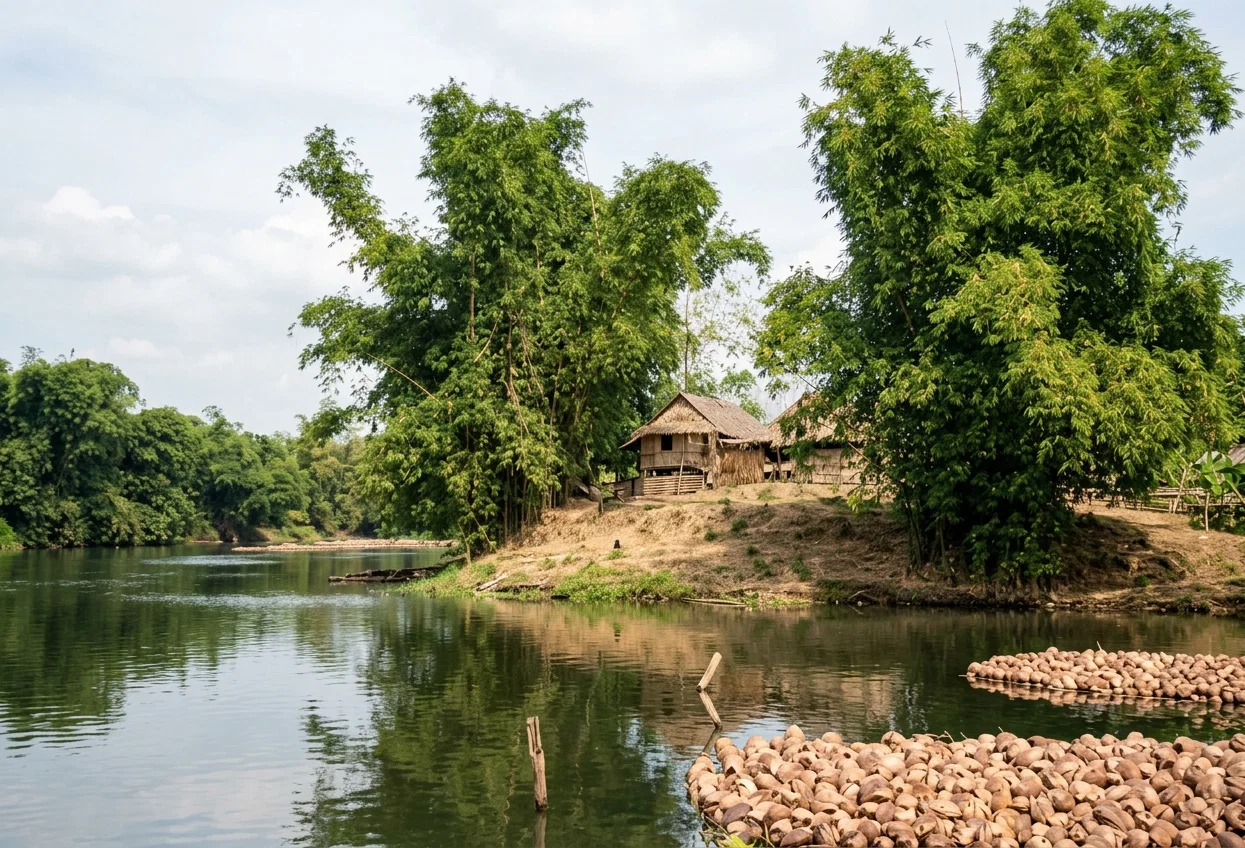
FLOATING COCONUTS TO MARKET ON PASIG RIVER
With the pressure brought to bear from so many sources, it is no wonder that within fifty years from the time of the arrival of the friars, a majority of the population exchanged their heathen deities for those brought by the Spanish teachers. To-day the Filipinos are very religious. Manila might almost be called the “city of churches.”
Within that part called intramuros, or the walled city, which is probably less than half a mile square, there are eleven large churches, including the magnificent cathedral; while in other parts of the city they are almost numberless. These have connected with them large buildings called conventos, the residence of the friars. Many of the friars have left the country since American occupation, but hundreds still remain.
Church feasts are often held in one or the other of the churches. At the time of these feasts, which continue for several days, temporary booths are set up all about the churches, where all kinds of eatables and all manner of trinkets are on sale. But the principal feature of the feast is the gambling booth, which has more patronage than all others combined. At night there is the religious procession on the street. Before that the people gather in the church and kneel in large numbers, while the priest recites his monotonous service. The procession then moves on, carrying flashily dressed images of the virgin and other saints, accompanied by bands of music, torches, illuminations, while the inevitable incense of tobacco smoke from thousands of cigarettes and cigars ascends like the smoke of a great furnace. At certain times in the
year the virgin is decked with the richest apparel, and adorned with jewels, pearls, and diamonds to the value of hundreds of thousands of dollars. At such times the poor virgin is carefully guarded by policemen who look after her financial interests. In the churches I have seen women walking on their knees the whole length of the immense churches, counting their beads, and saying their prayers.
But though the seeds of evil that have been sown for so long time in the Philippines will continue to bear their baleful fruits, it is hoped that a brighter day has dawned. After almost four hundred years in which the Bible has been a sealed book, God’s Word is now as free in this field as in America. The British and Foreign Bible Society and the American Bible Society have agents in this field, with prospects of good success. The agent of the latter society told me that he had himself placed thirty-four thousand copies of the Bible or parts of the Bible in the hands of the people during the past year. Of this matter I will write more fully in another article.
(To be concluded)
Generosity Measured by What We Give
“Our generosity is measured not by what we give, but by what we have left.”
W. W. MILLER
By W. W. Miller
India
I VISITED East Bengal in company with Brother A. C. Mookerjee and a young man with whom I have been holding readings. We had a most interesting time, indeed. The interested people of the town had a building partly up when we arrived, in which to hold meetings, also a nice place for us to lodge in, and plenty of rice and dahl (lentils) to eat, and good strong board beds to sleep on. We spoke to the people from the time we landed until twelve that night. We were astir early the next morning, visiting families that expressed their desire to keep the Sabbath. While visiting these, word came that the chief magistrate wanted us to come and speak in his office. So we went.
As we passed the court room, Brother Mookerjee said, “There are all the government employees in there, and they may put many strange questions to you.” We went to our lodging-house, and had a season of prayer first. Then we took our chart and entered the court room. I took the bench, with the magistrate to my left, and Brother Mookerjee to my right, and I presented Daniel 2. The Lord helped in a special manner, and I spoke until after time for the court to open. All the government employees were present, and listened very attentively. The head schoolmaster extended me a vote of thanks for the instruction, and said he would teach these things to the people. The magistrate said we could stay in his house for two years, and if we wanted to start our work there, he would help. Another man who works in his office brought in a donation of eggs and potatoes. Truly, there is an interest there, and also opposition; for the next day after I returned to Calcutta, a leader of the mission called on me, and requested me to start our work two or more miles away. But I told him that the message I had for that village was just as much for him and his mission as for any one else. I promised him that those who accepted our message and lived up to the teaching would become their best citizens. He finally promised to read some of our books and papers.
W. W. MILLER
W. C. HANKINS
By W. C. Hankins
China
KULANGSU, AMOY.—The language is a difficulty, but the Lord is helping us to master it, and even now I can talk and preach a little. Since my arrival I have preached six times in the Chinese language. I have read “Pilgrim’s Progress,” “Jessica’s First Prayer,” and the Gospels of Matthew, Mark, and eleven chapters of Luke. I will probably have finished the Gospels, and perhaps Acts and Romans, before this reaches you.
Brother Keh and I have completed a book on our faith. I presented the main points of the message to him, beginning with the creation, and giving the fall of man, God’s plan of redemption, sacrificial and sanctuary questions, the prophecies, etc. We took it up in a connected way, and I proved each point to him before he wrote it down, and when he understood it thoroughly, he wrote it in Chinese characters. So we now have a book of twenty chapters, setting forth the main points of our faith.
Next week Brother Keh will go to Canton, to attend a convention which Brother Anderson is intending to hold for the native workers. While there he will go through the book with Elder Anderson, and try to get it ready for publication, if Elder Anderson thinks it worth publishing. When he was here about two months ago, he suggested that we write the book in this way. We very much need a work of this kind, as we are entirely destitute of this sort of literature, and of course this could be read anywhere in China. I hope and pray that it may be the means of bringing many souls to a knowledge of the truth.
In this province, in about another year, Brother Anderson thought I might go into a city, preaching there at night, and in the daytime have each worker sell some book, such as ours, for a few cash, going from house to house. Even a large city of several hundred thousand could easily be canvassed in two or three weeks. Thus we would go from city to city, and from village to village, spending more time at the large places, sowing the seeds of truth broadcast through the land. As we behold the countless numbers of these people, it seems to us the only way.
We enjoy our work here to the utmost, and are very thankful that the Lord led us here. Pray for us, that we may have his Spirit abiding with us, that we may be able to carry on his work in an acceptable manner.
W. C. HANKINS
Caterham (England) Sanitarium
By L. Brooking
The work here is progressing, and we are quite busy. Needed improvements are being made. Last month one of the lady patients accepted the truth. We have had the privilege of a visit from Elder Spicer, and we all appreciated the talk given on the advance of the message in Great Britain since his first visit here over twenty years ago, and the part the training-schools are doing in preparing an army of young people to speedily finish the work. As we listened to the exhortations to hold fast the truths that made us Seventh-day Adventists, our hearts were stirred, and we appreciated the truth more than ever.
The following Sabbath, a church was17organized by Elder Salisbury, of eighteen members; a few others will join, most of them being helpers in the institution. The writer was chosen as elder, and Brother Guyton as deacon.
L. BROOKING.
J. A. STRICKLAND
By J. A. Strickland
Jamaica
KINGSTON.—I have recovered from my recent attack of fever. I was laid up for four weeks, but now feel as hearty and strong as I ever did. I have had an attack of fever each year since I came here.
The question of Sunday desecration is again agitated here. The governor has discovered an ancient enactment prohibiting Sunday work on the wharves, and is showing a disposition to enforce it.
I am of good courage, and thankful for the many signs seen all over the world that Jesus is surely coming soon.
J. A. STRICKLAND
Dominica, West Indies
By P. Giddings
THE week of prayer was a pleasant and profitable time to the company here. We met at five o'clock every morning, and our songs of praise in the stillness of that early hour were impressive. Some of our neighbors joined with us in the services. We had our first baptism of two candidates on Sunday, December 31. A large crowd assembled to witness the ceremony. Tracts on baptism were sold at the close of the service.
Our annual offering was $13.12; the tithe was $116.51; and the Sabbath-school donations amounted to $17.76, $8.17 of which was given to missions; other donations came to $6.34; and on the building fund one hundred dollars was collected, and we are making an earnest effort to raise the rest this year.
Since writing the above, we have had a severe shock of earthquake, which shook terribly the largest buildings. No damage was done except the stone wall of a house separated from the wooden structure. P. GIDDINGS.
S. B. HORTON
By S. B. Horton
Louisiana
NEW ORLEANS is having some pleasant experiences of a missionary character. Sisters Shields and Cushman, who have been visiting cities and towns in their journey from California in the interest of the Watchman, are doing faithful work with that periodical in our Crescent City. Sisters Bishop and Kirby are in the city also, in the interest of the Watchman, and report that their work is of an encouraging character. Sisters Lackey and McDonald came to New Orleans about ten days ago in behalf of the work in India. Their plan is to sell the Bible Training School, published by Elder S. N. Haskell, and they have had some success in this worthy endeavor. Sister Richardson stopped a few days on her way to interior Mississippi, where she will engage in colporteur work. Sister Snyder also spent three or four days waiting for the sailing of the “Prince Arthur” for Cuba, where she will join her husband in the work in that field. Brother Howard Peebles, of College View, is now with us, awaiting the sailing of a vessel to Honduras, his new field of labor. We are glad to see these workers, and to assist all we can in the good work.
We are planning for an institute at Welsh, beginning March 1, and hope for much good as a result. The program for the meeting includes an educational and religious liberty convention, besides a regular canvassers’ institute.
We are having some experiences just now in the religious liberty work. Another effort in behalf of additional Sunday law enforcement is to be made in May before the legislature.
S. B. HORTON
The New Zealand Camp-Meeting
By S. M. Cobb
HAVING been asked to connect with the work in New Zealand, I reached this field Nov. 1, 1905, and at once took up my duties in this conference.
Our camp-meeting was planned for Jan. 12-28, 1906, and after spending some time with a few of our churches, with encouraging results, we made ready for the meeting. This meeting was held at Island Bay, a beautiful suburb of Wellington, the capital of New Zealand. Our camp was pitched on a beautiful site near the seashore.
This camp-meeting was the largest ever held in New Zealand, and certainly the Lord has done great things for us during this annual feast of tabernacles. A goodly number started for the first time in the divine life, and all our people were much encouraged.
Twenty-six were baptized during the meeting. The outside attendance was very good, and a deep interest was manifested in the truth as presented from the desk, and already some have decided to obey. We shall follow up the interest with a tent effort.
Elder O. A. Olsen, president of the Australasian Union Conference, has spent one month in this field, having been with me two weeks before the camp opened, and we greatly appreciated his help and counsel. Elder W. A. Hennig and Dr. D. H. Kress were also with us, and rendered valuable assistance.
The business of the conference was very interesting, and steps were taken to increase our facilities, and to advance the work in all its different phases. We are now entering the field with three tents, and are also taking up the Maori work, that is, the work for the natives of this field. We have “Christ Our Saviour” and one tract in the language of this people, and have set apart one man for this work, and shall add to this force as we can.
The conference has also decided to open an industrial school for New Zealand as soon as a suitable location can be found, and, as soon as consistent, to start a food factory and a sanitarium, and to purchase sufficient land to permit these institutions to be located in one place, or on the same property. While at the camp, we raised about three thousand five hundred dollars toward the school. The work at our present sanitarium in Christchurch is also to be encouraged and built up.
The usual officers of the conference were elected, and the camp-meeting closed with good prospects for the future of our work in this field.
S. M. COBB.
Burma
By Heber H. Votaw
INSEIN.—We have good news to report, but I am at a loss to know how to tell it clearly. A part of the work was done by Brother and Sister Myers, some by our faithful brother, Mg. Maung, his sister, Mah May, and Brother Mg. Mya Htoon, and, lastly, we watered, and God gave some increase.
For a long time there has been an urgent, steady call from Moulmein. The rainfall is so heavy there that we were loath to go during the rainy season, especially during our first season here. But as soon as the rains stopped, we left Brother and Sister Hansen in charge of the work in Rangoon, and went to Moulmein.
We found one brother already keeping the Sabbath. He had been convinced for about a year, but has been obeying for only five or six months. He is as earnest as a man can be. He has given up tobacco, tea, etc., and spends all his time in studying and preaching the truth. He goes into the jungle villages, and preaches to Buddhist and Christian. His sister, Mah Thaue Me, was also keeping the Sabbath. They were keeping this day about as people generally observe Sunday, so our first care was to instruct them in regard to proper Sabbath observance. They received the word gladly, and upon Friday did all the work of preparation.
Another member of this family, David Hpo Hla, also accepted the message while we were there. For nearly twenty years he has been in the employ of a mission as a catechist. When I arrived in Moulmein, he came to his sister's home, where we stopped, and began asking questions. Soon we were studying together two or three hours every day. As new ones began coming in, he interpreted for me, thus he went over some of the points of our faith many times. After we had studied for some days, he came in one morning, and announced that he could not sleep at night. We thanked God, and took courage. One Sabbath we studied some points in the life of King Saul. Early Sunday morning he came over and said, “I don't want to hold another service in my church.” After some talk, he went and conducted services that day, and left his resignation for his priest, to take effect at once. The priest wrote and chided him; the bishop wrote and scolded the priest for laxity in caring for his charge; the people of the parish and the children of the school wept. But our brother's face was so bright and happy, and his whole being so joyful in the Lord, that we knew that all that was being said was not affecting him.
One woman came to our Sister Mah May, and said, “Those people have taken the best man in the church.” We have known of similar statements being made in America, as a result of the giving of the message.
Brother Hpo Hla had taken several degrees in the Masonic lodge, but before I thought of his doing so, he had withdrawn from this order. He has accepted some position with a lumber firm, where he can keep the Sabbath, and where he will be put in a quiet place suited admirably for study.
His wife is with us in the truth, and I hope his five children may all be trained in this message. As I looked at them, I longed for a school of our own.
A young lady whose parents bitterly opposed her, saw the Sabbath, and is endeavoring to keep it, but I can not say how she will do finally. She is a good Burmese scholar, and I am hoping she will be firm.
An old man came to us and acknowledged the points shown. But he is so beset by his family and church friends, that I am not sure of the results. If we can keep in touch with him, I entertain strong hopes for him yet. He seemed so earnest.
One woman, fifty years of age, and always a Buddhist, has requested baptism. She smokes, as all Burmese women do, and of course I can not baptize her yet; but we are hoping to help her to see the importance of giving this habit up. If she gains the victory, and upon questioning seems fully instructed, she will be our first fruit from Buddhism direct.
Mrs. Votaw gave much of her time to visiting and canvassing; in fact, she went whenever able, and sometimes when ill. Her burden lies in the direction of the heathen, mostly. She went with the Good Health and “Story of Daniel” to the English-speaking Burmese, and although most of them refused the book, almost all took the paper, and she embraced the opportunity to speak of Christ and of his return. Her canvassing brought into the mission more than our wages for the month spent in Moulmein.
Brother Maung Maung is now following up the interest, and we shall return soon, and then we hope to hold a baptismal18service. Our work reaches all classes. Mrs. Votaw secured orders from Jews, Mohammedans, Hindus, Buddhists, Romanists, and Protestants. God has honest ones in all, I believe.
We have received a most cordial invitation to stay with an Eurasian family when we return to Moulmein. The woman has a reputation for piety, and we hope to show them the precious and solemn message of the hour.
HEBER H. VOTAW.
Work Among the Jamaican Churches
By W. H. Randle
LEAVING Kingston on the morning of the fourteenth, after a ride of thirty-six miles I reached Hart Hill. Here I was well received and kindly treated. In the evening we had meeting in the little church building. We first had a praise service. While singing, a few strangers came in, and at the close of our praise service, we had a profitable time together, studying the Word of God.
My next station was Moore Park. I reached this place on the fifteenth, and remained until the morning of the seventeenth. Some of the members of this church are unable to attend service, because of illness. I visited a few of them, and am glad to report that they are still firm. Their church building greatly needs repairs.
I went from Moore Park to Swift River, on the morning of the eighteenth. The members here are all of good courage. This church is indeed working for the bringing in of souls, and as the result, the Lord is blessing it. I had two evening meetings, and at each the attendance was good. Two persons gave in their names, desiring to be admitted as members. This is an evidence that the Lord is blessing the efforts of the believers here.
Passing through Port Antonio, I went to John's Hall on the twentieth, where I remained until the twenty-sixth. I had meeting every evening. Brother Burke, the leader of this church, is a whole-hearted Christian, but he is greatly hindered from doing all that he would like to do, through failing health.
Brethren, pray for the work in Portland, and for me, that wisdom may be given me, and that I may faithfully bear the great responsibilities laid upon me, drawing strength continually from Jesus.
W. H. RANDLE.
Port Antonio.
The Oakwood School
By G. H. Baber
THE many readers of the REVIEW will no doubt be pleased to know how the Oakwood Manual Training-school, at Huntsville, Ala., is prospering. We are thankful to say that God has blessed us with excellent health, plenty to eat, and above all, a desire to do his will.
While our enrolment, only about fifty, has not been large, the Lord has not allowed any unruly nor wilfully disobedient students to come to our school. For this we thank him, and pray that he may continue to work for us. Since last September nineteen students have been baptized and received into the church, and I believe there is not one of this number who is not still striving to overcome, and to walk with the Lord daily.
Besides the enrolment already mentioned, we have a primary department of six, which we have placed in the hands of the students as a normal department in embryo; however, as we are not in a thickly settled community, we think this department will not take on large proportions.
We have just built, equipped, and have in successful operation a fine little greenhouse, where the plants are urgently pleading for an outside temperature suited to their requirements. We have great hopes of success in this undertaking.
A shoe-cobbling department has just been installed, where we give weekly lessons to the boys, nearly all of whom seem anxious to learn how to repair their own shoes. This will also be a saving to the institution of many dollars during the year.
Sewing classes for the boys as well as for the girls are in operation. The boys are learning how to repair their clothing and to make gloves, the girls how to make their own dresses and keep them in repair.
The mechanical department teaches the boys to sharpen and repair tools, and the use of plane, square, saw, and hammer. If we had money, this department could do much more than it is doing. We could build a much-needed laundry, a milk-house, poultry-houses, and cattle sheds, to say nothing of a bath house and treatment rooms.
No doubt many of the contributors to the October collection for the colored work in the South will wonder what has become of all that liberal donation of about nine thousand dollars. My brethren, I think it my duty to tell you that this institution did not receive one third of that donation, and half of what it did receive was used to reimburse the Southern Union Conference for salaries advanced to teachers of this institution, and the other half was used to pay for the erection of three cottages built last year; so you see that not one cent of that donation was made available for present requirements. We have now come to the time to put out another crop, without resources with which to purchase the different kinds of seeds, fertilizers, etc. Since the October collection our donations have been very small, which, however, is not to be wondered at when we consider your liberality in October; but as I have said, that portion of it which came to this institution was used in paying old debts.
At our last Southern Union Conference several of the brethren pledged to support one or more students in this school for a year, which will require an actual outlay of from sixty-five to seventy-five dollars. I am impressed that among the readers of the REVIEW there are other friends of the colored work here who would be pleased to thus help some poor worthy student.
The Lord has told us through the spirit of prophecy that not only those who were directly responsible for the oppression of this people, but the entire nation has become debtor to them. Surely, brethren, if the entire nation, as such, is debtor to them, we who have the saving truth of the three messages are doubly so.
We believe that when we get our farm up to a high state of cultivation,—and it is susceptible,—the institution can be made entirely self-supporting, yea, more—profitable. But until that time comes, we must rely on your generosity for the continuance of the work at this place. To avoid delay I would ask that any who may feel impressed to come to our help in this time of need will send donations directly to our treasurer, W. H. Williams, Box 414, Huntsville, Ala. G. H. BABER.
Australasia
By Ole A. Olsen
It is now some time since we landed in Australia. During this time we have been occupied to the fullest extent of our strength. Our first engagement was to attend the Australasian Union Conference Council at Melbourne, Victoria, September 5–17. This was a very profitable occasion, especially for me, as I had recently come to this field; for during the council nearly every branch of our work here received more or less consideration. At this council we also had representatives from all parts of the field, which was very helpful to an understanding of the whole situation.
It was a great pleasure to me to meet all these brethren and fellow workers, also to find the work in this field so well established and so prosperous. The reports from the various institutions were all of an encouraging nature, showing the work to be in a healthy condition.
Since the close of our council I have visited the Avondale School at Cooranbong, attending the closing exercises for the year. The school has been greatly prospered from every standpoint. Everything in connection with the school shows a thrifty and prosperous condition. I have also visited Adelaide, South Australia, to counsel with the brethren there concerning more extended plans for their medical missionary work. I found the work making steady progress, and while there I had the privilege of dedicating a new church building at Prospect, one of the suburbs of Adelaide.
On the same tour I also visited Melbourne and Warburton, Victoria. The brethren of the Echo Publishing Office were very busy getting ready for the removal of the plant to Warburton, the country place selected for the future location of the Echo Publishing Company. The frame for the new factory was up and being enclosed. The prospect is that the removal will be completed in February.
In October, 1905, the camp-meeting and conference for New South Wales was held at Marrickville, Sydney. We were favored with most excellent grounds, quiet, well shaded, and easy of access from all parts of the city. This was a good meeting, and largely attended by our own people, and also by the people of the surrounding community. All the various lines of work received careful consideration, while the meeting was also rich in spiritual blessings. Quite an outside interest was raised during the camp-meeting. This has been followed by a course of tent-meetings, and a goodly number have taken their stand for the truth. We look for a good, strong company of believers to be raised up in this place.
The New South Wales Conference had the pleasure of adding seven new churches. During the meeting eleven souls were baptized. At the close of this meeting, Brother S. M. Cobb, who has been laboring here for the past two years, left the field for New Zealand. The Lord has greatly blessed the labors of Brother Cobb, and the brethren were loath to have him leave; but the work is one, and this was cheerfully appreciated by all the brethren. Brother J. E. Fulton was elected president of the conference. He arrived later, and is now at his post of duty.
I am now returning from the camp-meeting and conference in New Zealand. This meeting was held at Island Bay, Wellington. Twelve years ago I had the privilege of attending a camp-meeting in the same city. It was then held near the center of the city, but now there would be no room for a camp in that position. A good place was found in the suburb of Island Bay, directly accessible by tram from all parts of the city. This was the largest gathering of our people in the colony. There were fifty family tents, besides the meeting tents, with from two hundred and fifty to three hundred of our people in attendance. We had an excellent meeting, and we can but feel that it will mark an important era in the work of that conference. The outside attendance was good, though not so large as at some previous meetings; but the same ones continued to come even when the weather was unfavorable, thus manifesting a real interest. Some who had been under conviction took their stand heartily for the truth. All the business of the conference passed off most harmoniously.
Brother W. L. H. Baker, who has labored faithfully here for several years, had left some time before the meeting for his field in Victoria; and Brother Cobb had taken up the work in this conference, where he has been given a hearty welcome.
The New Zealand Conference feel that the time has come for an industrial intermediate school to be opened in their State. They have faithfully supported19the Avondale School at Cooranbong, both by their means and by their patronage; but there is a large number of young people who ought to be in school who can not go to Cooranbong. Seven hundred and seventeen pounds six shillings was raised in cash and pledges for the school, and a locating committee was elected to select a location and start the enterprise.
An excellent spirit pervaded all our meetings, while a deep solemnity rested over the camp. Twenty-five souls were baptized during the meeting; and all our brethren and sisters felt much encouraged over the outlook and prospects for the work in New Zealand. Good results will follow if they will take hold unitedly to carry out the good resolutions made at this meeting. O. A. OLSEN.