Your ShelfYour Projects

Signs of the Times, Vol. 28, No. 39.

THE TESTIMONY OF HIS WORKS

Signs of the Times

Sep 24, 1902

Pacific Press Publishing Company · OAKLAND, CALIFORNIA · Sep 24, 1902

THE TESTIMONY OF HIS WORKS.

WITH eyes turned in upon self, man soon loses sight of God; with his thoughts busy with self-interest, he forgets the hand that is measuring out his life.
THE sin of the ancient world—the thing that made their sorrowful course possible—was forgetting God. That is the sin, too, of the present age; men are forgetting God now, putting Him far away from them. In that age men "did not like to retain God in their knowledge," and so He "gave them over to a reprobate mind." The same disinclination to remember the Creator is seen to-day in every walk of life, from the feeder of swine to the polished orator who essays to feed the mind and soul of man.
"RACING from God" might fittingly be inscribed over the "triumphal arch" through which the twentieth century enters in. The wild racing of the high-power horseless carriage of to-day is typical of the religious attitude of the world. Forgetting God, the heathen world went farther and farther into sin, sinking lower the farther they went. At the same time they thought they were advancing toward the light. The present age is fleeing from the knowledge of God, and it claims to have just within its grasp the greatest light the world has ever known. It may be that the "light" of this age will not lead to the same grossness as did theirs of ancient times; but that it will lead to the same goal—soul ruin—is beyond dispute; for the author of the present great "light" was the author of that will-o-the-wisp which, in the days of Tyre and Babylon, Memphis and Carthage, was leading its followers to ruin. Away from God there is only one goal. The world is turning away from God. It will find but one goal.
WE are in the age of philosophy and psychology. The temples of these cults are called churches, and the people imagine they are listening to religious teachings when the expounders of occultism and philosophy are teaching their doctrines from a pulpit and denouncing the Word of God which proves their dogmas false.
Photo by E. J. Drake. Nevada Falls, Yosemite Valley. Height of Fall, 605 Feet.
IT is not necessary that man should forget his Creator. The world is full of His handiwork. We can not look to the sky by night without beholding the dazzling splendor of the rubies and emeralds and diamonds with which He has caught up the sweeping portiers of the halls of infinity. They are shining forth His praise and telling of His love and care. Their speech is heard in all His realm by the ears that welcome the message which they bear. We can not look to the heavens by day without beholding other emblems of His provision, His tender care, and His unfailing love. The chariots of the clouds are dropping down their benedictions while they tell us of the glory of the chariots which bear their Maker up, and the sun is gilding them with a slight tinge of the splendor that shines out from the throne of God. These are all telling us of Him, and bidding us not forget.
BUT God has not left His witnesses in the far reaches of space alone. He has peopled the earth on which we live with myriad witnesses of Himself, mute or voiceful, openly evident or hidden like jewels of the mine. In the mighty waterfall He has even condescended to paint for us a faint glimmer of His glory. In its roaring waters He has taught us to hear the symbol of His mighty voice. "The floods have lifted up their voice;" but "the Lord on high is mightier than the noise of many waters." Ps. 93:3, 4. "The Lord is upon many waters. The voice of the Lord is powerful." Ps. 29:3, 4. We read in Rev. 1:15 that His voice is "as the sound of many waters." Again: "I heard as it were the voice of a great multitude, and as the voice of many waters, and as the voice of many thunderings, saying, Alleluia; for the Lord God omnipotent reigneth." Rev. 19:6. That was the voice of the mighty multitude singing praises to His name. The one who heard it could liken it to nothing but the sound of many waters, and the tongue of the mighty tempest.
SO AS we stand in the presence of the great waterfall and listen to its speech, we can, with our inner ear, hear the voice of God speaking to our soul. He who heeds the voice will find his ear is becoming attuned to its faintest whisperings. He who is absorbed in self will hear but the roar of the waters. To him God's voice is discordant thunder.
THERE are other voices in the earth telling us of God, voices which the mind alone can hear, but which to the ear are dumb. To the upright mind they are unmistakable and their words are filled with all the power of infinity. They are the works of His hand telling us of His wisdom, power, and love. The fields, the forests, the hills, and the heaving sea are filled with such mute witnesses of His majesty; and the soul that can not hear their speech is dumb to the best this old earth has to give. "He putteth forth His hand upon the rock; He overturneth the mountains by the roots. He cutteth out rivers among the rocks." Job 28:9, 10. The power of the hand that carved this pictured waterway through the eternal hills, and flung the mighty boulders right and left to let it pass, is past the comprehension or thecomputation of the mind of man. Tier on tier He has piled the ponderous blocks that once lay where this thunderous river runs. Age on age it has tumbled its seething waters down this mighty mill-race, and its testifying tongue, vibrant by day and by night, will never cease to tell of the glory of Him who made it until all things are fashioned new.

DO YOU BELIEVE IN HIM?

THERE is no other way of being saved than by believing in Christ. But understand this, that believing in Christ means to put confidence in Him. He is supreme in every respect; implicitly confide in Him. He is also a jealous God. By yielding to His service we know Him. If we know Him we will love Him. If we love Him we will obey Him; "for this is the love of God, that we keep his commandments; and his commandments are not grievous."
Reader, according to His words, do you know Him? Do you love Him? Are you walking in His footsteps? He says, "He that saith he abideth in Him ought himself also so to walk, even as He walked." What about this? can you do it while following the creeds of men! When examining the things that they teach, do you find that they are in harmony with the Word of God? Does the belief which every or any human creed sets forth make God a liar?
There is only one way of salvation, and that is the way of "Thus saith the Lord." Any way that has not "Thus saith the Lord" all along the path is not the way.
"Hear O Israel, the Lord our God is one Lord. And thou shalt love the Lord thy God with all thine heart and with all thy soul, and with all thy might." There is "one Lord, one faith, one baptism." May you believe in God and therefore be guided by His chart—the Scriptures—so that you may reach heaven. There is no other way but through Christ, the Word of God, who is the way, the truth, and the life. "Be not deceived." "Prove all things; hold fast that which is good." "And the very God of peace sanctify you wholly; and I pray God your whole spirit and soul and body be preserved blameless unto the coming of our Lord Jesus Christ."
WM. O. BEECHER. Port Maria, Jamaica.

CHRIST'S SACRIFICE FOR US.

BY MRS. E. G. WHITE.
THE Lord created man pure and holy. But Satan led him astray, perverting his principles and corrupting his mind, turning his thoughts into a wrong channel. His purpose was to make the world wholly corrupt.
Christ saw man's fearful danger, and He determined to save him by the sacrifice of Himself. That He might accomplish His purpose of love for the fallen race, He became bone of our bone and flesh of our flesh. "As the children are partakers of flesh and blood, He also Himself likewise took part of the same; that through death He might destroy him that had the power of death, that is, the devil; and deliver them who through fear of death were all their lifetime subject to bondage. For verily He took not on Him the nature of angels; but He took on Him the seed of Abraham. Wherefore in all things it behooved Him to be made like unto His brethren, that He might be a merciful and faithful high priest in things pertaining to God, to make reconciliation for the sins of the people. For in that He Himself hath suffered being tempted, He is able to succor them that are tempted."
"We see Jesus, who was made a little lower than the angels for the suffering of death, crowned with glory and honor; that He by the grace of God should taste death for every man. For it became Him, for whom are all things, and by whom are all things, in bringing many sons unto glory, to make the Captain of their salvation perfect through suffering." Through the agency of the Holy Spirit, a new principle of mental and spiritual power was to be brought to man, who, through association with divinity, was to become one with God. Christ, the redeemer and restorer, was to sanctify and purify man's mind, making it a power that would draw other minds to Himself. It is His purpose, by the elevating, sanctifying power of the truth, to give men nobility and dignity. He desires His children to reveal His character, to exert His influence, that other minds may be drawn into harmony with His mind. "As ye have therefore received Christ Jesus the Lord, so walk ye in Him, rooted and built up in Him, and stablished in the faith, as ye have been taught, abounding therein with thanksgiving. . . . For in him dwelleth all the fulness of the Godhead bodily. And ye are complete in Him, which is the head of all principality and power."
Christ might, because of our guilt, have moved far away from us. But instead of moving farther away, He came and dwelt among us, filled with all the fulness of the Godhead, to be one with us, that through His grace we might attain perfection. By a death of shame and suffering He paid our ransom. From the highest excellency He came, His divinity clothed with humanity, descending step by step to the lowest depths of humiliation. No line can measure the depth of His love.
Christ has shown us how much our God can love and suffer in order to secure our complete restoration. The Son of God, in whom dwelt absolute perfection, became sin for the fallen race. He did not know sin by the experience of sinning, but He bore the terrible weight of the guilt of the whole world. He became our propitiation, that all who receive Him may become sons of God. The cross was erected to save man. Christ uplifted on the cross was the means devised in heaven of awakening in the human soul a sense of the sinfulness of sin. By the cross Christ sought to draw all to Himself. He died as the only hope of saving those who because of sin were in the gall of bitterness.
To break down the barrier that Satan had erected between God and man, Christ made a full and complete sacrifice, revealing unexampled self-denial. He revealed to the world the amazing spectacle of God living in human flesh, and sacrificing Himself to save fallen men. What wonderful love! As I think of it, I weep to think that so many of those who claim to believe in Christ are encrusted with selfishness. Living for self, they know not their Saviour. O that they had more faith, more love! If they entered into God's work in the spirit of Christ, if they knew the power of His grace, they would be imbued with holy zeal. They would labor earnestly to give the Lord's workmen in needy, difficult fields every possible advantage. With their prayers and with their means they would compass sea and land to establish memorials for God.
It is because the divine influence has not imbued Christ's followers that there is so little unselfish work. A message must be borne to the world that will impart new, sanctified impulses to those who are corrupted by sin. By those nigh and afar off the message is to be heard.
My soul is filled with sorrow as I see those professing to be children of God bringing their sinful habits and tendencies into the Christian life. Self gains the mastery, and Christ is dishonored. I marvel that professing Christians do not grasp the divine resources, that they do not see the cross more clearly as the medium of forgiveness and pardon, the means of bringing the proud, selfish heart of man into direct contact with the Holy Spirit, that the riches of Christ may be poured into the mind, and the human agent be adorned with the graces of the Spirit, that Christ may be commended to those who know Him not.

JESUS THE BEAUTIFUL.

[James Mudge, in Zion's Herald.]
THERE is no friend like Jesus, I've proved Him o'er and o'er; His love is like no other love; How could He love me more? He always does the best for me, Whatever may betide; And so I trust Him fully; He will provide.
There is no king like Jesus, The Monarch of the sky; How glad I am to serve this Lord! How sweet for Him to die! His army never knows defeat, His power no foe can face; And so I'm sure of victory In every case.
There is no sin in Jesus, The spotless Lamb of God; The rough and thorny paths of life With holy steps He trod. He bids me follow where He goes; Full strength comes with each day; And so I've no temptation From Him to stray.
There is all joy in Jesus, All gladness and delight, He turns my sorrow into song, He makes my darkness light. Through all earth's thick entanglements He leads, my perfect Guide; And so I cling the closer To His dear side.

The Testimony of God’s Works

GOD has made His wonderful works to be remembered, that in remembering them as His wonderful works man might remember the wonderful Worker by whose hand these works were wrought. Are you hearing in them the voice of testimony? or are they to you nothing more than the sound which they produce? If they are the mute witnesses, are you unable to translate their speech? As you look into the face of a morning-glory or a pansy, do you see nothing but the tissue of the petal and the blending of the colors thereon? If so, then it is more than likely that Niagara or Nevada Falls would have no words for you that you could understand, no sound but the noise of their rushing waters.

C. M. SNOW

LET these witnesses testify to you as God designed they should. Learn their speech. It is not the tongue of a dead language. Every syllable is pulsing with life. Their testimony will then be to your soul like refreshing rivers in a thirsty land, like streams that bring down gladness from the hills. Your life then will be like a fruitful tree by the river's side, your "soul shall be as a watered garden." Let the works which God has made and the Word which He has given testify unhindered in the courtroom of your soul, and it will do you good and not evil all the days of your life.

C. M. SNOW

The Prophecy of Zechariah

THE PROPHET'S FIRST VISION.

Chapter 1: 1-11.

WE have seen that the Jewish people fell far short of the purpose of God for them; and the book of Zechariah was written at the time when God was seeking to encourage them and to lead them to grasp by faith all the promises that He had given them. In order better to understand the book, let us review a little more carefully the circumstances under which it was written.
Going back to the time of the major prophets we find that even Isaiah and all who followed him warned that people of the danger of forgetting God. In 2 Chron. 36: 14-20 we have the following statement concerning them:—
"Moreover all the chief of the priests, and the people, transgressed very much after all the abominations of the heathen; and polluted the house of the Lord which he had hallowed in Jerusalem. And the Lord God of their fathers sent to them by His messengers, rising up betimes, and sending; because He had compassion on His people and on His dwelling-place; but they mocked the messengers of God, and despised His words, and misused His prophets, until the wrath of the Lord arose against His people, till there was no remedy. Therefore He brought upon them the king of the Chaldees, who slew their young men with the sword in the house of their sanctuary, and had no compassion upon young man or maiden, old man, or him that stooped for age; he gave them all into his hand. And all the vessels of the house of God, great and small, and the treasures of the house of the Lord, and the treasures of the king, and of his princes; all these he brought to Babylon. And they burnt the house of God, and brake down the wall of Jerusalem, and burnt all the palaces thereof with fire, and destroyed all the goodly vessels thereof. And them that had escaped from the sword carried he away to Babylon; where they were servants to him and his sons until the reign of the kingdom of Persia."
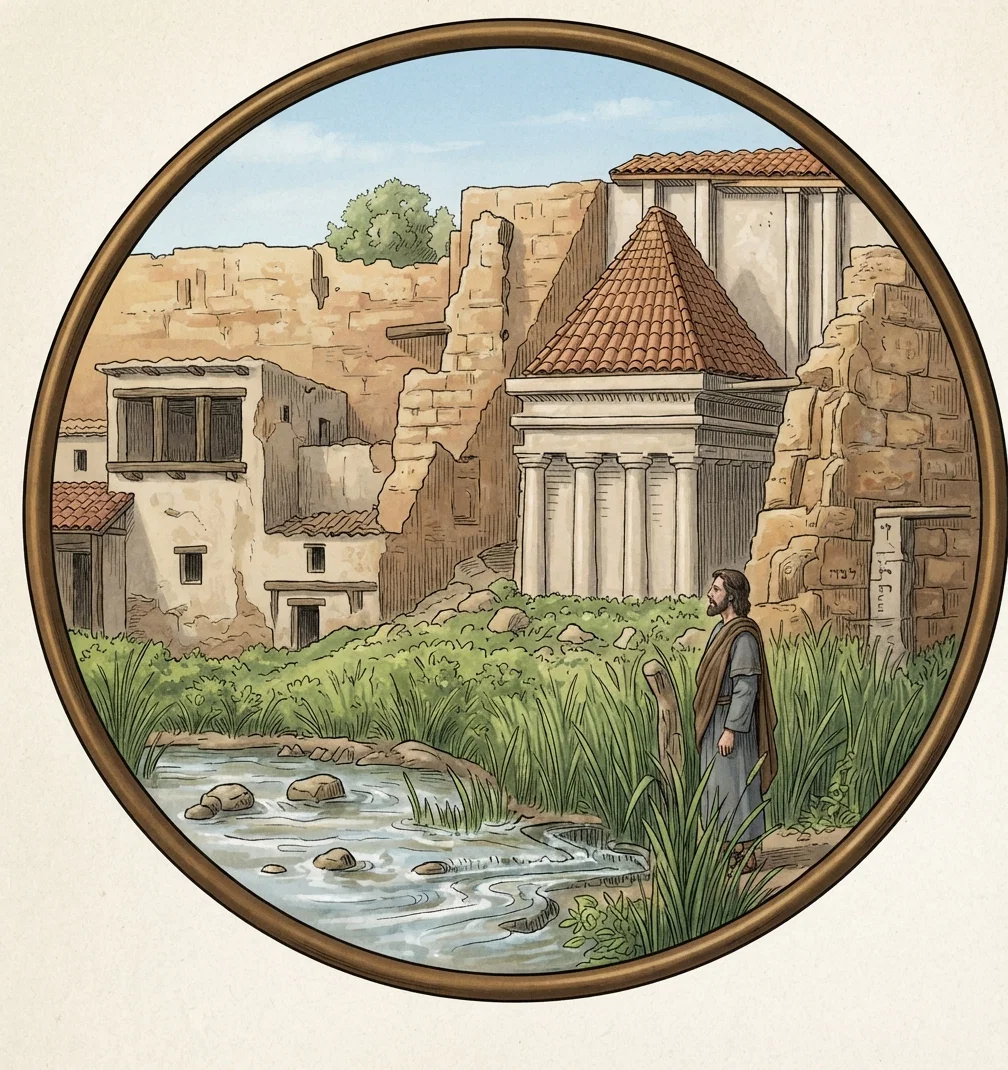
For a period of seventy years the city of Jerusalem was in ruins, the tombs of their fathers broken down, the walls of their city demolished, the beautiful temple a mass of ruins, and "Ichabod" written upon it all. At the end of this time the Lord moved upon the Persian monarch, Cyrus, to issue a decree for the restoration of the temple and to permit the people to return to their land. Under this decree some of the people returned, and the work of rebuilding was begun; but enemies beset them on every side. Only few, comparatively, had returned, and among them, fewer still had the faith in God which would enable them to grasp the fulness of His promise. Instead of laying a foundation of the temple grand and beautiful as the one described by the prophet Ezekiel, they laid the foundation of one far inferior even to the temple of Solomon.
At the laying of this foundation we find there was a mingling of the voice of weeping and the voice of rejoicing; for while the young men rejoiced, the old men who had seen the temple of Solomon gave themselves up to sadness. They were greatly disappointed; for God through Ezekiel had portrayed the building of a temple at Jerusalem which was to far exceed the glory of the temple of Solomon. At this time God raised up the prophets Haggai and Zechariah to encourage the people. By comparing the first verse of Haggai with the first verse of Zechariah it will be seen that these two prophets began their work in the same year and within two months of each other.
Haggai told the people not to weep or be discouraged at the prospect before them, but urged those who had seen the temple of Solomon in its glory to be strong in the Lord; assuring them that the glory of this latter house should be greater than that of the former; that altho they had come far short of God's purpose and plan, yet the Desire of all Nations should come to this house, and fill its courts with His presence. The Lord was ready to carry out His plan, even tho the people had failed in meeting His mind. With these facts before us, we will now enter upon a more careful study of the book of Zechariah.
We shall need to keep in mind that while God continued to encourage this people and to lead them to grasp all that was possible for them to grasp of the promises of God, yet God knew that they would fall short of it; hence in the symbols given by this prophet we shall have set before us not only the experiences of that people, but the experiences of God's people to the end of time, when God's purpose will finally be carried out.
After the introductory statement in the first verse giving us the time of the prophecy, and also stating the agent through whom God would speak, we have set before us in verses 2-6 the certainty of God's word. The statement is first made, "The Lord hath been sore displeased with your fathers." The prophet is to say to the people, "Turn ye unto Me, saith the Lord of hosts, and I will turn unto you. Be ye not as your fathers, unto whom the former prophets have cried, saying, Thus saith the Lord of hosts; turn ye from your evil ways and from your evil doings: but they did not hear, nor hearken unto Me, saith the Lord. Your fathers, where are they? and the prophets, do they live forever? But My words and My statutes which I commanded My servants the prophets, did they not take hold of your fathers? and they returned and said, Like as the Lord of hosts thought to do unto us, according to our ways, and according to our doings, so hath He dealt with us."
Thus the prophet was to call them to witness that the Word of the Lord had stood fast, while their fathers had passed away; and tho the prophets who had spoken the Word had passed away the Word had remained, and the thing spoken had been accomplished. From this they were to learn that the Word of God spoken in their day by the mouth of His prophet would just as surely come to pass; and if they, like their fathers, refused to heed His words, so they, like their fathers, would pass into darkness and oblivion.
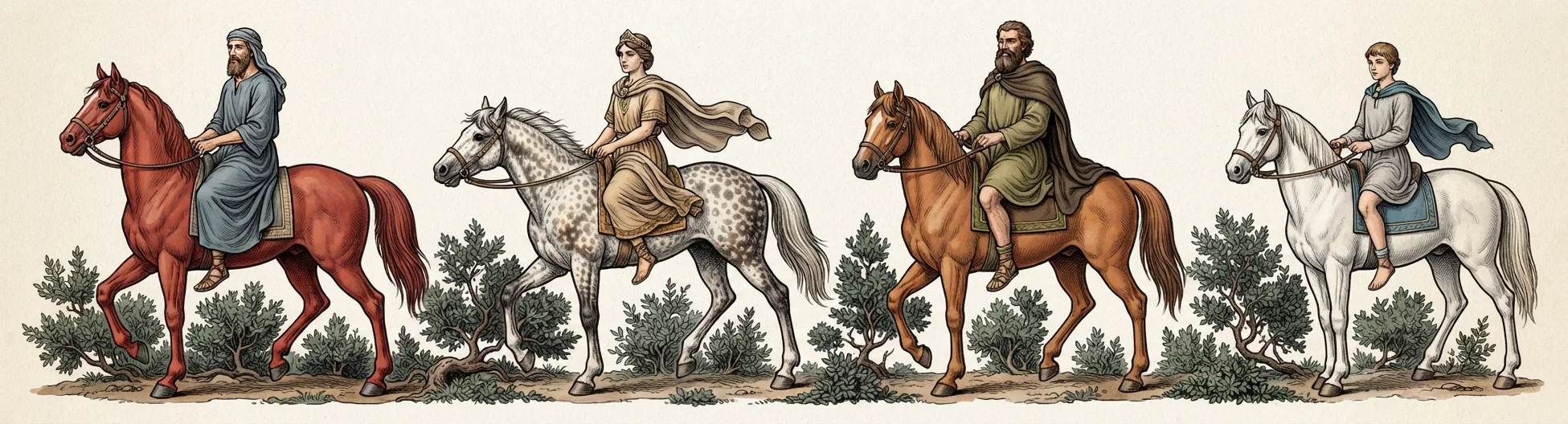
In verses 7-10 we have recorded the first symbolic vision of Zechariah. In this vision, given on the twenty-fourth day of the eleventh month, the prophet saw in the night vision "a man riding upon a red horse, and he stood among the myrtle trees that were in the bottom; and behind him were there red horses, speckled, and white. The prophet asked the question, "O my lord, what are these?" And the angel answered, "I will show thee what these be. And the man that stood among the myrtle trees answered and said, These are they whom the Lord hath sent to walk to and fro through the earth. And they answered the angel of the Lord that stood among the myrtle trees and said, We have walked to and fro through the earth, and, behold, all the earth sitteth still and is at rest."
In studying these symbols I wish first to notice the fact that there are three bands of horses following the first red horse, namely,—red horses, speckled, and white.
Trees are often taken to represent kings; so the myrtle trees here represent the kings of the earth. Another king, represented by the man riding upon a red horse, comes and takes his place among them; and following it are three other powers, symbolized by the three different-colored horses which were behind them. But we notice that the destiny of these is not simply to take their places among the myrtle trees, but that they are to walk to and fro through the whole earth, symbolizing a universal dominion. Thus we have four universal kingdoms brought to view.
When the prophet asked the meaning of the symbol, the answer is said to come not from the angel, but from the man on the red horse, or from the first of these powers. That the purpose and intent of these powers would be clearly set forth by the career of the first one, Nebuchadnezzar, as he went from nation to nation establishing his authority and extending his dominions until he walked to and fro through the earth, gave the answer to the question. That the kingdom of Babylon, under the leadership of Nebuchadnezzar, was one of those whom the Lord sent forth to walk through the earth becomes apparent from these words of Jeremiah:—
"I have made the earth, the man and the beast that are upon the ground, by My great power and by My outstretched arm, and have given it unto whom it seemed meet unto me. And now have I given all these lands into the hand of Nebuchadnezzar the king of Babylon My servant; and the beasts of thefield have I given him also to serve him. And all nations shall serve him, and his son, and his son's son, until the very time of his land come; and then many nations and great kings shall serve themselves of him." Ch. 27: 5-7.
His kingdom was to be followed by three others, each in turn to sway the scepter of universal dominion. Medo-Persia, Grecia, and Rome successively came to power, performed their part of the tragedy, and passed from the stage of action. But the prophecy says that when they have walked through the earth, then shall the whole earth sit still and be at rest. We find the explanation of this in the fact that when these kingdoms have fulfilled their appointed stations among the nations, then shall there arise the fifth universal kingdom, even the kingdom of the Son of Man, under whose benign and peaceful reign all the world will be at rest.
Standing to-day near the time when the kingdom of peace is soon to be established, we have opportunity to cast a glance backward over this world's history, and, what a picture do we behold!—the earth as one vast battle-field over whose sin-cursed surface the armies of the nations have chased each other to and fro with hands reeking with gore and clad in dyed garments of Bozrah. Here and there we see the vast columns of smoke ascending from the cities and villages fired by the incendiary hands of greed and blood. Other cities appear on the scene with walls falling before the violent assault and siege of the foe. The inhabitants are fleeing in terror only to be overtaken and slain. The babe is snatched from the breast of the mother, and despite her pitiful pleadings, is dashed against the stones. Age and youth are alike disregarded. The tottering grandfather, stooped with the weight of years, lies side by side with the toddling infant, their life-blood mingled in one common pool. Maranding hosts and conquering armies sweep over fertile regions, dotted with the homes of peace and comfort, and their track is marked by a trail of blood, fire, smoke, and desolation. Wreck and ruin, rapine and carnage, furnish both the background and the foreground of the picture, for the scene extends like a vast panorama from the dim centuries of the past down to our feet.
About us to-day the nations are getting angry; extensive preparations are being made; mighty engines of destruction are multiplying; magazines are being stored, mines are being laid, the hosts are marshaling. The hand of more than one power is extended to-day to grasp the scepter of universal empire, and to walk to and fro through the earth. But not one of them will succeed; for God's Word has said that there shall be but four universal kingdoms before the kingdom of peace. But that same Word foretells a terrible upheaval of strife, in which the nations of earth shall go down with a crash. Beyond it all will be the reign of Christ; and as we view these scenes and think of the change that will come, our hearts cry out, O, come, Thou King of Peace, and fill the earth with the ocean of Thy love, and let us hear the gentle rippling of its waves on the shores which have been so long lashed by the billows of sin.
Behold, a man riding upon a red horse, and he stood among the myrtle trees that were in the bottom; and behind him were there red horses, speckled and white.

The Hand of God in Disease

THE MISSION OF PAIN AND THE LANGUAGE OF DISEASE. NO. 9.

The Hand of God in Disease.

"For the arrows of the Almighty are within me, The poison whereof my spirit drinketh up; The terrors of God do set themselves in array against me." —Job 6:4.
WHEN we come carefully to study, and more thoroughly to understand, the real nature and purpose of disease, we are compelled to look upon it as nothing more nor less than a struggle for life under adverse circumstances and unfavorable conditions. That God is dealing with the sick man as best He can under existing conditions, and in the sickness itself endeavoring to discipline, instruct, and lead to repentance, becomes more and more apparent to the one who will take pains to study these matters.
"And if they be bound in fetters, and be holden in cords of affliction; then He sheweth them their work, and their transgressions that they have exceeded. He openeth also their ear to discipline, and commandeth that they return from iniquity. If they obey, and serve Him, they shall spend their days in prosperity, and their years in pleasures." Job 36:8-11.
This scripture is so plain it needs but little comment. Disease is the correcting hand of God laid upon us that we may return from our iniquity to obey and serve Him, and thus be able to spend our "days in prosperity" and our "years in pleasures."
The loss of appetite which invariably accompanies fever is an instance of how intelligently and lovingly God works to save the disease-stricken soul from inflicting further injury upon himself. Ordinarily, fever is the result of accumulations of large quantities of poison in the system; that is, we take in poison, or produce it in the body, faster than we can eliminate it; so fever is an effort on the part of nature to burn up and otherwise rid itself of these poisons. Hence in case of fever, nature very kindly takes away the appetite for food, because the digestive apparatus is in no condition whatever to handle food, and so its presence would prove to be a source of poison instead of nourishment. The temperature of the blood is also raised, thus greatly increasing its poison-destroying power. And the patient has a general feeling of weakness which causes him to keep to his bed,—a very necessary thing in view of the fact that he is taking little or no nourishment, and hence is not prepared to maintain the normal bodily activity. So in all these matters those who will take pains to examine carefully into the real working of disease, can not fail to recognize the hand of God. Likewise in case of wounds. The white blood-corpuscles are immediately assembled at the place where the injury was inflicted, and there continue their fight for the individual's life, often sacrificing themselves in large numbers; and this gives rise to the existence of pus, which is so often present. A thorough study of this one point alone would be enough to convince the most skeptical that the wisdom of God is back of the working of every one of the little corpuscles in its work of life-saving and germ-destroying. The presence of pus is in itself an indication that a terrible struggle has been in progress between these microscopic defenders of the individual's life and the disease-germs, and other poisons which have sought to find their way into the circulation. So investigation discloses the fact that many of these conditions which are ordinarily regarded as disease, are in themselves protective efforts on the part of nature, curative processes, and healing endeavors.
So in the case of a broken bone. The pain experienced by the sufferer causes him to lie comparatively still, thus permitting the ends of the bones to remain in contact, undisturbed, and so allowing the healing process of cementing them together to progress uninterruptedly.
Also in the case of the blister that appears when the hand is burned. It is a germ-proof dressing, a water-bath, as it were, arranged by nature to protect the injured tissues; and it must be clear to all that it is God who raises the blister, not Satan; that these efforts on the part of nature to repair the injuries due to accident or transgression, and which we ordinarily call disease, are in reality extraordinary efforts on the part of nature and the God of nature to repair our injuries, and thus to heal the results of intentional, accidental, or ignorant abuse. W. S. SADLER.
Continue reading: COUNTERACTING FORCES