"I charge thee therefore before God, and the Lord Jesus Christ, who shall judge the quick and the dead at His appearing and His kingdom; preach the word; be instant in season, out of season; reprove, rebuke, exhort with all long-suffering and doctrine. For the time will come when they will not endure sound doctrine; but after their own lusts shall they heap to themselves teachers, having itching ears; and they shall turn away their ears from the truth, and shall be turned unto fables."—God's Apostle to the Christian Minister.
Verses 2-11, 18-20, 25 of Joel 2 very clearly show what is meant—great hordes of devastating insects which sweep over the agricultural world in the last days. Where insects have committed their devastations in limited territories, a more accurate description could not be given than in the third verse: “The land is as the Garden of Eden before them, and behind them a desolate wilderness; yea, and nothing shall escape them.” This is God’s army of which He speaks in the twentieth verse: “But I will remove far off from you the northern army, and will drive it into a land barren and desolate, its forepart into the eastern sea, and its hinder part into the western sea; and its stench shall come up, and its ill savor shall come up.” Twenty-fifth verse, “And I will restore to you the years that the locust hath eaten, the canker-worm, and the caterpillar, and the palmer-worm, My great army which I sent among you.” These four expressions are used to denote the whole array of devouring insect plagues. We see no appropriateness whatever in referring them to the angels.
Knowledge of Adam and Eve
2339.—Knowledge of Adam and Eve.
1. Did Adam and Eve have any knowledge of sin previous to their partaking of the fruit of the tree of the knowledge of good and evil? 2. Could they have been tempted on any other point than on that which they yielded? 3. Were the Ten Commandments as given to Moses on the mount given to Adam and Eve previous to their fall? If so, did they not impute to them a knowledge of sin? Does it seem that God would give them such commands as the fifth, seventh, and tenth, when at that time there was nothing to tempt them in that direction? A. W.
1. Our first parents had no experience in sin until they sinned. They did know, however, from God's word, by faith in that word, that it was sin to disobey. That is the only true knowledge that any soul can have. If we are content with that knowledge, we shall have strength to resist sin. If we desire the knowledge that comes by experience, we shall always fall with the knowledge. That is not the knowledge which saves.
2. Their temptation involved several points. The manifest means which the enemy used was the forbidden fruit, but underlying that was the disbelief in God, having other gods before the Lord, taking that which did not belong to them, spiritual fornication, and bringing death to the race; consequently the transgression of several of the principles of the Lord's law. Satan evidently attacked the most vulnerable point in their defense.
3. The Ten Commandments were not given them on tables of stone. The word expressly declares that they were not given in that form until the time of Moses. That does not mean that the law did not exist, because it is the very reflection of God's character, and is as eternal as God. They were children before God and He taught them just as they needed. Sometimes we are asked why it is that such commands as the seventh are found in an eternal law which the angels knew. Those who ask such questions fail to take this great thought into account, that God's government is eternal and universal, and every condition of life, every temptation to sin, every provision to save from sin, are all comprehended in God's law and Gospel. There is no surprise in God's government, no change needed to meet the exigencies which may arise.
When the first man was created, there came into the purview of his life the principles of the first table of the commandments, honor to his God. When more than one being was created, there came into the operations of their life the principles of the second table. It was their duty to honor father and mother and regard each other according as the law indicates. Every one of these commandments grew out of man's relationship to God or man's relationship to his fellows. Adam and Eve were not babies. Man's mind was sufficient to comprehend God's creation. He understood the prohibitions which God gave him against sin, and had understanding to know that contrary to God's will was sin; harmony with His will, righteousness.
With Our Inquirers
"If ye will inquire, inquire ye."
[All questions to this department will be answered which to the editors will seem to minister to the good of the readers and to the mission of the paper. The same question can not be answered repeatedly in the same volume. The name and address must accompany question, not for publication, but as an evidence of good faith, and that answer may be made by letter if deemed advisable. It is well always to enclose a stamp for reply.]
Beer-Drinking and Slang Terms
2336.—Beer-Drinking; Slang Terms.
Not for faultfinding do I ask these questions, but for information and help to all. (1) Is it pleasing in God's sight to use the word
These are certainly all practical questions of life which all Christians should regard, not simply for their own soul's sake, but for others' sake. Replying categorically, we would say, first, it never is good to use terms that do not express just what we mean. It has come to be quite common for people of various classes in life to call children
2. Beer-drinking and whisky-drinking of all kinds is bad, bad for the individual who does it, bad in the example which it sets, bad in the effect and influence which it has; physically, morally, spiritually, always bad. Of course there are some who do not see this. Let us pray that the Lord may enlighten their minds and open their hearts to receive His instruction.
3. We should treat game laws as we would treat every other law of the land, save those laws which conflict with our duties to God. The instruction of the word is,
The Altar of Incense
2338.—The Altar of Incense.
Will you kindly explain the apparent discrepancy between Heb. 9:4 and Ex. 30:6-8? The first seems to indicate that the altar of incense was in the most holy place, while the second places it in the holy place.
W. O.
Heb. 9:4, in the Common Version, places in the most holy place the golden censer, the ark of the covenant, the golden pot of manna, and Aaron’s rod that budded, and the tables of the covenant. The Revised Version reads, “having a golden altar of incense;” but you will see by the margin that censer is given instead of incense, depending doubtless on the difference in Greek copies. “Wherein” is thought by some to refer to the most holy place rather than to the ark. The scriptures about which there is no question seem very clear and decided as to where the furniture was placed in the sanctuary, “and he put the golden altar in the the tent of the congregation before the veil; and he burnt sweet incense thereon.” Ex. 40:26, 27.
The Mormons tell us, referring to the prophecy of Ezekiel, that the stick of Judah applied to the Jews, but that the stick of Joseph applied to the American continent, Joseph Smith being that stick. H.
The thirty-sixth and thirty-seventh chapters of Ezekiel are God's promises to Israel then and there, if Israel would but comply with the conditions. They were at that time divided and scattered. If they had returned to God with all their heart, the Lord would have restored them to their own land, would have brought back all those of the scattered tribes who would come, would have brought from the dead those who were sleeping in Him, would have established them in their own land with the sanctuary and under the wonderful glories referred to in the last chapters of Ezekiel; but they were not ashamed of their doings. Therefore, according to the conditions which the Lord laid down in Jer. 18:7-10, Israel was rejected. But God's plan will not fail, He will still have all of Israel, all of those who, like Israel, prevail by faith, not of the Jews only but also of the Gentiles, the "other sheep" whom He would bring to His fold. This is the concurrent testimony of all the Scriptures. The whole Mormon scheme is utterly unscriptural, and if tested alone by the Scriptures would have no standing whatever. It is only by faith in a so-called revelation that it is made to stand.
Are the Dead Conscious?
2341.—Are the Dead Conscious? Job 14:21, 22; Isa. 66:24.
Do these scriptures teach that the dead are conscious and that they know what is going on upon the earth? A. L. M.
It seems as tho a reading of Job 14:20, 21 would be sufficient to answer this question of the death of man, "Thou prevailest forever against him, and he passeth; thou changest his countenance, and sendest him away. His sons come to honor, and he knoweth it not; and they are brought low, but he perceiveth it not of them." The twenty-second verse refers to man's condition before that change comes, "His flesh upon him shall have pain, and his soul within him shall mourn;" that is, during this time and this life. But when the change comes he knows nothing of what takes place here upon earth, as expressed in another scripture, "the dead know not anything." Isa. 66:24 is answered in another question on Mark 9:43-48.
2343.—C. W.—Matt. 8:22 reads, "But Jesus saith unto him, Follow Me; and leave the dead to bury their own dead." It was an answer to a request from a disciple, "Lord, suffer me first to go and bury my father." What Jesus evidently meant was to let those who are dead to the purposes of His mission in their spiritual life bury the dead. That was work which was suitable, which they could do, but the time had come for the disciples to follow Him.
Christ the Teacher and Healer
By Ellen G. White
By Mrs. E. G. White
Object-Lessons in Nature.
The Saviour's life on earth was a life of communion with nature and with God. In this communion He revealed for us the secret of a life of power.
Jesus was an earnest, constant worker. Never lived there among men another so weighted with responsibilities. Never another carried so heavy a burden of the world's sorrow and sin. Never another toiled with such self-consuming zeal for the good of men. Yet His was a life of health. Physically as well as spiritually He was represented by the sacrificial lamb, "without blemish and without spot." In body as in soul He was an example of what God designed all humanity to be thru obedience to His laws.
The childhood of Jesus, spent in poverty, had been uncorrupted by the artificial habits of a corrupt age. Working at the carpenter's bench, bearing the burdens of home life, learning the lessons of obedience and toil, He found recreation amidst the scenes of nature, gathering knowledge as He sought to understand nature's mysteries. He studied the word of God, and His hours of greatest happiness were found when He could turn aside from the scene of His labors to go into the fields, to meditate in the quiet valleys, to hold communion with God on the mountainside, or amid the trees of the forest. The early morning often found Him in some secluded place, meditating, searching the Scriptures, or in prayer. With the voice of singing He welcomed the morning light. With songs of thanksgiving He cheered His hours of labor, and brought heaven's gladness to the toil-worn and disheartened.
During His ministry Jesus lived to a great degree an outdoor life. His journeys from place to place were made on foot, and much of His teaching was given in the open air. In training His disciples He often withdrew from the confusion of the city to the quiet of the fields, as more in harmony with the lessons of simplicity, faith, and self-abnegation He desired to teach them. It was beneath the sheltering trees of the mountainside, but a little distance from the Sea of Galilee, that the twelve were called to the apostolate, and the sermon on the mount was given.
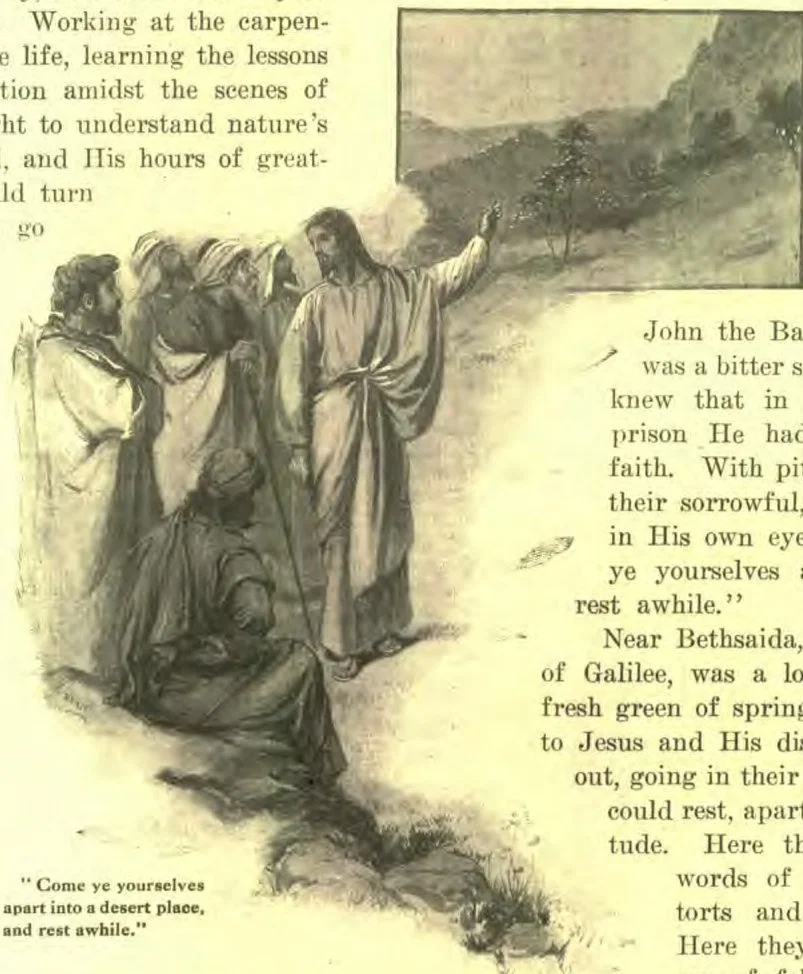
"Come ye yourselves apart into a desert place, and rest awhile."
Christ loved to gather the people about Him under the blue heavens, on some grassy hillside, or on the beach beside the lake. Here, surrounded by the works of His own creation, He could turn their thoughts from the artificial to the natural. In the growth and development of nature were revealed the principles of His kingdom. As men should lift their eyes to the hills of God, and behold the wonderful works of His hand, they could learn precious lessons of divine truth. In future days the lessons of the divine Teacher would thus be repeated to them by the things of nature. The mind would be uplifted and the heart would find rest.
The disciples who were associated with Him in His work, Jesus often released for a season, that they might visit their homes and rest; but in vain were their efforts to draw Him away from His labors. All day He ministered to the throngs that came to Him, and at eventide, or in the early morning, He went away to the sanctuary of the mountains for communion with His Father.
Often His incessant labor and the conflict with the enmity and false teaching of the rabbis left Him so utterly wearied that His mother and brothers, and even His disciples, feared that His life would be sacrificed. But as He returned from the hours of prayer that closed the toilsome day, they marked the look of peace upon His face, the freshness and life and power that seemed to pervade His whole being. From hours spent alone with God He came forth, morning by morning, to bring the light of heaven to men.
A Season of Rest.
It was just after the return from their first missionary tour that Jesus bade His disciples, Come apart, and rest a while. The disciples had returned, filled with the joy of their success as heralds of the Gospel, when the tidings reached them of the death of John the Baptist at the hand of Herod. It was a bitter sorrow and disappointment. Jesus knew that in leaving the Baptist to die in prison He had severely tested the disciples' faith. With pitying tenderness He looked upon their sorrowful, tear-stained faces. Tears were in His own eyes and voice as He said, "Come ye yourselves apart into a desert place, and rest awhile."
Near Bethsaida, at the northern end of the sea of Galilee, was a lonely region, beautiful with the fresh green of spring, that offered a welcome retreat to Jesus and His disciples. For this place they set out, going in their boats across the lake. Here they could rest, apart from the confusion of the multitude. Here the disciples could listen to the words of Christ, undisturbed by the retorts and accusations of the Pharisees. Here they hoped to enjoy a short season of fellowship in the society of their Lord.
Only a short time did Jesus have alone with His beloved ones, but how precious to them were the moments. They talked together regarding the work of the Gospel and the possibility of making their labor more effective in reaching the people. As Jesus opened to them the treasures of truth, they were vitalized by divine power, and inspired with hope and courage.
But soon He was again sought for by the multitude. Supposing that He had gone to His usual place of retirement, the people followed Him thither. His hope to gain even one hour of rest was frustrated. But in the depths of His pure, compassionate heart, the good Shepherd of the sheep had only love and pity for these restless, thirsting souls. All day He ministered to their needs, and at evening dismissed them to go to their homes and rest.
In a life wholly devoted to the good of others, the Saviour found it necessary to turn aside from ceaseless activity and4contact with human needs, to seek retirement and unbroken communion with His Father. As the throng that had followed Him depart, He goes into the mountains, and there, alone with God, pours out His soul in prayer for these suffering, sinful, needy ones.
When Jesus said to His disciples that the harvest was great, and the laborers were few, He did not urge upon them the necessity of ceaseless toil, but bade them, "Pray ye therefore the Lord of the harvest, that He would send forth laborers into His harvest." To His toil-worn workers to-day as really as to His first disciples He speaks these words of compassion, "Come ye yourselves apart . . . and rest awhile."
All who are under the training of God need the quiet hour for communion with their own hearts, with nature, and with God.
In them is to be revealed a life that is not in harmony with the world, its customs, or its practises; and they need to have a personal experience in obtaining a knowledge of the will of God. We must individually hear Him speaking to the heart. When every other voice is hushed, and in quietness we wait before Him, the silence of the soul makes more distinct the voice of God. He bids us, "Be still, and know that I am God." This is the effectual preparation for all labor for God. Amidst the hurrying throng and the strain of life's intense activities, he who is thus refreshed will be surrounded with an atmosphere of light and peace. He will receive a new endowment of both physical and mental strength. His life will breathe out a fragrance, and will reveal a divine power that will reach men's hearts.
Christian Science in the Light of Reason and Revelation
By R. A. Underwood
By R. A. Underwood
III. Spirits, the Holy Spirit, Heaven.
As already seen, the Christian Science gospel is a repudiation of the Gospel of Christ in all the essential facts of revelation and human experience. It builds its foundation for faith upon a denial of great fundamental truths of the word of God. Such a foundation, built of hay, wood, and stubble, will quickly perish in the day when every man's work shall be tried by fire. Christian Science, as it is falsely named, will prove to be like a rope of sand in the day of trial to every one who has trusted in this delusion. Christ, the Rock of Ages, is the only Foundation that will prove to be safe in the coming storm.
We continue the contrast, as in previous articles, between the claims of Christian Science and the teaching of the Bible, quoting, as before, from the 1905 edition of "Science and Health with Key to the Scriptures."
12. The Gospel of Christ recognizes evil spirits.
"And in that same hour He cured many of their infirmities and of plagues, and of evil spirits; and unto many that were blind He gave sight." Luke 7:21.
13. The Gospel of Christ presents the benefits of prayer.
"Be careful for nothing; but in everything by prayer and supplication with thanksgiving let your requests be made known unto God." Phil. 4:6.
"If ye then, being evil, know how to give good gifts unto your children, how much more shall your Father which is in heaven give good things to them that ask Him." Matt. 7:11.
"And whatsoever ye shall ask in My name, that will I do, that the Father may be glorified in the Son. If ye shall ask anything in My name, I will do it." John 14:13, 14.
14. The Gospel of Christ is given to save men from death.
"As it is appointed unto men once to die, but after this the judgment." Heb. 9:27.
"I heard a voice from heaven saying unto me, Write, Blessed are the dead which die in the Lord from henceforth: Yea, saith the Spirit, that they may rest from their labors, and their works do follow them." Rev. 14:13.
"Then said Jesus unto them plainly, Lazarus is dead." "And he that was dead came forth, bound hand and foot with grave-clothes." John 11:14, 44.
15. The Gospel of Christ brings the Holy Spirit to the believer.
"For John truly baptized with water; but ye shall be baptized with the Holy Ghost not many days hence." Acts 1:5.
"Then Peter said unto them, Repent, and be baptized every one of you in the name of Jesus Christ for the remission of sins, and ye shall receive the gift of the Holy Ghost. For the promise is unto you, and to your children, and to all that are afar off, even as many as the Lord our God shall call." Acts 2:38, 39.
"But the Comforter, which is the Holy Ghost, whom the Father will send in My name, He shall teach you all things, and bring all things to your remembrance, whatsoever I have said unto you." John 14:26.
16. The Gospel of Christ offers a definite and literal place for the eternal home of the redeemed.
"In My Father's house are many mansions: if it were not so, I would have told you. I go to prepare a place for you. And if I go and prepare a place for you, I will come again, and receive you unto Myself; that where I am, there ye may be also." John 14:2, 3.
17. The Gospel of Christ is to save the soul from eternal loss.
"For what is a man profited, if he shall gain the whole world, and lose his own soul? or what shall a man give in exchange for his soul?" Matt. 16:26.
"The soul that sinneth, it shall die." Eze. 18:20.
18. The Gospel of Christ appeals to man's senses.
"Blessed is he that readeth, and they that hear the words of this prophecy, and keep those things which are written therein; for the time is at hand." Rev. 1:3.
"He that hath an ear, let him hear what the Spirit saith unto the churches: To him that overcometh will I give to eat of the tree of life, which is in the midst of the paradise of God." Rev. 2:7.
"O taste and see that the Lord is good." Ps. 34:8.
12. Christian Science denies the existence of evil spirits.
"The supposition that corporeal beings are spirits and that there are good and evil spirits, is a mistake." Page 70.
13. Christian Science belittles prayer, and makes it a hindrance to spiritual growth.
"The habit of pleading with the divine mind as one pleads with a human being perpetuates the belief in God as human, circumscribed, an error which impedes spiritual growth." Page 2.
"Audible prayer is impressive, it gives momentary solemnity and elevation to thought, but does it produce any lasting benefit? Looking deeply into these things, we find that a zeal not according to knowledge gives occasion for reaction unfavorable to spiritual growth." Page 7.
14. Christian Science denies the existence of death.
"Death, an illusion, the lie of life in matter, the unreal and untrue. . . . Any material evidence of death is false, for it contradicts the spiritual facts of being." Page 584.
"To the real man and the real universe there is no death process. . . . Matter and death are but mortal illusions." Page 289.
15. Christian Science arrogates to itself the fulfilment of the coming of the Comforter, the Holy Spirit.
"In the words of St. John, 'He shall give you another Comforter, that He may abide with you forever.' This Comforter I understand to be divine science." Page 55.
16. Christian Science denies that heaven is a locality.
"Heaven is not a locality, but a divine state of mind." Page 291.
17. Christian Science denies that the soul can be lost.
"It is the sense of sin, and not a sinful soul, which must be lost." Page 311.
18. Christian Science denies the evidence of the five senses.
"Christian Science teaches that matter is the falsity, not the fact, of existence, that nerve, brain, stomach, lungs, etc., have, as matter, no intelligence, life, or sensation." Page 127.
"The five corporeal senses afford no evidence to the grand facts of being." Page 471.
"To the five corporeal senses man appears to be matter and mind united, but Christian Science reveals him as the idea of God, and declares the corporeal senses to be mortal and erring illusions." Page 477.
Satan would be pleased to have men believe that there are no such things as the five senses, for it is by means of the senses of hearing, seeing, tasting, and feeling that Satan appeals to man in momentary pleasure and captures him. Of the tree of good and evil, the Lord said to man, "Ye shall not eat of it, neither shall ye touch it, lest ye die. And the serpent said unto the woman, Ye shall not surely die. . . . And when the woman saw that the tree was good for food, and that it was pleasant to the eyes, and a tree to be desired to make one wise, she took of the fruit thereof, and did eat, and gave also unto her husband with her; and he did eat." Gen. 3:3-6.
It is thru these corporeal senses that the Spirit of God also appeals to man's power of choice in accepting the good and rejecting the evil. Christian Science seeks to destroy in man all consciousness of sin. It would not have man recognize the still, small voice of the Spirit of God, who comes as the representative of Christ to reprove and also to comfort. In the place of the Holy Spirit we are asked to accept Christian Science as the Comforter.
If there is no such thing as matter, and the only thing that exists is mind, which is affirmed over and over again by Mrs. Eddy's book, and if the five senses are "erring illusions," or all myths without any reality of being except as they exist in our imaginations, then we need make no distinction in the taste of food or drink. In fact, we need neither food, drink, nor clothing to wear. If man is only mind, a beautiful thought, when any one calls for material substance to5satisfy hunger, or to keep him warm, all that is necessary to do is to simply say, "You are warm, you are fed, mind needs no food nor raiment. Your wants are unreal." Methinks the answer to such a response would be, "If a brother or sister be naked, and destitute of daily food, and one of you say unto them, Depart in peace, be ye warmed and filled; notwithstanding ye give them not those things which are needful to the body; what doth it profit?" James 2:15, 16.
19. The Gospel of Christ presents the most complete system of sanitary laws in the world.
"Having therefore these promises, dearly beloved, let us cleanse ourselves from all filthiness of the flesh and spirit, perfecting holiness in the fear of God." 2 Cor. 7:1.
"But Daniel purposed in his heart that he would not defile himself with the portion of the king's meat, nor with the wine which he drank: therefore he requested of the prince of the eunuchs that he might not defile himself." Dan. 1:8.
"Whether therefore ye eat, or drink, or whatsoever ye do, do all to the glory of God." 1 Cor. 10:31.
19. Christian Science repudiates all sanitary and hygienic measures to remove and prevent disease.
"When there are fewer prescriptions, and less thought is given to sanitary subjects, will there be better constitutions, and less disease." Then she quotes with approval the proverb, "Where ignorance is bliss, 'tis folly to be wise." Page 175.
"Treatises on anatomy, physiology, and health, sustained by what is termed material law, are the promoters of sickness and disease." Page 179.
"A Christian Scientist's medicine is mind, the divine truth that makes man free. He never recommends hygiene." Page 453.
Christian Science counts as naught all the scientific and successful measures of recent years adopted by medical boards and societies all over the world to prevent the ravages of plagues by means of sanitary measures in removing the cause of disease, as well as treating the same. These sanitary methods and rational means of treating disease have nearly removed the plague-spot from Europe, and greatly lessened it in the Orient. But all this successful movement is denounced as folly by this science (?) of Mrs. Eddy's.
This doctrine, put into practise, would dry up every particle of the milk of human sympathy, kindness, and effort to help suffering humanity. When the needy, suffering, or dying appeal for help, the only logical, consistent response the man or woman who believes the doctrine can give is to say, "You are laboring under an illusion or deception. You need no food, no clothing. You are not sick or in distress."
This kind of blind faith is strikingly pictured by the pen of Inspiration in Rev. 3:16, 17, as follows: "I will spew thee out of My mouth. Because thou sayest, I am rich, and increased with goods, and have need of nothing; and knowest not that thou art wretched, and miserable, and poor, and blind, and naked."
H. W. REED
By H. W. Reed
therefore the law of God forbids evil in thought as well as in deed.
So the conclusion that one must come to is that the commandments of God contain the whole duty of man. But the trouble with some individuals is that they do not want to see their duty. I would not make this remark if I had not heard a goodly number of people say in substance the following: "If you should convince me that it was right to keep the seventh day for the Sabbath instead of the first day, I would not keep it." Such persons are sinners without a doubt, for they refuse to do what is right, and James says this is sin. "Therefore to him that knoweth to do good, and doeth it not, to him it is sin." The persons who talk as stated above do not want to open their eyes, nor allow the Lord to open them for them, that they may see the binding force of the fourth commandment.
David was not of that class, as a quotation from him will show: "Open Thou mine eyes, that I may behold wondrous things out of Thy law." I would be exceedingly glad if this were the sincere prayer of all of the people on our earth, and I make an appeal to all who may read these lines to let David's prayer be their most earnest supplication that God anoint their eyes with eye-salve that they may see what that perfect law requires of them.
We will imagine that some of you who read this article need to have your eyes opened to see the binding force of God's law upon you. Suppose that you should make this prayer, and the Lord should open your eyes, and by showing you wondrous things out of His law should thereby show you that you were violating the fourth commandment of His law, what then ought you to do? Let us see what David did and it will be well for you to follow his course. David says: "I made haste, and delayed not to keep Thy commandments."
When any man finds himself breaking the commandments of God, then is the time when he should make haste, and delay not to keep them. Dear reader, do you not think such a course to be a wise and safe one? Let us all fear God and keep His commandments, for this is our whole duty.
H. W. REED
Whole Duty of Man.
THE law of God is the righteousness of God, and is also a transcript of His character, and the whole duty of man is to fear God and keep His commandments. This truth is found in the following scripture: “Let us hear the conclusion of the whole matter: Fear God, and keep His commandments: for this is the whole duty of man. For God shall bring every work into judgment, with every secret thing, whether it be good, or whether it be evil.”
It is here taught in plain language that the judgment passes upon every secret thing; and it is just as plainly taught that the law of God is the standard used in the judgment. This standard determines accurately the quality of every act, whether good or evil,
The Two Angels.
God has two angels whom He sends
Amongst His children here,
They come, as all His angels come,
To strengthen and to cheer.
But they seem often stern and cold,
We think them cruel foes,
And turn away and strive to hide,
Or shrink beneath their blows.
That dark, grim form and piercing glance—
I tremble and I cry,
"Withhold thy hand so pitiless,
O strike not, lest I die."
And thou, so grave and full of care,
No brightness gilds thy brow,
Wilt thou not bid me rest awhile?
Let joy possess me now.
They will not heed, but calmly take
My trembling hands, and press
Upon my lips a kiss so soft
It has no bitterness.
Tearful and faint I, yielding, trust,
And trusting, learn to see
Those dreaded forms hide God Himself,
Grace veiled in mystery.
Would'st know what are these spirits' names
Whose ministry we prove?
Patience and Pain we call them now,
God calls them PEACE and LOVE.
—Christian World.
The Gospel Not Compulsory.
THE Gospel of God is not of this world, even as Christ and His servants are not of this world. Christ’s kingdom and theirs is therefore not of this world. John 17:14; 18:36. They therefore have no right to use earthly methods or means for its advancement. Matt. 20:25-28. The greatest is the humblest, and the one who will be chief must best serve.
The officers in Christ’s church were not to be those who had the right either to condemn or discipline those without the church (1 Cor. 5:12, 13), nor to lord it over the faith of those within (2 Cor. 1:24), but to be helpers of their joy. In this they have the example and words of the Master: “And if any man hear My words, and believe not, I judge him not: for I came not to judge the world, but to save the world. He that rejecteth Me, and receiveth not My words, hath One that judgeth him: the word that I have spoken, the same shall judge him in the last day.” John 12:47, 48.
To His disciples who thought it was their duty to execute the judgment of God upon those who rejected Christ, He said: “Ye know not what manner of spirit ye are of. For the Son of Man is not come to destroy men’s lives, but to save them.” Luke 9:55, 56. To-day we have proud and pompous lord bishops and spiritual lords, but the apostle declares of the ministers of Christ that they are not to be “lords over God’s heritage,” but “ensamples to the flock.” 1 Peter 5:3. The weapons of the Christian are not carnal, but nevertheless mighty thru God to the pulling down of strongholds. 2 Cor. 10:4, 5. The outward act of man is to rule by regenerating and ruling the inward thought. The whole panoply of the Christian warrior is wrought in the fire and forge of God. Eph. 6:13-18. Men are not to be compelled or coerced, but besought and persuaded. 2 Cor. 5:11.
Christian Life Is Action
By F. W. Robertson
CHRISTIAN life is action: not a speculating, not a debating, but a doing. One thing, and only one, in this world has eternity stamped upon it. Feelings pass; resolves and thoughts pass; opinions change. What you have done lasts—lasts in you. Thru ages, thru eternity, what you have done for Christ, that, and only that, you are.—F. W. Robertson.