Your ShelfYour Projects

Signs of the Times, Vol. 23, No. 26.

Editorial

Signs of the Times

Jul 8, 1897

Pacific Press Publishing Company · Oakland, California · Jul 8, 1897

Editorial

The Power and the Glory.

"Thine is the kingdom, and the power, and the glory, forever. Amen."
The Kingdom is the Lord's, and it includes the whole universe. Nothing is outside his jurisdiction. Every creature in the heavens and on earth rightfully belongs to his dominion.

A King Must Have Power

For a king without power is a king only in name. God is really King, and therefore to him belongs power. "God hath spoken once; twice have I heard this: that power belongeth unto God." Ps. 62:11.

No Division of Power.

We must not fall into the error of limiting God, by thinking that power is divided, and that he has merely a share of it, even tho it be the largest share. "Thine is the kingdom and the power." "His kingdom ruleth over all;" and wherever his kingdom is, his power is supreme. God alone has power.

God the Almighty One.

That is to say, he has all might. Therefore no other being possesses any might in himself. Because God possesses all the power in the universe, Christ, the only-begotten Son, could say, "All power is given unto me in heaven and in earth."
"The heavens declare the glory of God; and the firmament showeth his handiwork." "Lift up your eyes on high, and behold who hath created these things, that bringeth out their host by number; he calleth them all by names by the greatness of his might, for that he is strong in power; not one faileth."

All of God.

"In him we live, and move, and have our being." Acts 17:28. Every motion that is made, every thought, every word, requires the exercise of power; but the power is not inherent in the man who moves, but in God. "There is no power but of God." Rom. 13:1. The power which men have to fight and blaspheme God, and to commit all sorts of wickedness, is but God's power perverted, just as the performance of righteous acts, and the utterance of praise, is God's power given free course.

Evidence of His Love.

Light-minded persons may see in this occasion for charging God foolishly; but others will see in it his superabounding grace and his everlasting love. While some think that God's seeming non-interference is an evidence of weakness, or of complicity with crime, the well-instructed will "account that the long-suffering of our Lord is salvation." 2 Peter 3:15.

The Patience of Power.

If God were not sure of his "everlasting strength," he could not thus sit still and see men defy him to his face, and even use his own power in opposition to him. But he has the patience of conscious omnipotence. Knowing that he really has power, he can not, like puny men, be tempted to make an exhibition of it simply to demonstrate to scoffers that he possesses it.

His Power to Save.

God desires that men should be saved, and in the Gospel he manifests his power to save them. All God's power, and every revelation of it, is for the purpose of leading men to trust him for their soul's salvation. The fact that men misunderstand God, even wilfully, and pervert the power which he reveals in them for their salvation, does not discourage him or throw him into a passion. Still he graciously manifests his power in them, in hope that at last they will allow him to use it to his own glory in their salvation. God's power is the power of love, and love does not use force; therefore he patiently waits, until he is positively and definitely rejected.

Joy in His Power.

What wonderful joy comes with the recognition that all power is God's! "For by grace are ye saved through faith; and that, not of yourselves: it is the gift of God." Eph. 2:8. Our salvation depends on him, and he has the power. His kingdom is in our hearts, but his enemy has been allowed to comein and raise the standard of rebellion. Nevertheless, as soon as we definitely choose the Lord for our King and our Lawgiver, he will save us by his mighty power. Isa. 33:22. He has power to drive out every enemy. What a comfort to rest confidingly in the almighty power of our God!

His Is the Glory.

Not only ought it to be, but it is. The last message before the coming of the Lord, calls loudly upon men to "fear God, and give glory to him," as the One who "made heaven, and earth, and the sea, and the fountains of waters." Rev. 14:6, 7. We are to give glory to him, because it belongs to him. His is the glory, because his is the power. Whoever takes glory to himself for anything that he possesses or has done, thereby robs God.

Glory in His Word.

"Thus saith the Lord, Let not the wise man glory in his wisdom, neither let the mighty man glory in his might, let not the rich man glory in his riches; but let him that glorieth glory in this, that he understandeth and knoweth me, that I am the Lord which exercise loving-kindness, judgment, and righteousness, in the earth." Jer. 9:23, 24. Wisdom, power, and riches, all come from the Lord; therefore "he that glorieth, let him glory in the Lord." 1 Cor. 1:31.

An Instance.

Take a single example, in the line of wisdom. On the day of Pentecost, and many times thereafter, God gave his servants power on the instant to talk foreign languages. Unlettered Galilean fishermen suddenly began to speak intelligently in languages that before were but meaningless jargon to them. It was manifestly a gift of God, and one instinctively shudders at the thought of one with such a gift boasting of his possession, as tho the glory of it were due to him. Very well; but "the Lord giveth wisdom; out of his mouth cometh knowledge and understanding." Prov. 2:6. If a man by study has acquired several languages, he has done it only by the power which God gave him, and therefore his knowledge is the gift of God just as truly as was the knowledge of the apostles.

His Keeping Power.

Whoever not simply openly, but in his inmost thoughts, continually gives God the glory, will be kept "to the praise of the glory of his grace." "In all thy ways acknowledge him, and he shall direct thy paths." Prov. 3:6. Men foolishly think that it is beneath their dignity, and a limitation of their freedom, to acknowledge that God alone has power, and that all glory belongs to him; but how much better it is to acknowledge the truth, and thus be "strengthened with all might, according to his glorious power" (Col. 1:11), than to deny him, and thus be left to our own disgraceful impotence. "Now unto him that is able to keep you from falling, and to present you faultless before the presence of his glory with exceeding joy, to the only wise God our Saviour, be glory and majesty, dominion and power, both now and ever. Amen." Jude 24, 25. E. J. W.

THE NEARNESS OF OUR LORD'S COMING.

Publishers and Terms

(Entered at the Post-office in Oakland.)
For Publishers and Terms, see page 15.

Men and Not Men.

The Gospel of Jesus Christ saves men, and counts them more precious than all the material things of earth; but it does not look to men for power or wisdom to carry it forward. The church of Jesus Christ is placed in the world to save men, to carry forward the work of the Master, to seek and to save the lost. But the church is not to look to men for her wisdom or power, however wise and learned or great or pious those men may be. As soon as she looks to men, she interposes a shadow between herself and God. It is cruel to lead a church to decide duty because some council or conference or set of men so decided. Jesus Christ is made unto us wisdom and righteousness and sanctification and redemption.

THE NEARNESS OF OUR LORD’S COMING.

Some of the Witnesses.

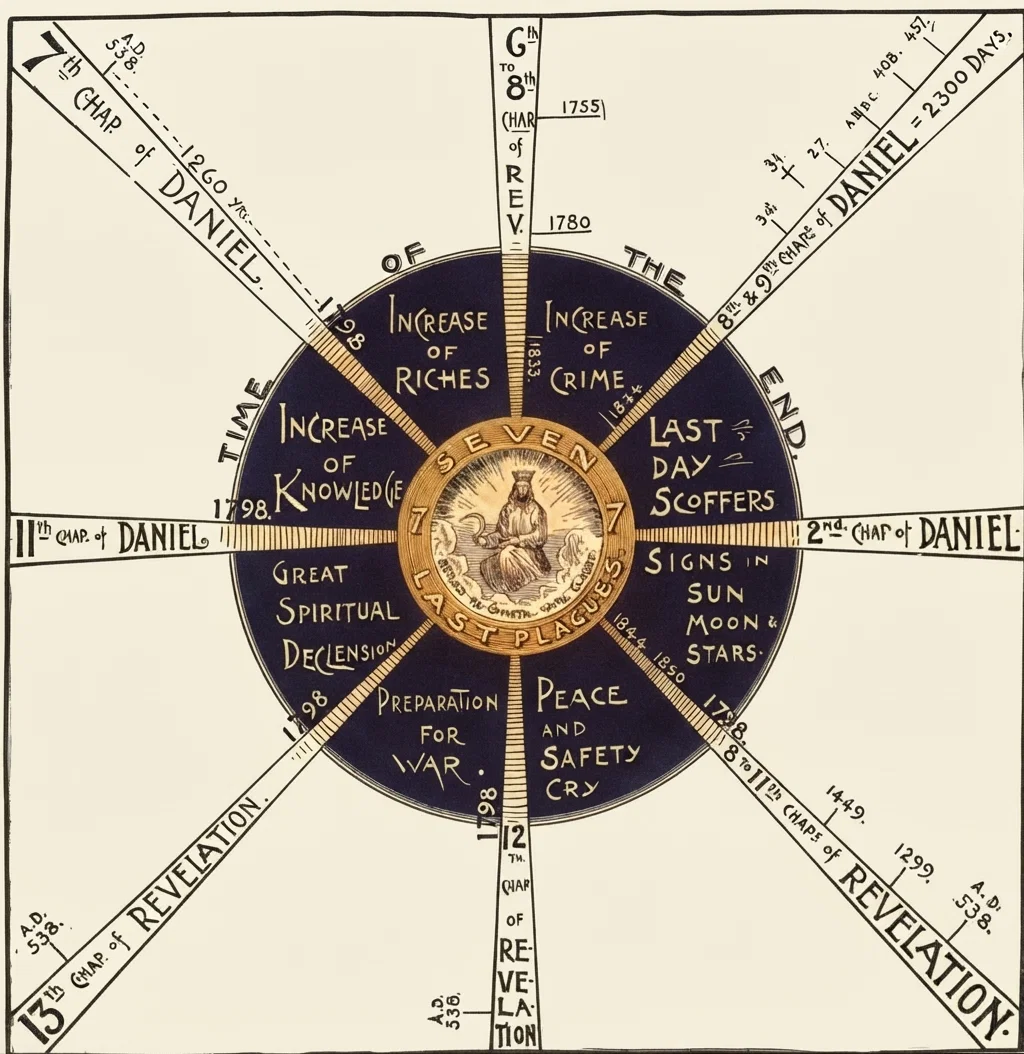
LAST week we gave in brief the evidences which God has given us in the great highways of prophecy that his coming is near. Eight lines of prophecy were briefly considered and illustrated by a diagram. These great prophecies were the second chapter of Daniel and the seventh chapter of Daniel, symbolic prophecies of the great universal empires of earth, Babylon, Medo-Persia, Grecia, and Rome; the eighth chapter of Daniel, a prophecy of the three last powers, of the persecution of the people of God and the work of Christ as prophet and sacrifice and priest, of the prophetic period of 2,300 days, or years, to 1844; the eleventh chapter of Daniel; the Seven Seals of Revelation 6–8; the Seven Trumpets of Revelation 8–11; and the symbolic prophecies of chapters 12 and 13 of the same book. The last and next event in all these great highways to the kingdom of God is the coronation of our coming King, Jesus Christ.

The Time of the End.

In most of these prophecies is a period of persecution distinctly marked, and in several this period is defined as a “time, and times, and half a time” (Dan. 7:25; 11:33–35; 12:7; Rev. 6:7–11; 12:14), “forty and two months” (Rev. 13:5), “a thousand two hundred and threescore days” (Rev. 11:3; 12:6). All these expressions mean, according to the Bible mode of reckoning time (twelve months to the year and thirty days to the month), three and one-half years, 1,260 days symbolizing 1,260 literal years, “each day for a year.” Eze. 4:6. It has been shown (see previous issues of June 17 and 24) that this period covered the persecution of the Dark Ages, beginning in 538 and ending in 1798. In 1798 therefore began “the time of the end,” during which would be seen the culmination of the great lines of prophecy, and the revelation of our glorious Lord, in whom all the types and hopes of the ages center. The year 1798 marks the ending of the first great prophetic period. Other periods are mentioned, like the 541 days and over (541 years, 15 days literally) of Rev. 9:5, 15, the 1,335 days of Dan. 12:12, and the 2,300 days of Dan. 8:14, ending respectively in 1840, 1843, and 1844; but no definite prophetic period reaches to the end. From the time of the closing of the first till our Lord shall come is the time of the end, when men in the light of the prophecies begin to look for Christ’s coming.

Assurance for All.

But some will say, “We do not understand history, and are therefore not fitted to understand prophecy; may we not have other assurance than this that these things are so?” In reply we would say that the understanding of the prophetic word is not beyond the reach of all intelligent men and women if they rightly regarded its importance. “Whereunto ye do well that ye take heed as unto a light that shineth in a dark place, until the day dawn, and the day-star arise in your hearts.” 2 Peter 1:19.
Yet God has other assurances, evidences which will appeal to every thinking mind. In addition to the great highways of prophecy leading to the kingdom, God has given us

Special Signs of His Coming.

These signs all occur within “the time of the end,” as indicated in the accompanying diagram. In answer to his disciples’ question, “What shall be the sign of thy coming?” (Matt. 24:3) our Lord replies: “And there shall be signs in the sun, and in the moon, and in the stars; and upon the earth distress of nations, with perplexity: the sea and the waves roaring; men’s hearts failing them for fear, and for looking after those things which are coming on the earth; for the powers of heaven shall be shaken. And then shall they see the Son of man coming in a cloud with power and great glory.” Luke 21:25–27.
“When ye see all these things, know ye that He is nigh, even at the doors.” Matt. 24 : 33, R. V.
In the Word of God, therefore, will be found a description of these signs, or evidences, which assure us that Christ’s coming is near; otherwise we would not know what to expect. Above we are told that these signs will be hung out everywhere,—in the physical, social, political, moral worlds. Let us note them as given herein and in other parts of his Word:—
1. Increase of Knowledge.—Not simply knowledge in general, but as regards the Word of God. Here is the prophecy:—
“But thou, O Daniel, shut up the words, and seal the book, even to the time of the end; many shall run to and fro; and knowledge shall be increased.” “And he said, Go thy way, Daniel! for the words are closed up and sealed till the time of the end. Many shall be purified, and made white, and tried; but the wicked shall do wickedly; and none of the wicked shall understand; but the wise shall understand.” Dan. 12:4, 9, 10.
Never has there been such an increase of knowledge as has been seen since the coming in of the present century. In the arts and sciences and in inventions this has been notably manifest. But it has been especially true as regards the Word of God. It is since the “time of the end” that British and American Bible societies have translated the Bible into various tongues of earth, and placed a copy in nearly every home of earth where language may be read. Seemingly the Bible, and especially the prophecies, were sealed until that time, and many would have us believe that it is so still; but, while the wicked do wickedly and will not understand when knowledge is within reach, “the wise [‘the fear of the Lord is the beginning of wisdom’] shall understand.” The manifestation of this sign is everywhere visible.
2. The Increase of Riches.—Read the prediction in James 5:1–7 (R. V.):—
“Go to now, ye rich, weep and howl for your miseries that are coming upon you. Your riches are corrupted, and your garments are moth-eaten. Your gold and silver are rusted; and their rust shall be for a testimony against you, and shall eat your flesh as fire. Ye have laid up your treasure in the last days. Behold, the hire of the laborers who mowed your fields, which is of you kept back by fraud, crieth out; and the cries of them that reaped have entered into the ears of the Lord of Sabaoth. Ye have lived delicately on the earth, and taken your pleasure; ye have nourished your hearts in a day of slaughter. Ye have condemned, ye have killed the righteous one; he doth not resist you. Be patient therefore, brethren, until the coming of the Lord.”
And all this we see. Witness the piling up of vast fortunes in a few years, months, and days, such as the world never witnessed before, and this at the expense and toil of the many. Children of God are slaughtered through hunger, famine, and cold, while those who profess his name live delicately. They multiply their costly and unused garments till they are moth-eaten, while many die of exposure. They heap up gold and silver and treasure till it rusts, corrodes, cankers, while thousands suffer in extremest poverty. They become wanton in pleasure and feasting, while myriads die from starvation. This is a sign of the last days—the two extremes—and that most marked in a republic.
3. The Increase of Crime.—Here are two prophecies among many:—
“But evil men and seducers shall wax worse and worse, deceiving, and being deceived.” 2 Tim. 3:13. “For your hands are defiled with blood, and your fingers with iniquity; your lips have spoken lies, your tongue hath muttered perverseness.” “Their feet run to evil, and they make haste to shed innocent blood; their thoughts are thoughts of iniquity; wasting and destruction are in their paths.” “In transgressing and lying against the Lord, and departing away from our God, speaking oppression and revolt, conceiving and uttering from the heart words of falsehood. And judgment is turned away backward, and justice standeth afar off; for truth is fallen in the street, and equity can not enter. Yea, truth faileth; and he that departeth from evil maketh himself a prey; and the Lord saw it, and it displeased him that there was no judgment.” Isa. 59:3, 7, 13–15.
The first prediction, it will be seen by reading the context, comes in close connection with a prophecy of the last days, which we quote under the eighth sign. The second is composed of brief extracts from Isaiah 59, the whole chapter of which speaks of the crime and wickedness even among those who profess to be the Lord’s children, and which will be especially manifest among them when Christ shall “put on the garments of vengeance,” when “the Redeemer shall come to Zion,” and will execute judgment “according to their deeds.” Verses 17, 18, 20.
And we see it all now, especially in this country. Untold and unnamed crimes of thirty years ago are now common. There were over ten thousand homicides and murders in the United States during the last year. There were but 1,449 in 1886. There were 160 lynchings. Suicide is also increasing, in many cases following crime. Bribery, embezzlement, and betrayal of trust is notoriously prevalent even among public officials. It is a sign that the last pages of earth’s history are being written.
4. Last-day Scoffers.—The apostle Peter, in speaking of the last days, gives us this assurance:—
“Knowing this first, that there shall come in the last days scoffers, walking after their own lusts, and saying, Where is the promise of his coming? for since the fathers fell asleep, all things continue as they were from the beginning of the creation.” 2 Peter 3:3, 4.
Here are two evidences, one explicitly given, the other implied. The one implied—that some persons will say that Christ is soon coming—is clearly stated elsewhere. God expressly gives the messages his servants are to proclaim. (See Joel 2:1; Zeph. 2:1–3; Rev. 14:6, 7.) When these messages are proclaimed to the world, scoffers will arise and ask, “Where is the promise of his coming?” It is asked to-day. By men in the church and in the world, in the pulpit and in the pew, from the sacred desk to the barroom, the question comes, “Where is the promise of his coming? The world does not change; things are now as they always were and always will be except in the constant progress made.” But the very question is itself a promise, because it is a fulfilment of the prophecy given eighteen centuries ago. Men ask it as did the Sadducees of old, because they “know not the Scriptures, neither the power of God.” Mark 12:24; 2 Peter 3:5. The word of his power created the world, changed it by a flood, preserved it to the present, and will restore and fashion anew at his coming. And even the scoffers proclaim that his coming is near.
5. Signs in the Sun, Moon, and Stars.—Here is one prediction:—
“And I beheld when he had opened the sixth seal, and, lo, there was a great earthquake; and the sun became black as sackcloth of hair, and the moon became as blood; and the stars of heaven fell unto the earth, even as a fig tree casteth her untimely figs, when she is shaken of a mighty wind.” Rev. 6:12, 13. Other predictions of the same signs are found in Joel 2:31; Matt. 24:29; Mark 13:24–26. All these, it will be noted, are given as heralds of Christ’s coming.
The darkening of the sun and moon came within the days of the great persecution, after the persecution had been stayed by the providence of God. May 19, 1780, the sun was supernaturally darkened, and the day has gone down in history as “The Dark Day.” The following night, altho the moon was at the full, it was as dark as tho “every luminous body,” says one writer, “had been struck out of existence.” When, however, the moon appeared, as it did at times, it had the appearance of blood. But these alone were not a sign of his coming till the “stars fell.” This was fulfilled Nov. 13, 1883, when the most remarkable meteoric shower, falling in the very manner described above, occurred that was ever witnessed by man. Abundance of historical testimony exists for all these, and many are now living who witnessed the latter. When the stars fell, the great three-fold sign was complete, and it has been heralded to the world in the light of the prophecy, and thousands have thus seen it as a sign of Christ’s coming.
6. Peace and Safety Cry.—Thus speaks the apostle Paul:—
“For when they shall say, Peace and safety; then sudden destruction cometh upon them, as travail upon a woman with child; and they shall not escape. But ye, brethren, are not in darkness, that that day should overtake you as a thief. Ye are all the children of light, and the children of the day; we are not of the night, nor of darkness.” 1 Thess. 5:3–5.
At the very time that the Lord through faithful servants and by a multitude of signs is warning the world of its coming doom and exhorting all to flee from the wrath to come by hiding in God and laying up treasure in heaven, another class will be crying, “Peace and safety! a good time coming!” Peace in sin has ever been the cry of false prophets from Jeremiah to the present day. Isaiah and Micah show us that this cry will deceive many people and many nations, and the “many people” and “many nations” will say: “Come ye, and let us go up to the mountain of the Lord, to the house of the God of Jacob; and he will teach us of hisways, and we will walk in his paths; for out of Zion shall go forth the law, and the word of the Lord from Jerusalem. And he shall judge among the nations, and shall rebuke many people; and they shall beat their swords into plowshares, and their spears into pruning-hooks; nation shall not lift up sword against nation, neither shall they learn war any more.” See Isa. 2:3–5; Micah 4:2–5. The mixture of the idolatry and divided worship implied in the message is shown in Micah 4:5. But concerning this message of peace of “many people,” the prophet says: “For thou [God] hast forsaken thy people the house of Jacob, because they be filled with customs from the east, and are soothsayers like the Philistines, and they strike hands with the children of strangers.” Isa. 2:6, R. V. Here is the cry as predicted. We have it even now as preached. And the Word declares, “When they shall say, Peace and safety; then sudden destruction cometh upon them; . . . and they shall not escape.” But the children of God shall not be deceived. That day will not overtake them as a thief. The false message that deceives and lulls to sleep its thousands will be to the children of the light an evidence that Christ’s coming is near.
7. War Preparations.—Strange, yet it is true, that, while the “many people” are raising the cry of peace and safety, of no more war, the Word predicts, and events fulfil the prediction, that war preparations shall go forth in an unparalleled manner when “the day of the Lord is near.” Here is the prophecy of the facts and the time:—
“Proclaim ye this among the Gentiles: Prepare war, wake up the mighty men, let all the men of war draw near; let them come up; beat your plowshares into swords, and your pruning-hooks into spears; let the weak say, I am strong. Assemble yourselves, and come, all ye heathen, and gather yourselves together round about; thither cause thy mighty ones to come down, O Lord. Let the heathen be wakened, and come up to the valley of Jehoshaphat; for there will I sit to judge all the heathen round about. “Put ye in the sickle, for the harvest is ripe; come, get you down; for the press is full, the fats overflow; for their wickedness is great. Multitudes, multitudes in the valley of decision; for the day of the Lord is near in the valley of decision.” Joel 3:9–14.
“The harvest is the end of the age.” Matt. 13:39; Rev. 14:14. The age closes with Christ’s coming. The nations are preparing for war. Never before were there so many men under arms and drilling for expected warfare. Never was so much money expended on implements and explosives for killing men. The nations of earth are groaning under the burdens of war expenditures, and still the heaping up of debts goes on. Because of this, socialism and anarchy are rampant, and greater preparations are made to meet these. “Distress of nations with perplexity” is manifest everywhere. But God still holds the winds of strife till his work of warning is done. Rev. 7:1–3. “Multitudes” are “in the valley of decision” over various voices sounding in the earth. Reader, what will be the decision in your case? Will it be on the side of man or God? Will you be lulled to sleep by the cry of peace and safety, or will you heed God’s message of light, and prepare to meet him? See Zeph. 2:1–3; Rev. 14:6–14.
8. Great Spiritual Declension.—Here are the predictions:—
“And because iniquity shall abound, the love of many shall wax cold. But he that shall endure unto the end, the same shall be saved.” Matt. 24:12, 13. “This know also, that in the last days perilous times shall come. For men shall be lovers of their own selves, covetous, boasters, proud, blasphemers, disobedient to parents, unthankful, unholy, without natural affection, truce-breakers, false accusers, incontinent, fierce, despisers of those that are good, traitors, heady, high-minded, lovers of pleasures more than lovers of God; having a form of godliness, but denying the power thereof; from such turn away.” 2 Tim. 3:1–5.
This is a sad picture. We expect to find such sins in the world, for all these are legitimate products of the carnal heart (see Gal. 5:19, 21; Rom. 1:28–32); but the sad thing is that all these things are manifest in the professed church, among those who have a form of godliness, but not the power as manifest in a godly life. The abounding iniquity of the world has been received into the church. What of its fulfilment? Read the scripture again, and ask yourself, reader, if these sins are not now everywhere manifest among the professed people of God. This then is a sign of the last days.

“Know That He Is Near.”

Here are the special signs of Christ’s near coming. Of one or two or more we might say, This has occurred in other centuries and generations since Christ first came; and that is true; but there was never another generation save this that saw all these signs fulfilled and fulfilling. “Now learn a parable of the fig tree [“and all the trees,” Luke 21:29]: When his branch is yet tender, and putteth forth leaves, ye know that summer is nigh; so likewise ye, when ye shall see all these things, know that it [“he,” margin and R. V.] is near, even at the doors.” Matt. 24:32, 33.
Yet we do not know the exact time; for “of that day and hour knoweth no man, no, not the angels of heaven, but my Father only.” Verse 36. But how near may we know him to be? Our Lord has answered:—
“Verily I say unto you, This generation shall not pass, till all these things be fulfilled. Heaven and earth shall pass away, but my words shall not pass away.” Verses 34, 35.
We see “all these things;” therefore we should know that he is near. “This generation,” the generation which sees and beholds these signs, the generation to whom is preached these warnings, now almost world-embracing, shall not pass. Blind eyes may not see the bursting buds and green leaves, and in the chill of cold spring days deny the approaching summer, but nevertheless it is coming. Blind eyes of unbelief may not see the signs of the King’s approach, yet he is coming. His words will not fail the heaven and earth be blotted out, “This generation shall not pass.” Reader, do you believe the Word of the blessed Lord?
“Heir of the kingdom, say, why dost thou linger: How canst thou tarry in sight of the prize? Up, and adorn thee, the Saviour is coming; Haste to receive him descending the skies.”
“Keep the eye single, the head upward lifted; Watch for the glory of earth’s coming King; Lo! o’er the mountain-tops light is now breaking; Heirs of the kingdom, rejoice ye and sing.”

LOOKING UNTO JESUS.

“Now is my soul troubled,” said Christ,—stirred to its very depths; “and what shall I say? Father, save me from this hour.” This is the cry of the humanity of Christ, as he contemplated the future. He was about to enter upon the hour of his humiliation. To his human nature, the death on the cross could not but be clothed with horror. But glory was to come from humiliation. Life and immortality were to be brought to light by his death.
The severity of the coming conflict and trial was vailed from the disciples. Christ saw the view they took of his work, and he knew that telling them now of his suffering and death, would not give them satisfactory light. It would not correct their belief in regard to his mission. He could not open before them all that must come upon him.
While in the presence of his disciples Christ seemed to them as one who saw things afar off, things which were unseen by them. He did not keep before them the scenes of his humiliation; these he must bear alone. But a faint glimpse of his soul anguish is given in the words, “Now is my soul troubled; and what shall I say? Father, save me from this hour.” These words were spoken in anticipation of the future. In anticipation he was already drinking the cup of bitterness. His humanity shrank from this hour of abandonment, when to all appearances he would be deserted even by God, when all would see him stricken, smitten of God, and afflicted. He shrank from public exposure, from being treated as the worst of criminals, from a shameful and dishonored death.
Then came divine submission to his Father’s will. “For this cause,” he added, “came I unto this hour. Father, glorify thy name.” Before the world was created, the plan was laid that the Majesty of heaven should come to the earth as the sin-bearer. As Christ said these words, a cloud seemed to enwrap him; once more divinity shone through humanity. There came a voice from heaven, saying, “I have both glorified it, and will glorify it again.” Christ’s life, from the manger to the time when he spoke these words, had glorified God, and his future divine-human sufferings would indeed glorify his Father’s name.

Exaltation through Crucifixion.

Some present, beholding the revelation of God, said that it thundered. Others, the Greekinquirers and the disciples, catching the words of the voice, said, “An angel spake to him. Jesus answered and said, This voice came not because of me, but for your sakes. Now is the judgment of this world; now shall the prince of this world be cast out. And I, if I be lifted up from the earth, will draw all men unto me. This he said, signifying what death he should die.” This is the crisis of the world. If I become the propitiation for the sins of men, the world will be lighted up. The defaced image of God will be reproduced and restored, and a family of believing saints will finally inhabit the heavenly home. This is the result of the crucifixion of Christ. “As many as received him, to them gave he power to become the sons of God.”
“And I, if I be lifted up from the earth, will draw all men unto me.” A short time only remained till the wall of partition reared by the Jews to keep others from the privileges which they enjoyed, would be broken down. Christ saw, as the result of his death, the ingathering of nations, tribes, and peoples. Lost in the contemplation of the scenes of triumph called up before him, he did not immediately speak.
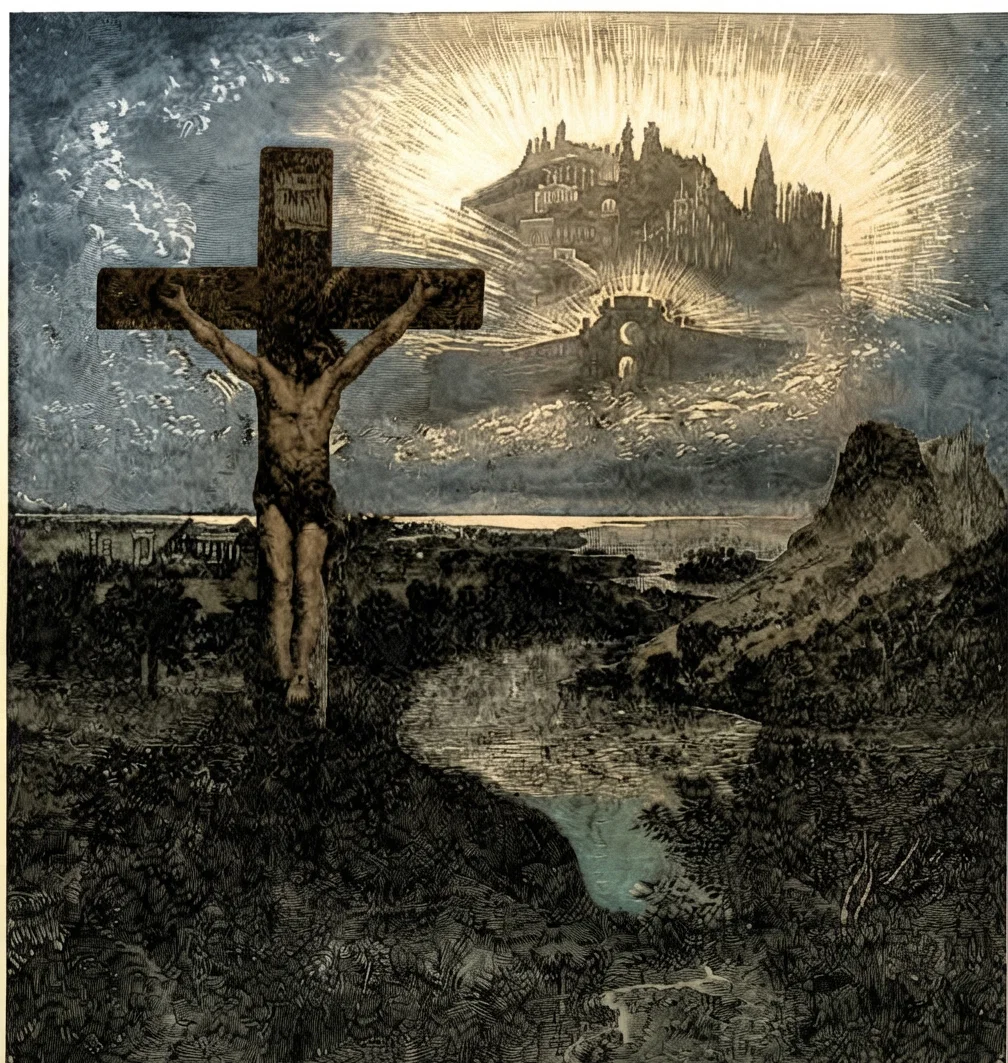
He saw the cross, the cruel, ignominious cross, with all its attending horrors, blazing with glory. But before the harvest can be reaped, the grain of wheat must fall into the ground and die. Even so must Christ be crucified. Only by his death could the work of redemption be accomplished.
“And I, if I be lifted up from the earth, will draw all men unto me.” The question is asked, Why then are all not drawn to Christ?—It is because they will not come; because they do not choose to die to self; because they wish, as did Judas, to retain their own individuality, their own natural and cultivated traits of character. Altho they are given every opportunity, every privilege, yet they will not give up those tendencies which, if not cut away from the character, will separate them from Christ. If, continuing to cherish these traits of character, they were admitted to heaven, they would cause a second rebellion.
“And I, if I be lifted up from the earth, will draw all men unto Me.” John 12 : 32.
Many people were round about Christ as he spoke these words, and one said, “We have heard out of the law that Christ abideth forever; and how sayest thou, The Son of man must be lifted up? who is this Son of man? Then said Jesus unto them, Yet a little while is the light with you. Walk while ye have the light, lest darkness come upon you; for he that walketh in darkness knoweth not whither he goeth. While ye have the light, believe in the light, that ye may be the children of light. These things spake Jesus, and departed, and did hide himself from them.” The Jews wished to provoke a controversy with him there and then, that they might have something with which to accuse him. Already a conspiracy for the purpose of putting him to death had been formed.
Notice the power of unbelief. “Tho he had done so many miracles before them, yet they believed not on him.” Christ had worked many miracles before the Jews. As an evidence of his divine mission, he had raised Lazarus from the dead. But the men who witnessed this miracle had set their hearts against Christ, and nothing could lighten the darkness that encompassed them. “Tho he had done so many miracles before them, yet they believed not on him; that the saying of Esaias the prophet might be fulfilled, which he spake, Lord, who hath believed our report? and to whom hath the arm of the Lord been revealed? Therefore they could not believe, because that Esaias said again, He hath blinded their eyes, and hardened their heart; that they should not see with their eyes, nor understand with their heart, and be converted, and I should heal them.”
“Nevertheless among the chief rulers also many believed on him; but because of the Pharisees they did not confess him, lest they should be put out of the synagog; for they loved the praise of men more than the praise of God.”

God’s Message to Us.

To-day Jesus reads the hearts of all; he knows the sentiments of every soul. And to us, at the very close of this world’s history, he is saying: “He that believeth on me, believeth not on me, but on Him that sent me. . . . I am come a light into the world, that whosoever believeth on me should not abide in darkness.”
Christ’s teaching made the disciples realize their own imperfections. And those who now behold Jesus, and fully submit to the sanctifying process that cuts away natural tendencies and habits, will be made patient, kind, forbearing, and full of compassion. This is a hope big with immortality, and full of glory.
God has graciously given men a probation, that they may through Christ obtain that power which will constitute them his sons. But full and entire consecration to God is required of us. While our Redeemer was laboring and suffering for us, he denied himself, and his whole life was one continued scene of toil and privation. Had he chosen, he could have passed his days on earth in ease and plenty, and appropriated to himself all the pleasures and joys of this life. But he did not. He lived not to glorify himself, but to do good, to save others from suffering, and help those who most needed help. He endured to the end. The chastisement of our peace was upon him, and he bore the iniquity of us all. The bitter cup was apportioned to us. But the dear Saviour took the cup from our lips and drank it himself, and in its stead he presents to us a cup of mercy, blessing, and salvation. O, what an immense sacrifice was this! What love, what boundless love!
After this manifestation of love, shall we shrink from the small trials we have to bear? Can we love Christ, and refuse to lift the cross? Can we love to be with him in glory, and not follow him from the judgment-hall to Calvary? If Christ be in us, the hope of glory, we shall walk even as he walked. We shall imitate his life of self-sacrifice; we shall drink of the cup from which he drank, and be baptized with the baptism wherewith he was baptized; for Christ’s sake we shall welcome a life of devotion, trial, and self-denial. Thus beholding him, we shall be changed from glory to glory, even as by the Spirit of the Lord. MRS. E. G. WHITE.

The Goodness of Humble People

No MAN or woman of the humblest sort can really be strong, gentle, pure, and good, without the world being better for it—without somebody being helped and comforted by the very existence of that goodness.
Continue reading: A BALLAD OF TREES AND THE MASTER