Your ShelfYour Projects

Review and Herald, Vol. 86, No. 6.

Witnesses to God's Glory

Review and Herald

Feb 11, 1909

Review and Herald Publishing Association · Takoma Park Station, Washington, D. C. · Feb 11, 1909

Witnesses to God's Glory

The spacious firmament on high, With all the blue ethereal sky, And spangled heavens, a shining frame, Their great Original proclaim: The unwearied sun, from day to day, Does his Creator’s power display, And publishes to every land The work of an Almighty hand.
Soon as the evening shades prevail, The moon takes up the wondrous tale, And nightly, to the listening earth, Repeats the story of her birth; While all the stars that round her burn, And all the planets in their turn, Confirm the tidings as they roll, And spread the truth from pole to pole.
What though in solemn silence all Move round the dark terrestrial ball? What though no real voice nor sound Amid the radiant orbs be found? In reason’s ear they all rejoice, And utter forth a glorious voice; Forever singing as they shine, “The hand that made us is divine.”
—Joseph Addison.

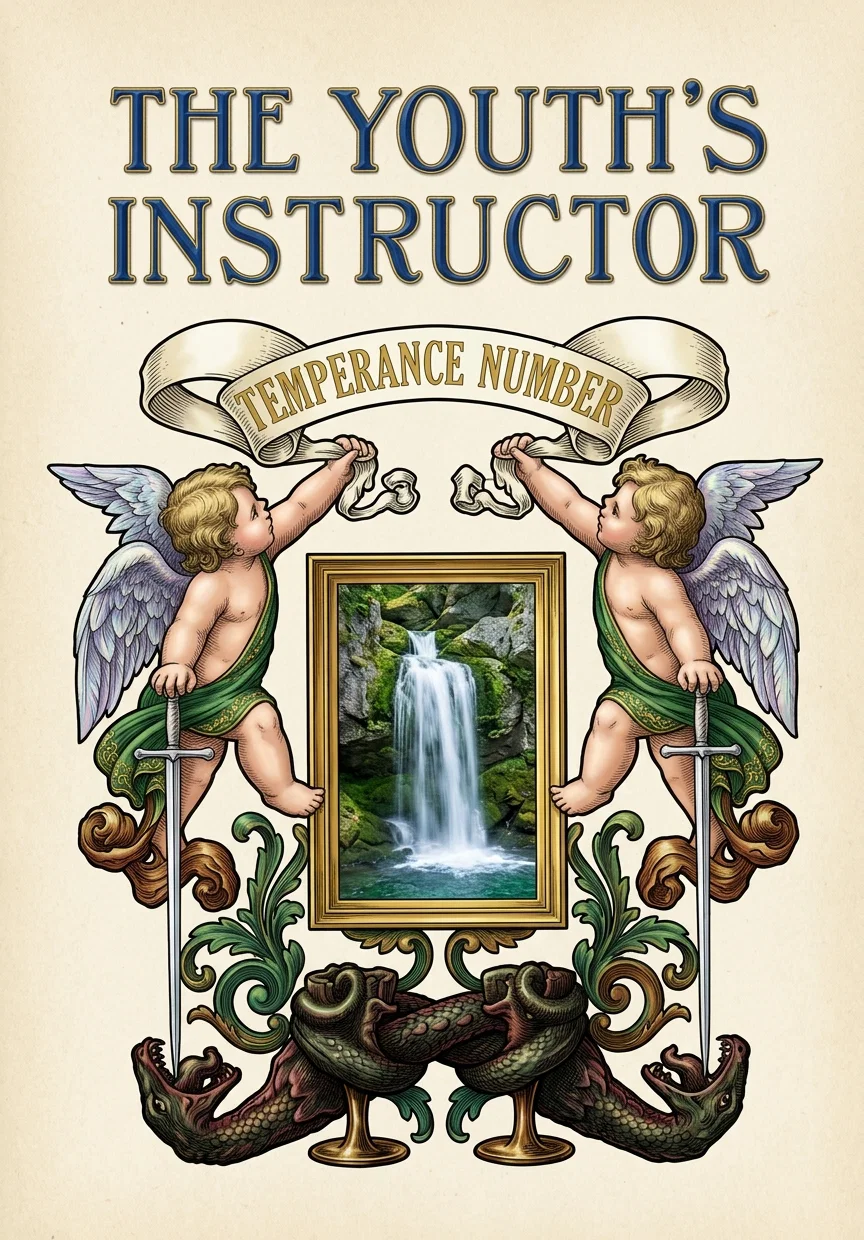
The Temperance Number

Of The Youth’s Instructor

To aid in uniting and strengthening our efforts in the great cause of temperance, a special temperance number of the Youth’s Instructor is to be issued. This number will bear the date of March 16, 1909, and will consist of twenty-four pages and cover, with an unusually attractive design for the front cover page. This artistic and suggestive design, together with the large number of illustrations and the valuable matter contained in the paper, must make this number the most important and easy-selling one ever issued.
All the leading themes of the temperance reform movement will be presented under these general headings:— The Evils of the Liquor Traffic; License and Revenue; The Returns of the Traffic; The Remedy—Prohibition, State and National; Alcohol in Heathen Lands; The Tobacco Evil; Allies of Liquor and Tobacco.
The fact that so many well-known temperance workers have contributed articles to this number will make it easy for one to interest the people in it. Among the contributors are: Edward Wavrinsky, Member of the Swedish Parliament; Mrs. L. M. N. Stevens, President of the National W. C. T. U.; Rev. Harry G. Greensmith, Grand Chief Templar of New York; Miss Jessie Forsyth, International Superintendent of Juvenile Work; Miss Alma Whitney, Grand Superintendent of Juvenile Templars; Rev. Joseph Crooker, President of the Unitarian Temperance Society; Mrs. E. G. White; and Daniel A. Poling, Traveling Secretary of the Intercollegiate Prohibition Association.

For Temperance Rallies

This number is admirably adapted to serve as the basis of programs for temperance rallies, which are an effective means of making known to the people our attitude as a church toward the liquor traffic, and of giving instruction and inspiration to those who take part in the rallies.

The Problem

Who is to place this paper in the hands of the people? All should have a part in it, as individuals, societies, schools, churches, and conferences. It is hoped that this number will form a feature of every temperance rally held in connection with the camp-meetings of 1909.
It is desired that young men and women sell this special number throughout the summer, and use the money obtained therefrom to pay their expenses in school the following year. Who will undertake this work?
Perhaps there is no question to which the people will more readily give their attention now than to the temperance question. Let us take advantage of the situation, and it may be that by this means we can also enlist the attention of many in the still greater reform now being carried on in the world by the third angel’s message.

PRICES

Single copy, 10 cents; 5 copies, 5 cents a copy; 25 copies, 4 cents; 100 copies, 3¾ cents; 500 copies, 3½ cents; 1,000 copies, 3 cents.

The Deity of Christ

IT has come to be quite the fashion in some quarters to acknowledge the divinity of Christ, using the term, however, only in an accommodated sense, while denying his deity. The real consequence of this teaching, and the importance of maintaining as a cardinal doctrine the deity of Christ, and consequently his supernatural birth, are well set forth in an article by Dr. Louis Matthews Sweet, in the Bible Record, from which we take the following liberal extracts:—
The view of Christianity which makes the deity of Christ, and hence the incarnation, a non-essential point not to be defended, diverts the attack from Christianity, which by the definition is rendered too insignificant to provoke discussion, only to concentrate it upon Theism, which, thus weakened and impoverished, is ill able to stand the assault. Note carefully the issue. The evangelical view of the “essence” is that the life of Christ is the “human life of God,” and being this, it becomes the power of a divine life for man. Christ reveals primarily the divine attitude toward men as the necessary precondition for the attainment of the right attitude on the part of men toward God. And he does this not by any mere expression of private opinion or conviction as to the character of God, but by the actual historical manifestation of the being of God among men. When we make a humanistic interpretation of Christ’s person compatible with essential Christianity, this element of immediate supernatural revelation is at one stroke removed from the gospel. It is expelled by the terms of the definition, and can not be brought back except by reconstructing it. Christ becomes the “Prophet of Nazareth,” and what he thought about God becomes our whole gospel. Now the vital question in the exposition of Theism is to make good the contention that God is of such a character as to warrant our taking the filial attitude toward him. There can be no question that the filial attitude toward God is the only reasonable one, provided God is our Father. But this is the very point in question with many minds: “Can we believe in God the Father?” This has been called the doctrine which is too good to be true. That Jesus of Nazareth was a convinced Theist must mean much to the seeker for truth, but it must be remembered that, by the terms of the definition under review, all that we have in Christ is a human being’s judgment and testimony as to the character of God. And if first his confessed moral and spiritual greatness give unique meaning and weight to his testimony, on the other hand his poverty, distress, and shame, all the horrible injustice of a tragic career as the reward of unexampled fidelity to high ideals, must be added to the already portentous sum of the world’s unexplained woe. It can not be added to the other side as an element, and a decisive element, in the solution of the most difficult of all theistic problems. For the very burning core of that question lies in this: that, seemingly, God thrusts us into a furnace where he himself never walks; he lays upon us burdens which he himself never bears. This thought may be taken as the real cause of most of the sincere unbelief in the history of the world. In the vivid story of an outlaw hiding among remote cliffs of the Pyrenees occurs this sentence, spoken when the fugitive looks down, unseen, upon his foes: “I am as safe here as God is in heaven.” Perhaps the skilful narrator imagined this sentence as appropriate to the situation, but it has a smack of reality, as if it had been taken from the lips of men. At any rate, it expresses a genuine feeling. God seems so safe in his heaven, while we are exposed to the bludgeonings of fate! For the bitter waters of this Marah of unbelief, Christianity, according to this interpretation of it, has no branch of healing.
It is only when we define Christianity in such a way that Christ’s deity and true incarnation become central and essential, that we can guard the doctrine of God at this point where the heart of man is apt to make its most powerful revolt. “Then,” to use the words of Van Dyke, “we can look up to a God who is not impassible, as the speculations of men have falsely represented him, but passible, and therefore full of infinite capacities of pure sorrow and saving sympathy. Then the dumb and sullen resentment which rises in noble minds at the thought of a universe in which there is so much helpless pain and hopeless grief, created by an immovable Being who has never felt and can never feel either pain or grief,—that sense of moral repulsion from the idea of an unsuffering and unsympathetic Creator which is, and always has been, the deepest, darkest spring of doubt, fades away, and we behold a God who became human in order that he might bear, though innocent and undeserving, all our pains and all our griefs.”

Amending the Law of God

In two articles in recent issues of the Waterloo (Iowa) Daily Courier, Dr. J. O. Stevenson (Congregationalist) openly takes the position that the law of God needs revising. He states his views thus:—
Since our modes of thinking and our constitution of society have radically changed from anything that existed in Bible days, we believe that the ten commandments need to be revised.
The letter of the Old Testament legislation on the observance of the Sabbath is very much in need of revision and adjustment to the needs and practises of to-day. . . . The primitive moon worship gave us our idea and practise of one day in seven as being the proper measure of work and worship.
In order to get rid of idolatrous connections, the Israelites changed it [the Sabbath], from shifting with the moon's phases, to a fixed day, the seventh, or Saturday. To get rid of Jewish ritualism, the Christian church changed it from the seventh, or Saturday, to the first day of the week, which is Sunday, and thus we have our day of rest on Sunday.
The fourth [commandment] should be, Remember Sunday as a day of sacred rest.
These are certainly remarkable utterances for a professed minister of the gospel to make. That law concerning:which the apostle Paul declared, “The law is holy, and the commandment holy, and just, and good,” according to this modern teacher is in need of being revised. Instead of allowing the law of God to be the standard of righteousness, and requiring all men to conform their lives thereto, this modern teacher would change the law to meet the practises of men.
Passing by the ridiculous claims, which contradict the plain statements of the Scriptures, that the weekly cycle is due to primitive moon worship and that the Israelites themselves established the seventh-day Sabbath, we direct attention to the fact that it is very late in the day for a professed Protestant to suggest a revision of the ten commandments, and that the change which he suggests, in the fourth commandment was made centuries ago by that power which, according to the prophecy, would “think to change the times and the law.” A revised form of the ten commandments is given in the various Roman Catholic catechisms, the second commandment being omitted, and the tenth commandment divided so as to preserve the original number. The Sabbath question is thus treated in one of these catechisms:—
Q.—Say the third [fourth] commandment. A.—Remember that thou keep holy the Sabbath day. Q.—What is commanded by the third commandment? A.—To sanctify the Sunday.
Instead of attempting to bring out another revision of the ten commandments, it would be better for this professed Protestant teacher to accept the revision already made by the Roman Catholic Church, especially since it harmonizes exactly with his own recommendation concerning the needed change in the fourth commandment.
Such teaching as that already quoted from Dr. Stevenson's articles is most convincing proof of the apostasy of Protestantism. In the days of the Reformation, and for about three centuries later, the motto of Protestantism was, “The Bible, and the Bible alone, a sufficient rule of faith and practise.” This was the answer of Protestantism to the claim of the papacy that tradition is “more clear and safe” than the written Word of God.
During the last quarter of a century, however, the original Protestant position has been practically abandoned by a very large proportion of the Protestant leaders, who have to all intents and purposes gone over to the Roman Catholic ground, and have substituted human authority for the Word of God.
In view of the message now going to the world urging the claims of God's law, only those who teach the ten commandments as originally proclaimed at Sinai, and who therefore in their practise observe the seventh day of the week as the Sabbath, can consistently maintain the original Protestant position, and oppose the demand of an apostate church, whether nominally Roman Catholic or Protestant, for a revision of the law of God.

Editorial

Jesus Christ and his work for man are the central theme of the written Word of God. The prophecies point to him. The truths of that Word radiate from and center in him. Their expression is a means to an end, and that end, the reconciliation of men to God. Be the priesthood that of Aaron or of Melchizedek, the great High Priest over both services is the Lord Christ. Be the dispensation the old or the new, the heart of both is the mediatorial work of Christ. To him who understands this, the Bible is one Book, and Christ is more than a great teacher.

An Unwarranted Demand

A RECENT number of The Union Signal contains an article on religion in the public schools, by Elizabeth W. Greenwood, evangelistic superintendent World's and National W. C. T. U. It is a distinct demand for religious teaching in the public schools. We quote some leading paragraphs:—
When the public school was first established, and for a hundred fifty years after, definite religious instruction was an important part of its curriculum. To-day special religious teaching is often banished from the public schools of the country. . . .
This change in sentiment has resulted from the multiplication of religious sects, the so-called appeal to “fair play,” the fear of sectarian training, and the inrush of immigrants from every land. . . .
Religious and moral teaching are essential to character. Any system of education which does not inculcate sound morality is defective and dangerous to the state. The culture of the conscience is far more essential to manhood and citizenship than the culture of the intellect. . . .
Our aim is not to teach Protestantism or Catholicism; not to unite church and state, and plunge into the difficulties of England or France, but to make religious and moral instruction one of the prime factors in our system of popular education. To teach every child the basic principles of the great religious truths which are supported by Protestant and Catholic, Jew and Gentile, and by all creeds—as, God's sovereignty; the immortality of the soul; the brotherhood of man; the fact of sin, and its consequences; the ten commandments; sermon on the mount; golden rule; lessons of psalm and proverb.
We freely grant that “religious and moral teaching are essential to character,” but we affirm that it is not within the legitimate province of the state to provide such teaching. The genius of civil government was ordained of God, but it was not the divine purpose that civil government should undertake the work assigned to the church.
It will also be apparent at once that even the attempt to teach the subjects mentioned would lead to conflict and confusion. There are many professed Christians, and their number is increasing, who do not believe in natural immortality; there are other professed Christians who differ in their view concerning the ten commandments, some claiming that they have been abolished, others that they are in full force. The whole army of evolutionists deny the fact of sin, and claim that the only fall was a fall upward. Furthermore, the infidel has the same rights in the public school as the Christian, and his money, collected by the authority of the state, should not be used to teach a religion which he regards as false. The Christian method is to leave the teaching of religion as a voluntary work, to be done by those who believe in it. The teaching of religion in the public schools is impossible apart from a union of religion and government, which is the same thing as a union of the church and the state. It is vain to proclaim the purpose “not to unite church and state,” and at the same time demand that which in itself requires such a union.

The Third Angel's Message

What Does It Mean to Us?

For eighteen hundred years men have been reading the messages of the three angels of Revelation 14. In spite of the fact that the prophet was forbidden to seal “the words of the prophecy of this book,” which contained these messages, and in spite of the fact that the messages committed to these angels contained the most striking, emphatic, and solemn language used in the Bible, no people ever took up those messages to give them to the world until the time of this last generation came. As the book containing them is the book of God, and the messages his messages, we know that his hand has overruled in reserving these for the people of our day.
In this is shown the logical consistency of the gospel plan and work. The first message declares that “the hour of his judgment is come.” That message was not due in the days of the apostles, nor in the days of the Reformation. It was not due until the work of the investigative judgment was to be taken up in heaven. But it was due then, and began to be given then.
Likewise the message of the second angel was not due until Babylon—the fallen church—could be pronounced by heaven as “fallen,” and the cause of the ruin of nations.
Neither could the message of the third angel have been given with consistency to any generation earlier than our own. A generation ago there was no “image of the beast” in visible process of formation. To-day there is; and so comes the warning: “If any man worshipeth the beast and his image, and receiveth a mark on his forehead, or upon his hand, he also shall drink of the wine of the wrath of God, which is prepared unmixed in the cup of his anger; and he shall be tormented with fire and brimstone in the presence of the holy angels, and in the presence of the Lamb.”
The conditions which make such warnings necessary have all come to pass.The investigative judgment has been entered upon, and in harmony with the declared purpose of God to do nothing without making it known to his servants, the prophets (Amos 3:7), that act is made known in the first angel's message.
When fallible men deigned to impute the characteristic of deity to a mere man—the head of the papal system—thus exalting him to the place of God, heaven's declaration of the complete fallen condition of that system was due; and it was given. Men declared the pope infallible. God declared the whole system of which the pope was the head, “fallen, fallen.” That message, like the other, has gone through the earth, and Babylon herself has heard it. Her priests deny the charge, while they preach the doctrines of darkness that make it apply. They bind the consciences of men that would lead them to the light, and they put out the light itself by withholding and burning the Word that contains it. They preach Christ crucified, and then put him away from us by putting another who has no power to help us between us and him. They exalt and carry about his crucified image, and then crucify him afresh in the persecution of his humble followers wherever they can so shape the laws of the land as to make such persecutions possible. They reap a golden harvest from their living devotees by pretending to pray their departed loved ones out of a place of torment invented for the occasion. Thus do they, as the prophet declares (Rev. 18:13), traffic in the “souls of men.” A glance at the history of the system wherever it has dominated any land, compels one instinctively to declare with the prophet, “fallen, fallen, is Babylon.”
But we are living in the days when the warning of the third angel is due. The “beast” which John saw did not pass away with the reception of its “deadly wound.” “His death stroke was healed.” Another power was to come upon the scene that would have sufficient influence to speak to the world and have its suggestions heeded. It speaks, and an image to that death-smitten “beast” is formed, and life is given to it, and it also speaks, demanding for itself what had been exacted by the “first beast,”—the worship of the world, with the penalty of death for refusal to worship. The “first beast” had demanded such worship under threat of a similar penalty, and had carried out the penalty. The “image” proposes in all things to be like the original.
Now forces are at work with feverish haste to bring about the very conditions foretold by the prophet. The whole plan has been laid out by the master of deception with cunning exactness. The proper conditions are being rapidly brought about in all parts of the world, and just such forces are wheeling into line as would be needed for the execution of his plans. A church losing the sense of the supreme value of souls, has been blinded by a sense of the supposed sacredness of a papal institution, and the necessity of forcing it upon the people. Through that procedure the way is opened for the combined forces of Protestantism to bring themselves under the leadership of the papacy, and bring about the consummation foretold in the thirteenth and fourteenth chapters of Revelation. Such a course is the most disastrous recorded in the Word of God. It is the last great apostasy of the professed church of Christ, and brings to a completion the work of sin in the earth so far as its power to influence future results is concerned.
It is not to be supposed that God would permit such a terrible consummation without warning the world concerning it and its consequences; neither has he. The third angel's message is God's protest against men's yielding to the deceptions that bring about that disastrous consummation. The time has come for the message, and the message is being given to the world. The people who are giving it are few in number when compared with the great religious bodies of the world, and when compared with the population of the great nations of the world. But this people is not set the task of converting the world, but of warning the world. The prophecy itself indicates that the great majority will turn a deaf ear to the warning. The warning is given not only to save souls, but to witness against those who would not be saved through its instrumentality. “This gospel of the kingdom shall be preached in the whole world for a testimony unto all the nations; and then shall the end come.” Matt. 24:14. If each of the one hundred thousand Seventh-day Adventists would give the message to ten persons each year, the remainder of the work of warning the world would be accomplished in a few years. Many are doing much more than this. Some are doing practically nothing. Many who long for the eternal rest and joy in the mansions of the redeemed are doing nothing to bring about the completion of the work that must first be accomplished. Such are not ready for the promised rest, and could not expect to hear the Master's “Well done,” if he were to come while they are thus idle. Every believer in this message should be a dispenser of the light which he has received. Every church of Seventh-day Adventists should be a light that could not be hid or quenched. We “believe the message;” but if we let it fall dead upon our doorstep, we can not consistently expect a share in the reward of the faithful workers. Bearing it in person to others, sending it in printed form where we can not go ourselves, and giving liberally of the means over which God has made us stewards,—these are the ways whereby we can share in the closing work and in the rest beyond.
While God's restraining power is being withdrawn from the earth, and calamity after calamity is befalling the people; while the powers of darkness are marshaling the forces for the last powerful onset, it behooves every lover of this message to stand in his lot and place, ready to go, give, or send, that a quick work may be done, and the saints be gathered home.
C. M. S.

Too Much Assumed

A WRITER in The Standard (Baptist) of Chicago, at the close of an elaborate argument to prove the immortality of the soul, hangs some assumptions upon the fact of Christ’s resurrection that would be, to say the least, very difficult to prove. He says:—
Out of this faith [in Christ’s resurrection] grew a claim on a day; one day in seven was set apart for worship. On the first day of the week men met for worship, for prayer, for study of truth. It is easy to build monuments, hard to seize a day, to get men to surrender one seventh of the time. This shows the power of the risen Christ over men. An empty tomb, a full day, a living church. If the resurrection of Christ is not a fact, account for the tomb, the day, the organization. . . . If the disciples had stolen the body of Christ, he [Paul] would never have preached the resurrection of Christ, would never have kept the day, never have joined the organization.
There is so much assumed in the above, with no basis whatever in fact, that it is a tax on one’s credulity to be asked to believe that it was written by a minister of the gospel. It illustrates the result of the training given in many modern schools of theology in which so much is made of the criticism of the Bible, and so little attention is paid to what the Book really teaches. It is assumed, to begin with, that the setting apart of one day in seven for worship began at thetime of the crucifixion; that the observance of Sunday as a day of rest and worship was begun by the immediate followers of our Lord; that men hitherto had not been in the habit of surrendering “one seventh of the time;” that the power of Christ as head of the church is demonstrated by the Sunday sabbath. Now all these are pure assumptions, and not only that, but are in direct opposition to the plainest teachings of the Word. There was no thought of keeping Sunday in commemoration of Christ’s resurrection until at least two centuries this side the cross. The observance of a Sabbath, the setting apart of one day in seven for rest and worship, was not a new thing to the people of Christ’s time. The immediate followers of our Lord kept no other than the seventh day, and Paul also knew nothing of a first-day sabbath to commemorate the resurrection of his Lord, but definitely declares his observance of the seventh day. If the power of Christ were demonstrated by the establishment of the Sunday sabbath, it is difficult to understand why the demonstration should have been postponed until the half-pagan emperor Constantine, in 321 A. D., established and enforced it by statute of the state. “The day” can be accounted for without any resurrection of Christ, and so adds nothing to the proof of the resurrection. “The day” was the holiday of the pagans for many centuries; began to be called the “Lord’s day” at the end of the second century; was enforced upon pagans and Christians alike from the year 321 A. D.; and was strengthened by the Council of Laodicea in 364, when a power-loving and apostatizing church joined hands with the state for its own exaltation. If the charge that Christ’s body was stolen by the disciples is to be disproved by the fact that Paul kept Sunday, then the charge against the disciples must hold; for on Paul’s own testimony he was an observer of the seventh day, not of Sunday. Into such bogs of confusion are men driven who attempt to prove the sanctity of a day God never commanded as a Sabbath.
C. M. S.

No Lack of Openings

WRITING from Italy, in response to a letter making reference to the great earthquake, Elder C. T. Everson says:—
You speak of the openings that this great sign of the times will probably give us in Italy. But the question that presents itself to us is, What will we do with new openings when we can not fill the ones we have now?
Well may we pray the Lord of the harvest to send laborers into the Italian portion of the harvest-field. We have less than fifty members there, facing thirty-three millions.        W. A. S.

An English Catholic Challenge

THE Catholic publishers, Burns and Oates, of London, publish a “Library of Christian Doctrine” for the Brotherhood of St. Vincent of Paul, an organization for mission work among Protestants. One tract of this series is entitled, “Why Don’t You Keep Holy the Sabbath Day? A question for all Bible Christians.” The following extracts (italics theirs) show that the Roman Catholic Church in England is as free to challenge the inconsistency of Protestants in the matter of Sunday observance as is the church in this country. The Roman Church is everywhere using the Sunday institution as the sign, or mark, of the supremacy of the papal church over the Word of God.
But Sunday is not the Sabbath day. Sunday is the first day of the week; the Sabbath day was the seventh day of the week. Almighty God did not give a commandment that men should keep holy one day in seven; but he named his own day, and said distinctly, “Thou shalt keep holy the seventh day;” and he assigned a reason for choosing this day rather than any other—a reason which belongs only to the seventh day of the week, and can not be applied to the rest.—Page 3.
You are a Protestant, and you profess to go by the Bible, and the Bible only; and yet in so important a matter as the observance of one day in seven as a holy day, you go against the plain letter of the Bible, and put another day in the place of that day which the Bible has commanded. The command to keep holy the seventh day is one of the ten commandments; you believe that the other nine are still binding; who gave you authority to tamper with the fourth? If you are consistent with your own principles, if you really follow the Bible, and the Bible only, you ought to be able to produce some portion of the New Testament in which this fourth commandment is expressly altered, or at least from which you may confidently infer that it was the will of God that Christians should make that change in its observance which you have made.—Page 3.
We blame you, not for making Sunday your weekly holy day instead of Saturday, but for rejecting tradition, which is the only safe and clear rule by which this observance can be justified. In outward act we do the same as yourselves in this matter; we, too, no longer observe the Jewish Sabbath, but Sunday in its stead; but then there is this important difference between us, that we do not pretend, as you do, to derive our authority for so doing from a book, but we derive it from a living teacher, and that teacher is the church.—Page 8.
Both you and we do, in fact, follow tradition in this matter; but we follow it, believing it to be a part of God’s word, and the church to be its divinely appointed guardian and interpreter: you follow it, denouncing it all the time as a fallible and treacherous guide, which often “makes the commandment of God of none effect.”—Page 8.
W. A. S.

God Knows Us

God knows his children. This is one of the most precious truths of Christian experience. The Saviour says, “I know my sheep.” He knows the characteristics, the peculiar temperament, of every individual member of his flock.
He knows the strength and the weakness of each. His discerning eye can trace the secret, underlying motives and purposes of every action. Small comfort this to the hypocrites of heart or the workers of iniquity; but true comfort indeed to his children.
It is natural for the human heart to long for that sympathy which springs from a knowledge of human needs. This knowledge Christ possesses, and this sympathy he can bestow. His knowledge is not that of theory, but of realization, of his own experience as a man. Says the apostle, “For we have not an high priest which can not be touched with the feeling of our infirmities; but was in all points tempted like as we are, yet without sin.”
He knows all his children. He knew Peter’s name, the name of the man with whom Peter was stopping in Joppa, the man’s business, the particular location of his house. He knows as much of every child now.
He knows how heavy are life’s burdens, how hard to lift and bear life’s crosses, how difficult the upward way. He knows how stinging the rude taunt, how hard to stand the base insult. He was a man of sorrows, and acquainted with grief. He knew the loss of friends, the poignancy of human woe. He wept at the grave of Lazarus, and his heart is touched to-day by scenes of sickness and suffering. He was born of poor parentage, and therefore can feel for the humble toilers in life’s conflicts. In all his public work he stood alone, alone though surrounded by a multitude, finding communion only with his own heart and with God, misunderstood and misrepresented. And he can feel for those who stand alone to-day. He understands their heartaches and longings, and can satisfy every desire for communion and companionship.
In view of this human experience of our divine Helper, the apostle concludes: “Let us therefore come boldly unto the throne of grace, that we may obtain mercy, and find grace to help in time of need.”
God knows how weak we are, and yet, knowing this, he blesses still. Says the psalmist: “Like as a father pitieth his children, so the Lord pitieth them that fear him. For he knoweth our frame; he remembereth that we are dust.” He blesses, knowing, when he does so, that his blessings will be unappreciated. Our failures never surprise God. His great heart of love is grieved, but he knew it all before. This consideration, instead of inclining to forgetfulness and thoughtlessness, should lead to greater care. He sheds abroad his love to win us. It is his goodness which leads to repentance. The one who truly loves our Father in heaven, will shrink from grieving his great loving heart.
May the knowledge that God knows, and knowing, can abundantly supply our need, lead us to walk carefully before him, and to fight courageously and hopefully the battles of our Christian warfare.
F. M. W.

The Earthquake’s Message

A CORRESPONDENT of the Washington Post sent to that paper a vivid account of the recent earthquake, which was printed under the significant title, “Like End of World.” This title indicates that the event to the ordinary observer conveys a message of warning concerning the day of destruction now near at hand. The correspondent of the Post designates the earthquake as “the most stupendous tragedy in the history of mankind,” and declares that “neither pen nor camera can give a faintly adequate impression of even the residue of utter desolation which nature has left.” After reciting with much detail the story of this greatest catastrophe, the correspondent of the Post thus closes his letter:—
So Messina died, and was buried. Leave her to her fate. Let her dead bury the dead. Now I am leaving the accursed city, this white inferno. Never may I look upon its like again. Her name must stand hereafter in the vocabulary of all tongues as the synonym of transcendent horror and human suffering. I have given but a fragmentary and inadequate translation of the greatest of human documents written by God or the devil with a single stroke of his pen.
This is but one of the latter-day documents, illustrated with scenes of ruin, and punctuated with cries of terror and groans of suffering, which proclaim to all the dwellers on the face of the earth that the hour of God’s judgment is come, and that soon the world will be brought face to face with its Maker. At the same time there is going forth to the world the final proclamation of the gospel, to prepare a people for translation when “the earth is utterly broken down, the earth is clean dissolved, the earth is moved exceedingly.” In this message of deliverance is found the only hope for the people of this generation.
Continue reading: Forging the Weapons of Peace