AFTER our profitable meeting with the Siberian Union Committee, Brethren Guy Dail, J. Sprohge, and I left on the Volga steamer "Samolett," June 4, reaching Tzaritzin next morning. Several of our believers met us here, and in the evening we had a meeting with our church at this place, which was attended by about fifty.
Proceeding on our journey that same night, we came to Alexandrodar next evening, and here we stopped three days. The village officials had kindly given their schoolhouse for our services, and it was well filled at every meeting. As Elder K. A. Reifschneider has been invited to take charge of the South Russian, or Azof, Conference, and Elder Sprohge is to take the presidency of the North Caucasian Conference, which office was thus made vacant, we met in council with the committee to arrange the details of the transfer. We were pleased to meet with the brethren in this field once more, and to see evidences of the progress of the work.
Immediately after the evening meeting of June 9, we took the train, reaching Tiflis June 11. Elder A. Osol and Brother T. Heyde met us at the station, whence we were conducted to Brother Heyde's home. That night we spoke to the brethren in Tiflis, some forty being in attendance. After the meeting we again took the train, accompanied by Brother and Sister Osol, who were going to visit our Molokan brethren at Basartschai, during a tour among the churches of the Transcaucasian field. There is a great interest in these mountain districts to hear the message, and the work is onward. The train was so crowded that some of us were absolutely unable to get a seat until morning, when we were passing through an interesting mountain pass, in the midst of beautiful scenery. To our left was the great Mt. Allakaja, or the "Eye of God." Later we saw the two highest peaks of the Mountains of Ararat on the right. Late in the afternoon we followed the Aras River, and near midnight we reached Julfa, the Russian border town, commanding the northern entrance to Persia. Here we remained until morning. We had letters of introduction to the leading banker of the place, and he kindly met us at the train and saw that we were brought to the hotel, where we stayed overnight. Next morning we called upon the banker at his office. As we had never been in Persia, we had to get some experience with the money in use there. There are no railways whatever in Persia; so our inland trip of about one hundred fifty miles had to be made entirely by team. We therefore not only purchased the outfit necessary for traveling, but also had to supply ourselves with the money. On exchanging about one hundred fifteen dollars, we were given a large bagful of silver coins to carry. As there was no gold money at the bank, and there is no paper currency in circulation that is good for the country in general, we finally got about two thirds of this money converted into a draft on the Russian bank in Urumiah, and even then our supply of silver was rather heavy.
After arranging our passport, we crossed the Persian boundary in company with a Persian merchant who spoke a bit of Russian, whom the banker had kindly secured to assist us in making proper arrangements for securing a team to Urumiah. We drove about half a mile to the iron bridge crossing the Aras, which was as far as the Russian team went. Then the Russian sentinel, finding our passports in order, called for the Persian porters to come over and carry our luggage across the bridge. The baggage was placed on a Persian carriage, after we had paid a small fee, and we went another half-mile to the Persian custom-house. Here our passports were beautifully ornamented with four different kinds of stamps, for which we were charged $1.25. The customs proved more a matter of fees than anything else. We were then driven to a Persian khan, or caravansary.
The khans of Persia, so far as our observation goes, consist of large courts where many teams may be accommodated, while the guests go into separate chambers that contain no furniture whatever. The servants brought us a few carpets upon which our luggage was placed. The merchant, finding no teams in town that might be hired for the trip, left us in despair, not even notifying us of the results of his search. Nor did he turn up next morning, so we finally began the search ourselves. I went to purchase some stamps at the Persian post-office, and there I found an official who knew French. Later on in the forenoon a Persian driver accosted us, asking if we did not want to have him take us to Urumiah. We looked over his hack, and his three horses, and finally went to the post-office, where the young man translated for us, and we secured the team for thirty-eight tomans (a toman is about ninety cents). After having closed this bargain, we desired to send a telegram, and were referred to the Indian telegraph office, where, to our surprise, we found a German woman who had been employed in Persia for about sixteen or seventeen years. She helped us in completing suitable arrangements for the trip, our driver giving us, at her suggestion, nearly three dollars as security that he would stick to his part of the bargain.
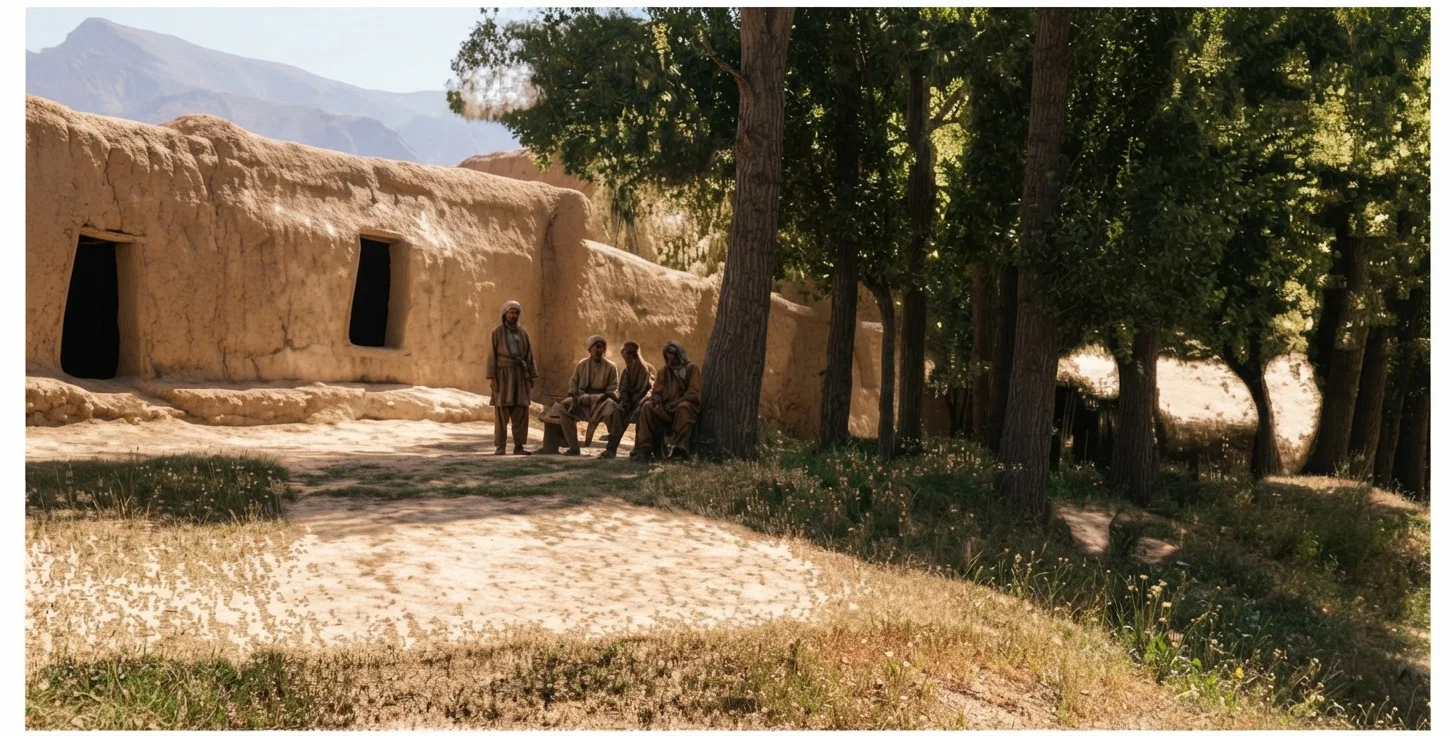
A PERSIAN VILLAGE SCENE
At four o'clock the next morning, the driver appeared, and tied our baggage securely on his rig, and we began to ascend toward Urumiah, via Khoi. Our road was largely the bed of a stream. We passed through that part of the country that was infested with robbers during the revolution three years ago, when traveling was very dangerous here. But now we found large numbers of Russian Cossacks patrolling the roads, ever on the lookout for those who might offer violence to travelers or to commerce.
We found the border country anything but inviting. There were high mountains all about, some of which were even snow-capped. The people of the valley are troubled with severe dust and sandstorms half of the year. The shops of Dschulfa are stocked with imported wares of poor quality, for which the merchants demand high prices.
About noon we were near a khan, and there we met a number of persons coming from Urumiah. One of these was a physician, who spoke English. We asked him if he knew Brethren F. Oster and H. Dirksen. He replied in the negative. But when we mentioned them as Sabbatarians, he at once knew whom we meant, and told our driver how to find the house without trouble. The first day we made about fifty miles, as the horses were fresh, and then we turned in for the night at Khoi, a town of some 25,000 inhabitants. The city was surrounded by a double wall, through which only a few gates had been made. In front of the entrance were Russian barracks, and the gates themselves were guarded by Russian soldiers. The bazaars were rather13interesting to us, and we soon learned to bargain in the Persian currency, purchasing such provisions as we needed. Our first night in this interior town was so interesting that we did not sleep very much. The khan was small, only large enough to accommodate four teams. Above the stalls for the horses there were small mud huts where travelers pretended to sleep. After some mats had been placed on the mud floor for us, we lay down, surrounded by our luggage; and the many marks upon our bodies next morning witnessed to the weary hours we had passed during the night.
Quite early in the morning we left Khoi. The country was now well watered. We were in the midst of many gardens, and there was a large number of trees to be seen. At Salmas we ate our dinner beside one of the clearest of brooks, running along under the trees. About three o'clock in the afternoon we reached Dilman, also a town surrounded by mud walls, lying in the heart of the plain. We experienced one great inconvenience here in this part of the country. What was once a good road had been very largely ruined because the peasants had converted the way into irrigation ditches, so that the road was full of mud-holes, and had been largely destroyed. At Dilman we had a somewhat better place to sleep than we enjoyed at Khoi, but still our rest was rather limited. Shortly after departing from Dilman, we came in sight of Lake Urumiah, but were surprised that there was not so much as even a sail to be seen. For several years a German had been operating a small steamboat on Lake Urumiah, by which the trip from Julfa to Urumiah had been shortened considerably, but the boat had recently sunk. However, there is hope that soon several boats will be plying on this lake, for the accommodation of travelers.
Having crossed the plain, we had to climb the steepest and worst divide on the journey. Our three horses were not equal to the task; but we had happily met the mail-wagon going from Tabriz to Urumiah, and the driver kindly lent us the use of one of his horses till the summit was reached, we ourselves naturally walking all the way up. Upon the top we found a Russian guard-house, from the level roof of which a watchman could be seen carefully surveying the landscape through a field-glass. The descent was also very steep, and by dinner-time we had reached the lake, and stopped in the town called Ghusty. At each town we saw the Russian flag displayed, and found quite a number of Cossacks stationed along the way. Proceeding on the journey, we discerned a heavy storm gathering in the mountains, but were glad to see that it did not reach the plain. We stopped about three hours' journey from Urumiah. Here we had to climb up a rude ladder to the "upper room," whither our luggage had been transferred, and there we spent the last night before reaching our brethren in Urumiah.
(Concluded next week)
Its Rules of Conduct
By J. O. CORLISS
Home Life — No. 3
Its Rules of Conduct
EVERY well-ordered home is such because of certain well-established rules of conduct by which each member of the household is governed in family intercourse. No organization can thrive without recognized law. In setting up the first family, infinite wisdom established a law of government for it, obedience to which would have insured perpetual happiness. God commended Abraham, and pronounced a blessing upon him for commanding his children and his household after him (Gen. 18: 17-19), and the Spirit exhorts parents to rear their children in the nurture and admonition of the Lord. Eph. 6: 4.
This in no sense means that members of a family are to consider themselves slaves to imperious dictation, since fathers are specially exhorted not to provoke their children unto wrath. When family laws are reasonable, and wisely administered, they are conducive to the closest unity, and the most perfect freedom of household converse, which is the acme of family happiness. Without such domestic regulation the peace of the home is jeopardized, and its divine purpose frustrated.
Nothing should be considered of so little account as to be exempt from this general rule. Every act relating to the family, however small, should be scrutinized in the light of necessary home regulations, and if it tends in the least to diminish esteem for these, it should at once be renounced as a disturber of the peace. The rules of every Christian home, especially, should require that all intercourse between members be subservient to soul culture, that the family mission may not be invalidated.
But this high calling is almost impossible to reach where the law of self-denial is disregarded. One may, in the walks of business life, put up with the selfish person now and then met, but none such is desirable in family association. The presence of but one of this kind in a home, whether parent or child, mars its harmony, and lowers the standard of true home life. For this reason, the most diligent care should be exercised by each member that no love of selfish interest be permitted to trench on the personal rights or general prosperity of others.
This should be the law of parents as well as of children. No father can justly demand that everything about the home must be arranged to suit his every whim, regardless of the comfort of other family members. He has no right to be a domestic tyrant, neither has the mother any call to be a shrew, and by so doing alienate the affection of husband and children. Children, also, ought to consider parental sacrifices in their behalf, and seek to remove some of the heavy load of parental care, by freely assisting in the discharge of family duties, rather than to study their own ease and comfort alone. Self-denial should be so marked on the part of each as to have mutual compromises the general rule, and thus make home the most desirable place on earth.
Courtesy is another essential principle in the amenities of home life. Many persons appear the soul of grace in society circles, who do not feel it incumbent on them to practise common politeness in the home enclosure; yet the home is the place above all others where every-day civilities are needed, and count the most in the end. A once popular writer has said with considerable enthusiasm that "the happiness of life is made up of minute fractions, the little, soon-forgotten charities of a kiss or a smile, a kind look, a heartfelt compliment,14and the countless infinitesimals of pleasurable thoughts and genial feeling."
A transient world can better afford, if necessary, to lose these expressions of courteous sympathy than can those with whom we constantly associate in family intercourse, because the happiness of home life depends on these things. Indeed, it must have them or be turned into the path of sorrow and grief. The world can and does pass by with evident scorn, social discourtesies and inadvertencies, but the sensitive family heart broods over these things to its own present discomfort and future detriment. Why not, then, give open expression to that love which must necessarily dwell in every heart united in family relationship?
In this way only can members of a family maintain real acquaintance with one another. Does it not seem strange that members of any household should be such strangers to one another as to seek counsel and comfort in time of trial from those in no wise related to them by family ties? Yet this often occurs. Can you not recall cases where young people have gone to family aliens and made them their confidants in matters that they had not courage to uncover to their own parents? Why was this? Simply because such had not been encouraged to go to parents with their little confidences, and secure consolation in return.
The loss in these cases is not to the children alone. The parents have thereby missed one important feature of family life—the acquaintance of their children. Parental authority may have been respected, and every stern command have been complied with; but the loving, gentle companionship that should obtain between parents and children has not been in evidence. In companionship alone is revealed the knowledge of another's disposition and needs. No two children, even in the same family, are just alike, so as to be dealt with similarly. Each has characteristics of his own, and must be treated in a way to meet successfully each peculiarity of his particular nature. This can be done only by thorough acquaintance, and by entering into all the little plans and considerations of the child mind. To secure childhood attachment is to hold permanently, for all time, the respect and love of mature years.
Those who have traveled extensively have noticed a great difference in families. In some a rough, boisterous spirit seems to prevail, and little, if any, courtesy is manifested, while in others a quiet, subdued manner seems to temper every movement. There is no less of ease and naturalness in the latter than in the former; but in the exuberance of spirit manifested, there is a freedom that does not infringe the rights of others, and a consequent harmony that is delightful to witness. In such homes the voices of father and mother have been calm and loving, instead of harsh and arbitrary. The individuality of the children was respected, and the children in turn learned to respect the distinct existence of one another. The result was a genuine well-ordered family, the kind that angels rejoice to behold.
In such a family, the young, inquiring mind is encouraged to seek information at the parental knee. By so doing the child has no secrets to be kept from father and mother, but freely unburdens itself under all circumstances, and thus, by dropping down into the mysterious depths of the child nature, the parent has become acquainted with the child, and knows how to claim its most ardent affection.
Another suggestion: No parent should be so raised above the child through false pride as to overlook any injustice done his child. If in reviewing any course of conduct, one sees that he wronged his child in any way, he should be quick to acknowledge his error. Children are not slow to recognize right; and if wrong toward them is confessed, they will more readily do the same when their own course has been wrong. Much depends on this. One can not afford to let the knowledge of a wrong done to his child slumber in the young breast, to be, perhaps, awakened in after-years to the discredit and grief of the parent. How quickly a confession of this sort will react upon the child, making him love his parent more for the act of humiliation. It will assist to bring peace and joy to the household, and make home life a perpetual bliss.
Heavenly Companionship
By Allen Francis Gage
ALONE Christ trod life's rugged way
O'er path untrod by man before;
None understood his time or day,
Or burden that his great heart bore.
He moved among the careless throng,
Unknown, unheeded, near forgot;
Unspotted, pure, and free from wrong,
A pilgrim lone his earthly lot.
Alone he drank the bitter cup,—
They all forsook their Lord and fled,—
In pain his life he yielded up,
Became companion of the dead.
All this he did for thee and me,
That we might know his keeping grace,
Might his great love and wisdom see,
While we pursue the heavenly race.
Like him, we, too, may stand apart
With none to pity or to cheer;
Like him, we, too, grow sad of heart.
No human helper cometh near.
But lo, he seeth our great need,
His eyes discern our sore distress;
For us in love his heart doth bleed,
He reacheth forth his hand to bless.
He'll go with thee where'er thou art,
A friend most true, a brother kind;
In life's great strife he'll take thy part
If thou in him thy joy shalt find.
Chicago, Ill.
The Noon-Hour Prayer
By Editor
"Evening, and morning, and at noon, will I pray, and cry aloud: and he shall hear my voice." "And the Lord turned the captivity of Job, when he prayed for his friends."
WE have received several earnest requests for prayer during the last few days. Some requests are of such a general character that we do not feel like presenting them to the readers of the REVIEW. It is proper always that we should pray for our neighbors, and for the advancement of the cause of God, and for the good of Israel. It is proper that we should acknowledge our coldness and indifference, but yet it would hardly seem that these should be presented in this column as subjects of special prayer. The special purpose of this service is to help the sick and afflicted, the burdened and discouraged, those who have struggled long and earnestly for victory over some besetment, and feel that their faith is too weak to grasp the saving power of divine grace. We would deny none access to this service, but we desire to help especially the burdened and oppressed.
25. An aged sister in Oregon has been suffering for some time from lameness and general ill health. Her eyesight is impaired, which prevents her from studying God's Word as she desires. She has long felt desirous of seeking help through the prayers of God's people. Pray for her healing.
26. From the same State (Oregon) another sister writes, requesting prayers for a brother and sister for whom she has been praying for long years. She anxiously desires their conversion.
27. A sister from Indiana writes of an afflicted friend who is in very feeble health. He greatly fears to die, and has not yet made his peace with God. She desires the conversion of this soul.
28. From Washington comes an earnest request for prayer from an afflicted sister who has not been able to walk for more than four years. Her joints are stiffened with rheumatism, and she is quite unable to help herself. She believes that God will heal her. The Lord desires us to cooperate with him in bringing about the realization of our desires. He has established laws that govern our being. These we should seek to obey. He has given light to this people with reference to healthful living. These principles should be regarded. He has given us knowledge of rational treatment. It is proper that we should seek relief through these natural agencies, praying God to work as he may see best in his great wisdom, either directly through the word of his power or indirectly through means and agencies that may be employed.
29. A sister from Iowa desires the prayers of her brethren and sisters in behalf of a brother who in moments of irritation profanes God's holy name.
30. A sister in Illinois feels a great burden for her unconverted husband, mother, brothers, and sisters. She desires prayers for their conversion.
31. From Tennessee comes a request from another burdened wife in behalf of her husband, who is a Sabbath-keeper but is being drawn away by the influences of the world. The truth has become to him a form. Pray for his reviving.
32. A sister from Texas writes that she is one in a family of six, all Christians but her husband. Her heart is greatly burdened for her family to be united in the Lord. She feels the need of her husband's help in training her children. This is representative of many homes among Seventh-day Adventists. Pray for the divided homes; and if you are a member of such a home, as you pray, seek to cooperate with God. When shut in alone with your family, away from the world and the observation of men, be a true Christian. Be kind and gentle and loving. Let no impatient word escape your lips. Your life, everything that you say and do, will tell in the conversion of your loved ones.
A Minister and His Critics
"A MINISTER was being discussed by members of his church, in his absence, and, of course, the weight of criticism was unfavorable to him. Finally an aged woman, being asked her opinion, said: 'Well, the poorest preacher I have ever heard could preach so much better than I can live that I never feel like criticizing any of them.' And silence fell upon the critics."
Humble Usefulness Is Better
“Humble usefulness is better than learned idleness.”
Medical Missionary Training
By M. E. Kern
"Medical missionary work is the pioneer work of the gospel." Recognizing this truth, and with the world field before us, and the great cities of the East at our very doors, the Washington Foreign Mission Seminary has provided for medical missionary instruction. Two lines of work are offered,—a course for graduate nurses, and elementary instruction in medical lines to all evangelistic workers.
The Postgraduate Missionary Nurses' Course
There is a large demand for medical missionaries, persons who are competent to diagnose and treat disease, though not working necessarily as physicians. The course we offer covers one year, and includes six hours a week for nine months in medical subjects, and two classes for nine months in Bible or history, and missions or Bible workers' training. The medical classes include such subjects as minor surgery and anesthetics, elementary dentistry, advanced hydrotherapy, physical diagnosis, obstetrics, chemistry of foods, tropical hygiene and diseases, eye, ear, nose, and throat, and advanced materia medica.
Three months are spent in practical work in our Washington dispensary. The plans and success of this new enterprise have already been presented in the REVIEW. The work continues to advance beyond our expectations, and is furnishing just the experience our nurses need to prepare them for foreign or city mission work.
In order to furnish dispensary experience to all, it is desired to have several nurses enter this course at the beginning of each term. There is room for a few more to enter September 4. Others may enter November 27, February 19, and May 14. Arrangements are made for those who can furnish good references, and desire to pay their expenses in school by nursing at the Washington Sanitarium.
Elementary Instruction in Nursing
We have been told that "in connection with our larger schools there should be provided facilities for giving many students thorough instruction regarding gospel medical missionary work." The subjects offered to evangelistic students who are not nurses are hydrotherapy, general diseases, tropical hygiene and diseases, skin diseases, accidents and emergencies, and any other subject which the previous knowledge of the students will allow them to take. These students are given the privilege of observation and experience in the dispensary also.
In an article in the REVIEW of Sept. 10, 1908, Sister E. G. White said: "Let our ministers who have gained an experience in preaching the word, learn how to give simple treatments, and then labor intelligently as medical missionary evangelists." It would be an excellent thing for a number of young ministers to drop their field work for a few months, and avail themselves of this instruction, as well as of the work in Biblical and historical research, and of evangelistic methods offered by the Seminary.
The words of the old Talmud are especially true at this time: "The day is short, the work is vast, the reward is great, the Master urges."
M. E. KERN,
President Foreign Mission Seminary.
Growth in Catholic Countries
By T. E. Bowen
GROWTH in Catholic countries must necessarily be slow. It is like fishing with a hook and line as compared with taking fish in a net. Patiently our workers must labor on in these difficult sections where the darkness is so dense, and people for many generations have been held practically in slavery to the dictates of the papal hierarchy. Think of working for people who are forbidden to read the Word of God, and who find it difficult even to procure a Bible. To illustrate this dense darkness, here is an incident:—
"On the French shore of the beautiful lake of Geneva lies a district in scarcely less than heathen darkness, where gospel truth is unknown, the Bible being a forbidden book. Some rays of light, however, are beginning to penetrate the gloom, and to one of the workers of the Mission Evangelique at Thonon, came the touching request from a poor village innkeeper for a large-print Bible to supply the place of one confiscated by the priest. To buy one at a shop was impossible, for no bookseller in Thonon dares risk his trade by exposing Bibles for sale. After two unsuccessful attempts the worker found the man at home. He told how four years ago he had been robbed of his treasure; and his gratitude at again possessing a Bible was extreme. He said he had now found a safe hiding-place for it, and that he intended to read it with two or three comrades."
Such persons as these are the ones our brethren must be directed to by the Lord's providences in introducing the third angel's message. Such circumstances make the figures presented below representing the growth of our work in the Catholic countries of Europe stand forth with a peculiar luster, especially when we take into account the fact that there is a constant emigrant tide out of these lands, and that our own brethren and sisters sometimes leave for North or South America. Let us truly pray for our workers in the Catholic countries of Europe.
TOTAL NUMBER OF SABBATH-KEEPERS
1908
1909
1910
1911
French Conference
260
241
248
216
Roman-Swiss Conf.
564
562
564
600
French Belgian Miss.
40
50
. . .
. . .
Italian Mission
44
42
52
72
Portuguese Mission
13
24
21
22
Spanish Mission
35
51
69
91
N. France Mission
. . .
56
16
23
Latin Union District
. . .
. . .
73
62
Ireland
86
106
116
121
Totals
1042
1132
1159
1207
T. E. BOWEN.
Opening Doors
By Guy Dail
THE difficulties here are so many, the prejudice is so great, and the demands made of the worker are so heavy that no young man who fully appreciates the situation will lightly enter the employ of a European mission. As the field is still new and our work in many places unknown, our laborers in general have to plan on being moved frequently from place to place, and they actually come to realize that they have no abiding city here.
A brother who has been working in Transcaucasia is to be transferred to Tashkent, Turkestan, Central Asia. Here we have vast fields, with one or two workers aside from the superintendent. Siberia is also a land of the future, a rich country in many ways, although it is subject to great extremes of heat and cold, and frequently parts of it suffer severely from famine. A number of our brethren have needed our assistance on account of famine, and great thankfulness was expressed by the committee for the help America and Europe have just been rendering the sufferers from the failure of their crops.
As to the openings for workers, we have these everywhere. It is almost heart-breaking to see the manner in which the conference presidents even in the German unions, where we are better off for laborers than anywhere else in the European field, plead and plead for just one more good man to assist them. I suppose, however, that in this respect the whole world is about the same; all fields would like to have more men, if they could get those of the right stamp, men who are real soul-winners for the Master.
There was a time when we were so cramped for means that had more laborers offered themselves for mission fields, we should have had to tell them that there was not sufficient means in the treasury for their support; but that time is past. We have now, through the abundant blessing of God, more means than we have men, comparatively speaking. Among our most destitute fields may be mentioned Egypt, Turkey, Persia, the Latin Union in general, Great Britain, Scandinavia, Russia, and Siberia. These include about all we have in Europe.16We could also use more good men in the African missions operated under our direction, in Italian, German, and British East Africa. Then one of these days we shall open up Montenegro, and in time more will be done in Greece.
In many of the fields that we are operating, native helpers will have to compose the majority of the workers; but we shall always find it greatly to our advantage to use a number of foreign workers, the association of laborers of different nationalities being a help to the work. This is one of the blessings that the message brings: it unites all into one people, and yet it gives to every nation enough liberty to work out the destinies peculiar to itself, and to every man it gives freedom for the exercise of his own abilities and peculiar characteristics. To allow our brethren the same liberty we wish accorded to ourselves, and yet to keep all in the unity of the faith, is one of the fine arts of Christianity that we must learn.
How thankful I am for the unity there is in the third angel's message, and for the oneness there is in Christ!
GUY DAIL.
This Way But Once
O, LET no chance by me be lost
To kindness show at any cost!
I shall not pass this way again;
Then let me now relieve some pain,
Remove some barrier from the road,
Or lighten some one's heavy load;
A helping hand to this one lend,
Then turn some other to befriend.
A larger kindness give to me,
A deeper love and sympathy;
Then, ah! one day
May some one say,
Remembering a lessened pain,
"Would she could pass this way again."
— Selected.
The North Texas Camp-Meeting
By F. C. Gilbert
THE annual conference and camp-meeting of the North Texas Conference was held this year in the city of Cleburne, Tex., July 25 to August 4. Cleburne is a thriving city of some twelve thousand inhabitants, about five miles distant from the town of Keene, the headquarters of the Southwestern Union Conference and the North Texas Conference. A camp-meeting had not been held in this place for a number of years, and there was a request from the citizens for our people to hold the meeting there this year. The city offered them many inducements to come, giving our brethren three hundred dollars in cash, besides many other favors.
There was quite a good attendance of our own people, some of the time as many as six hundred or seven hundred being present. From the first, the Spirit of the Lord was manifest at the meeting, and it seemed as if the pillar of cloud stayed with us right through the ten days. The Lord blessed his servants in the giving of the message both to our own people and to those not of our faith. The word of God was greatly appreciated by all who attended.
For several mornings Bible studies were given on the subject of the gifts of the Spirit. We believe that these had a tendency to strengthen all our people, and bring back some who had become somewhat wavering. Thank God there is a strength and a power in his Word which is able to demonstrate that those who believe in the third angel's message have not followed cunningly devised fables.
The proceedings of the conference passed off harmoniously. The same officers were reelected who served during the previous year, except that a few minor changes were made by the exchange of workers from one office to another.
On the two Sabbaths of the camp-meeting about $206 was given for missions. The first Sabbath of the camp-meeting being the day for the Midsummer Offering, about $100 was contributed for this phase of the missionary work.
The people were interested in every branch of the work of God, and a strong resolution was adopted by which all the people pledged themselves to pay fifteen cents a week a member, during the present year, for missions. The brethren and sisters gave nearly $40 toward providing some necessary things for the colored school at Divoll's Bluff, and they also gave over $400 for the Jewish home at Concord, Mass. There seemed to be a truly liberal spirit on the part of the people to give, and the blessing of the Lord was surely with his people.
The outside interest was exceptionally good. The newspapers of the city gave freely of their space in advertising the meetings and in giving good reports of the services; and hundreds of the people of the town came to the meetings. On several evenings it seemed that there must have been present from two thousand to three thousand persons, and the best of attention was given to the word of God as presented from the desk. The living present-day issues of the truth were expounded during the evening services, and the Lord gave his servants freedom and power in delivering the messages.
The two Sabbath days were exceptionally good ones. The first Sabbath of the meeting, at the close of a stirring sermon by Elder G. F. Watson, about one hundred persons came forward for prayers, among them being about twenty-five young men and women who gave their hearts to the Lord for the first time. On the second Sabbath the Lord again came very near, and about two hundred came forward for prayers, forty of these giving their hearts to God for the first time. Many fathers and mothers were blessed of God as they led their children to the penitent seat, and we are sure that the angels of God were made to rejoice during these days, especially as souls were reclaimed and many born into the kingdom of God.
The last Sabbath afternoon about fifty were baptized, and doubtless more will be baptized after they return home. There is no doubt that the meeting was a success, and we hope its fruits will be seen in the kingdom of God.
During the meeting there was held an interesting memorial service for our beloved fellow worker, Elder R. M. Kilgore. Elder Kilgore was the father of the work of present truth in the State of Texas, and one of the first places in which he labored after coming to this State was the town of Cleburne. Many interesting and earnest words were spoken by the brethren who were brought to a knowledge of the truth by the labors of this man of God, and there was a large number present who first learned of the third angel's message after Elder Kilgore came to the State of Texas.
Besides the local workers, there were present from the union conference, G. F. Watson and son, E. E. Farnsworth to represent the educational and young people's work, and A. F. Harrison to represent the book and publishing work, David Voth, president of the Oklahoma Conference, and J. I. Taylor, president of the South Texas Conference, were also in attendance for a few days. J. H. Schilling was present for a few days toward the close to help the German brethren, and the writer was in attendance throughout the meeting.
It was indeed a privilege and a pleasure to meet the brethren and sisters of the North Texas Conference, and we are certain that all went away with a stronger determination to live the truth before their neighbors and friends, and to be faithful to this most blessed cause till the end shall come. May God bless the workers and members of the North Texas Conference.