Signs of the Times, Vol. 35, No. 11.

The Motive in Service
Earlier text: The Motive in Service

With Our Inquirers

"If ye will inquire, inquire ye."
[All questions to this department will be answered which to the editors will seem to minister to the good of the readers and to the mission of the paper. The same question can not be answered repeatedly in the same volume. The name and address must accompany question, not for publication, but as an evidence of good faith, and that answer may be made by letter if deemed advisable. It is well always to enclose a stamp for reply.]
Our Bible Band
Our Bible Band

Schedule for Week Ending Oct. 24, 1908.

Sunday Oct. 18 Eze. 26, 27 Acts 24
Monday " 19 " 28, 29 " 25
Tuesday " 20 " 30, 31 " 26
Wednesday " 21 " 32, 33 " 27
Thursday " 22 " 34, 35 " 28
Friday " 23 " 36, 37 Romans 1
Sabbath " 24 " 38-40 " 2, 3

Suggestive Notes.

Ezekiel 26 to 40 covers our Old Testament readings. Very stirring are some of these prophecies against the nations. The ruin of Tyre and the lamentation over her destruction are given in chapters 26 to 28. From Tyre the prophet rises to the instigator of all Tyre's wickedness, Satan, one of the covering cherubs at one time, but fallen now, even as he comes to fall. The utter destruction of Tyre is predicted, and praise God, too, the utter destruction of Satan, the king of Tyre, of whom it is said that he will be "brought to ashes upon the earth in the sight of all them that behold thee," and "thou shalt nevermore have any being." Chapters 29, 30, 31, and 32 are prophecies of Egypt. Literally have they been fulfilled. That kingdom which was at that time one of the greatest kingdoms and at one time the greatest empire in the earth, would become the very "basest of the kingdoms."
Our Bible Reading
Our Bible Reading

The Gospel Grain-field.

1. WHAT is the scope of this field? "The field is the world." Matt. 13: 38.
2. Who is the sower of the good seed? "He that soweth the good seed is the Son of Man." Verse 37.
3. What is the good seed? "The seed [represented by wheat, Matt. 13: 25] is the word of God." Luke 8: 11.
4. In what does the sowing and growth of the good seed result? "The good seed are the children of the kingdom." Matt. 13: 38.
5. Who sows the evil seed? "His enemy came and sowed;" "the enemy that sowed them is the devil." Verses 25, 39.
6. What is the evil seed called? and in what does it result? "His enemy came and sowed tares among the wheat." "The tares are the children of the wicked one; the enemy that sowed them is the devil." Verses 25, 38, 39.
7. Will the evil be rooted out from among the good? "Nay; lest while ye gather up the tares, ye root up also the wheat with them." Verse 29.
8. How long will these two classes exist together? "Let both grow together until the harvest." Verse 30.
9. What is the harvest? "The harvest is the end of the world [age]." Verse 39.
10. Who are the reapers? "The reapers are the angels." Same verse.
11. What became of those represented by the tares? "As therefore the tares are gathered and burned in the fire; so shall it be in the end of this world. The Son of Man shall send forth His angels, and they shall gather out of His kingdom all things that offend, and them which do iniquity; and shall cast them into a furnace of fire; there shall be wailing and gnashing of teeth." Verses 40-42.
12. How will it be with "the children of the kingdom"? "Then shall the righteous shine forth as the sun in the kingdom of their Father." Verse 43.

2629.—Sinning Ignorantly. Rom. 2:12.

Shall all perish who have not kept the fourth commandment in the past?

C. K.
The matter of salvation does not depend upon what humanity can do. It is the Lord who saves; it is for humanity to accept of that salvation. God has His perfect law epitomized in the Decalogue. The transgression of that law is sin; the teaching of the word of God is that it is a sin whether we know it or not; but the Lord does not count it sin against us if it is in our heart to follow the light and if we do follow it as it is revealed to us. Therefore, "the eyes of the Lord run to and fro throughout the whole earth, to show Himself strong in the behalf of them whose heart is perfect toward Him."
There are many thousands who have transgressed the fourth commandment. There are many thousands who have transgressed the seventh commandment. All these, however, supposed that they were living up to the law of God, and were, doubtless, according to the light which they had. They were transgressors of that law, but God for Christ's sake forgave them. And His blood atones for the sins of ignorance when the heart is right. To every soul upon this earth God will bring the light of His Sabbath command, its wonderful importance and truth. He will save the souls who have been loyal to one ray of His light, just as truly as He will save those who have seen more light and followed that. Those who were worthy of salvation in the past, who yielded all to God, would, had they lived when all God's truth was shining from His word, have observed that truth. He who is loyal in the little, will be loyal in much. He who is unjust in the little, will be unjust also in much.

The Devil's Prayer

2630.—The Devil's Prayer.
Will you tell me where in the Bible I can find the devil's prayer? N. E. H.
We do not know of any such thing in the Bible unless our inquirer has reference to what is given in the record of Matt. 8:28-31 and Luke 8:31. Matthew says, "The devils besought Him [Jesus], saying, If Thou cast us out, suffer us to go away into the herd of swine." Luke adds also this thought: "They besought Him that He would not command them to go out into the deep." By "into the deep" is meant the same as "the bottomless pit" in Revelation 20, when the work of Satan and his angels in tempting humanity is over. So in Matthew they say: "What have we to do with Thee, Jesus, Thou Son of God? Art Thou come hither to torment us before the time?" But these were the prayers of the demons, angels of Satan. There are two words used in the Scriptures translated "devil" in our Common Version. One is diabolos, always in the singular, and always referring to Satan. The other is the Greek word daimon, usually in the plural, a demon or supernatural spirit, the angels of the devil. These are much more limited in knowledge and power than Satan, their master. And yet the petition which they offered to Christ can hardly be called a prayer in the same sense in which Christians pray.

The Soul in Matthew 10:28

2631.—The "Soul" in Matt. 10: 28.
In chapter ten of Matthew, verse 28, I learn that we should not fear them that kill the body, but are not able to kill the soul. What is meant by soul in this verse? It certainly does not mean the body.
The word soul in Matt. 10: 28 means simply life. The meaning is, "Be not afraid of them that can take away this life, but be afraid of one who has power not only over physical ills, but all future life." There are those who hold that the pronoun "him" in the verse refers to Satan. "Be not afraid of them that kill the body," those who can harm us physically, but fear him who is able to destroy both soul and body in hell, by corrupting both soul and body. The word soul comes from psuche, which is rendered life in Matt. 16: 25.

Lead Us Not into Temptation

2628.—"Lead Us Not into Temptation."
Please explain, "Lead us not into temptation." How can He who is perfect so lead us? S.
God does not tempt men to do evil. James 1:13-15. The prayer should teach us that we are too weak of ourselves to meet the power of our arch enemy. Some court temptation, ask for it. God would have us feel a due sense of our own weakness, and pray that we may not be led into temptation by His permission, and be delivered from the power of the evil one.

The Spiritual Watchman's Duty

Chapter 33 is a wonderful setting forth of the spiritual watchman's duty in all ages. It also shows God's wonderful mercy, and gives the lie to all those charges made again and again that God is cruel. He swears by Himself, "As I live, saith the Lord Jehovah, I have no pleasure in the death of the wicked; but that the wicked turn from his way and live: turn ye, turn ye from your evil ways; for why will ye die, O house of Israel?" "God is no respecter of persons," and the pledge stands for every single soul.

God's Scattered Sheep and Restoration

Chapter 34 speaks of God's sheep that are scattered and torn by wild beasts because of the unfaithful shepherds, and of the promises of the restoration. The remainder of the book of Ezekiel ought to be regarded as prophecies of the restoration of God's people in the very days of the prophet himself. If Israel had but complied with the conditions set forth in these prophecies, but more emphatically set forth in Jer. 18:7-10, that sanctuary promised by the prophet, with its blessings, would have been given to Israel then. Only by keeping this in mind will we ever be able to understand the last part of Ezekiel's prophecy. But Israel would not be ashamed of their sins or turn from them, and God could not fulfil to them His blessings; yet all His covenant blessings will be fulfilled in larger measure still to the true Israel of God in Christ Jesus.

Readings from Acts and Romans

Our New Testament readings finish Acts, with the closing years of the work of the wonderful apostle to the Gentiles. The first three chapters of the book of Romans are also a part of our lesson. Romans is the first in order of the epistles of the apostle Paul, but not the first in point of time; placed first, probably, because of its doctrinal importance and the fact that it was addressed to the people in the largest city of the world. The first eight chapters are doctrinal, closing with a triumphant shout of victory. The other chapters are a rich and detailed exhibition of experiences appropriate to Christians, closing with a long list of greetings to friends and kinsmen. The epistle was probably written about 57 A.D., from Corinth.

Meeting the Demand for Literature in China
By H. W. Miller, M.D.
THE Chinese, while for centuries opposed to the entrance of any European power, are not slow in seizing an opportunity, especially if there are pecuniary benefits to be derived from it, since the foremost of the five blessings is that of wealth. They are always ready to supply the necessities, and even quick to run in competition with foreigners. When, upon one occasion, some Europeans found a desirable location on the top of a mountain for a summer resort for missionaries, the question was, owing to poor facilities for getting up, how they would get provisions and material there for building purposes; but no sooner was the enterprise undertaken than the Chinese began to build brick kilns on the top of the mountain, gather fuel together for burning the brick, and soon there followed stone masons who dug into the ground and found stone. It was soon noticed that several native huts were being built on the inclines of the mountain, and a Chinese village was established before operations of building the resort were under headway. There they had their chickens to supply eggs, and in fact everything was provided there in anticipation of the foreigner's wants.
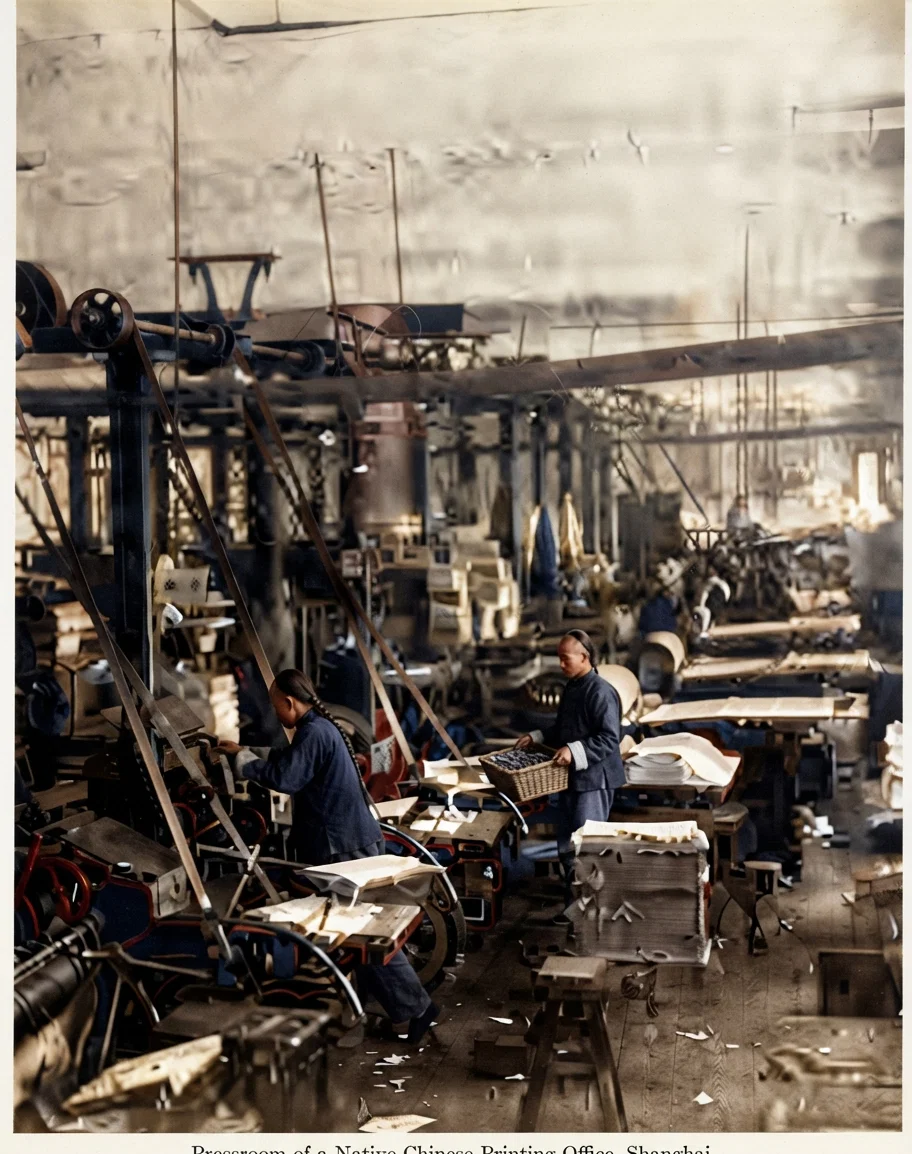
Pressroom of a Native Chinese Printing-Office, Shanghai.
This is a characteristic that marks the progress in the Chinese Empire. A Chinese servant is considered better than other servants because he anticipates your wants. Perhaps no other people are better readers of character than the Chinese. If a man should stop in the street a minute, hesitating, the minute would probably not pass before two or three Chinese would be at his assistance, who had undoubtedly anticipated the reason of hesitation and so offered their services. Thus in reference to Chinese literature, they have become intensely active in supplying the demand.
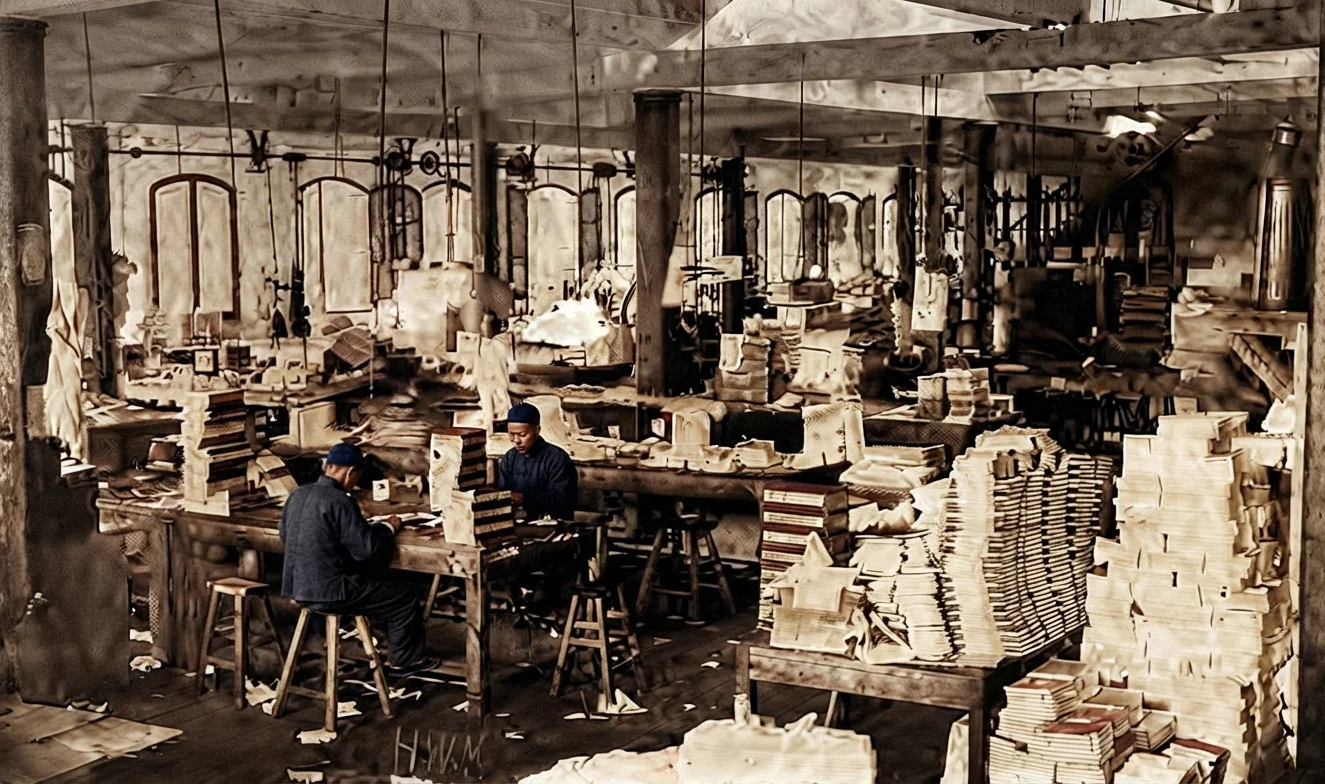
Portion of Foreign Binding Department of a Native Chinese Printing-Office.
After the complete Bible was translated, the Bible Societies began to publish a small edition. Owing to the complexity of printing in Chinese by the carving of wood characters, there were matrices made in Paris for casting the most common characters in Chinese type. Using these matrices as models, other sets of matrices were made, so that it is possible to set up by regular method of composition Chinese manuscript. But owing to the inadequate facilities for traveling, the distribution of literature was largely limited, through several decades, to that of Bibles, Bible tracts, and hymn-books, which were circulated by missionaries residing in different parts of the empire; and the art of printing was practically limited to the publishing-houses run by missionary societies.
Thus the circulation of literature from year to year was comparatively small, and the demand for literature in the whole empire of China was met by four or five publishing-houses located in the port cities. In 1905, Dr. Griffith John, who had been a resident in China for fifty years, made the statement that ten years before that date such a thing as a newspaper for the natives was not known in the empire, except the Peking Gazette, published principally for the use of the officials; and that only five years before there were not more than ten or twelve newspapers, located chiefly at the ports. But now there are native newspapers found all over the empire. In all the large cities will be found the newsboys running about with as much eagerness to dispose of their papers as is characteristic of newsboys in any country. There are so many newspapers in the city of Shanghai, and the number is being added to so rapidly, that it is almost impossible for one to keep informed as to the numbers and kinds issued. The Japanese, being in such close proximity to China and having a language so similar, have in many respects anticipated China's needs, and there are to be found large foundries for making Chinese type as well as machine-shops for the manufacture of printing-presses. They also supply a large amount of paper to the Chinese. To-day we have in China equally large type-foundries and machine-shops.
Just a few years ago, some of the Chinese workmen in one of the mission presses, including in all sixteen individuals, organized a printing company for the production of Chinese literature. They started with sixteen five-hundred-dollar (Mexican money) shares, and within a few years—a little over a month ago—one of these shares was sold at auction for a little over eleven thousand dollars gold. They operate over a score of large cylinder presses and almost an equal number of job-presses, and this does not include their lithographic department. Their printing-office is complete, including photo-engraving. They advertise themselves thus: "Commercial Press, print in Chinese and foreign languages. Printers, publishers, lithographers, type-founders, stereotypers, matrix-makers, book-binders, and book-sellers. Dealers in printing-presses and foreign paper." Within about five minutes' walk from this large printing-office is another large plant, the Presbyterian Mission Press.
With a constituency of 426,000,000 who arise and assert their desire for knowledge concerning the progress of the world at thistime, the present facilities may in a year or two be duplicated and then be unable to meet the demand. Who could have believed fifty years ago that in such a short time China would have publishing-houses that would be excelled by few even in the most civilized countries? I was told that the publishing-house just referred to puts out a hundred new books every year, besides printing other editions of books already issued by their press.
But in all this mass of literature issued by the hundreds of presses found in this empire, and with all the facilities at hand for duplicating thought by the art of printing, little do we find that is supplying the actual demand—that of telling to the natives who are already startled at the progress of the modern methods what these things mean.
At present we are conducting our printing work in a native Chinese house. It is the best we can do in starting our work here. While we know that it has never been show or display which advances the cause of God, still we know that it is pleasing to Him that His work should be honored in the selection of respectable quarters for carrying it on. Institutions do to a certain degree give character to the work they represent. We are sadly in need of suitable buildings for our publishing work. We can only locate things temporarily in a Chinese dwelling-house, for we may be turned out any time by a native landlord prejudiced or disaffected to the work of the Gospel. However, we believe that God's protecting care will rest over our work here until suitable quarters are provided. We must be able to supply the demand for literature for the enlightenment of the natives which will make them wise unto salvation. A suitable building is our greatest need now; and we believe, after considering the magnitude of the opportunities which lie in the publishing work, that many will respond to our urgent need at this time.

Hoarding Money in India

Hoarding Money in India.—English financiers who are seeking to extend the railroads of India have ascertained that the people there have a mania for hoarding money. They say that when gold goes into India it is to be buried there and never returned. The very wealthy people of India hide their gold, and the middle classes hide their silver, and this means the cutting short of all improvements and the impoverishing of the lower classes.

A Veteran Worker Fallen.

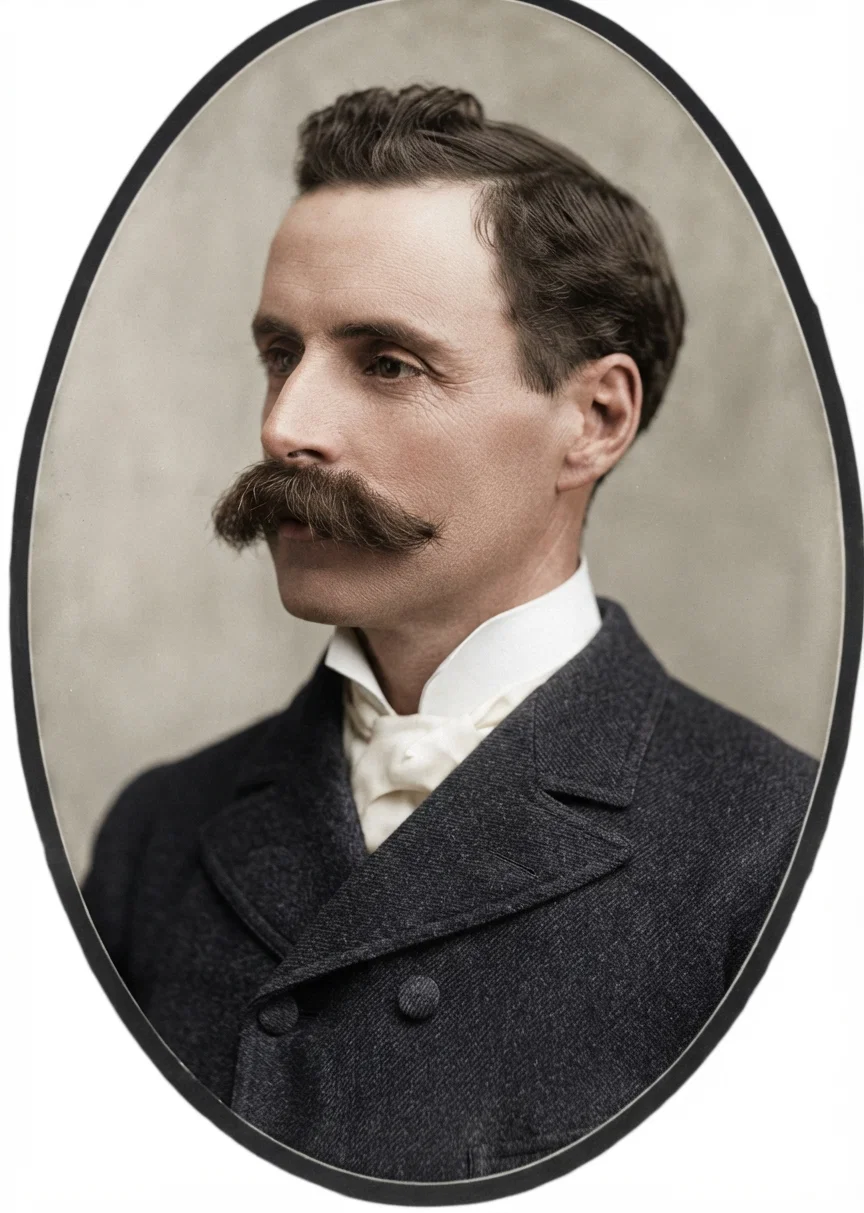
It is our sad duty to record the death of Brother E. A. Chapman, who died at Oakland, Cal., September 8, at the early age of forty-nine. Brother Chapman connected with this institution when he was only nineteen years of age, his father being one of the early pioneers of our work on this coast. His father's active interest in our work and his strong belief in the great message for which this paper stands were determining factors in causing the young man to connect with the institution at such an early age. He worked in various positions in connection with the office, finally being elected the secretary and treasurer of the company, which position he held during the greater part of his long term of service here.
The Late E. A. Chapman.
It was the universal testimony that he had one of the sweetest and most evenly-balanced dispositions that it is our privilege to meet, and with all of this, he was a strong character, ever standing stanchly for the right. During his service with this institution, he handled many hundreds of thousands of dollars and carried very heavy responsibilities, through all of which his sturdy Christian character carried him with honor and the highest esteem.
It was with indescribable sadness that we laid him to rest at his birthplace in Petaluma, Cal., right in the very prime of his life and in the zenith of his usefulness.

Our Chinese Mission.

We have had occasion to mention from time to time the work that our missionaries are carrying forward in China. We hope our readers are following the articles which are appearing from Dr. Miller, who has been laboring for a number of years in that field. While Dr. Miller is a physician and attends to his medical work, yet he says that but very little can be done in China without literature, and so from the first he has interested himself in having a good printing-plant established in that field to produce our good religious literature in the Chinese language.
At least $5,000 is needed for establishing their printing-plant. With all of the millions of people in China to be reached by our literature, it would seem that this is a very small sum. We are sure that much more than this will be needed as the work progresses. We hope that what our missionaries are doing in that field is appealing to many of our readers who have means and that they will esteem it a privilege to assist them.
Donations for the work in China may be addressed to the SIGNS OF THE TIMES, Mountain View, Cal., and will be promptly forwarded to the workers in the field.

An Epoch-Making Debate.

This fall brings us to the fiftieth anniversary of the great debates that were held between Lincoln and Douglas in some six or seven towns in Illinois. These debates were epoch-makers. Lincoln stood for great principles. He had not had the advantage of training in the schools, but nevertheless he was a deep student and a great thinker, and was one of those few characters who have been successful in training themselves without the aid that the schools afford. These debates gave Lincoln his national reputation and resulted in his being nominated to the presidency two years later by the then very young Republican party. This was followed by the great Rebellion, and Lincoln's Emancipation Proclamation, and the freedom of the slaves.
When Lincoln was so earnestly and so masterfully advocating the principles of freedom that were set forth in his great speeches in these debates, little did he realize what was before him. One of the peculiar characteristics of his speeches was that they were not the same stereotyped matter given over and over again at these various cities, but each speech brought out the grand old principles of freedom in a new light and placed them in a strong individual setting of their own. In all of the literature of the English language, there is nothing to be found that is more masterful nor fundamental than these speeches made by Lincoln. Douglas was witty and very tactful in seeking to combat Lincoln, but Lincoln had the power of moral earnestness and of deep conviction of purpose that was altogether too much for the oratorical skill of any opponent.

Contents of This Number.

General

The Motive in Service - - - 1 The Holy City - - - 2 Canon Fausset on the Tower of Babel - - - 2 Power to Work Through Prayer - - - 3 Deep Plowing - - - 3 The Defeat of Justice - - - 5

Editorial

Done in Righteousness - - - 4 The Day of the Fourth Commandment - - - 4 The Angel of the Lord - - - 4

With Our Inquirers

Questions Nos. 2628 to 2631 - - - 6 Our Bible Band - - - 6

Our Bible-Reading

Th Gospel Grain-Field - - - 6

Missions

Meeting the Demand for Literature in China - - - 7
Poetry

Surrender - - - 2 Waiting - - - 3

DATE OF EXPIRATION

Manuscripts should be addressed to the editor. Address all business and make all money-orders, etc., payable to the SIGNS OF THE TIMES, Mountain View, Cal.
The first issue in the month contains a review of the great world-movements, with some striking, special features. Sixty-four pages with colored cover. On each recurring Wednesday of the month an 8-page issue deals with the great objects for which the paper stands.
We send no papers from this office to individuals without pay in advance. When persons receive copies without ordering them, they are sent by other parties, and we can give no information in regard to them. Persons thus receiving copies of the SIGNS are not indebted to the office, and will not be called upon to pay for them. Please read the papers you may receive, and hand them to your friends to read.
Our authority is the Bible, the Holy Scriptures of the Old and New Testaments. When the Common ("King James" or "Authorized") Version, or the American Standard Revised Version is used, quotations will not be designated in reference. Any Bible quotation in this paper, therefore, differing from the Common Version, unless otherwise indicated, will be almost invariably from the American Standard edition of the Revised Bible, copyright 1901, by Thomas Nelson & Sons.
SUBSCRIPTION RATES. (Weekly, fifty numbers.) Four months . . . . . . . . . . . . . . . . . . . . . . . . . . $0.50 Six months . . . . . . . . . . . . . . . . . . . . . . . . . . . . .75 One year . . . . . . . . . . . . . . . . . . . . . . . . . . . . . . 1.50 To foreign countries, including Canada . . . . . . . 1.75 (Monthly, twelve numbers.) Single copy . . . . . . . . . . . . . . . . . . . . . . . . . . . $0.10 Three months . . . . . . . . . . . . . . . . . . . . . . . . . . . .25 Six months . . . . . . . . . . . . . . . . . . . . . . . . . . . . . .50 One year . . . . . . . . . . . . . . . . . . . . . . . . . . . . . . 1.00
  1. One new yearly subscription and one renewal, or two new yearly subscriptions, sent at one time, $2.50.
  2. Two new yearly subscriptions and one renewal, or three new yearly subscriptions, sent at one time, $3.25.
  3. Three new yearly subscriptions and one renewal, or four new yearly subscriptions, sent at one time, $4.00.
Sample copies sent on application.

DATE OF EXPIRATION.

The SIGNS' wrapper bears date of last issue due on your subscription. Unless renewed in advance, paper stops with expiration date.
If herewith is an order-blank, you will know you have overlooked sending renewal. You will not wish to miss a single issue. Back numbers often can not be furnished.
CHANGE OF ADDRESS.—When a change of address is ordered, both the new and the old address must be given. The notice should be sent one month before the change is to take effect.
HOW TO REMIT.—Remittances should be sent by Draft on San Francisco or New York Express-order, or Money-order, payable to order of SIGNS OF THE TIMES. Cash should be sent in Registered Letter.

You have reached the end of this edition.

Signs of the Times · Oct 14, 1908