On January 18 I left Lucknow en route for Burma, to attend the first of a series of local meetings planned last year by Prof. H. R. Salisbury before his departure for the council in America. The local fields had been looking forward to these meetings for some time, but Professor Salisbury’s untimely death made it impossible to carry out the plans as originally made, and others had to be arranged.
At a meeting of the India Union Committee called shortly after the news of the accident had been received, it was decided to proceed with the meetings as before planned, but on different dates for each field.
After spending two days counseling with the Bengal committee and workers in Calcutta, I took steamer for Rangoon, where I arrived January 24, after a very pleasant voyage of three days. The meeting began the evening of the twenty-sixth, with all but two or three of the workers present, those remaining away being detained by urgent work.
As we were to be together but a short time and considerable business had to be transacted, our daily program was necessarily quite crowded. The forenoon was devoted to devotional services and committee work, the afternoon to committee work and a Burmese service, and in the evening a sermon was delivered.
The meeting closed January 30. That same night I started, in company with Pastor G. A. Hamilton, to visit his mission station on the Salwin River, about sixty miles north of Moulmein. After one night on the train, a steam launch took us up the river to within twelve miles of the mission station. This last distance had to be covered in a Burmese boat, poled along the bank by four men. We reached Brother Hamilton’s house the next afternoon at one o’clock. Here I received a cordial welcome from Sisters Hamilton and Gibbs, who had to remain at home because of work they could not leave.
I was greatly impressed with the way the work is opening at this station. Here is a mission growing right out of the wildest, roughest jungle on the banks of a mighty river. The station is situated at the lower edge of the Karen country, where its people, in leaving their homes to trade with the world and in returning, must pass it. The mission house, which is now under construction, has a commanding view of the Salwin River for miles north and south, and far over into the western border of Siam.
Brother and Sister Hamilton are working hard under great difficulties to reclaim from its jungle fastness the land belonging to the mission. Miss Gibbs is laying strong hold on the hearts of the people of the community by her efficient and unselfish labors in behalf of the sick and suffering. She will soon be ready to leave her improvised outdoor dispensary for a neat, well-planned little building where she can do her work under less trying conditions. She needs very much the assistance of a Karen girl to act as a helper in the dispensary, and to go with her in answering the many calls out in the jungle. A small, inexpensive building where she can care for patients who come to her from long distances would greatly add to the effectiveness of the work she has undertaken. The people all about are calling for a school. I hope the time will soon come when a company of Karen boys and girls will be under instruction for future workers.12
May God greatly bless this new Karen station with a large ingathering of souls. These workers are all alone amid the wildest surroundings, but they are not lonely. They are far separated from their own civilization, yet they do not pine away. They live without many of the comforts and conveniences of modern life, yet they are happy and contented, and they love the people among whom they labor, and the people love them.
From Pastor Hamilton’s station I went north to Mandalay, where Brother and Sister R. A. Beckner are, and spent Sabbath, February 5, with them and the company of believers they have gathered in that large and important city. In the afternoon it was my privilege to baptize two Burmese and one Tamil in the Irrawaddy, Burma’s largest river. The time is not far away when we shall have a good church established in this ancient capital of “the land of the pagodas.”
From Mandalay I went to Kalaw, where a bungalow is to be built for the use of our European workers in Burma during their sojourn among the hills each year. A beautiful location has been selected here, and the building is planned. This inviting retreat in the wilds of nature, 4,000 feet above sea level, where our workers in this country can resort during the extreme hot weather, will be a great boon, and will many times repay for itself in the saving of life and strength.
Meiktila was the place of my last visit in Burma, where I spent two days with Brother and Sister D. C. Ludington. They are in charge of the Meiktila Technical School at that place, which is attended by about fifty Burmese boys, some of our faith and some coming from heathen homes. Brother and Sister Ludington are doing their utmost to bring the work of this school up to the highest standard, and their efforts are being rewarded by a growing enrolment, the love and respect of both pupils and teachers, and the confidence of the public.
Brother and Sister F. A. Wyman are in charge of the treatment-rooms in Rangoon. This institution, being a new departure in that city, and having to make a reputation in the face of considerable prejudice and opposition, has not done so well financially as was hoped, but we believe better days are in store for it in the near future.
A Visit to the Peninsula
By C. V. Achenbach
C. V. ACHENBACH
PATANLLYI [in the Lake Titicaca Indian Mission] is the place where we opened the work among the Indians a few months ago. Every Sabbath one of our native workers holds meetings among them. Last Sabbath it was announced that those who desired medical help should come to the church on Thursday, and the mission doctors would be there to give them medicine, advice, and any other help needful.
Brother J. M. Howell and I started early Thursday morning for the peninsula, having with us medicines, and instruments for operations and for pulling teeth. We arrived at the place at ten o’clock; soon the people began to come from all directions. Some were complaining of bad eyes, pain in the stomach, bad teeth, headache, malaria, bad colds, etc. We had thirty patients.
After we got through with them, we were invited to dine with the chief. The dinner consisted of two cups of hot milk and scrambled eggs with red pepper. Dinner over, we called all the people together, and held a short religious service. I spoke to them about the importance of the Word of God, its power, and the changes it is able to work in the human heart. All listened very attentively to the words spoken. At the close of the service we shook hands with them, after which we mounted our horses and returned home, realizing that the day had been well spent.
“I Am Afraid”
W. B. WHITE
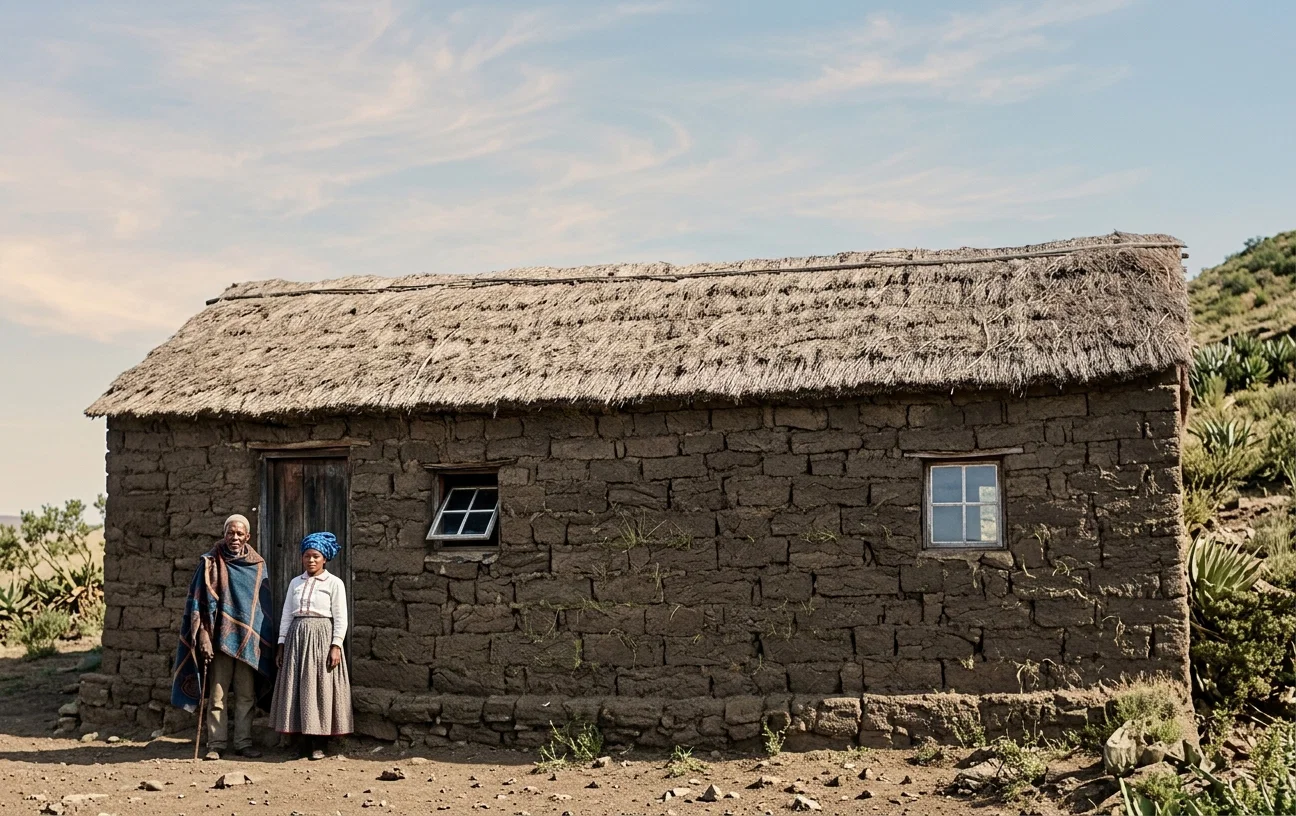
It was over in Basutoland, South Africa. The writer had been speaking in the little sod church at the Kolo Mission. The room was full of native Basutos, who had gathered in from the near-by villages, and the Spirit of God was present to convict hearts.
THE SOD CHURCH AT KOLO, BASUTOLAND, SOUTH AFRICA
At the close of the preaching service, we had a testimony meeting, and a goodly number of native believers spoke of their faith in God and in his truth for this time. At length there arose an old chief named Jacob, and standing up straight, he said, very deliberately, “I am afraid.” Then he went on to say that a few years ago he was greatly troubled with rheumatism, so much so that he could scarcely use his legs, and he was a great sufferer. He called the native doctors, and took their abundant medicines, but found no relief. Finally, in his extremity, he asked the great God in heaven to help him and relieve him of his suffering, promising that if his request was granted, he would serve God and do right.
“Well,” said the chief, “God heard my prayer, and in a little time the rheumatism left me, and I was well. But I failed to keep my promise, and soon forgot God. A few years later I got into trouble again, this time with a hard pain in the chest, and coughing, so I could not sleep nights. I called the doctors, but they could not help me. I was ashamed to ask anything again of the great God, but finally I did, promising him again that if he would hear me and send relief, I would lead a better life. A second time God relieved me of my trouble, but I sinned again right in the face of God, and did not do as I had promised him. I have gone on in sin, have not given up jollo [native beer], but have drunk it very much. I am afraid.” And the words came straight from the old chief’s heart.
I was urging the people to surrender to Christ and forsake sin, but this old black man was face to face with a difficulty that has troubled many others. He feared to make another trial. He wanted to serve God, he knew it was the right thing to do; but he knew that he was weak, and he feared to make another trial lest he would fall again, and this he did not want to do. We tried to point the old chief to the Source of strength, to the power that would keep him from falling, and we trust he may yet lay hold of it with all his heart.
But how many there are in more favored lands who are saying the same thing. They have made many mistakes in the past, have made many promises to God that they have not fulfilled, and now, when urged to yield all to Jesus and serve him, they say, as did old Chief Jacob, “I am afraid.” They fear they have not strength to stand, and in this hesitating attitude they sometimes remain for years. But there is power in God to keep the soul that is committed fully to him, and notwithstanding the many failures of the past we must press on to final victory.
South Africa:
A Ruler’s Visit
FROM the Shan States of Burma, one of our medical missionaries, Dr. Ollie Törnblad, sends this experience:—
“About ten days ago a ruler, whom I had met and whose daughter I had attended, was passing our place. He stopped and spent the night with us. His family wanted to come too, but as he had five wives and nineteen children, with the children’s children the entire family consisted of sixty-three persons; so he told them they were too many for all to come. He and two of his attendants came. Not being accustomed to entertaining royalty, I do not know that I did it right. These rulers are subject to Great Britain, but they have great power in their own states.
“I was talking to him about the eternal God, when he asked me, ‘If the Christian’s God is all-powerful and knows all things, why are these Christian nations that worship this same God, fighting and killing one another?’”
“This old man, though he cannot speak English, and lives far from any center of communication, knew the location of the European countries, with their populations. He was also well acquainted with the location and population of the largest cities in the United States. His tribe, with others here in Burma, greatly need help that they may learn of God’s true character.”
Mission Note
A MISSIONARY pictures mission life on one of the large African mission farms in these words: “You may picture us as plodding along, spending commonplace days, with neither missionary romance nor missionary hardship in them. And this is a very common kind of day in the life of every missionary. For these commonplace tasks have to be done, and we have this for comfort, that the lives of the greatest heroes are mostly made up of them. Then we must walk down on the level ourselves, and not weary, if we are to teach our native Christians how to do it. They learn all too easily, sometimes, to preach and to pray, but they often fail in the everyday life. It is just through the trivial round, the common task, that we may teach them how Christianity must sanctify their lives at every point,—by keeping our own tempers, by entering with loving sympathy into all their troubles and joys, by seeing them not only from the pulpit and the school platform, but on the common ground of their daily life and ours.”
For the King
By Edith Jaques
EDITH JAQUES
It was Monday evening, but along the village street little groups of people could be seen making their way toward the tiny chapel. There was to be a special service tonight, and the people were eager to hear the great preacher who was paying them a visit.
Standing at one of the cottage doors was a young woman with a baby in her arms, and several other little ones playing around her. She had a rosy, pleasant face; but this evening, as she watched the people go by, it wore a look of weariness and discontent.
“Good evening, Mrs. Risden,” said a cheery voice. “How are you this long time, and the dear bairns?”
The speaker was a little old woman, whose wrinkled face wore a sunny smile.
“We are all well, thank you,” was the reply, “except the baby, who is just as cross as he can be. I’ve scarcely had him out of my arms all day. Dear me, what a trouble children are! Here you and the rest of the folks are off to meeting, while I have to stay at home. I never seem to get a minute for enjoyment nowadays.
“There’s my next-door neighbor, who has six children; off she goes in the evening, and leaves them all to play in the street till she comes back. But there! I suppose we are not all the same. I never could do that.”
“And quite right, too, my dear,” said the old woman. “Ye be a good little mother, I know. Let me come in and mind the baby for ye a bit. Yes, I was going to the meeting, but that does not matter. Ye see, my hearing is not so good as it was, so perhaps it will be just as well to leave my place for some one who can hear better; not but what I believe in going to church whether one can hear or not, for ’tis to worship God we should go.”
The younger woman, glad to rest her aching arms, handed over the baby, and the two entered the cottage together.
“Now, my dear,” said the old woman, “you just put the children to bed while I get baby to sleep, then methinks, if ye don’t mind, I’ll be telling ye a little experience of my own which happened years ago. It has just come to my mind, all of a sudden like.”
The baby, made comfortable in the experienced arms of the good old dame, was soon sleeping peacefully, while his mother, in the short space of half an hour or so, had put the other children to bed, replenished the fire, and made the room nice and tidy. This done, she drew her chair to the fire, and turning to her old friend, said with a smile, “Now for the story you are going to tell me.”
“It isn’t much of a story, my lass, but just a message the dear Lord sent to me years ago. It may help you now as it helped me then.
“It was when I was about your age, my dear, and my three lads were just such as your own bonny bairns. Oh, what boys they were! so full of mischief, always tearing their clothes and getting into some scrape or other.
“Just about that time my little Jessie was a baby; such a delicate, fretful little thing she was. I can tell ye, my hands were full. Many a time did I go to bed almost too tired to sleep.
“Joe had a good job as gardener up at the castle. I could have afforded to have some one in to help me, but bless ye! I never could get a girl to do things as I liked them done. Truth to tell, I was a lot too particular, and thought that my way of doing things was the only right way.
“Well do I remember how, many a day, I spent hours polishing the furniture, and cleaning the many useless ornaments in which I took such a foolish pride. When it was time for the children to go to bed, I was too tired to care about hearing them say their prayers.”
A flush of shame dyed the listener’s cheek, for had she not that very evening put her own little ones to bed without a word of prayer?
Seeming not to notice this, however, the old woman went on. “And so, my dear, in those busy days I grew very careless about the important things of life. So absorbed was I in looking after the children, and giving them their daily bread, that I forgot all about their spiritual food,—forgot that the Saviour had said, ‘Feed my lambs.’”
“Joe would often say to me that it was a pity we could not have family worship as we used to do. I always answered him that I had no time to spare now, and that it was such a bother to keep baby quiet the while.
“In a very simple way I was led to see my error. It happened like this:—
“The weather was very hot, and the heat always did make me irritable. The children were unusually trying, and baby was cutting a tooth. To make things worse, Joe was working extra long hours up at the castle.
“The king was expected to pay a visit to the neighborhood, and was to be the guest of Joe’s master. What a turning of things upside down there was, to be sure! Joe was not the only one who was doing extra work, but I doubt if there was another who took such a pride in it.
“My Joe did love his plants and flowers. No matter how hot the weather, or how tired it made him, he did his work cheerfully. As he told me, he was determined that the king should see those flower beds and gardens looking just as nice as it was possible for them to look.
“Well, I remember he came home one evening, after a long day’s work, with a smile on his face, and whistling as he came up the garden path.
“It had been an extra trying day for me, and I wasn’t in the best of tempers. I took him to task for staying so long, and even told him that he was more interested in those roses and things than he was in his wife and children.
“Poor Joe! how quietly he took it all! He never did get cross, as I did. He just looked at me reproachfully, and said, ‘I am sorry, my lass, but I thought you would not mind my working a bit extra just now. It is only for a little while; ’tis for the king.’
“I never could tell how it was, but those three words just haunted me. Even when I went to bed, the clock on the mantlepiece seemed to be ticking out, ‘for the king, for the king.’”
“I could not sleep; and as I lay thinking in the stillness of the night, my conscience awoke.
“I thought of my husband toiling cheerfully to make his work fit for the eye of an earthly king, while I, whose work was for the King of kings, grumbled when the work was hard. Little children had been given into my care to train and prepare for his presence, and I was sadly neglecting my14God-given task. I, who called myself a Christian, had never even tried to lead them to the Saviour. I had spent—aye, wasted—many precious hours in work that would avail nothing, while that which was for eternity lay untouched.
“That night I claimed the Lord’s forgiveness, and promised to do better. From that time on, I tried to do my duty, and do it cheerfully.
“The path of duty may be blessed, but it is not always pleasant. Many a time when discouraged, I just had to say to myself, ‘Now, Mary, no grumbling; your work is important,—right royal work,—a contract for the King.’ It is wonderful how the thought helped me.
“Now that the years have gone by, and the bairns have all left me, I wonder how I could ever have thought them so troublesome.
“Yes! they have all gone now. Two of them I shall see no more till the coming of the King. My daughters are both Christian women, and my Jim—wilful, wayward Jim, who the neighbors used to say would be sure to come to a bad end—is now a worker for the Lord, and a joy to my poor old heart.
“Take an old woman’s advice, my dear. Whatever must go undone, don’t neglect to bring the children up in the fear of the Lord. Always keep in mind the importance of the work intrusted to you. When the little ones are trying, and the work is hard, ‘cast thy burden upon the Lord, and he shall sustain thee.’”
Long after her visitor had gone, the young mother sat thinking of her words; and in her heart that night was born the resolution that in future she would do her work cheerfully and faithfully “for the King.”
England.
To Mothers
By Katie M. Pogue
MRS. KATIE M. POGUE
Dear mothers, so burdened and weary,
Does your load seem too heavy to bear?
Do life's duties and cares seem too irksome?
O, take all to Jesus in prayer!
Do you thoughtlessly yield to impatience,
And a frown black and threatening wear,
Speaking words that are biting and cruel?
O, take all to Jesus in prayer!
Do you know that the work God gives mothers,
Though so lightly regarded on earth,
Is accounted of value in heaven,
Where all is appraised at true worth?
Then let us be faithful, dear mothers,
That at last, when we all gather home,
We may say, “Behold here, dear Jesus,
Our little ones; not one is gone.
“Thou didst lend them to us for a season,
To brighten our earth-dreary days;
Lo, now we are bringing them, Master,
To join in thy worship and praise.”
Home Life
By Mrs. T. H. Evans; Miss Lora E. Clement
Conducted by Mrs. T. H. Evans, Takoma Park, Washington D. C.
Assisted by Miss Lora E. Clement
Through the columns of this department, hints will be given on all matters pertaining to the home life. Short articles and letters are solicited from home makers, telling of their everyday experiences,—their joys and sorrows, their failures and successes.
Do We Mend, or Do We Embroider?
By Martha E. Warner
MARTHA E. WARNER
“Yes, I had a delightful time at my daughter’s,” said a member of the Thimble Club one afternoon. “I mended forty pairs of stockings during my visit, and I am sure there were as many more left to darn. The children are so nearly of a size that the stockings get dreadfully mixed. I wish I knew of some plan to suggest to her that would help keep them in order.”
“Pin them together with a safety pin before they are washed,” said one. Another suggested marking the stockings with a different color for each child; and a third proposed white “French knots,” one for the oldest child, two for the next younger, and so on. Lest the conversation become too practical, the hostess skilfully turned it to other topics, and stockings were forgotten for the time.
Since that day I have often thought of that mother with eighty pairs of stockings to mend, and wondered if darning has gone out of fashion. Some time ago business called me to a certain home on a rainy day. In the living-room I found the lady of the house facing an armchair piled high with an assortment of stockings. With a wry smile, she explained that as the weather was unfavorable for callers, she thought of mending a few stockings. In another home where I was calling, a child pulled the cushion out of a Morris chair, and exposed to view many pairs of stockings waiting to be mended—or perhaps, thus tucked out of sight, to be forgotten.
I had just about made up my mind that only old-fashioned persons did any darning, when I was called to see a lady who was ill. She was really only a girl, and had never known a mother’s care. The family of four lived in two rooms, but the tiny home was neat and clean, and on the table lay a stocking slipped over a glass for want of a darner, and the neatly mended hole told its own story. Of course this family was poor. Their income was less than ten dollars a week. Yet, on the other hand, she was rich in that she had been taught to mend, and was willing to practice this economy. Mending saves many a hard-earned dollar, and that little woman saved fifty dollars during the winter. A little here and a little there soon count up. Christ says, “Gather up the fragments that remain, that nothing be lost;” and if we would learn to save the wasted “littles” for him and his work, we should often have dollars to give where now we have only dimes.
Clintonville, Conn.
An Astonishing Boy
Six mothers were asked at a meeting one day
To describe the best boy in their block.
The description when given was surely enough
To give all their hearers a shock.
One spoke of the bonny blue eyes that he had;
Black, hazel, and brown, others said.
Some thought he was short; others vowed he was tall;
He had yellow hair, chestnut, and red.
One praised up his dimple; one said he had none;
Another saw one in his chin.
One said he was fat, while another declared
That never a boy was so thin.
These ladies were truthful; not one of them all
Had ever been known to deceive,
But that such a chameleon boy could exist
Their hearers declined to believe.
“Pray tell us whose is this astonishing boy;
His name and his station define.”
Then six mothers rose to their feet to reply,
And six voices answered, “He’s mine!”
— Selected.
Do You Know That
LIGHT promotes cleanliness?
Moderation in all things prolongs life?
The careless spitter is a public danger?
The air-tight dwelling leads to the grave?
A clean mouth is essential to good health?
Milk that is not Pasteurized frequently spreads disease?
Walking is the best exercise—and the cheapest?
Bullets kill thousands, but flies tens of thousands?
Bad teeth and bad tonsils may be the cause of rheumatism?
A little cough is frequently the warning signal of tuberculosis?
Physical training in childhood is the foundation of adult health?
Sweeping and Dusting
The following recommendations on this familiar part of the day’s work in every home have been printed and distributed by the New York City Department of Health:—
“In sweeping a room raise as little dust as possible, because dust, when breathed in, irritates the nose and throat and often sets up catarrh. Some of the dust breathed reaches the lungs, making portions of them black and useless.
“If the dust breathed contains the germs of tuberculosis or consumption,—tubercle bacilli,—which come from persons who have pulmonary tuberculosis spitting on the floors, the risk is run of getting the disease. If the sick person uses proper spit cups, and is careful to hold a handkerchief over the mouth when coughing or sneezing, so as not to scatter spittle about in the air, the risk to others who live in the same rooms is inconsiderable.
“Before sweeping bare floors, sprinkle moist sawdust on the floor. When the room is carpeted, wet a newspaper, tear it into small scraps, and scatter these over the carpet. In sweeping, brush these scraps of paper along with the broom, and they will catch most of the dust, and hold it fast, just as the sawdust does on bare floors. Do not have either the paper or the sawdust dripping wet, only moist.
“In dusting a room, do not use a feather duster or dry cloths. These do not remove the dust from the room, but only brush it into the air.
“Do all dusting with slightly moistened cloths, and rinse them out in water when finished.
“In rooms with bare floors (in houses, stores, shops, schoolrooms, etc.), all dust can be easily removed after it has settled, by using a mop, which has been wrung out so as to be only moist, not dripping wet.”
Birth Registration
By Mrs. T. H. E.
HAS the birth of your baby been properly registered? This is a matter in which all parents should take an interest; and if it has not been done, it should be attended to without delay. “It may sometime be of the greatest importance to your child that there be in existence an accurate legal record of his birth,—date, place, and parentage. Such a record serves to establish his age beyond question, and through this his right to the legal period of schooling and freedom from labor. It may also serve to establish his right to a disputed inheritance, and to establish for him various property or other legal rights which may be in dispute. There are numerous instances where the lack of this sort of record has been the cause of serious losses of inheritance and of educational and other rights.
“It is, in most States, required by law that the doctor, midwife, or other attendant at birth shall report the birth to the registrar of births; but as this duty is not infrequently neglected, parents should investigate to see whether it has been done properly in the case of their children.”
MRS. T. H. E.
Pittsburgh Pitt Theater Meetings
By F. H. Robbins
The interest has deepened among the people since the beginning of the meetings in the Pitt Theater. Many were stirred by the first two lectures on the war, which were delivered by Elder A. G. Daniells. The first meeting was held March 12, during the union conference session, and a lecture has been given every Sunday night, except one, since that time.
Owing to Elder Daniells's many duties, he could speak only on March 12 and 19. The lecture committee, seeing the situation, and realizing that there was an unusual interest, extended a very pressing call to Prof. B. G. Wilkinson to do the speaking on Sunday nights. Brother Wilkinson at first declined to accept our invitation, as his union conference work is very heavy, and he feared that he would not have time. But finally he consented, and has been giving very stirring lectures.
In spite of the big strike in the mills, and the thirty-one hundred street car men who came out on a strike, last Sunday night, April 30, we had an attendance of about thirteen hundred, who were deeply interested. Many lingered in the building at the close of the service, and asked questions concerning the things which had been presented in the lectures. On the same day in this building there had been a debate on preparedness and an announcement was made that a lecture on that subject would be given that evening in a near-by theater. There was also a large mass meeting held by railroad men about two squares from the Pitt Theater at the same time as our meeting. These meetings of course drew some from our evening service. We thanked God that amid the great unrest of humanity and the clash between capital and labor, a large audience, calm and composed, was listening to a lecture on the second coming of Christ.
As our workers go among the people, they have many interesting experiences. One man gave up the use of tobacco, and kept his first Sabbath, April 29. I heard him say, “Well, Dr. Wilkinson, your lecture last Sunday night settled the question and did the work for me. I am convinced that your teachings are right, and I have quit using tobacco, and am keeping my first Sabbath today.” This is a clean-cut, intelligent, and well-to-do business man, and he will be a real help when fully established in the truth. Brother Wilkinson and I spent one night in his home since he began to keep the Sabbath, and we were entertained most royally.
Our Bible workers have been bringing their readers to the meetings, besides holding studies with them in their homes. Since the meetings began, nineteen have taken their stand for the Sabbath, and are now keeping it. Although some of these were studying the truth before the meetings in the Pitt Theater began, yet these lectures helped very much in getting them to make their decision. We have about twenty-five hundred names of persons who want reading matter.
Elders D. A. Parsons, J. P. Gaede, W. F. Schwartz, Dr. D. H. Kress, Prof. B. G. Wilkinson, and five Bible workers, two colporteurs, some members of the churches, and the writer have been visiting the people, and have had many good talks and Bible studies with them.
We rented a large auditorium in the heart of the city. Last Sabbath we had two hundred and fifty persons present, forty of them not of our faith. Some of them had never been to a Sabbath service before, but they had been attending the Sunday night meetings in the theater.
After Sabbath school and preaching service in this auditorium, Prof. C. L. Stone, who was here for two or three days, and Sister Minnie Dauphinee held a young people's meeting in the Century Building, which is about two squares away. There was a good attendance also at this meeting. The Lord came very near in all the services of the day.
We realize that it will take much prayer and visiting to bring these interested ones into the truth. We need the prayers of God's people, and our hearts have been made glad to hear that our brethren and sisters in various parts of the United States have been praying for the work in Pittsburgh. It is very helpful to us to know this, and we beg them to continue praying until Pittsburgh has heard the message. F. H. ROBBINS.
Experiences in Mexico
By E. Virginia Martin
[This report was written just before the receipt of the telegram from the Mission Board advising our missionaries to come out of Mexico for a short time because of international complication and possible danger to the lives of the missionaries.]
THE Bible work is onward in Mexico City. Since ceasing Red Cross work, my readings have kept increasing, until now I have sixteen studies each week. While visiting in connection with the Red Cross work, I came in contact with various families, and with three of them I am now studying the Bible. One Catholic family, when I began studying with them, manifested much interest as I explained the way I gave the studies. I asked if they had any objection to having prayer before the beginning of the study. The father said, “No, should you like me to bring an image?”
One of our church members is a teacher in the public schools. When she was telling her children about how the pagans worship idols, one of the pupils stood up and said, “Then we are idolaters.” Two girls with whom I am studying waited five years, longing to have Bible studies. It is now two years since I began studying with them, and it does me good to see how they have grown in the knowledge of the truth, although they are not yet members of the church. The first change which I noticed was that the lamp ceased to be lighted before the images, and finally disappeared altogether, although the images still hung on the wall. One day I pointed to them, saying that I was sad to see them there, and one of the girls said, “Ought we not to burn them?” I told her that was the best thing to do with them. The next week the walls were all free from the relics of paganism.
The work is onward in Mexico.
E. VIRGINIA MARTIN.
Work Among the Colored of the South
By C. B. Stephenson
It was my privilege to attend the biennial meetings in the three Southern union conferences this spring. We were much pleased with the progress of the colored work as shown by the reports in these meetings. There has been a substantial increase in all lines. In the Southern Union the membership in 1913 was 649; in 1915 it was 939. The number of churches in the same period increased from 23 to 31; church buildings from 12 to 18. The tithe in 1913 was $7,449.47; in 1915, $8,073.66. Tithes and offerings increased during the same time more than $3,000. Offerings per capita averaged $14. About the same increase was shown in the reports of the South-eastern Union Mission. In the South-western Union, the work of the colored people was reorganized, and we feel confident that the future will show more rapid advancement in the spread of the message in that great territory. Reports, however, show encouraging progress in this field.
Prof. C. J. Boyd, principal of the Oakwood Manual Training School, presented a very interesting and encouraging report of his school for the biennial period. He said that more than one hundred and fifty students have been in attendance each year. Their mission department is conducted for the children of the community not of our faith. More than sixty are enrolled. This department is under the direction of the normal teacher. Prospective teachers are engaged to do the work, thus affording splendid normal advantages. The new dormitory, which is now completed, is a very valuable asset to the plant. The building is three stories high, modernly equipped, and will accommodate about sixty students. It was erected and furnished at a cost of about $8,000. The most of the material was sawed by our own mill out of trees felled from our place. In this way, the building was erected quite economically. The new six-inch well, just drilled, will furnish an adequate supply of water. Such a well has been a long-felt need, especially during the dry spells. Professor Boyd also spoke of the new steam laundry, equipped with modern machinery that was purchased for about $300, the first value of which was $1,200; and of the tent factory, which is doing a splendid work. Many of the students are becoming quite proficient in tent making, especially those who are contemplating entering the ministry.
Altogether, the reports presented in these meetings were of an encouraging nature, and we believe the future will bring rapid strides in the spreading of present truth among the colored people. The work in this department is well organized, and the workers are of good courage and loyal to the message.