Does it make a difference what one believes? Does one’s faith make him acceptable to God? This is the question which the editor of the Independent considers in his issue of June 2. The occasion for his remarks is found in the question of discipline before the recent General Assembly of the Presbyterian Church. An appeal was taken against three young men who had been recommended by the New York Synod for ordination, on the ground that they did not believe in the virgin birth of Christ, in the supreme authority of the Holy Scriptures, and the bodily resurrection of Lazarus and Christ. Speaking of the attitude of the Assembly toward these questions, the Independent says:—
They generally believe in the virgin birth, but they do not care so much about it. And why should they? What is its importance? Let us come down to the radical, essential, basic essence of religion. What is it? Is it anything whatever that a man believes which will make him acceptable to God? Is it anything that a man believes about God, or about Jesus Christ, or about the atonement, or about heaven or hell?
If the Word of God be taken as the divine moral standard, it surely makes all the difference in the world what one believes, or whether he believes at all. We are abundantly assured of this in the Scriptures of truth. Faith in the death, resurrection, and mediation of Jesus Christ is set forth as absolutely necessary to salvation. “Without faith,” says the apostle Paul, “it is impossible to please him [God].” “If thou shalt confess with thy mouth the Lord Jesus, and shalt believe in thine heart that God has raised him from the dead, thou shalt be saved. For with the heart man believeth unto righteousness; and with the mouth confession is made unto salvation.” “For ye are all the children of God by faith in Christ Jesus.” There is “one Lord, one faith, one baptism, one God and father of all.” “Neither is there salvation in any other: for there is none other name under heaven given among men, whereby we must be saved.”
But this record the Independent does not accept as final authority. It claims that “the sixty-six books of the Bible must be tested just as much as any other good book, and by that test they must stand or fall.”
What is to be the standard of test? Shall we submit the Bible to the test of the ages? In the world’s literature it stands unique. Says the apostle Peter, “The word of the Lord endureth forever.” For long centuries it has stood the fiercest assaults of fanatical zealot, of carping critic, of ranting infidel. It still stands as an impregnable fortress, a monument of its Author’s infinite power.
Shall we submit it to the test of historical research and archeological discovery? The ruins of ancient Babylon and Egypt, of Tyre and Sidon, give silent witness to its authenticity. The tablets of clay and the monuments of stone confirm its historical setting. All the delvings of men in the chronicles of the past declare the Word of the Lord to be true in every detail.
Shall we submit it to the test of practical Christian experience, of simple, childlike trust and faith? Here its potency is manifest in a marked degree. It has ever wrought effectually in him that believeth. Its benign influence has softened savage natures, transformed ferocious cannibals into humble children of peace, thrown down strongholds of ignorance and superstition, broken the shackles from the enslaved, and in a greater or less degree raised the whole human family to higher ideals of thought and living. Thousands in every age have demonstrated its power and shared its consolation. Beyond the ken of human reasoning, or the logic of cold philosophy, the Bible has proved its truthfulness and demonstrated its living power.
Shall we submit it to the test of human judgment? Here it must fail. The carnal heart is at enmity with the pure principles of the Word of truth. The natural man knoweth not the things of the Spirit of God. This is the test to which the Independent would invite us, the same as we test the current literature of the day.
As to the necessity of the acceptance of the virgin birth of the Lord Jesus, if one believes in the Scriptures of truth, in the record which God has left of the earthly experiences of his Son, there can be absolutely no question. Says Isaiah, in speaking of Christ’s birth: “Behold, a virgin shall conceive, and bear a son, and shall call his name Immanuel.” Of Christ’s birth by Mary it is declared, “Now all this was done,13that it might be fulfilled which was spoken of the Lord by the prophet.”
Regarding this Scriptural truth, the Independent inquires:—
Now what will happen to him as a religious man, or a Christian man, if he lacks assurance as to the virgin birth? Certainly it need not make him love the less the character of Jesus Christ or the less follow his teachings. To us, as bearing on our character and life, it is perfectly indifferent whether Jesus had or had not a human father.
It makes all the difference in the world as to whether Jesus Christ was the divine Son of God or only the son of Joseph. As the first, he is the divine Saviour of men; as the second, he would be but a man. As man alone he would be to the human family only a great moral teacher. While presenting a higher code of moral ethics than Buddha or Socrates, like them, he would be utterly powerless to enable his followers to reach the standard placed before them. Cheerless indeed the outlook for the human family with such a Saviour as this. Awakening to higher ideals would be but sad mockery without the power to attain to a realization of the hope created. His view destroys the whole mediatorial scheme of the gospel, and makes of none effect all the statements of Holy Writ concerning the worth of the atonement. It makes of the faith of apostle and prophet and of the church of God in all ages but idle dreams and vain imaginings. It makes of Christian believers blinded dupes, and of Christian teachers base deceivers.
But in what a different character is the Lord Jesus Christ presented in the Word of truth! Man by disobedience had separated himself from God. Christ in infinite love comes to pay the penalty of man’s rebellion. His death bridges the gulf between the finite and the infinite. His Holy Spirit awakens desires after a new life of righteousness. He knocks at the heart’s door, and pleads for admission. Simple faith in his atoning sacrifice opens the door and bids him enter. His imputed righteousness covers the dark record of the past, and the impartation of his own divine grace and life enables the believer to meet the standard of righteousness for the future.
This is the Christ of the Scriptures of truth. Not a great moral teacher, by the example of whose life only we are saved, but the God-man, combining in himself both humanity and divinity, the one arm encircling the throne of the Highest, the other reaching down to the depths to raise man up to sit in heavenly places. “Christ in you the hope of glory,”—this is the very essence of the gospel he came to proclaim. “They shall call his name Emmanuel, which being interpreted is, God with us.” And this is the Saviour of which higher critics of the Scriptures of truth would rob us to-day. What have they to offer in his place? What would they erect to take the place of the pillars of truth which they seek to tear down?—Nothing but a savior of their own vain imagination, a man like unto themselves; nothing but a Bible mutilated by the caprice of human reasoning, a vain hope without foundation.
Until these self-constituted judges of the Infinite can present something better than we now possess, we do well to remain steadfast in the simple faith of our fathers. Their simple, childlike trust in the Lord Jesus Christ as a divine Saviour gave them strength for Christian living and grace for the dying hour. That Word accepted by us in the same spirit will do for us what it did for them, and what it has done for the saints and martyrs of every age. The vaporings of the higher critics can not afford us this sweet assurance and blessed experience. F. M. W.
One Reason for Making a Large Offering on Sabbath, July 2
By A. G. Daniells
THE one great reason which I wish to urge in this appeal for a large Fourth-of-July offering for missions, is that by it the finishing of our work may be hastened. Every well-informed Seventh-day Adventist believes that the generation now living is the last one that will occupy a place in the history of this world. This is so serious a position to hold, and to proclaim to the world, that it should be supported by the best of evidence from the Scriptures, and by the most consistent lives of those who make the claim.
No truth set forth in the Scriptures is more clearly and positively declared than that relating to the return of Christ to this world. “I will come again,” is his positive promise to his people. That promise will be fulfilled. He will as surely come the second time as he came the first time. And the generation to whom he will come will be the last that will live on this earth in its present sin-cursed condition.
I repeat, Seventh-day Adventists believe and teach that the generation now living is the one to whom Christ will come, and for this reason they believe that this is the last generation of human history. This view is based upon what the Bible says regarding the signs of his coming. The great lines of prophecy recorded in the Scriptures furnish the most reliable evidence respecting the time of the second advent. Each great line, after giving more or less relating to the affairs of this world, terminates with the second coming of Christ, and not And the establishment of his kingdom in the highest place of the kingdoms of this world.
Now it is not at all difficult to find the place of the generation now living in these lines of prophecy. Beyond all question, we are now, to-day, at the end, the terminating point, of every line of prophecy that reaches to the end of time. All the events pointed out by the symbols of the prophecy of the second chapter of Daniel are in the past, save the very last one, and that is the smiting of the image by the stone which will dash it to pieces. That event represents the setting up of Christ’s kingdom. It is yet to come, but it will as surely come as any of the events of the prophecy that have already been fulfilled.
The same general statement may be made with reference to the seventh chapter of Daniel. The symbols of the earthly kingdoms end where the prophecy of the second chapter ends; but the symbol of the Papacy brings us down to 1798, thirteen hundred years nearer our own time. Here this prophecy leaves us with but one event yet to come, and that is the setting up of Christ’s kingdom.
By the twenty-three-hundred-year period of the prophecy of chapter eight, we are brought to 1844, half a century nearer our own time, or to the beginning of this generation. This brings us to the last definite period of prophetic time. At this point the Judgment began. All prophecies relating to events to take place after the termination of the two thousand three hundred years in 1844, deal with the affairs of the generation now living. The church of Christ living in this generation is to proclaim to all the world the solemn truth that in 1844 the hour of God’s judgment began. To this same generation the signs of Christ’s coming and of the end of the world are to be proclaimed by the people of God. And in this generation, before it passes from the stage of action, the kingdoms of this world are to become “the kingdoms of our Lord, and of his Christ.” This will mark the close of probation and the end of the world. Thus we are forced by the Word of God to the belief that the generation now living must witness the end of all things.
That which stands between us to-day and the coming of our Lord is the unfinished work of his church on earth. That which we should pray for most devoutly, and work for most earnestly, is that the finishing of his work may be hastened.
Now it is for this that a large offering for missions should be made in all our churches on Sabbath, July 2. The work the Master has given us to do can not be hastened as it should be in all14parts of the world without means to send and support messengers. We are not at this time beginning to answer, as we should, the very definite, reasonable, pressing calls that are coming to us from every land. We are paralyzed for lack of funds.
Brethren and sisters, just in proportion as we long to see our blessed Saviour, just to the extent that we desire to see the end of the reign of sin and sorrow and death, to just that degree should we put forth all our powers in service and sacrifice for the finishing of the work yet to be done. This is why a large offering is called for and should be made at this time.
A. G. DANIELLS.
Note and Comment
Lowering Ministerial Dignity
A RECENT number of the Christian Advocate speaks of the temptations presented to clergymen to lower the dignity of their sacred calling, and to conform to worldly standards, particularly in the matter of speech-making. It quotes a judge connected with a legal club as saying:—
Preachers, as a rule, have proved a disappointment when invited to make after-dinner speeches before our club. They have invariably assumed that the more they conformed their sentiments and speeches to the standards of the world, the more certain they would be of winning favor and applause of men.
Commenting upon this remark, the Advocate says:—
Unfortunately, it is too often the much-advertised minister—the man who is on intimate terms with newspaper reporters—who is invited to attend functions. The minister who does his work quietly and conscientiously, and dreads to live in the limelight of public notice, is not generally the type of man who is sought out for such functions. We need not wonder, therefore, that those men who have lofty ideals of what a minister should be are so frequently disappointed when they call upon sensational preachers to make after-dinner speeches.
The minister of Christ has a sacred calling; and no desire to please, or to become popular with, certain classes should lead him to descend from the dignity which belongs to his work. This does not indicate by any means that the preacher of the gospel should be long-faced or solemn-visaged. Above all men, he should be cheerful and joyful; but it should be a cheerfulness which does not descend to cheap witticisms, and a joyfulness which does not find its exercise in frivolity.
The Danger of Pantheism
SOME there are in every church who recognize the dangerous errors that are seeking to overthrow Christian faith to-day. Invasion of pantheistic ideas is causing uneasiness to those who still believe in the simplicity of Bible teaching regarding the personality of God. Naphtali Luccock, D. D., in an address before a general convention of the Methodist Episcopal Church South, sounds a warning note, as published in the Northwestern Christian Advocate of May 25:—
The church is threatened, at least among us, with a subtle invasion of pantheism. It comes in the guise of a benevolent philosophy, that would open our ark, and explain its contents to us. It starts out with the principle of monistic idealism, and would from this explain the universe. When it is through, we are robbed of a personal God. Atonement, we are told, is a splendid illustration of the altruism of a tremendously good man; conversion, a bracing of the will for moral endeavor; sanctification, progressive ethical culture; immorality, to be investigated by the psychical society; the resurrection, a harmless dream. Alas, the fire is out! It is said that a progressive philosopher of this sort, a theological professor, was explaining to an audience the conversion of St. Paul on the theory of a sunstroke. A Scotchman, who had gotten through at a Methodist altar and knew it, arose, and asked the privilege of making a suggestion. It was granted, and this was the suggestion: “When you return, professor, take your faculty and the students out in the sun, and leave them there a good while. This old world needs nothing so much as Pauline sunstrokes, when you consider all that has come out of that wonderful experience.”
It may be said of these theorists, in the words of the Lord Jesus: “Ye do err, not knowing the Scriptures, nor the power of God.” He whose heart has been touched by the power of divine grace, whose own soul has felt the influence of the Holy Spirit, knows that there is something more in conversion than the bracing of the will, and in sanctification than ethical culture. The gospel of the Lord Jesus still works effectually in the lives of those who will receive it in simple faith; and those who follow on to know the Lord Jesus Christ in the simplicity of that faith, after the revelation of his Word, will experience the power of the resurrection, and share the glories of immortality at last. The vain philosophies of men furnish a poor standard to live by, small solace in the hour of need, and will prove ineffectual as a passport to the life beyond.
Like Unto Sodom
By C. E. H.
In Colonel Roosevelt’s speech at Oxford, England (June 7), were some statements which should be of special interest to students of Bible prophecy. He said:—
Forces that we can see, and other forces that are hidden, or that can but dimly be apprehended, are at work all around us, both for good and for evil. The growth in luxury, in love of ease, in taste for vapid and frivolous excitement, is both evident and unhealthy.
These “evident and unhealthy” conditions are not confined to the United States, but are found all over the world. It was said of Sodom that her iniquity was “pride, fulness of bread, and abundance of idleness;” and because of this she came to an untimely end. There is a striking similarity in these respects between Sodom and the world to-day. Mr. Roosevelt also stated that “no man is more apt to be mistaken than the prophet of evil.” He then gave several examples of men who have made pessimistic predictions, only to have them fail of coming true. But a greater than man has written the future of this world; and as surely as Babylon fell before the15Medo-Persian army, so surely will the wicked kingdoms of this world soon pass away, and Christ’s everlasting kingdom of righteousness be set up.
Men who view the world with an unprejudiced eye, acknowledge that conditions are far from satisfactory. In his warning concerning the last days, Paul says that “men shall be lovers of their own selves,” and “lovers of pleasures more than lovers of God.” These predictions are shown to be correct by Mr. Roosevelt’s own admissions.
C. E. H.
Bible Finance
“And they came, every one whose heart stirred him up, and every one whom his spirit made willing, and they brought the Lord’s offering to the work of the tabernacle of the congregation, and for all his service, and for the holy garments.
“And they came, both men and women, as many as were willing-hearted, and brought bracelets, and earrings, and rings, and tablets, all jewels of gold: and every man that offered an offering of gold unto the Lord.
“And every man, with whom was found blue, and purple, and scarlet, and fine linen, and goats’ hair, and red skins of rams, and badgers’ skins, brought them.
“Every one that did offer an offering of silver and brass brought the Lord’s offering: and every man, with whom was found shittim wood for any work of the service, brought it.
“And all the women that were wise-hearted did spin with their hands, and brought that which they had spun, both of blue, and of purple, and of scarlet, and of fine linen. . . .
“And the rulers brought onyx stones, and stones to be set, for the ephod, and for the breastplate; and spice, and oil for the light, and for the anointing oil, and for the sweet incense.
“The children of Israel brought a willing offering unto the Lord, every man and woman, whose heart made them willing to bring for all manner of work, which the Lord had commanded to be made by the hand of Moses.”
“And they spake unto Moses, saying, The people bring much more than enough for the service of the work, which the Lord commanded to make.
“And Moses gave commandment, and caused it to be proclaimed throughout the camp, saying, Let neither man nor woman make any more work for the offering of the sanctuary. So the people were restrained from bringing.”
If We Had But a Day
By Mary Lowe Dickinson
We should fill the hours with the sweetest things,
If we had but a day;
We should drink alone at the purest springs
In our upward way;
We should love with a lifetime’s love in an hour,
If the hours were few;
We should rest, not for dreams, but for fresher power
To be and to do.
We should waste no moments in vain regret,
If the day were but one;
If what we remember, and what we forget,
Went out with the sun,
We should be from our clamorous selves set free
To work or to pray,
And to be what the Father would have us be,—
If we had but a day.
— Mary Lowe Dickinson.
Visit to Loma Linda and Other Places on the Pacific Coast
By R. A. Underwood
Early in May it was my privilege, in company with a number of men representing the General Conference, the North Pacific, Lake, Central, Northern, Southwestern, and Pacific union conferences, and the Southern California Conference, to meet in council regarding the establishment of a medical college at Loma Linda, Cal. This was my first visit to this place. Some years ago I spent two years on the Pacific Coast, laboring from San Diego to British Columbia. At that time a portion of the present Loma Linda Sanitarium building was standing, and was known as the Mound City Hotel.
I entered the State at Needles. Here I was happy to meet Elders A. G. Daniels and W. C. White, with Prof. H. R. Salisbury, who also were on their way to attend the council. Together we continued our journey, reaching San Bernardino on Friday morning, May 6. This city, an old Spanish settlement, is the county-seat of San Bernardino County, the largest county in California. It is famous as the “city of mineral springs.” In later years the city has grown to large railroad importance, on account of its many machine- and carshops, notably those of the Santa Fé. It is also the distributing and outfitting point for mining districts to the north and east, and has a commodious and well-equipped county hospital. The population of the city, now estimated at fifteen thousand, is rapidly increasing.
We were met at San Bernardino by friends from the sanitarium, and driven across to Loma Linda, five miles distant.
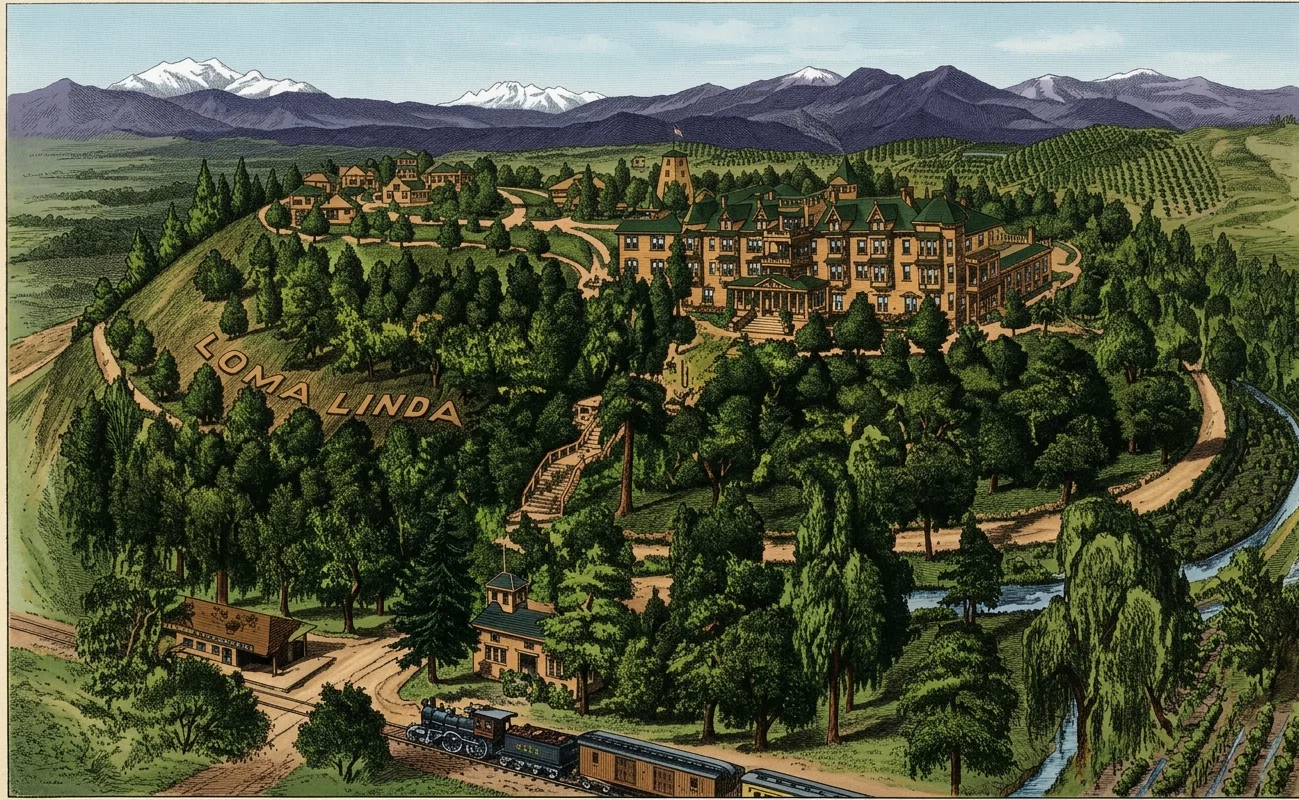
Of easy accessibility, and within reach of a large population, yet remarkably isolated, Loma Linda is favored as to location. Situated upon an eminence about two hundred feet above the surrounding valley, and at an altitude of over thirteen hundred feet above sea-level, Loma Linda lies in the midst of the San Bernardino valley, sixty-two miles east of Los Angeles, on the main line of the Southern Pacific Railway running from San Francisco and Los Angeles to El Paso and New Orleans.
One visitor has written thus concerning the surroundings of the Loma Linda Sanitarium: “In the foreground, orange groves spread northward to the mountains; to the left, Colton glistens in the sunlight; to the right, Redlands reposes green against the upland; while nine miles across the foothills is Riverside. It is thus in the heart of the famous citrus belt of Southern California. Hundreds of acres of orange and lemon orchards are to be seen for miles up and down the valley; while still farther beyond, stretching from the extreme east to the west, tower the majestic mountains of the San Bernardino range, which for a part of the year lift their snow-capped peaks above the smiling verdure of the lower landscape — the land of perpetual summer.”
Loma Linda is not a town, or even a village, in the ordinary sense of the term. The sanitarium has its own railway station and ticket-office, post-office, bakery and food factory, cannery, stables, dairy, and gardens. For two miles round about there are only ranch-houses, surrounded by orange orchards and fields of grain; but a little farther on are several centers of population, connected with one another and with Loma Linda by well-kept roads; while at the foot of the hill is a Southern Pacific railway station, giving direct and frequent communication with Los Angeles and all other points. At night the electric lights of eleven towns and cities are in plain view from the verandas of the main building.
In order to give us a better knowledge of the surrounding region, the managers of the sanitarium arranged with friends who have automobiles to take us on a trip to Redlands, Colton, and Riverside. On this ride we were shown a rich district lying within a radius of ten miles from the sanitarium, with a population of fully one hundred thousand.
We first visited Redlands, four miles eastward. Twenty years ago this district was but “a waste of sage-brush and cactus.” To-day it is a beautiful little city of about twelve thousand, with an assessed property valuation of upward of twenty-five million dollars. Redlands is preeminently a city of homes. No saloons are permitted within its borders. Close by Redlands is “Smiley Heights,” a natural park, beautified by upward of twelve hundred varieties of shrubs and plants brought from many lands across the seas. As one visitor has testified: “Flowers are everywhere — a limitless wealth of color, fragrance, and beauty. This park, with the scenery which it commands, is one of the most fascinating of all the beautiful places made possible by the fertile soil and balmy climate of Southern California.”16
From Redlands we returned to Loma Linda for dinner, and then went on to Colton and Riverside. Colton is a growing town of about six thousand inhabitants, situated within four miles of Loma Linda, on the main line of the Southern Pacific Railway into Los Angeles. It is the center of the honey industry of Southern California, and is also an important fruit center.
From Colton we went on to Riverside, lying in the midst of what is perhaps the most noted orange district in the United States. In the Riverside valley there are over twenty thousand acres of orange groves. The product of these groves nets the growers over two and one-half million dollars annually, and nearly seven thousand cars are required to haul the fruit to market.
Just at the edge of the town is a rocky elevation known as Rubidoux Mountain. From the base of this mountain there has been constructed a broad road circling round to the top. The view from this road, as it winds for three miles up the sides of the mountain, is magnificent beyond description. From the top of the mountain one may behold a pleasing panorama of orchards and ranches, with their fruits and flowers; of beautiful cities and country homes; of the broad valley below, extending westward to the Pacific; while beyond, to the northward and eastward, rise snow-capped mountains to a height of more than two miles above the level of the sea; and to the southward tower in the distance the mountains of Old Mexico. My eyes never beheld a view more grand and inspiring, in any land, than that presented from the summit of Mount Rubidoux.
Returning to Loma Linda, we were the better able to appreciate the advantages of its location in the heart of this populous district. Five miles distant is Highlands, a town of about three thousand inhabitants.
The Loma Linda property now consists of 166 acres of land, including considerable valley land at the foot of the hill. All this is in cultivation, and under irrigation. The grounds on the hillside were laid out several years ago by a landscape artist, and are covered with pepper, eucalyptus, and other ornamental evergreen trees, with flowering shrubs and spreading lawns; while along the shaded walks and graded driveways flowers of many varieties bloom the entire year. A portion of the hill is covered with groves of orange, lemon, grapefruit, plum, apricot, and olive trees. The accompanying cut, showing the main sanitarium building in the midst of the various trees, will give the reader a good idea of the appearance of the place as one approaches Loma Linda.
THE LOMA LINDA SANITARIUM
A feature of the institution that is daily appreciated by patients and students alike, is the system of gardens under cultivation. Several acres are devoted to the growth of vegetables and small fruits. During our sojourn at Loma Linda, we had the pleasure of eating strawberries three times a day, oranges picked fresh daily from the trees, vegetables from the gardens, and olives from the orchard. Butter, milk, and cream were supplied in abundance from their modern dairy, while bread, crackers, and canned goods were supplied by the food factory and cannery owned by the institution, and located near the railway station at the foot of the hill. The patients, numbering about seventy-five, and the large family of students and helpers, were liberally provided with the bounties that were daily spread before us.
The main building of the sanitarium contains one hundred rooms. The ceilings are very high, and in many portions of the building the floors are double. The treatment-rooms are amply large for present demands.
Some distance from the main building, on the crown of the hill, is a group of cottages, half a dozen or more in number, and an assembly hall. These buildings have been utilized as quarters for the medical students and nurses. In the immediate future additional facilities must be provided in order to accommodate all who may come. Of this, others will speak in the REVIEW.
A neat chapel, with seating capacity of nearly seven hundred, has been erected near the main building. It is soon to be dedicated.
Our council-meeting was greatly favored by the presence of the Holy Spirit, and all our brethren in attendance came to see eye to eye. Plans were laid for the development of a well-equipped medical school without incurring a large debt. The consolidation of the sanitarium property with the medical college places the college on vantage-ground at the very beginning, and minimizes the additional expense that must be incurred in providing adequate laboratory and other facilities and appliances. The visiting brethren were pleased with the general outlook, and are hopeful regarding the future of the institution.
No great undertaking that has proved a blessing to the cause of God, has been developed without continued sacrifice and much labor. No doubt the Loma Linda College of Medical Evangelists will have the same experience; but we believe that it is destined to prove a blessing to those who may have the privilege of availing themselves of its training. Plans have been laid for its faculty; and the courses of study, in science as well as Bible, are strong and well balanced, and calculated to prepare our youth to pass with credit the examinations required by the State boards throughout the land.
At the close of the council, our brethren from the East separated, in order to visit various other institutions and churches in the State before returning to their home fields. It was my privilege to visit the Pacific Press, at Mountain View. I was greatly pleased to see their simple, inexpensive, and remarkably economical system of conducting business in unpretentious quarters.
I spent Sabbath, May 14, in Oakland, where I met Elder S. N. Haskell and wife and a goodly number of old associates, including several former members of the old North Bloomfield church in Ohio, representing the Chinook family. On Sabbath day I spoke to acquaintances and to those whom I had never before met, in their new church building on Twenty-fifth Street, near Telegraph Avenue. It was a great pleasure to meet here Miss Flora Jones Fulton, whom I took when but a little child of about four years, soon after the death of her father and mother, across the continent to our home in Mesopotamia, Ohio, where she was a member of our family for several years.
Monday, May 16, I reached the St. Helena Sanitarium, where I met, among others, Elder H. A. St. John; also Elder W. C. White and family. The St. Helena Sanitarium has grown to large proportions, and is enjoying a good patronage.
From the sanitarium I was taken up the mountain-side about five miles to the Pacific Union College, which is about seventy miles northeast of San Francisco. Here I met Prof. C. W. Irwin, the principal of the school, Elder G. A. Irwin and wife, Miss Hattie Andre, and Elder A. O. Tait, all native Ohio people. I spent two days with these old friends at the Pacific Union College. This school has the largest resources for developing a great educational institution in practical industries of any school the17denomination operates.
At present it owns over seventeen hundred acres of land. Considerable of this is mountainous.
There is estimated to be on this tract of land several million feet of saw timber, consisting of white pine, redwood, fir, and oak, besides an almost inexhaustible supply of fire-wood. There are about thirty acres of orchard and vineyard, so situated as to produce the best quality of fruit. The elevation at this point is seventeen hundred feet above the sea-level, making it especially adapted for raising a good quality of fruit. There are two thousand apple trees, over two hundred peach trees, ten acres of prune orchard, besides pears, cherries, blackberries, and some English walnuts.
They have thirty acres in alfalfa and a number of acres in garden and vegetables. This is all under irrigation from their own water-system, supplied with the purest mountain water. The farm is stocked with nineteen head of horses, two yoke of oxen, and about fifteen milch cows. There are eight or ten buildings on the ranch. The original cost of the buildings and the water-plant, including water-piping, etc., for the irrigation, was over forty thousand dollars. This does not include the price of the land. All of the buildings and equipment are now utilized for school purposes.
I took a trip over the school ranch with Prof. C. W. Irwin and his father, traveling with a team from fifteen to twenty miles to get a good view of the entire school plant. I should judge that five hundred acres or more of the land now unimproved can be utilized for orchard purposes, which would be especially adapted to raising apples and peaches. This property, including the farm, tools, stock, and buildings, which are in excellent repair, was bought by the Pacific Union Conference for $60,000, which I consider a very low price for a property of this character. The school has recently put in a saw-mill, and has just contracted for the sale of two thousands dollars' worth of firewood.
Each student is required to work two and one-half hours daily in addition to paying a tuition of eighteen dollars a month. The teachers and students are doing all the work, and managing the ranch. One student has charge of the blacksmith shop; this enables the school to shoe its own horses, etc. While I was there, teachers and students were sawing lumber for a new dormitory, to be erected the present year. They say they have a good market, right at their yard, for all the lumber they can saw.
Leaving California, I took the shortest route, the Union Pacific Railroad, for Salt Lake City. Just before reaching Ogden, we crossed Salt Lake on the train, a distance of a little more than thirty miles, giving one the impression of being at sea. This “cut-off” saves seven hours’ time in crossing the desert, and takes one over Salt Lake on the longest bridge in the world. Aside from the long miles of trestlework, the bridge for twelve miles rests on piling, each pile representing a tree standing on end. Some of these trees are said to be 110 feet in length. By this new route, three hundred sixty miles of the old railroad bed have been abandoned.
I was glad to meet with the members of the Salt Lake church, and to speak to them on Sabbath, May 21, in their comfortable church building in that growing city. Salt Lake has made rapid growth since I was permitted to preach in that city something like twenty years ago. At the close of the service I assisted the president of the conference, Elder S. G. Huntington, in the ordination of H. G. Gjording to the gospel ministry. Elder Gjording is to work in South Dakota, taking the place of Elder N. P. Neilsen, who goes to New York City. Salt Lake City is controlled by Mormons, fully three fourths of the city being of that faith. It is said that many of the Mormons still practise polygamy, and the city being under their control it is very difficult to enforce the law against this practise.
Leaving Salt Lake City near the close of the Sabbath, I reached Omaha on Monday morning. As I stepped from the Union Pacific train, in company with a gentleman who had been traveling in California for nine months, I was somewhat amused to hear him ask some railroad men the following question: “Can you tell me the road and the train that will take me to the best city in the United States? If I can find that city, I want to go to it.” A conductor, standing by, said: “Take the Northwestern Railroad and the train that stands on track No. 4. That will take you to Minneapolis. I think you will find what you are looking for.” I boarded the same train, and Monday night reached Minneapolis after an absence of a little more than three weeks.