Your ShelfYour Projects

Review and Herald, Vol. 90, No. 44.

LIBERTY

Review and Herald

Oct 30, 1913

Review and Herald Publishing Association · Takoma Park Station, Washington, D. C. · Oct 30, 1913

LIBERTY

A MAGAZINE OF RELIGIOUS FREEDOM
PUBLISHED QUARTERLY 10 CTS. A COPY 35 CTS. A YEAR
WASHINGTON, D. C.

PRICES, POST-PAID

Yearly subscription - - - - $ .35 Three years (or 3 subs. 1 year) - - - - .90 Four years (or 4 subs. 1 year) - - - - 1.00 Ten years (or 10 subs. 1 year) - - - - 2.00 Ten copies, one year to one address or more 2.00 (Subscriptions for less than one year not accepted) 20 copies ordered at one time - - 1.00 50 copies ordered at one time - - - 2.00 100 copies ordered at one time - - - 4.00
NO EXTRA CHARGE ON FOREIGN SUBSCRIPTIONS

SPECIAL

American Principles Number

Striking Cover: Two-Color Portrait of Geo. Washington; Back-Page Cartoon, “Undermining the Foundations”

PARTIAL CONTENTS

Will “Christian Citizenship” Save the World? Catholics and Protestants Have Equal Rights Religion in the Public Schools American Principles of Freedom National Reformism—A Layman's View Struggles for Freedom Congressman Bartholdt on Personal Liberty and Sunday Legislation Forces Antagonistic to America Freedom of Speech Religious Liberty in the Philippines Roger Williams, “the First American” World's Christian Citizenship Conference Constantine's Sophistry Practised on Americans Jefferson's Prophecy Nearing Fulfillment Voluntary Religion an American Policy Mayor Gaynor's Rebuke to a Religious Spy What Prominent Men Have Said About Religious Legislation and the Rights of the Minority (with portraits) The Liquor Traffic vs. Personal Liberty

AN ARSENAL OF EFFECTIVE RELIGIOUS

LIBERTY AMMUNITION
The portrait and cartoon on the cover make this an easy seller. The articles are exceptionally valuable and interesting.
AGENTS WANTED EVERYWHERE IN AMERICA! Send ten cents for sample copy. Liberal terms to agents on yearly subscriptions. Write today for particulars.
Become our agent by sending $1.00 for 20 copies; $2.00 for 50; $4.00 for 100. We pay the postage and will ship to one or more addresses as desired. Send $2.00 for 10 yearly subscriptions for your friends.

ORDER THROUGH OUR NEAREST AGENCY

(If you do not know the address of our Agency, ask “Liberty Magazine,” Washington, D. C.

“Vaticanism Vs. America” and “Free Speech” Number

Three Striking Cartoons and a Double-page Picture of the “American Federation of Catholic Societies” Convention
DON’T MISS THE ARTICLES TELLING OF THE MOBBING OF JEREMIAH J. CROWLEY AND OTHER PROTESTANT LECTURERS, AND THE BOYCOTTING OF THE WASHINGTON “POST.”

PARTIAL NOVEMBER CONTENTS

Four-page Frontispiece—Nast Cartoons—“Uncle Sam’s Appeal to Rome,” “Vaticanism in Germany and the U. S.,” and Other Pictures.
Attitude of Roman Catholics Toward Freedom of Speech
Papal Boycott Against Washington “Post,” for Printing the Truth.
Archbishop Ireland Vs. the Popes (parallel quotations)
Bible to Be Understood by All
Papacy Foretold in Prophecy, No. 3—Prof. Gaussen on Daniel 7
Vaticanism in Germany and the United States, No. 2—Warning of Republican Congressional Committee.
Fourteen Other Articles and Items
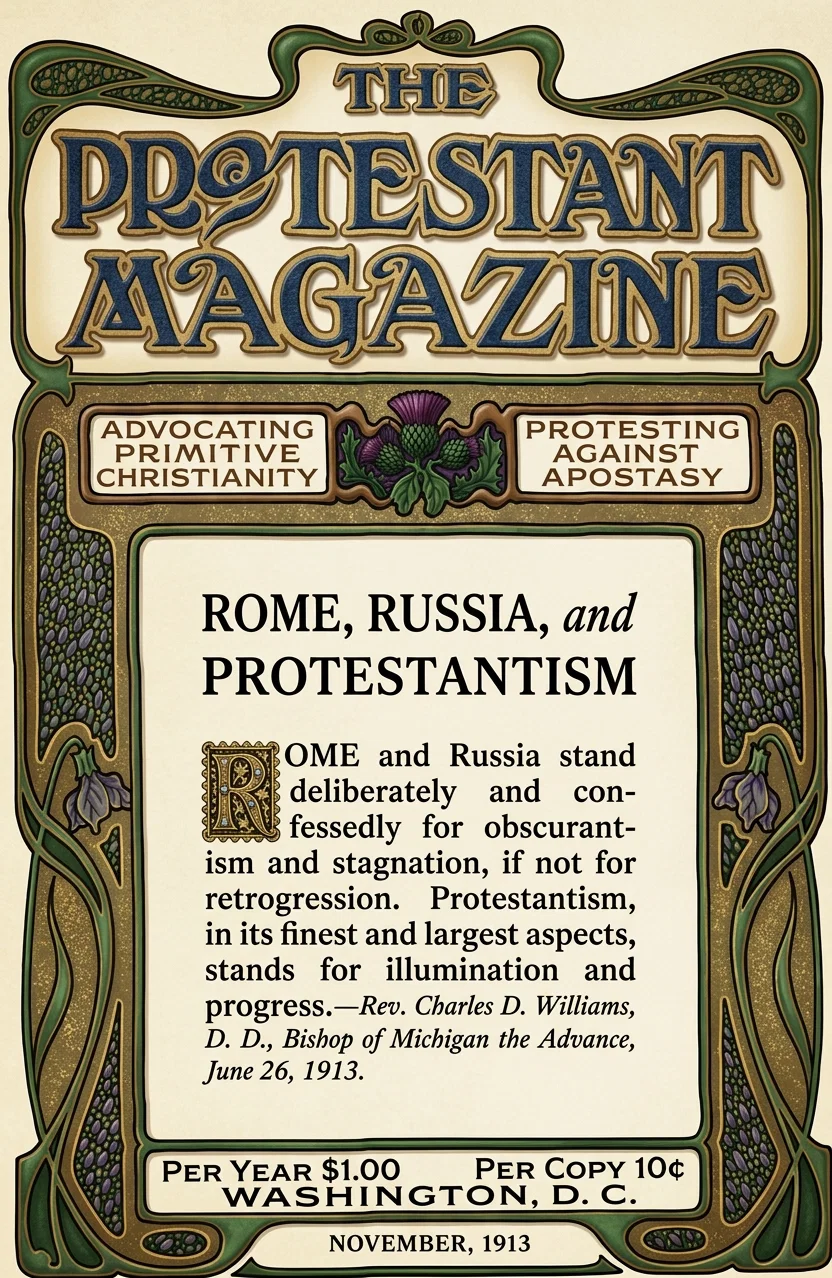
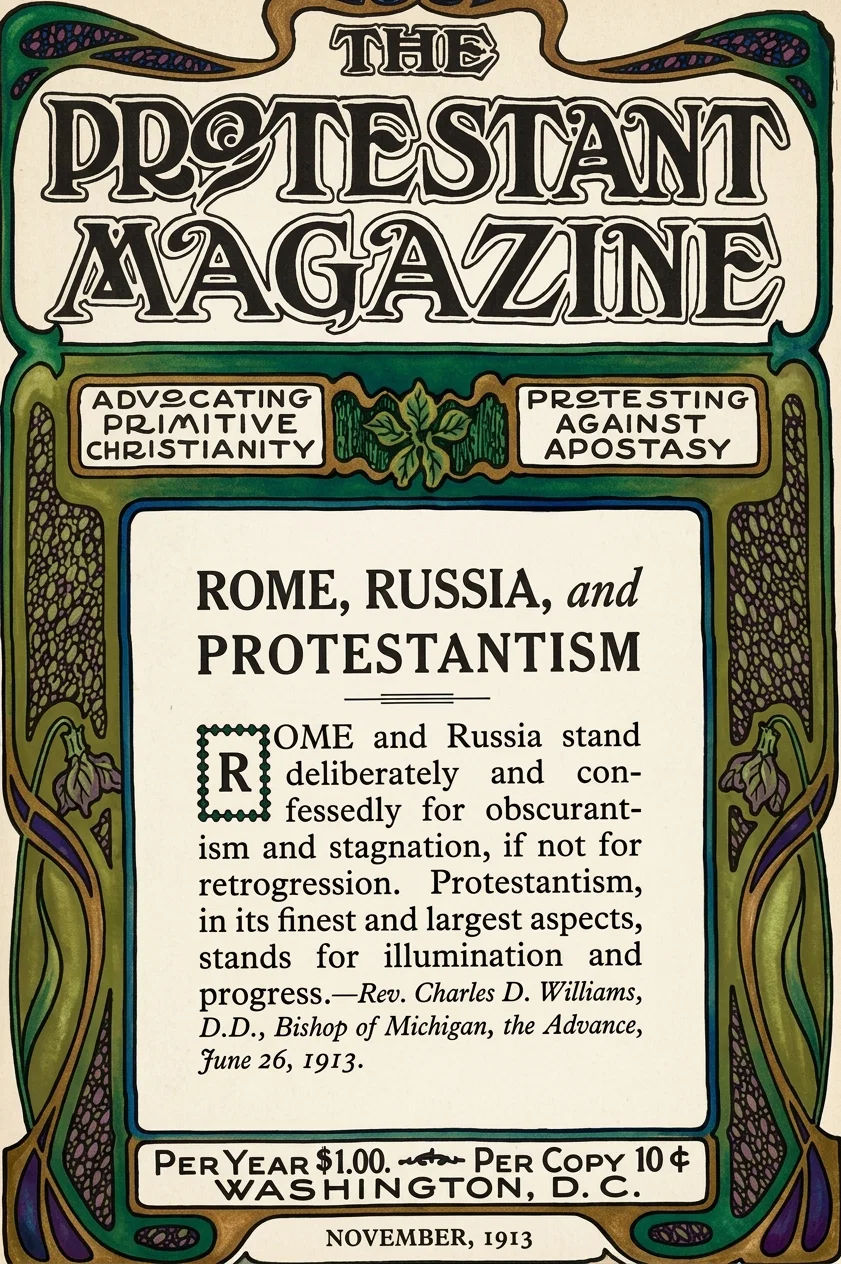
LIBERAL TERMS TO AGENTS. Write for particulars. Send 10 cents in stamps for sample copy.
TO TEN FRIENDS. You can send $3.00 for 10 six months’ (or 5 yearly) subscriptions, in behalf of friends. Five or more copies, mailed by publishers to one or to five addresses, each, 5 cents.

ORDER THROUGH OUR NEAREST AGENCY

(If you do not know the address of our Agency, ask “Protestant Magazine,” Washington, D. C.)

ARTHUR W. SPAULDING

Doxology

ARTHUR W. SPAULDING

The earth is full of the glory of God: Alleluia!
Shine forth, ye stars that deck the night; Thou moon, thy fulgent rays employ; And praise, thou noonday orb of light, Give praise with all thy splendor bright; Ye hosts of heaven, beam forth your joy: Alleluia!
The mountains and the hills break forth, They clap their hands, they also sing; The forests rock with rapturous mirth; With praise the solitudes do ring: Alleluia!
The elements a voice have heard, Stormy winds fulfil his word: Alleluia!
Cry fire, and hail, and mist, and snow, From deeps above, from deeps below, Alleluia!
The crooked lightning steers its fate Where mock the non-inviolate, While thunders deep reverberate: Alleluia!
And soft the balmy airs caress The timorous bird, the shrinking beast, And light the smiles of God impress The greatest of the earth, and least, That him they may with praise address: Alleluia!
The valleys and the plains rejoice In golden corn and grasses green; Vineyard and orchard lend their voice, And all the flocks that graze between; Honey and milk and fruitage choice, Harvest and store, rejoice, rejoice: Alleluia!
Praise, praise, ye people, praise the Lord! Alleluia!
Ye kings of earth, your homage pay; Ye princes and ye judges, bow; Young men and maidens, children gay, Ye grave of mien, ye old men gray, Come forth, and pay your highest vow; With joy before your Sovereign bow: Alleluia! Alleluia!
Praise him, ye seraphim above; Praise him, ye angels of his love; Ye winged spirits of his grace, That day by day behold his face, Sing, sing the rapture that ye know, And lend your joy to earth below; For earth is full of the glory of God: Alleluia! Alleluia! Alleluia! Amen!
Sanitarium, Cal.

“What Doest Thou Here?”

(Concluded)
MRS. E. G. WHITE
To Elijah, in his place of hiding, the Lord said, “What doest thou here, Elijah?” I sent you to Samaria with a message to Ahab; I sent you to the brook Cherith, and afterward to the widow of Sarepta. I commissioned you to return to Israel and to stand before the idolatrous priests on Carmel; and I girded you with strength to guide the chariot of the king to the gate of Jezreel. But who sent you on this hasty flight into the wilderness? What errand have you here?
So, to every child of God not actively engaged in service whose voice the enemy of souls, no matter by what means, has succeeded in silencing, the question is addressed, What doest thou here? I commissioned you to go into all the world and preach the gospel, to prepare a people for the day of God. Why are you here? Who sent you?
The joy set before Christ, the joy that sustained him through sacrifice and suffering, was the joy of seeing sinners saved. This should be the joy of every Christian, the spur to his ambition. Those who realize, even in a limited degree, what redemption means to them and to their fellow men, will comprehend in some measure the vast needs of humanity. Their hearts will be moved to compassion as they see the moral and spiritual destitution of thousands who are under the shadow of a terrible doom, in comparison with which physical suffering fades into nothingness.
Of families, as of individuals, the question is asked, What doest thou here? In many churches there are families well instructed in the truths of God’s Word who might widen the sphere of their influence by moving to places in need of the ministry that they are capable of giving. God calls for Christian families to go into the dark places of the earth, and work wisely and perseveringly for those who are enshrouded in spiritual gloom.
To answer this call requires self-sacrifice. While many are waiting to have every obstacle removed, souls are dying, without hope and without God. For the sake of worldly advantage, for the sake of acquiring scientific knowledge, men are willing to venture into pestilential regions, and endure hardship and privation. Where are those who are willing to do as much for the sake of telling others of the Saviour?
“The love of Christ constraineth us,” the apostle Peter declared. This was the motive that impelled the zealous disciple in his arduous labors in the cause of the gospel. It was the impulse that moved the great apostle Paul. And no less is the need today that the followers of Christ feel the same constraining power and respond to its influence with the same zeal and devotion.
If under trying circumstances, men of spiritual power, pressed beyond measure, become discouraged and desponding, if at times they see nothing desirable in life, that they should choose it, this is nothing strange or new. One of the mightiest of prophets fled for his life before the rage of an infuriated woman. A fugitive, weary and travel-worn, bitter disappointment crushing his spirits, he asked that he might die. To all who, spending their lives in self-sacrificing labor, are tempted to give way to despondency and distrust, the experience of Elijah on Mt. Horeb should bring hope and courage in the assurance of God’s watchful care, his love, and his power.
When men see their zeal for God’s cause misunderstood or unappreciated, their counsels and reproofs slighted, their efforts to do a work of reform repaid with hatred and opposition; when they see those from whom they have a right to expect help and support, adding to their burdens, let them study anew the work of Elijah and the experience he gained on Horeb. It was when hope was gone, and his life-work seemed threatened with defeat, that the prophet learned one of the deepest lessons of his life. In the hour of his greatest weakness he learned the need and thepossibility of trusting God under circumstances the most forbidding. Never would Heaven forsake him while he maintained his integrity.
It is at the time of greatest weakness that Satan assails the soul with the fiercest temptations. It was thus that he hoped to prevail over the Son of God; for by this policy he had gained many victories over man. When the will-power weakened and faith failed, then those who had stood long and valiantly for the right yielded to temptation. Moses, wearied with the faithlessness and rebellion of the Israelites during the forty years of wandering, lost for a moment his hold on infinite power. He failed just on the borders of the promised land. So with Elijah. He who had stood undaunted before Ahab, who throughout that terrible day on Carmel had stood before the whole nation of Israel, the sole witness to the true God, in a moment of weariness allowed the fear of death to overcome his faith.
And so it is today. When we are encompassed with doubt, perplexed by circumstances, or afflicted by poverty or distress, Satan seeks to shake our confidence in God. It is then that he arrays before us our mistakes and tempts us to distrust God, to question his love. He hopes to discourage the soul, and break our hold on God; for he knows that once he succeeds in separating us from the source of our strength, he is sure of his prey.
Those who, standing in the front of the conflict, are impelled by the Spirit of God to do a special work, will frequently feel a reaction when the pressure is removed. Despondency may shake the most heroic faith, and weaken the most steadfast will. But God understands, and he still pities and loves his servants. He reads the motives and the purposes of the heart. To wait patiently, to trust when everything looks dark, is the lesson that every leader in God’s work needs to learn. Heaven will not fail them in their day of adversity. Nothing is apparently more helpless yet really more invincible than the soul that feels its nothingness and relies wholly on God.
Not alone for men in positions of large responsibility is the lesson of Elijah’s experience in learning anew how to trust God in the hour of trial. He who was Elijah’s strength is strong to uphold every struggling child of his, no matter how weak. Of every one he expects loyalty, and to every one he grants power according to the need. In his own strength man is strengthless; but in the might of God he may be strong to overcome evil and to help others to overcome. Satan can never gain advantage of him who makes God his defense. “Surely, shall one say, in the Lord have I righteousness and strength. . . . In the Lord shall all the seed of Israel be justified, and shall glory.”
Fellow Christian, Satan knows your weakness; therefore cling to Jesus. Abiding in God’s love, you may stand every test. The righteousness of Christ alone can give you power to stand against the tide of evil that is sweeping over the world. Bring faith into your experience. Faith lightens every burden, relieves every weariness. Providences that are now mysterious you may solve by continued trust in God.
It is when God’s people see no way of advance, when the Red Sea is before them and the pursuing army behind, that God bids them go forward. Thus he tests their faith. When such experiences come to you, go forward, trusting in Christ. Walk by faith in the path he marks out. Trials will come; but go forward.
This will strengthen your faith in God, and fit you for service.
The records of sacred history are written not merely that we might read and wonder, but that the same faith which wrought in God’s servants of old may work in us. In no less marked a manner than he wrought then will he work now wherever there are hearts of faith to be channels of his power.
To us, as to Peter, the word is spoken, “Satan hath desired to have you, that he may sift you as wheat: but I have prayed for thee, that thy faith fail not.” Christ will never abandon those for whom he has died. We may leave him, and be overwhelmed with temptation; but Christ can never turn from one for whom he has paid the ransom of his own life. Could our spiritual vision be quickened, we should see souls bowed under oppression and burdened with grief, pressed as a cart beneath sheaves, and ready to die in discouragement. We should see angels flying quickly to the aid of these tempted ones. They force back the hosts of evil that encompass these souls, and place their feet on the sure foundation. The battles waging between the two armies are as real as those fought by the armies of this world, and on the issue of the spiritual conflict eternal destinies depend.
In the vision of the prophet Ezekiel there was the appearance of a hand beneath the wings of the cherubim. This is to teach God’s servants that it is divine power that gives success. Those whom God employs as his messengers are not to feel that his work is dependent on them. Finite beings are not left to carry this burden of responsibility. He who slumbers not, who in every crisis has been the strength and dependence of his people, will carry out his eternal purpose. He will thwart the designs of wicked men, and will bring to confusion the counsels of those who plot mischief against his people. He who is the King, the Lord of hosts, sitteth between the cherubim, and amidst the strife and tumult of nations he guards his children still. When the strongholds of kings shall be overthrown, when the arrows of wrath shall strike through the hearts of his enemies, his people will be safe in his hands.
“Thine, O Lord, is the greatness, and the power, and the glory, and the victory, and the majesty: . . . in thine hand is power and might; and in thine hand it is to make great, and to give strength unto all.”

A. T. ROBINSON

“By Us”

A. T. ROBINSON

“For all the promises of God in him are yea, and in him Amen [be it so], unto the glory of God by us.” 2 Cor. 1:20.
LET us make an application of the principle stated in this text, to a definite, specific promise which the Lord is just now holding out to every Seventh-day Adventist in the world.
It seems but yesterday that we were startled with the statement that our mission enterprises demanded an expenditure of $1,000 for every day in the year. We are less moved today upon learning that every rising and setting sun, $2,000 has to be forthcoming to keep our world-wide missionary operations going. We do not expect the advance in the demands of our missions to grow less in the years that remain for the finishing of this work. Rather we may expect the increase to be greater. Every thinking man or woman knows, however, that at the rate our mission enterprises are advancing, it will be but a very short time until the demands of our work will go far beyond the financial ability of this people. As the limit of their financial ability to carry the work approaches, we may be sure the Lord will be preparing the way for means to come into our ranks from outside sources.
The Lord has given us a definite, specific promise for just such an emergency. This promise states that in the closing of this message, as outlined in the sixtieth chapter of Isaiah, “the wealth of the Gentiles shall come unto thee.” Verse 5, marginal reading.
This is one of “all the promises of God,” which “in him are yea, and in him Amen [be it so], unto the glory of God by us.” “By us.” In the providence of God, this people has been raised up to carry forward this closing message of the gospel to mankind. If he had chosen to do so, he might have sent angels from heaven to proclaim the message, but his plan was to accomplish this work through human instrumentality. He might have rained down gold from heaven to meet the demands of his work, as he did the manna, but he ordained that the needed means should be supplied through the spirit of sacrifice on the part of his chosen people. He might now move upon men of the world to give of their earthly treasures to carry forward the work, but this he will not do without the cooperation of his people.
The promise of God, that “the wealth of the Gentiles shall come unto thee,” will be fulfilled “unto the glory of God by us.” We are to cooperate with his plan in bringing about the fulfilment of this promise.
In the Harvest Ingathering campaign we have a most wonderful opportunity of seeing this promise fulfilled, “unto the glory of God by us.” As we do our part in bringing this precious message-laden REVIEW to the people, and present to them in a simple way how wonderfully God is bringing thousands of people inheathen lands to rejoice in the saving message of the gospel, we should expect God to move upon hearts to respond in liberal gifts.
“Wherefore Jesus also, that he might sanctify the people with his own blood, suffered without the gate. Let us go forth therefore unto him without the camp, bearing his reproach.” Heb. 13: 12, 13.
* College View, Nebr.

A Blessing or a Curse

Gospel Finance—No. 14

A Blessing or a Curse

E. K. SLADE
“WILL a man rob God? Yet ye have robbed me. But ye say, Wherein have we robbed thee? In tithes and offerings. Ye are cursed with a curse: for ye have robbed me, even this whole nation. Bring ye all the tithes into the storehouse, that there may be meat in mine house, and prove me now herewith, saith the Lord of hosts, if I will not open you the windows of heaven, and pour you out a blessing, that there shall not be room enough to receive it.” Mal. 3: 8-10.
These direct and clear-cut utterances should mean much to a people who take the Lord to say what he means and to mean what he says. The question, “Will a man rob God?” should be read with proper emphasis on certain words in order to get their full force. For a man to rob his neighbor is a grave wrong. It seems even worse for him to rob a friend or a benefactor, but for a man to rob his Maker, from whom every gift comes, is the worst kind of robbery. The Lord appeals to the consciences of mankind by the pointed question and by setting forth the results of obedience and disobedience. With most men there must be a quickening of the conscience as related to the question of tithes and offerings. Men who would shudder at the thought of taking any amount of money from a man seem to have no sense of guilt when they make it a common practise to take that which God claims and requires, and appropriate it to their own use. Professed Christians will do this and appear to treat the words quoted above as meaningless. Men will become careless in their accounts and in accurately reckoning their tithes when they would feel required to be exact to the penny in settling an account with a man in a business transaction. The slack, haphazard, and dishonest way in which men have handled their accounts and made their remittances to the Lord’s treasury indicates a misconception of or a shameful indifference to the claims and requirements of God in this matter.
The words, “Ye are cursed with a curse: for ye have robbed me,” should have a startling effect upon those who have failed in this particular. The curse of God should be no part of a Christian’s experience; and as long as he is in such a condition, there is something seriously wrong with his Christianity. It is altogether out of harmony with the gospel plan as to its functions and its fruits, yet there are those who seem contented to enjoy or endure such a Christian experience.
In order to have his people have a more vivid sense of the sin involved in their covetous practises, the Lord makes the appeal: “Bring ye all the tithes into the storehouse, that there may be meat in mine house, and prove me now herewith, saith the Lord of hosts, if I will not open you the windows of heaven, and pour you out a blessing, that there shall not be room enough to receive it.” These words are deeply significant. The nature of the sin of robbing God has been pointed out; and now, as if to make a final effort to have his people see the seriousness of their course, he asks them to prove him by bringing all the tithes into the storehouse to see if he will not recognize and reward their faithfulness by bestowing bountiful blessings instead of the curse.
No Christian can afford to be under the curse, nor can he be contented to be without the blessing. Much less can he afford the double loss. As we have already shown, God’s requirements in his plan for financing his work in the earth are not for the purpose of enriching himself, but they are for the purpose of being a blessing to his people. His whole purpose is to bestow blessings upon us. The curse he would not have us experience. For us there is a curse to be escaped, and a blessing to be enjoyed. Should not the remnant church enjoy the fulness of the blessing, and be fully freed from the blighting curse?
Mount Vernon, Ohio.

Preserving Quietness and Order in the House of God

M. W. DE L’HORBE
“Ye shall keep my Sabbaths, and reverence my sanctuary; I am the Lord.” Lev. 19:30.
Why this injunction to reverence the house of worship?—Because such a place is devoted to the worship of God. God has said, “Every devoted thing is most holy unto the Lord.” Lev. 27:28. It matters not whether the place is a regular church building, or simply a hall or room rented for the purpose, in either case it is chosen as a place of worship; it is offered to God as a place for him to meet his people; and, being sanctified and made holy by God’s presence, it thus becomes his sanctuary.
The promise is, “Where two or three are gathered together in my name, there am I in the midst of them.” Matt. 18:20. The great and eternal God who created all things, and whose name is Holy, condescends to be present in our meetings. We commune with him there. It is the presence of God that sanctifies the meeting-place and makes it most holy. No wonder we are commanded to reverence such a place.
“Even them [the sons of the stranger] will I bring to my holy mountain, and make them joyful in my house of prayer; their burnt offerings and fruits, their sacrifices shall be accepted upon mine altar; for mine house shall be called a house of prayer for all people.” Isa. 56:7.
This fifty-sixth chapter of Isaiah is a prophecy relating to New Testament times, and teaches us how to regard all houses devoted to God’s service. If we were to step into the actual presence of God, doubtless we should at once bow in reverence, and abstain from all loud talking, laughing, jesting, and gossip. Should we not treat the Holy Spirit, who is always present at our meetings, with equal consideration and respect? “Serve God acceptably with reverence and godly fear.” Heb. 12:28.
Truly, it is a solemn thing to go into the presence of God. “God is greatly to be feared in the assembly of the saints, and to be had in reverence of all them that are about him.” Ps. 89:7.
The Lord commanded Joshua, “Loose thy shoe from off thy foot; for the place whereon thou standest is holy.” Joshua 5:15. To Moses, God gave similar instruction. Ex. 3:5. The wise man said, “Keep thy foot when thou goest to the house of God.” Eccl. 5:1.
These texts show that we should always remember to enter the church with sacred composure, having our thoughts directed toward God, being careful to avoid everything that would interfere with our devotions.
But it is apparent that many of our dear people fail to realize these things, or become careless regarding them. Some enter the house of prayer noisily, and move about laughing and talking immoderately. Children are sometimes allowed to run wildly about the house before and between times of worship, playing and laughing aloud. This is a scandal to the house of God, and should never be permitted. It is the duty of parents to look after their children, teaching them by both precept and example to reverence God’s house. God requires that they be thus taught. Reason with the child. Tell the children how it grieves the heart of Jesus when they disturb the meeting, or play in the church. Teach them how much Jesus loves them and wants them to be quiet and orderly in his house. If children are taught to reverence the family altar, and to sit quietly during family worship, they will seldom cause trouble at church.
God loves the children, and is pleased to have them attend Sabbath-school and meeting. He wants to bless them every Sabbath, and impress their tender hearts with the greatness of his love and power. Teach them that if they really love Jesus, they will try hard to be quiet in his house, and not play nor talk nor laugh aloud. If they will try this, they will experience for themselves the nearness of the Saviour, and realize his blessing.
I consider that it is a great mistake for parents to absent themselves from church services, for fear that their children will disturb others. Jesus is very near, and all, both young and old, need the instruction and encouragement to be found in the services. Faithfully attendall regular services whenever possible, and always bring the children.
Sometimes the older people will stand in groups, discussing the weather and its effects upon the crops, and talking about other commonplace matters. I have been at church, on different occasions, when the people became so absorbed in visiting and discussing various topics that they seemingly forgot that it was time to begin the meeting. When the minister steps into the desk and calls the meeting to order, he is sometimes obliged to call the second time, and to raise his voice to command attention.
Then some will engage in whispering or reading a paper during the sermon. These things are very displeasing to God, and grieve his Holy Spirit. If some have to wait a few moments before the service begins, they should improve this time by engaging in silent meditation, keeping the heart uplifted to God in prayer, that the meeting may be of special benefit to their own hearts and to others. We all lose much sweet communion with God by our restlessness. There is eloquence in silence in God’s house.
When the minister bows in prayer before opening the service, every one of the congregation who fears God should with bowed head unite in silent prayer with him, that God may grace the meeting with his presence, and give power for the presentation of the message. When the word is spoken, remember that you are listening to the voice of God through his servant. Listen attentively. Do not sleep, but open your heart to receive the message God has for you. “But as for me, I will come into thy house in the multitude of thy mercy; and in thy fear will I worship toward thy holy temple.” Ps. 5:7.
Elmira, N. Y.

Coatless Congregations

W. S. CHAPMAN
During the prevalence of the excessive heat last summer there arose a movement in the popular churches among the men to discard their coats and to attend service in their shirt-sleeves. Some ministers appeared in their pulpits coatless. In several of our own churches coats were discarded by many of the members as well as church officers.
Diversity of opinion seems to exist as to the propriety and consistency of such a course, but in the Testimonies there is light on this as well as other questions concerning duty. We shall not find the matter of appearing in the house of God in shirt-sleeves presented or even named, but we are shown clearly the principle involved and are expected to make the proper application.
In the history of ancient Israel as presented in the Bible, the manner in which God sought to train his people to observe his requirements is given. We find that even the dress of his people was to be different from that of the nations round about them, and when the ceremonial service was instituted the dress of the priests and Levites was described in minutest detail.
“Anciently the priests were required to have their garments in a particular style to do service in the holy place, and minister in the priest’s office. They were to have garments in accordance with their work, and God distinctly specified what these should be.” “There was to be nothing slack and untidy about those who appeared before him, when they came into his holy presence. And why was this? What was the object of all this carefulness? Was it merely to recommend the people to God? Was it merely to gain his approbation? The reason that was given me was this, that a right impression might be made upon the people. If those who ministered in the sacred office should fail to manifest care and reverence for God in their apparel and their deportment, the people would lose their awe and their reverence for God and his sacred service. If the priests showed great reverence for God, by being very careful and very particular as they came into his presence, it gave the people an exalted idea of God and his requirements: It showed them that God was holy, that his work was sacred, and that everything in connection with his work must be holy.”
In these statements God’s servant lays before us a principle that governs wherever it is applicable. In the matter of dress whatever would apply to a minister is, unquestionably, applicable to any and all church officers and members. The following was written to a brother who did not appreciate the value to him personally of previous testimonies that had been sent to others:—
“The object in publishing the testimonies is that those who are not singled out personally, yet who are as much in fault as those who are reproved, may be warned through the reproofs given to others. . . . The last view given me was above two years ago. I was then directed to bring out general principles, in speaking and in writing, and at the same time specify the dangers, errors, and sins of some individuals, that all might be warned, reproved, and counseled. I saw that all should search their own hearts and lives closely, to see if they had not made the same mistakes for which others were corrected, and if the warnings given for others did not apply to their own cases.”
“A minister who is negligent in his apparel often wounds those of good taste and refined sensibilities. Those who are faulty in this respect should correct their errors, and be more circumspect.” “The very dress will be a recommendation to unbelievers. It will be a sermon in itself.” “But look at the style of dress worn by some of our ministers at the present day. . . . What is the impression given by such a manner of dress? It is that the work in which they are engaged is considered no more sacred or elevated than common labor, as plowing in the field. The minister by his example brings down sacred things upon a level with common things.”
Our God is precise in all his ways, methodical in all his work, and particular concerning details. Let us strive to meet his requirements that we may be pleasing in his sight.
Continue reading: A Short Sermon