"For, behold, I create new heavens and a new earth: and the former shall not be remembered, nor come into mind. But be ye glad and rejoice forever in that which I create: for, behold, I create Jerusalem a rejoicing, and her people a joy." Isa. 65:17, 18.
"And righteousness shall be the girdle of His loins, and faithfulness the girdle of His reins. The wolf also shall dwell with the lamb, and the leopard shall lie down with the kid; and the calf and the young lion and the fatling together; and a little child shall lead them. And the cow and the bear shall feed; their young ones shall lie down together: and the lion shall eat straw like the ox. . . . They shall not hurt nor destroy in all My holy mountain: for the earth shall be full of the knowledge of the Lord, as the waters cover the sea." Isa. 11:5-9.
"A little child shall lead them"
With Our Inquirers
By Editor
"If ye will inquire, inquire ye."
[All questions to this department will be answered which to the editors will seem to minister to the good of the readers and to the mission of the paper. The same question can not be answered repeatedly in the same volume. The name and address must accompany question, not for publication, but as an evidence of good faith, and that answer may be made by letter if deemed advisable. It is well always to enclose a stamp for reply.]
Melchizedek
2454.—Melchizedek.
Who was Melchizedek? and what does the writer of Hebrews mean when he says of him, “Without father, without mother, without descent, having neither beginning of days, nor end of life; but made like unto the Son of God”? Heb. 7:3.
As to who Melchizedek was is yet a matter of investigation, yet there are some very plausible theories presented which are seemingly conclusive; but we do not care to attempt to present them in the brief space allotted to the Questions Department. He certainly was one who was living upon the earth in the days of Abraham. The expression “without father, without mother,” etc., simply means that we have no record of his father or mother or birth. No children sprang from him; he stood out there all alone, a representative of God, a high priest. Even so did Christ in His priesthood, having an everlasting priesthood.
2451.—The Kingdom of God
Please explain Luke 17:20, 21. It is used here to prove there is no personal God.
B. F. R.
There is absolutely no proof whatever in that text that there is no personal God. It does not deal with the thought. The thought of the 20th verse is that the kingdom of God does not come with great pomp and show; that is, Christ's spiritual kingdom which He was establishing among men. "Neither shall they say, Lo here! or lo there! for, behold, the kingdom of God is among you," as the margin reads. The margin of the Revised Version reads, "in the midst of you." Christ's kingdom, and the Maker of the kingdom, was there among them. The personality of the Godhead is taught in so many scriptures that it seems to us there can be no question in regard to it. See for instance John 17:1-3.
Does God mean when He says, Ye shall observe them “thruout your generations,” that these generations should extend down to the end of time? Why should these laws not be observed now the same as the Sabbath commandment? The same words are used in Ex. 31:16 of the Sabbath.
No. 616.
The term “generation” is elastic; it would naturally refer to the life of the thing to which it is applied. “Thruout your generation,” pertaining to the sacrifices, would be just as long as the sacrifices were to be offered. When those sacrifices ended, as they did at the cross, when Christ, the Lamb of God died for the sins of the world, the typical service ended. In a clearer, larger sense the service was carried on, but not in that form. So much for the ceremonial observance. The Sabbath is found in God’s moral law, and is of an entirely different character, a memorial of God’s creative work. Just as long as He has creatures to revere and serve Him, which will be eternally, just so long the Sabbath is a memorial of that work. The former was fulfilled in Christ Jesus, the latter will continue for all eternity, sanctified by Christ. See Isa. 66:22, 23.
2453.—A Closed Door.
What is meant by the closing of the door in the holy place of the sanctuary by Jesus in 1844?
If our inquirer has access to the book, "Man's Sin and Saviour," by Elder Uriah Smith; or "Christ Our Advocate," by Elder M. H. Brown, the latter a ten-cent pamphlet published by this office, he will find this question explained. In 1844, when the 2,300 days of Dan. 8:14 ended, Jesus Christ as High Priest changed His ministration in the plan of salvation; or, in other words, reached an advanced step in the plan of salvation. Previous to that time He had ministered in the holy place, as did the priests of old. On the closing day of the year, or the great day of atonement, the sanctuary itself was cleansed, the judgment took place, and the priest's work in the holy place closed up. Leviticus 16. No door in particular was closed, but ministration for sins in the holy place of the sanctuary ceased; men must look beyond that to the most holy place, where the priest ministered before the holy law of God. The former department was closed to service, the latter was open, as in the type, when our Lord's mediation was closed in the holy place. These books to which reference is made will explain much more fully than it is possible to explain it in this department.
Tithing and Vows
2455.—Tithing and Vows.
In Lev. 27: 28, 29, are some things which perplex me, and also verses 2-8. Can you give me some light upon them. J. S.
Verses 2-8 refer to the dedication to the Lord of persons whom one could dedicate. Of course they could not be sacrificed even tho given to God, and therefore the Lord placed a certain value upon persons thus dedicated, children they might be, servants or slaves—for the Israelites held slaves, and it might be captives—taken in the wars, which would be used as servants. Males between the ages of twenty and sixty were valued at fifty shekels of silver, a female at thirty, and others in proportion to their ages. The individual could give the money into the treasury of the Lord's house instead of giving the person. Of course the persons were not to be offered as sacrifices, nor could they be used otherwise. Verses 28 and 29 refer to devoted things, that is, things that are accursed; that is the meaning of the word "devoted," accursed, or devoted, of God. So Jericho was devoted. It must be destroyed. So a man or beast thus devoted was one which was worthy of death, and consequently must be put to death. We are not to understand by this, however, that the devoting of persons to death rested with the individual; that must be in harmony with God's plan. In His plan those tribes which inhabited Palestine had reached that condition of wickedness that it was a mercy to rid the earth of them. So when Saul was sent on his mission against the Amalekites, they were to be devoted, all their cattle, and all their beasts; they could not be redeemed.
Please explain Eze. 34:25. Does it mean that the angels will sleep in the new earth?
The text says nothing about angels, nor does it speak of the new earth. All the latter chapters of Ezekiel were God's promises to Israel if they would only return. He would have fulfilled for them then and there chapters 34 and 35 and so on to the last. They were fulfilled to them only in a very faint measure. All future fulfilment will be in harmony with the promises laid down in the New Testament. The sanctuary of Ezekiel will not be built, for Christ ministers in a far more glorious temple. Palestine will not be renovated as suggested by Ezekiel, but the earth will be completely renewed. In the plan proposed by the prophet, Israel still would have been mortal and would have needed sleep, but there would have been safety everywhere. In the new heavens and the new earth, God's people will be immortal. Whether they will sleep there or not, we do not know. Sleep may be the means of pleasure and joy outside of the recovering from weariness. We may not judge all conditions in the new earth by conditions here.
More Tolerable
2457.—M. M.—“More Tolerable.” Matt. 11:21-23.—No, the scriptures do not mean that the inhabitants of these cities will be saved, but rather the contrary; but the punishment which Tyre and Sidon and Sodom would receive would be more tolerable—easier to endure—than that which would be visited upon Chorazin, Bethsaida, and Capernaum. Those cities had light enough to save them, because there were those in them who were saved and who will demonstrate in the day of judgment that God gave sufficient light to those cities to save all who were there. But Capernaum had a superabundance of light; it ought to have been enough to lead to Christ. God gives sufficient light to any soul to believe. Some have rarer opportunities, but to all there is sufficient for salvation, and the great judgment day will justify God for all His graces.
Animals and God's Care
2458. — Ps. 104: 29-31. — M. M. — This text speaks of animals in general and not of particular animals. The passage shows God's care for animals. He gives them their food in due season; when He takes away their breath, they die and return to their dust; He sends forth His Spirit, and the earth is inhabited again with animals. He does not tell us they are recreated. The thought is that the face of the ground is renewed by the things which live upon it year by year. So far as humanity can understand at all, there is nothing in the beast which looks forward to the future, or expects anything in the future. They suffer because of man; "the whole creation groaneth and travaileth in pain together until now;" and they do this because man yielded to sin. But we do not know, nor can we understand, how God is bound in any way to bring back again the countless brute creation which have died or suffered from man's cruelty upon this earth.
Death-Bed Salvation
2459.—Death-Bed Salvation.—M. M.—Character is made up of two things, whole-souled purpose and experience. Where children who are not responsible die, and are saved in the kingdom of God, they will be like those who may be created in the future, they will be trained to character under conditions the result of which will be unquestionably good. Where persons receive Christ on their death-beds, it will be because there has been such a surrender to Him that He can then, and must then, receive them. Experience will be given in the life to come. But it may be quite seriously questioned whether most of the death-bed repentances are not very superficial, and but few genuine. This is demonstrated by many cases where the sick ones get well and go back to the husks of the world.
As Regards Jonah
2460.—As Regards Jonah.—M. M.—The SIGNS OF THE TIMES has no question in regard to the record concerning Jonah, nor do we believe, as your Jewish neighbors express, that God lied to the prophet. If you will read in connection with the prophet's message to Nineveh Jer. 17:7-10, you will there see that the Lord has certain conditions upon which His blessings are given or withholden. Nineveh complied with those conditions. God turned away from the punishment that He thought to bring upon the city according to His own principles of right-doing. If they had not repented, He would have destroyed them. We can find no better explanation of the many passages of scripture than the conditions laid down in the passage above referred to.
The Fulfillment of Zechariah's Prophecies
2461.—B. B. No. 706.—Zech. 13:8, 9 refers to the trials and divisions which took place when Jesus Christ was manifested among men, and may have a larger fulfilment in the very last trials among God's children. Chapter 14:16-21 is not yet fulfilled, nor will it be in just the way it is stated in Zechariah. God would have done wonderful things with Israel of old, but Israel did not meet the conditions. Yet not one good promise which God has given to His children will fail. He will fulfil it in a far larger sense in the glorious earth made new, when all His children will come home to their Father's house.
Christ the Teacher and Healer
By Ellen G. White
By Mrs. E. G. White
A True Knowledge of God.
LIKE our Saviour, we are in this world to do service for God. We are here to become like God in character, and by a life of service to reveal Him to the world. In order to be co-workers with God, in order to become like Him, and to reveal
"From the solemn roll of the deep-toned thunder."
His character, we must know Him aright. We must know Him as He reveals Himself.
A knowledge of God is the foundation of all true education and of all true service. It is the only real safeguard against temptation. It is this alone that can make us like God in character.
This is the knowledge needed by all who are working for the uplifting of their fellow men. Transformation of character, purity of life, efficiency in service, adherence to correct principles, all depend upon a right knowledge of God. This knowledge is the essential preparation both for this life and for the life to come. "The knowledge of the Holy is understanding." Thru a knowledge of Him are given unto us "all things that pertain unto life and godliness." "This is life eternal," said Jesus, "that they might know Thee the only true God, and Jesus Christ, whom Thou hast sent."
"Thus saith the Lord,
Let not the wise man glory in his wisdom,
Neither let the mighty man glory in his might,
Let not the rich man glory in his riches;
But let him that glorieth glory in this,
That he understandeth and knoweth Me,
That I am the Lord which exercise loving-kindness,
Judgment, and righteousness, in the earth;
For in these things I delight, saith the Lord."
We need to study the revelations that God has given of Himself.
"Acquaint now thyself with Him,
And be at peace:
Thereby good shall come unto thee.
Receive, I pray thee, the law from His mouth,
And lay up His words in thine heart. . . .
And the Almighty will be thy treasure. . . .
"Then shalt thou delight thyself in the Almighty,
And shalt lift up thy face unto God.
Thou shalt make thy prayer unto Him,
And He will hear thee;
And thou shalt pay thy vows.
Thou shalt also decree a thing,
And it shall be established unto thee;
And light shall shine upon thy ways.
When they cast thee down, thou shalt say,
There is lifting up;
And the humble person He will save."
"The everlasting hills tell of His power."
God Revealed thru Nature.
"The invisible things of Him since the creation of the world are clearly seen, being perceived thru the things that are made, even His everlasting power and divinity." The things of nature that we now behold give us but a faint conception of Eden's glory. Sin has marred earth's beauty; on all things may be seen traces of the work of evil. Yet much that is beautiful remains. Nature testifies that One infinite in power, great in goodness, mercy, and love, created the earth, and filled it with life and gladness. Even in their blighted state, all things reveal the handiwork of the great Master Artist.
From the solemn roll of the deep-toned thunder and old ocean's ceaseless roar, to the glad songs that make the forests vocal with melody, nature's ten thousand voices speak His praise. In earth, and sea, and sky, with their marvelous tint and color, varying in gorgeous contrast or blended in harmony, we behold His glory. The everlasting hills tell us of His power. The trees that wave their green banners in the sunlight, and the flowers in their delicate beauty, point to their Creator. The living green that carpets the brown earth tells of God's care for the humblest of His creatures. The caves of the sea and the depths of the earth reveal His treasures. He who placed the pearls in the ocean and the amethyst and chrysolite among the rocks, is a lover of the beautiful. The sun rising in the heavens is a representative of Him who is the life and light of all that He has made. All the brightness and beauty that adorn the earth and light up the heavens, speak of God.
"His glory covered the heavens."
"The earth is full of Thy riches."
"Day unto day uttereth speech,
And night unto night showeth knowledge.
There is no speech nor language;
Without these their voice is heard.
Their line is gone out thru all the earth,
And their words to the end of the world."
All things tell of His tender, fatherly care, and of His desire to make His children happy.
Extravagant Waste in Restaurants and Hotels.
WILLIAM ARCHER, a Scotchman, has the following to say in regard to his impression of living in hotels and restaurants while traveling in this country, and his statements incidentally show the careless and wantonly wasteful habits and tendencies of the time:
\u201cI am too much of a Scot to take any real pleasure in American luxury. It produces an odd effect on the habitually economical soul. You do not feel that you are being robbed and fleeced as you often do in European hotels\u2014that you are paying extortionate prices for little or nothing. However high the charges, you generally recognize that you are getting your money's worth\u2014that there can be no excessive margin of profit. Only you are getting, and you can not avoid getting, far more of everything than you want\u2014far more than the healthy human appetite has any use for.5\u201cIn the restaurants, for example, the army of waiters is imposing, every dish is served in Gargantuan quantities, and all the 'frills' of table service are elaborated to the last degree. But the resultant feeling is not one of satisfaction, but rather of wanton waste in service and in material.
\u201cIt is significant that in the bedrooms there are none of those expostulations against waste of (say) electricity which are so common in European hotels. I can, if I please, keep eight electric lamps burning day and night without remonstrance. The charges are fixed so high as to cover all possible waste short of absolute destruction.
\u201cI do not know but what this sense of waste is more exasperating to the canny soul than the sense of extortion. And yet, assuredly, I have seen nothing to indicate that the gospel of the simple life has found many converts in New York City.\u201d T.
"Jesus Stretched Forth His Hand."
By Max Hill
AND immediately Jesus stretched forth His hand, and took hold of him. . . . And when they were gone up into the boat the wind ceased.'' Matt. 14:31, 32.
The disciples, obedient to the instruction of the Master, were crossing the sea in a small boat, while He remained on the land to pray. The wind was contrary, the waves rough and high, and the disciples weary from long rowing. Longing for His comforting presence, they strove at the oars. Suddenly, in the midst of their distress, they saw a Man coming toward them from the gloom, walking on the water. Fear came upon them as they beheld Him. But to their cry of terror came an answer of assurance from the Master, ``Be of good cheer; it is I; be not afraid.''
Peter was first to find voice: `Lord, if it be Thou, bid me come unto Thee upon the waters.'' And the Master answered, Come.'' Bravely the apostle left the boat to meet his Lord. At first he saw only the Master, but when the waves surged round him, and he considered the danger of his position, fear came upon him once more, and with a despairing cry he began to sink. `And immediately Jesus stretched forth His hand, and took hold of him,'' and guided him safely to the boat.
When the waves were highest and roughest, when the danger was greatest, and their hearts were filled with fear, the Master came to the disciples. He came in answer to their dire need, and yet His presence brought fear to their hearts. Because their wish was not realized in the way they expected, they feared the very manifestation of His prayer-answering love. But a blessing was in His presence, and rallying from his fear, Peter longed to be nearer Him, and begged the Lord to call him to meet Him on the waters; the Master answered, ``Come.''
`Come.'' In the word was the promise, and grasping the promise by faith, Peter hastened to meet his Lord. But alas for his faith! The angry waves tossed about him, and for a moment he lost sight of the Saviour. In that moment of wavering he began to sink, for tho within reach of the Saviour, there was the danger of going down beneath the waves. But One stood near to save, for at his cry for help, `immediately Jesus stretched forth His hand, and took hold of him.'' With loving hand He held him up, tho He chided him for his lack of faith.
Man is ever prone to be surprised and even affrighted by God's way of answering prayer. We long for a certain thing, and seek Him for it, because we feel the need of it; but the answer staggers us; instead of exclaiming, `It is the Lord!'' we tremble. Again, having received it, we presume to ask that which is really unnecessary, to test the love of Heaven. And then, Peter like, we slip the anchor of faith before the prize is gained. Even still there is the strong arm of the Saviour. Tho He chide our lack of faith, His arm will save. His invitation to come includes protection and guidance and safety at last. That invitation and that strong arm, if accepted, will invariably lead, as did the word to Peter, to safety, for `when they were gone up into the boat, the wind ceased.'' MAX HILL.
The Way of Salvation.
By F. E. Gibson
"Look unto Me, and be ye saved, all the ends of the earth; for I am God, and there is none else." Isa. 45:22.
THERE is salvation to every one who looks unto Jesus Christ our Saviour; who speaks nothing but righteousness, and who only declares things that are right. By looking unto Him we behold One who is holy, just, and good. Looking unto Him we behold One who is perfect; one who did no sin, neither was guile found in His mouth. By looking unto Him we behold One who abides in the love of God and keeps all of His Father's commandments; and by looking unto Jesus we behold One who is able to save us from our sins. How is it possible that some, yes, many, neglect so great a salvation which could be had by just looking unto the Lord our Saviour? It is true they must be looking elsewhere. They might be looking at their own goodness and their own righteousness which are red as crimson, and as filthy rags. They may be looking at their brother's or sister's faults. They may be looking at their own wisdom, which is nothing in the sight of God, or their riches, or their husband, wife, son, or daughter, or their houses or lands, or to some pastor or teacher, or to be some great man of this world, and by so doing be lost eternally, because the Lord has said, "Look unto Me, and be ye saved, all the ends of the earth."
They may think perhaps the Lord does not mean just what He says; but I firmly believe the Lord means just what He says, for He changes not, and is the same yesterday, to-day, and forever.
O, so many of us are looking to the faults of our brethren and sisters, which the Spirit of the Lord has warned us over and over again not to do. If we can not see Christ in an individual, we had better not look, for, by beholding, we become changed. If Christ is not to be found in an individual, Satan must be there, and let us not look at him.
The Lord says that by beholding we become changed. . . . A Christian life is a Christlike life. A Christian is one who is continually walking in the footsteps of Jesus. I might just mention what F. W. Roberts says: "A Christian life is action; not a speculation, not a debating, but a doing. One thing and only one, in this world has eternity stamped upon it. Feelings pass; resolves and thoughts pass; opinions change. What you have done lasts—lasts in you. Thru ages, thru eternity, what you have done for Christ, that, and only that, you are."
Let us look unto Jesus who was despised and rejected of men, a Man of sorrows and acquainted with grief, who was despised and esteemed not, who hath borne our griefs and carried our sorrows.
Let us look unto Jesus who was oppressed and afflicted, yet He opened not His mouth; who was brought as a lamb to the slaughter, and as a sheep before her shearers is dumb, so He opened not His mouth.
Let us look unto Jesus who was persecuted for righteousness' sake, and cast into prison, and taken from prison and from the judgment-hall; who was cut out of the land of the living by being nailed to the cruel cross; for the transgression of His people was He stricken. O, let us look to Jesus who made His grave with the wicked and with the rich in His death; because He had done no violence, neither was any deceit in His mouth. Let us look unto Jesus who was raised from the grave of the wicked by the voice of God, and who is now sitting at the right hand of God in the heavens above, making intercession before God the Father and pleading in our behalf.
Let us look unto Jesus who is able to keep us from falling, and to present us faultless before the presence of His glory with exceeding great joy.
O list the glad story, the Saviour is coming,
Not now as to Bethlehem lowly He came;
Not now to the thorn-crown, the gall, and the
wormwood,
Not now to the sorrow, the smiting, the shame.
But, lo, in the beauty of heavenly splendor,
Transcendent in brightness, while angels attend,
He comes with His scepter, a King in His glory,
A King whose dominion shall ne'er have an end.
O'er all the fair earth in its Eden-like beauty,
Where sickness and sorrow shall nevermore reign,
No war-cloud to darken, no shroud and no weeping,
No farewells to sadden, no funeral train;
But life everlasting, and peace like a river,
And bliss such as mortals have never yet known,
With praise and thanksgiving forever ascribing,
To Jesus the King on the Conqueror's throne.
The Saviour is coming! from ocean to ocean
The message is sounding in notes loud and plain.
In earth's darkest corners the truth-light is shining,
And hearts wait to welcome His coming again.
Proclaim the glad Gospel of love and salvation,
Nor weary nor falter the dying to cheer.
The Saviour is coming! lo, this is our watchword,–
Yes, Jesus is coming, His advent is near.
JOHN M. HOPKINS.
An Inquiry of Infinite Importance.
By Charles G. Finney
[The following are paragraphs selected from Rev. Charles G. Finney's "Lectures on Systematic Theology." Doctor Finney's lectures created a wide-spread interest, both in this country and in Europe, when they were published.]
HOW much sin may we commit, or how much may we, at every moment, come short of full obedience to the law of God, and yet be accepted and justified?
This must be an inquiry of infinite importance. If we may wilfully withhold a part of our hearts from God and yet be accepted, how great a part may we withhold? If we may love God with less than all our hearts, and our neighbor less than ourselves, and be accepted, how much less than supreme love to God, and equal love to our neighbor, will be accepted?
Shall we be told that the least degree of true love to God and our neighbor will be accepted? But what is true love to God and our neighbor? This is the point of inquiry. Is that true love which is not what is required? If the least degree of love to God will be accepted, then we may love ourselves more than we love God, and yet be accepted. We may love God a little, and ourselves much, and still be in a state of acceptance with God. We may love God a little and our neighbor a little, and ourselves more than we love God and all our neighbors, and yet be in a justified state.
Or shall we be told that God must be loved supremely? But what is intended by this? Is supreme love a loving with all the heart? But this is full and not partial obedience; yet the latter is the thing about which we are inquiring. Or is supreme love not love with all the heart, but simply a higher degree of love than we exercise toward any other being? But how much greater must it be? Barely a little? How are we to measure it? In what scale are we to weigh, or by what standard are we to measure, our love, so as to know whether we love God a little more than any other being?
But how much are we to love our neighbor, in order to our being accepted? If we may love him a little less than ourselves, how much less, and still be justified?
These are certainly questions of vital importance. But such questions look trifling. Yet why should they? If the theory I am examining be true, these questions must not only be asked, but they must admit of a satisfactory answer. The advocates of the theory in question are bound to answer them. And if they can not, it is only because their theory is false. Is it possible that their theory should be true and yet no one be able to answer such vital questions as these just proposed? If a partial obedience can be accepted, it is a momentous question, how partial, or how complete must that obedience be? I say again that this is a question of agonizing interest. God forbid that we should be left in the dark here.
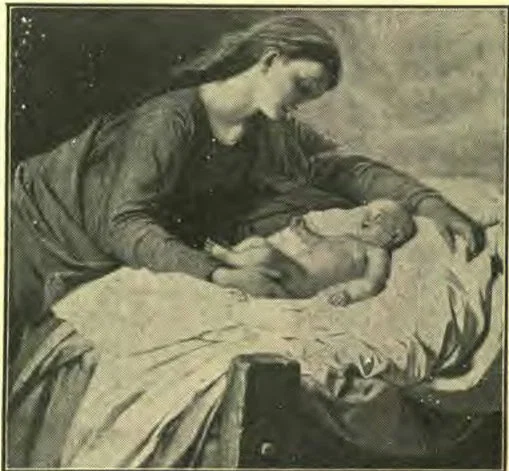
Madonna and Child.
By Geo. McCready Price
O SACRED Form! why didst Thou come to earth
In this poor, helpless way, and hush the harps
Of millions there at this strange act of love?
Why make Thyself an exile for long years
Of toil and pain, with that last act
Ever before Thy vision as a goal?
And did th’ Almighty Father sanction this,
Placing Thee here where Thy fell foe hath reigned
For long millenniums? Was there no way
Save this that Wisdom infinite could find
To win the ruined race, and yet be just?
Who now dare say that evil doth inhere
In nature’s self, implanted thus by God,
Helpless or careless of its dire results?
The creature’s or the Creator’s fault
It surely is; but holy Bethlehem
Cries protest ’gainst the heathen, hellish lie
That makes it man’s misfortune, not his fault,
That sin and evil dog his every step.
Who says this holy drama was evolved
From an ape’s brain? Who dare maintain the lie
Before this Form, and trace Its crimsoned steps
While winding up the way to Calvary?
Up from the depths of hell there never came
A stronger proof of sin’s foul blight than this
Black, damned libel on the spotless One.
GEO. MCCREADY PRICE.
Moral Integrity Without Intellectual Integrity
Moral Integrity without Intellectual Integrity.
THIS often exists. Many are the sincere persons who have a twist in their judgment; they can be trusted to do what they believe right, but their ideas of what is right are often far astray. Their imagination intoxicates them; some such would not steal, but they believe in and promote large schemes sure to fail, and even claim divine direction; but their unstable intellect originates the revelation, and they lead into hopeless ruin the friends who trust in them because of their moral integrity. Having done this, without intending to injure any one, as soon as they regain the least foothold another dubious scheme appears.
If not operating in financial spheres, they judge harshly all not agreeing with them, denounce them as hypocrites, declaring at the same time that they "love their souls and pray for them every day." One of the most brilliant men in this country has changed his religious views four or five times, and written to us in the same rebuking strain because we can not see that his ideas are in harmony with Scripture or with reason. Many geniuses are of this type and their very brilliancy depends in great part upon the fact that their good intentions and belief in divine direction cause them to neglect to summon the powers of the intellect to aid them in deciding, while they use all those powers in carrying out the last inconsistent notion that fascinates them.
It is this lack of intellectual integrity, which may exist in great minds as well as small, that explains the persistence with which they adhere to an untenable position. They will make a statement or a contract which to every plain person has one meaning, and then read into it something that no one else can see. In this state of mind they act exactly as do those who have intellectual integrity without moral integrity, and in dealing with men one of the most difficult questions to decide often is, Are their motives bad, or is their judgment unreliable?
In the widely different realms of physical science, philosophy, theology, psychology, and criticism (classical or Biblical) men dealing with the same facts and principles will deduce or induce, as the nature of the case may be, the most diverse results. Assuming equal moral integrity, all the fundamental errors must be attributed to lack of intellectual integrity.—The Christian Advocate.
Seek Ye the Lord
"Seek ye the Lord while He may be found, call ye upon Him while He is near."
The Impatient Man.
NO MAN is more constantly unhappy, or makes others more so, than the impatient man. He is out of harmony with things; and all things fight and worry and wound him. He feels himself dishonored, too, by his impatience; and he does lose, so far as he indulges it, the true dignity of life. He is not cast, indeed, like the victim of sensual vice, into the slough of dishonor; his garment perhaps is not soiled, but it is burned thru in a thousand spots by the ever-dripping little sparks of petulance; and it is in tatters and disorder with the ever-crossing flurries of angry passion; and he seems to himself and to others as one who scrambles thru life, rather than as one who walks in the calm and dignified robe of conscious self-possession. Constant fretting and fault-finding and breaking out into sarcasm and anger may bereave a house of all honor, peace, and comfort, almost as effectually as gluttony and drunkenness. Or suppose that the fretful temper be hidden and smothered in the heart, then it wastes and consumes the springs of the inmost life.—Orville Dewey.