READ again Daniel 7. We repeat the specifications of the prophecy of the little horn given in our last. They are as follows:
1. It arose among the ten horns. V. 8.
2. It was a little horn at first. V. 8.
3. In order that it might be established, three of the first horns are plucked up before it. V. 8.
4. It had eyes like the eyes of a man. V. 8.
5. It had a mouth which uttered not the meaningless noise of a beast, but great boastings, such as could be uttered only by a being above a beast. Vs. 8, 11, 25.
6. It was a different horn in character from those around it. V. 24.
7. It became strong, so that its look was more stout than its fellows. V. 20.
8. It made war upon the saints, or people of God. V. 21.
9. It was to prevail against them till the Lord should come and take judgment to Himself. Vs. 21, 22.
10. It should presume, or think, to change "the times and the law" of God. V. 25, R.V.
11. It should continue for "a time and times and half a time," or three and one-half years. V. 25, R.V.
12. It would lose its temporal dominion as a horn. V. 26.
13. Its greatest words come in the very closing part of its career.
Fulfilment of the Papacy.
Four of these were considered last week. Let us study the last eight in this lesson.
5. Great words have been spoken. In the tremendous claim which the Papacy has made as the one sole authority in all religious matters above conscience and the Bible; in its right to dethrone and set up kings and rulers, and to absolve their subjects from obedience; in the titles assumed for the bishop of Rome—as for instance, "Lord God the Pope," "Vicar of Jesus Christ," "Arbiter of the World," "The Light of the World," etc., etc., it has surely spoken great words, and "great words against the Most High," in assuming prerogatives and authority which belong only to God, and which even Jesus Himself did not assume.
6. It is diverse in character from the kingdoms among which it arose. The ten kingdoms were civil governments. The state was at the head, even if religion was connected with it. The only true idea of government, the Christian idea, is that of absolute separation of church and state; that civil government has no right to meddle in the things of religion. Its duty is to protect all its subjects equally without respect to religion. It is to prevent as far as possible incivility to all, irrespective of creed. Many nations of the past had departed from this, but the state had been kept paramount. Religion was subject to it.
When the Papacy came in, a different theory was taught; the church should be dominant, the state subject. The church should define heresy and its punishment; the state should execute it at the behest of the church.
A Threefold Phase.
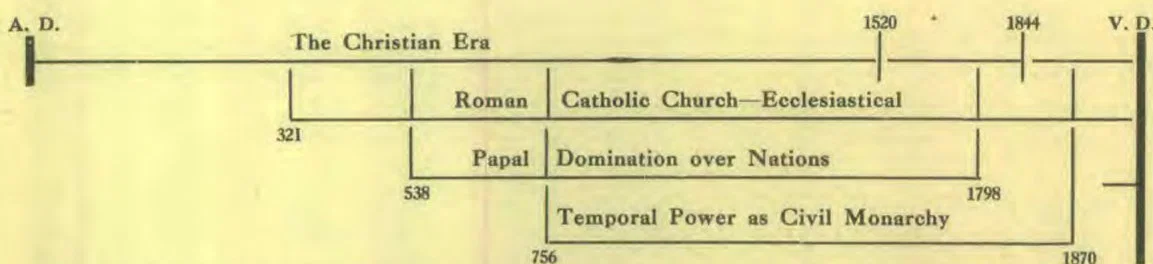
The great Christian apostasy is set before us in the prophetic word in three phases: (1) As the Roman Catholic Church, ecclesiastical, in which are many honest, earnest, self-sacrificing souls, longing for light, and living according to their best knowledge. This apostate church, beginning in organized form, markedly in the days of Constantine, exists to the end as an ecclesiastical organization. (2) As the Papacy, the power or claim of which to define heresy and its punishment is acknowledged by the civil power, the state placing itself at the disposal of the Papacy, to execute the sentence of the church. This phase of the Papacy, acknowledged by the civil powers, began in A.D. 538 and ended in 1798. We will call it spiritual domination over the nations. (3) The Papacy as a civil kingdom, limited to the States of the Church, beginning in the middle of the eighth century, and terminating in 1870. This is the true "temporal power" of the Papacy. All these are contrary to, and subversive of, the Gospel of Christ. The last two phases are presented in this chapter.
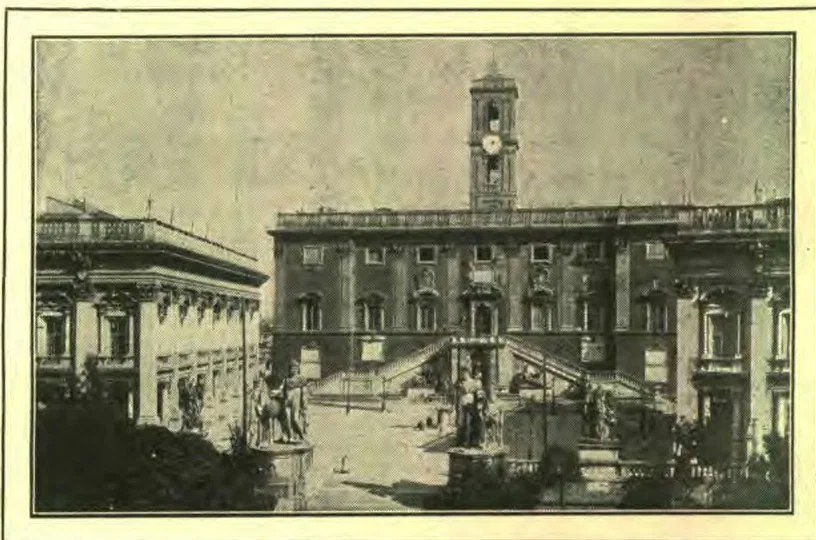
The Capitol at Rome—Formerly Held by the Papacy, but Now Opposed to It.
7. The little horn became strong, so that its look was more stout than its fellows. At first it sued for power, for prestige, for favor; it soon came to command. The Chaldean word, rab, translated "stout," is rendered chief, captain, great, lord, master. The look of the Papacy, or its representative, became more masterful than that of his fellows. The Papacy became chief. Jesus said, "I am among you as one that serveth;" the Papacy, the self-assumed "vicar of Christ," became as one that ruled.
War with the Saints.
8. It made war. Logically, it could not do otherwise and be true to its system. Jesus Christ said, "If any man hear My words, and believe not, I judge him not; for I came not to judge the world, but to save the world." John 12:47. The Papacy assumed to be judge, or arbiter. It defined the faith without regard to conscience. It stepped between the individual soul and its God, to whom each one must give an account. It separated the child from its Father. It placed between the human subject and the divine-human Redeemer, who invites all to "Come unto Me," a cordon of ecclesiastical police. Assuming all this, it must, to maintain its dignity and power, punish infractions of its law. It logically argues, from its false premises, always, that the very honor of God's throne demands that heretics (those who dare disobey the Papacy's interpretation of God's will) should be punished with death if need be. And therefore the Papacy could do naught but make war, and, too, with the saints. For the saints of God are free souls, who receive their law, not in the cold, dead creeds of men, but in living words of truth from Heaven. Of course, they could not yield their life to an organization that had departed from the Fount of Life, and therefore they were, by that organization—the Papacy—adjudged heretics; and the powers of earth dominated by the Papacy executed the sentence.
9. It prevailed against God's people. It put to death, in mistaken zeal, countless thousands of the—
"Whitest of the saints of God,"
and it will continue to make war, so far as its power lies, till the Master comes again, and judgment shall be given to the saints of the Most High. See 1 Cor. 4: 5; 6: 2, 3.
The Times and the Laws.
10. The little horn shall think to change times and laws. Not that it should be able to do this, but it would think itself able, it would assume to do this. The Septuagint reads, "the law;" the Revised Version, "the times and the law;" Spurrell's translation, "the appointed times and the law." All these point to the times of God's appointment, the law of His giving. And the Papacy has thought to do this. It has substituted for the Sabbath of the Decalogue, the seventh day, the first day of the week—a day which has absolutely no claim to Scriptural authority.¹
11. It was to continue for a time, times, and a half. A "time" is a year. See Dan. 11:13, margin. "Times," dual, the least number that can be expressed by the plural, is two years. The total is three and one-half years, or forty-two months—twelve hundred and sixty days. Rev. 11:2; 12:6, 14; 13:5. As God uses short-lived beasts to represent long-existing dynasties, so He uses brief periods of time to represent longer periods. A day in prophecy symbolizes a year. Eze. 4:4-6. The 1,260 days of the prophecy represent 1,260 literal years. These years began in A.D. 538, when the last Arian power was plucked up and the Papacy became the head of Christendom generally recognized by the states of Europe. In 1798 these days expired. In a larger sense10
Studies in the Book of Daniel
(Continued from Page 9.)
these days began in a period from 533 to 538 and ended in a period from 1793 to 1798. The corruptions of the Papacy and the light of the Gospel thru the Reformation took from Europe the fear of the pope; and its final blow as corrector of heretics, as the acknowledged head of the church, came when the army of the French directory, under Berthier, entered Rome, and took the pope prisoner, in February 1798. The dominancy of the Papacy over the other horns there and then received its finishing deadly blow. The ecclesiastical organization of the Roman Church was not affected, nor did its own dominion over its own territory here come to an end. The deadly wound and its healing is more fully set forth in the Revelation.
The chart above covers the time of the Christian era, from Christ's fire, afreat to His second coming; 1530 marks the era of the Reformation; 1884 the time of the Investigative Judgment. Dan. 7:9, 10.
Daniel sees the whole career of the little horn as a persecutor until the coming of the Ancient of Days. He notes the preeminent power for 1,260 years. But he does not mention the restoration which makes it a persecutor to the end, as indicated in verse 21. This is reserved for John.
Loss of Temporal Power.
12. The little horn was to lose its own dominion as a little horn. "The judgment shall sit," the prophet declared, "and they shall take away his dominion, to consume and to destroy it unto the end," not the end of the world or age, but to the end of his dominion, the last of it. Her dread judgment, prior to Christ's coming, is presented before us in verses 9 to 14. That judgment is, in connection with the closing of Christ's priestly work, a subject to be treated later. It began in 1844. Immediately after this is the removal of the dominion of the little horn. "They" evidently refers to other horn-powers. In 1844 the States of the Church covered an area of 16,000 square miles, with a population of 3,000,000. Four years afterward revolution broke out in France and northern Italy. In 1849 they revolted, but were brought back by France. In 1859 Romagna revolted, and was annexed to Sardinia in 1860. The same year Umbria and Marches revolted, and placed themselves under the standard of Victor Emmanuel. These were annexed to Sardinia. From 1848 to 1860 the consuming process had reduced the papal states from 16,000 square miles to 4,500, and from 3,000,000 population to 700,000. In 1870 the last vestige of temporal power was swept away. The end of his temporal dominion, as a horn, had come.
13. Verse 11 indicates that the greatest words, the greatest assumptions of the little horn, occur near the end of all earthly dominion, close down to the burning day of God. We have seen a partial fulfilment in the utterance of the dogma of the immaculate conception in 1854 and of infallibility in 1870. Doubtless the world will listen to still greater words; they will be the logical result of the system, the perverted Gospel of the Papacy.
Which Will We Choose?
Every one of these thirteen specifications is met in the Papacy; they are met in no other power. God has warned us in His word of its evil. He has portrayed its career and end. Great tho it has been, mighty above all kingdoms of earth, daring, even, to substitute its law for that of Jehovah, before that mighty truth of God, "the Most High ruleth in the kingdom of men," it falls, and falls forever. Not knowing God, it has blasphemed His name, usurped His throne, persecuted His people. It has seemed to triumph, and those who walk by sight, and are guided by sense, have yielded to its kingdom of outward pomp and show. If they continue with it, they will reap its fruitage.
But those, who, as free men, have dared to worship God according to the dictates of conscience, who have dared to be non-conformists, who have dared excommunication, proscription, anathema, exceration, banishment, torture, death, are in God's hands, held in remembrance by Him; and when it has been demonstrated to the world, and to worlds, what the fruit of exalting man to the place of God is, then the Lord will come and save those who have acknowledged His rule in their own hearts. There it must begin, and then, when earth's struggle is over, "the kingdom and the dominion, and the greatness of the kingdoms under the whole heaven, shall be given to the people of the saints of the Most High; His kingdom is an everlasting kingdom, and all dominions shall serve and obey Him."
The Kentucky Tobacco War.
FOR a number of months past there has been a regular war going on in Kentucky between the tobacco trust on the one hand and a mob called the "night riders" on the other. These "night riders" would usually come into a town or neighborhood on horseback and burn and destroy the property of the tobacco trust and also of those who would sell their tobacco to the trust. The following news item that is current in the press gives an idea of the sharp stage to which the fight has come:
"Lexington (Ky.), March 22.—Because of warning letters and visits from 'night riders,' many farmers in nearly all of the forty-two counties in the White-Burley tobacco district are busily destroying their tobacco beds, and at the present time less than one-third of the number usually planted have been started. In many counties huge signs have been erected on buildings and in high places nearby declaring the intention of the farmer not to raise a crop this season. Realizing the difficulty in making a living for their families in case the decision to raise no tobacco is adhered to, many tenant farmers are preparing to move to other states, while many farm owners have placed their property on the market with the avowed purpose of leaving Kentucky.
"The murder of Farmer Hedges in Nichols County yesterday and the raids in Woodford and other counties last week, have increased the alarm. In announcing their determination to go elsewhere, the tenants declare that it will be impossible to subsist from the proceeds of crops of hemp, wheat, and corn.
"In the neighborhood of Mount Sterling many farmers have been receiving threatening letters, with which were matches, powder, and poison, and in both farm districts and tobacco towns armed guards have been placed at threatened points. Conditions throuout the state are declared to be worse than at any time since the tobacco war began."
This contest is merely illustrative of the rioting that will exist all over this world at no distant day. The prophecies of the Bible tell us that such will be the condition of things in the last days; but if the Bible had said nothing about it, any observing person should be able to see from the discussions that are going on in the world that just such lawlessness must finally result.
There are many composing a large section of society, who are teaching that the rich are robbing the poor and that some drastic thing should be done about it. This doctrine has been dinned into the ears of the poor man until he is becoming very violent in his feelings toward the rich. And then when any provocation arises they start out in marauding mobs to burn and destroy. When the mob is once formed and the spirit of frenzy has seized the multitude, there is no knowing what they will do. Those who are perfectly innocent are just as likely to be struck down by the hand of violence as are the ones against whom the leaders in this rioting may have a grievance.
The only protection against this is the protection afforded by the arm of the infinite Father. But, thanks be to His name, this protection is more than ample.
Blindfolding Their Gods
Blindfolding Their Gods.—There is a custom in some of the Chinese temples where certain orgiastic ceremonies are in operation to blindfold their idols. The same custom is followed in private houses when the inmates are playing cards or dice. What a conception of God. It is another development of that primal falsehood, “Ye shall not surely die; . . . ye shall be as God.” First man exalts himself to Deity, and in this he degrades Deity to the low human level, with all the low human limitations. In more civilized lands men act as the God was not simply blindfolded, but blind. Yet is He neither. He sees and hears our every thought afar off. We can not hide from Him. “Thou God seest me,” is a mighty thought for constant waking consciousness. It is a deterrent to the sinfully inclined; it is a comfort to the faithful.
THE OUTLOOK
Watchman, What of the Night?
"Watchman, what of the night?"
Mass Meetings and Indignation in China
Mass Meetings and Indignation in China.—The greatest indignation prevails at Canton, China, because of the action of the Chinese Government in seizing the Japanese steamer loaded with rifles. The Chinese contended that they had a right to seize the vessel for they had good reason to believe that the guns were being so disposed of as to reach the hands of revolutionists who were exciting trouble. Japan demanded the restoration of the vessel, indemnity for the goods that were seized, and an apology from the Chinese Government. She sent a war-ship to enforce these demands. It looked for a time as if they might come to war over the question, but England stepped in as the ally of Japan, and a settlement was reached. But while the original demands of the Japanese were modified to some extent, yet the question was settled in such a way that the Canton province of China is holding mass meetings to express its indignation at the yielding to Japan. It is stated that 50,000 people attended the mass meetings that were held in a single day of last week. The meeting recommended the impeachment of Yuan Shi Kai of the Board of Foreign Affairs for weakness shown in yielding to Japan.
How They Say It.
By Editor
WE have been accused of bitterness toward Roman Catholics when we have shown what seems to us the erroneousness and unscripturalness of their belief. But we hold naught against Roman Catholics. We hold them honest, but deceived. Their degree of culpability, their motives, we leave with God. That is how the Western Watchman characterizes Protestantism and Protestants in an editorial in its issue of March 19. It is not Lenten-season groutiness either; it is characteristic of Dr. Phelan the editor. He says:
"Men who have become Catholics assure us that they were perfectly honest while professing Protestantism. Both Cardinal Manning and Cardinal Newman say so. They were as honest as any prejudiced Protestants could be. A man in his mind and heart believes another a scoundrel, who is, however, one of the purest and best of men. He may claim to be honest in his opinion; but the object of his prejudice will be slow to admit it. Protestantism rests on a foundation of lies. Its walls are built with lies. It is roofed in with lies. Protestants may claim to be honest, but indignant Catholics say to Hades with their honesty. With this stock of lies are wrapped up a world of contempt and scorn and rancor and malice. Binding them in one compact whole is the love of ease, the pride of life, the lust of the flesh. Cowardice keeps Protestants out of the church. They have not the courage to break their chains. Every priest who has received a convert into their church knows with what fear and trembling the latter took the step. But these obstacles of human and diabolical creation must be removed. It matters little how, so they are removed."
We submit that such language is not inclined to win them. It would be of interest to know how many Protestants had been persecuted, anathematized, tortured, or put to death because they became Catholics. It is becoming quite popular to join the Catholic Church now. It is the right and duty of every soul to judge as to the truth or falsity of a religion, a system. Prove all things; hold fast that which is good. But the judgment of the individual soul, the person, rests with God.
Converts to the Roman Catholic Church.
The Western Watchman of March 19 records three converts among the Episcopal clergy, as follows: Edward Hawkes and James H. Bourne, professors of the seminary of the Episcopal Church in the West, at Nashoshah, Wis., and another minister, Henry Allen Yost, in Missouri. And still they go. They desire certainty, can not find it in the decadent Protestant churches; therefore they go to Rome. And many others who are willing will find their way there.
Sunday-Law Agitation in New York.
By Editor
REV. DR. CHARLES H. PARKHURST has presented a formal request to Governor Hughes of New York to have Mayor McClellan and Police Commissioner Bingham removed from office because they are not enforcing the Sunday ordinances of New York City.
Dr. Parkhurst has been before the country for a good many years as a very staunch reformer, his reform work, however, partaking very much of the nature of detective and police methods. When he first introduced himself to the public in a prominent way, it was by the advertisement that was given him because of his going into the dives and dens of New York City in order to get the evidence that would enable him to bring convictions against them in court. And his work has continued to partake more or less of this nature all thru the years.
And so in getting the evidence to present to the governor in order to induce him to begin proceedings against New York's mayor and police commissioner, he has employed detectives to visit various saloons on Sundays in order to see if they were doing business the same as on other days. In the argument presented, Mr. Parkhurst cites the fact that the mayor and police commissioner were able to combine their influence in such a way as to close the theaters for several successive Sundays; and if they could close the theaters, they could also close the saloons.
This paper has no use for either the theater or the saloon. The theater does a great deal of harm in the vile tastes and low morals that it inculcates; and it can not be doubted that this evil is much greater than any possible good that can come from the so-called ``high-class'' theater, if there can be any such. But if these things are right for the state to foster on any day of the week, why not let them run just as they see fit. To have them closed on Sundays merely is to put them in the category of being all right on any other day of the week. We could not favor the closing of the saloons on Sundays alone for this very reason. We could not go into partnership with this business by saying to them that if they will close on Sundays, we will let them go on the other days of the week.
The facts are that Sunday is a religious institution; and if you take the religious notion out of the day, you will take away the cause that is at the bottom of the desire to have certain things illegal on that day that are declared all right on other days. The only Being in the universe that can make a thing wrong because it is done on a certain day is God. Neither the state nor the police force has any right to prescribe the relations that are to exist between man and his Maker.
We should not fail to note how that precedent is urged in this Sunday movement. It is urged that since the theaters can be closed on Sundays, therefore the saloons may also be closed. No effort is lacking in following up anything that has already been done. And when one thing after another is accomplished in the Sunday-law movement, it will be seen that the ultimate that is finally reached will be to take away the religious freedom that we now enjoy. We have been pointing out for more than a quarter of a century that the country would be driven upon the rocks of religious intolerance and medieval persecutions thru the enforcing of the Sunday laws that have crept into the statutes of nearly all our states and into the ordinances of almost every city.
There is a very strong wave of Sunday-law enforcement sweeping over the country just now, and it is ominous.
Minister Lauds Satan
"Minister Lauds Satan."—The above is the title of an article in the Seattle Post Intelligencer of March 10. The rector of St. Paul's Episcopal Church, as reported in his own words, chooses "to be the devil's advocate." Following are two excerpts from the sermon:
"All glory, laud, and honor to the mission of Mephisto! He stood at the cradle of the human race and taught it the difference between good and evil. He made it possible for men to lay aside the swaddling-clothes of innocence and to put on the armor of virtue!"
"What could the race have accomplished without the aid of Mephisto? It would still climb trees with the orang-outang, it would still chew the cud and howl with the hyenas."
All this is flat infidelity or inexcusable ignorance. Man could have resisted sin without sinning. It is from God's Book that we learn about the devil, his origin, history, power; but it is not, nor was it, in harmony with the will of God that man should fall under the power of Satan. God did not start the race as tadpoles or monkeys or orang-outangs, or as cavemen. They were innocent, children in experience; but under God's tutelage they would have learned to resist evil and do good, and so have developed strong character. No man learns the evil of sin as does he who believes God. Sin deceives him who yields to it or looks upon it.
Never will we view Satan, Satan's work, sin, evil, in a right light or at a right angle till we see it in the visions of God. There will then be no lauding of the devil. This is a bold fulfilment, isn't it? of Rev. 13:4, "And they worshiped the dragon [the devil] which gave power unto the beast!"
Russia’s Growing Financial Burdens
Russia's Minister of Finance says that it will be necessary for his government to seek for new loans to support the financial burdens that it is called upon to bear. Russia is already very heavily in debt, but she is double-tracking the Siberian railway, largely for military reasons; she is making extensive national defenses, and also has to raise a large amount for famine relief. These extraordinary expenditures will require $75,000,000 annually for several years to come in addition to the regular amounts of current expenditures.
Religious Liberty at the Nation's Capital.
Washington, D. C., is now in the midst of a religious liberty campaign. It ought not to be a need in this late day. The capital of the nation ought to be the country's very palladium of religious and civil liberty, and the men who are gathered there to make and amend the laws ought to be the strongest supporters and advocates of freedom of conscience. Every public monument ought to speak for liberty. Every memorial of the nation's dead and of public achievement ought to cry for freedom to worship God. Yet it is a startling fact that there are six bills, at least, now before Congress which if crystallized into law will effect a union of church and state, and result in persecution.
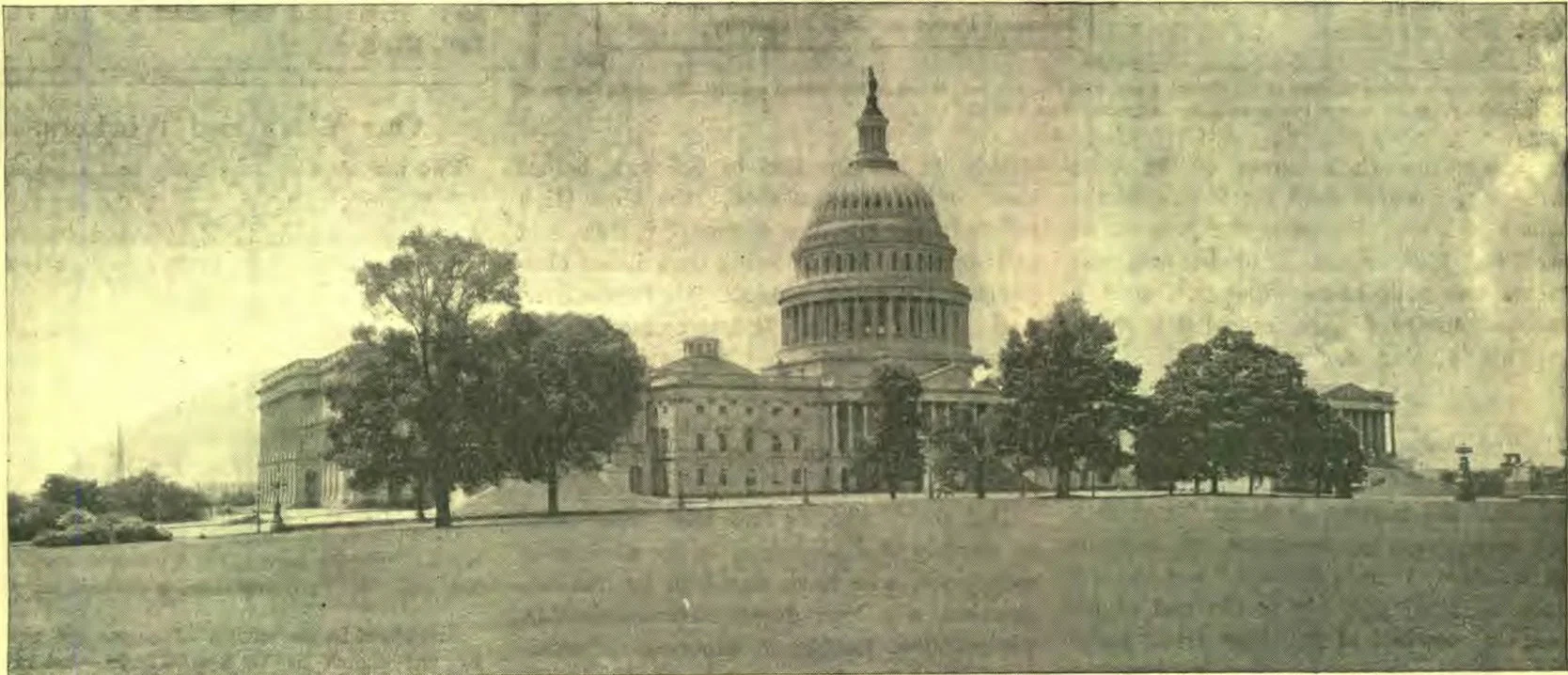
A Unique View of the Capitol, Washington, D. C.
Earnest lovers of liberty for all men are endeavoring to enlighten public opinion and bring before the law-making bodies the true issues involved and their meaning. As of old it is a struggle between principle and policy, between religious despotism and freedom. Earnestly we hope that our statesmen and representatives will dare to stand for equal liberty for all.
The Sabbath and the Law.
Among the staunchest advocates of civil and religious liberty in the United States have been the Baptists. In the early centuries in the history of our country the Baptist Church stood for the principles of liberty. The following paragraphs from The Word and Way reveal that there are those who still hold to the same truth:
"The Sabbath observance question is difficult to deal with as a law question. This is true both in framing and in enforcing the law. On what basis is the law to rest? Shall it be civil, social, moral, religious—what? It would be contrary to the genius of our government to make a law requiring people to observe the Sabbath for religious reasons. But apart from the fact that it is a law of God, why should people be prevented by law from laboring all the seven days of the week if they wish to?
"And then where shall the line be drawn? How is it to be decided what is or is not labor, according to the law, or absolutely? According to Christ, works of mercy and works of necessity may be performed on the Sabbath. But what are works of necessity, for instance? Once friction matches were a rarity and a luxury; now they are a necessity. Are the running of street-cars and passenger-trains on Sunday a necessity? Is it any more necessary for railroads to operate freight-trains on Sunday than it is for the grocer to operate his store or the farmer his plow?"
And it might be added, a necessity or not, has any class the right to regulate matters which relate wholly to God and His law? Is He unable to protect His own institution? Can man's laws make a day holy? H.
Noted Diplomat Killed
Noted Diplomat Killed.—In San Francisco on March 23 a Korean, fired with what he termed patriotism, shot Durham White Stevens, who died from his wounds a few days later. Mr. Stevens was an American and began his diplomatic life under an appointment by President Grant to the American Legation at Tokio. While connected with this legation he attracted the attention of the Japanese, and they employed him, first as counselor to their legation in Washington, and later in various capacities. He is said to have been one of the most trusted and influential diplomats in the Far East. When Japan occupied Korea, he was sent there, and the Koreans hailed his coming with joy, for they had confidence in him as an American. Some Korean agitators became possessed with the idea that he was working against them in the interest of Japan, and on his recent arrival in America the Koreans here took the matter up with the result that he is killed. Owing to the sharp friction between Japan and Korea the matter will be much discussed in certain legations concerned.
The Power of the Papacy in Rome.
The influence which the pope may exert either for or against the prosperity of the city of Rome is thus voiced by the Roman Catholic Western Watchman:
"Pius X has been long enough on the papal chair to have convinced the world that he is a man of resolution. The threat just audible within the precincts of the Vatican to countermand all celebrations and pilgrimages in contemplation next year has thrown the trades-people of the metropolis into consternation. Their bread and butter are involved, and what is patriotism weighed against them? Were it not for the tourists drawn to the Eternal City by the presence of the Holy Father, the grass would grow in the streets of Rome and wolves would run at large in the Villa Burghese."
The Active Menace of Socialism
Former Premier Rosebery recently made an address at a dinner given in London by the Liberal League on "The Active Menace of Socialism." Mr. Rosebery's speech may be summed up in the sentence, "Socialism would mean the end of the empire, religious faith, and freedom of property."
Japanese Steamer Collision
One Japanese steamer collided with another near Hakodate on March 23 and sank with a loss of life among passengers and crew of 287.
How Roman Catholics View It
How Roman Catholics View It.—It is thus that Catholics look upon Methodist union as voiced by the St. Louis Western Watchman:
"The three sects of Methodism in England have merged and the act of reunion was ratified the other day in John Wesley's historic chapel on City Road. This does not mean strength, but weakness. When Protestantism was strong, it was prolific in sects; when she is in her decrepitude, it finds the old home big enough to shelter her scattered children. When the volcano is active, its crater is ever widening; when it becomes extinct, its walls fall in."
Italy Strengthens Its Navy
Four new battle-ships of the Dreadnaught class have just been decided upon by Italy. They will be 19,000 tons each, and are all to be completed by 1911. And incidentally there is a good deal of speculation in connection with this strengthening of the Italian navy, and the further fact that there is an unprecedented number of war-ships of the various nations assembling in the Mediterranean waters.
Germany Launches Battleship Nassau
Germany recently launched her big battleship Nassau that is intended to be a match for England's Dreadnaught. The cost of construction, including her trial run, will total $9,190,000.
Our Work and Workers.
Two new churches have lately been organized in Greater New York.
A SABBATH-SCHOOL of eight members has been organized at Mena, Ark., by Brother H. Clay Griffin.
"Six more souls in the German department have lately taken their stand for the truth. Others are deeply interested."—G. P. Gaede, Cleveland, Ohio.
SISTER C. E. KNIGHT reports that nine have accepted present truth at Tacoma, Wash., some under very trying circumstances.
BROTHER E. H. HUNTLEY writes from Boosburg, Wash.: "Twelve have taken a stand to keep God's Sabbath. We have organized a Sabbath-school.
ADDITIONS to the number of sixteen are reported for the church at Walker, W. Va., by Brother W. R. Foggin, who has just closed a series of meetings.
ABOUT seventy of the students of Pacific Union College, at Healdsburg, Cal., have been baptized as the result of revival meetings conducted by Elder Luther Warren.
"A SABBATH-SCHOOL with a membership of twenty has been organized at Weiser, Idaho. Brother A. E. Baker is superintendent, with Miss Pearl Baker as secretary."—North Pacific Union Gleaner.
"At the close of a four weeks' meeting, five miles south of Seneca, Mo., four precious souls took their stand for the truth, and quite a number of others say they see the truth."—The Workers' Record.
The Jubilee Anthem
The "Jubilee Anthem."—This production which has just been published by the Pacific Press Pub. Co., of Mountain View, Cal., will be of particular interest to lovers of music. It is especially adapted for use by church choirs, for the nature of its music; and the theme makes it very appropriate for use on occasions when a church, conference, or institution feels jubilant over a debt fully paid, and for praise services.
Published in sheet form, and may be obtained for the price of twenty-five cents per copy by addressing the Western Washington Missionary Society, 309 Second Ave., North Seattle, Wash., or the author, Elder F. M. Burg, at the same address.