Your ShelfYour Projects

Review and Herald, Vol. 81, No. 40.

Faith and Action
Earlier text: Notes of Travel

The Romance of Light

(Concluded)
TOWARD the middle of the eighteenth century the number of lamps increased among the poorer classes, owing to the invention of colza-oil. The new liquid was far cheaper than the olive-oil used in France and Italy, or the whale-oil of England and America. Not till then began the processes of lamp regeneration. It was in 1783 that an enthusiastic and radical reformer, one Argand, discovered a lamp which consumed its own smoke, and most of the odor. By admitting oxygen to both sides of a flat flame, he increased the light so that a shade became necessary. The new lamp was at once popular in France and England. When improved by a convex reflector placed behind the flame, the light was rendered too dazzling for an ordinary room.
Fred and Phillipe Girard improved this lamp, placed the reservoir for oil below the wick, and softened the glare by the use of whitened glass, giving the first effect of beauty to artificial light. It is an interesting fact that the first appearance of the new lamp devised by the brothers Girard took place in London at a party given by the Duchess du Barry, then in exile. Josephine, hearing that it was enthusiastically admired, and jealous that it was not first seen at her soirees, ordered the brothers to bring a lamp at once to the palace. The significance of this circumstance is little beyond the fact that the lamp presented by the brothers to the empress was decorated by a young and obscure artist, struggling for bread, to be later known throughout the world as Jean Auguste Ingres.
On the arrival of the Pilgrims at Plymouth in 1621, they adopted the Indian's method for light, using the pine knots, furnished in abundance by the virgin forests. No doubt the pitchy drippings of these knots were a source of discomfort to the cleanly housewife, and the candle, when it came, was greatly prized. Cattle were not introduced into the colony until about eleven years after the arrival of the “Mayflower,” up to which time candles were unknown except when imported at rare intervals. Elliot translated the Bible by a spluttering, smoky torch. New England literature was spattered by the dripping flame, and clouded, perhaps, by the odorous smoke.
There is a long step between the torch of the fathers, still in use at the opening of the nineteenth century, and the electric search-light, of which it was the humble progenitor.
The forerunner of the street light was the basket torch, fastened to a building at a street corner, or later swung by a chain across the street. This basket filled with pitch-pine knots made the place quite light. Such a basket, but of enormous proportions, was swung from a crane at the top of a high place in Boston, and gave the name to Beacon Hill.
In the year 1666 candle making became quite common with the Pilgrim housewife. Tallow was not plenty, so the fat of the bear and deer was added to the tallow, increasing the light, but softening the candle, making it less durable. The method usually employed was dipping, with a few molded candles for “company.” To dip, a number of wicks were placed upon the sticks a sufficient distance apart, the wick suspended vertically. These wicks were dipped or carefully lowered into a pot of hot tallow on a cold day. Tallow would adhere and quickly cool. This, repeated until the proper size was reached, secured the “taller dip” of the “mothers.”
Not alone was the oil from the sperm whale used as an illuminant, but the fatty substance which gives the name to the fish was discovered to be most excellent for candles, being more costly, but of greater power. Inclosed in little square lanterns, “spermaceti” candles lighted the streets of Boston, were suspended over the front doors of the wealthy, and adorned the front halls of some elegant mansions. That which gave happiness to the young eyes of “Dorothy Q.,” the grandmother of the genial “Autocrat of the Breakfast Table,” is still in existence.
Not until about 1830 did our fathers have a match to carry in their pocket. Up to that time they must light their pipe with an ember or by the tinder-box. Should the fire of the hearth go out, he must revive it by steel and flint, or make a hurried trip to the neighbor's to secure his fire. At an early hour on a cold morning this was no pastime.
In the early days of the last century, Sir Walter Scott, writing from London, to a friend in Edinburgh, said: “There is a fool here who is trying to light the city with smoke.”
Sir Walter's “smoke” was not a human invention. It was a product of nature's laboratory. Accumulations of gas from coal-beds found their way to the surface, and being highly inflammable, attracted the attention of men who erected altars over them, and their perpetual fires were dedicated to the gods. After the defeat of the Persian armies at Platea, two victorious generals, Pausanius and Aristides, were directed by the oracle to build an altar to Jupiter, and to offer no sacrifice thereon until they had extinguished every altar fire in the country, polluted by the Persians, and had relighted them with the sacred fire from Delphi. It would be natural to expect men of science to imitate a process of nature which held such promise. For thousands of years the Chinese have speculated upon the meaning of the natural gas which has escaped abundantly from the earth in several provinces.
In 1726 Dr. Hales informed chemists that by distilling a few grains of coal, he had obtained an equal number of cubic inches of “inflammable air,” and that, if attempted on a large scale, millions upon millions of cubic feet of that valuable substance could be made, and conveyed unseen along the highways of the land, and become the means for obtaining perpetual day. In 1813 Sir Walter's “smoke” was burned on Westminster Bridge in London, and one year later the streets of St. Margarets, Westminster, enjoyed illumination from gas, it being the first parish contracting for such a luxury.
The common kerosene lamp, with its chimney of glass, its varied forms of beauty, its shades modified to every grade of vision and of taste, suggests the relation of man to light. The oil, natural, cheap, brilliant, and volatile, was long known to civilized humanity as a crude outflow from the earth. It was not until about 1845 that the iridescent scum seen floating on the surface of a stream near Pittsburg suggested to thoughtful men to dig for a greater supply. Indians came from a distance, and soaked it from the water with their blankets, which they wrung out into vessels in order to secure a quantity for some secret purpose. When the American found it, he was rich beyond computation, at the same time providing at a small cost the best fuel and the cheapest light for the common people. It was not until 1860 that it passed into common use. Since that time it has driven every form of wax, grease, fluid, camphene, and whale-oil lamps from the common use of mankind.
From the clouds overhead, lowering along the horizon as the sun goes down, Franklin and Edison have drawn the electric fire, and in our chambers darkness is unknown. All the way from the pine knot to a nightless day has been won from the darkness in the lifetime of one man, and he but just reaching the century point. This is the age of light.
—Fred Hovey Allen, in Scientific American.

The Old Man’s Comforts

“You are old, Father William,” the young man cried, “The few locks that are left you are gray; You are hale, Father William, a hearty old man; Now tell me the reason, I pray.”
“In the days of my youth,” Father William replied, “I remembered my youth would fly fast, And abused not my health and my vigor at first, That I never might need them at last.”
“You are old, Father William,” the young man cried, “And pleasures with youth pass away, And yet you lament not the days that are gone; Now tell me the reason, I pray.”
“In the days of my youth,” Father William replied, “I remembered that youth could not last; I thought of the future whatever I did, That I never might grieve for the past.”
“You are old, Father William,” the young man cried, “And life must be hastening away; You are cheerful, and love to converse upon death; Now tell me the reason, I pray.”
“I am cheerful, young man,” Father William replied, “Let the cause thy attention engage; In the days of my youth I remembered my God, And he hath not forgotten my age.”
—Robert Southey.

—E. L. Sabin, in Lippincott’s Magazine

Trouble-Proof

NEVER rains where Jim is,— People kickin’, whinin’,— He goes round insistin’, “Sun is almost shinin’!”
Never’s hot where Jim is; When the town is sweatin’, He jes’ sets and answers, “Well, I ain’t a-frettin’!”
Never’s cold where Jim is— None of us misdoubt it, Seein’ we’re nigh frozen! He “ain’t thought about it.”
Things that rile up others Never seem to strike him! “Trouble-proof,” I call it,— Wisht that I was like him!

—E. L. Sabin, in Lippincott’s Magazine

Some Things Animals Teach Us

THE woodpecker has a powerful little trip-hammer.
The jaws of the tortoise and turtle are natural scissors.
The framework of a ship resembles the skeleton of a herring.
The squirrel carries a chisel in his mouth, and the bee the carpenter’s plane.
The gnat fashions its eggs in the shape of a life-boat. You can not sink them without tearing them to pieces.
A porcupine’s bill is strengthened by ribs in the same way that the iron masts of modern ships are strengthened.
The divingbell imitates the water spider. It constructs a small cell under the water, clasps a bubble of air between its legs, dives down into its submarine chamber with the bubble, displacing the water gradually, until its abode contains a large, airy room surrounded by water. — Kind Words.

Nothing Worth Being Angry Over

A WRITER says: A dear lady of my acquaintance confided to me an excellent piece of advice when I asked, “Now, tell me, how do you manage to keep so unruffled a temper?”
“Ah,” she replied, “there are very few things in this world worth being angry about; so when I feel annoyance rising within me, I ask myself, quite judicially: ‘Is this worth being angry over?’ and in nine hundred and ninety cases out of a thousand my common sense answers, ‘O, no.’”
If you want your husband to love you to his life's end, if you want him to turn to you as his best friend, if you want to keep him your devoted lover, if you want to make him a thoroughly happy man, be amiable, even if it is rather an effort and does not come to you by nature.—Selected.

Travel in Honan — Notes by the Way

A. C. SELMON AND H. W. MILLER
DURING the three weeks of which we write, we had opportunity to make use of all methods of travel in China, including donkey cart, wheelbarrow, sedan-chair, railroad, donkey, jinrikisha, river raft, and house-boat.
THE FIRST RAILROAD IN CENTRAL CHINA
Accompanied by two of our Chinese boys, we left our station—Sin Tsai Hsien—Wednesday evening, June 1. We traveled the entire night, the next day, and the following night in a two-wheeled donkey cart, reaching the railway station only a few minutes before the train arrived.
The illustration of the railroad station is a typical picture of all the depots on this line. The officials will not permit the railroad to come within one-half mile of the city wall. The reason for so doing is founded on the superstition that spirits travel in certain currents in the earth. These currents are located by “wind and water.” Doctors are called upon for advice in locating temples, pagodas, etc. They claim that if a tomb is so placed that the spirit dwelling there is comfortable, the deceased spirit will grant those who supply its wants all that the spirit world possesses.
By the side of the railway is a pagoda, which was erected to help the spirits of the dead ancestors to reach heaven easily. Most pagodas are higher than this one, being five, six, or seven stories.
Seated in the same car with us was a mandarin and his family and servants. He was transferred from this province to a city in Hu-nan. The old mandarin sat in one corner of the flat car, occupying the time in going to sleep, falling forward, and catching himself, or sometimes the servant would catch him, to prevent his getting hurt. His complexion was livid, and both his mental faculties and his physical form convinced us that they were rapidly degenerating from his almost constant use of opium. This is no unusual description of the officials in China. Most of them serve only as subjects to demand respect, and act as monuments to whom the people must pay taxes, the large portion of which they are required to hand over to higher officials to whom they are indebted for their office.
All along the way we saw the farmers harvesting the wheat and planting rice, thus raising two crops in one year. Although the fields were small, from one fourth of an acre to one acre, still the number of people busy gathering the wheat reminded one of thrashing or log rolling in the States. Men, women, and children were all actively harvesting the grain.
Each had his proper position, just as the cog-wheels and needle of a binder. One man would swing a bamboo cradle, throwing the grain on a large net stretched across the top of a wheelbarrow. The man pushing the wheelbarrow would keep it in the proper position to catch the grain, just as the sheaf carrier on a self-binder.
Following the cradle and wheelbarrow were the women and children, some having small sickle knives to cut the stray straws left by the cradle. Others followed with hand rakes, thus clearing the ground so completely that there was not a straw left to tell which way the wind blew. When the barrow was loaded, it was conveyed to the thrashing-floor. This is a level plot of land, about one hundred feet square, on which the grain was spread out and thrashed by wooden flails, and a stone roller, drawn by two donkeys, or by a donkey and a cow. This roller is two feet in diameter, and two and one-half feet long. Behind it is drawn a flat stone of about one hundred and fifty pounds. The Chinese children take great delight in riding on this flat stone behind the roller.
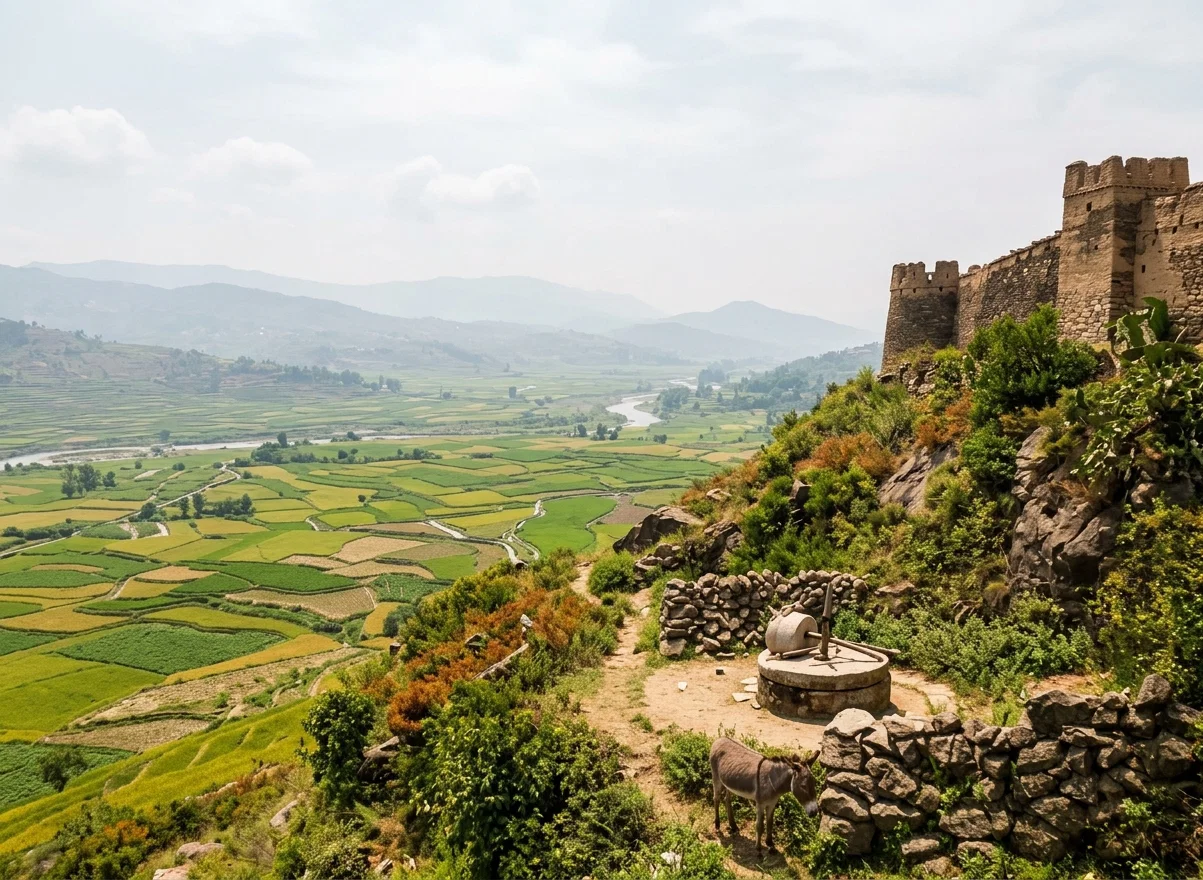
The straw is nicely stacked, and is used for fuel for cooking. The wheat is cleaned by fans or the wind, and ground into flour by the family mill. The accompanying picture illustrates this mill, so that very little explanation is necessary. It is composed of two circular stones, the lower with a flat top, and the upper with a flat bottom. These two plain surfaces are revolved upon each other, having the grain between. Either a man or a donkey turns the stone. The flour is not quite so good as that in the States, but by mixing the Chinese flour with foreign flour, light bread can be made.
No sooner is the wheat harvested than the plots of ground are inundated with water three inches deep, preparatory to breaking the land for rice. In the sections of country where the land is rolling, the water is obtained from a pond situated at the highest point, so the water can be easily drawn off on the plots of land beneath.
CHINESE FLOUR MILL
Plots of land in the valley are rice fields
CHINESE FLOUR MILL Plots of land in the valley are rice fields
In level districts the water is collected in reservoirs. The Chinese have used their ingenuity in devising plans to raise this water. One method is to attach a rope at each side of a pail, and two men standingon the bank revolve the pail in such a way that when it comes down, it fills, and when drawn up, it empties the water on the field. At some places the water is so low that they are unable to raise it by this method, so they have a deep trough, about eight inches in width, inside of which at each end is a wheel upon which a chain of wooden paddles is carried, and the water is raised in the same way that grain is raised in the elevators in the States. The top wheel is revolved by a pole, which has wooden paddles fastened to it similar to the levers of a windlass in the States. Four or five Chinamen sit on a pole and strike these paddles with their feet, thus turning the wheel. This they seem to consider play, and take great delight in it. It is much easier than swinging the pail. The land is broken and cultivated under water. The rice plants are first grown in a bed, and then reset. The rice requires about four months to mature. Wheat and rice are the staple products in this part of China.
(To be concluded)

Mission Notes

A new Sabbath-keeper is reported by Brother J. A. Morrow, of Bermuda.
Elder R. W. Munson writes from Padang, Sumatra: “After a year of teaching, seven Chinamen have asked for baptism, and ere long I shall bury them in baptism with Christ. The outlook is encouraging, and the work is onward in this part of the field.”
China contains about one quarter of the total population of the world, people with souls for whom Jesus died. Should the 2,785 missionaries be equally divided over the vast empire, every two would have a district of 1,315 square miles, with 291,447 heathen! Can you realize what that would mean? In this land we have a minister to every few hundred population, with evangelists and Christian workers on every side.

French-Swiss Conference

I. P. TIECHE
We are on the shores of the beautiful Lake Geneva, in the city of Vevey, attending the annual meeting of the French-Swiss Conference. This is a manufacturing city, noted for its chocolate and condensed Swiss milk. It was here that the dissenters from the established church were persecuted in 1845. The city is only a short distance from the famous castle of Chillon. We have been holding a series of tent-meetings here, and the camp-meeting is the termination of this. As a result of our work, a new church of seventeen members has been organized here, and was received into the conference sisterhood of churches at this meeting.
We had an attendance of about two hundred and twenty-five of our own people, and from two hundred and fifty to three hundred not of our faith. Thirty-three delegates were present, representing the churches in Bienne, Chaux-de-Fonds, Geneva, Lausanne, Moudon, Neuchatel, Renan, Tramelan, Yverdon and St. Imier, while the churches in Perles and Val de Travers were not represented.
As to the growth of our field, during 1903 twenty-six persons were baptized, but since Jan. 1, 1904, we have added fifty-one, including the nine who were baptized at this meeting. We have employed one new Bible worker, but have given one young laborer, one experienced licentiate, and one ordained minister to the French Mission.
Our tithe for the year was 17,353.70 frs., while the Sabbath-school donations were 1922.78 frs.; First-day offerings, 164.41 frs.; and annual offerings, 1400.05 frs.; and 846.13 frs. was donated to the local conference work. This tithe is about 6,000 frs. less than that of last year; and on account of this, the following resolution was brought into the conference, and carried unanimously:—
“Whereas, The income of our field this year shows a decrease of 6,000 francs when compared with the income of the previous year, therefore,—
“Resolved, That, with the help of the Lord, we will be more faithful in tithes and offerings.”
The canvassing work in our field is in a weak condition, and ought to be materially strengthened by the printing of new books, suitable for circulation among the people. This resolution, with its preamble, was passed:—
“Whereas, The territory of the French-Swiss Conference has been several times canvassed for the same works, therefore,—
“Resolved, That we urge the publication of a few new books of moderate size, to be sold for a price within reach of the common people.”
The matter of establishing local church poor funds was discussed at length, and it was felt that it would be wise to accept of the proposition of the French-Latin Union Committee that every church establish such a fund, and that a tithe of the money received in this fund be forwarded to the conference headquarters, as a conference poor fund, which could be available for the relief of such cases of poverty as the local church could not take proper care of.
On the ground there were forty tents pitched. Everything was neatly arranged, and, in general, the impression made upon the visitors to the ground seemed to be good. There were no cases of lawlessness or disturbance. The services on Sabbath were especially good and interesting. The forenoon meeting closed with an invitation for those who felt the need of starting to serve the Master, or who felt that their religious life was not what they could make it, and what they ought to make it, to come forward, and join the ministering brethren in seeking that peace of mind which comes from a realization of sins forgiven and iniquities cleansed. About seventy-five came forward, and took part in this service.
The outlook for the work the coming year is brighter than ever before. We are of good courage. We feel desirous of training yet more workers, and pushing the battle to the very gates. Remember us, brethren, in your sympathies and prayers. After a session of seven days, the meeting has just closed.
Vevey, Switzerland.

Missionary Progress in China

At the time of the Boxers’ uprising in China (1900), it looked as though missions would receive a severe setback; but by the end of 1902 there were twenty-five new stations started, mostly in the provinces of Honan, Hunan, Shan-si, and Sze-chuan, and about 373 new missionaries have entered the field since the persecutions ceased. Great Britain, the United States, and Continental Europe now have working in China 1,233 men, 868 wives, and 849 single women, or a total of 2,950.—Selected.

One Man Ready to Die for India

WHEN Dr. Duff, the great Scotch missionary, came home after his life-work in India, at a crowded meeting held in Edinburgh he spoke two hours and a half. Then he fainted, and was carried out of the hall. Presently he came to, and said, “Take me back; I must finish my speech.” “You will kill yourself if you do,” said his friends. “I shall die if I don’t,” exclaimed the old man. They took him back. The whole meeting rose, many in tears. His strength failed, and he could not rise; but, gathering himself up for one final effort, he said, “Fathers of Scotland, have you any more sons for India? I have spent my life there, and my life is gone; but if there are no more young men to go, I will go back myself, and lay my bones there, that the people may know there is one man in Christian Britain ready to die for India.”—Exchange.

A Mission in Barotseland

It is in Barotseland, north of the Zambesi, that our latest mission station in Africa has been chosen. We have received the grant of land, but as yet workers have not been selected to man it. In view of the fact that we are to have a mission there, the following will be read with interest: “The Barotse countries on the upper waters of the Zambesi will doubtless soon be settled by many Europeans. Reports come of a steamer having been launched above the Victoria Falls, and Europeans are coming in search of mineral wealth. The railroad is in process of construction from Bulawayo to a point near the Victoria Falls, and it has been said that the British South African Company has invited the British Association to meet at Victoria Falls in 1905. It is not quite clear whether this invitation is given seriously, but it certainly will not be an impossibility for a meeting of European savans in this section of Africa, two years hence.”

W. C. BARLOW

India

SANTAL MISSION SCHOOL, SIMULTALA, BENGAL.—We are delighted week by week with the encouraging reports which we read in the REVIEW AND HERALD, from different parts of the world. We can see that God's blessing is accompanying the message with power and success. May we all continue to watch, pray, and do our very best to sound forth the message of a soon-coming Saviour, and to warn the world against the mark of the beast, while we have health and strength.
Since writing last to the REVIEW, God has been blessing the work among the Santal students here. Some time ago Brother Shaw paid us a visit, and baptized two of the students and a young woman, the wife of one of them.
Elder Shaw also dedicated a small church and schoolhouse, which was erected by the students. It is built of mud walls and grass roof, in the Indian style. During the first part of the day, the students study in Hindi, Santali, etc., and the latter part of the day they work in the fruit and flower garden. They also do a good share of the work of planting trees on the roadside, aided by the district board. We have set out several hundred fruit-trees already this rainy season, as well as a large number of papia trees in our own mission compound. We are very busy with this work at present. One day the students go to the jungles for thorns for fencing the trees. Another day they go out to transplant. And by way of change, they help in digging another well to supply water for the papia garden during the hot season. So you see they are fully engaged in some kind of practical work with the soil, as well as with their studies.
We have almost finished building a small village church and schoolhouse about ten miles to the northeast of Simultala. We hope to camp there this cold season with our training-school students, for a few months, and encourage other Santals to come and hear the gospel message · given by testimony and song.
Last month we treated twenty-five sick people. Cholera has lately broken out around us, and we give medicine to as many as will take it.

W. C. BARLOW

E. W. THOMANN

Chile

VALPARAISO.—I have now been in Chile a little over a month, again. The work goes on. We are all of good courage. Though we are so few for so great a field, yet we hope that the Lord will soon raise up new workers and send them to us to help give the truth to a country unprepared for the coming of the Saviour.
We had rented a house for office and printing room. But the Lord helped us to find another better situated, cheaper, and more suited to our needs. One of the six rooms is large enough to hold meetings in. The new location is near the center of the city.
We hope that a good work can be accomplished here at Valparaiso. Satan is striving very strongly against us. This gives us courage, because we know that he would not work so against us if he were not fearful of losing some of those he counts as his. We are confident that with Christ on our side we shall gain a victory to the glory of God and for the good of many souls.
I have worked some with our Spanish missionary paper, Señales de los Tiempos (Signs of the Times), and have already taken eighty subscriptions in one street, and have strong hope that I may make the full one hundred before I finish on that street.
How I long for more workers! Brethren, where are they who love the Lord? Let them go to work. Not every one need be a preacher. We could use to good advantage one hundred, yes, a thousand, colporteurs, paper agents, Bible workers, etc. If I could, I would be glad to tell every brother and sister in the States that the harvest is waiting for laborers. Go out to reap. Jesus calls for you all.

E. W. THOMANN

A. C. SELMON, M. D

China

SIN TSAI HSIEN.—The hot season is here, and it is hotter than we had expected. We are on the great plain, where the country is very flat, with few trees.
Brother Pilquist has removed to a city about sixty miles to the southwest of us. When he left, Mrs. Selmon and I moved up into the compound with Dr. and Mrs. Miller and the two nurses. We had to clean up our Chinese quarters quite a little to make them respectable, and also had to make some changes. Our courtyard is very small. The one Mrs. Selmon and I have is about forty feet long and sixteen feet wide, and surrounded on all sides but one by houses from twenty to twenty-five feet high, and on the side where there are no houses there is a wall twelve feet high. So we are shut up in a sort of pen, where but little air can get to us. We have all the available space in the yard, that is not taken up by walks, planted out in flowers and vegetables. This helps matters a little. It is very difficult for us to do any studying or any mental or physical work. If we could have secured a place outside the city, where we could have a large, airy courtyard and some trees, it would not seem nearly so hot. At present all are in good health. We continually ask the Lord to keep us in health amid these unfavorable surroundings. In our present circumstances we are led to see more clearly than ever before our dependence on the Lord.
With our limited capacity for speaking the language, and our lack of experience, we are finding constant occasion to thank the Lord for help. At present we have just completed arrangements to rent another small compound near us, where we can have our native evangelist. We shall have a street chapel, and conduct meetings every day. Adjoining the chapel is a room for our dispensary, and back of this are rooms for the evangelist and his family. The whole compound will cost us twenty-four strings of cash—about $14.50 gold—per year. We shall have to clean it out and repair it a little.
The Lord is surely helping us greatly in the study of the language. Dr. Miller and myself are now able to hold Bible studies with our little company; and while we can not give a connected discourse, yet we can explain the truths, and give illustrations and make applications.
We are glad to hear of the progress of the work in the States. Pray thatwe may have some earnest, consecrated converts from among the people here, who can do evangelistic and Bible work. Also pray that the Lord will lay the burden for this work on some of the young men in the States. We need Bible workers who can be here now learning the language.

A. C. SELMON, M. D

Oregon

FALLS CITY.—Elders R. D. Benham and J. M. Cole have labored here the past summer; and, as a result, four accepted the truth and three were baptized. A lot was donated for a church building, which will be erected soon. There are eleven adult Sabbath-keepers here. A rich field for labor has been opened up, and we expect to see many others accept the truth. We have a good Sabbath-school.
Wm. Estell.

Elgin Church Quarterly Meeting

Illinois

ELGIN.—Last Sabbath was a good day for the Elgin church. Quarterly meeting was held in the forenoon, and in the afternoon four were baptized, and five were added to the church, one having been baptized a short time ago. For two years I have been pastor of this church, and our relations have been most pleasant. I expect to go to Dixon next week, to build up a work in that city. A Bible worker will remain here to follow up the interest; in this, she will be assisted by the elder of the church. We are sure that the Lord will bless their work, and that others will accept the truth, and be added to this dear church. L. D. SANTEE.

South Carolina

BOYKIN.—I have been holding meetings in a schoolhouse in a country district for nearly two weeks, and am seeing some interest, but as yet no one has accepted the truth; but there is some prospect of accomplishing something here. This is one of the most conservative States, and it is hard to get the people to break off from their old habits and thoughts. But the truth has power in it, and we are witnessing that power here. We have invitations to visit the leading families, and hope to see the work established, but it will take time. We are of good courage, and have better health than for some years.
We constantly pray for the Lord to bless the work and the workers at the capital. We hope to have a small donation soon for the work there; a part of it is in hand now. E. W. WEBSTER.

W. A. SWEANY

Trinidad

ARIMA.—“Sects” and “missions” are lightly regarded by the established churches and by the higher class in these colonies and countries. During our two and one-half years’ stay there, we were enabled, by the help of God, in various ways—chiefly by the Watchman, canvassing work, the health food work, and personal Bible and cottage meeting work, and our public Sunday evening services—to begin to reach the hitherto untouched upper classes. Our last conference was a climax, a revelation, and convinced the people that we are not to be numbered with the fanatical sects. Lawyers, judges, legislators, merchants, attended, and were amazed at what they saw and heard. Of course, the clergy and others who did not attend attacked us in print and otherwise. To this we paid no attention, but prominent men, including a member of the legislature, himself an Anglican, defended us in the daily papers. The fundamental truths of the message were presented by the conference laborers, in the power of the Holy Ghost sent down from heaven. Most marked attention and deep interest were shown by all. Conviction laid hold of practically all, and some began to obey the message; many others are in the valley of decision.
It was my happy privilege to baptize ten persons. Six of these were white people, of the better class, and the others were of the corresponding class of colored people. Of course the common people, who heard the Master gladly, are just as dear to him, and to us, as the so-called “higher” class. About as many more made a start, and will be baptized as soon as fully instructed. Most of these are the fruit of our daily effort there during the last two and one-half years, chiefly the personal work of Mrs. Sweany and Mrs. Honeywell.
The interest in Barbados is such that our entire conference force could busy themselves there, in the most interesting and fruitful work. But of course the needs of the rest of the field will not permit this. Brother Enoch is there, and his burdens are great, as he is editor of the Watchman, and secretary and treasurer of the conference and depository, and has hundreds of interested souls in the great city of Bridgetown to look after. Brother Haysmer and family will locate in the next largest place in Barbados, to look after the country work.
February 26 I pitched the tent here in Arima, a new field and Catholic stronghold. From the beginning till the end of the meetings, the attendance was extraordinary, as many as five hundred being present at most of the services. Book sales and collections were remarkably good. The tent-meetings lasted about ten weeks. My wife assisted in the services, and in personal work, canvassing, etc. A native boy slept at the tent, and cared for it. I preached every evening except Saturday. Sabbath morning I started by the early train, or by wheel, for some one of the churches, and spend the entire day, and sometimes the night, and Sunday, in trying to help our brethren and sisters, returning just in time for the Sunday evening service. This continued until we went to conference. However, before going, we rented and fitted up a small hall, which will seat about one hundred and fifty, and held several services, with a large attendance. About twelve began to obey, and many more are convinced and interested. Sabbath services were held during our absence by one of our native brethren, who is not a conference laborer.
The work here is important. I believe by God’s help a church can be organized, and a building erected.

W. A. SWEANY

Continue reading: Kansas Camp-Meeting