Your ShelfYour Projects

Signs of the Times, Vol. 37, No. 5.

An Inspired Exhortation to the CHRISTIAN MINISTRY

Signs of the Times

Feb 1, 1910

Pacific Press Publishing Association · Mountain View, California · Feb 1, 1910

An Inspired Exhortation to the CHRISTIAN MINISTRY

In everything commending ourselves, As ministers of God, In much patience, in afflictions, In necessities, in distresses, in stripes, In imprisonments, in tumults, in labors, In watchings, in fastings; In pureness, in knowledge, In long-suffering, in kindness, In the Holy Spirit, in love unfeigned, In the word of truth, in the power of God; By the armor of righteousness On the right hand and on the left, By glory and dishonor, By evil report and good report; As deceivers, and yet true; As unknown, and yet well known; As dying, and behold, we live; As chastened, and not killed; As sorrowful, yet always rejoicing; As poor, yet making many rich; As having nothing, And yet possessing all things.

Question Corner

Please Be Definite.— For instance, a question comes to us asking us to be so kind as to explain the meaning of the latter part of “the 28th verse of Hebrews.” But the question is not definite enough so that we may know what chapter is referred to. There are five chapters in Hebrews which have 28 verses or more: chapter 7, chapter 9, chapter 10, chapter 11, chapter 12. If our correspondent will tell us what chapter is referred to we will be glad to answer the question if we can.

3019.—A Continuous Ministry

How can one now baptize to any benefit? or how can divine authority be claimed, or does any one claim it, in baptism? In the time of Christ He gave His apostles the authority and power to heal the sick, and authority to pass it on to the assistants and converts; but now the line has been cut off so that no one knows. C. Q. S.
There is no question among the best of scholars but that the ministry in God’s church has been continuous all the way through. The Lord made provision for this in His instruction to the apostle Paul and the others. “The things that thou hast heard of me among many witnesses, the same commit thou to faithful men, who shall be able to teach others also.” 2 Tim. 2:2. The real power, however, does not rest in “apostolic succession,” in the mere laying on of hands of some persons authorized or who think they are authorized. It rests in the very message of God itself, and the evidence in that message, and the fruits which it bears. Character weighs more with God than does ritualism. In all the various Protestant denominations the ministry is traced back through other ministers, and through other denominations from which they sprang, till, if records could have been kept, it could easily have been traced back to the time of Christ; and yet Protestants have done rightly in not basing the Gospel ministry upon mere continuity of priests or ministers, but upon the call from God and the witness of His Spirit; and God has demonstrated the authority of His servants to preach the Word down to these very days in which we live, by fulfilling His promises in connection with the preaching of the Word.
Our Lord gave faithful warning when His disciples came back and said, “Master, we saw one casting out devils in Thy name; and we forbade him, because he followeth not with us.” This, Jesus told them, they should not do, for every one that was not against Him was for Him. Then, too, it would be a denial of the Lord’s commission to His children to say that His ministers do not have authority to teach now. It was He Himself who said, “Go ye therefore, and teach all nations, baptizing them in the name of the Father, and of the Son, and of the Holy Ghost: teaching them to observe all things whatsoever I have commanded you; and, lo, I am with you alway, even unto the end of the world.” Matt. 28:19, 20. Certainly God’s Word has been fulfilled.

3020.—The Seventh-Day Sabbath

(1) A writer in your paper deals with the change of the Sabbath, says the seventh day was kept by our Lord during His sojourn upon earth, and by His apostles after His crucifixion, and goes on to say that this proves the eternal and unchangeable claims of the seventh day. I claim that it proves nothing of the kind. Christian Jews of Jerusalem observed the rite of circumcision, attended the temple service long after our Lord’s ascension; they kept the seventh day and the first day of the week as well; but after A.D. 70 the seventh-day Sabbath was discontinued by them. (2) Does the editor of the SIGNS recognize Cardinal Gibbons as an authority in matters of faith? The writer in question quotes him with approval. W. B.
The things above referred to by our correspondent are only a few of the many confirmatory proofs brought forward in behalf of the seventh day. The author of the series of Sabbath articles proved conclusively from God’s law, and Christ’s relation to that law, and His testimony concerning it, that the seventh-day Sabbath is eternal. Christ’s example was confirmatory of His words; and it is the apostle John who says, “He that saith he abideth in Him [Christ] ought himself also so to walk, even as He [Christ] walked.” And Christ kept the Sabbath as one of the ten moral commandments of God. The early Christians also kept it, and continued to keep it down as late as the fourth century after Christ. In fact in the fifth century the two days were kept as sister days. Sunday was never kept in the early church of the first three centuries as a Sabbath. It was not until 1,200 years after Christ that it was ever called the Sabbath.
2. Cardinal Gibbons was cited simply as testimony to the prophecy. The prophecy made certain accusations concerning a certain power which would do a certain work. That was one side of the evidence, God’s Word; and Cardinal Gibbons and others as representatives of that power, come forward and say that they did the very work that the prophecy declared they would do. Certainly when you have a reliable witness concerning a crime, and then the criminal comes forward and confesses to the crime, his evidence is worthy of citing; and that is what we have in the testimony of Roman Catholics concerning the change of the Sabbath. Any amount of Protestant evidence could be given to the same effect.

3021.—Representation of Angels

Some time ago you recorded the criticism of a Catholic priest upon some church decorations because the angels were represented as women. While the Bible always speaks of them in the masculine gender, why then do not the illustrations in our papers correspond? Of course it is only a minor point, but it seems to me not too insignificant. M. A. P.
We have to use just what illustrations we can get; and as our querist says, some of these minor points we must pass over. Presumably no artist has ever seen an angel, or was divinely inspired to make representations of one, save those who wove the marvelous curtains of the ancient tabernacle. But these were never copied. Certain it is that when some of the angels appeared to the servants of God, as to John and Daniel, they appeared as strong and mighty beings. So they ought to be represented. In some of our later illustrations, where we have had connection with the artist and he was capable of making figures without copying, we have endeavored to correct this; but if we use copies of old paintings, this can not be done. The ideal of a picture of an angel ought to give it all the strength and dignity and power of the noblest manhood combined with all the gentleness and sweetness of woman. Very few artists meet this ideal.

3022.—Not from Man, but God

How would you explain to one who does not understand, Rom. 14:1-3, also verses 5 and 6? INQUIRER.
If we are asked questions regarding the meaning of Romans 14, we would say as we have often said in the past that the one great object, the great central thought, of that whole chapter is that man is responsible to God and not to man; in other words, that man should not judge his fellow Christian. That is the one thing that is presented over and over again. Paul is talking to Christians, to those in the faith. He is not drawing distinctions between those who believe and those who do not believe, but he is talking of Christ’s followers. Some of those were weak in the faith, some of them strong; and some of them believed that they ought to continue on in the old customs of the Jews, in the eating of the Passovers; not only the Passover lamb, but the bitter herbs that were connected with it. Some of them observed the Passover day and other annual sabbaths. Others who saw that in the light of Christ those types had passed away, were inclined to criticize the observers of these days, and condemn them, and perhaps vice versa. The apostle gives instruction to meet all these cases: One Christian should not judge another. “Who art thou that judgest another man’s servant? to his own master he standeth or falleth. Yea, he shall be holden up [despite anything you can say or do]; for God is able to make him stand.” And then the climax of it all, “But why dost thou judge thy brother? or why dost thou set at naught thy brother? for we shall all stand before the judgment-seat of Christ.” “So then every one of us shall give account of himself to God. Let us not therefore judge one another any more: but judge this rather, that no man put a stumbling-block or an occasion to fall in his brother’s way.” That is the meaning of the chapter, and that is the lesson that every Christian ought to get from it.

3023.—Tithing Presents

Are we required to pay tithe on Christmas and birthday presents, etc.? Are they counted as increase? I am a music teacher and get fifty cents a lesson. If I take the car to my pupil and back, should I pay tithe on the fifty cents, or should I take out my car fare and tithe the forty cents? E. J.
If our presents are substantial presents of real worth to us in maintaining existence, should they not be considered among the legitimate increase? If they are not such as we would have purchased or such as we particularly need, I do not think that the Lord calls us to tithe what other people’s mistakes or generosity is responsible for.
Regarding the second question, the amount to be tithed would be forty cents rather than fifty cents. That is legitimate expense which occurs in obtaining the income.

3024.—“First Day” in the Greek

Can the words “first day of the week” be found in the New Testament in the Greek language? I notice in our Common Version, according to the King James translation, the words “first of the week” occur in the New Testament seven times, and the word “day” does not occur, only in the italics, which I understand to be supplied by the translators. W. H.
The word “day” is not in the Greek language; but the adjective “first” demands the supplying of a noun, and that agrees with “day” understood. See the tract, “Sabbath in the Greek,” “Bible Student’s Library,” No. 154, price one cent. This explains the matter fully, giving the Greek terms and their proper translations, with the rules for their agreement.

3025.—The Two Witnesses

Please explain Rev. 11:3-14. A. E. H.
For explanation of this Scripture see “The Great Controversy,” chapter 15, entitled “The Bible and the French Revolution.” The SIGNS will have to leave that prophecy until the study of the book of Revelation is taken up—a few months hence.

3026.—J. S. D.—Rev. 14:1-5.

The change that will take place in the 144,000, in all who are translated when the Lord shall come, will be from mortality to immortality. It is utterly impossible for any one who is mortal to understand what that will mean. We can grasp it by faith. We may apprehend, or lay hold upon it through God’s Word; but we can not comprehend it or understand it. We know this, that the changed ones will not be mortal flesh and blood, not corruptible, sinful men. In the words of our Common Version, “Who shall change our vile body, that it may be fashioned like unto His glorious body” (Phil. 3:21); or like the Revised Version, which is nearer the original, “Who shall fashion anew the body of our humiliation, that it may be conformed to the body of His glory.” Then shall this mortal put on immortality, and this corruptible shall put on incorruption. See 1 Cor. 15:50-54. Flesh and blood of the mortal is dying, decaying. The body of the redeemed will be a spiritual body, stripped of many limitations which mortals know. Further than this, we do not know.

The Downward Trend

An Appeal
EDITOR SIGNS OF THE TIMES: Suffer a soldier in the army of Christ to appeal to his Christian brethren in the Protestant churches:
My brethren, I desire to bring home to your mind and heart certain facts and questions which to me seem worthy of careful, serious consideration.
The Son of God, the anointed One, the Word, who, according to the Scriptures, “was made flesh,” who suffered and “died for our sin,” who rose from the dead, who “showed Himself alive after His passion by many infallible proofs”—is it all a myth?
We are at least professed believers in the Gospel of God through Jesus Christ. We have seen its mighty regenerating effect upon those who believe it to be “the power of God unto salvation.” We have not seen that change of regeneration and reformation evolved in the soul through a long process of years, but wrought by the creative power of the Holy Spirit through the Word.
We have seen the magical and tremendous indirect effect of this Gospel upon all the nations of the earth, so that wherever the Book has gone and has been received, blessings have followed, civilization has advanced, refinement has manifested itself, social relationships have been lifted to a higher plane, and education in all its various departments has progressed, and various beneficences have multiplied.
We know that all this has come about by the simple preaching of the Gospel of Jesus Christ.
Do we not also appreciate its call to union, to the one Lord, the one faith, the one baptism, the one God and Father of all?
Can we not see the deplorable effects of a departure from that Gospel, and the divisions which have followed that departure?
Do we not see the departure from that pure Gospel in the early ages of the Christian era? How pagan philosophy, and worldly customs, came in and perverted the Gospel, and disunion and confusion followed,—a disunion and confusion which God denominated Babylon!
Do we not see that the great strides made in the time of the Reformation came because the Reformers returned to the simple preaching of the Word of God? They did not understand it all; they did not see all that God had for His church, but what they did see they preached, and the simple doctrine of justification by faith changed the face of the world. Was the Reformation a mistake?
Have we not also read with sad hearts of the disunion which followed? That movement which gave promise of being a united movement, which would cement together the Christians of the world, became divided, and out of that, as in the early church, confusion came—a second Babylon, not named of God because wholly apostate, but because of the confusion consequent upon division; the confusion caused by men leaving the Word, building up human creeds, and determining that souls should adhere to circumscribed beliefs, bounded by the limitations of the human.
Yet notwithstanding this, God’s children were and are scattered among these divided branches; for every creed formed, professedly placed as its very basis, the Bible and the Bible only.
But can we not see the departure from that standard?
Do we not now see the present drift away from the Book? The inspiration of the Bible is openly denied; its miracles are flouted, its story of creation is set aside; the virgin birth of our Lord, the miracles which He wrought, and His resurrection from the dead, are considered myths, fables, traditions.
Do we not see that as faith in the Word was lost in the beginning of the Christian era, so the church which turned from the Word, which combined tradition and heathen philosophy with that Word, turned to the state to enforce their human dogmas? and that just as the church did then, so is she passing over the same by-paths now?
As she is losing faith in God, she is demanding the power of the state to do the work which the church has not power to do; and that power to be exercised in enforcing dogmas that are entirely unscriptural.
Now, if the Bible is true, if it is what it professes to be, if it is what the church has held it to be—the complete norm of faith and duty—if it has been given by a God who sees the end from the beginning, can we not see that He certainly must have anticipated this drift, this apostasy away from His Word? and that He would have pointed it out, and thus have warned His children?
Divine foresight anticipated the Jewish apostasy, and from the time of Moses to Malachi predicted that apostasy clearly, defined its various features, and also presented the true remedy.
Divine foresight through prophet and apostle pointed out the apostasy in the early church, and also gave the remedy. Can we not believe, nay, ought we not to expect, ought we not to be assured, that the same Word would point out the present-day apostasy? that it would show clearly just how the church would depart from the Word and “heap to itself teachers, having itching ears”?
Did not the very Master Himself ask the question which can be answered only in one way, “When the Son of Man cometh, shall He find faith on the earth?”
Has He not by message after message, by Old Testament prophet, by New Testament apostle and prophet, and by His own words, pointed out the last-day apostasy, in which, “because iniquity shall abound, the love of the many shall wax cold”? Does He not say that all the various sins manifest in the heathendom of the early centuries will be found in Christendom in the last days?
We know that there are many in thevarious churches of the land who see this, whose hearts bleed not only because of the divisions in Zion, but on account of the apostasies in the great Christian churches whom God has used so wonderfully in the past.
Where shall the remedy be found to heal the divisions, to save the souls who are being led by the blind into the ditches of doubt and destruction?
Shall we look to science for the healing balm? — Science built on human hypotheses and uncertain conclusions, denies the Word of God; nor does it recognize the disease.
Shall we look to long ages of evolution for the regeneration of the race? — That is absolute denial of the creative power of God which He would exercise through the Gospel in behalf of humanity.
Shall we look to the tradition of the great Roman Catholic Church for hope in this time? — It is that tradition which brought the Dark Ages.
To what then shall we look? — To the very message of the very Word which comes to us, pointing out all these dangers, and difficulties, and departures.
The faithful physician who makes the sad diagnosis, also gives us the healing remedy; and that panacea is a return to “the everlasting Gospel” of our Lord and Saviour Jesus Christ. It is a return to the law which God Himself spoke from Sinai, and which our Lord Jesus Christ taught and observed in His earthly life of example. In the one there is salvation from sin; in the other there is the holy, unwavering, immutable standard of conduct.
May I plead with our brethren in all these various denominations to study these things? I am not pleading for the building up of a church or sect. I am not pleading in behalf of any denomination. I am pleading in behalf of the truth of the Gospel of Jesus Christ; in behalf of the messages which He has given us in His Word. I am pleading in view of the sad wreck which must follow the apostasies which are making such rapid progress now, and in the light of that judgment-seat before which every man must appear and give an account of his work. I am pleading by the love of Christ who gave His life that His way, His truth, His life may be recognized in their fulness.
And so again I plead with you to study these things, and give these questions, as tame as they seem when compared with the great subject with which they have to do, the consideration which the awful, vital facts demand. ARDIEL.

The Ten-Horned Beast of Revelation 13

WHAT is the meaning of the beast of Rev. 13:1-10? What does it symbolize? What is the meaning of “the image to the beast”? These are questions of importance.
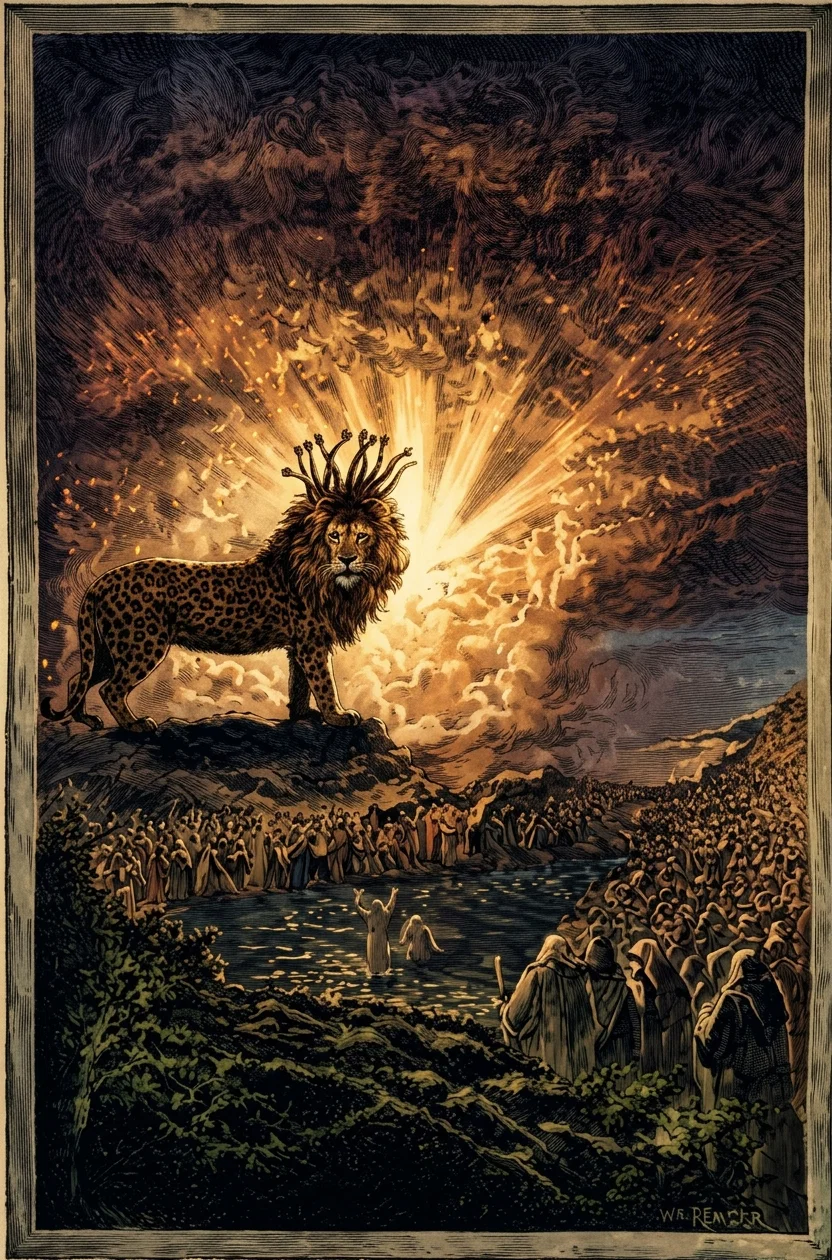
A “beast” in prophecy represents a kingdom, empire, government. This is seen in the visions of the seventh and eighth chapters of Daniel. Dan. 7:17, 18; 8:20, 21. But a beast represents more than a mere kingdom or power; it is the symbol of a power antagonistic to God and His people. For when mere kingdoms or powers are to be symbolized, as in Daniel 2, different metals are used in the figure of a man. These different metals—gold, silver, brass, and iron—in the image of Nebuchadnezzar’s dream, represented Babylon, Medo-Persia, Grecia, and Rome. But when the true character of these powers is to be revealed as opposed to the work and people of God, they are represented by fierce and cruel wild beasts of prey, the lion, the bear, the leopard, the combination of them all and more, the terrible nondescript with ten horns. The ten-horned, composite beast of Revelation 13 covers the same ground as the four beasts of Daniel 7. It has the mouth of the lion, the body of the leopard, the feet of the bear, and the ten horns of the terrible nondescript.
It has an additional feature; namely, seven heads; but each head has the lion’s mouth, and upon all heads were the “names of blasphemies.”

Essential Elements of a Persecuting Power

No power is antagonistic to the government of God or a persecutor of His people which does not combine in its scheme of government church and state, or religious dogma enforced by civil statute. A government purely civil will not persecute; a government purely religious or ecclesiastical can not persecute, or visit upon the dissenter civil penalties. In the first—the purely civil—all religionists are equal before the law; in the second—the ecclesiastical—its jurisdiction is limited to its own body and the voluntary submission of its adherents. Therefore we repeat again: A purely civil government will not persecute; a purely ecclesiastical body can not persecute. The combination of these constitutes the power which combines them in the light of the prophecy, a “beast.” “Religion” is the personal relationship between man and his conception of God. Conscience is the voice of God in the soul.
Whenever the creature—man or government—assumes authority over religion and conscience, it assumes the place and authority of God, and writes blasphemy upon its pretensions. The logic of such action is to deem the laws which demand such assumption the highest and most important of the realm; and therefore follows prosecution and punishment of all dissenters to these dogmas. Therefore the prophecy places upon the heads the “names of blasphemies,” declares the beast to be an object of worship and the blasphemer and persecutor of the people of God.
This beast power is not of God; for it receives its power, throne, and authority from the dragon, and the dragon is the symbol of God’s great adversary Satan, the world’s great deceiver the Devil. Rev. 12:9. He has led many good men to erroneously believe that religion could be preserved only by embodying it in civil statute, a curse to the state, a tyrannous engine in the hand of a backslidden church.
The beast and the dragon are synchronous in their work; that is, they cover the same time and do the same work.

The Dragon

In the twelfth chapter is revealed this dragon or serpent, the great spiritual foe of God’s church. He may not exercise physical power through his invisible angels of evil; but through them he deceives and influences men to do evil, to mold governments, to issue decrees, ostensibly for the good of state and church and society, but always resulting in the persecution of the children of God. The seven-headed serpent was a symbol of ancient, apostate Babylon; and the dragon, the serpent, is used to show that the system is Babylonian all through. So Satan, once Lucifer, is called the king of Babylon. See Isa. 14:4, 12-14. Satan, the invisible, evil one can not issue laws; his will must be uttered through the governments he influences, and these are represented by the heads, which are successive, not contemporaneous. (See Rev. 17:10.) The speaking mouths of these heads are symbolical of the persecuting, law-making power of the dynasties typified by the heads. These began with Babylon and Nimrod. When our Lord was born of the flesh, it was Pagan Rome speaking through Herod and Pilate, and later, through emperors. Rev. 12:4, 12, 13.
In chapter 13 the dragon is in the background, and there is revealed his direct persecuting agency, the beast, acting by the authority of the devil, and doing his work. Still the power is Babylonian, for it is the lion’s mouth throughout which utters the laws, and the lion is the symbol of Babylon. Dan. 7:4; Jer. 4:7. Do not misunderstand,—civil government is right and necessary; and proper civil government is not a cruel beast, but a broad over-sheltering tree. The beast is the union-of-church-and-state element,which, entering in, vitiates the whole. There were many excellent things about Babylon, the first of these heads; but the beast came in when Nebuchadnezzar demanded the worship of his apotheosis of patriotism. See Daniel 3. There were admirable things among the ten kingdoms which composed the Papal-Roman dynasty; but the evil thing was the union of church and state which exalted man to the place of God and enforced his decrees by statute law.
The Roman governments—the ten horns—of themselves were not that beast; the Roman Catholic Church—ecclesiastical—was not the beast, nor a head of the beast. But the Papacy dominating civil authority was the fifth head which dominated that beast; and for the time that head was dominant, it was the beast, for it is the head which gives character to the beast.
The heads began with Babylon, as did the beast; and the beast is essentially Babylonian throughout its career, in character and in the abnormal form or forms of body, representing the confusion consequent upon sin or departure from God’s plan. The heads represent so many distinct and characteristic forms of government, or dynasties, which Satan has endeavored to use to bring the whole world into subjection to himself and to hold it in rebellion to God. Hence the Babylonian spirit of self-exaltation and assumed authority, hence also the Babylonian condition of confusion, persists from the beginning.

The Heads

The beast’s body of Revelation 13 is Babylonian—abnormal and confused; its various phases of government are Babylonian—they speak through the lion’s mouth. Down to the chronological application of verses 4-10 of the prophecy, there have been five of these heads in existence; namely, Babylon, Medo-Persia, Greece, Pagan Rome, Papal Rome.
Papal Rome exercised domination over the divisions of the Roman empire, represented by the horns, from the days when Justinian made the bishop of Rome “head over all the churches,” and “true and only corrector of heretics,” in A.D. 533, a decree made more effective by the subjection of the Ostrogoths in 538. From that period to the period of 1793 to 1798, the bishop of Rome held tremendous sway; and that system of church and state—the beast under its fifth head, Papal Rome—put to death its awful sacrifices of thousands upon thousands, estimated by some at fifty millions. Fitly is that period, stretching from the days of Justinian to the French Revolution, the direct outgrowth of papal intolerance, called the Dark Ages. The saints of God were persecuted to the death, and were driven to mountain fastnesses and deserted places, while the great majority witnessed for their faith at the stake, the rack, and in other inhuman ways of torture. The men who did that work for the devil believed they were doing God service. Men had become wedded to an evil principle, which deceived and made them demons, and which if made operative to-day and perpetuated, will do the same again.
That period of time, 1,260 years, is symbolized by the “forty and two months,” 1,260 days, each day standing for a year. Eze. 4:6; Num. 14:34.

The Reformation

As the end of that time drew near, Europe wakened from its awful night. The Reformation had touched the consciences of its jaded and satiated governments. They saw their most upright subjects either dying for a faith which did not injure either government or society, or leaving their country for the new world opening beyond the sea. In 1776 Maria Theresa issued laws of toleration in her realm, and the awful reign of intolerance ended even in name in the captivity of Pope Pius VI in 1798. After that time the Roman church still lived and flourished, but with no power to persecute save in the little territory of the States of the Church, and her temporal power there was abolished in 1870 by Victor Emmanuel. That church still lives, and is prospering as never before in her history. If forever she would renounce all desire, all right, all prerogative to control the faith of men, or the laws of states in the matters of religion, it would be well for the world. But her inclinations, her assumptions, her claims, her demands, are the same as when Henry the Fourth of Germany walked as a penitent barefoot in the snow suing for clemency, pleading the papal pardon, or when John Huss of Bohemia was burned at the stake. That same ambition to rule for God, the same principles dominating men, will result in the same evil effects now if voiced in civil law, that they did in Pagan or Papal Rome. We plead with our readers to reject forever the evil principles.
Yet out of these principles will grow the image to the beast, the essential likeness in respect to the union of those two things, church and state, or religious dogma enforced by civil law. Would we save ourselves from the awful result?—Heed then the divine protest and warning embodied in the third angel’s message of Rev. 14:9-11: “If any man worshipeth the beast and his image, and receiveth a mark on his forehead, or upon his hand, he also shall drink of the wine of the wrath of God, which is prepared unmixed in the cup of His anger”—God’s just wrath against persistent, implacable rebellion.
Continue reading: God's Eternal Law