“If I should die, John, I suppose you would spend a good deal of money for flowers.”
“Why, yes, Anna; but what ever put that into your head?”
“O, nothing, only I thought that ten-dollar wreaths and fifty dollar anchors wouldn’t make any difference to me when I’m dead, and just a little flower now and then while I’m living would mean so much to me.”
“Just a little flower, now and then, while I’m living.” The reply of the young wife is eloquent of the heart-hunger of thousands.
Why do we withhold the appreciative word, the loving look, the fervent handclasp until the pulses are stilled, the eyes closed, the ears unheeding? Why wait until flowers can no longer give pleasure to shower them upon our near and dear?
We can make the present beautiful if we will; we can fill it with loving, tender acts and gracious words. Now is the time to gladden the hearts of those about us. Now is the time to give the “little flower.” To-morrow it may be all too late!—Anon.
THE BOY WHO WAS READY.
NEARLY twenty-five years ago we clipped the following from one of our exchanges, but it is as interesting to-day as it was then:—
“Chaplain Byers told, in one of the Ohio conventions, of a Scotch boy whom he knew many years ago, who had little knowledge in his head, but much in his heart. They called him underwitted; but he knew enough to believe in Jesus as his Saviour. There came one of the grand meteoric showers by night, which startled many with the thought that the end of the world was here. That boy’s mother was as thoroughly alarmed as any one. Seeing the strange sight from her window, she ran to her boy’s bed-room, where he was sleeping quietly, and called out, ‘Wake up, Sandy, wake up! The judgment-day has come.’ The boy roused himself, and sat up in bed; and as the mother cried out again in her terror, ‘O Sandy, Sandy! the judgment-day has come,’ Sandy, rubbing his eyes to get them open, called out in joy, ‘Glory to God, mother! I’m ready.’ He knew the truth by heart, and his perfect love cast out all fear.”—Selected.
THE PAPAL YOKE IN SPAIN.
In this much-afflicted land are found no less than 21,500 parish churches, 2,500 monasteries, 100 collegiate churches, 62 cathedrals, and 33 seminaries for priests. For clergy there are four cardinals, 9 archbishops, 51 bishops, 543 clerical dignitaries, 1,239 canons, 692 priests with free board at collegiate13tables, 172 who have half board at the same tables, 20 precentors, 16,931 parish priests, 23,608 clerical incumbents of livings, 5,471 parish chaplains, 10,876 vergers, 5,532 assistants at mass, 37,363 assistant priests, 5,774 clergy of lower orders, 37,363 monks, 2,290 novices, 7,802, lay brothers, 151 order priests, 20,550 nuns, 1,005 novices, 1,130 lay sisters; or a total of 154,517 clerical and other religious officials supported by the people of Spain. Nor is the case much better in France, Italy, Belgium, or Austria.—Missionary Review.
THE WOMEN AND GIRLS OF PORTO RICO.
By D. M. Traill
[Mission Board Correspondence.]
THERE are two phases to a woman’s life in Porto Rico as elsewhere, viz., the public or social phase, and the private or home life. I propose to tell our American sisters something about these, so that they may understand how the women live here.
Starting from infancy, a little girl’s life here is much the same as elsewhere; the same pleasures and the same baby sorrows enter it, and the same motherly love watches over it. The first change may be said to enter her life when she goes to school, if she is so fortunate as to enter one. She then enters, to a certain extent, into the social world, and has to be jealously watched and guarded from all suspicion or appearance of evil. She is not allowed out of doors alone, but must be chaperoned on all occasions. This, of course, refers to a family of what is called “la primera,” i. e., the first class of society. The lower in the social scale a family may be, the more lax are all these social rules.
Hitherto the education received by the women of Porto Rico has been very meager. They have learned reading, writing, and arithmetic fairly well, and then have been taught sewing, embroidery, crochet work, music, and painting. These last two arts were only attainable, however, by the rich. Our readers will wonder why the girls never received more education. The fact is that there were only three avenues open to them to self-maintenance,—marriage, school-teaching, or such work as dress-making, laundry work, or domestic service. Then what use was there in educating one’s daughters? The drudgery work was left to the poorer families, and the whole aim of the average girl’s life was to look pretty so as to capture some desirable young man as a husband.
Girls are carefully drilled in social etiquette and manners, the art of looking pretty, and all the various accomplishments that might aid in furthering this aim, such as dancing, singing, graceful carriage, etc., etc.
The liberties allowed to the girls in the United States never enter a girl’s life here. A young man can never take her out for a walk, drive, or to the theater, without a chaperon; nor can he ever interview or visit his “novia” (i. e. fiancée, or sweetheart) alone. To do so by stealth would be to ruin the young lady’s reputation. The young men here are the staunchest supporters of this idea. While they are as “wild” as their Northern brothers, they would not dream of asking for a girl in marriage whose reputation is questioned in the slightest degree because of any “escapades.” Of course, then, as the marriage state is most desirable, the girls do not demand such liberties as do their American sisters.
Do not imagine from this that a girl’s life is at all commonplace. Household work keeps her pretty well employed if she is poor, and direction of the servants, fancy needlework, and social duties if she is rich. All classes of society have their visits, dances, and church duties at very frequent intervals. These furnish her a chance to prove herself attractive and to captivate. The poor girl of good but poor family has to practise rigid self-sacrifice in order to keep pace with her wealthier associates. This self-sacrifice will often take the form of seamstress work, candy-making for street sales, or even of going without her meals, so as to be able to buy a new dress for the carnival ball, or for the casino, the “novenas” of the church, or other social events such as these.
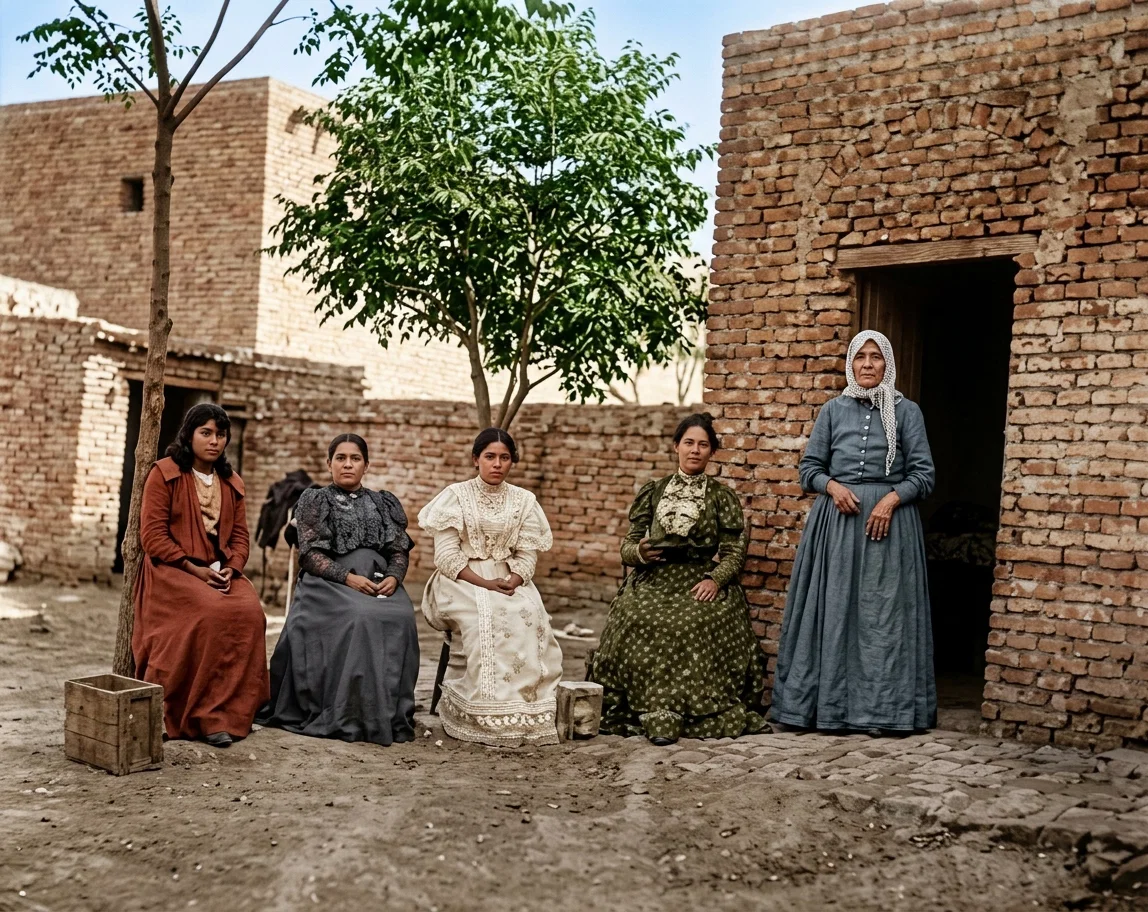
Group of Porto Rican Women.
As a rule the Porto Rican girl is decidedly pretty, of a somewhat pronounced brunette type. She is very tasty in her dresses and costumes. These are generally made from copies of Parisian “creations,” altho some of the prettier American patterns are being followed lately. The materials are of course light to suit the warm climate, such as muslins, batiste, silks, satins, lawns, etc., etc.
In towns such as San Juan, Ponce, and Mayaguez, one of the regular social functions is the open-air band concert on the plaza. All the “eligibles” are out for a promenade. They are all prettily gowned, and the hair prettily “fixed up.” This last is very necessary, as they go bareheaded. The “mantilla,” so common in other Spanish countries, is seldom used here, but a few flowers take its place to add to the wearer’s natural attractions.
Let us suppose now that the señorita has attracted some desirable young man. He generally tries to feel sure that his affection is reciprocated. This is at times very difficult to ascertain. The señorita fears he may be trying to trifle with her affections, and returns no signs of her feelings. The young man then gathers courage to tell her frankly of his love. She does not answer “yes” definitely; if she refers him to her parents, this is considered sufficient. To the parents he must go, then. If the parents consent, the engagement is announced.
Now begins another stage of the girl’s life. Her affections are whole-hearted and individual. She has plighted her troth; her fiancée’s slightest wish is law to her, and she obeys without question. He will not allow her to receive visits, or walk, or correspond with any other young man. She must not dance with any other than he, and she obeys. Often the lover will test his fiancée’s fidelity to him by putting her to the proof. If she stands the test, his love is deepened; but if not, the match is broken off. And she generally does stand the test, if for no other reason, because she knows that the young men will not look at a girl who has been engaged two or three times; for they say there must have been some cause for breaking off the match.
The engagements, as a rule, are of long duration, sometimes running for five or six years. Cases have been known of their lasting for ten and twelve years. This is, of course, a severe ordeal for any girl, knowing, as she does, that the young man may back out after all.
The saying here is, “that a father keeps his daughter under lock and key all the time she is single; and when she does marry, he simply turns the key over to the husband.” This explains the regime in a few words. It is true in most cases; but there are some husbands who are more enlightened, and give their wives a great deal of liberty.
Seldom indeed do the Porto Rican wives abuse their privileges or their position. Their great fault, if they have any, is that they are too docile and meek. There are few husbands who respect their marriage vows, but the Porto Rican women are model wives and mothers. They keep their homes above reproach. If they are poor, they will slave their lives away to economize for their husband’s and children’s benefit. If their husbands fail or prove unfaithful, they suffer with a patience and fortitude that is almost inexplicable.
Once married, the señora’s part in society life is merely passive. If wealthy, she figures as an entertainer and as a member of some charitable or religious organization. But her dances are past, unless it may be occasionally with her husband or a brother as a partner. She now enters the festivities only as chaperon to her sisters, daughters, or young lady friends. Most of her time is passed in housekeeping, entertaining, and looking after her husband and children. These duties she generally fulfils very well. She is a charming hostess, loyal friend, and loving companion.
In all stages of her life, the religious duties enter. A small proportion only in Porto Rico are unreservedly Catholics, and religion is only a form or social duty, necessary to society because it upholds law and order. They know nothing of Protestantism, and in their imaginations generally class Protestants among freethinkers and infidels. If Protestantism were fashionable here, thousands would join so as to be popular. Very few have ever seen or read a Bible in their native tongue. Long accustomed to a religion of appearances, they see no necessity for a doctrine that teaches a change of heart. They are whatever their husbands are. How, then, can they be reached?—By literature, by personal work, and by medical missionaries. If they do not want to come out to hear the Gospel, it must be taken to them. Now, since social etiquette here prohibits interviews with male workers even on religious topics, we can only work through our sisters.
Dear sisters in Christ, we appeal to you in the name of our Lord and Saviour to consider seriously your share in this work. It may be that He has other work for you either at home or in other lands. We then bid you God-speed, and wish you success in your work. But if you are still undecided as to where your duty lies, will you prayerfully consider the needs of your Porto Rican sisters? Will you take their needs to the Lord in a spirit of self-sacrifice, and ask Him to show you what you can and ought to do? When He shows you, pray, or come, or give, proving by your acts that you really believe the end to be near, and that He is personally leading you. The Lord has a rich harvest here. Who wants to work for Him? His burden is light and His yoke easy, and the reward is great,—a crown of righteousness. Will you not be willing to earn it?
Las Marías, Porto Rico.
D. M. TRAILL.
SPEAK SWEETLY.
“Had I but known in the morning,
How wearily all the day
The words unkind
Would trouble my mind
I said when I went away,
I had been more careful, darling,
Nor given you needless pain,
But we vex our own
With look and tone,
We can never take back again.”
A Century of Missions
“The Missionary Helper has the following statistics: In 1800 the foreign missionary societies numbered seven; in 1900 they numbered over five hundred; in 1800 the income of the seven societies amounted to about $50,000; in 1900 the income was over $15,000,000; in 1800 there was not one unmarried woman missionary in all heathen lands; in 1900 there were at least 2,575; in 1800 there were no patients treated by Christian physicians; in 1900 there were over 200,000 patients under treatment in hospitals and dispensaries established by foreign missionary societies.”
LIVING ON AN OLD EXPERIENCE.
By J. H. Rogers
One of the greatest difficulties we have in getting persons to see and accept present truth, is an old experience. In our labor we are sometimes met with such objections as, “I was converted at such a time, and know that I am a child of God; so I shall not listen to your idea of those new things you bring to view. If these things are necessary, why were they not seen before? Great and good men have lived, and died, and gone to heaven, and they never kept the Sabbath you speak of, nor believed in Christ’s soon coming. What is the use of stirring up the people on those things? My father and mother were good Christians, and are saved; so I am satisfied to live and die as they did. Then this idea of proselyting; I think it is wrong to get people from the church they were brought up in, as that keeps the people stirred up.”
These are some of the objections that are met in giving to the people the advancing light for this time. But, brethren and sisters, old Sabbath-keepers, I want to say to you, that we find some among us living on their own experience, having settled down in a condition equally deplorable and dangerous. We profess to be giving the last message to be given to the world before the Lord comes, and yet some among us seem to be settled down and fast asleep in Satan’s easy chair, doing nothing to warn the world; and talking of the great things they have done in the past, how they bore burdens, kept preachers, attended meetings, and how strictly they kept the Sabbath, and how much they enjoyed the truth,—all of which we have no doubt they did. But of such we ask, What are you doing now? How are you feeling in regard to the advancement of the cause at the present time? “Is your heart warm, glowing,With His love o’er-flowing?” or have you settled down and begun to murmur in regard to the workings of the cause? Are you suggesting doubts in regard to the raising of so much money, or manifesting disapproval of the appeals for all to do more than they have ever done before,—seeming to forget that the Lord has placed them here in the world as His representatives, and expects them to reflect the light of truth wherever they are and show themselves a pattern of good works in all things?
Brethren, the time has come for us to realize that living on an old experience will not do for us any more than it will for others. To trust to this is like relying on the food we ate yesterday to sustain us to-day. We must have a living, daily experience, ever advancing as we near the end, being more zealous and investing more to advance the cause of God. Shall we be like men with our loins girded and our lights burning, seeking how we may bear some part in this closing work?
Yankton, S. D. J. H. ROGERS.
VALPARAISO, CHILE.
By J. W. Westphal
[Mission Board Correspondence.]
THE Lord is surely blessing the work in Chile. Considering the few laborers that have been in this field, we wonder how the Lord has wrought. Much of this work has been done by canvassing. Sabbath-keepers have been and are springing up in many places. Elder Ogden and I baptized four on our trip south, and Elder Ketring baptized five on a trip just before. We learned of seven more who wished to be baptized, but circumstances would not permit it when we were there. There are some German brethren and sisters who are keeping the Sabbath, but need further instruction.
We are planning to go to the north, where there are several places in which they call for baptism and ministerial labor. Some of the lay brethren are active in spreading the truth, with good results.
Our trip to the south covered a distance of about five hundred miles, and we expect now to go to the north beyond Iquique, perhaps eight or nine hundred miles from this place.
Living is cheap in Chile. Fruits, grains, and nuts are very plentiful, especially fruits. I understand that in the northern part they are scarce and more expensive, as there are no rains in this region, and everything has to be shipped from the southern districts. Travel by rail is very cheap, but by water it is expensive, unless one takes third-class passage.
We see the necessity of a school in Chile. More workers must be trained on the ground. A brother offers fifty acres of land for that purpose. We have decided to take it, provided we can get it in proper shape, and of this we have some hopes. As it is, it is stretched out over a mile in length.
We need canvassers more than any other class of laborers. J. W. WESTPHAL.
OUR WORK AND WORKERS.
JUNE 22, in connection with the camp-meeting at Watertown, S. D., thirty-one persons were baptized.
THOSE who donated means toward the school building in Tahiti will be pleased to know that the home has been finished, and is now occupied.
NOW THAT peace has been declared between the British Government and the Boers, our brethren in South Africa are hopeful that a new impetus will be given to the work in that needy field.
THERE is to be a harvest ingathering service in the Sabbath-schools all over Montana the coming fall. The children are said to be devising all manner of honest ways to earn some money for the occasion.
DONATIONS are solicited for the erection of a church building in Salt Lake City. Offerings for this purpose should be sent to Brother W. A. Alway, Provo, Utah, superintendent of the Utah mission field.
A REPORT in the Review from Jonesboro, Ark., by Brother E. L. Pickney, notes that five persons are keeping the Sabbath there as a result of reading our papers and tracts. Others also are deeply interested in the truths they contain.
A BROTHER in Chile has offered fifty acres of land, partly covered with heavy timber, for a training-school for workers. The Señales de los Tiempos, published in Santiago, Chile, is now self-supporting, having a monthly circulation of about three thousand.
DR. T. S. WHITELOCK reports to the Pacific Union Recorder that the way is opening auspiciously for medical missionary work in San Diego, Cal. They have already a vegetarian restaurant, a health-food store, and treatment rooms, and some excellent locations are offered for a sanitarium.
OF the tent-work at West Point, Miss., Brother R. S. Owen reports to the Southern Watchman that the “three newspapers give favorable reports of the meetings, one of the editors being in frequent attendance. Two of the pastors have met with us in our services, and we are receiving kind courtesy from all.”
THE South Lancaster (Mass.) Sanitarium is to be moved from its present location to Melrose, within a few miles of Boston, with a view to enlarged quarters and patronage. The old site can be sold, and the new one secured on very favorable terms. There are buildings at Melrose equipped with modern facilities, and railroad connections are very favorable.
A REPORT of work in Natal, South Africa, says that eight acres of ground have been secured at Sweetwaters for a school site; that the money is in hand for a school building, and the work is in progress. Bro. G. W. Reaser retains the oversight of the Natal-Transvaal field for the present, while visiting other parts of South Africa.
BY the Australian steamer that sailed from San Francisco on the 3d inst., Brother John S. Reekie and wife returned to their southern home. Brother Reekie came to this country to complete his medical course, and has received degrees both in medicine and surgery. He is a native of Australia, and his wife (formerly Miss Hare) is a native of New Zealand. They will take up work for a time in the latter island.
THE South African Union Council requests the Mission Board of America to advance $7,500 for the purchase and equipment of a mission farm at a central point of access to the natives of Pondoland, Griqualand East, Natal, Zululand, Swaziland, Amatongaland, Gaziland, the Transvaal, and the Orange River Colony. It is said that this region is one of the most healthful in all South Africa, as well as being well adapted to agriculture and stock-raising. It was also decided to apply to the Mission Board for a church-school teacher for Natal.
BIBLE ELECTION.
By M. C. Wilcox
By M. C. Wilcox. A brief presentation of God's plan and purpose concerning man, showing that the doctrine of election, or predestination, according to the Bible, is full of comfort and instruction. It throws new light on old controversies. Bible Students' Library, No. 67; 24 pp.; price 3 cents. Address Pacific Press Pub. Co., Oakland, Cal.
THE AMERICAN BIBLE SOCIETY.
This society has recently made public its eighty-sixth annual report, from which it appears that the total issues of the year, at home and abroad, amount to 1,723,791. This is an increase of 169,663 over those of last year. Of these, 686,755 were distributed in the United States, not counting the Philippine Islands, and 1,037,036 in foreign lands. This means an increase of 63,421 in the foreign field and 106,242 in our own country. One-half of these issues were manufactured at the Bible House; of the remainder, a large part were printed in China, Japan, Siam, Syria, and Turkey.
The total issues of the society in eighty-six years amount to 70,677,225 copies.
The Bible has not lost its hold on the mind and heart of the world. There are abundant evidences that more than ever it arrests the thought and compels the homage of men of every kind and degree, and especially the more intelligent classes. The publication of the English Bible in various literary forms, and with ingenious accompaniments to illustrate its meaning, attests the interest of this generation in the Book itself.
A Methodist minister in Korea has recently testified: “At the lowest estimate, nine-tenths of our successes are the result of Bible Society work;” and a Presbyterian minister adds, “Indeed, nearly every encouraging case brought to our notice shows some connection with the colporters.”
The society has established a special agency among the colored people of the Southern States. The Rev. J. P. Wragg, B.D., has been appointed agent, at Atlanta, Ga. Under his superintendence colporters have been sent out into a number of the Southern States, to go from place to place and visit the people at their cabin doors. Special depots have been opened in connection with some of the leading schools for the colored people.
A GROWING MEXICAN MISSION.
By R. C. Elliott
EDITOR SIGNS OF THE TIMES, Oakland Cal.
Dear Sir: Yesterday the captain of the San Juan, Pacific Mail Steamship Company, gave me a copy of your excellent paper bearing date March 26, in which Mr. C. D. Crosby has something to say of the Lord’s work, or lack of it, in Mazatlan. It is surprising to us that so many Christian men and women come into Mexico, and never visit or learn anything about our mission work. Had Mr. Crosby inquired of the American consul, of whom he justly speaks so highly, he would have learned that the Methodist Church has had a mission in Mazatlan for twelve years at least.
This is a very prosperous work; the congregation is now compelled to find a larger house, and the church is looking for a suitable lot on which to build a church and house. Brethren, pray for us.
Yours in the Lord, R. C. Elliott, Missionary, Methodist Episcopal Church South. Mazatlan, Sinaloa, Mexico, June 17, 1902.
P. S. We have services regularly in both English and Spanish in Mazatlan. R. C. E.
1 “And when the people saw that Moses delayed to come down from the mount, the people gathered themselves together unto Aaron, and said unto him, Up, make us gods, which shall go before us; for as for this Moses, the man that brought us up out of the land of Egypt, we know not what is become of him. 2 And Aaron said unto them, Break off the golden rings, which are in the ears of your wives, of your sons, and of your daughters, and bring them unto me. 3 And all the people brake off the golden rings which were in their ears, and brought them unto Aaron. And he received it at their hand, and fashioned it with a graving tool, and made it a molten calf: and they said, These be thy gods, O Israel, which brought thee up out of the land of Egypt. 5 And when Aaron saw this, he built an altar before it; and Aaron made proclamation, and said, To-morrow shall be a feast to the Lord. 6 And they rose up early on the morrow, and offered burnt-offerings, and brought peace-offerings; and the people sat down to eat and to drink, and rose up to play.”
30 “And it came to pass on the morrow, that Moses said unto the people, Ye have sinned a great sin; and now I will go up unto the Lord; peradventure I shall make atonement for your sin. 31 And Moses returned unto the Lord, and said, O, this people have sinned a great sin, and have made them gods of gold. 32 Yet now, if Thou wilt forgive their sin—; and if not, blot me, I pray Thee, out of Thy book which Thou hast written. 33 And the Lord said unto Moses, Whosoever hath sinned against Me, him will I blot out of My book. 34 And now go, lead the people unto the place of which I have spoken unto thee: behold, Mine angel shall go before thee; nevertheless in the day when I visit, I will visit their sin upon them. 35 And the Lord smote the people, because they made the calf, which Aaron made.”
Golden Text.—“Thou shalt have no other gods before Me.” Ex. 20:3.
Suggestive Questions.
(1) To what place had God called Moses? How long did Moses remain there? Because of Moses’ delay, what appeal did the people make to Aaron? Verse 1. Note 1. (2) What did Aaron say to this appeal? Verse 2. (3) How did the people respond? Verse 3. (4) What then did Aaron do? What did the people say when they saw the calf? Verse 4. Note 2. (5) What further aid did Aaron give to this idolatrous worship? Verse 5. Note 3. (6) How zealously did the people enter into this worship? Verse 6. Note 4. (7) After Moses had discovered and rebuked this great sin, what did he say to the people? Verse 30. Note 5. (8) What report did Moses carry to the Lord? Verse 31. (9) What appeal did he make in behalf of the people? Verse 32. (10) What denunciation did the Lord declare? Verse 33. Note 6. (11) Then what counsel did He give Moses? And what promise did He add? Verse 34. Note 7. (12) What was the consequence of the people’s sin? Verse 35. Note 8.
Notes.
1. Moses had been absent about forty days (Ex. 24:18), and the people had not learned how to trust God without a visible leader. This is the secret of idolatry. When men lose faith in the “invisible God,” they necessarily walk by sight; so they turn to gods that can be seen. In less than six weeks Israel had utterly backslidden from their solemn promise to obey the “Voice” of God (ch. 19:5, 8), a promise made in confidence that they could of themselves keep the law of God. Their example is a standing testimony to the futility of all such efforts.
2. Lack of faith in God was manifested by Aaron when he feared the people more than God. It would have been much easier for him to have dissuaded the people in the beginning, than for Moses to turn them from the gross idolatry into which they were plunged by Aaron’s encouragement. To encourage wrong in a people for the purpose of being in favor with them, is to assume a fearful responsibility. Following in the wake of public sentiment is a dangerous position for a minister of the Gospel.
3. Proclaiming a feast to Jehovah was assuming that the idol was a representative of the true God, and building an altar to it was imitation of true worship. All false worship had its origin in imitation of true worship. As Satan’s prime object is to supplant God in the minds of men, he operates through imitations of God’s ways.
4. A burnt-offering indicated entire consecration to the object to which the offering was made, so we find the people entering fully into the spirit of idolatry.
5. Moses had been tested by the Lord’s offer to destroy Israel and raise up a new nation with Moses as the head (see verses 8 to 14 of lesson chapter); but Moses stood the test, and reminded the Lord of His promise to Abraham, Isaac, and Israel, and threw himself in the breach of his defaulting flock. The student should read carefully the portion of the chapter omitted from the lesson.
6. The Lord’s declaration that He would blot out all who had sinned did not include the penitent ones; for they all had sinned. Moses had called out all who would stand on the Lord’s side before the avenging sword had been sent out to slay the impenitent leaders of the great apostasy.
7. The Lord heard with favor the importunity of Moses. The visible leader of Israel was a type of the real Leader, whose offering of Himself is honored in behalf of every one who will come unto God by Him. But, as in their subsequent failure at Kadesh-Barnea, they had to suffer the consequences of their sin.
8. “They made the calf which Aaron made” is an expression showing the responsibility of the people for the act of Aaron done in response to their clamor. The people’s sin in demanding a heathen god was not lessened by Aaron’s yielding to the demand, tho he was for the moment their temporary leader.
(Read “Patriarchs and Prophets,” pp. 315–330; see also article in editorial column, same title as the lesson.)
The World-Famous Puritan Pure Water Still
Is a practical scientific invention that furnishes pure water for every one. Water distilled by the Puritan is the acme of purity. It is purified, aerated, revitalized with sterilized oxygen. Common distilled water is invariably flat and insipid, because it is not aerated and revitalized with oxygen. Our process overcomes all this.
Price, $8.00Agents Wanted
F. J. SILSBEE, General Agent
858½ Twentieth Street, Oakland, Cal.