Your ShelfYour Projects

Review and Herald, Vol. 84, No. 11.

Rest in the Lord
Earlier text: Echoes from the Field

Modern Marriages

D. H. KRESS, M. D.
Of Samson it is recorded, “The child grew, and the Lord blessed him. And the Spirit of the Lord began to move him at times.”
Samson’s heredity was good, both father and mother being devoted worshipers of the true God. So near did his parents live to God, and so desirous were they of bringing up their promised son for him, that an angel was commissioned to impart to the mother directions regarding her own food and drink. He said: “Beware, I pray thee, and drink not wine nor strong drink, and eat not any unclean thing: . . . for the child shall be a Nazarite unto God”—these were the words of this heavenly messenger. Samson, like the rest of mankind, had weaknesses which were constantly asserting themselves, and he needed constant divine grace to subdue them.
“The Spirit of the Lord began to move him at times.” But this was not sufficient to keep him from making shipwreck of what might have been a useful life. For young men to be kept securely, it is necessary for them to have such a constant union with God that his Spirit will move them at all times; otherwise, as in the case of Samson, feelings will arise that will lead them to do that which will mar, if not wholly destroy, their usefulness.
How many promising young men and women who have had godly parents, good environment, etc., have been crippled for life simply because they have not been wholly given up to God, and have consulted and followed their feelings and impressions when they should have consulted and followed God’s Word and the Testimonies of his Spirit, and taken the counsel of their parents and guardians.

Samson’s Weakness and Cause of His Sad Life

“And Samson went down to Timnath, and saw a woman.” This was the beginning of his fall. He became infatuated with this woman, and lost his reason. He did not come up to counsel with his parents. “He came up, and told his father and his mother. . . . Now therefore get her for me to wife.”
When his father and mother tried to reason with him and to persuade him that God would not be glorified by their union, Samson said to his father, “Get her for me; for she pleaseth me well.” Love is of God, but that which Samson supposed to be love was not love, but sentimentalism.
What a sad history is now recorded of the future of this man who was moved by the Spirit of the Lord “at times.” “And he went down, and talked with the woman; and she pleased Samson well. And after a time he returned to take her.” The marriage proved to be an unfortunate one. In a short time there was a separation or divorce, and “Samson’s wife was given to his companion.”
Samson did not profit by this bitter experience. “It came to pass afterward, that he loved a woman in the valley of Sorek, whose name was Delilah.” That which Samson termed love, and much of that which is termed love by many good young men to-day, is merely a delusive infatuation that Satan makes use of to cause their destruction. Samson could not be persuaded of this by friends or parents, but he was married to the woman he thought he loved.
By Delilah, Samson was shorn of his seven locks of hair in which were concealed the secret of his strength; and when the Philistines came upon him, “he awoke out of his sleep, and said, I will go out as at other times before, and shake myself. And he wist not that the Lord was departed from him. But the Philistines took him, and put out his eyes, and brought him down to Gaza, and bound him with fetters of brass; and he did grind in the prison-house.” Samson was now a weak man, completely at the mercy of his enemies.
Many of the marriages contracted in these last days are prompted by the same spirit which prompted Samson’s marriage. The usefulness of one or both parties is either lessened or ended altogether by the marriage. The disregard of the Word of God and its warnings in this respect on the part of so-called Christian young men and women constitutes this as one of the signs of the last days.
Just before the destruction of the earth by the flood, Satan employed this same means in influencing and infatuating young men and women, and keeping them from giving themselves unreservedly to God and engaging with faithful Noah in warning the world of its coming doom. “The sons of God,” it is said, “saw the daughters of men that they were fair; and they took them wives of all which they chose.” God’s glory and the advancement of his work was not the motive that prompted in forming these unions; they were controlled by inclination rather than principle. This has been recorded especially for the benefit of the young men and women who have a connection with the closing message, who should seek first the kingdom of God and give themselves unreservedly to the cause of Christ, and warn the world of its coming doom and Christ’s speedy return. But strange to say, in spite of this, the warning is unheeded, for “as the days of Noe were, so shall also the coming of the Son of man be. . . . For as in the days that were before the flood they were eating and drinking, marrying and giving in marriage, until the day that Noe enteredinto the ark, and knew not until the flood came, and took them away; so shall also the coming of the Son of man be.”
The same infatuation is seen to-day among many of the young who are in training for God’s work, and Satan meets with the same success. They think their case is an exception, that they are doing right, and they can not be persuaded to the contrary. Principle is sacrificed to carry out the promptings of the unrenewed heart. No one should enter the marriage relation unless the work of God can thus be better advanced. When the sacred nature and claims of marriage are understood, marriage is honorable, both parties will be blessed, and the work of God advanced thereby. Such marriages heaven approves.

One Woman’s Work

“Who having little yet have all.”
A NARROW sphere, how can you call it so? Three pairs of baby eyes look up to mine, And seem the gates through which a light divine Transfigures all my life with tenderest glow.
Because I can not paint with artist skill The changing colors of the sea or sky; Because I can not write of visions high, And move you all with pain or joy at will;
Because to learning’s shrine no gifts I bring, Nor take a foremost stand for woman’s cause; Because I trust unquestioning the laws, That bring us snow in winter, birds in spring,
You think my life is circumscribed and cold In what would make it helpful, rich, and strong. Ah, friends! these happy days are none too long For all the loving duties that they hold.
Nor has the heart you love been all denied, For loveliest pictures every day I see In childhood’s careless grace and movements free, From waking morn till dreamy eventide.
My Edith’s braids, now brown, now golden bright, Imprison tints no artist’s brush has known: The baby’s deep-blue eyes, that meet my own, In living beauty mock all painted light.
And in reforms we are not learning late A still, small voice need not be all in vain; These childish hands may bring the greatest gain If I am willing now to simply wait.
And in what science or philosophy Can pass in interest the baby heart Seeking in untried ways to take its part For good or ill in life’s great mystery?
God help us mothers all to live aright, And may our homes all truth and love enfold, Since life for us no loftier aims can hold Than leading little children to the light.
— Selected.

The Tired Girl

WE all know the girl who is chronically tired.
And it is utterly impossible for even the strongest of women to keep busy and stirring about continually without dire results.
A certain amount of relaxation is absolutely necessary even in work.
But very often it is the women who have the least to do that do the most, living each day in turmoil and rush.
Pretty soon the drooping lips, the languid air and pallid cheeks tell of the fagged-out condition of this busy lady’s body.
Diagonal lines, criss-crossed, in the middle of the brow are the telltales that one has been giving in to frets and small worries.
The only remedies for these many wrinkles, fagged nerves, and the generally mean, irritable disposition that precedes nervous prostration are found in taking life a little more calmly, in cultivating a cheerful disposition, and a watchfulness over one’s face to see that it doesn’t crinkle up into plaitings.
Outdoor exercise, restful, refreshing sleep, and nutritious food are absolutely essential to the chronically tired girl.
For a tonic nothing will equal contact with cold air. At night the windows of the sleeping apartment should be wide open.
An hour out of doors each day will be of the greatest possible benefit. The body rallies its forces to repel the cold, and so becomes strong and robust.
Too much coddling is the worst possible thing for the girl who is chronically tired. It makes her more delicate, and gives her absolutely no power of resistance.
And while these girls are making themselves physically strong, it will also be a good idea to make themselves mentally strong.
Emotional excitement will play havoc with one’s looks and feelings. Anger, jealousy, envy—all these emotions are tearing down one’s vitality.
One can become old and weary and lifeless in a very few years if she gives up to fretting and that sort of thing.
Be straightforward, kindly, firm, calm, and have a good word for every one, or keep your mouth closed tightly. You will be surprised to find that in such a mental attitude you will retain the buoyancy of youth, and build a firm foundation for happiness.
The chronically tired condition has a dreadful effect on the mind, too, creating morbid thoughts and a general depression of spirit that drives every one into despair.
One of the first things that must be learned is to develop the chest by deep breathing. The chest must be open and erect at all times, and it is necessary to keep in mind the need of continuous effort, not just during the deep-breathing seances, but many times during the course of a day.
Let the breathing be deep and tranquil, but such as to cause the chest to rise fully and fall freely at every effort.
Do this twice or three times a day, and in thirty days you will have lost that chronically tired feeling, and will be five years younger.
Keep your body strong, well, and clean; make up your mind to learn as much as you possibly can, to be kind and generous to the faults and failings of others—and if you do not look beautiful, you will be so, and that will suffice.—Mary Eleanor O’Donnell.

Animal Memories

KARL HAGENBECK, the famous lion tamer, insists that the power of memory is as well developed in animals as in human beings, and that wild animals are better endowed in the matter of remembering events and persons than are domestic ones. The story is told that he at one time visited a “zoo” to which he had sold some animals, and entering the lion house on tiptoe, he exclaimed “Halloa!” in German; the larger lion jumped to his feet at once, and it was but a moment before both lions and two tigers were greeting him and licking his hands in joyful recognition, although he had not seen them in twenty months.
Dr. W. T. Hornaday, director of the New York “Zoo,” is very highly regarded by the tenants of the monkey house, and never enters, even when the place is filled with sightseers, without receiving a hearty greeting and the outstretched hands of chimpanzees and orang-outangs. Last spring, after a long absence on account of sickness, he walked slowly to the outer circle of spectators and said, “Hello, Polly,” and instantly there was a rush for the bars and a shout of welcome that could be heard a long way.
The memory of dogs is well appreciated. Mr. F. M. Ware, in a recent number of Outing, does not attribute a highly developed memory, especially for persons, to the horse.—The Circle.

Tea Drunkards

UNDER the above heading a leading London daily quotes from a Preston medical practitioner on the evils of tea, as follows:—
“I firmly believe that the moderate and reasonable use of beer as a beverage is less harmful than the same use of tea, and that immoderate tea drinking causes more pain, suffering, ill health, and nervous breakdown than the excessive consumption of beer. If a man takes too much beer, its effects are gross and palpable. If a man takes too much tea, the results are quite as deadly, or even more so, but as they are insidious, and not generally apparent, they are put down to some other cause.”

The Right Thing to Do

MRS. D. A. FITCH
SHE said, “I don’t want any one to tell me of my faults until he has none of his own.” “I fear you must wait a long time then, for none are free from faults,” was a very proper rejoinder.
A cursory reading of Matt. 7: 1-5 and Luke 6: 41, 42, might lead to the inference that reproof should not be accepted from one having an obstructed spiritual vision. Is it not rather true that the unhappy results are all to the one having the beam in the eye?
Happy is he who courts reproof, taking it so kindly that encouragement is given for the performance of like kindly acts again. They are our best friends who tell us our faults in kindness. A shade of sadness may pass over the countenance, but let it be because there is occasion for reproof, rather than because it is given.
You do not frown, but rather say, “Thank you,” if one points out a fault in your attire. Is perfection of dress more important than a character pure and unsullied?
National City, Cal.

Helping Others

LIGHT and reflector both have their part in the radiance of the lighthouse. If we can not have the power and brilliance of a flame for good, we can unselfishly reflect whatever light others make. Many a great man’s life is made a beacon not only by its own flame, but by the wife, or sister, or friend, who helps to gather, focus, and send out the rays. “I had a friend,” was Charles Kingsley’s explanation of his success in life. In helping others to shine, many souls can find the loveliest usefulness and radiance that could be asked for.—Selected.

A Temperance Argument

WHAT made a noted Buffalo gentleman such a temperance man was the fact that a boy who brought to his home a parcel of clothes that he had purchased at a tailoring establishment, in reply to the question, “How are you making out?” replied, “Father is dead, and now mother and myself will be able to get along nicely.” That boy had a history that we sincerely hope few boys have.—Selected.

The Annual Conferences in Germany

L. R. CONRADI
After having organized the Silesian Conference at Goerlitz, and the North German Conference at Harburg, we held the Rhenish Conference December 27-31, in one of the best halls in the very heart of the city of Bonn, on the Rhine—a city of eighty-two thousand inhabitants. The business sessions, and the public services in the evening, were held in the hotel “Golden Star,” on the market-place, opposite the city hall. The city of Bonn is especially noted for its university and its beautiful surroundings. The sons of the emperor complete their university course here.
The territory of the Rhenish Conference is composed of only the Prussianprovince of Rhineland, with a population of about six and one-half million. At the time of our meeting, we were able to receive six companies and churches. During the year there were two hundred and twenty-six additions in this field, bringing their membership up to six hundred and twenty-five. Their tithe was over eight thousand dollars for the last year.
The first two churches in Germany were organized in this conference, as much as thirty-five years ago; but as no one looked after them, their membership decreased, in the course of time, and finally there was but one church left—the church at Vohwinkel; but now the membership has so increased that it was found well to re-establish the Solingen church, and it was again received into the conference. Although the Rhenish Conference has been organized only four years, and had at the time of its organization only six laborers, yet it has been so blessed of God that the work has extended from the extreme north to the south, and from the east to the west of the province, good churches being established in the leading cities.
In view of its increase in membership, and the size of its territory, the Rhenish field was glad to receive Elder Behr, of the West German Conference, as one of its workers, so that now this province starts out with two ministers, four licentiates, and seven Bible workers. It was very encouraging to me to see so many brethren present at the meeting.
About one hundred and twenty-five dollars was raised toward the material fund for the German “Ministry of Healing,” and the conference voted twelve hundred dollars toward the old people's home. The book sales for the year were about nine thousand dollars.
Elder G. W. Schubert was again unanimously elected president. Brethren Luepke, Pieper, and Hoenes assisted in the meetings, and all our people went home refreshed and strengthened.
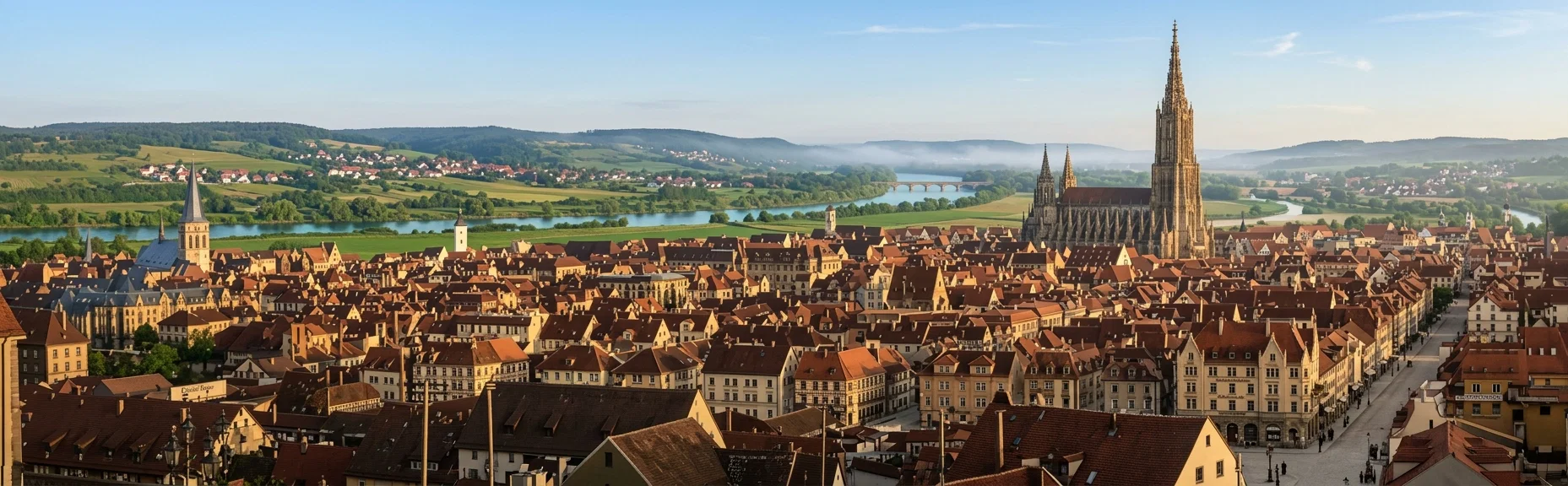
ULM, SOUTH GERMANY
Just beyond the large cathedral was held our South German Conference.
ULM, SOUTH GERMANY Just beyond the large cathedral was held our South German Conference.
From here we went to Ulm, where we held our next conference, January 2-6. The South German Conference was but a mission field in 1901, and it had the smallest population of any of our conferences in Germany; but since we now have seven different organizations in northern Germany, this South German Conference (organized in 1902) is the largest in population, containing about thirteen million inhabitants; its membership is nearly six hundred and fifty; during 1906 there were one hundred and thirty-six additions, and several new companies could now be received into the conference.
Ulm is a fortress in Würtemburg. It has a population of fifty-two thousand. Just across the River Danube from Ulm, is New Ulm, in Bavaria. It contains about ten thousand inhabitants. As the two cities are so near each other, it gives the believers in the Bavarian town an opportunity to cross the river, and worship freely with their brethren in Ulm. We were also pleased to see so many strong, promising men in this meeting. We are still suffering under the rigid laws of Bavaria; but the Lord is helping our workers to find ways and means by which the truth steadily progresses, and our membership increases, in spite of all the obstacles that men may place in our way.
Elder G. W. Schubert and Dr. Hoenes assisted in this meeting. There was an excellent outside attendance each evening. The leading Lutheran paper in Würtemburg had three full columns about this general meeting, giving our history, naming all the books and journals our canvassers circulate, and giving the address and time of our general meeting, and warning the people not to come; but this advertisement simply worked well, for it increased the curiosity of the people.
Seventeen were baptized at this meeting. Elder J. T. Boettcher was again unanimously elected president of the field. The canvassing work in southern Germany was especially blessed of the Lord in 1906, as they sold sixteen thousand five hundred dollars' worth of books and publications. Their tithe was over nine thousand dollars. The pledges here toward the material fund amounted to one hundred and fifty dollars. The people also gave liberal donations on Sabbath and Sunday, as Sabbath-school and first-day offerings. Twelve hundred dollars was voted toward the old people's home. This conference starts out for the new year with two ordained ministers, six licentiates, and eight Bible workers.
January 7 I spent at Basel, with the German-Swiss committee, auditing their conference accounts, and looking after the depository there. We still occupy the hall and business offices in the old building once owned by our people, and pay only a nominal rental of three hundred dollars a year for the room we have there. The property has already changed hands again, and the parties who secured the property seem to have a hard time to use it to good advantage. The German-Swiss Conference had also a good growth of over ninety during the year. Its population is about two and one-half million. Their membership is now four hundred and thirty-five. The eight tenths of their tithes easily covered their expenses, and with the rest of their income they were able to secure a second tent for their summer meetings. At the time of their last summer meeting, this conference voted sixteen hundred dollars toward the old people's home.
Our next meeting was held in the Lutheran town of Erfurt, January 9-13. It is now a growing industrial center of about one hundred thousand inhabitants. Here we also had secured a fine hall in the leading hotel in the heart of the city, opposite the city hall and main post-office, and our public lectures were well attended. In Erfurt we have a good church of about sixty members. It was in Erfurt that Luther was a monk in the Augustinian monastery, 1505-08. This monastery is now an orphan asylum, known as the Martin Asylum.
The West German Conference was able to receive some new companies at this meeting in Erfurt. They had two hundred and eighty-five additions during the year, making their present membership ten hundred and ninety-five, about four hundred and seventy-five of whom will, from the first of 1907, belong to the North German Conference. After the division of the field, western Germany will still retain about seven and one-half million people. During the meeting Brother Zerndt was ordained to the ministry. He had been laboring faithfully in Westphalia. Brethren G. W. Schubert, Luepke, and Dr. Hoenes assisted in the meetings. The West German Conference has three ordained ministers, two licentiates, and eleven Bible workers.
This conference voted twenty-four hundred dollars of its surplus for the Friedensau old people's home. Over one hundred dollars was raised for the material fund. During all these meetings liberal donations were made for the mission fields, and the objects of these funds were set before the people plainly. Prayer was also offered for our workers in German East Africa, and for the young men who are enduring imprisonment because of refusal to serve in the army on the Sabbath. In each meeting the deep movings of the Spirit of God were felt. Our brethren went home stronger than ever before. At the same time quite a favorable impression was left with the people in the city about our work and the principles we hold. The meetings generally began Wednesday night, and before the Sabbath came, all the conference business had been attendedto, so that we had Sabbath and Sunday for spiritual services, and for instruction and public meetings. The good attendance on the part of our people was the best testimony of the value they place on these gatherings. We were pleased to see a number of young people offer themselves for service in God's cause. Everything went off in perfect harmony, and we have every reason to be encouraged concerning the progress of the work in the different conferences, and the outlook for the future.

F. W. FIELD

Korea

F. W. FIELD

During November last, in company with Brother W. D. Burden, I made another trip to Korea in the interests of our work there. Over two years had elapsed since my first visit among the Korean believers, and it was a great pleasure to meet them again, and to note the growth made in the work.
The railway from Fusan is now in operation to Wi-ju, on the Yalu River; but there are no through trains, so we had to stay overnight at Seoul, and the next night at Ping-Yang, reaching Soonan early next morning. Here Brother Smith has permanently located, having built a substantial and comfortable dwelling. We remained here with these workers, over the Sabbath, counseling together concerning the work. On Sabbath we met with the believers at Soonan. They have an organized church of twenty-two members. This is a new company, brought out since the work first started in Korea. From here the truth has spread to various villages to the north, and quite a number of new believers are reported in these parts. The Soonan company have recently purchased a house, so they now have a regular meeting place of their own.
From Soonan we went to Ping-Yang, and met with the believers there. Brother Lim Ki Pan is now located at Ping-Yang, and will labor to develop the work in that important center. At our final meeting there arrangements were made for the purchase of a native house as a meeting place. There are difficulties attending the work in this city not met in the country; but the outlook for the work is encouraging.
At Ping-Yang we took the little steamer down the river to Chinnampo, where we spent the Sabbath. At their Sabbath-school and meeting about sixty were present, perhaps half of these being children and those interested in the truth. They have a comfortable and convenient place for meetings, but it is still somewhat encumbered with debt. Brother Kang Chang O has charge of the work in Chinnampo, and the prospects are hopeful.
From Chinnampo we visited all the little companies in the country, where the truth first gained a foothold in 1904. We first called at Nongdong (the Rondon of my earlier reports). It has been reported that nearly all of the original company here had given up the truth. But we were glad to find about eight believers still faithful; and a neat little meeting-house on the hill overlooking the village, is an evidence of their zeal and a witness for the truth they profess.
We next visited Kangdemuro, on the Tadong River. This company is well established, and they have built a neat chapel since my first visit. We received a warm welcome at Pamegi, across the river, and were glad to find the believers there still faithful to the truth.
From Pamegi we came to Sondol, the strongest company in these parts. It was here that the believers, being formerly Methodists, were refused the use of their meeting-house after they began to observe the Sabbath. Since then they have built a very credible meeting-house, with schoolroom and pastor's living-rooms.
We arranged for all the native laborers to meet us here, for a kind of general meeting in the interests of the work. Various matters were considered, such as the distribution of the laborers, the extension of the work in new fields, the Sabbath-school work, tithing, etc. An excellent spirit of harmony and co-operation was shown by the workers and believers generally, and they all seemed much cheered and encouraged by our visit. We also made a brief call at Pekochi. The believers here still hold their membership at Sondol, but have a church building of their own, and maintain their own services; so a separate organization seems advisable.
From Sondol, in company with Brother Kim Sung Wun, we visited Ham-jong, while Brother Smith returned home via Ping-Yang. Ham-jong is about a day's travel (afoot, of course) to the north from Sondol. This was my first visit here. There is a company of twenty or more believers, and the field is regarded as a very promising one. Though not yet organized as a church, this company has secured a house for a meeting place, and has it nearly paid for. It will be observed that every one of these little companies and churches in Korea has a meeting place of its own, though in several instances they have had to be assisted by loans.
At our meeting at Sondol it was arranged that Brother Li Pon Sung shall remove from Sondol to Ham-jong, and engage in labor at this new station; also that Brother Kim Sung Wun remove to Soonan, to assist Brother Smith in work on the language, and in translating; and that Brother Kim Tu Yung, elder of the Soonan church, shall engage in labor among the villages north of Soonan, where quite a number have already begun to obey the truth. Brother Lim Ki Pan will remain in Ping-Yang, and will be assisted by Brother Kang Kun Myung, who was one of the first to accept the truth there. Brother Kang Chang O will continue his labors in Chinnampo and its vicinity, and Sister Li Sung Il will labor as heretofore in the villages about Sondol. This gives us a corps of seven native Korean laborers, well distributed throughout the field where the truth has entered. And we are full of hope and courage for the progress of the work.
From Ham-jong we returned to Soonan, lodging one night in a Korean inn. This was a unique experience. As we had had only a light lunch since morning, we did fair justice to the big brass bowls of boiled rice, and the various accessory dishes. At bedtime we spread our blankets upon the matted floor, which in some places was altogether too hot for comfort. We had supper, lodging, and breakfast, for three, with stable and food for the donkey that carried our baggage; and our total bill amounted to forty-seven and one-half cents, with no haggling over the price. We thought that very cheap after our experiences with innkeepers in Seoul and Ping-Yang.
Returning to Soonan, we found Brother Smith's little daughter ill with some form of throat trouble. They consulted one of the American medical missionaries stationed at Ping-Yang, but he declared it nothing serious. But as she grew worse, another physician was summoned, but too late; for at midnight, November 24, the end came, and little Willena quietly fell asleep in her mother's arms. This was a severe trial to Brother and Sister Smith, separated as they are so far from home and friends; and we bespeak for them the sympathies and prayers of all who read these lines.
Leaving Soonan for our return trip, we spent another Sabbath at Ping-Yang, and then returned to Japan. We can assure our people that the work is moving forward in Korea. The various little companies are holding onto the truth, and are growing. Of course much remains to be done to develop and extend the work; and to this end we ask the prayers and co-operation of all our people. We are glad to report the arrival of Sister Mimi Scharffenberg, of Wisconsin, who goes to Korea to prepare for Bible work among the women of Korea, who have so little opportunity to hear the gospel. She accompanied Brother and Sister Smith on their return from our general meeting at Kobe the first of this year. A report of this meeting will appear soon.
Tokyo.

A Pleasant Trip

B. E. CONNERLY
After celebrating the week of prayer with our two churches in Porto Rico, I left San Juan for the West Indian Union Conference, to be held at Kingston, Jamaica. Traveling by a slow steamer that did local work among the islands, I was given a good opportunity to visit several ports in the republic of Santo Domingo, and also in Hayti, and was able to do some work.
Santo Domingo has an area of 18,045 square miles, and a population of nearly seven hundred thousand. Spanish is the prevailing language. It would seem impossible for any country to pass through more changes, or to have more wars and revolutions, than have fallen to the lot of this little republic in the last four hundred years, since Columbus sailed his three little barks into the mouth of the Ozama River, the site of the present city of Santo Domingo, the capital of the republic. As war has been the principal occupation of the people, their country has been neglected, and its resources are undeveloped. The soil is still virgin. Vast forests of mahogany, ebony, and satinwood still stand, practically unmolested. Coffee, chocolate, oranges, bananas, and cotton grow wild. Sugar-cane is the only crop that the people pretend to cultivate. Some mining is being done at present, as gold, silver, copper, and coal are found there.
The Catholic religion is strong,—I counted sixteen churches in the capital alone,—and, as a result, there is much superstition and ignorance. Only a small per cent of the people are educated.
Columbus is a great hero among them. They claim that immediately after entering their harbor, he became infatuated by a damsel who came to meet him, married her, and made his home there. Now these people can show you the home of Columbus, the church he attended, and his tomb; the altar where his wife worshiped, and her tomb; also the home of his son, and many other antique memorials of the great sailor. But the traveler has little confidence in these stories, as history does not corroborate them. While listening to one man who was telling me about the great ‘Colon,’ I said, ‘Did you know Columbus?’ Throwing both hands above his head, in a gesture of astonishment, he replied, ‘Who-ee, a man! Columbus died when my father was a little boy.’
Since the intervention of the United States, Santo Domingo has a fairly stable government, making it perfectly safe for missionaries to come. Thus far there has been practically nothing done; but now is the time. The people are ready for the message; and, realizing this, Satan is astir, and is sending there ship-loads of liquor, and many gamblers. God has led one of our boys to go there from Porto Rico. He became discouraged, went to Santo Domingo, and got employment, and has been telling people of our work, of the Sabbath, and of the coming of the Lord, so that when I went there, I found quite an interest. We surely must follow up this opening that the Lord has made. Arrangements have already been made for Brother Spied, a tailor, elder of the Port Antonio church in Jamaica, to go next month to the city of Santo Domingo as a self-supporting worker.
We stopped at two places in Hayti, the black republic—another needy field. But here we saw signs of life. Brother Tanner has caused a ‘sound of going’ in many parts of that island.
At Jacmel we tried to land, but were not permitted to do so for an hour or two, because the mayor or some other official suspected me of being an ex-convict, who had escaped and was returning for treasure that he had hidden in the mountains. After some persuasion, and tangible evidence that I would purchase wares of the venders, he let me land, but placed me under the custody of some soldiers. Afterward I found the consul from Santo Domingo. As he could speak Spanish, we were able to converse, and he showed me about the city, telling me many things about these superstitious people.
Sabbath morning, January 19, we entered the beautiful harbor of Kingston. Soon after, we arrived in the city, and a little later reached the Seventh-day Adventist church, just in time for Sabbath-school. O how good it was to meet the dear brethren, after having been on the frontier for more than four years! After Sabbath-school, Elder Farnsworth preached. How it did our souls good to hear again a stirring advent sermon! After lunch came an excellent testimony meeting, in which five hundred brethren took part. The Jamaica Conference is developing some strong young men, who will be a blessing to the work.
Just as the business work of the West Indian Union Conference began, the great earthquake came. That, for the time, seemed to frustrate our plans; but in reality it turned to the furtherance of the third angel’s message. After arranging for some of the Jamaica brethren to go to Santo Domingo, to help us open the work there, we went to the States, by way of Philadelphia and Washington. At the latter place it was decided for me to visit the New York Conferences, and tell the churches of our work in the islands. It was, indeed, a great privilege for me, after more than four years’ absence, to visit the dear Advent people who are traveling the ‘narrow path.’ As we talked concerning what the Lord has caused us to experience, it bound us together in a bond of deeper love, and trials seemed to lose their sting. We talked of the time when Jesus will gather us beside the river of life, and, in the shade of the tree of life, will explain why he permitted trials to come into our lives, and their purposes there. In the contemplation of such joys, ‘Ills have no weight, and tears no bitterness.’

Grand Cayman, West Indies

F. HALL
We can look with gratitude to our dear Heavenly Father for the success that has attended the third angel's message among the Caymans during the year 1906. Georgetown, East End, and North Side have heard the message, and as a result, thirty-six persons, including five or six children, have embraced the truth. The following places are still waiting for the message: Boddentown,—next to Georgetown, the capital, in importance,—Prospect, West Bay, and Newlands. The fields are white, therefore a good harvest of souls is anticipated.
I need a good, consecrated young man to labor with me, as the work can not be successfully carried on by one man. The people here do not like to worship in private houses; hence, a tent would be a great blessing. I hope some Seventh-day Adventist merchant or farmer will help the Cayman people with this. Your work of love would never be forgotten, and a rich ingathering of souls would be your reward. The man at the front of the army feels the point of the bayonet. North Side and East End are calling for teachers. We expect some help from the West Indian Union Conference in this direction.
Our thermic treatments (the little that we know being put into practise) have proved very successful with these sick people. Finding this a successful way of reaching the people, Mrs. Hall began giving treatments. Being a hospital nurse, the confidence of the people was gained, and she has had plenty to do since beginning the work, all having been treated with more or less success. She has treated some difficult cases. A man at the North Side who had been sick for over thirty years from congestion of the brain has been made better by simple water treatments and prayer. He had been to nine physicians, and the last one sent him home, incurable. To-day he is a wonder to the neighborhood.
The medical missionary work, as the Lord has said, is an entering wedge for the third angel's message to the homes of the people. Homes that were barred against us when we first came are opening now. The very first woman that turned against the truth sent for me to treat the inflamed eyes of her blind husband, and this has been a success. Praise the Lord for such a victory! Mrs. Hall can not even get her sleep, on account of the many calls. A physician is greatly needed in this little field.
Continue reading: China