PERU presents to us a most interesting field of labor. There are nearly four million people in this area of five hundred thousand square miles. Topographically, the country has three divisions—the coast, the Sierra, and the Montana. The mighty ranges of the Andes, like a great wall, attempt to bar the entrance to the interior.
Along the coast it seldom, if ever, rains, the nearest approach to rain being the falling of a heavy fog, or mist, which dampens the ground.
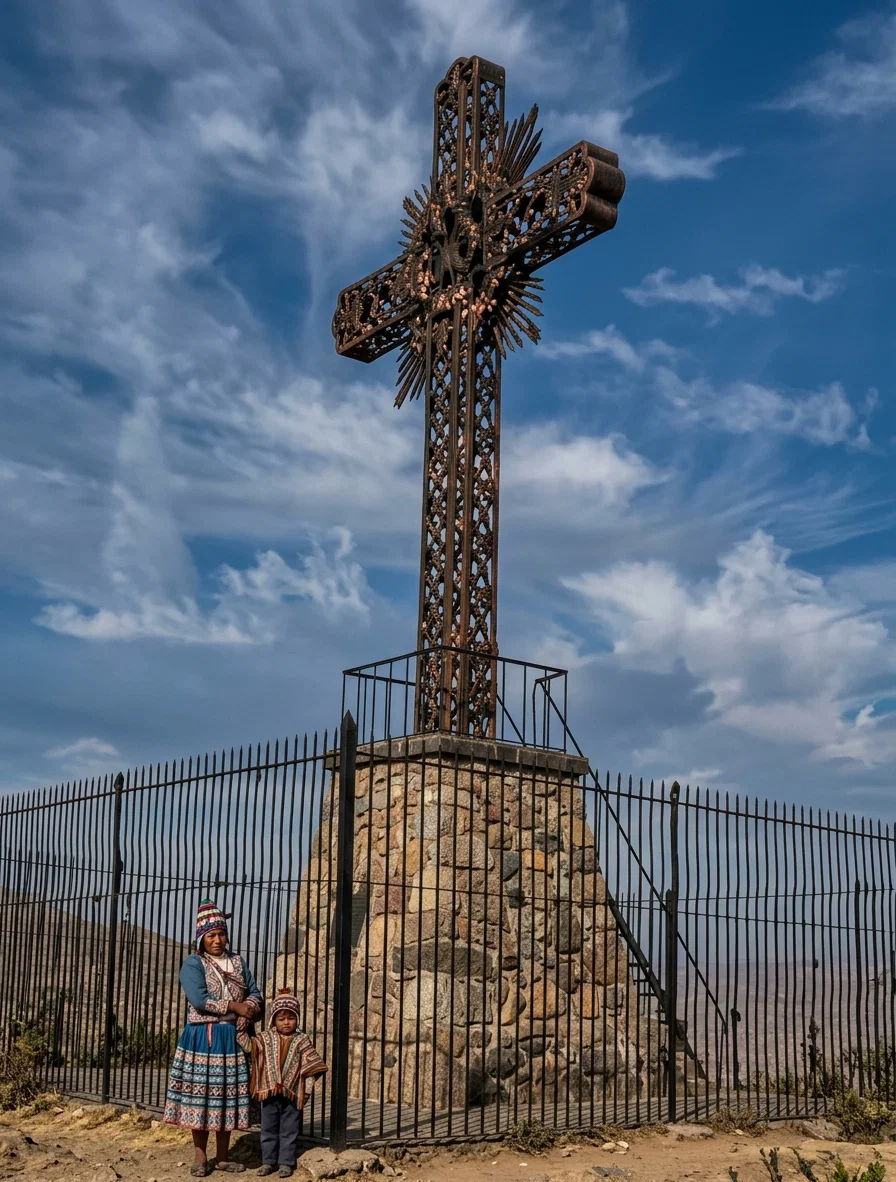
THE GREAT CRUCIFIX ON MT. CRISTOBAL, ERECTED IN MEMORY OF POPE LEO XIII
The many small streams that descend from the mountains make irrigation easy, and abundant crops are raised. We are now in the hot season. The days sometimes get very warm, but the nights are always cool.
The Sierra is the mountainous part of the country. Here the climate and vegetation vary with the altitude. There are many exceedingly productive valleys, which, with better methods of cultivation, would yield large crops. Here also mining is a principal industry. American capital is being invested in these mines, and engineers and mechanics from the States are coming to develop the resources of the country.
From the Andes the surface slopes eastward, toward the broad plains of Brazil. In this region are the sources of the Amazon and the other great rivers of South America. The country is covered with a dense growth of timber, and is sparsely settled.
In its varied resources of mine and soil, Peru has by nature been richly endowed. These treasures, however, are yet largely undeveloped. Almost every variety of climate and vegetation known the world over may be found in Peru. Its western border is the California of South America.
The inhabitants present almost as great a variety of types as the natural conditions. In the interior may be found almost heathen savages, native Indians, who have a language of their own. These form about fifty per cent of the population.
In the coast towns and principal cities there are many people as highly educated, as refined, and as intellectual as can be found anywhere in the world. Lima is a beautiful city, as modern, in most respects, as the cities of the United States. Its many beautiful stores are filled with the necessaries, and many of the luxuries of life. Its market-place is the nicest that I have ever seen. The city is lighted throughout with electricity, and has an excellent street-car service, and electric railways to neighboring villages. The sewerage and sanitary conditions are very good. Six miles inland, lying right at the foot of a mountain range, Lima is a picturesque city.
The message of Christ’s soon coming has entered it none too soon. Almost every day I am reminded of the Saviour’s words, “Look on the fields; for they are white already to harvest.” From the day when Pizarro’s priestly companion, with lying and malicious cunning, entrapped the unwary Inca, and afterward led him to the fire, these poor people have been dominated by the priests of Rome. Could the history of their rule be written, it would doubtless equal some of the darkest chapters in that of France or Spain. Here, darkness has covered the earth, and gross darkness the people. In Lima, the most enlightened and liberal part of Peru, images of Jesus, Mary, and the saints may be seen in almost every window. Men and women, especially on Sunday mornings, carry images through the streets, and these receive the adoration and contributions of many. The shopkeepers take advantage of this to perform their worship, and do penance, I suppose, for working on Sunday.13
But the light of the everlasting gospel, which is to lighten all the world, could not be kept out of Peru. On the part of the learned and rich, there has been a turning away from Catholicism, and a liberal spirit has come in. They still acknowledge the church, but only in a nominal way. A prominent Peruvian said, in reply to my inquiry while en route, “Yes; we are all good Catholics, but we do not get excited about it.”
The other day I first witnessed the host being carried through the streets. As I was passing along, I heard a bell behind me. Turning, I saw a cab coming toward me. Inside was a priest, in his robes. The carriage was surrounded by men, bare-headed, carrying candles. As the priest passed along, all the men uncovered their heads, and the women dropped upon their knees, in reverence. I had no respect for this idolatry, and so manifested none. Such a mocking of the Lord made all my Protestant blood rise in indignation. A few years ago such “irreverence” would have brought a mob; but I was not molested, receiving only some angry looks.
Great prudence is necessary, even in Lima, in teaching the gospel. Only last Friday a Methodist colporteur, teaching in the street, was attacked by two priests, and roughly handled, and his books stolen. So far, we have had peace, for which we thank the Lord.
About three weeks ago I received a letter from a Brother Morales, who lived at Canete. He told of his work there. His wife taught a day-school, and he was a carpenter. He also held meetings in his house, and conducted a Sabbath-school. Brother Espinoza had done some work there. In some way the opposition of the people was aroused, and they tried to break into Brother Morales’ house. This was repeated until he found it necessary to close his meetings. He writes: “I hear that they are getting up a petition to prohibit us from holding meetings, for they fear a curse will rest upon them, if they let us go on. Also, our Brother Espinoza has gone to Lima, to bring you here, dear brother, to preach and explain the Holy Word. And as you are a stranger from a foreign land, I believe they will have more respect for you. . . . If you determine to come here, take all the measures necessary to protect yourself while preaching, for the priests tell the people that it is no sin to kill a heretic.” But as I could not preach in Spanish, and had no interpreter, I thought it useless to go.
A week ago Sabbath I went to Callao, six miles distant, as usual, to hold a Sabbath-school (returning in time to hold another in Lima in the afternoon). While we were praying, the door of Brother Espinoza’s house opened, and in came Brother Morales and his wife, tired and dusty. He had been attacked by twelve men, and severely beaten. The police then came and took him to the jail, where he remained five days. The jailer was a Mason, and as Brother Morales was a Protestant, supposed he was also a Mason, and so desired to help him.
On the fifth day he regained his liberty, by promising to leave Canete at once. He took time only to gather up his few belongings, and came to Callao, where he found us.
Besides the company in Lima there are, I am informed, scattered Sabbath-keepers in Truxillo, Callao, Pisco, Canete, and Chincha Alta. There are about thirteen who desire baptism.
We acknowledge the daily care of our Heavenly Father for us and for the work here. There are many perplexities. We need much of God’s wisdom and power.
Lima.
Children's Feet
The feet of the stockings worn by a child whose circulation is feeble will generally be found to be both cold and damp when taken off at night; but very often no one troubles to feel whether they are so or not.
They are probably dry again by morning, but the perspiration has dried into them. This is just what we should avoid. Remember that the perspiration of the body always contains some of the waste, and, therefore, poisonous matter of the blood. When this dries into the stockings, and they are put on again next day, the impure matter is reabsorbed, and without doubt this is injurious to the child's health.
This shows us the importance of warm, dry, and clean stocking feet. If you would do your best for a delicate child, never let it wear stockings which have been wet with perspiration and are merely redried. They should be well rinsed out first to remove the perspiration. It is not necessary to wash the whole stocking each time, but merely the feet. — Farming World.
Sleeplessness
A SWEDISH servant maid, finding that her mistress was troubled with sleeplessness, told her of a practise of the people of her country who were similarly afflicted. It was to take a napkin, dip it in ice-cold water, wring it slightly, and lay it across the eyes. The plan was followed, and it worked like a charm. The first night the lady slept four hours without awakening — something she had not done for several months. At the end of that time the napkin had become dry. By wetting it again she at once went to sleep, and it required considerable force to arouse her in the morning.— Selected.
The Swedish Annual Meeting
By Guy Dail
GUY DAIL
June 19-24 the twenty-fifth annual meeting of the Swedish Conference was held in the prosperous city of Vesteras, a comfortably and neatly built town of about sixteen thousand inhabitants, a great many of whom are engaged as workmen in the electrical manufacturing works here.
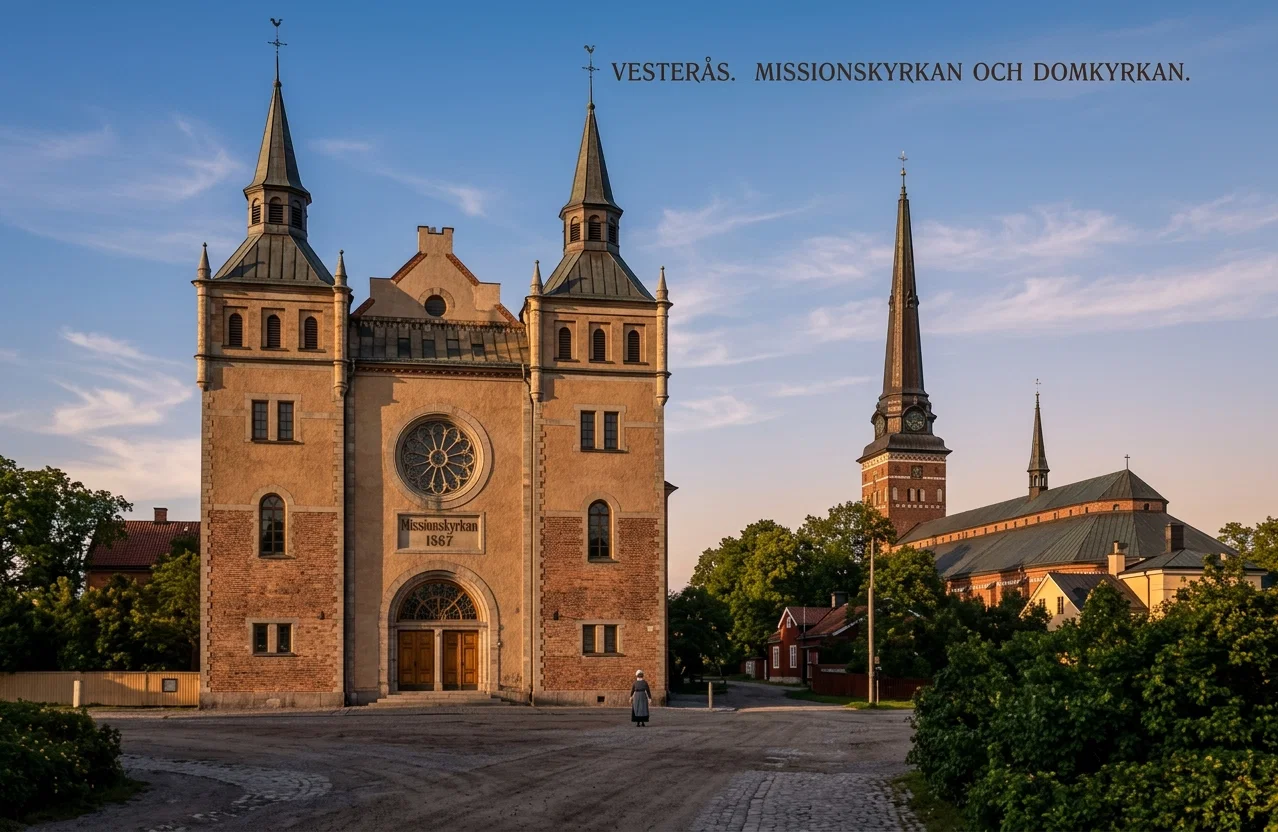
MISSION AND STATE CHURCH, VESTERAS, SWEDEN
Several weeks previously, a tent had been pitched in the city, and a regular course of lectures had been in progress, so that there was a good outside interest already developed, and the citizens of the town helped to form a part of the evening congregation.
Twelve of the thirty churches sent twenty-seven regularly accredited delegates; but a number of other brethren were accepted as delegates by vote of the conference. About one hundred and fifty of our people were on the ground. We have no church at Vesteras, so we think this a fair representation.
Outside help was rendered by Elders L. R. Conradi, P. A. Hansen, Fred Anderson, and F. R. Oberg. One of the subjects most strongly presented was the need of unity in the work of God. This led to greater devotion and consecration on the part of the delegates. Sabbath was indeed a day of blessing; for some gave themselves to God for the first time, backsliders were reclaimed, and nearly all rededicated themselves to the Lord's service. Seven were baptized.
Two new churches were received into the conference, one at Solvesborg (fourteen members), and the other at Karlshamn (seventeen members). In round numbers, eighty were added during the year, raising the membership from eight hundred and one to eight hundred and twenty-seven. A number emigrated to America; indeed, since the conference was organized, about three hundred members have left this field for America, so that this cause alone helps to cut down the net increase.
We heard several good experiences at this meeting, especially with reference to the circulation of the printed page. One man in southern Sweden, where we have the hardest field on account of the prejudice against us, bought a copy of “Prophecies of Jesus,” and read it through fifteen times, and then began to keep the Sabbath, with his wife. Another instance: One of our colporteurs was canvassing, and had the privilege of making his headquarters in the city mission house. In a short time the pastor became angry at him, because he was succeeding so well in his work. He was compelled to leave the mission house, but then the elder of the church said to him: “Drive up to my house, and stay there until you have delivered your books.” In four months this brother took orders for three thousand kroners' worth of books—the best record yet made in Sweden by any of our canvassers. Five or six years ago this brother stammered so much that it was thought by many it would be impossible for him to work as a colporteur. However, so long as he speaks with prospectus or Bible in hand, he does not stammer, but talks well, and is one of our most successful salesmen. God helps him.
Yet one more case: A few days previously to our meeting, the Inland Mission minister had warned all his people against “Christ's Object Lessons;” but the Free Missionary thought that was going a little too far, for he had formerly14bought and read “Steps to Christ,” and thought it a good book. So he went from house to house, reading selections from that book, and asking, “Do you see anything wrong with that book? The other book will be just like it, you may be sure.” His influence helped us very much.
We might refer to some of the things that are taking place in Sweden itself. There has been formed a confederation of churches, whose purpose is to secure the enactment of more stringent Sunday laws; this is perhaps the strongest religious movement in the popular churches of Sweden to-day. Aside from it, we might mention the tendency among the educated classes of the state church toward “higher criticism;” there are also some learned men in the free churches who appear to be infected with the “new thought;” but on the other hand, there are some strong men belonging to the free churches that oppose this “higher criticism.” Spiritualism and Romanism are gaining some ground, and the Millenial Dawn party is growing.
But to return once more to the conference proper: The delegates heartily indorsed the re-establishment of the Scandinavian Union school; the dedication of the First-day offerings to the Abyssinian Mission; and the sending of Ole Nelson to begin work in the Swedish part of the Northlands Mission this fall, to be kept on the Swedish pay-roll until Jan. 1, 1907, when that mission will be formally separated from conference territory. Brother S. F. Svensson was invited to remain, and labor in the conference. It was recommended that a minister should not finish a course of lectures until he had presented the leading principles of the third angel's message, and attempted to get the people to take their stand; that the gospel worker should not be satisfied with simply preaching the word, but that he do thorough house-to-house visiting in the homes of the people; that all be faithful in the payment of their tithes and offerings; and that greater zeal be manifested in the Sabbath-school and missionary departments of the cause.
The health work carried on in Nyhyttan and Orebro has done well. The outlook for this is brighter than ever before.
Here, as in the other Scandinavian meetings, a very great interest was developed in considering the proposed mission for Africa. The collection for this purpose amounted to nearly thirty-four dollars. We hope that the coming year will see a large increase in the First-day offerings, that the necessary funds for the support of the Abyssinian Mission may be forthcoming.
Last year the tithe of Sweden was $4,100, an increase of $1,000 over 1904; the offerings were $770, or a little less than for the previous twelve months. Our book sales here amounted to $16,200 in 1904, and to $16,750 in 1905. The canvassing work and the publishing house have done well. It will be of interest to know that none of the conference institutions have fallen behind financially.
The officers chosen for the coming year are as follows: President, O. Johnson; Vice-President, E. Lind; Treasurer, J. R. Lindqvist; J. M. Erikson, C. Kahlstrom; Secretary and Treasurer of Sabbath-school Department, A. F. Roos; Auditors, M. Haglund and J. Bergstrom; substitutes, A. J. Settergren, J. F. Larsson.
Sanningens Harold: President, E. Lind; Vice-President, O. Johnson; Treasurer, J. R. Lindqvist; Secretary, J. M. Erikson; K. A. Farnstrom, and J. A. Lindberg.
Ministers: O Johnson, J. M. Erikson, K. A. Farnstrom, A. J. Settergren, S. F. Svensson, E. Ahren; licentiates, B. Anderson, O. Nelson; Bible workers, P. Hedstrom, Mathilda Olsson, J. Andersson.
Workers and people return to their work and to their homes with new strength and new courage for another year's effort. May God be with all, and give them still more fruit for their labors, so that this fair land of Sweden may have its full portion of representatives in the great assembly that is soon to take place in the heavens.
GEORGIA A. BURGESS
By Georgia A. Burgess
India
GEORGIA A. BURGESS
We were unable to obtain the piece of land in Tulsipur which we had selected for our mission station. When we made the application, we did not know that the land was under cultivation, but afterward learned that it was in the hands of the cultivators. While we were in Tulsipur, my husband became acquainted with a native gentleman from Almora, a hill station in the Himalayas, several hundred miles from Tulsipur, who gave him a cordial invitation to spend the hot season there. And as it was already becoming so warm on the plains that we could accomplish very little during the day, either in study or in work among the people, it seemed to us a providential opening.
About two weeks ago we came here, and can plainly see the Lord’s hand in guiding us here. While at this season of the year the heat on the plains is intense, here the air is cool and bracing, and the surroundings are delightful. The Lord has opened the way for us to obtain the use of half of a small furnished cottage at a monthly rental of about $3.25. There are many Hindi- and Urdu-speaking people here, and we are already finding openings for work among them.
We are planning to remain here during the hot season, and spend some time in study and getting out literature in the Hindi and Urdu languages. Until recently we have had but one little four-page tract, on the coming of the Lord, for these eighty million people. As we were coming over on the boat, we got out a little tract on the first angel’s message, in Hindi, and while in Tulsipur, with some native help, put it into the Urdu language also. Our tract society in Calcutta had ten thousand printed for us, and while in Tulsipur we had an excellent opportunity of scattering these silent messengers far and wide. Last month there was a large gathering at that place, attended by many thousands from all the surrounding country, whom we could never hope to reach in their homes. Through the help of a native brother, a large number of these tracts were distributed at that time, and we trust that eternity will reveal some fruit as the result.
It certainly seems that among these millions, where there are so few workers, it must be largely through the circulation of our literature that the message will be carried. During the few months we remain here, if the Lord wills, we hope to get out a little magazine of perhaps sixteen pages, in the Hindi and Urdu languages, containing articles on all the leading points of the message—something that will be sufficient to give those who read it a clear view of the truth for this time, though they may never have the opportunity of hearing the living preacher. We are both well and happy, and rejoice every day that the Lord opened the way for us to return to this needy field.
Almora.
A Sensible Conclusion
A CHINESE teacher was taken into a mission family to learn English and translate the Bible into the Celestial tongue. For a long time he remained insensible to anything in the Scriptures but their literary beauty. Abruptly, one day, he rose from his manuscripts, the New Testament open in his hand, and with the rapid manner of one who has been startled by a great discovery, he exclaimed: “Whoever made this Book made me. It knows all that is in my heart. It tells me what no one but a god can know about me. Whoever made me made that Book.”—Selected.
Mission Notes
It is estimated that more than a million people in Persia are addicted to the opium habit.
“BECAUSE they can not please everybody some confine their efforts to pleasing themselves.”
“ALL nations whom thou hast made shall come and worship before thee, O Lord; and shall glorify thy name.” Ps. 86:9.
“HE which soweth sparingly shall reap also sparingly; and he which soweth bountifully shall reap also bountifully.” 2 Cor. 9:6.
“HE shall cause them that come of Jacob to take root: Israel shall blossom and bud, and fill the face of the world with fruit.” Isa. 27:6.
THE Protestant churches in the United States spend annually for home work eighty million dollars; for foreign work, four million dollars—one-twentieth.
The Pacific Press
By H. W. Cottrell
SABBATH, July 21, as the brethren and sisters at the Oakland (Cal.) campground were assembling in the large pavilion for the morning services, word came that the entire manufacturing plant of the Pacific Press Publishing Company, at Mountain View, Cal., had been burned to the ground the night before. The awful news was whispered to a few, but those who heard were at first inclined to disbelieve the report; and not until the sad fact was publicly announced from the stand, at the beginning of the service, did the people realize that a terrible disaster had befallen our work.
Monday forenoon at the camp was devoted to the interests of the publishing work, and particularly to the needs of the Pacific Press in view of the fire. Elder W. T. Knox, chairman of the meeting, made a few introductory remarks, and referred to some preliminary plans to meet the present emergency, and also to plans of a more permanent character. He then asked the writer to make a general statement of the existing conditions and of the future work of the company.
In brief, I dwelt upon the lessons that may be learned from the burning of our publishing house, and upon the plans that have been suggested for the continuance of its work. History repeats itself. As in the days of Elijah, so now; after beholding manifold manifestations of power, including an earthquake and a fire, Elijah heard a still, small voice, the voice of the Lord to him individually. Significant, indeed, is the message that came to him: “What dost thou here, Elijah?” Then, in tender compassion, the Lord manifested himself to Elijah, showing him that those who in quiet trust place a firm reliance upon God will ever find him a present help in time of need.
From every outward appearance, the manufacturing plant of the Pacific Press is totally destroyed, with the exception of two or three office desks and typewriters, and the vault and safe containing plates and valuable papers. This loss is variously estimated at from two to three hundred thousand dollars. The insurance is about one hundred thousand dollars, and it is hoped that this will be paid in full.
But far greater than any monetary loss, is the loss that comes to us from the inability to give the truth to the people by means of the printed page. And in all our planning, this is where our chief interest should center. The people must not be lost sight of. Our periodicals must be sent out as heretofore. Our canvassers and other workers must be supplied with publications. Arrangements are being made by the board of directors to meet these imperative demands.
One of the problems to be solved is that of rebuilding. After much prayer and careful study, we have thought that if the town of Mountain View assures us of ample fire protection and sufficiently liberal monetary inducements, if our brethren and sisters at the Oakland encampment approve of our plans, and if we should not be turned to some other way by the spirit of prophecy, we would rebuild on strictly economical lines. Of course, were everything else favorable, we could not rebuild unless we realize some return from our insurance, and unless our brethren and sisters in California and in many other places rally nobly to our support. But we feel as if we ought, as one man, to arise and move forward in the name of the Lord.
A Statement From Brother C. H. Jones
Brother C. H. Jones, general manager of the company, followed with a heart-to-heart talk regarding the present situation. “It is with sorrow of heart,” he declared, “that we appear before you this morning. We are cast down, but not discouraged; for we know that God lives and reigns. Our buildings are in ashes,—the material things have gone,—but the institution remains; for it is in the hearts of our people, and in the hearts of our employees. The work of the institution will go on; for it is God’s work, and he still has a work on the earth to be done by us.
“This morning I, for one, desire to stop and listen to the still, small voice; for God is in the voice. I desire to hear what he has to say to me individually, not what he has to say to some one else. I believe that from this calamity I can learn a lesson that will be a blessing to me. And more than all else, I believe that God is able to turn this calamity into one of the greatest blessings possible to the entire cause. I look forward to the next two years, and I firmly believe that if we take the right course, we shall see this work moving forward as we never believed we could see the truth going to the people. Though we are temporarily disabled, I believe that God is able to bring things around so that the truth will go more rapidly and with greater power than ever before.
“One great encouragement to us,” the speaker continued, “is the fact that no lives were lost. Our lives have been spared, and we are all of good health, and of good courage in the Lord. Four persons came very near being killed. It seems a miracle that they were not; but not a soul suffered any bodily injury. God in his mercy cared for us all.
“Our hearts have been touched by the telegrams and letters that we have received. The managers of several small printing plants have said, ‘Our place is at your disposal. If you so desire, you may send your men here to work it at night, and we will work during the day.’ Some of the San Francisco representatives of the largest type-foundries in America, have sent their men to us with the offer to furnish our company with a complete outfit of type and machinery, and leave us entirely free to pay for it at such time as we might choose. Bankers have proffered liberal assistance. Other offers have come to us, in various ways.
“As stated before, I am thankful for the privilege of laying before you our present situation and needs. Above all, I hope we may do a great deal of praying that God shall guide in this time of need. In all our afflictions he is afflicted. We know we have a kind, loving Heavenly Father, and that his hand is ever extended to help his children in their extremity. If we all take hold courageously and earnestly, we can lift this thing out, and God will turn it into a great blessing for this people.”
Words of Counsel and Encouragement From Sister White
At this juncture of the meeting, Sister E. G. White spoke, as follows:—
“I am so glad that we have for our God One who judges righteously, and who understands the human heart. He knows just how to deal with every human being; and for this we ought to render to him grateful, heartfelt thanksgiving.
“We are distinctly denominated as a people that keep the day which the Lord gave man in Eden in commemoration of the creation. After God had made the world in six days, he rested on the seventh day, and was refreshed; and he blessed the day upon which he had rested, and sanctified it. By observing this day, we are to be reminded continually of the creative power of our God.
“The world’s inhabitants have lost sight of the holiness of God’s law, and have set aside the day that he has sanctified. In its place, they have substituted a day of their own choosing. As a people, we are bidden to restore that which has been broken down. The breach that has been made in God’s law, must be repaired. In directing the attention of the world to the light of the truth for this time, preparatory to the second coming of Christ, we are to use every agency possible for the proclamation of our message.
“It is for this purpose that our institutions have been established. The world is filled with subjects of Satan’s kingdom. We thank God that we have many institutions wherein are carried forward various lines of work.
“How thankful we should be that we have a God who can preserve and sustain us in the hour of trial! We can not always understand his dealings with us. His providences may at the time seem strange; but he has in view something that is for our good and for the glory of his name.
“In the book of Job we find recorded a narrative that throws considerable light on things otherwise difficult to understand. [Sister White then read the first chapter of Job.]
“From this scripture we may learn much regarding God’s dealings with his people. And when calamity comes, unless the Lord indicates plainly that this calamity is sent as a punishment of those who are departing from the word of his counsel; unless he reveals that it has come as a retribution for the sins of the workers, let every man refrain from criticism. Let us be careful not to reproach any one.
“The enemy is often permitted to try God’s people in just such a way as Job was tried. And when Job’s friends came to him and began to remind him of his sins, and to urge that he was suffering because of divine displeasure, they were doing a work that was wholly uncalled for.16
“Job endured the test; he proved true to God. And after his trial, his blessings were manifold. The prosperity that attended the closing years of his life gave the enemy no opportunity to exult over the former misfortunes of God’s faithful servant.
“The Lord desires us to labor for the benefit of one another. Let us all, ministers and people, be careful of our words. The power of speech is a talent; the mind, the voice, the strength,—all these are precious talents. Let us keep them wholly sanctified for service in God’s cause. We must sanctify ourselves, body, soul, and spirit, unto God, that he may use us effectually as evangelists for the carrying forward of his work.”
Elder S. N. Haskell’s Talk
At the close of Sister White’s talk, the chairman called upon Elder Haskell, who responded as follows:—
“I hardly know what to say, brethren and sisters. You all know what we want. We expect you will help raise some money to rebuild the Press; and this is the beginning and the end of my plea.
“I should like to add one thought, however, about Job, and about another man, too, brought to view in the Bible. You know that those who came to comfort Job were miserable comforters. The Lord had said that there was not another man like Job in the earth; but these self-appointed comforters tried to show the afflicted man his sins. They were satisfied that they knew exactly how to correct him, and so they set their hands to do it, and labored to this end for some time. They thought they could tell him exactly why he was sick, and why he had lost all his property. To the very end, Job held fast his integrity; and finally, when they came to make an offering to the Lord, he responded by directing them to ask Job to pray for them. Job was more acceptable in God’s sight than were these men who thought they could discern his mistakes.
“There is another scripture that throws some light on this matter. It is the word of the Lord at the time Balaam was trying to curse Israel. Speaking of God, Balaam declared: ‘He hath not beheld iniquity in Jacob, neither hath he seen perverseness in Israel: the Lord his God is with him, and the shout of a king is among them.’ But what had the Lord been doing all along?—He had been reproving Israel for their sins; and yet, just as soon as the enemy rose up and began to curse Israel, God came to their defense. I suppose the righteousness of Christ made them all right in his sight.
“I think, dear friends, the very best thing we can do now, under the circumstances (and I know you will all think the same way), is to put our hands in our pockets, and give willingly for the restoration of our printing plant. It has been thought by our brethren who are in a position to know, that a hundred thousand dollars, at least, will be required in order to place the manufacturing plant on vantage-ground. If you make a good start here, you will have to give until you feel it. The Californians know how to lift when they find themselves in a tight place. I know this; for I have seen them try it in the past, and very successfully, too.”
A Generous Response
Elder Haskell then called for gifts, large and small. The brethren and sisters responded nobly, and over nine thousand dollars, in cash and pledges, was raised in a short time.
By a rising vote, as well as by their offerings, the congregation signified their desire to see the Pacific Press plant re-established at Mountain View. It is hoped that as the needs of the publishing work are brought to the attention of the churches throughout the State, California’s offering will be largely augmented.
We are sure that in this, our great loss, we shall have the sympathies of the people of the entire denomination. May we not expect a manifestation of sympathy in a very material way?
H. W. COTTRELL.
British Central Africa
By Thomas H. Branch
PLAINFIELD MISSION, CHOLO.—As we read how the message of mercy is finding a hold in the far-away places of the earth, and how small companies of Sabbath-keepers are being raised up here and there, in places we knew not of, we know this is the Lord’s doing, and with the reports of troubles, of earthquakes, of accidents on railroads, and of the many lives that are being destroyed thereby, also of the destruction of life by famine and war, it plainly shows us that the Lord is at the door.
I am anxious about all the work in Africa; for a strong force is needed to carry the truth into regions beyond. This great field has scarcely been touched with this warning message. How I long for power to do more! But I am sure that God’s word is true, and not one of his promises fail. He has promised to put his Spirit upon young men of every kindred, tribe, and tongue, and fit them to go forward with this message. To this end we are laboring and praying, that erelong in this dark spot there will be a strong force of young men to work for the Master.
I think our crops this year are the very best we ever had. The yield of corn was good, also of the beans, peanuts, and sweet potatoes. There is plenty to feed our schoolboys, and we have quite a little for the market. We have a boarding-school for the boys. While it takes a little more of some things, such as beans, salt, and other things for relish, I find it much cheaper, and a great deal more satisfactory. Everything is moving on well. Of course now and then a boy goes away. But we have some excellent boys, who have been with us several years. They are advancing slowly, step by step. These people do not learn fast; but, considering that they are just beginning to see the light of day, and of better things, we think their progress remarkable. I am now instructing them in church organization daily, and when they understand the principles well, we wish to organize a church. Many of the boys are now paying tithes; and they respond well to the offerings which we take once a month in the Sabbath-school. All do not as yet see their duty in this matter, but I think they will soon.
The attendance and interest in the school work are very good. The work in general at the mission is encouraging. But more laborers are needed, and we are praying for the God of the harvest to send them, and send them quickly; for the field is white to the harvest, and much will be lost if we delay too long.
We have received some financial aid from some dear brethren, for the support of native workers. We certainly appreciate this effort, for it helps so much. We have received a letter from Elder Hyatt, telling us that the native boy, Peter Nyambo, who has been in London studying for the past three years, is to start for home soon, and is to help us here at the mission. For this we are very glad, for we are much in need of help.
Sometimes I think I shall be glad when this battle is over, and God’s people are gathered home, to sing of the redeeming love of Christ. But when I look around, and see so many wanderers in the darkness, I know that they will have no part with the saved, so I pray for God to give me grace to labor on until his will is done. We ask your prayers, that we may have wisdom from God to labor on.