Your ShelfYour Projects

Signs of the Times, Vol. 31, No. 48.

GOD’S LOVING-KINDNESS

Signs of the Times

Nov 29, 1905

Pacific Press Publishing Company · Mountain View, California · Nov 29, 1905

GOD’S LOVING-KINDNESS

The transgression of the wicked saith within my heart, There is no fear of God before his eyes. For he flattereth himself in his own eyes, that his iniquity will not be found out and be hated. The words of his mouth are iniquity and deceit: he hath ceased to be wise and to do good. He deviseth iniquity upon his bed; he setteth himself in a way that is not good; he abhorreth not evil. Thy loving-kindness, O Jehovah, is in the heavens; Thy faithfulness reacheth unto the skies. Thy righteousness is like the mountains of God; Thy judgments are a great deep: O Jehovah, Thou preservest man and beast. How precious is Thy loving-kindness, O God! And the children of men take refuge under the shadow of Thy wings. They shall be abundantly satisfied with the fatness of Thy house; and Thou wilt make them drink of the river of Thy pleasures. For with Thee is the fountain of life; in Thy light shall we see light. O continue Thy loving-kindness unto them that know Thee, and Thy righteousness to the upright in heart. Let not the foot of pride come against me, and let not the hand of the wicked drive me away. There are the workers of iniquity fallen; they are thrust down, and shall not be able to rise.

The Four Specials Bound Together

As our readers are aware, we have just published a series of four Special numbers of the SIGNS OF THE TIMES. As these numbers are very closely related and ought to be circulated in sets, we have decided to bind a limited number of them together. The prices will be as follows:
Per Set
One to four sets to one or more addresses $.25
Five or more sets to single addresses .16
Twenty-five to five hundred sets to one address .11
This will not interfere in any way with those who wish to circulate the papers singly, as only a portion of the stock on hand will be thus bound. The prices on the regular sets not bound together will be as follows:
Per Set
One to four sets to one or more addresses $.20
Five or more sets to single addresses .15
Twenty-five to five hundred to one address .10
Five hundred and upward .09
These papers will remain fresh and salable for months. Let none think because their dates are past that we ought not to continue our efforts to circulate them.
Address
SIGNS OF THE TIMES
Mountain View, Cal.

A Double Number of OUR LITTLE FRIEND

Our little folks have great reason for rejoicing. Their paper, OUR LITTLE FRIEND, has decided to come out in holiday dress, in the form of a four-page cover in three colors, and with twice as many stories, pictures, and letters as usual. This Special number will take the place of the last two issues of the year, and will soon be ready. Of course all those who are regular subscribers to OUR LITTLE FRIEND will receive this number without extra charge. The price to others will be five cents each, but to those who wish to sell it, the price will be two and one-half cents each in lots of 10 to 499, or two and one-quarter cents each in lots of 500 or more.
If each subscriber to OUR LITTLE FRIEND will sell five copies, more than 75,000 copies will be circulated. Is this too much to expect, when we stop to think of the many, many good things OUR LITTLE FRIEND brings to us from week to week?
Please order early, and remember the price:
5 cents each if you take less than ten; 2½ cents each if you take ten or more; and, 2¼ cents each if you take 500 or more.
Address all orders to
OUR LITTLE FRIEND, Mountain View, Cal.

CHILDREN'S CORNER.

"HOW A LITTLE GIRL WENT TO AFRICA."

How many of the little folks would like to take a trip to Africa? Everyone, we are sure, providing your fathers and mothers went along and you could come back home sometime.
But not many of you can ever go, because it is a long way off and costs a great deal to get there. One little girl did go, however, and on the way she took notes of all that she saw, and many things in the far-away land that other little boys and girls will be delighted to read about.
She has had it printed in book form, especially for the little folks that can not go, and has put into it some pictures of the queer sights she saw in that strange land.
171 pages. Price in cloth binding, $1.00.

"MAKING HOME HAPPY."

How the children all enjoy a happy, cheerful home, where no cross words are spoken, and where the family gather around the fireside and read and talk of pleasant things. Even the cat and the dog and the horses and the cows seem more happy and contented around a home like this.
Our book tells how an unhappy home was made happy, and pictures before you in interesting story form just how you may have a home like that all the time. The book is bright and cheery throughout, with attractive pictures and interesting stories, and has also a beautiful cover design.
200 pages. Price, cloth, 50 cents.

"OUR LITTLE FOLKS' BIBLE NATURE."

How the children enjoy taking a walk with papa and mama out through the woods and down by the babbling brook, and to pick the beautiful flowers growing in some sunny nook. If you watch closely you will see the fish in the water, too, and many queer bugs and insects about you.
Do you know who made all these things and what they were made for? "Our Little Folks' Bible Nature" tells many things about trees, plants, flowers, birds, and insects that will help you to enjoy them better, and teaches you how to read at the same time. It has pictures on every page, too, and some of them are nicely colored.
128 pages. Price, board, 25 cents; cloth, 40 cents.
PACIFIC PRESS PUB. CO., MOUNTAIN VIEW, CAL. 285 Salmon St., PORTLAND, ORE. 1109 E. 12th St. W., KANSAS CITY, MO.

THANKSGIVING

IT is a good thing to give thanks unto the Lord, and to sing praises unto Thy name, O Most High; to show forth Thy loving-kindness in the morning, and Thy faithfulness every evening.” Such expressions as this make our one-day-in-the-year of national thanksgiving, with its varied demonstrations of self-gratification, seem decidedly insufficient. Nevertheless “it is a good thing to give thanks unto the Lord” even for one day.
If the people all over the land would really engage in thanksgiving for one day, it would open the way for the Spirit’s work upon hearts to an extent never before known. There would be a humiliation of heart before God, a confession of sin, a righting of wrongs, a restitution of ill-gotten substance, a breaking of yokes and shackles, a reconciling of enmities, and a general outburst of charity for all men, such as the country never has experienced. All these things are involved in true thanksgiving on the part of a sinful people.
THANKSGIVING means much more than a slaughter of turkeys, with gambling for their carcasses, a popping of corks, a gormandizing dinner, a night of revelry, and a busy day for the guardians of the peace—all to be followed by a day of physical debility and feelings of anything but thanksgiving. It means more than a general relaxation of business restraint, a day of jubilation, a day composed of two parts religious meetings—in which we have much of self-praise for what we have accomplished in the past year—to ten parts sensual pleasure, and the whole spiced with debauchery.
THE thirtieth day of November will give the people of these United States an opportunity to express their ideas of what thanksgiving means to them. We offer a suggestion, taken from the ninety-fifth psalm: “O come, let us sing unto the Lord; let us make a joyful noise to the Rock of our salvation. Let us come before His presence with thanksgiving, and make a joyful noise unto Him with psalms. For the Lord is a great God, and a great King above all gods. In His hand are the deep places of the earth; the strength of the hills is His also. The sea is His, and He made it; and His hands formed the dry land. O come, let us worship and bow down; let us kneel before the Lord our Maker.”
The President’s proclamation, which appears on page 7 of this paper, is a good expression of the idea of a thanksgiving day; it is the best that has been issued for many years by any executive. It is true that no nation has more, or as much in some respects, to be thankful for than the United States of America; yet no people ever were more prodigal of the gifts of God than those of this highly-favored land. We have been even reckless of our fertile lands, in allowing them to pass into the hands of greedy speculators; wasteful of our protecting forests; neglectful of our great water ways, allowing them to become obstructed in various ways; we have become careless of our natural rights, yielding them to capitalists and politicians; and we have become especially regardless of our civil and religious liberties, which are rapidly passing from us by default of the people in the matter of zealously guarding them. In all this we have shown a spirit of unthankfulness, by manifesting a lack of appreciation.
In a general way the President’s proclamation gives us a comprehensive suggestion for thankfulness. We would not discount it in the least, but would add the injunction of the apostle Paul, “In everything give thanks; for this is the will of God in Christ Jesus concerning you.” As people in general “walk by sight,” they have no idea of thankfulness excepting for things that appear to the natural eye. It requires the eye of faith to appreciate the goodness of God in the as yet unseen things manifested through His Word. With a belief of His promises we may see grounds for thankfulness that far exceed the transitory evidences of temporal prosperity.
When fleeing from Egyptian bondage, the children of Israel sang a song of thanksgivingafter passing the Red Sea which they might just as well have sung on the other side of the sea, before the waters gave any sign of opening. The victory of faith is just as sure in the prospective as in the retrospective; and the thanksgiving of faith is not confined to the year’s retrospect, it looks forward to the far greater things involved in the unfailing promises of God. Such a spirit of thankfulness will show forth the loving-kindness of God every morning, and His faithfulness every evening.
True thanksgiving also implies rendering what is due to God. “Offer unto God thanksgiving; and pay thy vows unto the Most High; and call unto Me in the day of trouble; I will deliver thee, and thou shalt glorify Me.” Ps. 50:14, 15. Surely there is before the people of this nation a day of trouble, for the mouth of the Lord hath spoken it. There is trouble before all the world. Will not the eye of faith look forward to this time and prepare for it by rendering to the Lord His due, and rendering thanks for the promise of deliverance in that time?
We most heartily desire that the people of this great country may have an enlarged appreciation of true thanksgiving on the coming day set apart for that purpose. May it be more than a mere festival, in which the temporal gains of the past are enumerated. May our thanksgiving reach forward to the glorious possibilities for those who trust in the Word of God. Let us all “enter into His gates with thanksgiving, and into His courts with praise; be thankful unto Him, and bless His name. For the Lord is good; His mercy is everlasting; and His truth endureth to all generations.”
G.

THE SCAPEGOAT.

Many people hold that the “scapegoat,” connected with the typical service of the earthly sanctuary, represented Christ. This error is so frequently expressed that a few words on the subject may be profitable.
The matter is connected with the service of the day of atonement, as described in Leviticus 16. After the high priest had made an atonement for himself and his house with the blood of a bullock, he was directed to take two goats and set them before the Lord at the door of the tent of meeting. Upon these he was to cast lots, “one lot for the Lord, and the other lot for the scapegoat.” The margin for scapegoat is “Azazel,” which both Jewish and Christian authorities define as referring to Satan.
Then the high priest was to “bring the goat upon which the Lord’s lot fell, and offer him for a sin-offering.” This goat that was offered, the one upon which the Lord’s lot fell, represented Christ. It was “the sin-offering for the people.” It was killed, and its blood was taken within the vail, and sprinkled before the mercy-seat and upon it, for the uncleanness of the children of Israel. This cleansing of the sanctuary was because of the sins which had been carried in by the high priest during the year and confessed before the Lord. The year’s round of service represented the work of our High Priest in the heavenly sanctuary, and the day of atonement represented the final judgment.
After the blood of the sin-offering was sprinkled upon and before the mercy-seat, underneath which was the ark containing the violated law, thus in type making an atonement for sin, there was another typical ceremony: “He [the high priest] shall go out unto the altar that is before the Lord, and make an atonement for it; and shall take of the blood of the bullock, and of the blood of the goat, and put it upon the horns of the altar round about. And he shall sprinkle of the blood upon it with his finger seven times, and cleanse it, and hallow it from the uncleanness of the children of Israel.”
We must bear in mind that the cleansing of the earthly sanctuary signified the removal of the sins confessed by the Lord’s people and borne in there by the high priest. So it is in the heavenly sanctuary, where Christ receives our confession of sin. The final judgment of the righteous is the antitype of the cleansing of the earthly sanctuary on the day of atonement. So the cleansing of the heavenly sanctuary is the removal of the sins that have gone before by confession unto judgment. 1 Tim. 5:24.
After the ceremony of “reconciling,” or cleansing, the holy place, and the tabernacle of the congregation, and the altar, the live goat was brought forward. The command was that the high priest “shall lay both his hands upon the head of the live goat, and confess over him all the iniquities of the children of Israel, and all their transgressions in all their sins, putting them upon the head of the goat, and shall send him away by the hand of a fit man into the wilderness; and the goat shall bear upon him all their iniquities unto a land not inhabited; and he shall let go the goat in the wilderness.”
This scapegoat, altho let go alive, was never heard of more. Evidently it perished in the wilderness. So it could not have represented the Lord Jesus Christ, who, altho He was put to death, appeared again on the third day and soon afterward took up His work as High Priest of the heavenly sanctuary. Even the man who led the scapegoat away to final destruction was obliged to cleanse himself and his clothes by thorough washing before he could re-enter the camp of the Lord’s people.
In the type the sins that had been confessed before the Lord in the sanctuary were carried away to perish with the bearer; so in the antitype, the final judgment of the righteous, their sins will be put away forever. Ps. 103:12; Jer. 31:34.
Satan not only originated sin, but he is the instigator of all sin; therefore justice demands that he suffer for that which he caused those to do who afterward repented and were forgiven. Their being forgiven does not forgive him. When the heavenly sanctuary shall have been cleansed, by blotting out the sins of the penitent class, and these sins are removed by our great High Priest, He will lay them on the head of Satan, who instigated them. So Satan is the antitypical scapegoat, bearing those sins with him to his own final destruction.
G.

Light from Heaven

THE light from heaven can never lead you astray.—Maclaren.

OUR EXAMPLE IN ACTIVITY.

A CLASS of literature has become very popular of late, which is but a revival of the religio-philosophical teaching of ancient heathenism. Books are written by the score expounding the mysterious intertwinings of humanity and divinity which finally terminate in man becoming god, and entering the realm of eternal cessation from all activity. It is a goal similar to that for which the Buddhist yearns—Nirvana.
But all these teachings based on human reasonings, pandering to the human desire for self-exaltation, and pointing to a glorious eternity of inactivity, are antagonistic to the spirit and principles of the doctrine of Christ and the example of the Father.
The Word tells us of the angels that they are “all ministering spirits, sent forth to minister for those who shall be heirs of salvation.” To minister is to serve, to work for. He who is the greatest minister is the greatest server. They who have been permitted to look into heaven in vision have beheld there scenes of intense activity. Who can imagine a busier week than that which put into shape our solar system, bathed it in light, and filled it with life? Our God is indeed a working God. Christ said of Him and of Himself, “My Father worketh hitherto and I work.” There is man’s example.
There is a rest for the people of God, but it is not the rest of idleness or slothfulness. It is the rest of peaceful, harmonious, God-ordained activity in carrying out the beneficent commands of our Father. The true Christian has true rest in the midst of strenuous activity; peace in the midst of the world’s turbulence and strife—all because he is trusting implicitly in the wisdom and mercy and power of God. That peace and that rest are foretastes of heaven, and come in their completeness when heaven shall have welcomed its loyal subjects home; when all sin and all suffering have been forever removed and the earth has been purified by the fires of God’s cleansing.
God’s command to His children is, “Go work to-day in My vineyard;” “Go ye into all the world, and preach the Gospel to every creature;” and that He Himself was not looking for any Nirvana is shown by the promise which He gave to His followers, “And, lo, I am with you always, even to the end of the world.”
As Christ Himself was not rewarded without service, neither can His followers expect to be. “A place of reward in heaven presupposes a place of service on earth;” and that place of reward in heaven will not be filled by us unless the place of service on earth has been filled.
Every person of sound mind has his talent or talents. We can not afford to bury even the one talent. God has done great things for us, and He expects great things of us. So He has placed at our command a power that will enable us to accomplish great things for Him. He has made it possible for us to be a source of joy and satisfaction to Him through all eternity. Do not disappoint Him. As there are no drones in heaven, we can not be drones here and hope to enter there. Let Him work out in you that which He has purposed concerning you. Then will our Saviour, that great servant of man, “see of the travail of His soul and be satisfied.”
S.
CARRY yourselves back in thought to ancient Babylon, five hundred and forty-one years before Christ. Nebuchadnezzar had passed away after learning the great lesson that “the Most High ruleth in the kingdom of men, and giveth it to whomsoever He will.” Three of his successors had perished, and Babylon is disrupted by external and internal troubles. Nabonadius, a devout religionist, is on the throne. He gives himself to temple building, and associates with himself his inexperienced and dissolute son Belshazzar, to whom is committed the actual rule and defense of the empire.
In the very beginning of Belshazzar’s reign God gives to His prophet for the benefit of His children then and for all time, the divine, infallible forecast of the great dynasties of earth before any one of them has finished its career. He looked down through the ages and saw the tyranny, the cruelty, the oppression, of those who would be loyal to truth and duty, and sends this beacon of warning to the world, this message of comfort to His people. The vision covers the same ground in time and empire as that recorded in Daniel 2.
In Daniel 2 the kingdom of man is symbolized as to its glory and lasting qualities by various metals, in the image of a man.
In Daniel 7 the same kingdom of man in the same dominant phases is symbolized as to its character by wild and cruel beasts.

Meaning of Symbols.

These beasts are represented as abnormal in appearance, possessing wings, multiple heads, and horns, and rising successively from a wind-swept sea.
The first was like a lion with eagle’s wings.
The second was like a bear raised up on one side, with three ribs in its mouth.
The third was a four-winged leopard with four heads.
The fourth was a terrible nondescript beast, with great iron teeth, strong exceedingly, devouring and breaking in pieces, and having ten horns.
The fifth is a little horn, arising later upon the same beast, and dominating all the other horns and the beast.
Elsewhere the Word of God, inspired by the same Spirit, interprets these symbols.
“Sea” and “waters” represent peoples, nations, tongues. Rev. 17:15; Isa. 8:7.
“Winds” symbolize war and strife. Jer. 25:32, 33; Rev. 7:1.
“Beasts” signify kingdoms, as do also “lions.” Dan. 7:17, 18, 23, 24.
The sum of the vision is this: The prophet looking down the ages upon the great sea of human life, sees as the result of war and strife four great successive world empires, of varied character, the last of which passes through several changes and forms to the end.
The first of these, the eagle-winged lion, represents Babylon, nearing her end. See Jer. 4:7, 13; 48:40; Hab. 1:8.
The bear represents the successor of Babylon, Medo-Persia, symbolized in Jeremiah by a wolf, and elsewhere in Daniel by a ram. Jer. 5:6; Dan. 8:20.
The four-winged, quadruple-headed beast is a symbol of Grecia, the four heads representing the four parts into which Alexander’s kingdom was divided a few years after his death. See also Dan. 8:21; 11:3, 4; Jer. 5:6.
The great and terrible beast is the iron kingdom of Rome; the ten horns the ten divisions of western Rome into which the kingdom was divided between the years A.D. 351 and 476.
These kingdoms are the Allemani, Franks, Burgundians, Vandals, Suevi, Visigoths, Anglo-Saxons, Ostrogoths, Lombards, and Heruli. The last of these arose in 476, and from that time to 493 there existed just ten divisions, no more and no less.

The Little Horn.

While the prophet considered the ten horns, he saw arising another little horn which lorded it over all the others. Of this little horn there are not less than eleven specifications in this chapter, as follows: (1) It arose in a ten-divisioned kingdom, verse 8; (2) Before it three of the ten fell, verse 8; (3) Strength and assumption compared with other horns, verse 20; (4) Diverse in character, verse 24; (5) Shrewd and far-seeing, verses 8, 20; (6) Blasphemous, verses 8, 11, 20, 25; (7) Persecuting, verses 20, 21, 25; (8) Presumes to change unchangeable law, verse 25; (9) Continues as persecutor a definite time, verse 25; (10) Dominion taken away, verse 26; (11) Power to persecute restored, verses 20, 21; Rev. 13:3.
These are fulfilled in the history of only one power in the world, either ancient or modern, and that is the Papacy. By this is not meant the Roman Catholic Church, in whose folds are many sincere Christians, notwithstanding her fearful departure from truth, but the Papacy state-recognized having dominion, or spiritual domination, over the Roman Empire during the time of the Dark Ages. Note the fulfilment, of which the space allotted to this article permits only the briefest mention:
1. The Papacy rose out of the ten kingdoms of Western Rome, through civil acknowledgment of her spiritual supremacy, obtained in various ways.
2. Before the rising influence of the Papacy there fell the three Arian powers, Heruli (493), Vandals (534), Ostrogoths (538).
3. Surely the papal form has been more stout than its fellow kingdoms. Many of them have utterly fallen; the Papacy abides.
4. The other powers were purely civil; the Papacy was “diverse,” religio-civil.
5. Other kingdoms have plotted and planned for the present; the Papacy for the far future,—man’s eyes in a beast.
6. It has been pre-eminently a blasphemous power, arrogating to itself powers and titles which angels would not assume, and demanding worship due only to God.
7. The Papacy, of itself and in its influence over the powers dominated, has martyred myriads of God’s children.
8. The Papacy, on its own confession, has thought to change God’s immutable law as respects the Sabbath.
9. The spiritual domination of the Papacy continued a time and times and half a time—three and one-half years, forty-two months, 1,260 days (Rev. 12:6, 14; 13:5)—which, according to prophetic time, a day for a year (Eze. 4:6; Num. 14:34), symbolizes 1,260 years. This period began in 538 when Justinian’s decree went into effect (given in 533) that “the bishop of Rome should be head over all the churches” and “true and only corrector of heretics.” It ended in 1798 when the papal domination over Europe was effectually broken by the capture of Pope Pius VI.
10. The civil dominion of the Papacy was taken away by Victor Emmanuel in 1870.
11. The power to persecute is not yet restored. It will be done by an acknowledgment of the papal claims as to what is authoritative in religious matters. That time hasteth greatly.

The Judgment.

Three great words of comfort God gives in this seventh chapter of Daniel. One is a description of the judgment scene, and the visitation of its sentence upon the oppressors of God’s people, the apostate governments of earth, which like cruel beasts have ravaged the vineyard of the Lord and persecuted Christ in the person of His own. Verses 7-12.

Christ and His Dominion.

In the closing of the career of these cruel earth-kingdoms a different scene takes place in the courts of heaven. The Son of Man is finishing His priestly work. He comes before the Father and to Him is given “dominion, and glory, and a kingdom, that all the peoples, nations, and languages should serve Him; His dominion is an everlasting dominion, which shall not pass away, and His kingdom that which shall not be destroyed.” Ps. 110:1; 2:7-9; Dan. 2:44, 45. He has demonstrated that “righteousness is life;” that eternal right is eternal might.

His People’s Glory.

God’s people are not forgotten. From the fiery furnace of Babylon to the last dungeon martyr or the auto da fé, God remembers them. Deprived of all justice, of all right, in the kingdoms of this world, they often have been; but when Christ shall come to His own, then “the kingdom and the dominion and the greatness of the kingdom, under the whole heaven, shall be given to the people of the saints of the Most High; His kingdom is an everlasting kingdom, and all dominions shall serve and obey Him.” See also Matt. 25:31. “And the ransomed of Jehovah shall return, and come with singing unto Zion; and everlasting joy shall be upon their heads; . . . and sorrow and sighing shall flee away.” Isa. 51:11.

TALKING PEACE AND BUILDING GUNS.

Another peace congress is called at The Hague, and the nations are sending their delegates thither. Only a few years ago he who is now the beaten ruler of a distracted empire convened a similar congress; but before the ink had dried upon the engrossed copies of their resolutions, he was planning the extension of his domain in the far East. He pushed his plans until Japan dared lie listless no longer under the menace of his pretensions. Then came a fearful and bloody war. It is ended. Russia has lost heavily in men, guns, and means; and her navy is practically destroyed. Again her ruler calls a peace congress, and again his representatives will propose a limit of naval construction; for without that, Russia will be fearfully behind her greedy and militant rivals.
Every nation in the world would welcome peace if it did not have to relinquish any of its ambitious designs. Russia wanted peace; but she wanted Manchuria more than she wanted peace. Now she wants peace; but when war suits her designs better, she will accept the gage of battle again. In this attitude she is not unlike the other nations of the world—peace when it does not interfere with national projects.
But now while the program of the second Hague congress is being prepared, and while the different nations are settling the question of delegates thereto, another program is being pressed vigorously forward by every great nation in the world; it is the program of war. Even China is aroused from her sleep of centuries. She is fast increasing the size of her fighting force, and is giving to her army the best training possible in harmony with Western ideas. Reports from China state that military representatives of other nations have been wonderfully impressed by the showing made by China’s army in its recent maneuvers. Heretofore China’s army has been a byword and a joke among military attaches. They are not joking about it now; and the possibility of having to reckon with China as a mighty military power in the not distant future, is worrying the great nations already. Russia, it is reported, will keep 300,000 troops on the border of China. She has used China about as she wished in the past, and China has yielded to demand after demand, because she dared not do differently. Japan, in protecting herself against Russian encroachments, has pointed out to China the road to the same goal. It is possible that Russia may, before many years, have occasion to use her China-border troops, and may find as great a surprise awaiting her there as she did in Manchuria. There are other nations that have pressed China in the past, that are holding Chinese territory for which they have given no equivalent. When China feels able to assert her rights, there is no doubt that these nations, too, will have to abandon their acquisitions or fight for them; and in that contest they will have to reckon with Japan as well as with China.
Japan has acquired much in the late war. She has taught some lessons and learned many. She is preparing to maintain what she has acquired, her navy has been largely increased by her captures from the Russians, and she is building other vessels. She has learned the chemical secrets of high explosives and how to use them. She has learned how to make arms of precision, and does not need now to depend upon foreign nations for these supplies. She is now making in her own shipyards battle-ships of the very largest size and greatest efficiency, the guns to arm them, the armor to protect them, and the engines to drive them.
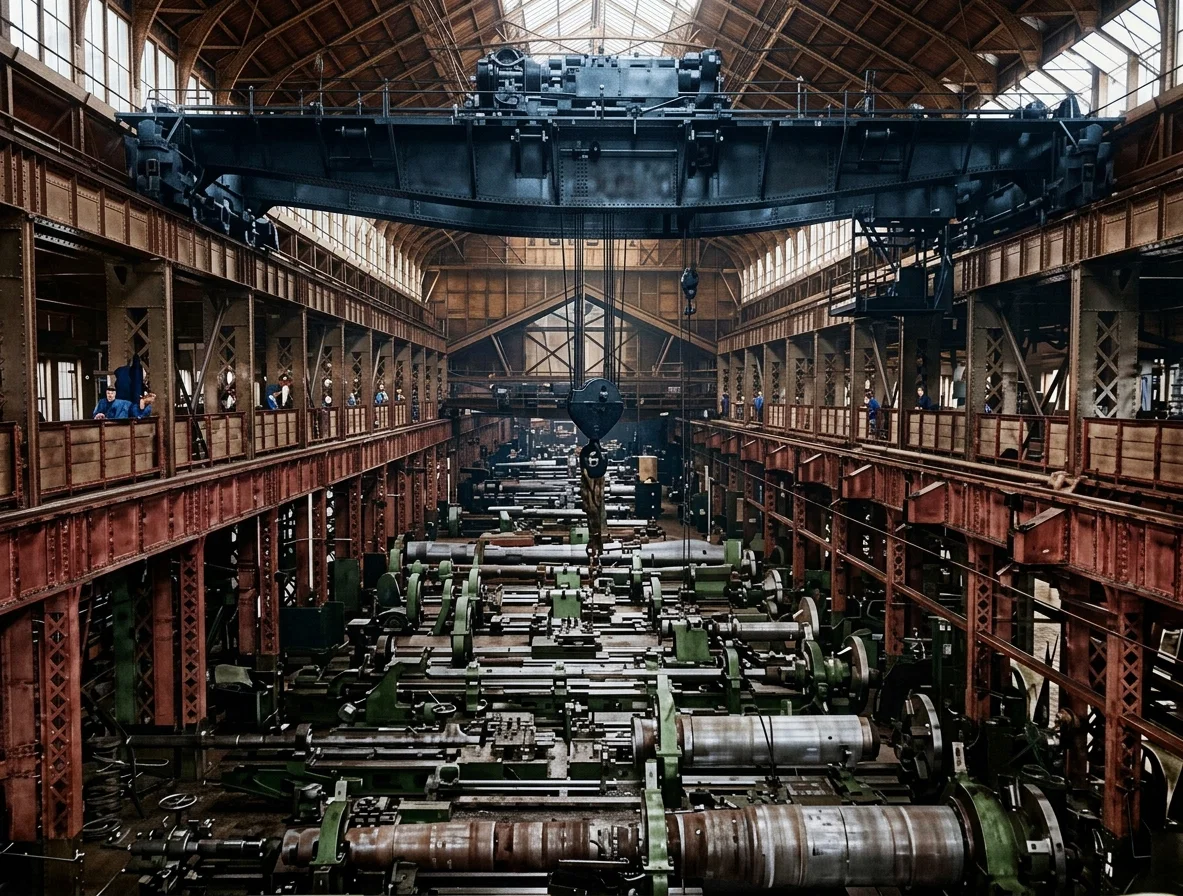
A Great Crane in the Famous Krupp Gun Works.
In Europe, the great nations are building larger and stronger battle-ships and swifter cruisers than ever before. They are studying the problem of how to mount more guns and more effective guns upon their decks and in their barbettes. They are all manufacturing and perfecting submarines; while their army officers are studying the problem of more effective artillery and small arms.
The general board of the American navy has recommended the construction of battle-ships of greater tonnage than any yet projected for the American navy. They are also considering the problem of installing ten, instead of four, twelve-inch guns on each battle-ship, and of increasing the tonnage of some of the battle-ships already authorized from 16,000 tons to 18,000 tons. There are now building in American shipyards six battle-ships of 16,000 tons displacement, which will be ready for commission within twelve or fifteen months, together with six large cruisers, and many smaller crafts.
The new peace congress will be lauded as another evidence of the growth of a universal peace sentiment; but the attitude of the nations and their feverish preparations for war teach us that the “peace and safety” cry is a false one. Be not deceived. The coming of our Lord is not ushered in by a period of universal peace, but by a period when men’s hearts are “failing them for fear, and for looking after those things that are coming on the earth.” Luke 21:25-28.
S.

AGAINST THE NATIONAL REFORM REGIME.

National Woman's Christian Temperance Union Refuses to Legislate on Religious Matters.
[From our own correspondent.]
On Monday, Oct. 29, a lady arose in the National Convention of the Woman's Christian Temperance Union in Los Angeles assembled, and said: “I move that one of our number be requested to frame a resolution to be presented to Congress from this body, requesting that the name of God be inserted in the United States Constitution, that Christ be recognized as the Ruler of Nations, and the Word of God, the Bible, as the fundamental law of this government.” She stated that the National Reform Association were looking to this body for action on this line, and she would be glad to bring them the message.
The congregation hardly waited for the motion to be seconded before several women were on their feet addressing the chair anxious for a part in the discussion of the question, while murmurs of “That will never do here;” “Why did she move that?” “That should never be brought before us here;” “The W. C. T. U. can never agree to that;” and expressions of like import were passing from lip to lip. In a few minutes the president called on one lady after another to speak.
The united expression was one of regret that such a motion should have been brought before the convention, as it would surely be voted down; that the W. C. T. U. stood on broader ground than to legislate on such a subject as this; that an action like this would exclude Jewesses and many valuable women from the rank and file, and the mover was kindly asked by the president to withdraw her motion, as she did not want to see it on the minutes.
This the mover refused, as she said she could not conscientiously do so. The vote was taken, and the noes were an immense majority.
Continue reading: Is It a Benefit to Humanity?