IN 1 Thess. 5:18 the apostle Paul uses these very comprehensive words: “In everything give thanks.” He does not say this as giving his own opinion simply, neither does he leave it indefinite as to the persons concerning whom he is speaking; for he says, “For this is the will of God in Christ Jesus concerning you.”
True gratitude to God is what we need. We can not give what we do not possess. We can not do effectual service as workers in God’s vineyard without it. We need it, to inspire in others new courage when in trial—not only in times when life is joyous and happy, but in the hour of trial. When weighed down by sorrow and trouble, when nearly crushed under the load, even then, he says to us, “Give thanks.” It is quite natural and easy to be happy when surrounded with pleasant associations in a home of plenty; but when losses come, and we are left destitute, and in trouble, or when sickness or death enters the once-pleasant home, and we are left alone in the world without home or earthly friend, what thankfulness can we have at such a time as that? The apostle makes no reserve. He says: “In everything give thanks.” It includes the very worst condition in which one can be placed.
The apostle James expresses the same thought in other words: “My brethren, count it all joy when ye fall into divers temptations.” Chap. 1:2.
We may not at the time see how such trials may work for our good, but he who sees the end from the beginning, he who weighs every motive, every desire, and every sigh and heartache, says: “All things work together for good to them that love God.” May we not even then be thankful that we have such a friend who can help us in every time of need? He knows just what we can bear, and will give us help to bear it, and will cause that even the trial shall make brighter the crown of glory. 2 Cor. 4:17.
Notice the precious words of the prophet: “Thus saith the Lord that created thee, . . . Fear not: for I have redeemed thee, I have called thee by thy name; thou art mine.” He first calls attention to his great power and wisdom as Creator, and to his infinite love and mercy as Redeemer. He gives these facts as a reason that we need not fear. This is in harmony with the words of Christ: “Fear not, little flock; for it is your Father’s good pleasure to give you the kingdom.” His heart of love seems desirous of imbuing us with a deeper sense of love and gratitude and confidence in him, for unless we learn this lesson, we can not inherit eternal life.
In the following gracious words he continues to inspire us with his love: “When thou passest through the waters, I will be with thee; and through the rivers, they shall not overflow thee: when thou walkest through the fire, thou shalt not be burned; neither shall the flame kindle upon thee. For I am the Lord thy God, the Holy One, thy Saviour.”
These promises have been literally fulfilled in the past. The three worthies in the fiery furnace came out without the smell of fire upon them. It was the power and love of God that held those gigantic walls of water on either side of the hosts of Israel when they passed through the Red Sea. It was infinite love for you and me that brought the King of glory from his shining courts above, that led him to give up his beautiful home, the sweet communion with his Father and with holy angels, and to give himself into the hands of the powers of evil to be spit upon and mocked, and finally to suffer the most cruel death that demons and wicked men could inflict. What was it all for? — It was that you and I, while yet rebels against his government, alienated from him, sinners by nature, subject to death, without God and without hope, might be brought back to share with him that beautiful home, with all the glory and happiness an infinite Creator can give.
Let us, in the language of the apostle, “behold, what manner of love the Father hath bestowed upon us.” Let us give our hearts to him. Do we fear that when opposition, or the scoffs and sneers of the world come, we shall not be able to stand? He says, “Fear not; . . . for I am the Lord thy God, the Holy One of Israel, thy Saviour.” Again Jesus says, “Fear not, little flock; for it is your Father’s good pleasure to give you the kingdom;” and again, “My grace is sufficient for thee.”
Jesus stands at the door of your heart knocking. Will you not open the door and invite him in? He will fill you with praise and gratitude, and your voice will be tuned to sing his praise and talk of his goodness, both now and in eternal ages.
Let us each heed well the admonition to behold his love, and then the desired result will follow, as expressed in 2 Cor. 3:18: “But we all, with open face beholding as in a glass the glory of the Lord, are changed into the same image.” We behold Jesus by studying and meditating upon his character. Let us do this, and become heirs to an immortal crown of glory.
Washington, D. C.
The Unspeakable Gift
By M. W. De L’H horbe
M. W. DE L’HORBE
“Thanks be unto God for his unspeakable gift.” 2 Cor. 9:15.
“In the beginning God created the heaven and the earth.” Gen. 1:1. The earth, as it came from the hand of the Creator, was very beautiful. “And God saw everything that he had made, and behold, it was very good.” Verse 31.
God was revealed in all his creative works. Even now, all created things declare his glory and his power, but his glory is veiled because of the curse of sin. “For we know that the whole creation groaneth and travaileth in pain together until now . . . waiting for the adoption, to wit, the redemption of our body.” Rom. 8:22, 23.
But before sin came, there was nothing to mar the beauty of his perfect work. He gave the word, and the surface of the earth was covered with a beautiful mantle of green,—nature’s carpet,—and with a countless variety of flowers, whose beauty and fragrance gladdened the heart of man. Upon all things in earth, and air, and sky, was written the message of the Father’s love.
Man disobeyed God, and the dark night of woe settled down upon the world. Everything seemed dark; nothing but eternal death stared him in the face. But God would not leave man to perish in his wretched condition. His great heart of love was touched. “God so loved the world, that he gave his only begotten Son, that whosoever believeth in him should not perish, but have everlasting life.”
In the beginning, God created man in his own image,—not merely a physical image, but a moral image,—a being capable of developing a character like that of his Creator. And this image, which he had lost through sin, must be restored. It was necessary that God’s love be revealed to man, in order that love might be awakened in his soul. This revelation could be made only through and by the Son of God.
He who alone knew the height and12depth and the length and breadth of the love of the Father, could reveal it to man. And the Son of God volunteered to give himself for the redemption of fallen man. This was a voluntary sacrifice. Jesus might have remained on his Father’s throne in heaven. He might have retained his glory which was his with the Father before the world was. But he gave back the scepter into his Father’s hands, and stepped down from the throne of his glory, to be one with us. “Let this mind be in you, which was also in Christ Jesus: who, being in the form of God, thought it not robbery to be equal with God: but made himself of no reputation, and took upon him the form of a servant, and was made in the likeness of men.” Phil. 2:5-7.
David prophesied of Christ’s coming in the flesh when he said, in the fortieth Psalm, “Sacrifice and offering thou didst not desire; mine ears hast thou opened: burnt-offering and sin-offering hast thou not required. Then said I, Lo, I come: in the volume of the book it is written of me, I delight to do thy will, O my God: yea, thy law is within my heart.” And about two thousand years ago a voice was heard in heaven, from the throne of God, saying, “Lo, I come to do thy will, O God.” Heb. 10:7. “Wherefore when he cometh into the world, he saith, Sacrifice and offering thou wouldest not, but a body hast thou prepared [“fitted,” margin.] me.” Verse 5.
Let us now turn to Heb. 2:6-9 and see what kind of body that was which was fitted up for him: “But one in a certain place testified, saying, What is man, that thou art mindful of him? or the son of man, that thou visitest him? Thou madest him a little lower than the angels; thou crownedst him with glory and honor, and didst set him over the works of thine hands.”
Notice that man was made a little lower than the angels, and that the next verse says that Jesus was made exactly the same way. We were both fitted with the same kind of body. “But we see Jesus, who was made a little lower than the angels for the suffering of death, crowned with glory and honor; that he by the grace of God should taste death for every man.” And that is not all. “And being found in fashion as a man, he humbled himself, and became obedient unto death, even the death of the cross.” Phil. 2:8.
“Wherefore in all things it behooved him to be made like unto his brethren, that he might be a merciful and faithful high priest in things pertaining to God, to make reconciliation for the sins of the people.” Heb. 2:17.
“But he was wounded for our transgressions, he was bruised for our iniquities; the chastisement of our peace was upon him; and with his stripes we are healed. All we like sheep have gone astray; we have turned every one to his own way; and the Lord hath laid on him the iniquity of us all. He was oppressed, and he was afflicted, yet he opened not his mouth: he is brought as a lamb to the slaughter, and as a sheep before her shearers is dumb, so he openeth not his mouth.”
“He is despised and rejected of men; a man of sorrows, and acquainted with grief: and we hid as it were our faces from him; he was despised, and we esteemed him not. Surely he hath borne our griefs, and carried our sorrows: yet we did esteem him stricken, smitten of God, and afflicted.” Isa. 53:5-7, 3, 4.
“For it became him, for whom are all things, and by whom are all things, in bringing many sons unto glory, to make the Captain of their salvation perfect through sufferings. . . . Forasmuch then as the children are partakers of flesh and blood, he also himself likewise took part of the same; that through death he might destroy him that had the power of death, that is, the devil; and deliver them who through fear of death were all their lifetime subject to bondage. For verily he took not on him the nature of angels; but he took on him the seed of Abraham.” Heb. 2:10, 14-16.
In Heb. 4:15 we are told that Christ “was in all points tempted like as we are, yet without sin.” Many think that the Christ had some advantage over us, that power and strength were given him with which to overcome, which we can not have; but that is not so.
If any temptation that has come to us had not been met and overcome by him, Christ would not be able to help us to overcome the same temptation. “For in that he himself hath suffered being tempted, he is able to succor them that are tempted.” Heb. 2:18.
What enabled him to overcome every sin? In the conflict he wrestled with God as did Jacob, and gained the victory. Here is the record of the struggle: “Who in the days of his flesh, when he had offered up prayers and supplications with strong crying and tears unto him that was able to save him from death, and was heard in that he feared; though he were a Son, yet learned he obedience by the things which he suffered; and being made perfect, he became the author of eternal salvation unto all them that obey him.” Heb. 5:7-9.
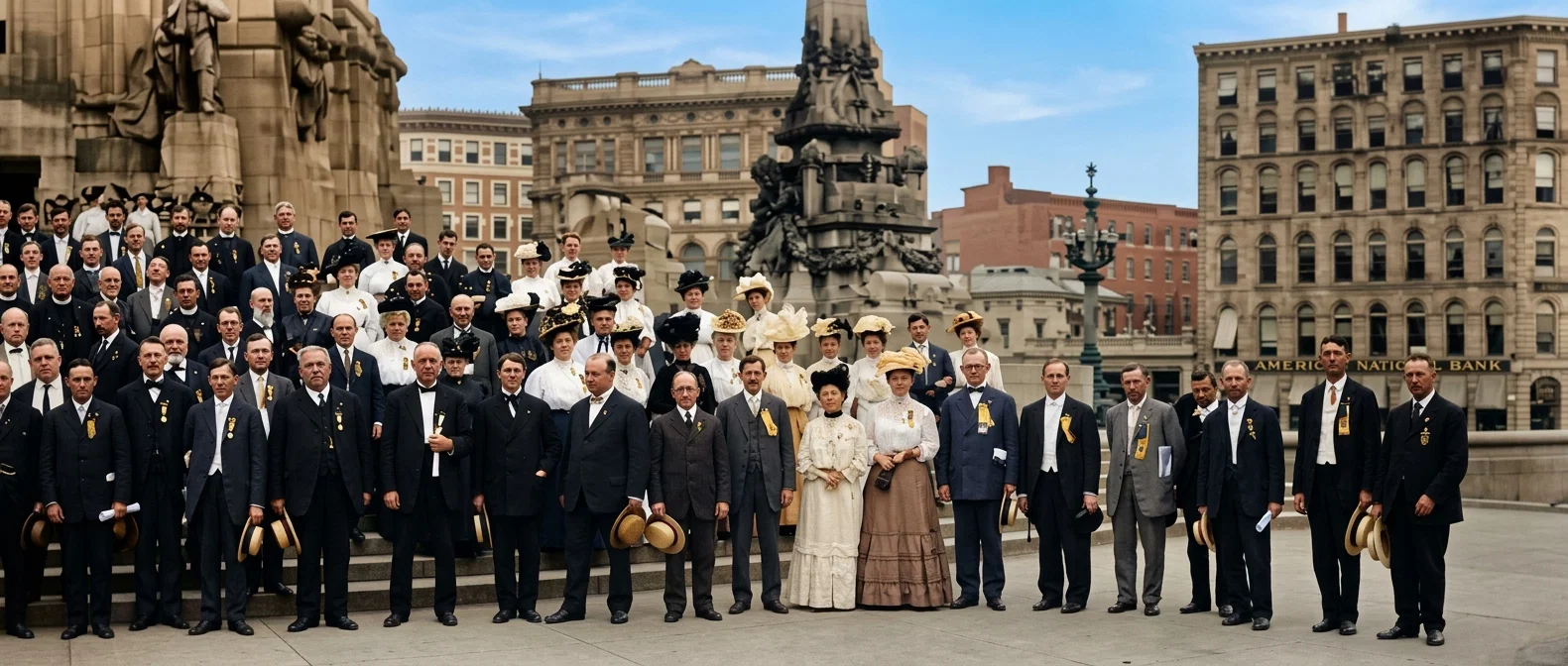
Y OF CATHOLIC SOCIETIES
Indianapolis, Ind., July 15, 1907
He believed that his Father would give him the power and strength necessary with which to overcome every temptation, and his faith was rewarded. It is written of those who are ready to meet Christ at his second coming, “Here are they that keep the commandments of God, and the faith of Jesus.”
Toronto Junction, Ontario.
(To be continued)
A Protecting Providence
The Scotch reformer, John Knox, had many enemies, who sought to compass his destruction. He was in the habit of sitting in a particular chair in his own house, with his back to the window. One evening, however, when assembling his family, he would neither occupy his accustomed seat, nor allow anybody else to do so. That very evening a bullet was sent through the window with a design to kill him. It grazed the chair he usually occupied, and made a hole in the candlestick.—Selected.
“Think on These Things”
By F. A. Zappe
F. A. ZAPPE
Ever since sin entered the world, there have been disagreeable things to behold and think of, as sin is that offensive germ which has been and is developing undesirable traits of character in humanity. All the sons and daughters of Adam naturally have some things about them which are usually regarded as faults. These often vary in manifestation in different individuals, yet all are of the same unchristlike character. For example: One may be especially weak in the matter of controlling his temper, unable to remain calm and sweet under the various trying circumstances of life; while another may not have this particular weakness, yet is perhaps more inclined to covet that which is his neighbor’s.
Be the faults of greater or less magnitude, if not controlled and completely rooted out, they will surely do their work, as do the germs of a fatal disease. And the only remedy that will enable us to successfully overcome hereditary and habitual tendencies is the transforming power of God, and our constant co-operation with that power.
It is not the writer’s purpose to make prominent the disagreeable and unlovely, as this is uncalled for. It is not necessary to invite one’s attention to the faults or failings of another, and request him to meditate thereon, as all these things are very often too freely discussed by people of the world, and not only they, but sad to say, by many of those professing to have Christlikeness manifested in their lives. Certainly this has often proved to be very injurious. It has grieved the Holy Spirit, and caused protecting angels to withdraw. Our Heavenly Father looks with great displeasure upon it.
Could we as brethren and sisters actually realize how much we harm others and sap our own souls of the Christ-life by talking of and thinking about the unpleasant things in others, there would be many heartfelt confessions made ere the judgment hour closes, ere the door of mercy swings shut forever.
What a change for the better would be seen today in the home and in the church if its members would accustom themselves to think only on such things as would tend to help them love their fellow beings as Christ loves them.
How helpful it would prove in maintaining a strong Christian experience, if, when tempted to fret because of evil doers, or to talk about the faults and mistakes of some of our neighbors, we would quietly rehearse that notable text of Scripture recorded in Phil. 4:8: “Finally, brethren, whatsoever things are true, whatsoever things are honest, whatsoever things are just, whatsoever things are pure, whatsoever things are lovely, whatsoever things are of good report; if there be any virtue, and if there be any praise, think on these things.”
Philbrook, Minn.
An Alarm of Fire
By J. S. Washburn
J. S. WASHBURN
An alarm is to be sounded, an alarm of fire. The Lord has said, “Sound an alarm before the great day cometh, whose fire shall consume the world and them that dwell therein.” I doubt not that every reader who lives in cities has heard an alarm of fire. There is a call to the rescue, a quick ringing of bells whose rapid clang speaks of terror, of danger to life and to all that is valuable.
There is a sound of quick and heavy hoof beats on the street, and rushing wheels, a thrilling sight,—the fire company to the rescue! Great, powerful horses, whose energies have been saved for this occasion, are straining every nerve and muscle in the wild joy of a sudden call to that purpose for which they live and have been trained. See them with distended nostrils, with heads close to the ground, rush at utmost speed, with hot, quick breath, straining at the heavy weight behind them—engine, ladders, and the silent firemen clinging to the engine. What a soul-stirring spectacle is the rushing of a fire company to the rescue!
Have you seen them arrive on the scene of action? The silent men, who have clung to the rushing engine, waiting their opportunity, spring to the ground, and with wondrous speed is everything adjusted, and in an instant men are climbing the ladders to rescue, or are pouring upon the flames the powerful extinguishing element. Brave men risk their lives. There are children in danger of an awful death. See them climb to the dizzy heights against the tottering walls, rush into the windows and doors from which the smoke and flame is even now pouring.
What a sight to thrill, to arouse to action, him whose blood is stagnant, whose mind is befogged, and who has not earnestness or zeal in the Lord’s work! Seventh-day Adventists are the world’s fire company, and should be intensely in earnest, swift in their work, and yet so cool and calm that no effort may be wasted, as are the noble horses and the noble men who rush to save from temporal loss by the element of fire.
Destruction is impending. The forerunners have come in the awful ruin of cities, in the terrible fires, in the awful disasters. Have not many already gone unwarned, unready? O how earnestly should we rush to the rescue of those in danger of eternal fire, above whom is impending a ruin that is eternal! The very sight of such earnestness sends a thrill to the heart of every one who sees the rescuers from a temporal fire rushing to help and to save. How much more would an impression be made upon all mankind, were they to see in us the same spirit of earnestness in this infinitely greater work. Brother, sister, are you awake? Do you hear the alarm? Are you really one of the company who are to pull men out of the fire, pluck them as brands from the burning? Your own husband, perhaps, your wife, your children, your neighbors, are in danger, and you asleep!
Nashville, Tenn.
Remember Me
By Eliza H. Morton
ELIZA H. MORTON
'Tis sweet to be remembered
In the month when roses bloom,
When birds in the trees are singing,
And the air rich with perfume.
'Tis sweet to be remembered
In the days of winter drear,
When life has been shorn of brightness,
And the heart is filled with fear.
'Tis sweet to be remembered
When the soul is sorely tried,
And all seems but gall and wormwood
While the grave stands open wide.
'Tis sweet to be remembered,
And it costs but little here
To give to the heart aweary
A kindness that's sincere.
'Tis sweet to be remembered
By the friends who kneel in prayer,
For God by his Holy Spirit
Makes a link connecting there.
'Tis sweet to be remembered,
And the words an echo seem:
“Remember me,” O Saviour,
When thy kingdom is supreme.
North Deering, Maine.
How to Live in Warm Weather
By D. H. Kress
How to Keep Cool and Prevent Sunstroke
D. H. KRESS, M. D.
THE human body possesses the power of adapting itself to changes in temperature. The temperature of many things found in nature is influenced by the weather. On a warm day butter melts; water and milk become warm. The stones and the earth itself warm up. In cold weather everything changes in temperature from warm to cold. This is not the case with the human body. It adapts itself to external conditions in such a way that the temperature internally remains practically the same winter or summer, the normal temperature being about 98.6, whether the temperature externally is twenty degrees below zero or one hundred degrees above.
How is this accomplished? In the first place, a steady and equable internal temperature is maintained through means of the circulatory system.
The temperature of the liver and some of the deeper muscles in which oxidation takes place, probably ranges from one hundred degrees to one hundred and five degrees, while the mucous membrane of the mouth has a temperature of only 98.6, and the skin a still lower temperature. The heated blood from the internal organs and muscles is brought to the surface for the purpose of cooling it. The cooled blood is then carried internally to cool off the internal organs, and in this way an equable temperature is maintained. Where the weather is cold, impressions are made upon the sensory nerves of the skin to that effect, and these impressions are conveyed to the blood-regulating centers, and less blood is permitted to be brought to the surface for the purpose of cooling. This accounts for the white skin or goose-flesh appearance noticeable on a cool day. This is nature's way of protecting the body from injury from excessive cold.
Some have imagined that alcohol has a warming influence in cold weather, but this is a deception. It is true there is a sensation of warmth, but the truth is the body is actually colder.
The sensation of warmth is due to the fact that alcohol is an enemy, and counteracts the efforts of nature. It paralyzes the vasoconstrictor nerves, and permits dilation of the small blood-vessels of the skin. This allows a greater flow of the blood to the periphery. This increased quantity of warm blood produces a sensation of warmth to the nerves of sensation located in the skin. But while there exists a sensation of warmth, the blood is being cooled by being brought to the surface. Should we take the internal temperature, we would probably discover a subnormal temperature. In cold countries drunkards frequently freeze to death, and yet they do not realize their danger.
In warm weather we have just the opposite condition. The peripheral, or surface, blood-vessels and capillaries dilate and permit a large flow of blood to the skin for the purpose of cooling. This accounts for the red, flushed faces on warm days, and the red, swollen hands. The cooling of the blood is brought about by evaporation of moisture from the surface of the skin. A normal adult may give off from two to four pints of moisture every twenty-four hours, and yet give no evidence of perspiration. This is what is known as insensible perspiration. If the weather becomes very hot, more moisture oozes out through the pores of the skin for the purpose of keeping the body cool. People who sweat freely do not suffer so much from heat as those who have a dry skin. On a warm day we surround the pitcher of water with a wet cloth for the purpose of cooling the water. The moisture on the skin answers the same purpose.
We can assist the body in its efforts to keep cool in warm weather by regulating the diet. In cold weather we feed our furnaces or stoves in order to keep our houses warm. In warm weather they require less fuel. The human body corresponds to a house. It has within it a living furnace and an automatic stoker or fireman. When an impression of cold is made upon the skin, it is communicated to the heat-regulating centers, and a greater amount of fuel is fed to the body furnace, and a greater amount of heat is produced. In warm weather people frequently eat the same foods, and often the same quantity, as they do in cold weather. The system has no need of it, and can not utilize it. Even if it should be digested, it would not be consumed, but would be piled up as adipose tissue or waste matter. The lack of energy experienced in warm weather is due to the clogging of the furnace and the living machine with this excess of fuel, and not to too little food, as is frequently supposed.
In warm weather the digestive organs can not digest the same quantity or kind of food that they are capable of digesting in cold weather. Wisely, therefore, nature takes away the desire for food, especially for solid food, on a warm day. Dogs fed on the same amount of meat in warm weather as in cold weather become ill, and have to be given, in place of meat, some biscuits. The dog's digestive organs are in a state of debility, and are not capable of digesting meat in warm weather. The result is decay of these foods and auto-poisoning.
The cat is apt to have epileptic fits if it makes no change in its food in warm weather. Much of the sickness among men in hot weather is due to the absorption of poisons resulting from the decay of undigested foods in the alimentary canal. Summer diarrheas are frequently caused by this.
Meat, above all foods, is dangerous and unsuitable in hot weather. Butter and other free animal fats should be used very sparingly in warm weather, if at all. Slow digestion and the deficiency in gastric juice favor fermentation and the formation of acids. Cream, being an emulsion, is preferable to butter. Fruits are, of all foods, the best in warm weather. The food elements in fruit are served in a form to require little effort on the part of the digestive organs to prepare them for absorption, while the acids and pectose are aids in the digestion of the small amount of solid food that it may be necessary to eat in addition to the fruit. They also contain liquids in the purest form obtainable to supply the needs of the body. In warm weather I would therefore recommend that the diet be composed almost exclusively of well-baked breads and fruits, with some additional harmless relish if craved. If this diet should be followed, there would be less summer sickness, and sunstroke would be practically unheard of. Nine times out of ten, sunstroke is due to some error or errors in eating and drinking.
The same amount of clothing should not be worn in summer. Loose cellular linen or cotton underwear is preferable to any other fabric, and this, with light, thin, loosely woven outer garments, is about all that is required in warm weather. The cellular underwear and loosely woven outer garments allow free evaporation to take place. This tends to keep the body cool and comfortable.
The Scandinavian Meetings
By Guy Dail
GUY DAIL
On this, the last day of the last of the meetings that have been held in our Scandinavian fields since the visit of the American brethren this spring, it gives us pleasure to render a brief report of what we have experienced in these delightful countries of the north, whose long summer days, whose kind and hospitable people, with their interesting customs, and whose varied landscape, attract hither thousands of tourists every year.
Since the Gland meeting, the local conferences of Norway, the Finnish Mission, and Sweden have been held in Christiania (June 4-9), Helsingfors (June 14-18), and Södertelje, near Stockholm (June 19-24).
Without exception these were the largest and the best conferences we have had here. They were practical, and missionary in their tendency. Two great subjects occupied much of the time of the business sessions: the proper education of workers, and the opening of the mission to the Abyssinians under the fostering care of the Scandinavian Union Conference. Advanced steps were also taken to occupy the new Northlands Mission, which sprang into being Jan. 1, 1907. Evidences of progress are noticeable in the publishing department. “Ministry of Healing” and “Daniel and the Revelation” are now out in the Danish-Norwegian; the former book is to be published in the Swedish; the latter book has existed in Finnish for some time, and is just from our Helsingfors press in the Swedish; a neat, thirty-two-page tract, our first publication in the Laplandish language, was finished by our Christiania House while we were there.
In voting upon the proposed union school, the Norwegian delegates raised about one thousand dollars, the Finnish brethren four hundred dollars, and the Swedish over eleven hundred dollars in cash and good pledges. Liberal sums were given toward the Abyssinian Mission. Norway voted to pay a second tithe to the Scandinavian Union, beginning with Jan. 1, 1908.
In Finland attention was also directed by the delegates to a seemingly open field for missionary work among the Swedes in various parts of Russia, and the name of one Swedish settlement was referred to; but at the time, no one present knew exactly where the place in question is. However, at the Sunday afternoon Swedish meeting in Helsingfors (there were two well-attended Swedish, and two fairly well visited Finnish meetings held that day) there sat on the front seat a nurse, who gave the best of attention to all that was said, and whom Elder Conradi, the speaker, met at the close of the service. She stated that she was under appointment to the very place in Russia about which we had desired the information, and furnished us just the knowledge we needed.
But perhaps even more remarkable than this is the coincidence that took place in Stockholm, as our party were en route to Finland. Elder Conradi had been very anxious to meet the officers of the Swedish Missionary Society working around Abyssinia; but he did not know their address; he did not know that they were to have an annual missionary conference right at the time we were passing through the city; he did not know that at this missionary conference there were missionaries who had spent ten to twenty years working among the Abyssinian natives that can be reached in the Italian colony of Etrea and in the valley of the Guba River, British East Africa; he did not know that there he would meet the Abyssinian professor who had been sent by Menelik at the request of the Emperor William to teach in the Oriental Seminary at Berlin, and was at the time assisting other missionaries in a revision of the Amharra Bible; nor did he know that he would be invited to take dinner with the secretary of the society, and secure from him much valuable information, and just the literature he needed to help us in making the right start among the Galla people when we send out our young Scandinavian missionaries this autumn; but such is the providence of God that all these things occurred, Wednesday, June 12, altogether unexpectedly to any of us.
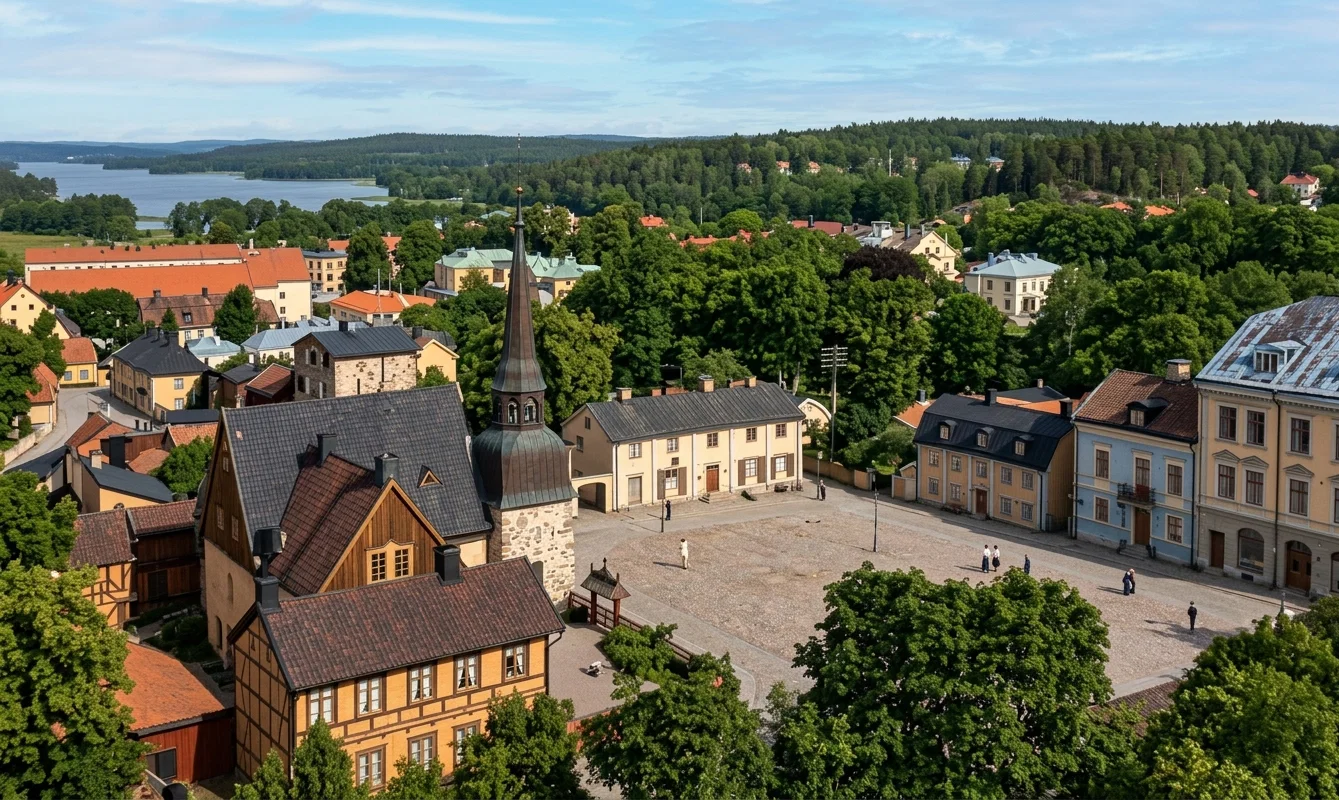
GENERAL VIEW OF SÖDERTELJE, SWEDEN
That Elder O. A. Johnson might be freed to give his whole attention to the school work in Norway, Elder C. C. Jensen, whose appointment to Abyssinia had been canceled because it was impossible for him to secure a passport, was unanimously chosen president. He is assisted by three ministers, three licentiates and three Bible workers.
Here, as in other fields, the canvassers also receive conference recognition hereafter. This has seemed but just in view of the importance attaching to the sale of our publications. The Norwegian tithe for 1906 was $5,828, or $850 more than for 1905; gifts, $848, against $659 the previous year. Their membership rose from 847 at the beginning of the year to 917 at its close, but this is now decreased to 824 by the loss that conference sustains through the organization of the Northlands Mission.
Finland's tithe for 1906 was $1,242, having increased from $805 for the previous twelve months; gifts, $365, an increase of $46 over the previous year. Their membership rose from eighty-one at the end of 1905, to one hundred and two at the close of 1906. Two ministers, one licentiate, and two Bible workers are laboring here. Elder Fred Anderson was unanimously chosen superintendent for the coming year.
The tithe of Sweden last year was $5,253, or $1,145 more than in 1905; gifts, $886, a growth of $616 over last year; book sales, $20,370, against $16,750 the previous year. Our numbers increased from 827 to 845 during the year. There are sixteen ministers, one licentiate, and four Bible workers in the field. Elder Svensson, who has been laboring here for a year or more, was unanimously chosen president, and Elder O. Johnson takes charge of the Northlands Mission. Elders Sewaldsen and John Wallenkampf will also assist in the Northlands Mission.
Not alone is Sweden interested in the proposed union school, which is to be located within its borders, but there are also to be erected a food factory, and, in the course of time, a sanitarium, in connection with the union school, a site for all of which must yet be selected and purchased. Preliminary steps toward the realization of this have already been taken, and this is a matter which ought to receive the hearty support of our Scandinavian brethren everywhere; for a good union school should be provided for each of our unions in Europe, answering the needs of each union, as Friedensau16and the Duncombe Hall Training College have answered the needs of their respective fields.
The Bible studies and missionary talks and practical instruction given by Brethren Conradi and Prescott at each of these meetings met with a very hearty response on the part of all the delegates. There were a number of conversions. Thirteen were baptized in Norway, four in Finland, and nine in Sweden.
The courage of the people in each field is good. Their institutions never were in as good a condition as now; and we believe that a bright future is before the work and workers in Scandinavia. To this end may we all work, watch, and pray.