From Barotseland we went to the Solusi Mission. This is our oldest and best-equipped station. The farm land is about as thin as the poorest farm land in the South, yet under the skilful management of Elder M. C. Sturdevant, it is yielding an abundance of mealies, monkey nuts, Irish potatoes, sweet potatoes, and other vegetables. They now have one hundred head of cattle. The larger share of these are oxen, but they have a sufficient number of cows and heifers to be able soon to carry on dairy farming, which will be more satisfactory and remunerative, as butter is from sixty to seventy-five cents a pound, and the grass affords pasture the year round. The soil is better adapted to dairy farming than to raising mealies. New fields, broken up, produce good crops for some time, however.
The school work is doing well at this station. It was our privilege to meet the assistant educational inspector during our visit here. He spent two days at the Solusi Mission school. Before leaving, we asked him how this school compared with the station at Solusi. He replied that it was equally as well organized, and its work as well systematized, the character of the work being in every way as good, only it was newer, and had not all the facilities that we had at Solusi. It was very encouraging to these workers to learn, aside from their work as missionaries in the interests of the proclamation of the third angel’s message, that they are counted among the best in their school work.
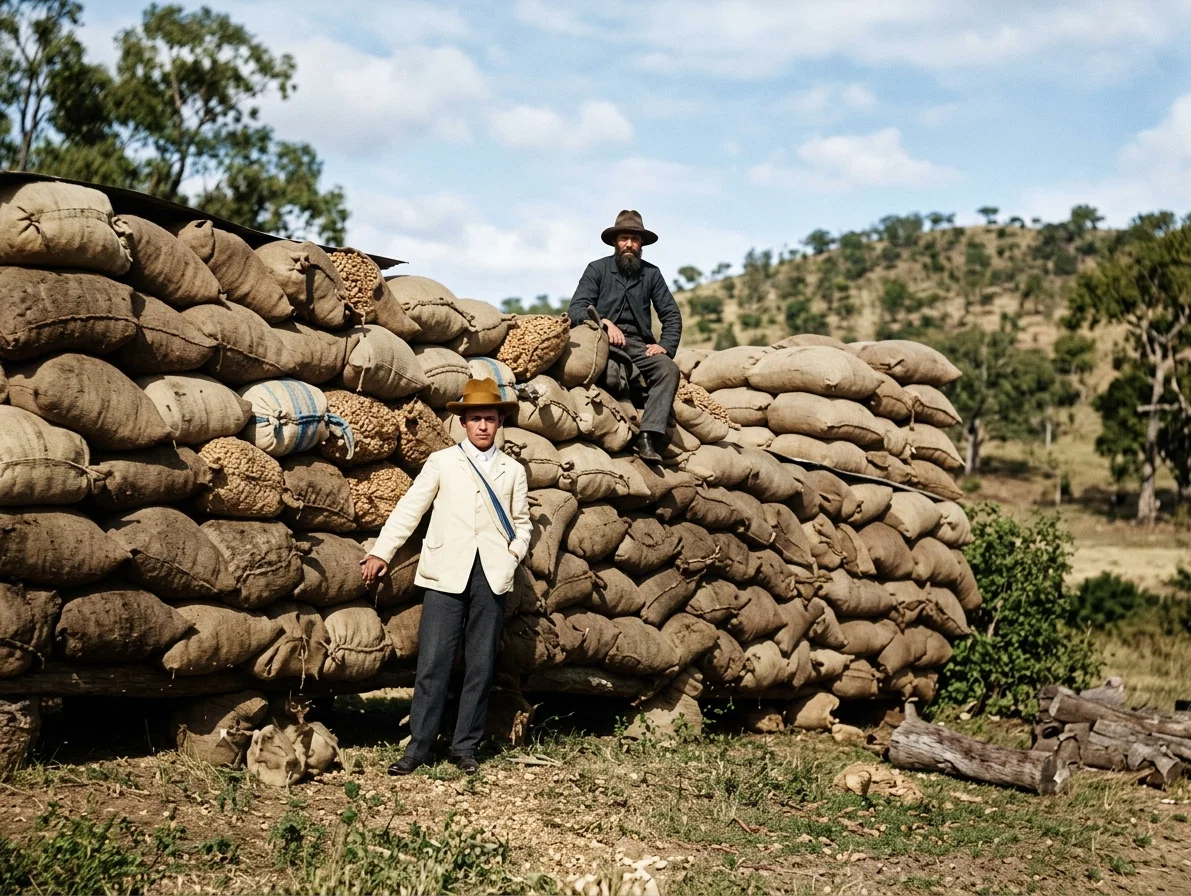
PORTION OF PEANUT CROP AT SOLUSI MISSION
Elder M. C. Sturdevant sitting on bags, Brother Victor Wilson standing
Both the Solusi and the Somabula missions are working toward the point of being self-supporting. Elder Sturdevant writes that they are not only planning to make their station self-supporting, but they hope to be able to render some substantial aid toward starting a new mission farther up-country in the near future. During our visit to these stations, the superintendents spared no pains to assist us in gathering all possible information with reference to present methods of operation, and plans for the future. The Solusi Mission has now fifty-five students, and more are applying for admission. It has six out-schools, with an average attendance of twenty-eight in each school. They are planning to open up, two or three new schools soon. Brother Victor Wilson is now the only white teacher at Solusi. Brother H. C. Olmstead, who was called to that station when Brother J. R. Campbell went to the Barotseland Mission, has been obliged to leave on account of a severe attack of the fever. He tried Barotseland, but was obliged to leave there for the same reason. We were sorry to have to recall him from this station. Brother Wilson thinks he will be able to carry the work with the help of the native teachers. Brother Wilson is a consecrated young man, willing to sacrifice all self-interests that these poor black heathen boys and girls may be brought to the light as it is in Christ. He works unceasingly from early morning till late at night. God will richly repay these young men for their unselfish labor of love. Elder W. C. Walston, superintendent of the Somabula Mission, met with us at the Solusi Mission; also Sister Dicks, of Uitenhage, and it was our privilege to unite this couple in marriage while here. They are both well adapted to mission work, and this union will greatly strengthen the work at the Somabula Mission. With Brother and Sister A. Butterfield as assistants, they are now well equipped for the finishing of the good work already begun. This station has eight native teachers for its main station, and two out-schools. The main station has thirty students, and each of the out-schools twenty. They are now rebuilding their native huts, and will soon build two brick cottages for the white superintendent and the teachers.
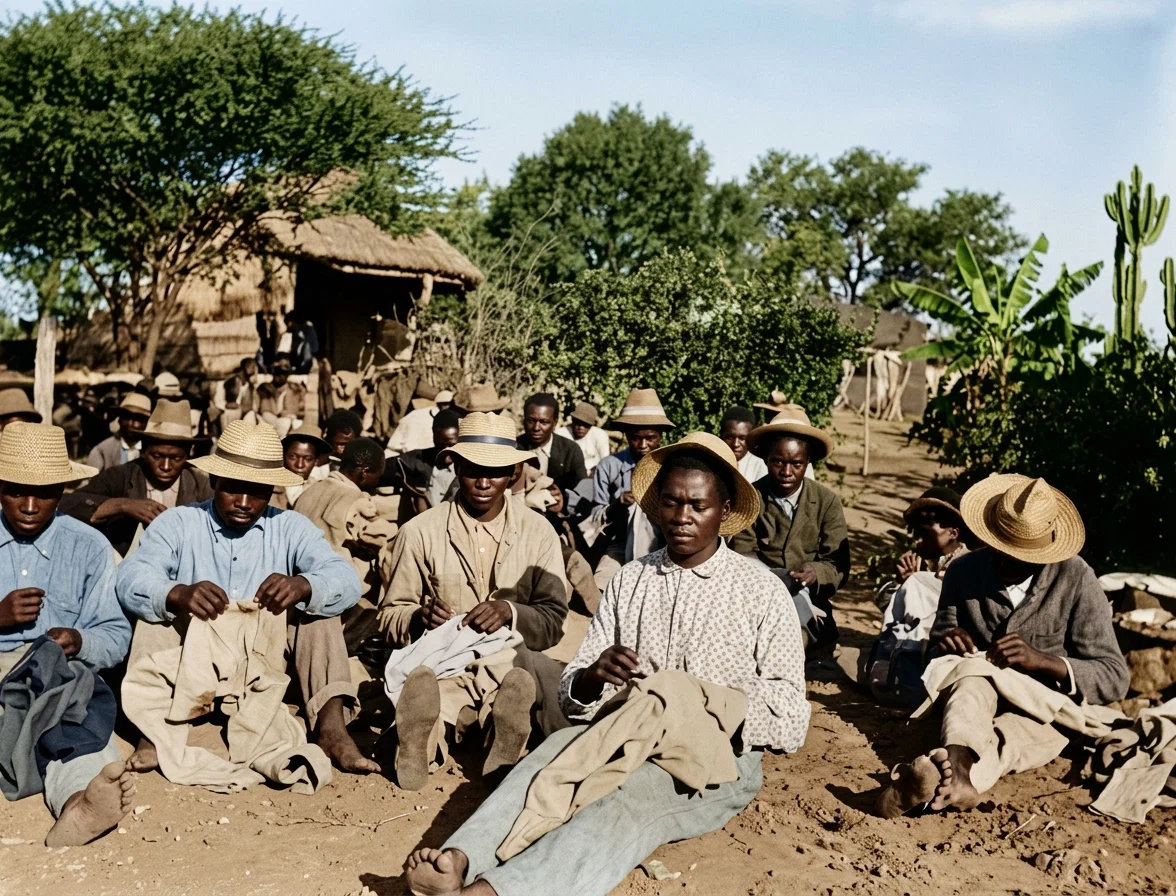
MENDING DAY AT SOLUSI MISSION
We have become much better acquainted with our mission work from this visit, and our interest and sympathy with these pioneer workers has correspondingly increased, as we have witnessed their isolation from white people, and the many privations and sacrifices they endure to carry the truth to the needy colored race. If the readers of the REVIEW could see what we have seen of the sacrifices they make, and the risk they run during the fever season each year, they would feel it a privilege to share with them in their labors by contributing of their means to relieve in part their exposure, by preparing suitable homes and equipment for their work. We are thankful to God that there is such a hearty co-operation from the home field in this direction. May it continue until the work is finished.
Cape Town.
The Dutch General Meeting
By Louis Richard Conradi
L. R. CONRADI
In The Hague, the city that is noted as being the headquarters for the Tribunal of Peace, the brethren from Holland and Flemish Belgium met August 4-8. The German Union Conference having donated a tent to Holland last year, Brother R. Klingbeil spent two months and a half trying to secure the necessary permission to pitch it. He met obstacles of all sorts at every step—difficulties placed in his way by the police, by the fire department, and by the neighbors. They feared that the13Socialists would make him much trouble. Finally, Elder Klingbeil was able to impress a high police commissioner with the importance of our work. He showed the commissioner the picture of Christ in one of our books, and the man said: “That is my patron; when I was in great difficulty last year, he helped me out.” Taking up this statement, Elder Klingbeil told the man that the Lord may have placed him in his position at this time to secure for us the permission necessary for our pitching the tent. This made such an impression on the officer that he soon overcame all the difficulties, and Elder Klingbeil was granted permission to hold public meetings in the evangelical tent. The people have been flocking to the tent every night for the last two weeks. As a great deal of the land adjoining the city belongs to the municipality, a lot on the outskirts of the place had to be secured. Quite a number of police came to the tent, and were surprised to find everything passing along smoothly.
Our conference sessions were held in the local hall, while the evening and Sabbath services were conducted in the tent. As help from without, Elder J. H. Schilling and the writer were present. All the brethren were glad indeed to welcome at this meeting for the first time, a representative of the Dutch colonies, Elder G. A. Wantzlick, who had been laboring for several years in Sumatra, but is now in Germany on a furlough, and had been sent to the Holland meeting by the German Union Conference. Elder J. W. Hofstra was also present. He is spending a few months in Holland before going on to Java. Owing to the interest which the Holland brethren and sisters feel in the Netherlands East Indies, they were naturally much pleased to meet these workers; and the workers were glad to become acquainted with the cause in Holland.
We were grateful to see so many new faces in the meeting,—faces of those who had accepted the truth since the last annual meeting. We were also impressed with the number of young people whom God has given our Dutch work. During the last twelve months, there have been seventy-six additions in this mission field. The largest church is that at The Hague, where we have seventy members; then Amsterdam, with forty-five members; Brussels, with forty-three; Rotterdam, with twenty-six; and Antwerp, with eighteen. In Flemish Belgium we have sixty-one members, and there are one hundred ninety in Holland.
Considering the membership of the field, the attendance was really remarkable, there being over one hundred seventy of our own people. Among these were nine from Aix la Chapelle, of the Rhenish Conference; so that the Holland meeting was really quite international in character. About four thousand dollars was spent in the gospel work of the Holland and Flemish Belgium Mission last year, half of which the field itself produced, while the rest was given by the German Union Conference. There are twenty-nine canvassers in the field, and the sales for last year amounted to five thousand seven hundred dollars. The Dutch paper has a circulation of six thousand. There are engaged in the field work, four ordained ministers, and four other gospel workers—a small force for the nine million people here. At this meeting it was voted that the coming year the churches begin to send their regularly authorized delegates, thus taking a further step toward the organization of a regular conference.
As the Holland Mission has sent a number of students to Friedensau, the brethren felt quite an interest in assisting worthy young people, and this interest was shown by their raising in a short time about four hundred fifty dollars for the educational fund, and also to assist in strengthening the general canvassing fund. This is by far the largest donation we ever secured in this field.
Elder Klingbeil was again unanimously elected superintendent of the Holland and Flemish Belgium Mission. As this mission will be a part of the West German Union Conference, beginning with Jan. 1, 1910, Elder Schilling improved the opportunity of visiting some of the leading churches in Holland and Belgium.
I stopped with our Dr. Rahden. He is a well-known physician, living in the center of the city. He accepted the truth some years ago. For a number of years he was a physician in the Dutch colonies, and now he has a good practise in The Hague. He and his wife know the Malay language well. He was happy indeed not only that his wife embraced present truth some time ago, but that at this time his son, a bright young man, was going forward in baptism; and as they have some relatives in England, the young man will attend the Watford school, and fit himself for the work.
Although much still needs to be done for this great field, yet we are assured that bright prospects are before us, and that soon there will be quite an ingathering of souls. For this we pray.
Hamburg.
Mission Notes
No male missionary may preach the gospel to any but the lowest caste women of India, and even these listen with timidity and are ill at ease in the presence of a strange white man. The missionaries’ wives work among them; but the affairs of their households, the claims of their children, and the necessary and legitimate sharing in the plans and burdens of their husbands, prevent them from being able to meet adequately the great demand for a female evangelistic and teaching agency. If the women of India, the home-makers and mothers of Hinduism, are to be evangelized and taught the gospel of Jesus Christ and saved to honored and worthy womanhood, this must be done by unmarried women from Christian lands preparing a band of native women-workers to carry the gospel into secluded zenanas in the cities and to mohullas in the villages of that populous land.—Selected.
IN the United States there is one minister to every seven hundred people. In China there is one ordained minister to every one million people.
As yet the Koreans have had access to only the New Testament in their own language. They are calling very earnestly for the Old Testament. One gentleman, for example, over seventy years old, said: “I wish I could live until I could read the Old Testament in my own language.” They have been able to pick up some from the Chinese versions, but this is very difficult for a Korean. The British and Foreign Bible Society hope to have the Korean Old Testament ready during the present year.
THE people in Korea are reported to be thorough Bible students. One missionary said: “I have gone through a theological seminary, but these Koreans know their Testament better than I do.” One woman walked over three hundred miles with a bag of rice (her provision while away from home) on her head, so that she could engage in the study of the Bible for ten days where classes are held for Bible study. Others bring their rice, and in addition strap their babies upon their backs, and walk long distances to attend. Surely Korea is ripe for the last gospel message.
To a criticism by a church-member, that preachers and other church leaders talk too much about money, an editor replies sharply that if church-members were not so nigardly and tardy, the talking would not be necessary. It is possible that the manner in which the talking about money is done has as much to do with the restiveness under asking as the asking itself. A blunt, perfunctory, censorious tone and manners do not open pocketbooks, even of those in whom the grace of giving is well developed. A promoter who wants to interest Mr. Moneybags in his scheme, is not careless as to the manner in which his approach and appeal are made. Why may not the “children of light” learn lessons from the “children of darkness” here?—The United Presbyterian.
REV. J. G. DUNLAP, of the Presbyterian Board, speaking of the work in Japan, says: “A general feeling of discouragement pervades the church in Japan at present. We are passing through a reaction such as has not been felt in a dozen years. In several departments of the central government a dead-set is being made against Christian work, notably in the department of education, and in the army, and the church is feeling the effects. Everywhere it is harder to get people to listen to Christian teaching, and weak-hearted Christians are falling out of the ranks. The victory of an Eastern nation over a Western has given to many a new faith in the East and its ways and beliefs, and we are witnessing revivals of Buddhism, Shintoism, and Confucianism. Meanwhile, the growing suspicion and hostility of the West toward the Japanese is driving the latter back upon themselves.”
Bermuda Islands
By M. Enoch
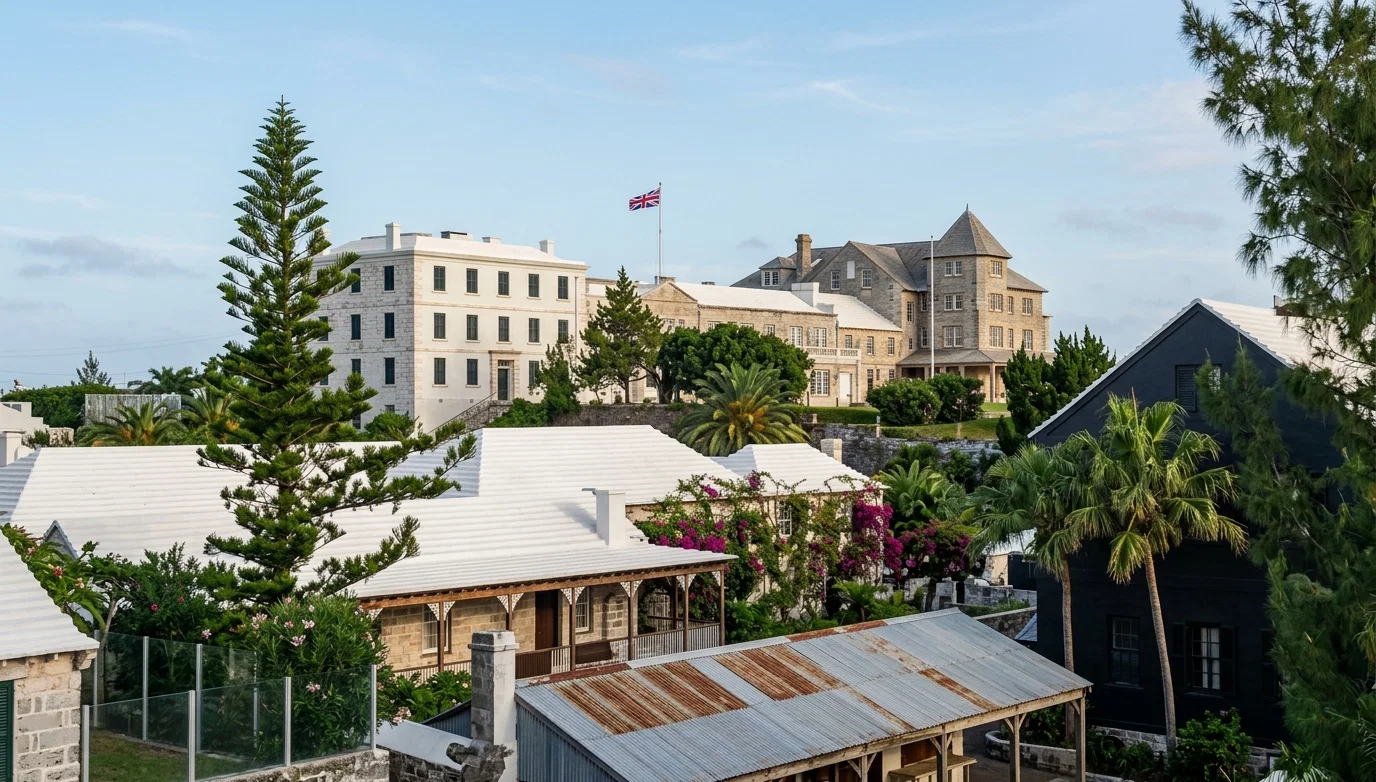
SITUATED on the Atlantic, seven hundred thirty miles due south of Halifax, Nova Scotia, and seven hundred miles southeast from New York, the Bermuda Islands, with a population of about eighteen thousand, appear as a mere speck on the map. Yet our island home seems to us who live here quite a place after all. Only about one third of the people are white. There is not a more equable climate in the world than is found in Bermuda. With the sun nearly overhead for about three months, the heat is not so extreme as one would imagine, and sunstroke is seldom known. The winters are very mild, and snow never falls. Jack Frost can not cross the Gulf Stream. Lying between the North and the South, the climate is semitropical. Miasma is unknown, and the fevers of the tropics find no place here. Crops grow, and flowers bloom, the year round. This is indeed a land of perpetual summer.
A VIEW IN HAMILTON, BERMUDA ISLANDS
Such, and more, is Bermuda; but sin prevails, and disobedience is just as marked here as elsewhere. However, “where sin abounded, grace did much more abound.”
After a residence of a little over sixteen years, my wife and I rejoice that there are at present about one hundred Sabbath-keepers, including the children, though there was not a resident Seventh-day Adventist when we came.
After a stay of six years and four months, Elder J. A. Morrow and wife, who came here from the tropics to recruit their health, left us, to attend the last General Conference; and as they have been assigned to labor elsewhere, the work is left for us to carry on.
As a result of the faithful labors of Brother and Sister Morrow, eighteen natives and nine Portuguese are live members, with their names on the church roll. There are six Sabbath-schools on the islands. The only large Sabbath-school is at Hamilton, with a membership of about fifty. Two of these schools are made up of parts of two families; the other three are family schools. Some of our members are Home Department members.
Elder Morrow has visited and scattered reading-matter everywhere, and has held meetings in the most important parts of the islands. For over two years, Sister Morrow taught the children of Sabbath-keepers, with some others. We know that her faithful work with these children will produce eternal fruits.
We began the erection of our church building Jan. 3, 1906, and the first meeting was held in it six months later, July 14. As the building now stands, unceiled, with the lot, fifty feet wide and eighty-five feet long, it costs about £400 ($1,920). We raised about one half the amount. By following the directions found in “Testimonies for the Church,” Vol. VI, pages 102, 103, as far as we could, we paid, last year £25 ($120), and we have on hand another £25, to pay August 5. This will reduce our indebtedness £50 ($240). For this we praise the Lord. How the remainder will be paid, we know not. We began by faith, and we are holding on by faith. Matt. 18:19. When we began to build, times were not so close as they have been since. This has not been through failures of crops, but because the New York market has failed us for three years, and the farmers have not only lost all, but they have been placed in inextricable indebtedness to the merchants. We have faith still that our debt will be paid. Praise the Lord!
M. ENOCH.
The Iowa Camp-Meeting
By R. A. Underwood
THIS meeting was held in a beautiful grove adjoining the sanitarium grounds at Nevada, Iowa, August 19-29. The attendance was much larger than the Iowa brethren had seen at any similar gathering for a number of years. From fifteen to eighteen hundred people were encamped upon the ground during the meeting. A number of those in attendance the first week returned to their homes before the close, so the average was about fifteen hundred for the entire time.
Sister E. G. White and Elder W. C. White were present the first five days of the meeting. Dr. A. C. Selmon, of China, and Elder H. H. Votaw, of India, were in attendance during the entire meeting. Elders Louis Christian, S. Mortenson, and M. L. Andreasen labored in the interests of the Scandinavian people. Elders Kunkel of North Dakota, Jackson of Minnesota, and Watson of South Dakota, and other members of the Northern Union Conference committee were also present to labor in the meetings.
Sister White spoke three times with great freedom. Hundreds in attendance had never had the privilege of meeting her, or of hearing her speak. This was a great privilege for such, as well as for all in attendance. The servant of the Lord spoke with great power to very large audiences.
In connection with this meeting the sanitarium erected at Nevada was dedicated. Also the graduating exercises of the nurses' training class of the Iowa Sanitarium were held one evening during the camp-meeting; the class consisted of nine members. All these special features had more or less attractions in drawing a large attendance. There was a good attendance of those not of our faith at the camp-meeting, especially on Sundays and during the evening services. At times hundreds were unable to find seats. The Scandinavian meetings were also well attended in another part of the camp.
Over five thousand five hundred dollars was donated in cash and pledges during the camp-meeting, the most of which was for foreign missionary work. The conference pledged at least twenty-five per cent of its tithes to the General Conference work.
Brother E. W. Wolfe was ordained to the gospel ministry, and he and his wife will accompany Dr. Selmon to China, as Chinese laborers, Iowa pledging their support and transportation.
In view of the call of the General Conference for Elder M. N. Campbell to take charge of the mission field in India, and the call for Brother Chris Juhl to go to Denmark to take the business management of the Skodsborg Sanitarium, there was considerable anxiety and interest manifested as to who should take the places of these prominent laborers in the Iowa Conference. Brother Juhl has had charge of the business interests of the conference for some little time, and his removal will be felt. Although a strenuous effort was made to secure an experienced man to take Elder Campbell's place as conference president, at the close of the meeting no one had been found whom the brethren felt clear in electing to that office. Hence the conference re-elected Elder Campbell as president, with the understanding that as soon as the General Conference could secure for them the proper person to take the presidency, they would release him. It is hoped that this may be accomplished within a few weeks, so that Elder Campbell and family may be able to go forward to India this fall.
Seventy or eighty persons presented themselves for baptism, but owing to the unsatisfactory condition of the stream where this ordinance could be performed, the most of the candidates were recommended to be baptized in their own home churches. Some one will be sent to the churches at once to perform this rite.15
Prof. P. T. Magan was present the latter part of the meeting, and labored with much acceptance to the people. Following Sister White's discourse on the first Sabbath, about two hundred persons came forward to seek the Lord; among these were a number of unconverted ones. However, on the last Sabbath's meeting there seemed to be a general move throughout the entire camp, and five or six hundred came forward to seek God earnestly; quite a number of these were making a start for the first time.
The triweekly paper of Nevada gave quite a full account of the meeting. The business of the conference was transacted with great despatch, occupying only about three days of the meeting. This demonstrates that it is not necessary, in connection with a camp-meeting, to weary the people with prolonged business sessions. There were only two business meetings a day, and these were very brief, not occupying over an hour at any one time. I think the meeting in this respect was a marked success, and a model of business meetings. On the whole, the meeting was one greatly enjoyed by the brethren, bringing much cheer and encouragement to all in attendance.
The Iowa brethren, in sending away Brethren Campbell, Juhl, and Wolfe to foreign fields, are giving of their best laborers, and we trust God will return in rich measure his blessing, not only in raising up new laborers, but in greatly watering the souls of believers in the conference.
It was voted not to hold a general camp-meeting next year, but to hold four camp-meetings in the field, located in different parts of the State, so as to reach all parts of the State with less expense, and give several localities the benefit of a camp-meeting.
R. A. UNDERWOOD.
The Ohio Camp-Meeting
By B. G. Wilkinson
THE annual camp-meeting of the Ohio Conference was held on the banks of a beautiful lake in one of the city parks of Lima. The grounds were only about five minutes' ride from the two principal railway stations, and not more than fifteen minutes' walk from the heart of the city. In consequence, there was a good attendance from those unacquainted with the truth, and they listened with great eagerness. One hundred forty tents, with their highways and byways, composed the temporary city in which were housed those Seventh-day Adventists who had come up to attend the annual feast of God's people. There were about six hundred fifty who had left their farms and fields for this purpose.
Unlike the annual maneuvers of national armies, all the exercises of this encampment were spiritual. The Captain of the Lord's host was there, and in his presence the people were blessed. The different phases of work—educational, young people's, medical, etc.—were well organized and well cared for. Elder A. G. Daniells was there, representing the General Conference, and his instructions were both helpful and strengthening. Elder A. J. Haysmer, of Alabama, visited the camp one day, in the interest of the work in the South.
The camp-meeting was one of the best. Each day the truths presented seemed more practical, and the work grew in strength. On the last Sunday of the camp, twenty-nine were baptized. The people gave, in cash and pledges, $683.65 to Mt. Vernon College, and $950.50 to foreign missions, or a total of $1,634.15.
During a revival, the last Sabbath afternoon, two who had been under conviction for over four years, surrendered to the truth. The following night, after the presentation of the Sabbath question, two strangers from the city publicly signified their intention to begin the observance of the Sabbath. As there was no business connected with the meeting, no items can be reported from that standpoint. The Lord certainly blessed in this gathering, and the work in Ohio will feel the results of the good spirit which came in.
B. G. WILKINSON.
North Missouri Camp-Meeting
By H. R. Salisbury
THIS meeting was held at Chillicothe, August 5-15. Last year the Missouri Conference was divided into the North Missouri and the Southern Missouri conferences; and as the division did not leave a sufficient number of family tents, the brethren planned this year to have many of the Sabbath-keepers take rooms near the grounds. While this may have some disadvantages, it also has its advantages, as was proved at this meeting; for our brethren and sisters living about the town with different families became personally acquainted with them, and not only took them to the meetings, but were also able to do missionary work in the homes where they were lodging. The result at Chillicothe was a splendid attendance from the outside, and the brethren were hopeful that the tent-meeting which was to follow the camp-meeting would result in establishing a good church at that place.
There was an earnest spirit of devotion at all the meetings, and also a spirit of liberality when the needs of the work were made known, especially when foreign missions were presented. While the division of territory left this conference to struggle with finances, yet all expenses had been met, and the members had given to missions more than ten cents a member each week; and although the conference committee have had to plan with the greatest care during the past year, they unanimously voted to appropriate to foreign missions five hundred dollars from their small surplus, as they felt anxious to share with the other conferences in America in sending a portion of the tithe to the needy fields beyond.
Two new churches were admitted to the conference. At the business sessions Elder A. R. Ogden was re-elected president, and broad plans were laid for an aggressive year's work.
Elders E. T. Russell and J. S. Wightman, Mrs. J. S. Wightman, Prof. C. C. Lewis, and C. G. Bellah were the union conference laborers, and Elders H. H. Votaw and J. W. Westphal, and the writer were the laborers from abroad.
H. R. SALISBURY.
North Carolina Camp-Meeting
By R. T. Dowsett
To say that this was a good meeting states it but mildly. The workers present were reminded of a meeting nearly nineteen hundred years ago, when the disciples of Christ, to the number of one hundred twenty, were assembled to seek God for the outpouring of the Holy Spirit, as promised before Christ's ascension. About the same number of God's dear children of the North Carolina Conference gathered at Cleveland, August 12-22, to seek the Lord for the outpouring of the latter rain. The promise that when we draw near to God, he will draw nigh to us, was verified. Both Sabbaths of the meeting were seasons of great refreshing. Great and decided victories were gained by burdened hearts and enslaved souls. Husbands and wives, parents and children, brothers and sisters, fell upon one another's necks, and with tears streaming down their cheeks, confessed wrongs committed and sought pardon for their transgressions.
Fourteen were baptized at Cleveland. Six others wished to be baptized at their home churches. The citizens of Cleveland and its vicinity responded to the invitation to join in the services. The people crowded the tent during the evening and Sunday services. A few decided to obey the truth. Elder R. T. Nash, with Brother and Sister A. G. Holmes, conducted a three-weeks' meeting before the camp-meeting. Elder Nash and other workers were left to follow up the interest, band the believers into a company, and more fully instruct them in the truth.
The business meetings of the conference were filled with the Spirit of God, and were much enjoyed. Elder G. W. Wells was elected conference president, with Elder M. H. Brown as his associate, acting as secretary and treasurer. Elder Brown is enjoying his labors in the South, and is in good health, as well as prospering spiritually.
Elders W. A. Westworth and K. C. Russell, Brother V. O. Cole, and the writer were the laborers present, besides16the regular workers of the North Carolina Conference.
The conference, though small in constituency, is in a prosperous condition. The Lord is blessing the Southland. Souls are responding to the message preached, and God's children are of good courage.
During this meeting three hundred eight dollars was contributed for home and union conference interests; six hundred twelve dollars was contributed for missions, besides thirty-five dollars in Sabbath-school offerings. Nearly one thousand dollars for a little band of one hundred twenty believers, poor in this world's goods, shows their love for the truth, and their anxiety to see their Saviour come.
The work for the colored race received considerable attention. The brethren sense the responsibility of doing more aggressive work for this benighted race. North Carolina, as well as the other conferences in the South-eastern Union Conference, is organizing for this work, and a strong effort will be carried forward for this people during the year to come. But little money is in sight with which to carry forward the work, but the brethren are walking out by faith. Hearing the call of God to take hold of this work, they know he will supply the facilities when they show their willingness to do their part. Bright days are ahead for North Carolina. R. T. DOWSETT.
Hunan, China
By P. J. Laird
CHANG-SHA.—When we understand that the people of Chang-sha are dropping their subscriptions for newspapers, which they used to share between little groups, to save cash, we are thankful to God for enabling us to sell a few Heralds from store to store.
Daily our prayers arise that God will lead us out to another ‘center if he desires us to change our location. Last month the eye-work gave some ‘excellent opportunities for testimony, praise God! Yesterday I was called several times to meet guests and preach Jesus. One was a fine fellow, a B. A., for four years in a responsible position at Changsha.
Brother Lu writes from Hankow, with praise on his lips for God's leading him to find a temporary home there while selling from three hundred to four hundred cash' worth of books daily. Yesterday morning Brother Huang came in with his face all aglow, telling of a precious experience with a family who had invited him to go and stay overnight with them, and explain the Scriptures to them. They live outside the city, and the gate closes early.
Mrs. Chang did her first bit of missionary work by going to a neighbor's and talking the gospel for a few hours. I wish you could have seen Brother Chang when he told me how he praised God for this token of his blessing. “Last year,” he said, “she would not believe.” P. J. LAIRD.