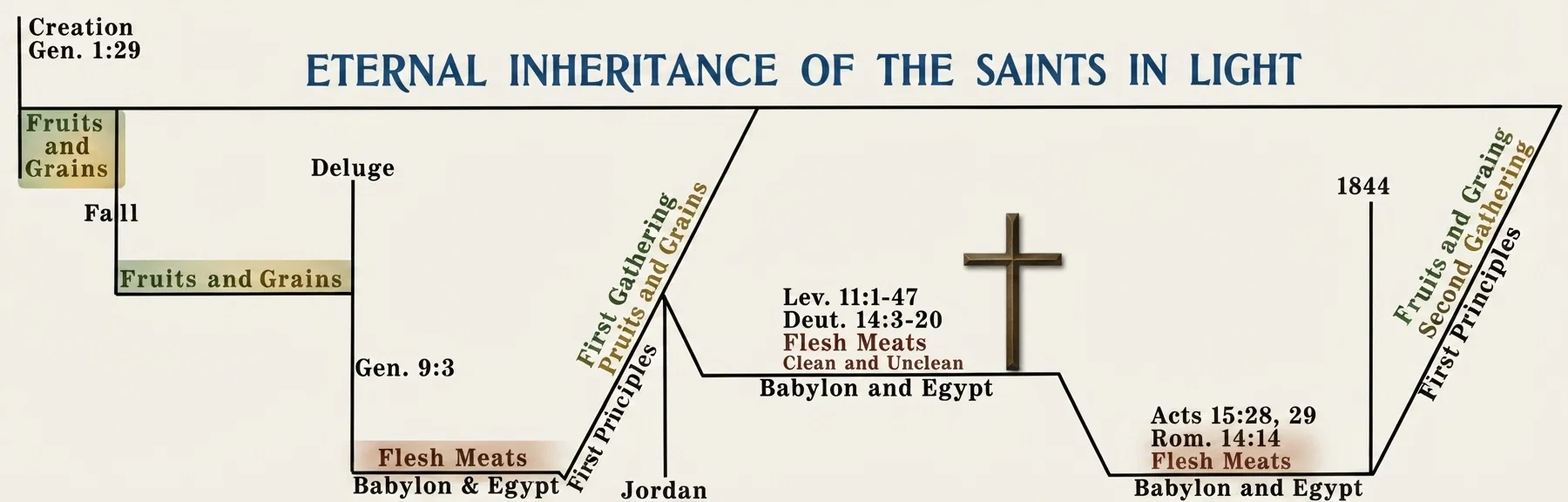
(Concluded.)
Permissive Diet—The Promise Sure—"The Second Time"—The Highway of Holiness—The Diet of Eden—Present Truth—A Safe, Economical, Simple, Moral Dietary.
THUS much for the ages past. During this time the people of God have lived upon the permissive diet, which ever spoke of death, and they have died. In the one time when God would have redeemed His people to eternal life and an eternal kingdom, in their unbelief they would not enter into His rest. But "what if some did not believe? shall their unbelief make the faith of God without effect? God forbid: yea, let God be true, but every man a liar."
The promise given them of entering into God's rest they would not accept; and now the "promise is being left us of entering into His rest," "Seeing therefore it remaineth that some must enter therein, and they to whom it was first preached entered not in because of unbelief," "there remaineth therefore a rest to the people of God." Heb. 4:1, 6, 9.
We have reached that time when the rest of God is opening to His children again, of which the renewed Sabbath is a pledge of God's power to perform His promise of old. Line after line of prophecy, and a multitude of signs in earth, sea, and sky, proclaim that Christ's coming is near; that He will soon take to Himself His great power and reign; and that His people shall enter the eternal rest of God. The promise still holds. The rest still remains; and its proclamation to the world is a part of the proclamation of the truth of the "everlasting Gospel" for this generation. It is "present truth."
But what does this mean?—It means that God will again set before His people His rest, and will gather them to it, as truly as He set it before Israel of old; for thus saith the prophet:—
"And in that day [now, in this day] there shall be a root of Jesse, which shall stand for an ensign of the people; to it shall the Gentiles seek; and His rest shall be glorious. And it shall come to pass in that day [in this day], that the Lord shall set [has set] His hand again the second time to recover the remnant of His people, which shall be left, from Assyria [Babylon], and from Egypt, and from Patmos, and from Cush, and from Elam, and from Shinar, and from Hamath, and from the islands of the sea. And He shall set up [has set up] an ensign for the nations, and shall assemble the outcasts of Israel, and gather together the dispersed of Judah from the four corners of the earth. And the Lord shall utterly destroy the tongue of the Egyptian Sea; and with His mighty wind shall He shake His hand over the river, and shall smite it in the seven streams, and make men go over dry shod. And there shall be an highway for the remnant of His people, which shall be left, from Assyria; like as it was to Israel in the day that he came up out of the land of Egypt." Isa. 11:10-16.
For the sin of unbelief the plagues of wrath fell upon Egypt of old. For the same sins the seven last plagues will fall upon a sinful, unbelieving world. Revelation 16. But from their power God will save His people. See Ps. 91:3-10.
When the Lord sets His hand to gather His people the second time, He will lead them over the same "highway" of holiness. Christ and His wonderfully-developed truth will be a pillar of cloud and fire to go before them all the way.
He will take them from this mortal, sinful world to an immortal, righteous one; from the imperfections of humanity, to the perfections of divinity; from the powerlessness of human striving, to the mighty working of His creative power through the outpouring of His Holy Spirit; from a land of death, to a land of life; and from a diet of death, to the diet of life, God-given "in the beginning."
But will the diet question be a test, as to Israel of old? Why will it not? Is not the rest to which God is leading us the same? Is not His standard of holiness the same? Is He not just as anxious that we shall have the very best now as then? Surely we can answer these questions only in the affirmative. He will lead His people now as then by the same "highway." Isa. 11:16. The stumbling-blocks will be gathered out. Isa. 57:14; 62:10. He will turn them back to the better diet of the beginning,—fruits and grains. And He points us back to Egypt, that we may be warned by unbelieving Israel's sad fate not to despise the straitness of the way, nor the goodness of God.
"Let us therefore fear, lest, a promise being left us of entering into His rest, any of you should seem to come short of it. For unto us was the Gospel preached, as well as unto them; but the word preached did not profit them, not being mixed with faith in them that heard it." Heb. 4:1, 2.
"Take heed, brethren, lest there be in any of you an evil heart of unbelief, in departing from the living God." Heb. 3:12.
ETERNAL INHERITANCE OF THE SAINTS IN LIGHT
"Moreover, brethren, I would not that ye should be ignorant, how that all our fathers were under the cloud, and all passed through the sea; and were all baptized unto Moses in the cloud and in the sea; and did all eat the same spiritual meat; and did all drink the same spiritual drink; for they drank of that spiritual Rock that followed them; and that Rock was Christ. But with many of them God was not well pleased; for they were overthrown in the wilderness. Now these things were our examples, to the intent we should not lust after evil things, as they also lusted [they lusted for flesh]. . . . Now all these things happened unto them for ensamples; and they are written for our admonition, upon whom the ends of the world are come. Wherefore let him that thinketh he standeth take heed lest he fall." 1 Cor. 10:1-12.
Shall more be said? Is not the Biblical argument enough? It matters not what diet God's people have eaten in the past, or what He has in His mercy for their ignorance permitted; these are not the questions for those to ask who are looking for Christ's coming. Rather, What is present truth—God's truth for this generation—God's truth for me? If we desire to fall in the wilderness, we may give way to the longings of an appetite yet in Egypt. We may place ourselves in "the devil's debating chair," if we will; we may ask about Moses and Elijah and Paul; we may excuse ourselves by the example of Abraham, even as men seek to do over irregular marriages; but still the present truth of God for this generation rings in our ears, "This is the way, walk ye in it." In this present truth He refers us to only one time in earth's sad history, and that is when He sought to lead Israel to life forevermore. What did He then ask of them? If we desire to enter alive the eternal rest of the earth made new, we will anxiously, gladly, go back to the diet of the beginning.
Other Considerations.
1. Safety.
In the fall of sin the curse rests most heavily upon the most highly-organized and responsible creatures. In a sinless state man was king over all creatures; now he has fallen so low that he is a prey to the infinitesimal bacillus. Next to him in weakness, deterioration, disease, and death are the domestic animals, with whom he has most to do. In many of the tuberculin tests of dairy herds the majority of the herd have been found affected with the dread disease tuberculosis, now sweeping off one-seventh of the people of earth. Cholera, anthrax, and other diseases, affect animals the flesh of which is used for food. Ptomain poisoning, almost wholly from flesh foods, is a very common thing. It is almost impossible to find a perfectly healthy beef. Thousands are discarding flesh foods for personal safety, and almost invariably, if wisely, with beneficial results. Thousands have tested the better fleshless diet for years, and are hearty advocates of its benefits.
2. Economy.
A vegetarian diet is an economical diet. There is much more food at less cost in such a diet than in that of flesh foods. It would be a great blessing to the poor of our teeming cities if they knew this. The wholesome, unstimulating diet of fruits and grains and legumes would be a mighty agent in overcoming the drink habit. The matter of economy will be demonstrated by putting into practise the principles herein advocated.
3. Simplicity.
In stomach troubles one of the most cogent factors is too great a variety of foods, and foods in wrong combinations; but man's primitive diet of fruits and grains offers no trouble on that score. Fruits and grains and nuts may safely be eaten together always; and no trouble will come by the combination.
4. The Moral aspect.
There is one further consideration which we lay before the sincere reader in the matter of diet, and that is the spiritual or moral aspect of food.
The nature of the brute is inherently selfish. His desire is to get and gorge, even to gluttony. He delights to take of nature's sweetest and best, and transmutes it into greedy brute. He is at times beautiful, graceful, faithful, and we admire him. He occupies a more intelligent plane than the vegetable, but not a more refined one. While he devours all he can, he willingly gives up nothing to humanity. All his exhalations, all that his system in its various functions throws off, is offensive to refined and sensitive eyes and delicate nostrils. And when the brute dies of himself, he is still more offensive. If slain in the prime of life, his flesh keeps "sweet" but a few hours at most in the ordinary climate. Unless artificially preserved, it soon becomes offensive to smell and taste, and poisonous for food. "Like produces like." Will not the love for and the continual5partaking of such food, change man to the same nature?
A different picture is presented in the creatures given of God in the beginning for food. In the vegetable world God has written the Gospel of unselfishness. The seeds are planted in the earth, oftentimes in decaying, offensive soil. They take of the base soil, and, by the power of God, through sunlight and moisture, transmute it into the cleanest fiber, flower, and fruit, pleasing to the eye, fragrant to the smell, delicious to the taste, and wholesome to the entire man. If allowed to mature, the grain is reaped, threshed, ground, or in various ways converted into palatable, nutritious food. In ordinary climates it may be preserved for years. If the fruit be allowed to ripen, it falls, or is plucked, and is at its very prime. The tree or vine has gathered from the basest and given to man the best. The tree is not injured by the plucking of the fruit. No life was taken by its transmutation into food.
Living is giving, and giving is living. The tree, the vine, the grain stalk gathered to give. Even so did Christ.
Reader, which is the better food to prepare us for unselfish service for the Master, for glorious translation into the kingdom of God, that which takes of the sweetest and most fragrant of earth and transmutes it into offensive, malodorous flesh, decaying in its living, filled with disease and death, or that which takes from the lowest of earth, the inert, decaying soil, and transforms it into beautiful blade and stalk and ear and kernel, or tree and leaf and flower and fruit, giving its fragrance and beauty during its growing, and at its maturity furnishing a store of clean, wholesome food?
It seems to the writer that but one answer can be given. Of himself he can say that since he adopted the latter diet, after years of the other, he has found less anxiety as to what he should eat, a keener relish, a better appetite, a clearer brain, a greater sustaining power in labor, a quicker recovery from weariness, a heart more responsive to the things of the Spirit, and purer delight in the things of God. O, there is life and health and blessing in God's way! "If any man willeth to do His will, he shall know of the teaching."
In conclusion, reader, take these things to yourself. "Hast thou faith? have it to thyself before God." As every one of us "shall give an account of himself to God, let us not therefore judge one another any more; but judge this rather, that no man put a stumbling-block or an occasion to fall in his brother's way."
Beyond, just beyond, lie the verdant shores of the promised land, which knows no pain nor death nor sorrow. The "highway of holiness," over which "the remnant" shall pass, leads from Egyptian darkness and Babylonian tradition through the wilderness, through the Jordan, into the eternal rest. God's promise is: "I will be as the dew unto Israel; he shall grow as the lily, and cast forth his roots as Lebanon. His branches shall spread, and his beauty shall be as the olive tree, and his smell as Lebanon. They that dwell under his shadow shall return; they shall revive as the corn, and grow as the vine." And as "the days of thy coming forth out of the land of Egypt will I show unto him marvelous things." And now the remnant may feed of the corn and fruit of the land, yet when passing through the desert of earth's last agonies of sin, when unrestrained wrath shall wreak its vengeance upon a shelterless world, the herd be cut off from the stall, the flock from the fold, the fruit from the vine, and the grain from the field, God will, if needful, give again to His people waters from the flinty rock, and the corn of heaven
for food; for has He not promised in that time that his "bread shall be given him; his waters shall be sure"?
"Who is wise, and he shall understand these things? prudent, and he shall know them? for the ways of the Lord are right, and the just shall walk in them; but the transgressors shall fall therein." "The wise shall understand."
MILTON C. WILCOX.
GAIN AND GODLINESS ACCORDING TO THE WORD.
By A. O. Russell
"PONDER the path of thy feet, and let all thy ways be established." Prov. 4: 26. This is a beautiful sentence; there is wisdom unto salvation in it. Many are the tears that never would have flowed, many are the sighs that never would have been heard, and many are the heartaches that never would have been felt, had this text always been heeded. The Lord would have every person diligently consider what is to his eternal interest.
Before you engage in that new "enterprise," stop and consider what associations you will have, what influences you will have to meet, and whether you may do any good, or receive or impart any spiritual strength, while in the new sphere of action.
Gen. 13: 10 says: "And Lot lifted up his eyes, and beheld all the plain of Jordan, that it was well watered everywhere, before the Lord destroyed Sodom and Gomorrah, even as the garden of the Lord, like the land of Egypt, as thou comest unto Zoar." Lot saw an abundance of pasturage for his flocks and herds, so he chose the plain of Jordan.
From a worldly point of view he made a good choice. But the record says that "the men of Sodom were wicked and sinners before the Lord exceedingly." Now Lot was a worshiper of the true God—the God who made heaven and earth; yet for worldly interests he "dwelled in the cities of the plain, and pitched his tent toward Sodom."
Very likely Lot expected, when he made the choice, that he would accumulate wealth and enjoy the good of a fruitful land; but God wants His people to take a different view of life than that. His instruction is, "Seek ye first the kingdom of God and His righteousness."
When the Lord warned Lot concerning the destruction of Sodom, He did not tell him to bring all of his goods, his cattle and his flocks, with him up out of the evil city. He simply warned him with reference to his family and his own soul. "And when the morning arose, then the angels hastened Lot, saying, Arise, take thy wife, and thy two daughters, which are here; lest thou be consumed in the iniquity of the city. And while he lingered, the men laid hold upon his hand, and upon the hand of his wife, and upon the hands of his two daughters; the Lord being merciful unto him; and they brought him forth, and set him without the city." Gen. 19: 15, 16.
"Treasures of wickedness profit nothing; but righteousness delivereth from death. The Lord will not suffer the soul of the righteous to famish; but He casteth away the substance of the wicked." Prov. 10: 2, 3.
"Better is little with the fear of the Lord than great treasure and trouble therewith." Prov. 15: 16. See also 1 Tim. 6: 5-12.
Easton, Minn. A. O. RUSSELL.
HYMN TO MICHAEL.
By Thoro Harris
["Michael," one of the names of our Saviour, means, "Who is like God;" "Archangel" is the chief of all the angels.—Ed. S. of T.]
BEARER of the sacred light,
Holy and serene,
Leader of those armies bright
From the world unseen,
Prince of angels, Michael,
Messenger divine,
Light of lights ineffable,
On thy votaries shine.
Seated on th' eternal throne,
Heav'nly Majesty,
Thou, the Father's only Son,
Sovereign Deity,
Brooding o'er the water's face,
Dismal, deep, and dim,
Plant in us thy seed of grace,
Chief of cherubim.
Thou who, at creation's dawn,
Shed the light of day,
Thou, the radiant star of morn,
Chase our night away,
Who art wont the saints to inspire,
Still Thy gifts divide;
Let the cloven tongues of fire
On us each abide.
Whose almighty power imparts
Precious truth divine,
Move upon our waiting hearts,
Seal us with Thy sign.
Holy One of Israel,
Clad in living flame,
God with us, Emmanuel,
Ever-blessed name.
WORTHY OF REMEMBRANCE.
By Dean Stanley
WHO is it that, when years are gone by, we remember with the purest gratitude and pleasure?—Not the learned or clever, but those who have had the force of character to prefer the future to the present, the good of others to their own pleasure. Give us a character on which we can thoroughly depend, which we are sure will not fail us in time of need, which we know to be based on principle and on the fear of God, and it is wonderful how many brilliant and popular and splendid qualities we can safely and gladly dispense with.—Dean Stanley.
A Child of the Almighty
By Edward Everett Hale
You are a prince of blood. You are the son, beloved, of the Almighty Power who rules this world and carries it on to-day. You can and will rule body and mind with absolute control if you choose. If you wish and choose, you will be in absolute confidence with your Father, and in the closest relations, with Him. Tell Him everything; ask advice in all difficulty; thank Him in all success; come back to Him in all failure. You will use His almighty power then for the sway of mind and body. You will be fellow-workman together with Him.—Edward Everett Hale.
Harmony With Nature’s Laws
By W. T. Nichols, M.D.
ALL things are the result of and subject to certain methods or laws. To insure health and happiness all beings must place themselves in harmony with these laws; any attempt to violate them, whether it be done purposely, ignorantly, or accidentally, produces discord and consequent suffering.—W. T. Nichols, M.D.
Think for Yourself
"SET your mind free; put away every prop. Lean directly upon God; go back to the divine individual conviction of right. It is your duty and privilege to think for yourself."
Murmuring Men
"SOME men are like brooks; they are always murmuring."
THE SABBATH AND THE FIRST DAY OF THE WEEK IN THE FIRST CENTURY.
By G. E. Fifield
The Sabbath in the Early Church—The Sunday in the Early Church—Testimony of Scholars Who Observed Sunday.
It has been made plain that Jesus did not change the Sabbath, but that, instead of doing this, He gave His life to restore the ancient Sabbath to its true place, and make it honorable.
Nothing could be plainer than that the seventh-day Sabbath was universally observed in the early church. Jesus Himself calls it the Sabbath as late as A.D. 70, when, in speaking prophetically of the destruction of Jerusalem, He says to His disciples, "Pray ye that your flight be not in the winter, neither on the Sabbath day." Matt. 24:20.
To the close of the sacred canon all the writers continue to call the seventh day the Sabbath, while they are utterly silent of any other day of weekly worship and rest.
Speaking of the synagog of the Jews at Thessalonica, it says, "Paul, as his manner was, went in unto them, and three Sabbath days reasoned with them out of the Scriptures." Acts 17:2. But it was not merely in the Jewish synagog and to Jews that it was his manner to preach on the Sabbath day; for at Philippi he tells us, "On the Sabbath we went out of the city by a riverside where prayer was wont to be made, and we sat down, and spake unto the women which resorted thither." Acts 16:13. And at Antioch, after preaching to the Jews one Sabbath in their synagog, "the Gentiles besought that these words might be preached to them the next Sabbath."
In all the Gentile world at this time the first day of the week, as the sun festival, was the day most honored. Now, if Paul had been preaching that it was a part of Christianity to observe this very day thus honored by the heathen, why did they not recognize the likeness between their religion and Paul's in this matter, and say at once, Now you have preached to the Jews in their synagog on their Sabbath, preach the same words to us to-morrow on our Sunday? But no; the request was for the next Sabbath day. "And the next Sabbath day came almost the whole city together to hear the Word of God." Acts 13:42-44.
Nothing would have more quickly excited those Jews to utter madness than to have preached to them to disregard the Sabbath, and to show religious honor to the first day,—the detested heathen sun festival. Yet in all their many persecutions of the disciples, this is never once entered as a complaint.
Paul faced these Jews with a statement they could not deny when he said, "Men and brethren, tho I have committed nothing against the people, or customs of our fathers, yet I was delivered prisoner from Jerusalem into the hands of the Romans." Acts 28:17. Christianity was built upon the foundations of the apostles and prophets, Christ being the chief corner-stone. It did not teach them to disregard a custom consecrated by Christ at creation.
Again Paul says: "Wherefore I take you to record this day, that I am pure from the blood of all men. For I have not shunned to declare unto you all the counsel of God." Acts 20:26, 27. Yet he never alluded to any change of the Sabbath; so we know God never counseled such a change.
Paul's words in Rom. 14:5, 6 and Col. 2:14-17 are often quoted to prove that the Sabbath was abolished. If they proved this, however, they would as clearly prove that there was now no weekly rest day. And especially would the words in Colossians reprove those who seek to judge and jail people for not keeping the first day of the week. In both instances the whole context makes plain that these texts refer to the Jewish yearly, typical festival days, and not to the weekly Sabbath. This, all Bible expositors once knew and taught. Of the fourteenth of Romans, Clark says:—
Reference is here made to the Jewish institutions, such as the Passover, Pentecost, feast of tabernacles, new moons, jubilees, etc. That the Sabbath is of lasting obligation may be reasonably concluded from its institution.
Of the passage in Colossians Clark says:—
There is no intimation here that the Sabbath is done away, or that its moral use is superseded by the introduction of Christianity.
Of the passage in Colossians the commentary by Jamieson, Fausset, and Brown says:—
Sabbaths of the day of atonement and the feast of tabernacles have come to an end, with the Jewish service to which they belonged. The weekly Sabbath rests on a more permanent foundation, having been instituted in Paradise to commemorate the completion of creation.
That there was a great controversy over just what should constitute the change from the old to the new, and just how many of the services sacred to the Jews should be brought into the new church, the Word makes very plain. If, as we are taught to-day, Christ and His apostles had sought to abolish the Sabbath and institute in its place the observance of the first day, this would have been the central point of this controversy. Here the Jewish converts would have made the strongest resistance. Yet in the whole record of this controversy and of the council that was called to settle it, the sacredness of the Sabbath is never called in question, nor is the first day of the week even once mentioned. To every thinking mind this, it seems to me, is conclusive.
Of the observance of the Sabbath in the early church, Kitto says:—
It is, however, clear from several passages in the New Testament that it continued to be observed as heretofore by these converts, along with other peculiarities of the law. Our Saviour adds, "Therefore the Son of man is Lord even of the Sabbath day," which is on all hands agreed to mean that he had power to abrogate it partially or wholly if He thought fit, and it is admitted that He did not then think fit to exercise it.—Kitto, Cyclopedia Biblical Literature, article Sabbath.
It must be constantly kept in mind that in all our quotations from commentaries and from historians, we are quoting the admissions of those who themselves observed the first day of the week. While they, therefore, do not falsify, they are sometimes very economical of the truth, and they frequently deal it out only on the instalment plan. This is true of the following, from "Chambers' Encyclopedia." One is reminded of the story of the boy who was selling the blind horse. He appeared to conscientiously tell all his defects, and especially that he was totally blind in one eye. After the sale was consummated, the buyer asked: "Is there anything else the matter with this horse? Come, now, tell me; it will do you no harm, for the horse is sold." "Yes," said the boy, "there is one other little thing. He is blind in the other eye." The reader will see the application as he reads the following:—
On no occasion does Jesus appear to have sanctioned the performance of real work on the seventh day, unless it was demanded by some higher duty than that of bodily rest. For several years after the death of Jesus, the church consisted of none but Jews, and by these the Sabbath and other Mosaic rites continued to be observed as before. . . . That Paul never taught the Jewish Christians to abandon the observance of the law, but, on the contrary, continued to the end to observe it himself, appears clear. . . . In the Eastern churches, where the proportion of Jews (i.e., Jewish Christians) was greater than in the West, the Sabbath continued to be observed till the fifth century. . . . Down to the present time, however, Sabbath-keeping . . . continues to be practised by the Christians of Abyssinia. In other countries, also, many of the Gentile Christians seem to have anciently observed the Sabbath.—Chambers' Encyclopedia, article Sabbath.
Thus, by degrees, the truth is out. First, Christ and His apostles kept the Sabbath and taught it; secondly, the Jewish Christians did so; thirdly, in the East, that is, in Palestine and Asia, the home of Christianity, the Sabbath continued to be observed by Jewish and Gentile Christians till the fifth century, and by some even till now. Predominant Jewish influence is the reason given. But I had supposed Christian influence predominated in the Christian church. And I had supposed the example of Christ and the apostles was Christian, not Jewish. Lastly, in other countries Gentile Christians anciently observed the Sabbath. It is the boy's last admission, "The other eye is blind also."
As to the observance of the first day, this same authority continues:—
At what date the Sunday, or first day of the week, began to be generally used by Christians as a stated time for religious meetings, we have no definite information, either in the New Testament or in the writings of the fathers of the church. By none of the fathers before the fourth century is it identified with the Sabbath, nor is the duty of observing it grounded by them either on the fourth commandment, or on the precept or example of Jesus or His apostles.—Article Sabbath.
Kitto also adds his testimony to prove that the first day of the week was not observed in the apostolic church. He says:—
We will merely remark that, tho in the later times we find considerable reference to a sort of consecration of the day, it does not seem at any period of the ancient church to have assumed the form of such an observance as some modern religious communities have contended for. Nor do these writers in any instance pretend to allege any divine command, or even apostolic practise, in support of it. [Italics his.]—Encyclopedia Biblical Literature, article Lord's Day.
Verily, the great church historian, Neander, speaks the truth when he says:—
The festival of Sunday, like all other festivals, was always only a human ordinance, and it was far from the intentions of the apostles to establish a divine command in this respect; far from them and from the early apostolic church to transfer the laws of Sabbath to Sunday.—Church History, page 184; translations by H. J. Rose.
It should be enough for all Bible Christians to know that the observance of Sunday has no scriptural authority, and that it did not have the sanction of the example of Christ, the apostles, or even of the early church. In succeeding papers we shall show whence it7did derive its authority. Its titles, "Lord's Day" and "Christian sabbath," are surely both fraudulent, since they bring not with them the sanction of Christ the Lord.
G. E. FIFIELD.
FAITH.
By SENEX
WHAT is faith? The importance of this question is not likely to be overrated. The word "faith" is used, as are most other words, in several different, tho related, senses. We inquire after its elementary, fundamental, essential sense.
The word "faith" and its synonyms, "believe," "trust," etc., with their derivations, are used in the Scriptures nearly a thousand times.
If we examine the word "believe," we shall find it used of a personal being as its object, with the preposition "in" or "on," where it signifies trusting in or confiding in; and also without the preposition, where often it simply means accepting the testimony of one. This implies confidence in the one whose testimony is received. "Ye believe in God, believe also in Me." "I believe God that it shall be even as it was told me." Sometimes when the preposition in or on is not expressed, it is implied. "Abraham believed God, and it was counted unto him for righteousness" (Rom. 4:3), is in the Hebrew "believed in the Lord" (Gen. 15:6).
Again it is used of the truth accepted, and generally without a preposition. "The man believed the word that Jesus had spoken unto him." John 4:50. In this case the belief of the word rested on faith in Jesus; therefore there was true faith. We may notice the difference between believing about, believing, and believing on a person. (1) We believe about one what we are told or learn otherwise. The demons believed about Christ that He was the holy one of God. This is not faith.
2. To believe a person is to accept his statement as true. This we may do without any faith in him; we may know him to be a consummate liar, wholly unworthy of our confidence, yet may believe that what he says is true, because we have other evidence of its truth. In this case we do not believe in him; we know him to be utterly unworthy of our faith.
3. But when we recognize the good moral character of a personal being, God or man, and confide in him, this is faith. "Faith," as President Mark Hopkins well said, "is confidence in a personal being, or rather it is confiding in a personal being."
And so we repeat, believing about God is not faith in Him. Believing what He has said is not always and necessarily faith in Him. The devils doubtless believe many things that He has said. But when, recognizing His perfect moral character, we confide in Him, this is "faith" in its fundamental, most exact, and essential meaning. Of course, as we said above, the word "faith" is used, like other words, in other derived senses. But this is the real and saving faith. Without this all other faith is vain, or, as James says, "dead."
It is true that we must believe about God in order that we may believe in Him. "He that cometh to God must believe that He is, and that He is a rewarder of them that diligently seek Him." This believing about, is sometimes called faith. It logically and almost necessarily leads to faith in Him. He who refuses to confide in Him, must in time cease to believe that He is, and that He is a rewarder of them that diligently seek Him. The beginning of unbelief is the seed of infidelity.
It is proper to ask, What are some of the results of faith? What are its fruits? and how does it act?
It produces peace. "Thou wilt keep him in perfect peace, whose mind is stayed on Thee; because he trusteth in Thee." Soon shall we need that peace in the coming time of trouble. Faith will give this peace without fear. Psalms 46.
It gives courage. He who runs in God's strength fears not to lose the race. He who fights the world, the flesh, and the devil, in perfect confidence in God, knows no fear of them. He has courageous confidence of victory, for God is his strength.
It supplies motives. God's promises and threatenings are known and felt to be true. Those are the realities, and the believer flees from the wrath to come and lays hold on eternal life. By patient continuance in well-doing he seeks for glory and honor and immortality, knowing that his labor is not in vain.
And repenting, giving ourselves to Him, accepting Him as our Saviour and our Lord, and trusting without a doubt, hope becomes a helmet for our head and an anchor to the soul. The man without hope is weak; hope gives joy and strength.
Faith works by love. Faith recognizes moral character in the one trusted, and all that separates us from God and Christ having been removed by repentance, we love Him who first loved us. If you have Paul's faith, you will have Paul's love; if you have John's faith, you will have John's love; if you have perfect faith, you will have perfect love. He who has no love has no faith.
Faith working by love produces obedience. "This is the love of God, that we keep His commandments; and His commandments are not grievous." It does not grieve us to serve those whom we love, and the true service and worship of God are a full and loving obedience.
Faith is the root from which all Christian graces grow. Without it we can have no fruit, for it unites us to Christ, the True Vine.
It is only by believing in Christ that we are sealed with the promised Holy Spirit. "In whom also after that ye believed, ye were sealed with that Holy Spirit of promise." Eph. 1:13.
And what more shall we say? Time would fail to tell of all God's people have done through faith.
But faith not only works in us, it enlists God on our behalf. Fremont said of some men who had fled from oppression and were supposed to be within his camp, "If they are here it is because they believed that I would protect them, and while my name is John C. Fremont it never shall be said that any man trusted in me and found that trust dishonored." And the man who claimed them as his slaves was not permitted even to search for them. God will never deliver unto Satan's hands those who trust in Him.
Fear not to fly to Him and trust beneath the shelter of His wings. Assured by His promise and invitation, tho your hand were thicker than itself with a brother's blood, you may turn and trust, and receive pardon full and free. And as to Christian life, while you trust in Him and watch and pray, giving yourself wholly up to His guidance and into His keeping, all temptations of the world, the propensities, appetites, and passions of your own nature, old habits stronger than log-chains, and all the wicked men of earth and devils of hell, are vanquished foes.
"The soul that on Jesus doth lean for repose
I will not, I will not desert to his foes;
That soul, tho all hell should endeavor to shake,
I'll never, no, never, no, never forsake."
What more can we want? What need we fear?
But you say: "I have no faith. Faith is the gift of God." So it is, not only that He permits us to trust in Him, but He enables us so to do, "working in us to will and to do of His good-pleasure." Yet it is our act, and that a voluntary act. We must will to confide in Him. God does not believe for us, but He commands us to believe. Not to thus confide in Him is disobedience. It is sin, for it is transgression of His command. And it is perhaps the greatest insult we can throw in His face. "He that believeth not has made Him a liar." He has treated God as he should treat the devil. What greater wrong can we do to a good man than to treat him as if unworthy of our confidence? What greater insult to God than to treat Him as a liar?
Do you say you can not believe? Is that not because you do not fully repent and give yourself to Him? Repent, and you can believe. Believe, and you can do all things.
THE MISSION OF THE CHURCH.
By George T. Lemmon
[Rev. Geo. T. Lemmon, in the New Voice.]
THE supreme mission of the church is to save the world. The race is sick; the church is to continue the labor of the great Physician, and give it health. Humanity is lost; Christ has found it, and He would lead the church to the lost, that it might enjoy the glorious privilege of leading the wanderer to the home eternal. Man is a sinner, a rebel; the church is set to subdue him, and fashion him into a saint, fit for the never-ending service of God. As Dr. Jenkyn said: "The world had forfeited its life; its reprieve has been procured by the atonement of Christ, and the church intrusted with the delivery of the reprieve into the hands of a world under condemnation—a commission which would have conferred distinction on angelic intelligences."
But to men—to us—and not to angels, God has committed the glorious work; and we should count it all joy to run with eager feet and, carry this reprieve to all for whom Christ died. Heed this word of the sainted Simpson: "The church must go down into the pit with the miner, into the forecastle with the sailor, into the tent with the soldier, into the shop with the mechanic, into the factory with the operative, into the field with the farmer, into the counting-room with the merchant. Like the air, the church must press equally on all the surfaces of society; like the sea, flow into every nook of the shore-line of humanity; like the sun, shine on things foul and low as well as fair and high; for she was organized, commissioned, and equipped for the moral renovation of the whole world."