The great advent movement is here in fulfilment of prophecy, and the people that represent it are fulfilling prophecy as verily as John the Baptist was fulfilling prophecy in connection with the first advent of Christ.
The prophecies relating to the closing work of the gospel in the earth are among the most prominent, earnest, and soul-stirring in all the Bible, and this would indicate the nature and character of the work, and the manner in which the message is to be given. The movement is to be world-wide in its extent. It is to every nation, kindred, tongue, and people the message must go, and all to be accomplished in the short period of one generation. This is beyond human comprehension, but the Lord has spoken the word, and therefore it can not fail.
The providence of God has in a most wonderful manner prepared the way for the accomplishment of this work in a short space of time. The great missionary movement of the past century, the translation of the Bible into hundreds of languages, and the wonderful facilities for printing and circulating the Holy Scriptures and other helpful literature are all important factors in the way of preparation for the accomplishment of the closing work. We should also mention the wonderful facilities for travel by sea and land, making it not only possible to reach all parts of the world, but also to get about with such rapid speed, and with such a degree of comfort, that the way is open for missionaries to be sent everywhere in the shortest possible time. Surely all these things are an evidence of the fact that we are now in the time of God's preparation, and great results must be expected. Neither are we in the beginning of this work that is to finish the gospel mission to the world, but rather on the very verge of its closing. Surely this is a momentous time, full of eternal consequences.
It must be evident to every one that such a situation and such a time calls for something far beyond the ordinary in the way of earnestness, devotion, self-sacrifice, and diligence on the part of those who are acting a part in this work.
In Rev. 18:1, 2, the work is represented by an angel coming from heaven, “having great power; and the earth was lightened with his glory.” This is a significant representation. “And he cried mightily with a strong voice.” Power, glory, and great energy are here represented. These, then, will be characteristics of the closing work and the people that carry the message. And now that we claim to be that people, is it out of place to inquire as to whether or not we meet the specifications?
The beginning of this movement was amid many difficulties. Great obstacles in every direction confronted the work, small numbers, lack of funds, none of the present facilities, with much opposition on every hand. But the men who led out in the message were men of great faith, whole-hearted consecration, and determined perseverance and energy. No sacrifice or self-denial was too great when the needs of the work required it.
In times of pressure their source of help was in prayer, yes, earnest, prevailing prayer, with fasting and many tears; and the result was that God wrought mightily. Difficulties were mastered, hindrances were overcome, opposition gave way, and the truth advanced gloriously. There was a power manifest in the work that made itself felt, and success attended the efforts put forth.
Times have changed. Now we are supplied with great facilities. We have publishing houses, training-schools, sanitariums, and other helpful agencies in large numbers, which should be a great help in the rapid advancement of the message, and in hastening it forward to its final glorious consummation.
But institutions and other facilities are not all that is needed. These facilities, all good in themselves, may even become a detriment if too much dependence is placed on them. The personal devotion, the self-sacrifice and determined perseverance must be manifested now, as in the beginning, in order to make the work effectual. Institutions and facilities can never take the place of personal devotion and diligent effort.
Is it not a fact that we all lament the lack of real spiritual power in our work? Is there not a feeling that our laborers do not bring the fruit that we rightly ought to expect? I have heard such sentiments expressed many times; indeed it seems to be quite general. If this is so, there must be a reason for it.
Recently my attention was called to a paragraph in an article from the Lord's servant, Sister E. G. White, published in The Watchman of Oct. 6, 1903, which stirred my soul. It reads this way: “But were the same diligence and self-sacrifice at the present stage of the work as at its beginning, we should see a hundred times more accomplished than is now. If the work is to go forward on the high plane upon which it started, there must be no falling off in moral resources.” That is a startling statement: “Were the same diligence and self-sacrifice at the present stage of the work as at its beginning.” From this it is evident that there is not now the same diligence and self-sacrifice; but if there were, then “we should see a hundred times more accomplished than is now.” “A hundred times more,”—what a difference! This is a sad comment. O that the Spirit of God may properly stir our every heart, that there may be an awakening commensurate with the needs of the time!
But this statement from the Lord's servant is not the only one that has come to us. Here is another: “My heart is filled with anguish when I think of the15tame messages borne by some of our ministers, when they have a message of life and death to bear. The ministers are asleep; the lay members are asleep; and a world is perishing in sin. May God help his people to arouse and walk and work as men and women on the borders of the eternal world. Soon an awful surprise is coming upon the inhabitants of the world. Suddenly, with power and great glory, Christ will come. Then there will be no time to prepare to meet him. Now is the time for us to give the warning message.”—Testimonies for the Church, Vol. VIII, page 37.
We read from another place these words: “The Lord calls for a renewal of the straight testimony borne in years past. He calls for a renewal of spiritual life. The spiritual energies of his people have long been torpid, but there is to be a resurrection from apparent death. By prayer and confession of sin we must clear the King's highway. As we do this, the power of the Spirit will come to us. We need the pentecostal energy. This will come; for the Lord has promised to send his Spirit as the all-conquering power.”—Id., page 297.
These are all solemn and stirring words. “We are living in a time when even greater earnestness is needed than in the apostles' day.”—Id., Vol. V, page 132. That is reasonable. Shall we then arise from our indolence, our sleepy indifference, and put ourselves to the task? “Why has the history of the work of the disciples, as they labored with holy zeal, animated and vitalized by the Holy Spirit, been recorded if it is not that from this record the Lord's people to-day are to gain an inspiration to work earnestly for him? What the Lord did for his people in that time, it is just as essential, and more so, that he do for his people to-day. All that the apostles did, every church-member to-day is to do. And we are to work with as much more fervor, to be accompanied by the Holy Spirit in as much greater measure, as the increase of wickedness demands a more decided call to repentance.”—Id., Vol. VII, page 33.
Thus we are admonished, encouraged, and urged by the Spirit of God to rise to our high calling, that we may meet the mind of God in such a momentous time as this. Not only ought our zeal, diligence, and self-sacrifice to be equal to that in the beginning of the work, but rather in advance of it, as the urgency is so much greater; for the work is about to close, and the destiny of every being to be sealed for eternity.
“In the early days of the message, very many of our people possessed the spirit of self-denial and self-sacrifice. Thus a right beginning was made, and success attended the efforts put forth. . . . The Lord has signified that his work should be carried forward in the same spirit in which it was begun. The world is to be warned. Field after field is to be entered. The command given us is, ‘Add new territory; add new territory.’ Shall we not as a people, by our business arrangements, by our attitude toward a world unsaved, bear a testimony even more clear and decisive than that borne by us twenty or thirty [now thirty-seven] years ago?”—Id., pages 53, 54.
What reply shall we make? What position shall we take? By these quotations from the Testimonies we see that there is not now the same diligence and self-sacrifice, and that the work is not on the same high plane, as when it started; for if it were, “we should see a hundred times more accomplished than is now.” Would we not rejoice to see a hundred times more accomplished? Would not such results rapidly hasten the glorious work to its final consummation? Why shall it not be so?
GROUP OF BELIEVERS ATTENDING THE SOUTH AFRICAN UNION CONFERENCE, TAKEN IN FRONT OF THE CLAREMONT CHURCH BUILDING, NEAR THE COLLEGE
We are blessed with facilities for carrying on the work with strength and power. We are favored with the providences of God in a most marked manner to hasten the message to all parts of the world. Doors that in the past have been closed are now open. The calls for consecrated, earnest laborers, who carry the weight of soul burden on their hearts, have never been so many and so urgent as just now. In the home field there is still a great work to be done. The large cities of our own country, with their thousands and hundreds of thousands of souls on the way to perdition, are a mighty appeal for something to be done to save them. Then the fields afar, with their hundreds of millions—O, what an appeal such a situation as this presents! Is it not great enough to stir every soul to its very depths?
Now is the time, now is the opportunity, to come to the help of the Lord against the mighty. Will any, like Meroz of old, refrain and hold back? “Curse ye Meroz, said the angel of the Lord, curse ye bitterly the inhabitants thereof; because they came not to the help of the Lord, to the help of the Lord against the mighty.” Judges 5:23. What was the sin of Meroz?—Neglect. They did not do. Let none of us come under such a curse.
The Lord is calling his people to arise, to put on the whole armor, to put themselves to the task of the effort. The Holy Spirit awaits our demand and reception. What is needed is an earnest taking hold on our part. Let us not be satisfied with the little success. Just think! “A hundred times more might be accomplished,” were there the same diligence and self-sacrifice as in the early times. Why should there not be the same diligence and earnestness now as then? If there should be any difference, the diligence and earnestness of the present should be much in advance of the early times,—yes, of every time in the past.
All heaven is waiting to co-operate with human agencies. O, then, let us avail ourselves of our privileges! Let us pray as we never before prayed, with prevailing prayer. Let our faith take hold of God's precious promises, and not be satisfied with anything less than the fulness of power and grace for the work. As laborers and ministers, let us decide that by the grace of God no more tame messages shall pass our lips, but rather that our words and actions shall be animated with holy zeal, and vitalized by the Holy Spirit. This is our privilege. O for the Holy Spirit's fervor and power upon ministers and people! The Lord is as ready now to work for his servants as in the days of the apostles. But to attain to this we are called to repent, to turn to the Lord with all the heart, and give ourselves to the work without any reserve.
May this week of prayer be blessed with the outpourings of the Holy Spirit as never before, fitting and qualifying ministers and people for pressing forward to the finishing of this work with the power and glory the Lord has indicated, and thus hasten the coming of the Just One, and bring the glorious consummation.
The Just Shall Live by Faith
“For yet a little while, and he that shall come will come, and will not tarry. Now the just shall live by faith.”
Children’s Lesson—No. 4: Growing
Children’s Lesson—No. 4
Growing
Write the word “Go” on blackboard or paper; this was what Jesus told his disciples to do. Mark 16:15. To us now he may say, “Go” to school, or, “Go” to work for me where you are.
It is not enough to simply “go.” We must go right. (Write “Right” under “Go.”) Some children go, but they go wrong. We must seek to find the right way during this week of prayer.
Nor is it enough to only start right. We must go right on—continue in well-doing. Gal. 6:9. (Write “On” under “Right.”)
But what shall we go right on doing? (Write “Working” under the other words.) Now we have—
Go
Right
On
Working
Children may sell books and papers, can earn money, can do helpful things at home and for others, and in this way work for Jesus.
If we do this, we shall (erase all but initial letters, leaving on the blackboard) grow.
G
R
O
W
When asleep, we know nothing of what is passing around us. We can not visit, play, or work; do not feel or sense anything.
It is unsafe to sleep sometimes; as, when the house is on fire, or when thieves are about; or in some places, as on a railway track.16
This world, and all the things in it, are soon to be burned up. 2 Peter 3:10.
There are two kinds of sleep—natural sleep and spiritual sleep, or body sleep and mind sleep. Before Jesus comes, many people will be sound asleep and who look as if they were wide-awake. Their consciences are asleep. Against this kind of sleep the Lord warns us. It is a deadly sleep. He says to all such—Isa. 52:1, first part.
It is hardest to keep awake just before morning. It is dangerous to be sleeping when Jesus’ coming is near. Rom. 13:11, 12.
Jesus tells us how to keep awake. Mark 13:33-37. “Watch, pray, work.” What shall we watch? for what pray? for whom shall we work? Let us do all these during this week of prayer, and keep on doing them till Jesus comes.
The Life of Self
EXTRACTS FROM “TESTIMONIES FOR THE CHURCH,” ARRANGED BY W. B. WHITE.
(Reading for Thursday, December 16)
[If so desired, the leader can cut out the following paragraphs and pass them around before beginning the study, letting different ones in the congregation read them in answer to the questions.]
1. What must be given up to become the follower of the lowly Christ?
TWO CRIBS OF "MEALIES" (CORN) ON THE SOLUSI MISSION FARM, OUR FIRST MATABELELAND STATION, AFRICA
“Many who profess the name of Christ and claim to be looking for his speedy coming, know not what it is to suffer for Christ’s sake. Their hearts are not subdued by grace, and they are not dead to self, as is often shown in various ways. At the same time they are talking of having trials. But the principal cause of their trials is an unsubdued heart, which makes self so sensitive that it is often crossed. If such could realize what it is to be a humble follower of Christ, a true Christian, they would begin to work in good earnest, and begin right. They would first die to self, then be instant in prayer, and check every passion of the heart. Give up your self-confidence and self-sufficiency, brethren, and follow the meek Pattern.”—“Early Writings,” Edition 1906, page 113.
2. For what service has God created us and placed us in the world?
“Some who think themselves excellent Christians do not understand what constitutes service for God. They plan and study to please themselves. They act only in reference to self. Time is of value to them only as they can gather for themselves. In all the affairs of life this is their object. Not for others but for themselves do they minister. God created them to live in a world where unselfish service must be performed. He designed them to help their fellow men in every possible way. But self is so large that they can not see anything else. They are not in touch with humanity. Those who thus live for self are like the fig tree, which made every pretension, but was fruitless.”—“Desire of Ages,” Trade Edition, page 692.
NATIVES COMING TO OUR SOLUSI MISSION TO TRADE
3. As Satan sees that his time is short, what does he seek to lead men to do? When he is successful, what does he do?
“I saw that there were some like Judas among those who profess to be waiting for their Lord. Satan controls them, but they know it not. God can not approve of the least degree of covetousness or selfishness, and he abhors the prayers and exhortations of those who indulge these evil traits. As Satan sees that his time is short, he leads men on to be more and more selfish and covetous, and then exults as he sees them wrapped up in themselves, close, penurious, and selfish. If the eyes of such could be opened, they would see Satan in hellish triumph, exulting over them, and laughing at the folly of those who accept his suggestions and enter his snares.”—“Early Writings,” Edition of 1906, page 268.
4. What change has come over many who formerly loved God and enjoyed his favor? Why the change?
“Some who have formerly loved God and lived in the daily enjoyment of his favor, are now in continual unrest. They wander in darkness and despairing gloom, because they are nourishing self. They are seeking so hard to favor themselves that all other considerations are swallowed up in this. God, in his providence, has willed that no one can secure happiness by living for himself alone. The joy of our Lord consisted in enduring toil and shame for others, that they might be benefited thereby.”—“Testimonies for the Church,” Vol. IV, page 224.
5. When we sit at the feet of Jesus, what shall we learn regarding the value of our own work?
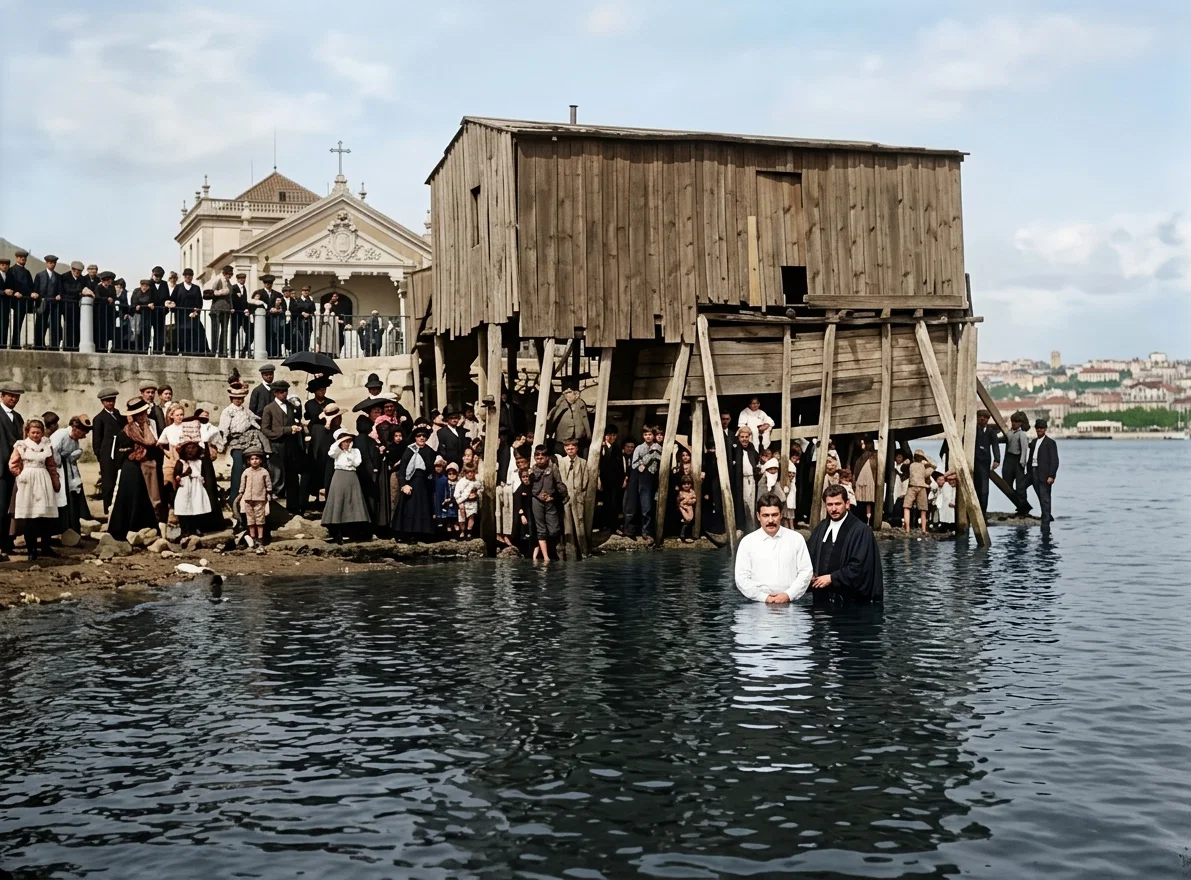
A BAPTISM OF BELIEVERS IN LISBON, PORTUGAL
“It is the love of self that brings unrest. When we are born from above, the same mind will be in us that was in Jesus, the mind that led him to humble himself that we might be saved. Then we shall not be seeking the highest place. We shall desire to sit at the feet of Jesus, and learn of him. We shall understand that the value of our work does not consist in making a show and noise in the world, and in being active and zealous in our own strength. The value of our work is in proportion to the impartation of the Holy Spirit.”—“Desire of Ages,” Trade Edition, pages 385, 386.
6. What is the cause of the great weakness in our churches? Whose spirit is it that rises up in the hearts of some when things do not please them?
“There is a cause for the great weakness in our churches, and that cause is hard to remove. It is self. Men have none too much will, but they must have it wholly sanctified to God. They need to fall on the Rock and be broken. Self must be crucified in every one who shall enter the gates of the city of God. The fierce spirit which rises up in the hearts of some in the church when anything does not please them, is the spirit of Satan, and not the spirit of Christ.”—“Testimony for Ministers,” page 26.
7. Why does God permit us to come in contact with suffering and calamity?
“Upon your faithfulness in this work, not only the well-being of others, but your own eternal destiny depends. Christ is seeking to uplift all who will be lifted to companionship with himself, that we may be one with him as he is one with the Father. He permits us to come in contact with suffering and calamity in order to call us out of our selfishness; he seeks to develop in us the attributes of his character,—compassion, tenderness, and love. By accepting this work of ministry, we place ourselves in his school, to be fitted17for the courts of God. By rejecting it, we reject his instruction, and choose eternal separation from his presence.”—“Christ’s Object Lessons,” page 388.
8. What should those who live to serve their own interests never expect?
“Let none suppose that they can live a life of selfishness, and then, having served their own interests, enter into the joy of their Lord. In the joy of unselfish love they could not participate. They would not be fitted for the heavenly courts. They could not appreciate the pure atmosphere of love that pervades heaven. The voices of the angels and the music of their harps would not satisfy them.”—“Christ’s Object Lessons,” page 364.
9. With whom will the great Judge place those who have drifted along, and who have sought to please themselves?
“Those who have drifted along, carrying no responsibility, thinking of themselves, pleasing themselves, will be placed by the Judge of all the earth with those who did evil. They receive the same condemnation.”—“Christ’s Object Lessons,” page 365.
10. Instead of withering up with selfishness, with what should our souls be expanding?
“I saw that he is greatly displeased with the least manifestation of selfishness on the part of his professed people, for whom Jesus spared not his own precious life. Every selfish, covetous person will fall out by the way. Like Judas, who sold his Lord, they will sell good principles and a noble, generous disposition for a little of earth’s gain. All such will be sifted out from God’s people. Those who want heaven must, with all the energy which they possess, be encouraging the principles of heaven. Instead of withering up with selfishness, their souls should be expanding with benevolence.”—“Early Writings,” Edition of 1907, page 268.
11. What is the duty of every soul? Name some of the terrible results of permitting self-exaltation to come into the heart.
“I saw that many prayed for God to humble them; but if God should answer their prayers, it would be by terrible things in righteousness. It was their duty to humble themselves. I saw that if self-exaltation was suffered to come in, it would surely lead souls astray, and if not overcome, would prove their ruin. When one begins to get lifted up in his own eyes, and thinks he can do something, the Spirit of God is withdrawn, and he goes on in his own strength until he is overthrown.”—“Early Writings,” Edition of 1907, page 120.
12. What is the sin that is well-nigh incurable?
“God can not connect with those who live to please themselves, to make themselves first. Those who do this will in the end be last of all. The sin that is most nearly hopeless and incurable is pride of opinion, self-conceit. This stands in the way of all growth. When a man has defects of character, yet fails of realizing this; when he is so imbued with self-sufficiency that he can not see his fault, how can he be cleansed?”—“Testimonies for the Church,” Vol. VII, page 200.
13. What, more than anything else, mars our communion with God and one another?
“How often our service to Christ, our communion with one another, is marred by the secret desire to exalt self. How ready the thought of self-gratulation, and the longing for human approval. It is the love of self, the desire for an easier way than God has appointed, that leads to the substitution of human theories and traditions for the divine precepts.”—“Desire of Ages,” page 484.
14. What always prevents our beholding the Lord? What kind of spirit in us enables us to see God?
“Selfishness prevents us from beholding God. The self-seeking spirit judges of God as altogether such a one as itself. Until we have renounced this, we can not understand him who is love. Only the unselfish heart, the humble and trustful spirit, shall see God as ‘merciful and gracious, long-suffering and abundant in goodness and truth.’”—“Desire of Ages,” page 351.
15. What will those be sure to do who love self more than they love Jesus?
“Satan is constantly seeking to cause distrust, alienation, and malice among God’s people. We shall be often tempted to feel that our rights are invaded, when there is no real cause for such feelings. Those whose love for self is stronger than their love for Christ and his cause, will place their own interests first, and resort to almost any expedient to guard and maintain them.”—“Testimonies for the Church,” Vol. V, page 242.
16. Before honor comes what?
“Before honor is humility. To fill a high place before men, Heaven chooses the worker who, like John the Baptist, takes a lowly place before God. The most childlike disciple is the most efficient in labor for God. The heavenly intelligences can co-operate with him who is seeking, not to exalt self, but to save souls.”—“Desire of Ages,” page 518.
17. When an individual thinks he is indispensable for the success of God’s work, what results?
“But when men exalt themselves, feeling that they are a necessity for the success of God’s great plan, the Lord causes them to be set aside. It is made evident that the Lord is not dependent upon them. The work does not stop because of their removal from it, but goes forward with greater power.”—“Desire of Ages,” page 518.
18. Of what must we be stripped before God can do anything for us?
“The Lord can do nothing toward the recovery of man until, convinced of his own weakness, and stripped of all self-sufficiency, he yields himself to the control of God. Then he can receive the gift that God is waiting to bestow. From the soul that feels his need, nothing is withheld. He has unrestricted access to him in whom all fulness dwells.”—“Desire of Ages,” page 347.
19. Many have served self so long that in their efforts to uplift Jesus, unconsciously to themselves, whom do they exalt?
“Watch unto prayer. In this way alone can you put your whole being into the Lord’s work. Self must be put in the background. Those who make self prominent, gain an education that soon becomes second nature to them, and they will soon fail to realize that instead of uplifting Jesus, they uplift themselves; that instead of being channels through which the living water can flow to refresh others, they absorb the sympathies and affections of those around them. This is not loyalty to our crucified Lord.”—“Testimony to Ministers,” page 330.
20. What is shut out of our hearts until self is emptied out? What is given us when self has been expelled?
“We can receive of heaven’s light only as we are willing to be emptied of self. We can not discern the character of God, or accept Christ by faith, unless we consent to the bringing into captivity of every thought to the obedience of Christ. To all who do this, the Holy Spirit is given without measure.”—“Desire of Ages,” page 202.
21. When every false god is cast out of the soul, what fills the place?
“When one is fully emptied of self, when every false god is cast out of the soul, the vacuum is supplied by the inflowing of the Spirit of Christ. Such a one has the faith which works by love and purifies the soul from every moral and spiritual defilement. The Holy Spirit, the Comforter, can work upon the heart, influencing, directing, so that he enjoys spiritual things. He is after18the Spirit, and he minds the things of the Spirit. He has no confidence in self; Christ is all in all.”—“Testimony for Ministers,” page 370.
22. With what sacrifices is God well pleased?
“‘The sacrifices of God are a broken spirit; a broken and a contrite heart, O God, thou wilt not despise.’ Man must be emptied of self before he can be, in the fullest sense, a believer in Jesus. When self is renounced, then the Lord can make man a new creature. New bottles contain the new wine.”—“Desire of Ages,” page 323.