THE conductors and publishers of the SIGNS OF THE TIMES believe in the Bible as the living Word of the living God.
They believe in Jehovah the God of the Bible; that He is a God of love and mercy and truth and justice, as His Word abundantly declares. "God is love;" "His mercy endureth forever;" "He keepeth truth forever;" He "executeth justice for the oppressed;" "the way of the wicked He turneth upside down."
We believe, as He declares, that the earth shall wax old like a garment, and that as a vesture "He shall change them and they shall be changed," but He "is the same" and His years have no end.
We believe that He is coming again in the manifest glory of His Son Jesus Christ "to execute judgment upon all, and to convict all the ungodly of all the ungodliness which they have ungodly wrought, and of all the hard things which ungodly sinners have spoken against Him." At His coming the whole earth shall be shaken.
That sinful man might live, God has veiled His glory, restrained wrath, and poured out His unstinted mercy. Yet in justice to mankind, and in mercy to the sinning, God at times withdraws His protecting hand and permits sin to work out its own results, bear its own full fruitage, bring the judgment which is sure to fall upon the perverters and transgressors of His living law. Thus He turned "the cities of Sodom and Gomorrah into ashes, condemned them with an overthrow, having made them an example unto those that should live ungodly."
He permits this that men may turn to Him; for when His "judgments are in the earth, the inhabitants of the world learn righteousness. Let favor be showed to the wicked, yet will he not learn righteousness." Therefore upon Babylon and Tyre and No-Ammon and Jerusalem, and other cities, fell the judgments of God because of their sins. To deny this is to deny the plainest statements of Holy Writ.
San Francisco's Calamity.
It is not for us to assume God's judgment seat, and to say why this one or that one suffered in the awful calamity which visited the city by the Golden Gate. But it is for us to declare God's terms of salvation. He says:
"At what instant I shall speak concerning a nation, and concerning a kingdom, to pluck up and to break down and to destroy it; if that nation, concerning which I have spoken, turn from their evil, I will repent of the evil that I thought to do unto them. And at what instant I shall speak concerning a nation, and concerning a kingdom, to build and to plant it; if they do that which is evil in My sight, that they obey not My voice, then I will repent of the good, wherewith I said I would benefit them."
To the sinful God says:
"Wash you, and make you clean; put away the evil of your doings from before Mine eyes; cease to do evil; learn to do well; seek justice, relieve the oppressed, judge the fatherless, plead for the widow. Come now, and let us reason together, saith Jehovah: tho your sins be as scarlet, they shall be as white as snow; tho they be red like crimson, they shall be as wool. If ye be willing and obedient, ye shall eat the good of the land; but if ye refuse and rebel, ye shall be devoured with the sword; for the mouth of Jehovah hath spoken it."
"Repent and believe the Gospel."
All these are solemn, impressive declarations of God's Word, and they might be multiplied by the hundreds. If unheeded, awful are the consequences, as all history shows. If heeded, they are helpful in result, and hopeful for all good.
At least, God permitted the earthquake and fire to come to San Francisco. To many it came as an awful rebuke of sin. Men and women wept and prayed and confessed their sin. But no sooner were the tremors well over than many returned like the dog to his vomit, or the washed sow to her mire wallow.
We have had no desire to press the rebuke home, to turn the probe in the wound. But we did desire above all things else to point the sinful hearts, the fearful hearts, the sin-sick hearts, the suffering, bereaved, hopeless, despairing, longing hearts to the sure Refuge from sin and its awful judgments; from the unstable world with its perishing cities, to the Lamb of God that takes away the sin of the world; to the One who has tunneled the grave by the power of His righteousness, and who will gather His people to the "Forever Land" with its "abiding city," whose "Builder and Maker is God." And to be faithful to our trust, we must still warn, still entreat, for His sake who died for the lost and the fallen.
We grieve because of San Francisco's awful calamity; yet2worse than that is San Francisco's sin, in which she is not alone. God knows, the wickedness there mounted to the heavens, that we felt no joy, no satisfaction, no careless indifference even, at her awful sorrow, tho our critics falsely so charge us. We sorrow for her awful suffering and grief. We sorrow more that more of her people do not take the lesson seriously to heart.
But What of the Pacific Press?
Is this the judgment of God? Are there not lessons here? These questions are being asked in seriousness, in cynicism, in skepticism, tauntingly, mockingly.
Of this seemingly awful calamity which came to a great publishing house, we shall say, as we said of San Francisco's, God, at least, permitted it. The same dangers have ever menaced God's people that menace the world. The enemy of all righteousness surrounds them with the gilded baits of worldliness, enthralls them in cares and pleasures, and stupefies them with prosperity and desire for gain.
They may in no way deal dishonestly. Their course and example in the world of commerce and manufacture, in trade and barter, may be exemplary in the highest degree. Men may have no evil thing to say of them. Yet, they may be using their energies, their talents, their means, their God-given powers, their influence, to promote and build up worldly enterprises, and thus become growingly indifferent to the claims which God has upon them. They may use the very facilities which God has bestowed upon them, to the neglect of God's work. They may do this honestly, mistakenly, believing it to be of indirect benefit to God's work; but indifference to God's claims on the part of His people is as bad as open, flagrant sin on the part of the world.
In God's mercy to His people, He must do more than warn. He must remove the means not used for Him; He must strip the human talents and energies of the facilities not used in His work, that His people may in humility learn that the King's business is paramount to all else; that God's work should be the business of His followers, first and last and all the time; that no work of any other character, honorable tho it be, must be allowed to hinder or interfere with the work of God. If they ignore the lesson as San Francisco is ignoring it, if they say the calamity to building has naught to do with business or character, they will fail to learn the great lesson, and thus lose the blessing of sanctified service for God.
Therefore with humbled heart we accept the lesson, the chastening from the hand of a merciful, patient, tender Father-teacher. And this lesson is not alone for the few workers here, tho it is for them; it is for those who profess to be His commandment-keeping followers everywhere. Indifference to God's claims on the part of His professed children is as bad as open, chosen sin on the part of those who know Him not; and the real test of faith and character is not the coming or not coming of a calamity; but how men learn the lesson.
God requires the whole heart, soul, mind, and strength. Yielding that to Him, all the calamities of earth are nothing. God's blessing and presence in the fiery furnace makes it safer than the throne of Babylon.
WOULD BE A COMMENDABLE STRIKE.
THERE is one strike that laboring men could make that would be of great gain to themselves and also to their employers. It is safe to say that if a general strike against the use of alcohol and tobacco had been made fifty years ago, very few, if any, of the great strikes since that time would have occurred. It has been demonstrated many times that employers do appreciate steadiness and sobriety in employees—and are willing to pay for it.
But the fraudulent union principle insists that the unreliable, unsteady, or incompetent man—if he belong to a union—must have the same wage for the same hours that is paid to the reliable, competent employee. The amount of work that the slowest man can do is made the standard, and however great the better man's desire to do more work in a given time, he must not do it. He is compelled to rate himself with the incompetent.
Competency never was a condition of unionism, practically, and now that the unions have avowedly gone into politics, the party will not reject any voters no matter how incompetent or unreliable they may be as workmen. The union is the resort of incompetency and unreliability, because, no matter how unsteady the man, he knows he has the union behind him; and if the unions have a political campaign on hand, he knows that they want his vote.
All the strikes that ever have occurred have occasioned loss generally to both employers and employed, but nearly always to the employed. Every advantage that they have gained costs no small amount to maintain. But if all would unionize and strike against these twin evils, alcohol and tobacco, instead of endeavoring to keep their fellow men out of employment, they would be so much more competent that employers would have more inducement to keep them employed and to pay them good wages. If there is one thing above another that the average employer appreciates, it is punctuality and clear heads on Monday morning.
Then how much farther a week's wages will go if spent for food, clothing, and other home comforts—and charity; not compulsory dues, but charity. G.
A Corner of Our Present Temporary Office.
HUMAN NATURE.
IMMEDIATELY after the great fire in San Francisco, the disposition on the part of landlords, merchants, and others to raise prices was summarily curbed by the mayors of the city and of Oakland. Those who raised prices on commodities had their places seized and placed in the hands of receivers. Of course such a recourse could not last long, because the process had only the authority of might behind it. There was nothing that would legitimately raise prices; the only reason was that men could take advantage of other's needs, and because they could get more they took occasion to do so.
So almost every line of staples has raised in price. Because of the demand, everything in the line of building material has been raised excessively; note it was not because of increased cost of production in outside markets, or because of increased freight rates, but because of the innate human desire to take advantage of public necessity. There seems to be a combination of the spirit of trustism, associationism, and unionism; the raiser in one line giving the excuses for advances in others, without other necessity for advance in either.
The greed inherent in human nature is at the bottom of it all—a greed that seems to fatten and grow even in the face of misfortune and suffering. It knows no sympathy, no charity. Even the donations of sympathetic people from abroad have been exploited to feed the appetite of the greed that is rampant in these last days. Some people have been making a text of the large donations from the country at large to preach the doctrine that "the world is growing better," but the conditions that prevail in and around the stricken city but emphasize the ever-increasing selfishness of human nature.
3And to add to the evidence of this condition, we have the disposition of insurance companies (mostly Eastern or European corporations) to evade the payment of losses. Then because merchants are retarded in re-opening their stores, it is reported that wealthy merchants in Eastern cities are taking advantage of the situation to occupy the field. Such is the spirit of this sin-cursed world. Is there not every inducement to seek an eternal habitation "wherein dwelleth righteousness." This is man's greatest opportunity. G.
Question Corner
1882.—Having Ears to Hear.
The following text is repeated in the New Testament:
"If any man have ears to hear, let him hear." Does this mean having an understanding of Christ's sayings and teachings and implying that all men had not, or that some lack the desire to hear or listen?
F. F. F.
It implies the latter. Christ is the "true light that lighteth every man that cometh into the world." Some will not see, some will not hear, yet over and over and over all are called to hear. The word of the prophet is: "O, earth, earth, earth, hear the word of the Lord." The apostle Paul declares to the heathen world that God is not far from every one of us, and all could hear Him and serve Him if they would.
MAN'S IMMORTALITY.
[Outline of a sermon by Dr. H. F. Carpenter, reported in San Jose (Cal.) Mercury.]
“Set thine house in order; for thou shalt die, and not live.” 2 Kings 20:1.
HEZEKIAH was a holy king, but was fatally sick. He was advised to arrange his temporal affairs accordingly. The prophet of God did not believe death to be a passport to heaven, a new birth, a beginning of increased activities, nor a “passing on” to any life whatsoever, but the cessation of all life—“Thou shalt die, and not live.” In this he was in harmony with nature, for we never call anything dead as long as it has life in it. If we were to adopt the sentiment of Isaiah, we should save ourselves from opposition to the prophet of God.
Secondly, we would save ourselves from applying many texts to death which have no reference to death. “Absent from the body” refers not to death, for Lazarus had been dead four days and was found in his body in the tomb. “To depart and to be with Christ” refers not to death, for Paul did not expect thus to depart till the resurrection at Christ’s coming. See 1 Thess. 4:16, 17. 2 Cor. 5:1 refers not to death, but to the time when mortality shall be swallowed up of life: read verse 4.
Thirdly, we would save ourselves from many inconsistencies of Biblical exposition. If everybody passes to judgment and reward at death, what need of a future day of judgment, as the Bible plainly teaches in multiplied texts? Why tell us that the “cloud of witnesses” with which Paul in Heb. 12:1 says we are compassed, are the spirits of our dead friends watching sympathetically over us, and then when we read in Eccl. 9:5 that “the dead know not anything,” tell us that that means they know nothing about the things of this world? Such inconsistent expositions will be avoided by believing God’s prophet.
Fourth, we would avoid mortifying our good sense. If death sets the gates of heaven not only “ajar,” but “wide open,” then Epaphroditus when sick unto death was well nigh heaven. But God, Paul said, “had mercy on him” and healed him. Phil. 2:27. Was it a mercy to keep him from heaven?
Fifth, we should avoid overtaxing lexicographers. They search in vain to find a meaning for “death,” destruction, perdition, to suit our theology in the root and etymology of these words, if we teach that life continues in death. They are compelled to add a sense which they call a “theological sense.” Why beggar language by contradicting God’s prophet?
Sixth, we would save the honor of the Gospel as the only revealer of future life and immortality. If future life is through the immortality of the soul, then the Gospel did not reveal it. The Bible speaks of the soul 857 times, but calls it immortal never. It also speaks of the human spirit nearly 800 times, and never calls that immortal or deathless, but it is written, “The spirit shall fail before Me, and the souls which I have made.” Isa. 57:16. Matt. 10:28 denies the soul’s immortality, and we read more than once of “killed” souls. The Egyptians first taught the soul’s immortality, but the Gospel teaches future life and immortality through a resurrection from the death state. Is it not better to honor the Gospel rather than Egyptian philosophy?
Seventh, we should save ourselves from strengthening the hand of the wicked. God chides some teachers, saying, “Ye have . . . strengthened the hands of the wicked, that he should not return from his wicked way, by promising him life.” Eze. 13:22. Persuade a man that death don’t kill, but his life will flow on, ever progressing, and what cares he for Christ as a life-giver? He will fix things all right in the endless life before him. So he risks it. If he believed God’s prophet that to die is to cease living for a time, he would feel the need of Christ to give future life immortality. The words of Christ would mean something when He says, “I am come that they might have life, and that they might have it more abundantly.” John 10:10.4
Eighth, we should find ourselves in harmony with science truly. Not a scientific fact can be brought to show that life continues in death. Buehner says that “unprejudiced philosophy is compelled to reject the idea of an individual immortality and of a personal continuance after death.” Vogt testifies to the same. Maurice Maeterlinck, in speaking of memory, the strongest point of our intelligence upon which philosophy can base a hope of continued life, says, “Memory is the most precarious of all our faculties, . . . one of those which disappear the most promptly.”
Ninth, we should save ourselves from belittling what the Bible magnifies. It magnifies the resurrection, day of judgment, the second coming of our Lord, the inheritance of saints, the new heavens and the new earth, the end of all sin upon earth, and the will of God done here as in heaven, and the earth filled with God’s glory,—Edenic beauties all restored. But of what account are all or any of these to a disembodied existence? Let us take our stand with Isaiah, the evangelistic prophet, and say to dying men, “Thou shalt die and not live.” Then point them to Jesus who alone can redeem from death and ransom from the power of the grave.
ASSIMILATED BENEVOLENCE.
WITH what a benevolent air the announcement is made that the Jamestown Exposition of 1907 will be closed on Sundays! The action is set forth as a real dispensation of privileges that visitors could not otherwise enjoy. The announcement, which we have received by favor of the Press Bureau of the exposition, says that the arrangement of Sunday closing "will afford exposition visitors opportunity to visit points of historic interest in the vicinity of Norfolk on Sunday, and spend a portion of the Sabbath day in attendance at worship in one or more of the several historic church buildings."
The logic of this announcement is that visitors could not have these privileges if the exposition were not closed on Sunday. No matter how much they might desire to see these places of interest, they would be deprived of the privilege if the exposition were open on Sundays. One is led to wonder if those historic points of interest are only to be seen on Sunday, and if they are to be necessarily shut off from view when the exposition is open. Again, it would seem that no matter how much a visitor might desire to attend some of the historic churches on Sunday, they could not be so privileged unless the great exposition were closed.
How good and benevolent it was in the church-and-state Reform Bureau of Washington to induce Congress to place a Sunday-closing proviso on the exposition appropriation, so that the governors of the great show could voluntarily have the place closed on Sunday, in order to give the visitors the privilege of visiting other places of interest on that day, and even to attend church part of the day! The wonderful liberties attached to religious legislation, to which enforced Sunday observance is the opening wedge, are past comprehension.
Furthermore, it is difficult to understand why it is morally worse to witness the interesting and instructive features of the exposition, gathered from all parts, than to visit historic places about Norfolk, on Sunday. The only reason that appears on the surface is that a certain class of religious would-be dictators have a chance to say what some other people shall not do on Sunday, with the hope, sometime in the near future, of being able to dictate what they shall do. G.
1883.—The Sabbath in Northern Latitudes
How can the Sabbath be kept in the northern countries from sunset to sunset when the sun is above the horizon several weeks at a time? O. M.
In the first place there are very few, if any, people living in northern latitudes where the sun does not set for several weeks at a time. Nearly all people live below that latitude; and yet even those who do live there have no trouble in keeping the day. They can tell when the Sabbath comes just as easily as they can tell when any other day comes. We have never heard of any trouble of our brethren who live in the northern regions of Iceland, Norway, and Sweden; nor have we from those who keep Sunday in those regions.
1884.—Power of the State.
Why has the state a right to enforce marriage laws and not Sabbath Laws? Isn't one a divine institution as well as the other?
O. M.
Yes, both are divine institutions; so is man and all that pertains to him; that is, God is their origin; but God gave us different things in different spheres of action. Marriage laws have wholly to do with man's relation to his fellow men. On a purely economic basis the state would have a right to regulate marriage laws. In this, of course, it does not say as to whom one shall marry. Some states prohibit certain marriages, but they do not direct the marriage nor the persons entering into such a contract. Marriage has to do with the home, has to do not only with the rights of those who enter into that relation, but to their children, grandchildren, and to all their posterity; and therefore it has to do with the settling and transfer of property. It has to do with one's citizenship, or transfer of citizenship or property rights from one country to another. Not so, however, with Sunday-keeping. The Sabbath is to be kept, not holy to man, not holy to the state, but holy unto the Lord. It is a worship day that pertains to the great Jehovah on the one side, and to His human child on the other, and therefore lies entirely outside the province of the state.
Please explain 1 John 3:9 which reads: "Whosoever is born of God doth not commit sin; for his seed remaineth in him; and he can not sin, because he is born of God." M. C. D.
He that is truly a child of God seeks only how he may please his Father. The declaration is not to be understood as having no physical power to commit sin, but having no will to commit sin. The man called, to the marriage supper, as recorded in Luke 14, said, "I have married a wife, and therefore I can not come," that is, he had no desire to come. So the man who has given himself and his heart to God, has been begotten of God, has no desire to commit sin. He may fail, he may make mistakes, but it is in his heart to do God's will, and the Lord counts the purpose of heart. That text is also rendered: "He that is begotten of God doth not practise sin." That is not his purpose, that is not his habit. His failures come, not because of purpose, but, like those of the child, from ignorance or inexperience. Yet these God does not count sin.
Your question on once in grace always in grace was answered a few weeks ago in an article in the SIGNS, which we can not refer to now as all our back numbers are burned. We will endeavor to give light upon the question in an article in the future, so that you will get it if you are a reader of the SIGNS.
A JAPANESE CHRISTIAN ENTERPRISE.
By S. A. Lockwood, M. D.
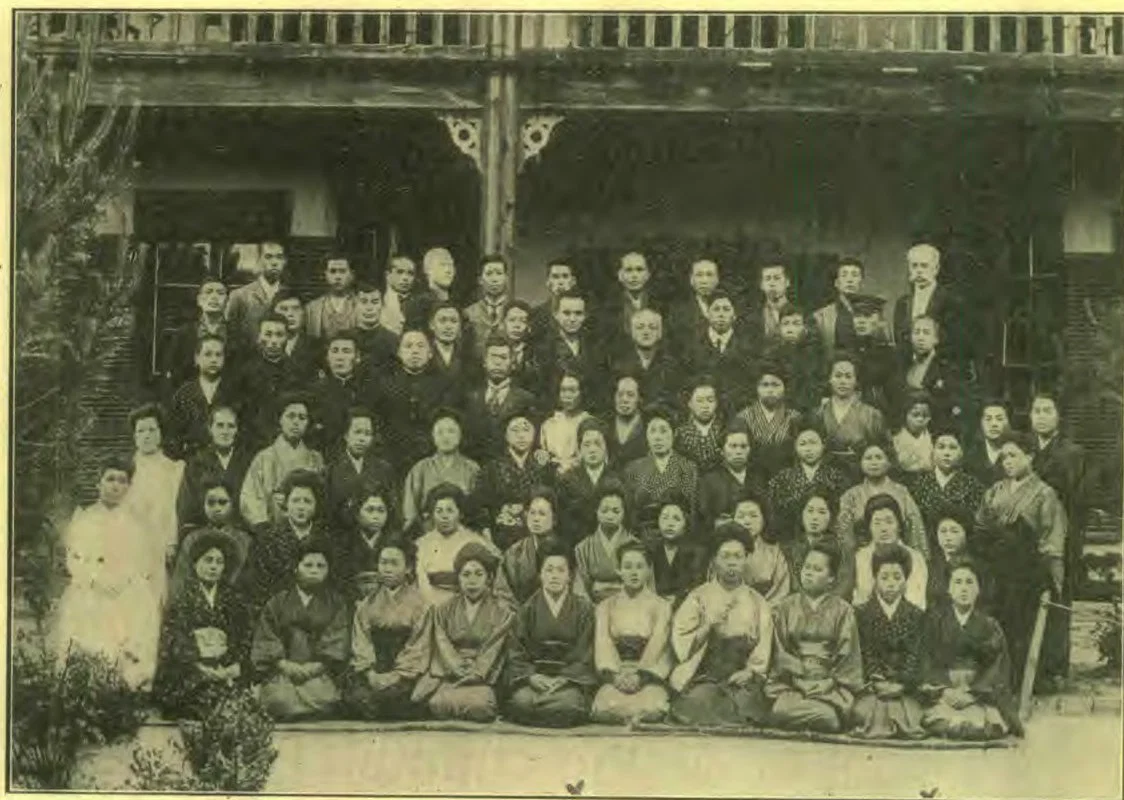
AMONG the charitable institutions in Japan, probably none are more deserving of notice than the Okayama Orphanage. Begun twelve years ago by an earnest Christian man, Mr. Ishii, with no endowment whatever, it has, year by year, extended its work until there is now an enrolment of twelve hundred children. How the last eight hundred children were received is best told in the words of Rev. J. H. Pettee, who, with his wife, has rendered invaluable assistance to the enterprise from its very beginning. In a recent appeal to the public Mr. Pettee says in part: 'Now that the severest distress in the north has been relieved by generous gifts from all over the world, I beg leave to report the part taken in this timely work by that mother of children's homes in Japan, the Okayama Orphanage.
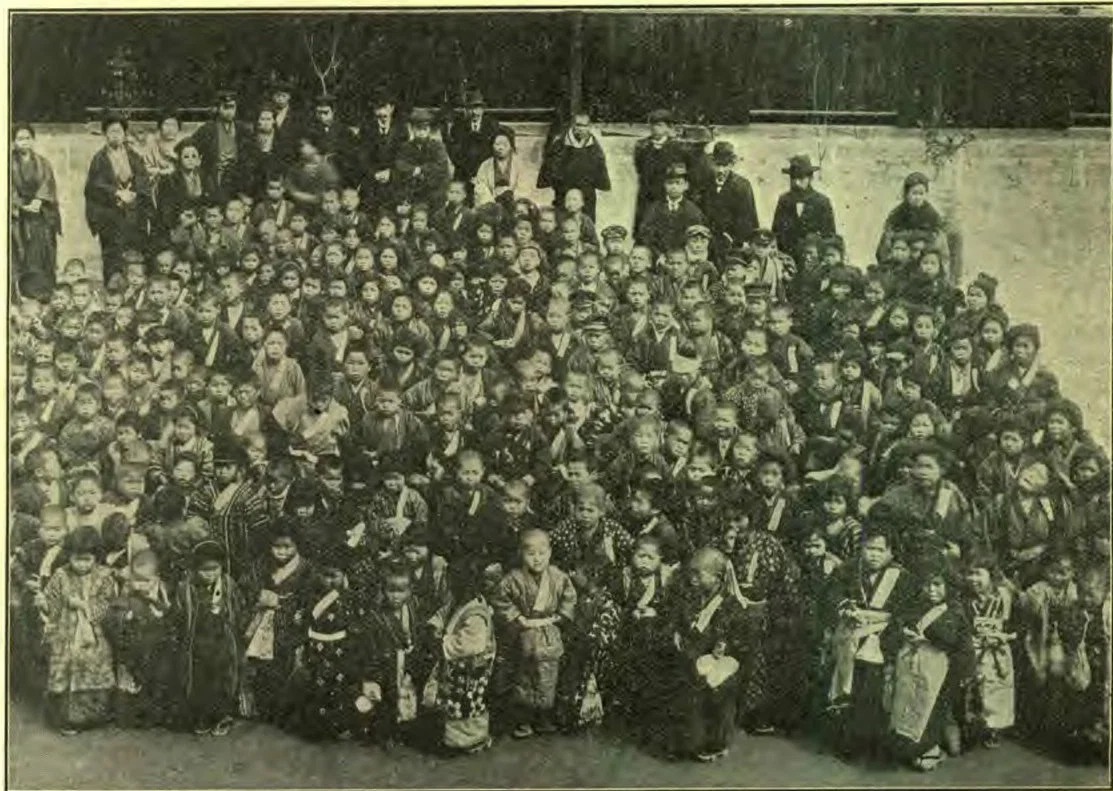
'Its superintendent, Mr. J. Ishii, visited the affected region five months ago and gave formal notice to the governors of the three suffering prefectures and the local aid committees that the Okayama institution, being not local but national and even international in its aims, would receive as many genuinely needy children as might be sent to it. As a result 825 such children have already come to Okayama from the famine district. This brings the present number up to twelve hundred.
'The faith, patience, pluck, and spirit of unceasing toil manifested by the workers of this brave-hearted institution to meet such an emergency can not be overstated. Cottages have been bought or built, large quantities of clothing and bedding prepared, and the running expenses trebled.
'Let it be remembered that a large majority of these famine children are under eight years of age. Many of them are in a pitiable condition. They need continued care and training. If this can be given them for a few years, they can return to their old homes strong, intelligent, self-reliant, enterprising young men and women full of the spirit of service based on Christian principles. This is no idle prophecy, but a suggestion of what is sure to happen if the Okayama Orphanage be helped to carry out its altruistic purposes.'
Even before these famine children came there were times when the supply of food was so low that it was difficult to tell whence the next meal would come. At such times the children would have little prayer-meetings and ask God for food, and He never failed to answer their prayers. When this added burden was taken, the managers knew not how the extra expense would be met, but they trusted that God would supply their needs, and this He has done through many channels.
The readers of the Signs who have contributed to the famine fund will no doubt be interested to know that a part of the amount collected was handed over to the trustees of this orphanage, and the accompanying cuts show some of those to whom aid and comfort have been given. The grateful thanks which were tendered for this gift we pass on to those who have remembered these children in their affliction.
S. A. LOCKWOOD, M. D.
Superintendent, house-mothers, teachers, and assistants. Superintendent, Mr. Ishii, over the cross, second row from the top. Rev. J. H. Pettee, first row at the right.
LABOR.
By Henry van Dyke
THIS is the gospel of labor,—
Ring it, ye bells of the kirk!
The Lord of love came down from above
To live with the men who work.
This is the rose He planted
Here in the thorn-cursed soil;
Heaven is blest with perfect rest,
But the blessing of earth is toil.
—Henry van Dyke.
MAX HILL
By Max Hill
TRULY the highest joy is that which comes from the knowledge of well-performed duty. An artist labors for weeks and months on a painting that shall be the expression of his highest ideals of beauty and excellence. Day by day he toils, and when the masterpiece comes from his hand he views it with joy, with satisfaction. The same is true of the musician, inspired and thrilled with divine melody; the poet and writer, charmed with the beauties or moved by the events and scenes about them; the teacher and physician, burdened for those in their care; the toiler tho wearied with the irksome task.
It must be true if the man really lives. However humble the task, whatever the burden or care, the true man will see in it something to bring joy. It is placed in the heart by the Creator Himself, who gave man at creation his regular work to do; and in the fall this work was not taken from him, but rather increased. No command comes from Him without the strength for performance, and no task well performed goes unrewarded.
MAX HILL
Feeling and Action
A PERFECT feeling eventuates in some form of action.—Henry Ward Beecher.
Sentiments and Lovely Actions
EVERY man feels instinctively that all the beautiful sentiments in the world weigh less than a lovely action.—Lowell.
The Puritans Gave Action
WHAT the Puritans gave the world was not thought, but action.—Wendell Phillips.
Action in Oratory
WHEN Demosthenes was asked what was the first
part of oratory, he answered, “Action;“ and which
was the second, he replied, “Action;“ and which
was the third, he still answered, “Action.“
Concealing One’s Ability
THERE is a great ability in knowing how to conceal one's ability.—La Rochefoucauld.
Adversity and Prosperity
By Carlyle
ADVERSITY is sometimes hard upon a man; but for one man who can stand prosperity there are a hundred that will stand adversity.—Carlyle.
THE JEWS IN RUSSIA.
AT one time all the world honored Israel and came to Jerusalem to hear the wisdom of Solomon, and to bring him presents. 1 Kings 4:29, 34; 10:24, 25. But through apostasy Israel fell to a position “worse than the heathen,” and, as a people, they never fully recovered their former glory and prestige. Their dispersion to all nations is still in evidence, and they have ever since been the objects of persecution. When the multitude were following Christ to the place of crucifixion, many of the sympathetic women were weeping because of the abuse heaped upon Him; but He turned to them and said, “Weep not for Me, but weep for yourselves, and for your children.” He had special reference to their terrible experience in the destruction of Jerusalem, which came thirty-six years later; but they have lived and labored as a scattered people without friends (excepting those of expediency) until the present time. Few, if any, people have had as little even of Christian missionary sympathy as the Jews.
There are more Jews in Russia than in any other country, and there they are the objects of special animosity, it being deemed a crime to even resemble a Jew. Of conditions there, the Jewish Ledger says:
“It is no surprise that our co-religionists in Russia are in a continuous state of excitement, fully realizing that their lives are in jeopardy, their property and personal effects subject to the mere whims of drunken hordes of moujiks, who come and go at the beck and call of any official who may desire to wreak vengeance upon the Jews.
“De Witte, of whom Americans expected better things, is authority for the statement that the Jews are responsible for the existing conditions in Russia. Regardless of the fact that it is proven that the government is responsible for all the horrors that have been perpetrated against the Jews, and altho again, very recently, the ‘official assurance’ has been given to the United States and England that these excesses will be prevented, it is paramount to any reader of Russian news items that the Jews in Russia are in jeopardy at all times.
“We are led to these conclusions in noting the latest, in reference to the assassination of General Kozloy in the Park of Peterhoff, on last Saturday afternoon.
“Because the countenance and appearance of the assassin is regarded to be Semitic, he is considered by the authorities to be a Jew. Furthermore, it is reported that he was seen in company with two other individuals, just previous to the ‘taking off’ of Kozloy, these parties also looking Semitic.
“By a process of reasoning, peculiarly Russian, the conclusion is arrived at that Kozloy’s assassin was a Jew. He has not given his name or antecedents, tho he openly avowed his connection with the ‘social revolutionary organization’—yet he is a Jew because he looks Semitic.
“It may be predicted that this latest incident in Russia’s affairs augurs no good for the Jews of that country, in fact it is disheartening to note, day after day, the imminent danger environing our co-religionists, and without a ray of hope to thwart the diabolical system, completely organized under the auspices of Russia’s rulers, which can signify nothing less than to keep the unfortunates in the toils.”
If there is a people on the earth that needs Christian sympathy, that needs the Gospel of Christ, it is the Jews. The apostle Paul had a great burden for them (Romans 9), and even when his mission was especially to the Gentiles, in going to a new place he would invariably call upon the Jews first, if any were to be found. But to-day their worst enemies are among those who profess to be Christians, yet one who professes to be a Christian is the last person who can, with any show of consistency, be an enemy to any one. And it is a significant fact that the principal cause of this enmity is Jewish adherence to the Sabbath of the Lord.
Altho the Sabbath observance of the Jews is in the main merely nominal, yet even that is sufficient to call down upon them the censure and even the persecution of those who hold to the Sunday counterfeit institution. While the Jews nominally hold to the law of God, and their persecutors profess faith in Jesus Christ, the Word of God sets up as the standard of truth, “the commandments of God, and the faith of Jesus.” Rev. 14:12. The law of God is not made void by the Gospel, but it is established by it. Rom. 3:31. A double burden rests upon the true missionary of to-day,—that of carrying the Gospel of Christ to the Jew, and that of impressing the importance of the commandments of God upon those who adhere to the ordinances of Rome.
An Installment of Famine Children Just Arrived at the Orphanage.