It may here be said by some that the charges thus far brought against this government are applicable only to the civil power, and that therefore it would be hardly proper to denounce the beast as a whole as speaking like a dragon. But we think a moment's consideration will be sufficient to satisfy any one that the ecclesiastical power of our land is not exempt from the charge brought forward in the prophecy. For if the right of private judgment is allowed in matters of religion in the Protestant Church, why are such numbers expelled from her communion for no other crime than following the dictates of their own conscience—a right which Protestantism professes to guarantee to every man? Why are they expelled from their midst for looking for the Lord they love, to return again according to his glorious promise? Why does she break fellowship with them for preferring to follow what seems to them the plain commandments of God instead of what seems equally plain to be the commandments and traditions of men? In short, why are they received on the Bible and the Bible alone, and then boosted out by the imperious demands of a little book, called a creed, if they happen to differ from the established opinions? It is the creed power that is fast neutralizing the fair profession of professed Protestants.
From a sermon by Chas. Beecher we make the following extracts which are to the point:
"Our best, most humble, most devoted servants of Christ are fostering in their midst what will one day, not long hence, show itself to be of the spawn of the dragon. They shrink from any rude word against creeds with the same sensitiveness with which those holy fathers would have shrunk from a rude word against the rising veneration of saints and martyrs which they were fostering."
"The creed system is now exerting upon the clergy of the Protestant churches a secret, unsuspected, but tremendous power against the Bible—a power of fear. Yes, while it professes to venerate and defend the Bible, it is virtually undermining it."
"The religious world has what is called a public sentiment of its own, and this is formed chiefly by the great evangelical denominations. Other denominations are, owing to their paucity of numbers, less perceived. By one or the other of these denominations, the first fact is, the young candidate is to be licensed; for public sentiment has settled that an unlicensed preacher is no preacher at all. He must have license, then; all his hopes centre on that. But there is not one of these great evangelical denominations from which he can get license, unless he will subscribe the creed of that denomination. In other words, the Protestant evangelical denominations have so tied up one another's hands, and their own, that, between them all, a man cannot become a preacher at all, anywhere, without accepting some book besides the Bible.
"It is true, each denomination says, 'We inflict no penalty—we only decline to receive into our ranks one who does not agree with us.' And this is so specious, it sounds so reasonable, that it might deceive the very elect; but it is the most consummate stroke of infernal craft, and doubly-distilled jesuitism.
"It is like Rome, handing over the victims of the Inquisition to the civil arm, charging it to do them no harm, and then piously lauding her own lamb-like disposition. It is true, the denominations do not do the candidate any harm, they only silently leave him to his inevitable fate.
"Unlicensed, without moral affinities with the minor sects, alone, before he has formed the self-sustaining habits of a man, before he has yet tried his armor, self-distrustful, generally poor, often in debt, inexperienced, he finds an invisible, intangible Power has entangled and enveloped him in complicate, writhing folds. The frown of society is upon him, public sentiment is against him—the public sentiment of good men, yea, of the best and most devoted! He is whispered to be unsound, unsafe, heretical. He is called by every sectarian name most frightful to ears evangelical, right or wrong; and yet nobody does it. He is smitten; he looks here and there, behind and before; he can see nobody. And thus he is politely, and respectfully, and silently, and invisibly crushed. He is in the religious world what a broken-down candidate is in the political, dead.
"Now there never was a torture of the Inquisition more exquisitely suited to extort conformity from an agonized victim. Not the body, but the mind is on the rack. Every most noble feeling is tried to the utmost. His natural need of livelihood, his care of family and of friends, his sense of reputation, his honest ambition, his tastes, his intellectual habits, his hopes of usefulness, yea, the very inmost, sacred emotions of his devotional experience, are here taken hold of—in the dark—by an unseen, ruthless hand—and are wrung, and racked, and wrenched, to the last extreme of mental torture. And there is no eye to pity, nor arm to save. The public will not hear him. He is nobody; an outcast; a mad-man.
"This, my friends, is the PENALTY, which good men, not of good motives, unconsciously, yet really, are proposing to the eyes of every candidate for the ministry—this intense spiritual martyrdom. During seven years it stares him in the face, during the whole forming time of his opinions. And for what?
"For daring to say, 'I do not receive your creed as containing the system of doctrines contained in the Bible;'—and for daring to say what God has said, 'With that Bible alone, I am perfect, thoroughly furnished unto all good works!' For repeating and holding on upon this declaration of God, he falls a spiritual martyr. And is not that an apostasy, then, that martyrs him? And is not the Protestant church apostate? Oh! remember, the final form of the apostasy shall rise, not by Rome's aggressive march; not by the pope's long arm, outstretched to snatch our Bible; not by crosses, processions, baubles. We understand all that. Apostasy never comes on the outside. It develops. It is an apostasy that shall spring into life within us; an apostasy that shall martyr a man who believes his Bible ever so boldly; yea, who may even believe what the creed contains, but who may happen to agree with the Westminster Assembly, that, proposed as a test, it is an unwarrantable imposition! That is the apostasy we have to fear, and is it not already formed?
"Accept the Bible and the book, and you may put your own private construction on both, as every one does. Accept the Bible, and put your own private construction on that—the great paw of the beast is on you. This is what I call taking the Bible out of the hands of the ministry.
"Will it be said that these fears are imaginary? Imaginary? Did not the Rev. John M. Duncan, of Baltimore, in the years 1825-6, or thereabouts, sincerely believe the Bible? Did he not even believe substantially the confession of faith? And was he not, for daring to say what the Westminster Assembly said, that, to require the reception of that creed as a test of ministerial qualification, was an unwarrantable imposition, brought to trial, condemned, excommunicated, and the pulpit declared vacant?
"There is nothing imaginary in the statement that the creed-power is now beginning to prohibit the Bible as really as Rome did, though in a subtler way. During the whole course of seven years' study, the Protestant candidate for the ministry sees before him an authorized statement, spiked down and stereotyped, of what he MUST find in the Bible, or be martyred. And does any one, acquainted with human nature, need be told that he studies under a tremendous pressure of motive? Is that freedom of opinion?—'the liberty wherewith Christ maketh free?' Rome would have given that. Every one of her clergy might have studied the Bible to find there the pontifical creed on pain of death. Was that liberty?
"Hence I say that liberty of opinion in our Theological Seminaries is a mere form. To say nothing of the thumb-screw of criticism, by which every original mind is tortured into negative propriety, the whole boasted liberty of the student consists in a choice of chains—a choice of handcuffs—whether he will wear the Presbyterian handcuff, or the Methodist, Baptist, Episcopal or rather Evangelical handcuff. Hence it has secretly come to pass that the ministry themselves dare not study their Bibles. Large portions thereof are seldom touched. It lies useless lumber; or, if they do study and search, they dare not show their people what they find there. There is something criminal in saying anything new. It is shocking to utter words that have not the mould of age upon them.
"For through the ministry the same spirit has been conducted to the people. The same penalties hang over them. The denominations are so nearly balanced, the strife for power is so keen between them, that every fancied departure from that creed is seized to make political capital as really as in any political campaign. Houses must be built; salaries must be raised. This requires wealth. Wealth requires numbers and patronage. This creates a servile dread of novelty, for every thing that another party can get hold of strikes at the gold. Therefore, the people watch their minister, and the minister is afraid of his people. For if he studies independently, if he goes outside of the book, if he slips the handcuff, the people tremble—it will not please—the opposition will seize it—we shall be unpopular—we shall not succeed.
"O, wofu1 day! O, unhappy church of Christ! Fast rushing round and round the fatal circle of absorbing ruin! Thou sayest, I am rich, and increased in goods, and have need of nothing; and knowest not that thou art poor, and miserable, and blind, and naked!"
"Thus are the ministry of the Evangelical Protestant denominations, not only formed all the way up, under a tremendous pressure of merely human fear, but they live, and move, and breathe, in a state of things radically corrupt, and appealing every hour to every baser element of their nature to hush up the truth, and bow the knee to the power of apostasy.
"Dimly does every one now and then see that things are going wrong. With sighs does every true heart confess that rottenness is somewhere, but ah! it is hopeless of reform. We all pass on, and the tide rolls down to night."
"The waves of coming conflict which is to convulse Christendom to her centre, are beginning to be felt. The deep heavings begin to swell beneath us. 'All the old signs fail.' 'God answers no more by Urim and Thummim, nor by dream, nor by prophet.' Men's hearts are failing them for fear, and for looking after those things that are coming upon the earth. Thunders mutter in the distance. Winds moan across the surging bosom of the deep. All things betide the rising of that final storm of divine indignation which shall sweep away the vain refuge of lies. When the Lord shall cause his glorious voice to be heard, and shall show the lightning down his arm, with the indignation of his anger, and with the flame of a devouring fire: with scatterings, and tempest, and hailstones; in that day, what shall save us? For judgment will begin at the house of God. What shall be our defense? Put your trust in Him, whose eyes are as a flame of fire, on whose head are many crowns, who is clothed with a vesture dipped in blood, whose name is called, THE WORD OF GOD!"
Sufficient has now been said on this portion of our subject. From the considerations thus far offered it is evident that this government in both of its leading principles, Republicanism and Protestantism, is false to its profession. It is a lamb only in appearance. How wonderfully has this nation thus far answered to the symbol; and what feelings should it create in our bosoms, as point after point we trace it out, and perceive the wonderful harmony. Thus another link is added to the great chains of prophecy that are leading us down to the end; another great way-mark is set up to show us our position in the world's history; another great evidence that we are right in our calculations of the approaching consummation, and that our hopes and anticipations of a glorious and immediate deliverance of all the faithful, are well founded. Ten times more credulous is he who can believe that all the signs of the times which are now transpiring around us, mean nothing, warn us of nothing, and will result in nothing, than he who in firm faith lays hold upon the promises of God, believes his word, and humbly thanks him for the evidences he has in mercy given us of the swift coming of the great day, and the space granted for preparation.
Two points more we had proposed to notice in the prophecy of the Two-horned Beast; namely, the form of the government symbolized, and its acts; and this last item might also be sub-divided into numerous specifications. But as we have concluded to give place in the REVIEW to Bro. J. N. Loughborough's work on this subject which he is now by request revising, we refer our readers for further information to that forthcoming work, and will burden them no further with our remarks.
NEW SPIRITUALIST PAPER.
By Editor
We learn from the Spiritual Telegraph that a new paper devoted entirely to Spiritualism is now published in Spanish at Caraccas, in Venzuela, South America, entitled "The Spiritualist," and "dedicated to the investigation of Spiritual Manifestations, with the object of enlightening Unbelievers, and of unfolding in the human mind the glorious destiny of man."
EVENING AND MORNING—A DAY.
By John Harvey Kellogg
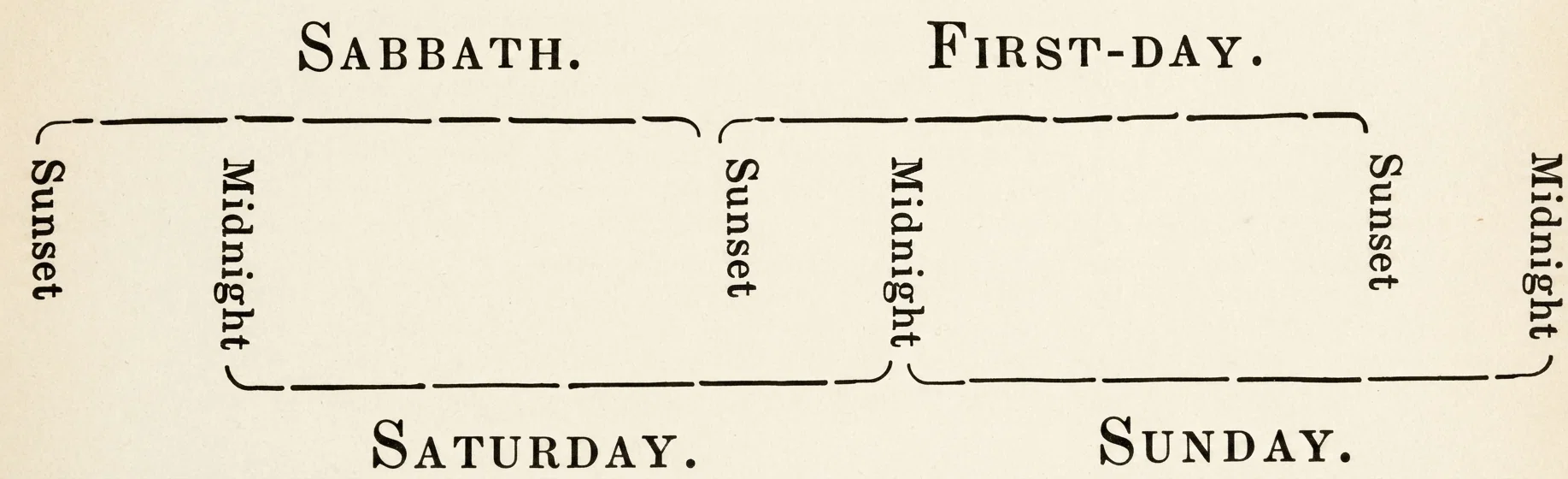
In the Bible the evening and the morning constitute a day. In Roman time, (the method of reckoning in common use,) it is not so, the order being reversed. And not only is the order reversed, but the time for the commencement of the parts of the day is changed. Without bearing this in mind there will be confusion in reckoning the true time, as the Roman Saturday is not identical with the seventh day of the Bible, and the Sunday is not the same as the first day of the week. The following diagram will illustrate this:
By this it will be seen that the Sabbath commences about six hours, or from sunset to midnight, before Saturday does. The Sabbath is a portion of time so named by the Creator, commencing and ending with the setting of the sun. Saturday was so named by the Romans, and denotes a portion of time from midnight to midnight, embracing about three-fourths of the seventh day, and about one-fourth of the first day of the week.
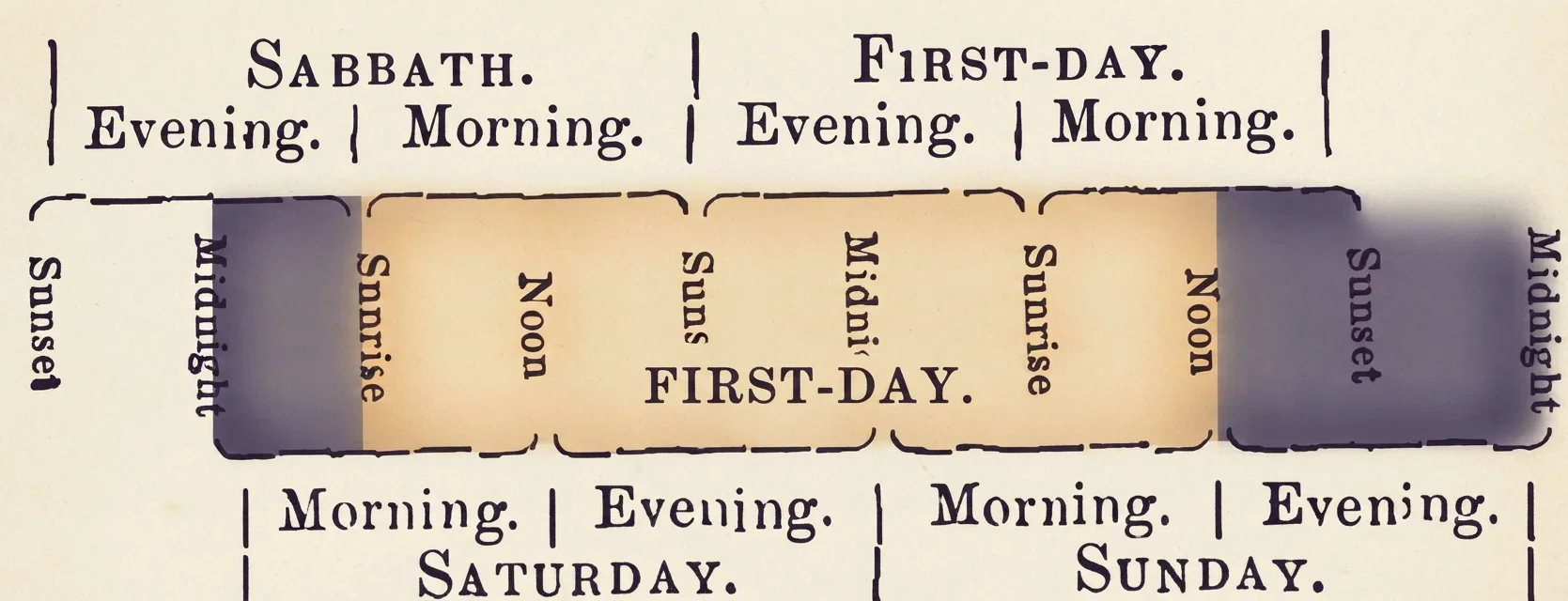
But the greatest confusion exists in regard to the evening. And to this it seems necessary to call attention as there are many Sabbath-keepers who have not fully considered this, and therefore would not understand an appointment or the report of a meeting given according to true time. The following diagram will show the difference between the evenings of the true and common time:
Sabbath evening commences on the Roman Friday afternoon at sunset, while Saturday evening commences at noon of the seventh day, about eighteen hours afterwards. A meeting on the evening of the first day of the week, [Acts xx, 7,] will be on a Saturday night. A Sunday evening meeting would be on the evening of the second day of the week.
Would it not be well to adopt the true reckoning amongst Sabbath-keepers? It seems necessary to prevent confusion, as all acknowledge and speak of the Sabbath evening as commencing at sundown on Friday P. M. If the others are reckoned differently there must be a break somewhere, and an explanation given to prevent misunderstanding. It seems wrong to call the Lord's Sabbath Saturday, but in reality it is equally wrong to call any of the days of the week by their heathen names. The Review is published on Fifth-day; this was adopted in 1853. Early writers on the Sabbath strenuously objected to following the customs of the heathens in this respect; and it is evident that if the proper method had been preserved, Sunday superstition would not be so deeply rooted as it now is. It is even, in some cases, difficult to make people understand that there is a difference between Sunday and Seventh-day. This misuse of terms is favored by advocates of Sunday-keeping, as may be seen by referring to Dr. Edward's Sabbath Manual. On this subject Dr. Owen wrote as follows:
"Among Christians this name, viz., Sunday, was not in common use, but by some was rejected, as were also the rest of the names of the days used among the Pagans. So speaks Augustine, wishing that Christians did not call the names as Pagans do. Jerome would not have the days of the week called after the idols and planets, but First-day, Second-day, Third-day, Fourth-day, Fifth-day, Sixth-day, Seventh-day or Sabbath-day; and he rejects the use of the ordinary names of the heathen. Philastus makes the use of them among Christians almost heretical. The popish Rhemist, on Rev. i, 10, condemns the name of Sunday as heathenish; and Polidore Virgil, before them, saith, 'It is both a shame, and matter of great lamentation, that before now the days have not been called by Christian names, that the heathenish gods might not have had among us such a standing monument.' Indeed, among sundry of the ancients, there occur many severe expressions against the use of the common planetary names; and at the first relinquishment of heathenism, it had no doubt been well if these names of Baal had been taken away out of the mouths of men, especially considering that the retaining of them hath been of no use nor advantage. I must add, that the severe afflictions, and contemptuous reproaches, poured out against them who abstain from using them, argue a want of charity; since certainly there is an appearance of warranty in them who use not heathenish names, sufficient to secure them from contempt and reproach. For it is given as the will of God. Ex. xxiii, 13. 'Make no mention of the names of other gods, neither let them be heard out of thy mouth.' And it cannot be denied, that the names of the days of the week were names of the gods among the heathen. The prohibition is renewed in Josh. xxiii, 7. 'Make no mention of the names of their gods, nor cause to swear by them, neither serve them, nor bow yourselves unto them; which is yet extended, in Deut. xii, 3, to a command to destroy and blot out the names of the gods of the people, which by this means are retained. Accordingly, the children of Reuben, building cities, formerly called Nebo and Baalmeon, changed their names, because they were the names of the heathen idols. Num. xxxii, 38. And David mentions it as a part of his integrity, that he would not take up the names of idol gods in his lips. Ps. xvi, 4."
J. H. W.
CONFERENCES IN MICHIGAN.
By M. E. Cornell
At Saline the Lord was with us. The testimony for the Laodiceans was presented with good effect. The church was much cheered by the exhortations of Sister White, and on the last day of the meeting the Lord reached down his hand in power to correct wrongs and direct and encourage us all. We truly felt that it was good to be there and know that the Lord was returning to his people.
At Shelby we were glad to find the church assembled at the hour appointed, thus showing their faith that the Lord would bring us in time, though the extreme bad going would cause them to hope almost against hope.
The testimony here was in demonstration of the Spirit and with power, and the effect was immediate and glorious. The melting power of God was with us, and the church was greatly revived. We were made to rejoice in a special manner at seeing Bro. Lawrence made free, and consecrated to the work of God. We believe he may be an efficient laborer in this last message of mercy.
At Tyrone the school-house was nearly filled each day and evening, and the word had free course. Some that had left the truth came back with humble confessions, and others resolved to go with us to the kingdom.
Here I had spent about fifteen years of my life; it being the place of my father's residence. As I arose to speak, and beheld the faces of my father's family, uncles, aunts, cousins, and many familiar friends of former days, and being solemnly impressed that this would probably be the last opportunity I should ever have to warn those near and dear to me by natural ties, I felt moved out in a special manner to confess my own past unfaithfulness, and describe the glory of the better land, and exhort to a speedy preparation for the great events now but just before us. I was glad to know there were yet feeling hearts in Tyrone; and since I have seen a manifest desire on the part of some of my friends to obey the truth, I can address them in the language of Samuel, the prophet, "Moreover as for me, God forbid that I should sin against the Lord in ceasing to pray for you: but I will teach you the good and the right way: only fear the Lord, and serve him in truth with all your heart; for consider how great things he hath done for you." 1 Sam. xii, 23, 24.
At Locke we were plunged into a cloud of darkness, in which we labored for some time; but the Lord was merciful, and on First-day morning a searching of heart began such as we had not before seen, and continued through the day. It was a solemn time. The great deep of the heart was broken up, and wrongs were thoroughly confessed. The Spirit of the Lord came down so that we could feel its melting power.
Age to Come views had divided the church and caused some to doubt the present work of God, but after the meeting we could not learn that a vestige of that theory remained in the minds of any there. Those who love the things which make for peace surely cannot very highly prize the theory called "Glorious Age to Come" which is about as appropriate as glorious bondage.
At Meridian we found the church in a low, divided state; but the message was realized and humble confessions being made, union and confidence were restored, so that the blessing of God came down upon us.
Three lectures were given in the village of Okemos, and some there manifested a desire to investigate; one, a Methodist Elder, purchased a set of books, and subscribed for the Review. O may the honest-hearted see and obey the last message, is my prayer.
At Delhi the brethren and sisters assembled from Meridian, St. Johns, Lansing, Windsor and Leslie, and all seemed anxious to know the worst of our half-hearted condition. Before the meeting closed there was a general rending of heart before the Lord. Deep solemnity characterized the meeting throughout, and a general determination was manifested to overcome and rise with the message.
One brother sixty-three years of age came twenty-six miles to meet in conference with Sabbath-keepers for the first time. He had stood aloof from the churches for twenty-five years, looking for the true church that had the signs following, and said he, "I have at last found God's people, and like Simeon of old, I am ready to depart in peace." It was truly a privilege to see this aged brother feast upon the heavenly bread of present truth.
Bro. Holt goes from Delhi to St. Johns, and will visit the brethren on his route from there to Waverly, via Grand Rapids.
We learned that Eld. Manning Curry who has for a time back been troubling some of the churches with his darkness concerning the future age, and opposition to the gifts of the Spirit, has given up the Sabbath, giving as a reason, that he embraced it under excitement. Thus it is in every place: those who reject the Faith of Jesus (spirit of prophecy) will soon slight the Commandments of God.
We often felt to praise the Lord for the union that existed between us in all our labors, and for the outpourings of his holy Spirit that we enjoyed together. In all our meetings we had a foretaste, more or less, of the latter rain. Zealous confessions have been made in every place, and we have grounds to hope there will also be a general reform and overcoming in all the churches we have visited. We shall therefore expect that all murmuring, evil-speaking and fault-finding, will be from this time abolished, and that the carnal mind will be put away forever. We learn that the good work is still going on in Ohio, and we rejoice that our labor is not in vain in the Lord. We can truly say that the Lord is returning his people, and they are rising to sink no more.
M. E. CORNELL.
Battle Creek, March 12th, 1857.
Pledge Toward Procuring a Power Press
By Editor
Bro. C. G. Cramer writes from Grand Rapids, Mich., March 23d, 1857: "Bro. Smith: I feel a desire to give back to the Lord some of that which he has made me steward over, but having looked too far into the future, I have put it out of my power to advance anything at present to aid in procuring a Power Press. But I can, without doubt, pay one hundred dollars in the month of July, which I propose to do. If that will do any good, mark me pledged for the same, and if there should be any lack, I can pay another hundred in the Fall."
COMMUNICATIONS.
By Editor
"Then they that feared the Lord spake often one to another."
From Bro. Carter.
BRO. SMITH:—It appears I have made a mistake with regard to Eld. B. Webb's view of the Third Angel's Message. Last Fall I wrote in a letter to the Review office that Eld. Webb contended that the Third Angel's Message is in the future. I so understood him; but he contends that it is a mistake. He claims that he said, In the past, and not in the future. Therefore I wish to correct it through the Review, that those who have read my letter may know that it is a mistake. I will gladly make all my wrongs right when I can see them.
I have started for the kingdom, and mean to go through, and enter through the gates into the city. I believe we are almost there. We are now thirteen years in the judgment, and I believe the Lord is about to judge the living saints. O that my sins might go to judgment beforehand. I want to be of that blessed and holy number that will have part in the first resurrection; on such the second death hath no power; but they shall be priests of God and of Christ, and shall reign with him a thousand years. But will our happiness stop then? No, praise the Lord! We have an eternity to spend in glory; for of Christ's kingdom there shall be no end. Luke i, 33.
The Review is still a welcome visitor. I hail with joy its weekly returns, and hope it may be sustained until the Lord comes. I remain your unworthy brother in Christ.
A. G. CARTER.
Rubicon, Wis., March 15th, 1857.
From another portion of Bro. Carter's letter we extract the following:
"When this Eld. Webb came to this place he professed to take the word of God for the rule of his faith, and said if he could see the light on the Sabbath, he would keep it. Therefore we all sympathized with him as a brother, hoping he would soon embrace the Sabbath. But alas! when we presented the Scriptures, he was not what we took him to be. He said he knew all about it, that we could tell him nothing about it; for he had been through it all at the East; that he was not so easily caught. He also spoke sneeringly of there being a Sanctuary in heaven covered with badger-skins, &c. I replied that God chose such articles for the earthly as pleased him—that it was not necessary for the earthly to be of the very same material, but that the same apartments and similar furnishing were necessary. He claimed that the pattern showed to Moses was like the draft of a building on paper."
It appears then that Eld. Webb thinks that the heavenly Sanctuary must be covered with badger-skins, &c., because such was the material used on the earthly, while in its movable condition. Indeed! We would ask him then what material was used on the Sanctuary when the tabernacle gave place to the temple? We find that boards of cedar were then employed, overlaid with gold. See 1 Kings vi, 14-22. But was not the earthly Sanctuary in this form as much a type of the heavenly Sanctuary as the tabernacle in the wilderness? Certainly; for it was made from a revealed pattern as well as the former. See 1 Chron. xxviii, 11-13, 19. Then let him henceforth cease to sneer about a Sanctuary of badger-skins in heaven, while we put a mark upon his sagacity or honesty.—Ed.
Making Our Calling Sure
By Julius I. Bostwick
From Bro. Bostwick.
BRO. SMITH: Feeling as I do a strong desire and a firm determination by God's assisting grace to make my calling and election sure, I am resolved to make use of those means that are placed in my reach to accomplish this desirable and all-important object. One of the means by which we may strengthen and encourage each other is by communicating our joys, our sorrows and determinations, and endeavoring to encourage each other to persevere in that straight and narrow way that leads to eternal life.
I take great pleasure in reading the Review, especially the communications from those of like precious faith, who are scattered abroad. It is cheering to hear others express in a few simple words their determinations to press their way on in the christian course in spite of every obstacle which may be thrown in the way.
We have every reason to believe that the counsel to the Laodiceans is to the remnant; and I for one feel the reproof, and am resolved to renounce the vain allurements of this world, and lay up a treasure in heaven, where moth and rust doth not corrupt nor thieves break through and steal; to heed the counsel of the true Witness, and buy gold tried in the fire that I may be rich, and white raiment that I may be clothed, and anoint my eyes with eye-salve that I may see and understand the Lord's will concerning me.
I feel sensible of my weakness and my unworthiness and desire an interest in your prayers that I may be zealous and repent; that I may open the door and receive the dear Saviour; that I may overcome and be permitted to sit with him on his throne.
The time is fast approaching, and we believe it to be very near when the Son of man will be revealed from heaven, taking vengeance on the ungodly, and all who obey not the gospel of our Lord and Saviour Jesus Christ. Let us then who profess faith in the Message of the Third Angel use all diligence in preparing for the solemn yet glorious event. It rejoices my heart when I meditate upon these things, and realize that we may soon be delivered from this vain, delusive world.
I am to some extent entangled in worldly things, having a family to provide for, which necessarily demands a great share of my attention; but if we are right at heart we shall glorify God in all that we do. I am resolved, as far as possible, to extricate myself from the cares and snares incident to this life, and make it my first business to prepare for my last great change.
Yours in hope of eternal life.
JULIUS I. BOSTWICK.
Stockton, Ills., March 15th, 1857.
Widowed by Drowning
By Betsey J. Cobb
From Sister Cobb.
BRO. SMITH:—It has now been about a year since my companion and myself embraced the Third Angel's Message. Last Fall Brn. Barr and Wheeler were here, and we repaired to the water-side to follow our Saviour's footsteps in the solemn ordinance of baptism. Little did I think as we stood by the water-side that my dear husband would so soon close his eyes in death beneath the cold waves.
The 19th of January, as he was attempting to get a piece of line off a large rock, the waves came unawares and washed him from the rock, and he was drowned. His father was a short distance from him, but could render him no assistance. He was aged 27 years. I am left with three small children. The way looked very dark at first; but I knew the Lord could provide for the fatherless. He has truly provided for us abundantly. I often feel lonely and discouraged in this dark world of tears; but when I look forward to that glorious day when we shall see those loved ones rising who are now asleep in Jesus, and be united to part no more, it is enough to cheer the sinking mind.
I have a strong hope that we shall meet again. It was his chief aim to be prepared to meet the Lord in peace. I now feel a strong desire to press forward through every besetment that I have to pass through here, if I can have a right to the tree of life at last, and enter in through the gates into the celestial city.
From your unworthy sister.
BETSEY J. COBB.
Cape Elizabeth, Me.
BENJ. HOSTLER
By Benj. Hostler
From Bro. Hostler.
BRO. SMITH: I have found that those who strive to keep the commandments of God must meet with persecution; that it is a very unpopular thing to live in obedience to God, and that to be his people is to be strangers and pilgrims on the earth. We feel indeed that it is our lot to have no continuing city here.
We look back for two or three years, since we have been connected with the Linklaen church, and would ask, Why has there been a dwindling away? I fear that some at least have felt that they were rich and had need of nothing; when it seems that all should receive the admonition of the faithful and true Witness, to repent, and buy gold tried in the fire, and white raiment, and eye-salve, that our eyes may be opened that we may see clearly what is our real condition; and I fear that it would be that we are wretched, and miserable, and poor, and blind, and naked. At least I feel that it is and has been the case with me, that I am too cold, and fear that unless I arise from this condition and put on the whole armor of God, the enemy will overcome me, and I be spued out, or sifted out, and fall by the way.
My companion and myself want to endure to the end. When we embraced the truth we had the end in view. We cannot be satisfied with any thing short of immortality and eternal life. I believe we have not had one addition to our number, but I fear many have fallen away in the last three years, and I would ask, Can it be that our ways have pleased God. My request is that God's people, his church at large, would pray for us.
Yours striving to overcome.
BENJ. HOSTLER
Linklaen, N. Y.
The Call to the Laodiceans
By Mary D. Elger
From Sister Elger.
Bro. Smith:—When I first heard the call to the Laodiceans it rejoiced my heart that there was hope in my case, and that the Lord was about to gather his people to their everlasting reward. I have been striving for a few years past to serve God by keeping all his commandments; and although I have been blessed in so-doing, yet I have felt a lack. I knew that I did not enjoy what I once did, yet notwithstanding all this, rejoiced that we had the truth, and felt that we were the only people that were in favor with God. I can now see, as I look back upon the past, that I have been lukewarm, while I thought I was rich and increased in goods, and knew not that I was wretched, miserable, poor, blind and naked.
I have truly felt chastened and rebuked, and have tried to be zealous in repenting of all my sins and wrongs, and have earnestly cried to God that mine167eyes might be anointed with eye-salve, that I might see my true condition, and be enabled to buy of him the gold tried in the fire, and the white raiment that I might be clothed, that the shame of my nakedness do not appear. The Lord has been hearing my cry, and searching my heart, until I have cried out in the depth of my soul, My Lord and my God, why hast thou forsaken me! But O, the goodness of God in watching and keeping me in the darkest hour!
I praise his holy name that light again shines upon my pathway, and for the blessed prospect of going through to mount Zion. O how great is the goodness of God to his erring children! What more could be done for us than has already been done; and shall we not take heed to this last message that will, if obeyed, prepare us for the latter rain? that will prepare us to stand in the time of trouble?
Are we not willing to give all for the gold tried in the fire, the white raiment that we may be clothed, and the eye-salve that we may see? What can be too dear to sacrifice for eternal life? God requires the whole heart, and shall we hold back part of the price? No, no; let us give all, that we may share in the rich reward that will soon be given to the faithful. Is not this the time to get on the wedding garment? And if it is, who of us will not want to get it on?
O it is my prayer that we may arise ere it shall be too late, and put on the beautiful garment of righteousness, that we may be prepared for the return of our blessed Lord.
Your unworthy sister striving to be an overcomer.
Mary D. Elger.